Unreal Past Forms: If I Were, I Wish, It’s Time

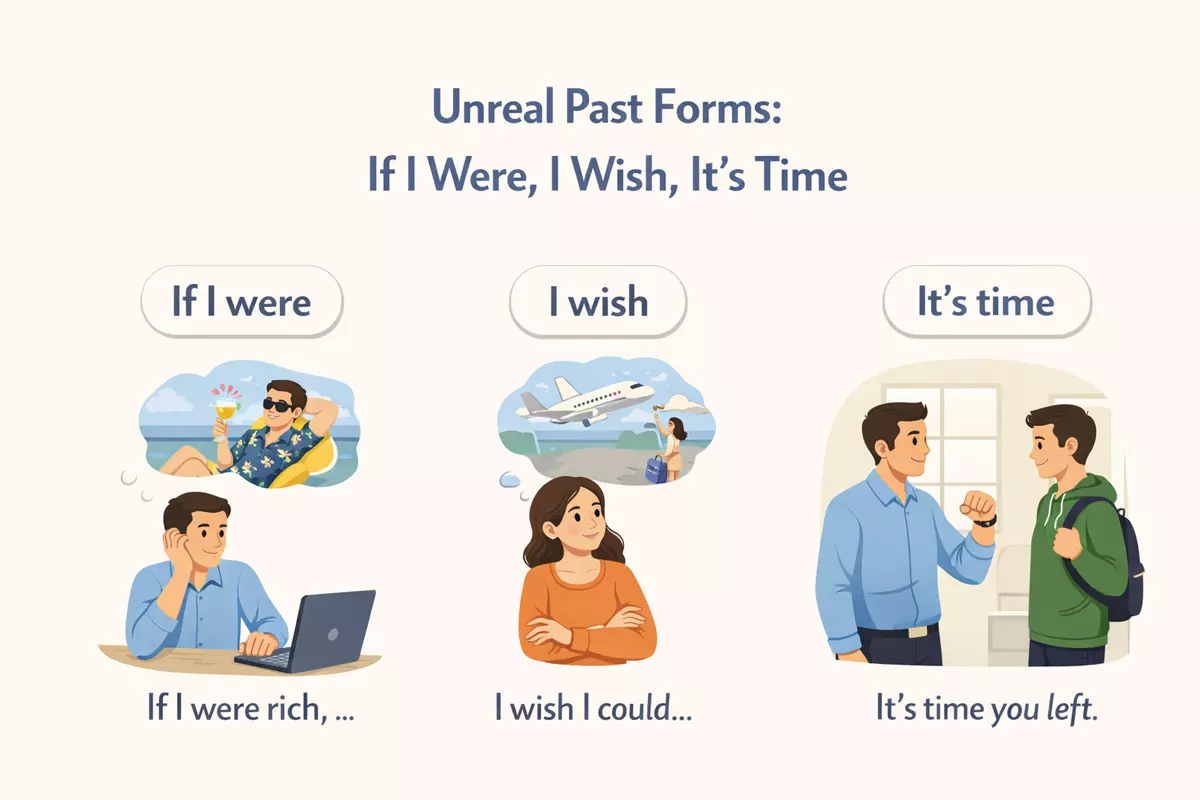 The article explains what unreal past means in English and how it’s used in if-clauses, wish and if only structures, and it’s time patterns. It also discusses was vs were, common mistakes, differences from past simple, and provides practice exercises.
Have you ever noticed that English often uses past tense forms to express situations that are not real or have not actually happened? This interesting feature appears when we talk about wishes, regrets, or hypothetical scenarios. For example, when someone says, "I wish I knew the answer," they are not referring to the past but expressing a present wish that is not true. By borrowing the past tense for these unreal or imagined situations, English adds subtlety and depth to how we communicate our feelings and possibilities.
What unreal past means in English
The term “unreal past” describes a special use of past tense forms in English, where they do not refer to real events that happened in the past. Instead, these forms talk about things that are not true, hypothetical, or imagined, often related to wishes, regrets, or situations that are different from reality. Although the verbs look like past tense, the meaning is not about time but about distance from reality.
How the unreal past works
When speakers use the unreal past, they are often expressing something that did not happen, could not happen, or they wish would happen differently. This is common after certain words and structures, such as if, wish, it's time, would rather, and as if. The verb forms look like the simple past or past perfect, but the situation described is not real.
- “If I had more time, I would travel.” (I don’t have more time.)
- “I wish I knew the answer.” (I don’t know it.)
- “It’s time you went to bed.” (You are not in bed yet.)
- “He acts as if he owned the place.” (He doesn’t own it.)
- “I’d rather you didn’t smoke here.” (You might smoke, but I prefer you don’t.)
Common uses of the unreal past
The unreal past appears in several patterns. Here are some of the most frequent:
- Second conditional: “If I were taller, I would play basketball.”
- Wishes about the present: “I wish I lived closer to work.”
- Wishes about the past: “I wish I had studied harder.”
- It’s (high) time + past tense: “It’s time we left.”
- As if / as though + past tense: “She looks as if she had seen a ghost.”
- Would rather + past tense (for other people): “I’d rather you came early.”
- Suppose / Imagine + past tense: “Suppose you won the lottery…”
- If only + past tense: “If only I knew her name.”
- Formal requests (rare): “I wish you would listen.”
Unreal past vs. real past: a comparison
| Form | Purpose | Example |
|---|---|---|
| Simple Past (real past) | Describes actions/events that really happened in the past | “I went to the store yesterday.” |
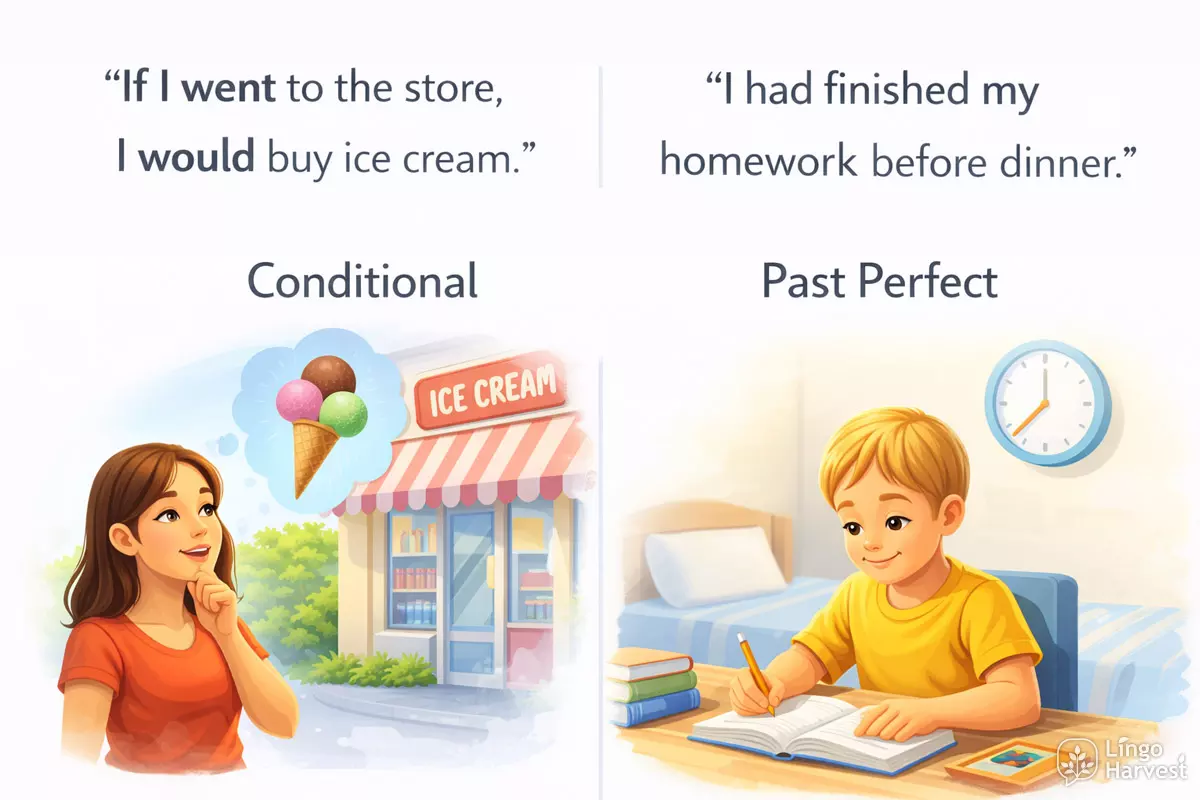
| Unreal Past (hypothetical) | Describes imagined, wished, or impossible situations | “If I went to the store, I would buy ice cream.” |
| Past Perfect (real past) | Describes something that happened before another past action | “I had finished my homework before dinner.” |
| Unreal Past Perfect (hypothetical) | Describes an unreal or regretted past situation | “If I had finished my homework, I could have gone out.” |
Key points to remember
- The “unreal past” looks like past tense but expresses imaginary or contrary-to-fact situations.
- It often appears after if, wish, as if, and similar words.
- Understanding this structure helps you talk about wishes, regrets, and hypothetical scenarios more naturally in English.
If-clauses with unreal past forms
Unreal conditionals often use past verb forms to discuss hypothetical or imaginary situations. These structures don’t refer to actual past events; instead, they express things that are not true now or are unlikely to happen. This can include regrets, wishes, or advice for an alternative present or future.
Typical Structure and Usage
The most common pattern uses "if" followed by a subject and a past simple verb, paired with a main clause using "would" or another modal verb. Despite the use of past tense, the meaning is not about the past but about an unreal or hypothetical present or future.
- If I were taller, I would play basketball professionally.
- If she had more free time, she could travel more.
- If we knew his address, we would send an invitation.
- If it rained tomorrow, the picnic would be cancelled.
- If they spoke French, they might move to Paris.
- If you studied harder, you would pass the exam.
- If I were you, I would take the offer.
- If my phone worked, I could call for help.
- If he didn’t have a car, he would walk to work.
- If we lived closer, we would meet more often.
Special Note: "Were" for All Subjects
When expressing hypothetical ideas with the verb "to be," English often uses "were" for all subjects, not just "I" or "he/she/it." This is especially common in formal or written English.
- If I were rich, I would travel the world. ✅
- If he was taller, he would play basketball. ❌ (informal, but less standard)
Comparison Table: Real vs. Unreal Conditionals
| Type | Example | Meaning & Use |
|---|---|---|
| Real (Present) | If she studies, she passes the exam. | General truth or predictable result; often used for rules and facts. |
| Real (Future) | If the results are consistent, the study will gain credibility. | Possible future condition with a realistic outcome. |
| Unreal (Present) | If she studied harder, she would pass. | Imaginary or contrary to fact in the present. |
| Unreal (Present – academic) | If the sample were larger, the findings would be more robust. | Hypothetical evaluation; common in academic writing. |
| Unreal (Past) | If she had studied, she would have passed. | Counterfactual past; expresses regret or criticism. |
| Unreal (Past – academic) | If the variables had been controlled, the results would have been reliable. | Used to evaluate past research limitations. |
| Advice (Unreal Present) | If I were you, I would revise the conclusion. | Indirect advice; speaker does not expect the condition to be true. |
| Mixed Conditional | If she had prepared better, she would feel more confident now. | Past condition with a present result. |
| Implied Conditional | With more funding, the project would progress faster. | Conditional meaning without explicit “if”. |
| Formal / Academic Conditional | Should further evidence emerge, the hypothesis will be revised. | Highly formal; common in academic and legal contexts. |
Common Uses and Expressions
Unreal past forms in "if" clauses are used for:
- Imaginary present or future situations
- Polite suggestions or advice
- Expressing regret or missed opportunities (with past perfect: "If I had known…")
- Dreaming or wishing about circumstances that are not true
Using these forms allows speakers to talk about alternatives to reality, express empathy, or offer hypothetical solutions. Mastery of these patterns helps convey subtle meaning and nuance in English conversations.
I wish and If only structures
Understanding how to talk about unreal situations or regrets in English often means using specific patterns with “wish” and “if only.” These expressions allow speakers to express desires for change, regret about the past, or frustration with the present. Both “wish” and “if only” use past forms to talk about situations that are not true or unlikely to happen, even if the time being discussed is present or future.
Common Patterns
“Wish” and “if only” are typically followed by a clause in the past simple, past perfect, or could/would, depending on what the speaker wants to express. Here are the main patterns:
- Wish/If only + past simple: Used for present situations we want to be different. (e.g. “I wish I knew the answer.”)
- Wish/If only + past perfect: Used for regrets about the past. (e.g. “If only I had studied harder.”)
- Wish + could/would: “Could” expresses ability or possibility; “would” expresses willingness or change. (e.g. “I wish I could travel more.” / “I wish you would listen.”)
Typical Uses and Nuances
The main difference between “wish” and “if only” is strength. “If only” is generally more emphatic, often expressing stronger emotion or regret. Both structures are used with unreal past forms, but context and intention affect which tense is needed.
| Meaning | Example Structure | Example Sentence |
|---|---|---|
| Present wishes | wish/if only + past simple | I wish I spoke French. If only it were sunny. |
| Past regrets | wish/if only + past perfect | I wish I had gone to the party. If only you had told me earlier. |
| Future desires | wish + would/could + base verb | I wish it would stop raining. I wish I could help you. |
| Annoyance (about others) | wish + would + base verb | I wish you would turn off the TV. |
Expanded Example List
- I wish I were taller.
- If only I didn’t have to work today.
- I wish you would call me more often.
- If only they had remembered my birthday.
- I wish I could speak Japanese.
- If only it would snow this weekend.
- I wish I hadn’t eaten so much cake.
- If only he were here now.
- I wish you wouldn’t shout.
- If only we had left earlier.
- I wish I could see the stars tonight.
- If only my phone worked.
- I wish I knew the answer.
- If only the bus weren’t late again.
- I wish I had taken that job offer.
- If only I could travel abroad.
These forms are essential for expressing hypothetical thoughts and feelings in English. By mastering these patterns, you can communicate regrets, hopes, and frustrations more naturally.
It’s time / It’s high time patterns
Expressions like “it’s time” and “it’s high time” are used to suggest that something should happen now or should have already happened. In English, these phrases often introduce unreal past forms, even when we are talking about the present or future. This makes them key examples of how English uses past tenses to express wishes, recommendations, or criticism.
Forming sentences with “it’s time” and “it’s high time”
Both “it’s time” and its more emphatic variant “it’s high time” are followed by either an infinitive or a past simple verb form, depending on the subject and the level of formality. When the subject is implied (usually “you” or “we”), the infinitive is common. When we specify who should act, the past simple is preferred, even if we mean the present moment.
- It’s time to leave. → (General statement; infinitive form)
- It’s high time we started the meeting. → (Specific subject; past simple form)
- It’s time you cleaned your room.
- It’s high time she apologized.
- It’s time for lunch. → (Noun phrase, not a verb)
- It’s high time they made a decision.
- It’s time to get going.
- It’s high time you learned the rules.
- It’s time for a break.
- It’s time I went home.
- It’s high time we did something about it.
- It’s time for everyone to pay attention.
- It’s high time you stopped complaining.
- It’s time we talked.
- It’s high time he arrived.
- It’s time to act.
- It’s high time the team trained harder.
- It’s time for a change.
Subtle differences: “it’s time” vs. “it’s high time”
While both phrases communicate a sense of necessity, “it’s high time” adds emphasis and often expresses impatience or criticism, suggesting the action is overdue.
| Pattern | Example Sentence |
|---|---|
| It’s time + infinitive | It’s time to go. |
| It’s time + for + noun | It’s time for dinner. |
| It’s (high) time + subject + past simple | It’s high time you called your parents. |
| It’s high time + subject + past simple (stronger) | It’s high time we fixed this problem. |
Why use the past simple here?
Using the past simple after these expressions doesn’t refer to a past event, but instead creates a distance from reality. This “unreal past” highlights that the action is necessary now, or even overdue, rather than already completed. It’s a subtle but important nuance in English grammar.
In summary, “it’s time” and “it’s high time” are common ways to signal that something should happen soon, often using past forms for present or future meaning. Mastering these patterns will help you sound more natural, especially when suggesting, recommending, or expressing frustration about delays.
Was vs were: why If I were matters
English speakers often wonder why we say “If I were” instead of “If I was” in certain sentences. The answer lies in the use of the subjunctive mood—a special form used for unreal, hypothetical, or contrary-to-fact situations. While “was” is the standard past form for “I,” “he,” “she,” and “it,” the word “were” signals that we’re talking about something imaginary or not actually true. This subtle difference changes the meaning and tone of a sentence.
When do we use “If I were”?
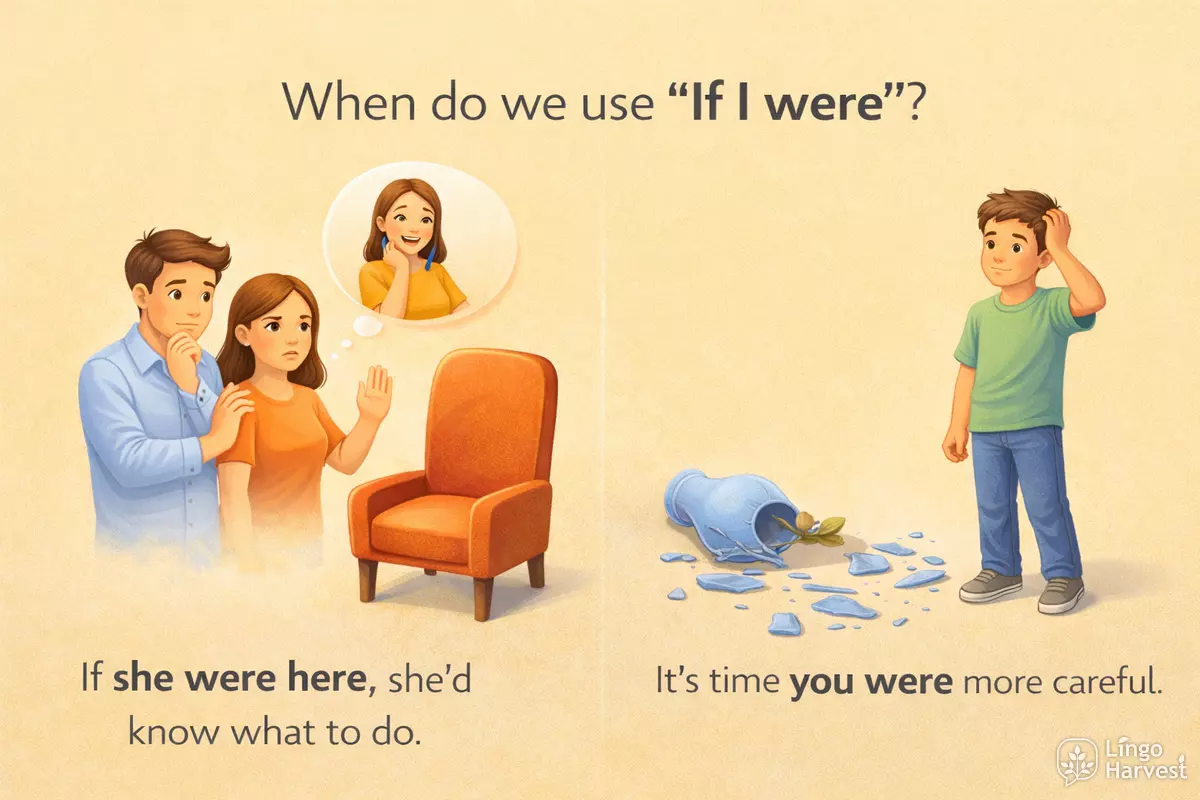
“If I were” is used when imagining something that isn’t real, such as a wish, a dream, or a hypothetical scenario. It’s especially common after “if,” “wish,” and expressions like “it’s time.” Using “were” instead of “was” makes it clear that we’re not talking about reality, but about a situation that doesn’t exist.
- If I were taller, I would play basketball.
- I wish I were rich.
- If she were here, she’d know what to do.
- It’s time you were more careful.
- If he were my brother, I’d ask him for help.
- I wish it were summer already.
- If you were the boss, what would you change?
- If that were true, we’d be in trouble.
- If we were in Paris now, we could visit the Louvre.
- I wish they were coming with us.
“Was” vs “Were”: Real vs. Unreal Meaning
Choosing between “was” and “were” isn’t just about grammar—it changes the meaning. “Was” is for real, possible, or factual situations. “Were” marks the situation as unreal or imaginary. This distinction helps listeners quickly understand whether you’re talking about reality or a hypothetical.
| Form | Usage Example | Situation |
|---|---|---|
| If I was | If I was rude, I apologize. | Real/possible past event |
| If I were | If I were you, I’d call her. | Unreal/hypothetical |
| She was | She was at the party last night. | Fact |
| She were | If she were taller, she could reach it. | Unreal/hypothetical |
Is “If I was” ever correct?
Yes, there are cases where “If I was” is correct—specifically when talking about something that might actually have happened, not just a fantasy. For example: “If I was late, it was because of traffic.” Here, you’re referring to a possible real event, not a hypothetical.
Why does “If I were” still matter?
Even though modern English speakers sometimes use “was” and “were” interchangeably, traditional grammar and many formal contexts still prefer “were” for unreal situations. Using “If I were” shows you understand the difference between reality and imagination, and it adds clarity and precision to your speech or writing. It’s a small detail, but it can make your English sound more polished and natural.
Common errors and how to fix them
Learners often run into several pitfalls when using unreal past forms like if I were, I wish, and it's time. These mistakes can make sentences sound unnatural or even change the intended meaning. Recognizing these typical blunders is the first step toward mastering these expressions.
Mixing up verb forms
A frequent issue is choosing the wrong verb tense or form. Unreal past structures usually require the simple past or past perfect, even when talking about present or future situations. Here are some examples of mistakes and their corrections:
- ❌ If I was you, I would apologize. → ✅ If I were you, I would apologize.
- ❌ I wish I know the answer. → ✅ I wish I knew the answer.
- ❌ It's time you go. → ✅ It's time you went.
- ❌ I wish I didn't ate that. → ✅ I wish I hadn't eaten that.
- ❌ If I would have seen him, I would tell you. → ✅ If I had seen him, I would have told you.
Confusing 'was' and 'were'
Another common slip is using was instead of were in hypothetical statements. English prefers were for all persons in unreal conditions, especially after "if" and "wish".
| Incorrect | Correct |
|---|---|
| If I was taller, I could play basketball. | If I were taller, I could play basketball. |
| I wish she was here now. | I wish she were here now. |
| If he was rich, he would travel more. | If he were rich, he would travel more. |
| I wish it was Friday. | I wish it were Friday. |
| If the data was complete, the analysis would be reliable. | If the data were complete, the analysis would be reliable. |
| I wish the experiment was conducted under controlled conditions. | I wish the experiment were conducted under controlled conditions. |
| If the theory was accurate, the results would align. | If the theory were accurate, the results would align. |
| I wish the sample size was larger. | I wish the sample size were larger. |
Using present forms after 'wish' and 'it's time'
Learners sometimes use present tense after these expressions, but unreal forms demand a shift back in time to show distance from reality.
- ❌ I wish I have more free time. → ✅ I wish I had more free time.
- ❌ It's time we start. → ✅ It's time we started.
Forgetting the past perfect for regrets
When expressing regrets about the past with wish, the correct form is past perfect:
- ❌ I wish I didn't forget her birthday. → ✅ I wish I hadn't forgotten her birthday.
- ❌ I wish he didn't say that. → ✅ I wish he hadn't said that.
Tips for avoiding mistakes
- Remember: Unreal situations use past forms, not present.
- After wish about the present: use simple past (I wish I knew).
- After wish about the past: use past perfect (I wish I had known).
- After if for unreal conditions: use were for all persons.
- After it's time: use past simple (It's time we left).
- Avoid present tense after wish or it's time.
- Practice by rewriting real situations as unreal ones, and double-check your verb forms.
Paying attention to these patterns and reviewing your sentences will help you use unreal past forms accurately and naturally.
Unreal past vs past simple meaning
Understanding the difference between “unreal past” forms and the ordinary past simple is important for expressing wishes, imaginary situations, and regrets in English. Although both use past verb forms, their meanings are not the same. The “unreal past” appears in structures like if I were or I wish to talk about situations that are not real, contrary to fact, or hypothetical. In contrast, the past simple is mainly used for actions or states that truly happened in the past.
Key differences in usage
- Unreal past: Refers to imaginary, hypothetical, or desired situations, not real events.
- Past simple: Describes real, completed actions or states in the past.
- Unreal past often appears with if (second conditional), wish, if only, and it’s time structures.
- Past simple is used for storytelling, facts, or events with a definite time.
Common patterns and examples
- If I were taller, I would play basketball. (I am not taller – imaginary)
- I wish I had more free time. (But I don’t – expressing a desire)
- If she knew the answer, she would help. (She doesn’t know – hypothetical)
- It’s time you went to bed. (Giving advice or criticism, not about the past)
- I visited Rome last year. (Real past event)
- They didn’t like the movie. (Factual past)
- If only I had a car! (Wish, not real)
- He forgot his keys yesterday. (Actual occurrence)
- We wish you were here. (Expressing regret or desire)
- She enjoyed the party. (Happened in the past)
Comparing unreal and real past forms
| Form | Example & Meaning |
|---|---|
| Unreal past (If I were) |
If I were you, I would revise the methodology. (Hypothetical situation; advice) |
| Past simple (Real past) |
I was present at the conference last year. (Factual past event) |
| Unreal past (Wish + past simple) |
I wish the sample size were larger. (Present regret; situation is not true now) |
| Past simple (Real event) |
The sample size was limited due to budget constraints. (Objective past fact) |
| Unreal past (It’s time + past) |
It’s time the department reviewed its assessment criteria. (Criticism or expectation of change) |
| Past perfect (Unreal past) |
If the variables had been controlled, the results would have been more reliable. (Counterfactual past condition) |
| Past perfect (Real past) |
The variables had been controlled before the final analysis began. (Action completed before another past action) |
| Unreal past (Wish + past perfect) |
I wish the experiment had been conducted under stricter conditions. (Regret about a past event) |
| Unreal past (Would rather + past) |
I would rather the results were interpreted with greater caution. (Preference about others’ actions) |
| Unreal past (If only + past) |
If only the data were more consistent. (Strong regret or frustration) |
| Modal + perfect (Speculation about past) |
The discrepancy may have resulted from measurement error. (Tentative explanation, not a fact) |
| Past simple (Narrative past) |
The study focused on three primary variables. (Neutral academic description of method) |
Summary
In short, the unreal past uses a “past” form to talk about situations that are not real or are imagined, while the simple past describes real events. Recognizing which context is intended helps avoid confusion and makes your English sound more natural and accurate.
Homework: unreal past exercises
Practicing unreal past forms is essential for mastering hypothetical and counterfactual statements in English. Here you’ll find a mix of exercises designed to reinforce your understanding of structures like “If I were…”, “I wish…”, and “It’s time…”. These tasks help you gain confidence in expressing regrets, wishes, advice, or imaginary situations.
Rewrite the Sentences
Transform the following real statements into sentences using unreal past forms. Use “If I were…”, “I wish…”, or “It’s time…” as appropriate.
- I don’t have a car. (Express a wish.)
- She isn’t here now. (Express a regret.)
- We don’t study enough. (Say what you wish.)
- He never listens to advice. (Suggest it’s time for a change.)
- I can’t speak French. (Express a wish.)
- The data are incomplete. (Express dissatisfaction.)
- She works too much. (Express a wish for change.)
- I live far from the university. (Express regret.)
- They don’t take the issue seriously. (Say what you wish.)
- The meeting starts too early. (Express a wish.)
Show answers
- I wish I had a car.
- I wish she were here now.
- I wish we studied more.
- It’s time he started listening to advice.
- I wish I could speak French.
- I wish the data were complete.
- I wish she worked less.
- I wish I lived closer to the university.
- I wish they took the issue more seriously.
- I wish the meeting started later.
Complete the Sentences
Finish each sentence with a suitable unreal past form:
- If I ______ (be) you, I would talk to her.
- I wish it ______ (not / rain) today.
- It’s time we ______ (leave).
- If he ______ (know) about the meeting, he would have come.
- I wish you ______ (can) join us next week.
- If the sample ______ (be) larger, the results would be more reliable.
- I wish the experiment ______ (conduct) under better conditions.
- It’s time they ______ (take) responsibility.
- If she ______ (pay) more attention, she wouldn’t have missed the error.
- I wish the policy ______ (apply) more consistently.
Show answers
- If I were you, I would talk to her.
- I wish it weren’t raining today.
- It’s time we left.
- If he had known about the meeting, he would have come.
- I wish you could join us next week.
- If the sample were larger, the results would be more reliable.
- I wish the experiment were conducted under better conditions.
- It’s time they took responsibility.
- If she had paid more attention, she wouldn’t have missed the error.
- I wish the policy were applied more consistently.
Patterns of Unreal Past Forms
Compare the main patterns for forming unreal past statements with “If”, “Wish”, and “It’s time”.
| Expression | Example Pattern | Usage |
|---|---|---|
| If I were/If he had… | If + subject + past simple/past perfect | Imaginary or impossible situations |
| I wish… | I wish + subject + past simple/past perfect | Regrets or desires about the present/past |
| It’s time… | It’s time + subject + past simple | Suggesting someone should do something now |
| I’d rather… | I’d rather + subject + past simple | Expressing preference about another’s actions |
Expand the Ideas
Use unreal past forms to expand these short prompts into full sentences:
- Regret: not going to the party
- Wish: being taller
- Advice: start saving money
- Imaginary: be able to fly
- Preference: your friend not smoke
- Regret: not studying harder at university
- Wish: live closer to work
- Criticism: your colleague arrive on time
- Imaginary: know the outcome in advance
- Preference: people take the issue seriously
Show answers
- I wish I had gone to the party.
- I wish I were taller.
- It’s time you started saving money.
- If I could fly, I would travel everywhere.
- I’d rather you didn’t smoke.
- I wish I had studied harder at university.
- I wish I lived closer to work.
- It’s time my colleague arrived on time.
- If I knew the outcome in advance, I would act differently.
- I’d rather people took the issue seriously.
By practicing these exercises, you’ll become more comfortable expressing hypothetical ideas, regrets, and suggestions. Remember, these structures use the past form, but they refer to imaginary or unreal situations, not real events in the past.