C1–C2 Editing Workshop: Rewrite Sentences with More Precise Conditional Logic

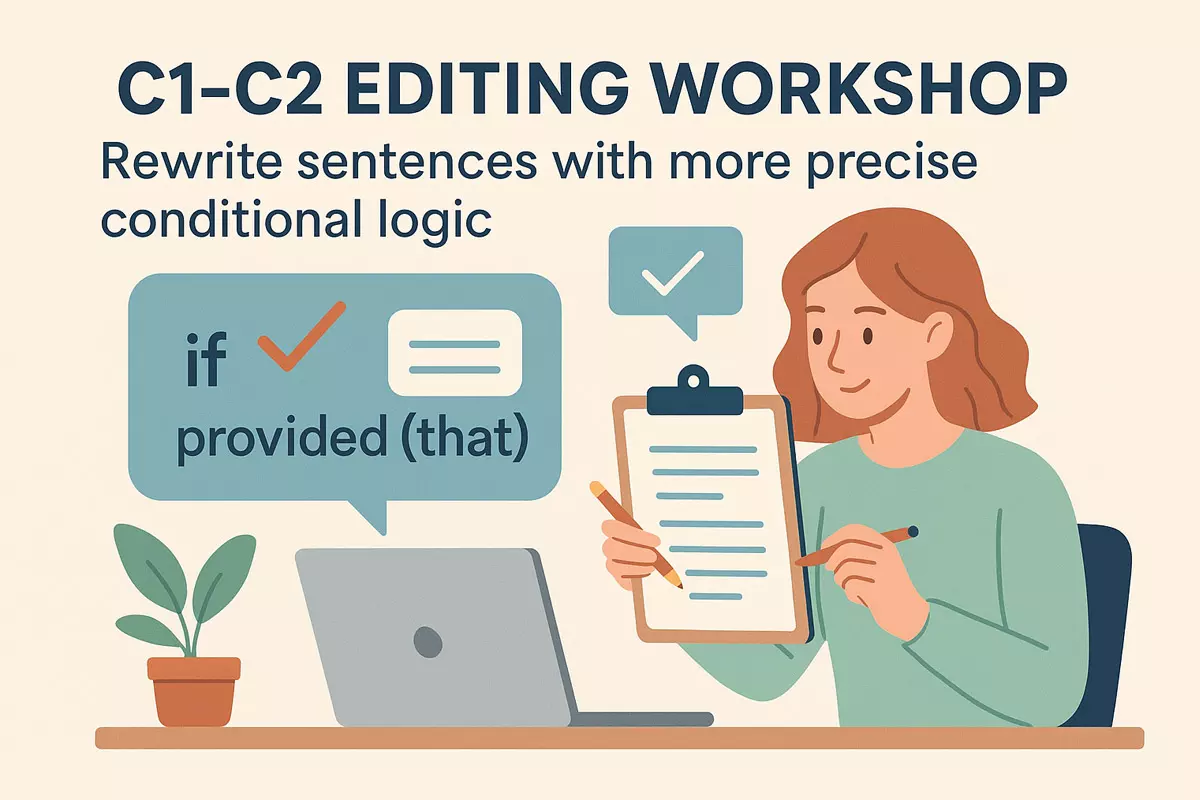 Here we advanced sentence rewriting, including how to identify and correct vague conditionals, improve logic with proper modals and tenses, clarify complex sentences, and practice transforming weak sentences using detailed examples.
- Guidelines for advanced sentence rewriting
- How to identify imprecise or vague conditional meaning
- Strengthening logic through careful modal and tense choice
- Improving clarity in multi-clause structures
- Complex rewrite tasks with step-by-step examples
- Practice: transform weak sentences into precise conditional forms
Mastering the expression of hypothetical situations can greatly enhance both the clarity and sophistication of your writing. In this workshop, you will learn practical techniques for revising sentences to accurately convey complex cause-and-effect relationships. Through focused exercises and examples, you will develop the ability to identify subtle distinctions in meaning and choose language that precisely reflects your intended message. By refining these skills, you will become more effective in communicating nuanced ideas and presenting your arguments with greater impact.
Guidelines for advanced sentence rewriting
To master rewriting sentences with nuanced conditional logic at the C1–C2 level, focus on clarity, accuracy, and subtlety of meaning. Advanced rewriting isn’t just about changing words; it’s about restructuring logic, expressing hypothetical or unreal situations, and making the cause–effect relationship more precise.
Key principles for enhancing conditional statements
Begin by identifying the core condition and result in the original sentence. Decide if you need to make the logic more explicit, handle degrees of probability, or introduce a hypothetical scenario. Consider whether to use mixed conditionals, inversion, or modals for finer shades of meaning.
- Identify the type of conditional (zero, first, second, third, or mixed).
- Clarify the time reference: present, past, or future.
- Use inversion for formality or emphasis (e.g., "Had I known…").
- Opt for modal verbs to express probability, possibility, or necessity (e.g., "might have," "should," "would").
- Distinguish between real and unreal conditions.
- Vary connectors (unless, provided that, even if, supposing).
- Reduce ambiguity by specifying conditions: "If it rains" vs. "If it were to rain."
- Use participle or reduced clauses for conciseness: "Given that he arrives early, …"
- Switch to negative forms for contrast: "Unless you call, I won’t know."
- Use fronting for emphasis: "Only if you agree will we proceed."
- Embed conditions within noun clauses for complexity: "The fact that he would come if invited impressed us."
- Replace ‘if’ with alternatives for stylistic variety: "Should you need help, …"
Common transformations for sophisticated conditional logic
Rewriting sentences at a higher level often involves shifting tense, changing the order of clauses, or employing less direct constructions. Here are some advanced transformation patterns:
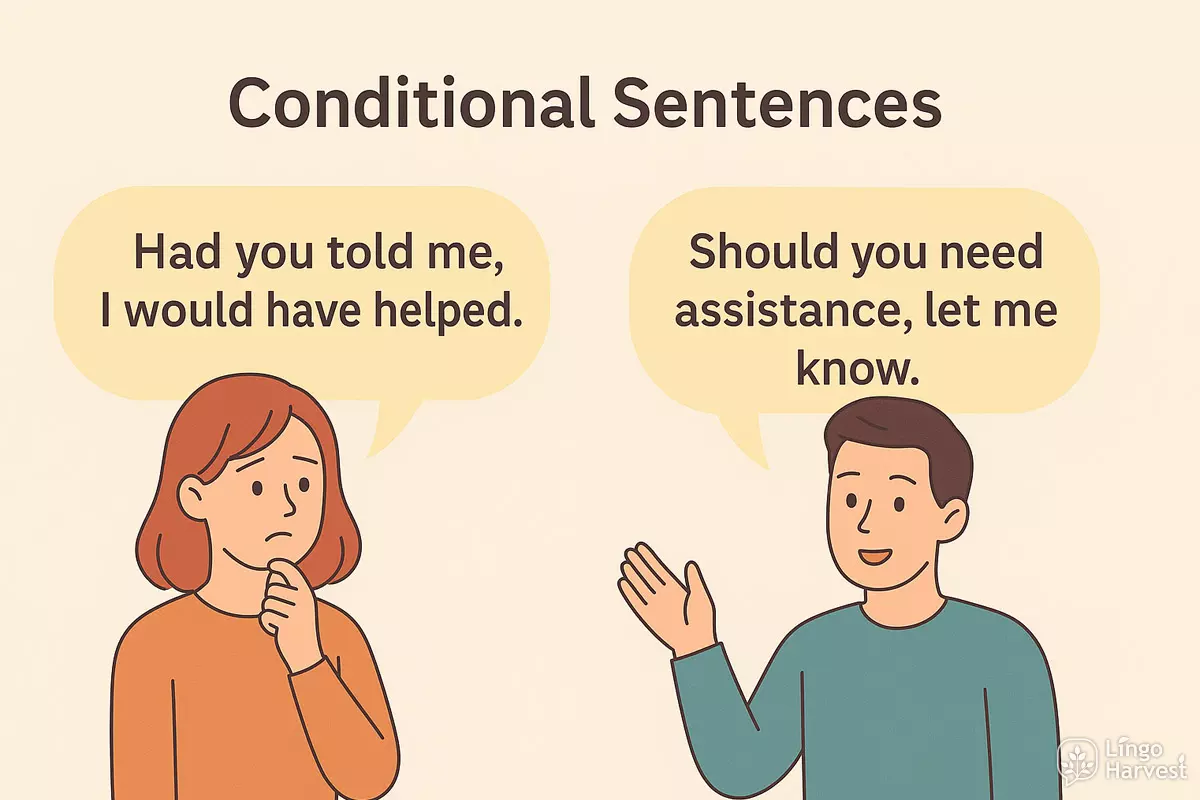
- If you had told me, I would have helped. → Had you told me, I would have helped.
- If you should need assistance, let me know. → Should you need assistance, let me know.
- If it weren’t for his advice, I would fail. → Were it not for his advice, I would fail.
- If he were to arrive early, we could start sooner. → Were he to arrive early, we could start sooner.
- If I see her, I’ll tell her. → Provided that I see her, I’ll tell her.
- If you don’t study, you won’t pass. → Unless you study, you won’t pass.
- If I had known about the meeting, I would have attended. → Had I known about the meeting, I would have attended.
- If you happen to see Jack, tell him. → Should you see Jack, tell him.
- If it rains, the picnic will be canceled. → In the event of rain, the picnic will be canceled.
- If not for her encouragement, he might have given up. → But for her encouragement, he might have given up.
Comparing conditional forms and their nuances
| Formulation | Implication / Usage |
|---|---|
| If you had called, I would have come. | Regret about a past unreal situation. |
| Should you need anything, let me know. | Polite or formal offer, future possibility. |
| Unless it rains, we’ll go hiking. | Negative condition, more concise than "if…not". |
| Were I in your position, I would decline. | Hypothetical advice, formal register. |
| Provided that you finish early, call me. | Explicit requirement, more formal than "if". |
Final tips for effective advanced rewriting
Always check that your revised sentence preserves the original intent but delivers it with greater precision. Consider the register and context: more formal writing may require inversion or alternative connectors, while spoken English often favors straightforward conditionals. Practice by rewriting sample sentences using a variety of structures, focusing on both grammatical accuracy and stylistic appropriateness.
How to identify imprecise or vague conditional meaning
Recognizing unclear or weak conditional logic is crucial for effective C1–C2 level editing. Sentences with vague if-clauses or ambiguous consequences can confuse readers and undermine academic or professional writing. To spot these issues, focus on whether the condition and result are clearly defined, whether the relationship between them is logical and specific, and whether the sentence avoids unnecessary ambiguity.
Common signs of weak conditional statements
- The condition uses general words like “something,” “anything,” or “somehow” instead of precise details.
- The result or consequence is vague, such as “things might change,” “something could happen,” or “it would be different.”
- The connection between the condition and result is unstated or illogical.
- There is unnecessary hedging: “If maybe,” “If possibly,” or “If in some cases.”
- Overuse of modal verbs (“might,” “could,” “may”) without clear reasoning.
- Missing timeframes, making it unclear when the condition applies.
- Conditions that are too broad or not measurable (“If people work hard, success follows.”)
- Ambiguous pronoun use, leaving unclear what “it,” “they,” or “this” refer to.
- Double conditionals: “If you would have called, I would have come.”
- Results that repeat the condition rather than building on it.
- Failing to specify the subject or agent responsible for the action.
- Using “if” when “when” or “unless” would be more accurate.
- Unclear causality: The connection between cause and effect is weak or missing.
- Contradictory or self-cancelling statements: “If it rains, it might not rain.”
Questions to ask when reviewing conditional logic
- Is the condition concrete and specific?
- Is the result a logical and direct consequence of the condition?
- Are both the condition and result free from ambiguity?
- Could a reader misunderstand the intended relationship?
- Does the sentence avoid unnecessary modal verbs or hedging?
- Is the timeframe or context for the condition clear?
Typical vague vs. precise conditional patterns
| Vague Conditional | Precise Alternative |
|---|---|
| If you do something, things might get better. | If you submit the report by Friday, the team can review it before the meeting. |
| If it happens, we could do something about it. | If the system fails during testing, we will implement the backup protocol. |
| If people work hard, success follows. | If employees consistently meet their targets, they receive a performance bonus. |
| If you call, maybe I will come. | If you call before 5 p.m., I will attend the event. |
| If there are issues, it might be a problem. | If the application displays errors, technical support should be notified immediately. |
Tips for revising unclear conditionals
- Replace vague nouns and pronouns with specific references.
- Clarify the timeframe or context whenever possible.
- Ensure the consequence directly follows from the condition.
- Avoid unnecessary hedging and weak modal verbs.
- Read the sentence aloud to check for logical flow and clarity.
Rewriting for precision not only strengthens your conditional statements but also improves the overall coherence and professionalism of your writing.
Strengthening logic through careful modal and tense choice
Choosing the right modal verbs and verb tenses is essential for expressing nuanced logical relationships, especially in complex or academic English. When revising sentences for advanced conditional logic, attention to these elements helps clarify possibility, probability, necessity, and time reference. This precision avoids ambiguity and ensures your meaning is unmistakable.
Why modals and tenses matter in conditionals
Advanced English often requires you to distinguish between real, unreal, and hypothetical situations. The selection of modals such as can, could, will, would, may, might, must, and should—along with present, past, or perfect tenses—determines the logical force of your statements. For example, “If she studies, she will pass” is different from “If she had studied, she would have passed.” The first suggests a real, possible future; the second reflects an unreal, past condition.
Common modals and tense choices in conditionals
- Will for real future results: “If you call, I will answer.”
- Would for hypothetical outcomes: “If I knew, I would tell you.”
- Can/Could for ability or possibility: “If you try, you can succeed.” / “If you tried, you could succeed.”
- May/Might for uncertain outcomes: “If it rains, we may stay inside.”
- Should for advice or mild condition: “If you should see him, let me know.”
- Must for necessity: “If you must leave, tell me.”
- Zero conditional (present simple): “If water boils, it evaporates.”
- First conditional (present + will): “If it snows, we will cancel the trip.”
- Second conditional (past simple + would): “If I had time, I would help.”
- Third conditional (past perfect + would have): “If he had called, I would have answered.”
- Mixed conditionals (combining time frames): “If I had studied, I would be successful now.”
- Use of were to for highly unlikely situations: “If she were to win, it would surprise everyone.”
- Using might have for speculative past: “If you had left earlier, you might have caught the train.”
- Modal verbs for polite or indirect suggestions: “If you could help, I’d appreciate it.”
- Shifting tenses for reported speech: “She said if it rained, she would stay home.”
- Using should inversion for formal writing: “Should you require assistance, contact us.”
- Implied conditionals (without ‘if’): “Were I to see him, I’d ask.”
- Negative modals for impossibility: “If he hadn’t lied, I couldn’t have doubted him.”
- Progressive forms for ongoing hypothetical actions: “If she were studying, she would be in her room.”
- Perfect modals for past speculation: “If I had known, I might have acted differently.”
Comparing modal and tense choices in conditionals
| Conditional Type | Example (Form & Meaning) |
|---|---|
| Zero Conditional (General truth/fact) |
If you heat ice, it melts. (Present simple + present simple) |
| First Conditional (Real future possibility) |
If you study, you will pass. (Present simple + will + base verb) |
| Second Conditional (Unreal/present hypothetical) |
If I knew the answer, I would tell you. (Past simple + would + base verb) |
| Third Conditional (Unreal/past hypothetical) |
If he had called, I would have answered. (Past perfect + would have + past participle) |
| Mixed Conditional (Past condition, present result) |
If you had studied, you would be confident now. (Past perfect + would + base verb) |
Tips for clear conditional statements
- Think about the time frame: Is the situation real, hypothetical, present, past, or future?
- Match your modal verb to the intended degree of certainty or possibility.
- Don’t mix tenses or modals arbitrarily—each combination signals a specific logic.
- Review each conditional for clarity: Can the reader easily understand what is possible, likely, or necessary?
- Practice rewriting sentences using different modals and tenses to see how the meaning shifts.
Precise use of modal verbs and verb forms strengthens logical connections and makes your writing more persuasive and accurate. Experiment with these structures to refine your command of conditional logic at an advanced level.
Improving clarity in multi-clause structures
When working with sentences containing multiple clauses—especially in advanced English levels like C1 and C2—ambiguity can easily creep in. Readers may struggle to follow the intended logic if connectors, verb forms, or conditional relationships are not clearly signaled. Precise structuring and word choice are vital for conveying complex conditional logic without confusion.
Strategies for clearer multi-clause sentences
- Use explicit connectors (e.g., if, unless, provided that, as long as) to clarify relationships.
- Keep clauses parallel in structure for easier processing.
- Place the main clause at the end to emphasize the outcome or result.
- Break long sentences into shorter ones if too many conditions are nested.
- Choose precise modal verbs (would, could, might) to indicate degrees of certainty.
- Avoid ambiguous pronouns; specify the subject where possible.
- Use commas to separate conditional clauses and avoid run-on sentences.
- Signal exceptions or alternatives with words like otherwise, except if, or in case.
- Be consistent in tense usage within conditional structures.
- Revise for logical order: ensure each condition builds on the previous one.
- Rephrase for directness: reduce unnecessary subordinate clauses.
- Use negative conditionals for contrast (unless, if not).
- Highlight consequences clearly with phrases like as a result or so that.
- Test your sentences by reading aloud—if the logic is hard to follow, simplify.
- Edit for redundancy; remove repeated ideas.
Examples: Before and After Editing
| Original Multi-Clause Sentence | Rewritten for Clarity |
|---|---|
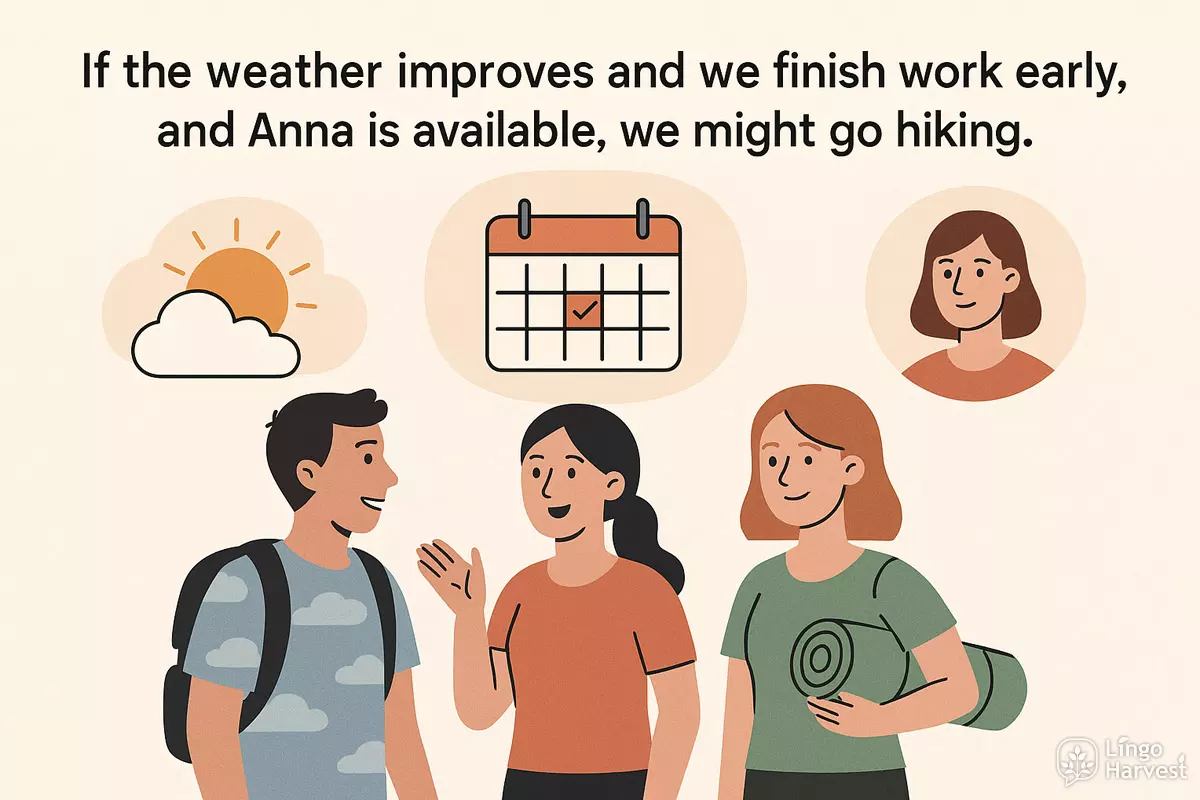
| If the weather improves and if we finish our work early, we might go hiking, but only if Anna is available. | If the weather improves and we finish work early, and Anna is available, we might go hiking. |
| Unless you contact me before noon, or if the package arrives late, I won’t be able to help you, which means you’ll have to reschedule. | If you don’t contact me before noon or the package arrives late, you’ll need to reschedule because I won’t be able to help. |
| Provided that everyone brings their own lunch, and as long as the meeting ends on time, we could meet in the park, otherwise we will have to postpone. | We could meet in the park if everyone brings lunch and the meeting ends on time; otherwise, we will have to postpone. |
| If you want to participate, you have to register by Friday and submit your documents; otherwise, if you miss the deadline, you cannot join the event. | To participate, register and submit your documents by Friday; if you miss the deadline, you cannot join the event. |
Common pitfalls with complex conditionals
Writers often unintentionally introduce confusion by stacking conditions or mixing forms. Watch for:
- Unclear referents (e.g., “it” or “they” that could refer to multiple nouns)
- Contradictory or overlapping conditions
- Switching tenses within one sentence
- Overusing conjunctions without punctuation
By applying clear structure and precise wording, you can ensure each part of your multi-clause sentence contributes to the overall meaning without ambiguity.
Complex rewrite tasks with step-by-step examples
Tackling advanced sentence transformations often means refining conditional logic for clarity and accuracy. This section breaks down typical C1–C2 level rewrite tasks, guiding you through the process and showing how nuanced changes can sharpen meaning. By analyzing each step, you can see how subtle shifts in structure affect the overall logic and precision.
Step-by-step rewriting: From basic to precise
Let’s examine how a simple conditional can be expanded or modified to express more specific relationships, intentions, or hypothetical scenarios. Here’s a process you might follow:
- Identify the type of conditional (zero, first, second, third, mixed).
- Clarify the intended meaning (certainty, possibility, regret, advice, etc.).
- Choose appropriate modal verbs, time markers, or linking devices.
- Rewrite the sentence, adjusting verb forms and structure as needed.
- Check for ambiguity and refine for precision.
Common transformations for nuanced conditional logic
- Transforming real to unreal conditionals: “If he comes, we will start” → “If he were to come, we would start.”
- Adding emphasis or probability: “If she studies, she passes” → “Provided that she studies diligently, she is likely to pass.”
- Expressing regret or hypothetical past: “If I knew, I would have told you” → “Had I known, I would have told you.”
- Using inversion for formality: “If you should need help, call me” → “Should you need help, call me.”
- Introducing alternatives: “Unless it rains, we will go” → “We will go as long as it doesn’t rain.”
- Clarifying cause and effect: “If you don’t water plants, they die” → “Plants die when they are not watered.”
- Mixing time frames: “If I had saved more, I would be traveling now.”
- Making the condition explicit: “If invited, she’ll attend” → “She will attend only if she is invited.”
- Softening advice: “If you exercise, you’ll feel better” → “If you were to exercise, you might feel better.”
- Highlighting consequences: “If you break it, you pay for it” → “Breaking it will result in you having to pay for it.”
- Shifting perspective: “If we had left earlier, we would have avoided traffic” → “Had we left earlier, traffic could have been avoided.”
- Adding conditions within conditions: “If you finish early, and if I’m free, we can meet.”
- Using ‘but for’ or ‘otherwise’: “If not for your help, I would have failed” → “But for your help, I would have failed.”
Comparing common and advanced forms
Below is a table contrasting basic conditionals with their more precise or formal counterparts, useful for advanced editing tasks.
| Basic Form | Advanced/Precise Rewrite |
|---|---|
| If you see Tom, tell him. | Should you see Tom, please inform him. |
| If it rains, we’ll cancel the picnic. | In the event of rain, the picnic will be cancelled. |
| If I had known, I would have come. | Had I been aware, I would have attended. |
| If you had listened, you wouldn’t be in trouble. | Had you listened, you would not find yourself in this predicament. |
| If she works hard, she’ll pass. | Provided that she applies herself, she is expected to succeed. |
| If not for your advice, I would have failed. | But for your advice, I would not have succeeded. |
Practice: Rewrite for precision
Try transforming these sentences to use more advanced conditional logic:
- If you call me, I will help you.
- If they had known about the meeting, they would have come.
- If she studies, she passes the exam.
- If you see any mistakes, let me know.
- If he apologizes, I’ll forgive him.
- If it rains tomorrow, we will stay home.
- If she were more patient, she would understand better.
- If you need assistance, I can guide you.
- If the bus is late, we’ll take a taxi.
- If he had left earlier, he would have avoided the traffic.
Show answers
- Should you call me, I will assist you.
- Had they been informed about the meeting, they would have attended.
- Provided she studies, she is likely to pass the exam.
- Should you notice any mistakes, please inform me.
- Were he to apologize, I would forgive him.
- Should it rain tomorrow, we will stay home.
- Were she more patient, she would understand better.
- Should you need assistance, I can guide you.
- Should the bus be late, we’ll take a taxi.
- Had he left earlier, he would have avoided the traffic.
Practicing these advanced rewrites will help you convey meaning with greater subtlety and accuracy, essential for high-level editing and academic writing.
Practice: transform weak sentences into precise conditional forms
Rewriting vague or imprecise statements into clear conditional sentences is a crucial skill at advanced levels of English. This practice section focuses on recognizing weak constructions and recasting them using strong conditional logic appropriate for C1–C2 writing.
Common weak sentence patterns
Many imprecise statements lack a clear cause-effect relationship or use ambiguous words like “maybe,” “sometimes,” or “could.” Here are some typical weak patterns to watch for:
- “She might be late because of traffic.”
- “Sometimes, people don't understand instructions.”
- “It’s possible he’ll call if he remembers.”
- “I probably won’t go unless I feel like it.”
- “They may help if they have time.”
Transforming into precise conditional forms
To strengthen these sentences, make the logic explicit. Use conditional structures (if, unless, provided that, as long as, etc.) to show clear dependencies. Here are some examples:
- If she encounters heavy traffic, she will be late.
- If people do not read the instructions carefully, they may fail to understand them.
- He will call, provided that he remembers.
- Unless I feel motivated, I will not go.
- They will help if they have enough time.
Practice: Rewrite the following sentences
Below are several sentences that lack precise conditional structure. Transform each into a more exact conditional statement. Try to clarify the relationship between cause and effect, and use a variety of conditional forms where possible.
- Sometimes, she forgets her keys when she’s in a hurry.
- Maybe we’ll visit the museum if we have time.
- He might not finish the report because he’s tired.
- It’s possible the event will be canceled due to bad weather.
- They may not join us unless someone invites them.
- People often misunderstand if instructions are unclear.
- I’ll help you, but only if you ask.
- He rarely calls unless it’s important.
- We could go for a walk if it stops raining.
- She probably won’t agree unless you explain your reasons.
Show answers
- If she is in a hurry, she sometimes forgets her keys.
- If we have time, we may visit the museum.
- If he is tired, he might not finish the report.
- If the weather is bad, the event may be canceled.
- Unless someone invites them, they may not join us.
- If instructions are unclear, people often misunderstand them.
- I will help you if you ask.
- He rarely calls unless it is important.
- If it stops raining, we could go for a walk.
- She probably will not agree unless you explain your reasons.
Conditional vocabulary and connectors
Expanding your repertoire of conditional connectors adds variety and sophistication to your writing. Here’s a useful list:
- if → If it rains, we’ll stay inside.
- unless → Unless you hurry, you’ll miss the train.
- provided that → You can join the trip provided that you register today.
- as long as → You can stay here as long as you keep quiet.
- in case → Take a jacket in case it gets cold.
- on condition that → You may leave early on condition that you finish your work.
- even if → Even if he tries, he won’t win.
- in the event that → In the event that the flight is delayed, we’ll notify you.
- supposing (that) → Supposing you lost your passport, what would you do?
- assuming (that) → Assuming that prices drop, we’ll buy a car.
- only if → You can go out only if you clean your room first.
- otherwise → Study hard; otherwise, you’ll fail the test.
- whenever → Whenever she travels, she sends me a postcard.
- so long as → So long as you’re honest, we can trust you.
- but for (formal, hypothetical past) → But for your help, I would have failed.
Comparison: Weak vs. Precise Conditional Forms
| Weak Sentence | Precise Conditional Form |
|---|---|
| Maybe she’ll come to the meeting. | She will come to the meeting if she finishes her work on time. |
| It’s possible we’ll leave early. | We will leave early if the presentation ends ahead of schedule. |
| He might miss the train. | If he doesn’t leave soon, he might miss the train. |
| They could help, but it depends. | They will help, provided that you ask them in advance. |
| Sometimes, errors happen. | Errors occur if the process is rushed. |