What Are Conjunctions? Simple Definition for Beginners

 This article explains conjunctions as words that join other words, phrases, or clauses. It gives everyday examples, shows how they create longer sentences, highlights their role in clear communication, and includes a short quiz to identify conjunctions.
- Basic idea of conjunctions as joining words
- Examples of very common conjunctions in everyday English
- How conjunctions connect words, phrases, and clauses
- Difference between one long sentence and two short ones
- Why conjunctions are useful for clear and natural speech
- Short beginner quiz: choose if a word is a conjunction or not
Have you ever noticed how sentences flow seamlessly from one idea to the next? This smooth connection is often achieved through the use of linking words, which are essential for clear and effective communication. Linking words help to organize thoughts, indicate relationships between ideas, and make writing or speech easier to follow. They can show contrast, add information, or explain reasons, making our language more precise and engaging. Understanding how to use these words not only improves your writing but also helps you express your thoughts more clearly in everyday conversations.
Basic idea of conjunctions as joining words
Conjunctions are words that help us connect ideas, actions, or descriptions within sentences. Instead of writing many short, choppy sentences, we can use these connectors to make our writing smoother and clearer. For example, in the sentence “I want tea and biscuits,” the word and brings two things together. Using such joining words makes communication easier and more natural.
How conjunctions work in sentences
You will often see these connecting words used to link two similar things, show choices, or explain reasons. They can join words, phrases, or even entire sentences. Here are some common ways they are used:
- Linking two nouns: cats and dogs
- Joining two verbs: run or walk
- Combining two adjectives: small but strong
- Connecting two sentences: He was tired, so he went to bed.
Common joining words in English
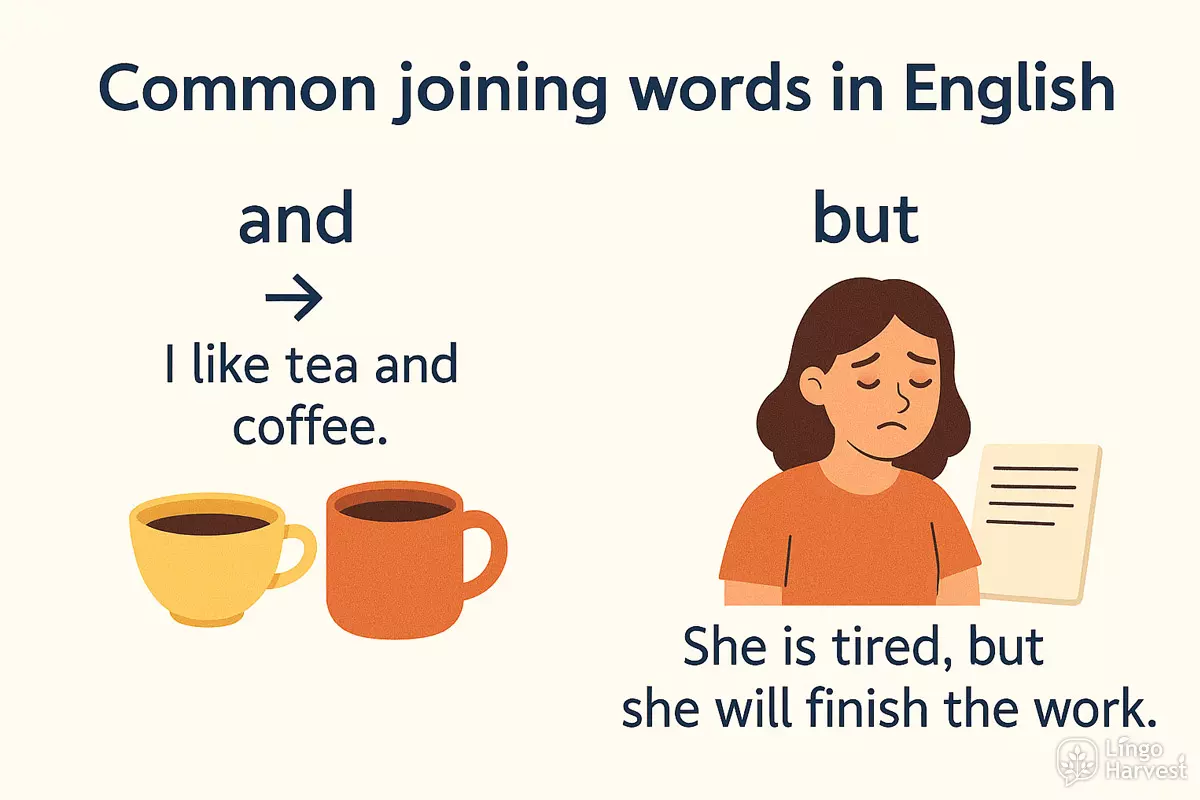
Some of the most frequently used connectors include:
- and → I like tea and coffee.
- but → She is tired, but she will finish the work.
- or → Do you want pizza or pasta?
- so → It was cold, so I closed the window.
- because → I stayed home because it was raining.
- although → Although it was late, he kept studying.
- while → She cooked dinner while he set the table.
- if → If it rains, we will stay inside.
- yet → She is young, yet very talented.
- unless → I won’t go unless you come with me.
- since → I’ve known her since we were kids.
- after → We went for ice cream after school.
- before → Wash your hands before you eat.
- when → Call me when you arrive.
- whereas → He likes winter, whereas I prefer summer.
- though → I like the dress, though it’s expensive.
- whether → I don’t know whether he’s home.
- nor → She didn’t call, nor did she text.
- as → As it got dark, we went inside.
- until → Wait here until I return.
Why use joining words?
Using connectors helps avoid repeating the same words or ideas and allows for more complex thoughts. This makes writing and speech less repetitive and more engaging. For example, instead of saying “She likes apples. She likes oranges,” you can say “She likes apples and oranges.”
Quick comparison: Without and with conjunctions
| Without joining words | With joining words |
|---|---|
| It is raining. I will stay inside. | It is raining, so I will stay inside. |
| We can go to the park. We can go to the zoo. | We can go to the park or the zoo. |
| He is smart. He is lazy. | He is smart but lazy. |
| She likes pizza. She likes pasta. | She likes pizza and pasta. |
Learning to use these connecting words is a basic skill for clearer, more effective sentences. They help your ideas flow and make your writing easier to understand.
Examples of very common conjunctions in everyday English
In daily conversations and writing, certain words help us connect ideas, sentences, or phrases smoothly. These words, known as conjunctions, play a crucial role in expressing relationships such as addition, contrast, choice, or cause and effect. Understanding how these connectors function can make your English clearer and more natural.
Most Frequently Used Coordinating Conjunctions
Coordinating conjunctions are used to join two parts of a sentence that are grammatically equal. In English, the most common ones are easy to remember with the acronym FANBOYS:
- For (reason) – I was tired, for I had not slept well.
- And (addition) – She likes tea and coffee.
- Nor (negative addition) – He doesn’t eat meat, nor does he eat fish.
- But (contrast) – I want to go, but I have work.
- Or (choice) – Would you like juice or water?
- Yet (unexpected contrast) – It was cold, yet she went swimming.
- So (result) – He was hungry, so he made a sandwich.
Common Subordinating Conjunctions
Subordinating conjunctions link a dependent (subordinate) clause to a main clause, showing relationships like time, reason, or condition. Here are several that appear often in spoken and written English:
- Because – She left early because she felt sick.
- Although – Although it was raining, we went outside.
- If – Call me if you need help.
- When – We’ll eat when he arrives.
- While – She read while waiting.
- Since – I haven’t seen her since Monday.
- Unless – You won’t pass unless you study.
- Before – Wash your hands before you eat.
- After – We’ll go after lunch.
- Though – Though he tried, he couldn’t win.
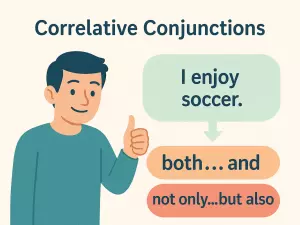
Correlative Conjunctions: Paired Connectors
Some conjunctions work in pairs to join words or groups of words. These are called correlative conjunctions. Here are a few you’ll often encounter:
- Either … or – Either you start now or you’ll be late.
- Neither … nor – Neither my brother nor my sister was at home.
- Both … and – Both the book and the movie were interesting.
- Not only … but also – She is not only smart but also kind.
- Whether … or – Whether you win or lose, try your best.
Quick Reference: Conjunctions and Their Functions
| Conjunction | Common Use | Example |
|---|---|---|
| And | Adding information | We bought apples and oranges. |
| But | Showing contrast | She is young but wise. |
| Because | Giving reason | He stayed home because it rained. |
| Or | Offering a choice | Would you like tea or coffee? |
| If | Expressing condition | If you call, I’ll answer. |
By recognizing and practicing these connectors, you’ll improve your ability to link thoughts smoothly in both speaking and writing. These basic joining words form the backbone of clear English communication.
How conjunctions connect words, phrases, and clauses
Conjunctions serve as joining tools in English, helping us link different parts of a sentence smoothly. They act as bridges between words, groups of words, or even entire statements, making communication clearer and sentences less choppy. Without these connectors, language would sound awkward and repetitive.
Joining single words
When you want to connect two or more words with similar roles in a sentence, coordinating conjunctions like and, or, and but are commonly used. This keeps the sentence neat and avoids unnecessary repetition.
- She likes tea and coffee.
- We can have pizza or pasta for dinner.
- He is tall but gentle.
Combining phrases
Sometimes, conjunctions link entire phrases (groups of words without a subject-verb pair). This helps expand ideas or add details to a sentence.
- We went to the park and played on the swings.
- She wants to learn Spanish or travel to Spain.
- He bought a ticket but missed the train.
Connecting clauses
A clause is a group of words with a subject and a verb. Conjunctions can join two independent clauses (each could stand alone), or an independent and a dependent clause (one relies on the other for meaning).
- I wanted to go outside, but it started raining.
- You can call me or send an email.
- She stayed home because she was tired.
- If you study, you will pass.
Types of conjunctions and their roles
There are three main types of conjunctions in English. Each type connects sentence parts in a slightly different way:
| Type | Function & Examples |
|---|---|
| Coordinating | Links equal parts (words, phrases, or clauses). Examples: and, but, or, nor, so, yet, for |
| Subordinating | Connects a dependent clause to an independent clause. Examples: because, although, since, if, unless, while, after, before |
| Correlative | Works in pairs to join balanced sentence elements. Examples: either...or, neither...nor, not only...but also, both...and |
Quick reference: Common conjunctions
Here are some of the most frequently used connectors in English:
- and → I bought apples and oranges.
- but → She is tired, but she keeps working.
- or → Would you like tea or juice?
- nor → He didn’t call, nor did he text.
- so → It was cold, so we stayed inside.
- for → I went to bed early, for I was very tired.
- yet → The task was difficult, yet he finished it.
- because → I stayed home because it was raining.
- although → Although it was late, she kept reading.
- while → She cooked dinner while he cleaned the kitchen.
- since → I haven’t seen him since last week.
- if → If it rains, we’ll stay home.
- unless → You can’t enter unless you have a ticket.
- after → We ate ice cream after lunch.
- before → Wash your hands before you eat.
- either...or → You can either stay here or come with us.
- neither...nor → She likes neither tea nor coffee.
- not only...but also → He is not only smart but also very kind.
- both...and → Both the teacher and the students were happy.
In summary, conjunctions help organize thoughts, combine ideas, and make speech or writing flow naturally. Whether you’re joining words, phrases, or clauses, these little words play a big role in clear and effective communication.
Difference between one long sentence and two short ones
Choosing between a single extended sentence and a pair of shorter ones can affect how your message is received. When you use a conjunction to join ideas, you create a more complex sentence that shows the relationship between them. On the other hand, splitting your thoughts into two separate sentences can make your writing clearer and easier to follow, especially for beginners.
When to Use a Long Sentence
- To connect closely related ideas that belong together
- When showing cause and effect, contrast, or sequence is important
- If you want your writing to flow smoothly
When to Use Two Short Sentences
- To avoid confusion or run-on sentences
- When each idea can stand alone clearly
- If the audience is just starting to learn English or needs simple language
Examples: Comparing Structures
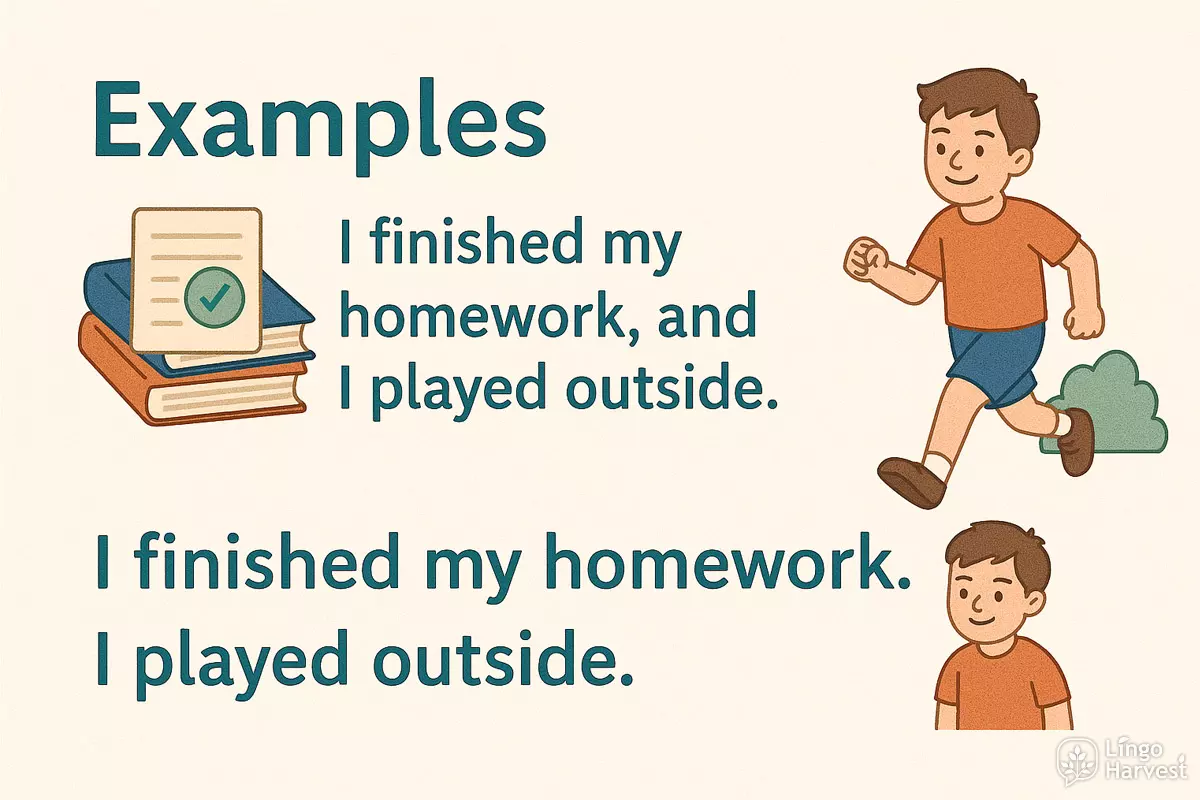
See how the meaning and readability change depending on how you join or separate ideas:
- Long sentence (with conjunction): I finished my homework, and I played outside.
- Two short sentences: I finished my homework. I played outside.
- Long sentence: She was hungry because she skipped breakfast.
- Two short sentences: She was hungry. She skipped breakfast.
Benefits and Drawbacks
| One Long Sentence (with conjunction) | Two Short Sentences |
|---|---|
| Shows how ideas are connected (cause, contrast, time, etc.) | Keeps each idea simple and clear |
| Makes writing flow more naturally | Prevents confusion for beginners |
| Can be harder to understand if too many ideas are joined | May sound choppy if overused |
| Great for showing relationships using words like and, but, because | Useful for emphasizing each point separately |
Tips for Beginners
- Start with short sentences if you are unsure.
- Use conjunctions to join ideas only when the connection is clear.
- Read your sentences aloud to check if they sound natural.
- If a sentence feels too long or confusing, break it into two.
In summary, both sentence types are useful. Practice deciding which style helps your reader understand you best. As you get comfortable with conjunctions, you’ll learn when to link ideas and when to keep things separate for clarity.
Why conjunctions are useful for clear and natural speech
Conjunctions help us connect words, phrases, and ideas smoothly. By joining separate thoughts, these linking words make communication less choppy and more understandable. Instead of speaking in short, disconnected sentences, you can build longer, more meaningful ones that flow naturally.
Making Sentences Flow
When you use words like and, but, and because, your speech sounds more like natural conversation. These connectors allow you to explain, compare, or add details without repeating information or pausing awkwardly. For example, instead of saying, "It is raining. I will take an umbrella," you could say, "It is raining, so I will take an umbrella." This small change keeps the listener engaged and helps your meaning come through clearly.
Expressing Relationships Between Ideas
Linking words show how one idea relates to another. They can indicate contrast, choice, reason, or time. This helps listeners understand the connection between your points, making your message easier to follow. Here are some common ways conjunctions clarify relationships:
- Addition: "I like apples and oranges."
- Contrast: "She is tired, but she finished her work."
- Reason: "He left early because he was sick."
- Choice: "Do you want tea or coffee?"
- Time: "Call me when you arrive."
- Condition: "You can play if you finish your homework."
- Result: "She studied, so she passed the test."
- Purpose: "He whispered so that he wouldn’t wake the baby."
- Comparison: "She runs faster than her brother."
- Exception: "Everyone went home except Tom."
Helping Speech Sound More Natural
People rarely speak in single, short sentences. In everyday conversation, we combine ideas to sound polite and fluent. Linking words make it easier to tell stories, share opinions, and describe events. They also let you avoid repeating the same words or phrases, which can bore or confuse your listener.
Examples of How Conjunctions Improve Clarity
Let’s look at a few examples that show the difference:
- "I went to the shop. I bought milk. I met my friend." → "I went to the shop and bought milk, and I met my friend."
- "She was hungry. She didn’t eat." → "She was hungry but didn’t eat."
- "You can have juice. You can have water." → "You can have juice or water."
Using connectors not only shortens your sentences but also makes your thoughts easier to understand.
Summary Table: How Conjunctions Shape Meaning
| Function | Example with Conjunction |
|---|---|
| Addition | She likes tea and coffee. |
| Contrast | He is tall, but not very fast. |
| Reason | They stayed indoors because it was raining. |
| Choice | Do you want pizza or pasta? |
| Time | We will leave when you are ready. |
| Condition | You can join if you want. |
| Result | He practiced, so he improved. |
| Purpose | She called so that he would remember. |
| Comparison | This book is longer than the other one. |
| Exception | Everyone left except Sam. |
By practicing with these connectors, your English will sound smoother and more natural, making your speech clearer and easier for others to understand.
Short beginner quiz: choose if a word is a conjunction or not
Test your understanding of conjunctions by looking at the words below. Decide for each one: is it a conjunction, or not? Conjunctions are connecting words like and, but, and or. Some words look similar but play a different role in a sentence. Try to identify the connecting words from the rest.
Decide: Is it a conjunction?
- Because
- Quickly
- Or
- However
- Before
- And
- Cat
- But
- Although
- Jump
- So
- Yet
- Between
- For
- With
- Nor
Take your time and think about what function each word has in a sentence. Some are used to connect parts of a sentence, while others describe actions, things, or positions.
Show answers
- Because – Conjunction
- Quickly – Not a conjunction (adverb)
- Or – Conjunction
- However – Not a conjunction (conjunctive adverb)
- Before – Sometimes a conjunction, but also a preposition; in grammar quizzes, it is often accepted as a conjunction.
- And – Conjunction
- Cat – Not a conjunction (noun)
- But – Conjunction
- Although – Conjunction
- Jump – Not a conjunction (verb)
- So – Conjunction
- Yet – Conjunction
- Between – Not a conjunction (preposition)
- For – Can be a conjunction or preposition; in this context, accept as a conjunction.
- With – Not a conjunction (preposition)
- Nor – Conjunction
Common conjunctions vs. similar words
It’s easy to confuse conjunctions with other types of words. Here’s a quick reference to help you see the difference:
- Conjunctions: and, but, or, nor, for, so, yet, because, although
- Prepositions: with, between, before (sometimes), after
- Adverbs: quickly, however
- Nouns: cat
- Verbs: jump
Remember, conjunctions connect clauses or words in a sentence. If a word links ideas, it’s probably a conjunction. Otherwise, check if it describes an action, object, or relationship in space or time.