Conjunctions to Show Consequence: consequently, therefore

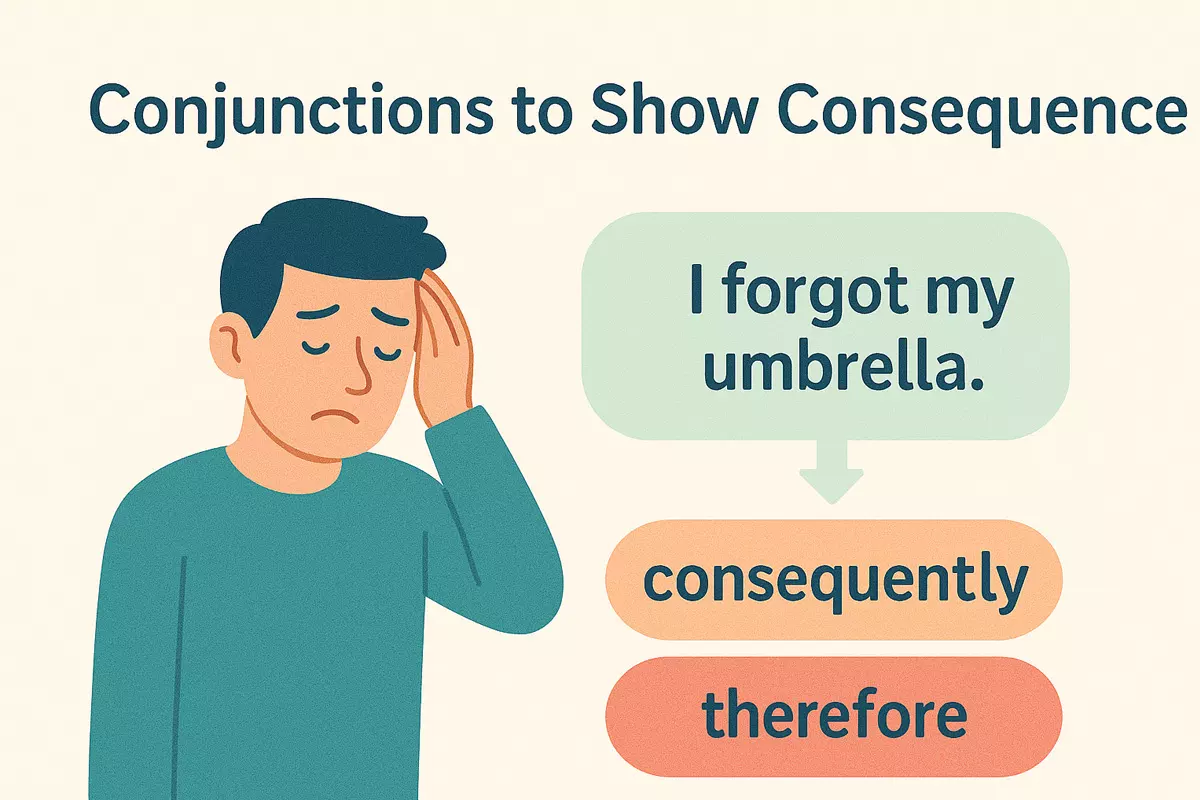 This article explains how to use therefore and consequently to connect ideas and show results in sentences. It covers their meaning, form, punctuation, differences from conjunctions, formal use in writing, alternatives, and sentence-joining practice.
- What consequence means in connected sentences
- Difference between sentence connectors and pure conjunctions
- Form and position of therefore and consequently in a sentence
- Punctuation choices: comma, semicolon, and full stop
- Use in formal writing, reports, and essays
- Alternatives such as as a result and so
- Practice: join sentences to show clear results and consequences
Using connecting words to express results or outcomes in English is essential for clear communication, as these transition terms help show how one event leads logically to another. Words and phrases like therefore, thus, as a result, and consequently clarify the relationship between ideas, making writing more coherent and persuasive. Mastering these connectors not only improves the flow of sentences but also enables writers to present their arguments and explanations in a way that is easy for readers to follow.
What consequence means in connected sentences
In English, the idea of consequence in a sentence connection refers to showing that one action, fact, or idea leads logically to another. When we use words like consequently or therefore, we signal that the second part of the sentence is a result or effect of what came before. This relationship helps readers or listeners understand not just what happened, but why it happened, making the connection between cause and effect clear.
How conjunctions highlight results
Conjunctions and linking words for consequence are essential when you want to explain outcomes or results. They help structure your argument or narrative, so your audience can follow the flow from cause to effect. For example, if you say, "She forgot her umbrella. Therefore, she got wet," the word therefore connects the reason (no umbrella) to the result (got wet).
Typical signals of consequence
- Consequently – introduces a direct result
- Therefore – signals a logical outcome
- As a result – points to what happened because of something
- Thus – often used in formal or written English
- So – more informal, but commonly used in speech
- For this reason – explicitly states the connection
- Accordingly – often used in reports or formal writing
- Hence – similar to "thus", often used in academic contexts
- That’s why – conversational, emphasizes explanation
- Because of this – restates the cause before consequence
Examples of consequence in context
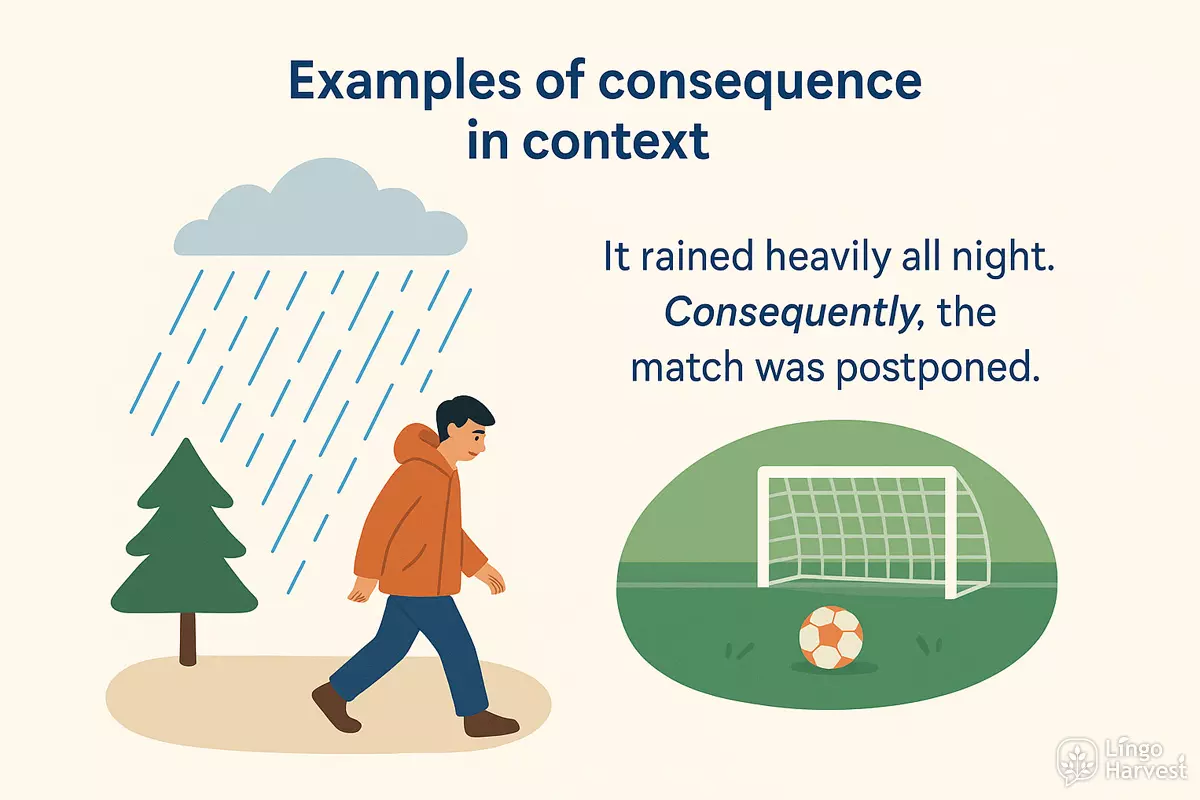
Here are some example sentences to show how these connectors function in real communication:
- It rained heavily all night. Consequently, the match was postponed.
- He didn’t study; therefore, he failed the test.
- The road was icy. As a result, several accidents occurred.
- She worked hard. Thus, she achieved her goal.
- The shop was closed, so we went home.
Why showing consequence matters
Clarifying cause-and-effect relationships makes your writing and speech more logical and persuasive. By using the right connecting words, you guide your audience through your reasoning, helping them see not just events, but the logic that links them. This is especially important in academic writing, reports, instructions, or any context where clarity of reasoning is valued.
Difference between sentence connectors and pure conjunctions
When discussing how we link ideas in English, it helps to distinguish between sentence connectors and the classic coordinating conjunctions. Although both serve to join thoughts, their placement, punctuation, and the flow they create in writing are quite different.
What are sentence connectors?
Sentence connectors—like consequently and therefore—are transition words or phrases that link two separate sentences or independent clauses. They usually appear at the beginning of a sentence, sometimes after a semicolon, and are followed by a comma. These connectors show relationships such as cause and effect, contrast, or addition. For example:
- It was raining heavily; therefore, the match was postponed.
- He missed his train. Consequently, he was late for work.
Notice how the connector acts as a bridge between two complete sentences, emphasizing the logical link.
What are pure conjunctions?
Pure conjunctions, like and, but, or, so, directly join two clauses within a single sentence, often without the need for extra punctuation. They are part of the clause itself and usually come between the items they connect. For example:
- It was raining, so the match was postponed.
- He missed his train and was late for work.
These words are essential for building compound sentences and keeping the flow smooth and direct.
Key differences at a glance
| Sentence Connectors (e.g. therefore, consequently) |
Pure Conjunctions (e.g. and, but, so) |
|---|---|
| Join separate sentences or independent clauses | Join clauses within a single sentence |
| Usually require a semicolon or period before, and a comma after | No special punctuation needed (just a comma for compound sentences) |
| Often appear at the start of a sentence or after a semicolon | Placed between the clauses they connect |
| Emphasize logical relationships (cause, result, contrast) | Simply link ideas without extra emphasis |
| Examples: therefore, consequently, however, moreover | Examples: and, but, so, or |
Summary
In summary, sentence connectors add structure and clarity when linking whole ideas or sentences, especially to highlight cause-and-effect or result. Pure conjunctions are more about efficiently joining parts within a sentence. Choosing between them depends on the level of emphasis and the rhythm you want in your writing.
Form and position of therefore and consequently in a sentence
Both therefore and consequently are used to express a result or consequence, but they have particular patterns when it comes to placement in a sentence. Understanding where to position these adverbs helps your writing sound natural and logical.
Typical sentence structures
These connectors usually appear at or near the start of the clause they introduce. They are most often used to link two independent clauses, and are commonly preceded by a semicolon (;) and followed by a comma (,). They can also be used after a period, beginning a new sentence.
- It was raining heavily; therefore, the match was cancelled.
- She did not study. Consequently, she failed the test.
- The company lost several clients; consequently, profits fell sharply.
- He was late; therefore, he missed the introduction.
Alternative positions
While the most common placement is after a semicolon or period, both adverbs can sometimes appear mid-clause for emphasis or stylistic reasons, though this is less formal.
- He missed the bus and, therefore, arrived late to work.
- The weather was terrible and, consequently, attendance was low.
Punctuation rules
Punctuation is important with these connectors. When linking two independent clauses, use a semicolon before and a comma after. When starting a new sentence, use a period or full stop, followed by the connector and a comma.
Comparison of patterns
| Pattern | Example |
|---|---|
| After semicolon, before main clause | She was tired; therefore, she went to bed early. |
| At the start of a new sentence | The project was delayed. Consequently, the launch date was moved. |
| Mid-clause (less formal) | He forgot the deadline and, therefore, submitted the work late. |
| Rarely at the end (not recommended) | She missed the train. She was late, consequently. |
Summary of usage points
- Both words are adverbs and not conjunctions.
- Usually link two independent clauses expressing cause and effect.
- Require careful punctuation for clarity.
- Positioned at the start or mid-point of the result clause, rarely at the end.
- Use in formal or semi-formal writing; for informal speech, alternatives like "so" are more common.
Punctuation choices: comma, semicolon, and full stop
When using consequence conjunctions such as consequently and therefore, the punctuation you choose can subtly shift the tone and clarity of your sentence. These connectors often appear in the middle of a sentence or at the start of a new one, and the punctuation helps guide the reader through the logical flow.
Using a comma
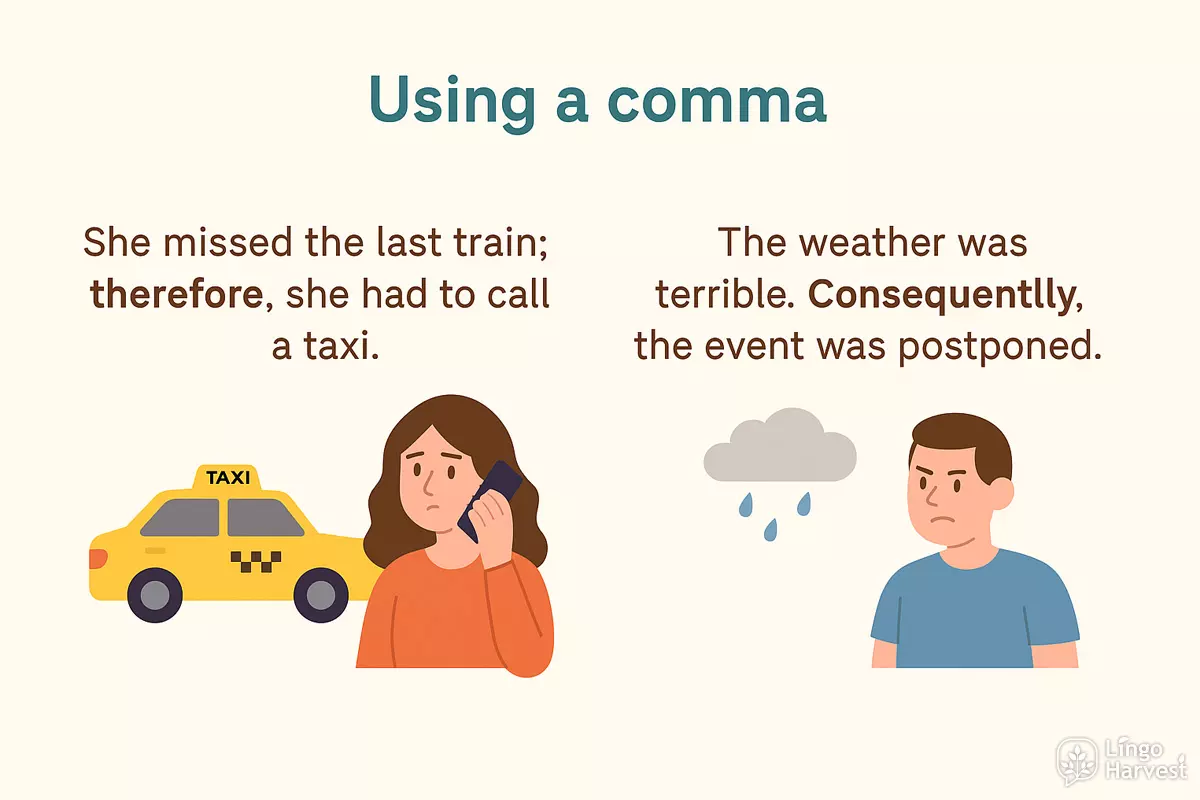
A comma is usually placed after "consequently" or "therefore" when they introduce a clause. This signals a short pause and keeps the sentence moving smoothly:
- She missed the last train; therefore, she had to call a taxi.
- The weather was terrible. Consequently, the event was postponed.
- He didn’t study enough; therefore, he didn’t pass the exam.
- The shop was closed. Consequently, we went to another store.
- She lost her keys; therefore, she couldn’t open the door.
- The roads were icy. Consequently, all buses were delayed.
The comma after the conjunction is important for readability, especially in longer sentences.
Employing a semicolon
A semicolon can be used before "consequently" or "therefore" when connecting two closely related independent clauses. This approach emphasizes the logical link:
- He forgot his umbrella; consequently, he got soaked.
- We ran out of flour; therefore, we couldn’t bake the cake.
- The alarm didn’t go off; therefore, he overslept.
- The experiment failed; consequently, the team restarted their research.
- They missed the deadline; therefore, the project was delayed.
- He didn’t lock the door; consequently, the wind blew it open.
The semicolon marks a stronger pause than a comma, but not as strong as a full stop.
Choosing a full stop
Using a full stop creates two separate sentences, which can make each idea stand out more. "Consequently" or "therefore" then begins the next sentence, followed by a comma:
- The application was incomplete. Therefore, it was rejected.
- She arrived late. Consequently, she missed the introduction.
- The meeting ended early. Therefore, we went for coffee.
- The computer crashed. Consequently, all progress was lost.
- He didn’t hear the announcement. Therefore, he missed his flight.
- The lights went out. Consequently, the show was interrupted.
This structure works well when you want to emphasize the result.
Comparison of punctuation patterns
| Pattern | Example |
|---|---|
| Semicolon + conjunction + comma | It rained; therefore, the match was canceled. |
| Full stop + conjunction + comma | It rained. Therefore, the match was canceled. |
| Comma after conjunction (mid-sentence) | The train was delayed; she, therefore, arrived late. |
| Comma after conjunction (sentence initial) | Therefore, we decided to wait. |
Quick tips for clarity
- Always use a comma after "therefore" or "consequently" when they start a clause.
- Use a semicolon before these words when linking two independent clauses.
- Don’t forget the full stop option for more emphasis or a slower pace.
- Be consistent with your punctuation style within the same piece of writing.
Choosing the right punctuation when using connectors of consequence ensures your writing is both accurate and easy to follow. The distinctions may seem subtle, but they play an important role in expressing cause and effect clearly.
Use in formal writing, reports, and essays
When writing academically or preparing professional documents, connectors like consequently and therefore help clarify logical relationships between ideas. These terms signal that what follows is a direct result or conclusion based on previously stated information, which is essential for clear, persuasive argumentation in essays, reports, and research papers.
Position and punctuation
Both consequently and therefore are typically placed at the beginning of a sentence or clause, often after a semicolon or period. They are usually followed by a comma. For example:
- The experiment produced unexpected results; therefore, further testing is required.
- There was a lack of supporting evidence. Consequently, the hypothesis was rejected.
Concision and clarity
Writers use these connectors to avoid vague transitions like "so" or "because of this," which are less precise in academic contexts. By choosing consequently or therefore, the cause-effect relationship is highlighted, adding formality and precision.
Common contexts and examples
These conjunctions appear frequently in:
- Research findings and conclusions
- Analytical essays
- Business and technical reports
- Policy documents
- Scientific writing
- Legal arguments
- Formal correspondence
- Process descriptions
- Problem-solution texts
- Recommendation sections
Comparison of use: "consequently" vs "therefore"
| Connector | Typical Usage & Nuance |
|---|---|
| therefore | Widely used for logical conclusions, especially in arguments and discussions; slightly more common in mathematics, philosophy, and general academic writing. |
| consequently | Emphasizes the result or outcome of a specific action or event; often found in scientific, technical, or process-focused writing. |
Checklist for effective use
- ✅ Use after stating a cause, observation, or premise.
- ✅ Place at the start of the result clause for emphasis.
- ✅ Follow with a comma.
- ✅ Avoid overusing in consecutive sentences; vary transitions.
- ✅ Ensure the logical connection is clear to the reader.
Using consequently and therefore appropriately demonstrates attention to structure, logic, and tone—all of which are valued in scholarly and professional contexts.
Alternatives such as as a result and so
When expressing consequence in English, speakers often choose from a variety of linking words and phrases beyond "consequently" and "therefore." These alternative connectors can make your writing more natural and flexible, depending on the context and desired tone. Knowing when and how to use these options helps you convey cause and effect relationships clearly and effectively.
Common Substitutes for "Consequently" and "Therefore"
Many alternatives can be used to show results or outcomes. Some are more formal, while others suit everyday conversation or informal writing. Here’s a selection of alternative expressions:
- As a result → She missed the bus; as a result, she was late.
- So → It was cold, so we stayed inside.
- Thus → The evidence was strong; thus, the case was closed.
- Hence → He didn’t study; hence, his poor exam score.
- For this reason → The team lacked resources; for this reason, the project slowed down.
- Accordingly → The rules changed; accordingly, we updated our policy.
- That’s why → It started raining; that’s why we left early.
- Because of this → He forgot his wallet; because of this, he couldn’t pay.
- Due to this → The system failed; due to this, production stopped.
- For this cause → The roads were icy; for this cause, travel was restricted.
- In consequence → She ignored the warnings; in consequence, she got injured.
- Resulting from this → Sales dropped; resulting from this, the company cut costs.
- On this account → He was unwell; on this account, he stayed home.
- Ergo → The premises were false; ergo, the conclusion was invalid.
- It follows that → The data is incomplete; it follows that the results are unreliable.
Usage Notes and Nuances
Some connectors, like "so," are informal and best for conversation or casual writing. Others, such as "thus" and "hence," appear more in academic or technical contexts. "As a result" and "for this reason" work well in both formal and neutral writing. Choosing the right phrase depends on your audience and the style you wish to achieve.
Examples in Sentences
Here are examples to illustrate how some alternatives function in context:
- She didn’t set her alarm. As a result, she was late for work.
- It rained heavily last night, so the match was postponed.
- The experiment failed; thus, we had to start over.
- The roads were icy. Hence, driving was dangerous.
- He forgot her birthday. That’s why she was upset.
Comparing Tone and Formality
The choice of connector can affect the formality and flow of your sentence. Here’s a quick comparison of some popular options:
| Connector | Typical Use / Register |
|---|---|
| So | Informal, spoken English, everyday writing |
| As a result | Neutral, suitable for both spoken and written English |
| Thus | Formal, academic or technical contexts |
| Hence | Formal, often in scientific or scholarly texts |
| That’s why | Informal, explanatory tone, spoken or casual writing |
Understanding these alternatives and their nuances can help you vary your writing style and communicate consequences with precision and clarity.
Practice: join sentences to show clear results and consequences
Understanding how to connect ideas with words like "consequently" and "therefore" makes your writing and speaking clearer. These conjunctions help you show that one event is the result of another. Below, you'll find practical exercises and examples to help you master joining sentences to express clear consequences.
Join These Sentences Using "Consequently" or "Therefore"
Combine each pair of sentences into one, using the appropriate conjunction to show the result. Try to choose the option that sounds most natural.
- It rained all night. The streets are flooded.
- She forgot her umbrella. She got wet on her way to work.
- The company increased its prices. Sales dropped significantly.
- He studied hard for months. He passed the exam with a high score.
- The alarm didn’t go off this morning. I was late to my appointment.
- The team worked overtime. The project was finished ahead of schedule.
- There was a power outage. All computers shut down unexpectedly.
- The restaurant received many bad reviews. It lost many customers.
- The weather was extremely cold. The lake froze overnight.
- She practiced the piano every day. She won the competition.
Show answers
- It rained all night; consequently, the streets are flooded.
- She forgot her umbrella; therefore, she got wet on her way to work.
- The company increased its prices; consequently, sales dropped significantly.
- He studied hard for months; therefore, he passed the exam with a high score.
- The alarm didn’t go off this morning; consequently, I was late to my appointment.
- The team worked overtime; therefore, the project was finished ahead of schedule.
- There was a power outage; consequently, all computers shut down unexpectedly.
- The restaurant received many bad reviews; therefore, it lost many customers.
- The weather was extremely cold; consequently, the lake froze overnight.
- She practiced the piano every day; therefore, she won the competition.
Common Patterns for Showing Consequence
Notice the typical ways to join sentences to make cause and effect clear:
- First clause; consequently, second clause.
- First clause; therefore, second clause.
- Because of X, Y happened. (Alternative structure)
- X caused Y. (Direct cause-effect statement)
Quick Practice: Choose the Correct Connector
Select either "consequently" or "therefore" for each sentence below:
- He missed the last train; __________, he had to take a taxi home.
- The experiment failed; __________, the team had to start over.
- Her computer crashed; __________, she lost her unsaved work.
- The store raised its prices; __________, many customers complained.
- It started raining heavily; __________, the match was canceled.
- The project was delayed; __________, the launch date was moved.
- He didn’t follow the instructions; __________, the device stopped working.
- The electricity went out; __________, the whole building became dark.
- The road was blocked; __________, we had to find another route.
- She didn’t feel well; __________, she decided to stay home.
Show answers
- therefore
- consequently
- consequently
- therefore
- therefore
- consequently
- consequently
- therefore
- therefore
- consequently
Practicing these structures helps you communicate results and consequences smoothly, making your ideas easier to follow and understand.