Linking Clauses in Complex Sentences with Conjunctions

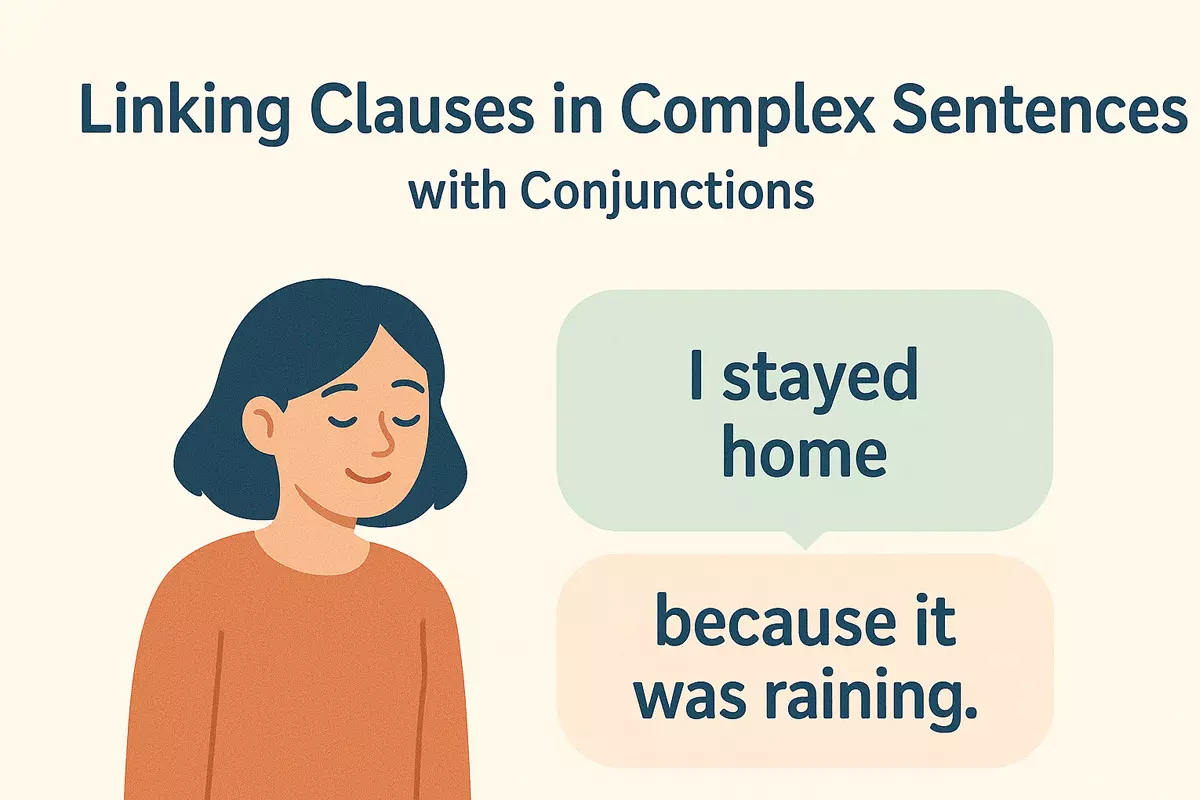 Here we how to distinguish simple, compound, and complex sentences, explains clause types and conjunction use, discusses word order for emphasis, punctuation in complex sentences, and offers strategies and practice for writing clear, effective sentences.
- Difference between simple, compound, and complex sentences
- Types of clauses and the role of conjunctions
- Choosing appropriate conjunctions for time, reason, contrast, and condition
- Word order options and how they affect emphasis
- Punctuation patterns in complex sentences with multiple clauses
- Strategies for avoiding overlong and confusing structures
- Practice: build complex sentences from short clause prompts
Have you ever wondered how longer ideas in English flow so smoothly? The secret often lies in the use of special linking words that connect different parts of a sentence. Mastering these connectors can make your writing clearer and your speech sound more natural. By learning how to use words like however, therefore, and although, you can express complex thoughts more easily and help your readers or listeners follow your ideas. Ultimately, using the right connectors is an essential skill for effective communication in English.
Difference between simple, compound, and complex sentences
Understanding how sentences are structured helps you connect ideas clearly and logically. English sentences come in several forms, each with distinct features and uses. Let’s explore how simple, compound, and complex sentences differ, especially when it comes to linking clauses with conjunctions.
Simple Sentences
A simple sentence contains just one independent clause. It expresses a complete thought with a subject and a verb. There are no additional clauses—just a straightforward idea.
- The cat slept.
- She reads every morning.
- Winter is cold.
- They played outside.
- The phone rang.
- He smiled.
- The sun rose.
- We waited.
- Birds sing.
- I understand.
Simple sentences can include compound subjects or verbs, but they don’t contain another clause.
Compound Sentences
Compound sentences combine two or more independent clauses, usually joined by coordinating conjunctions like and, but, or, so, yet, for, and nor. Each clause could stand alone as a complete sentence.
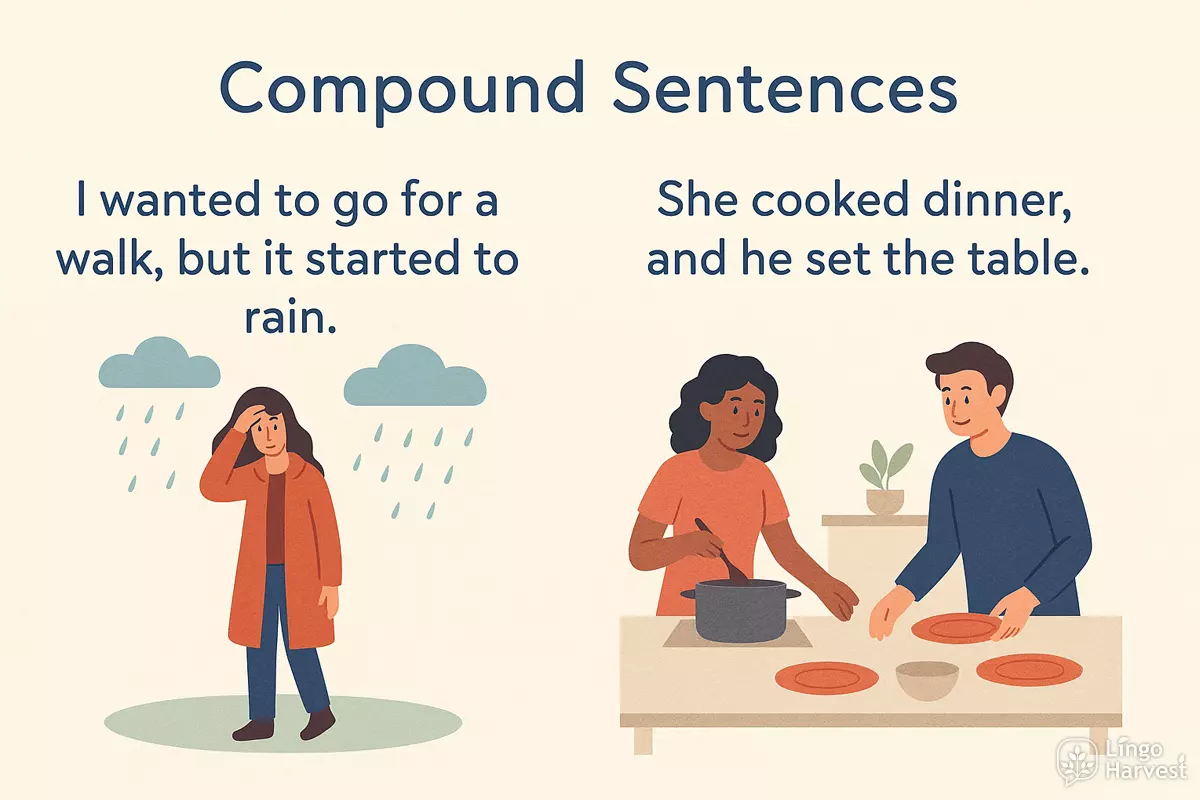
- I wanted to go for a walk, but it started to rain.
- She cooked dinner, and he set the table.
- We can watch a movie, or we can play a game.
- He was tired, so he went to bed early.
- The test was difficult, yet she passed it.
- I called her twice, but she didn’t answer.
- They cleaned the house, and then they relaxed.
- You can take the bus, or you can walk.
- It was getting late, so we headed home.
- She didn’t like the weather, nor did she enjoy the food.
The key feature is that both sides of the conjunction are independent clauses.
Complex Sentences
Complex sentences are built from one independent clause and at least one dependent (subordinate) clause. Subordinating conjunctions such as because, although, while, since, and if link the clauses, showing relationships like cause, time, or contrast.
- Because it was late, we took a taxi home.
- I will call you when I arrive.
- Although he was tired, he finished the project.
Dependent clauses cannot stand alone; they rely on the main clause to complete the meaning.
| Sentence Type | Structure | Typical Conjunctions |
|---|---|---|
| Simple | One independent clause | None (may use compound subjects/verbs) |
| Compound | Two or more independent clauses | and, but, or, so, yet, for, nor |
| Complex | One independent + one or more dependent clauses | because, although, since, if, when, while, unless, after, before |
Quick Reference: Key Features
- Simple: Single idea, no clause linking.
- Compound: Equal ideas joined by coordinators.
- Complex: Main idea plus one or more subordinate ideas, linked by subordinators.
Recognizing these sentence types helps you choose the right conjunctions and structure for linking clauses effectively in your writing.
Types of clauses and the role of conjunctions
Understanding how clauses function is essential for constructing clear and nuanced sentences. In English, clauses can be categorized based on their structure and the meaning they contribute to a sentence. The connectors that join these clauses—conjunctions—play a crucial role in shaping the relationship between ideas.
Main and Subordinate Clauses
A main clause (also called an independent clause) can stand alone as a complete sentence. In contrast, a subordinate (or dependent) clause cannot stand alone; it relies on a main clause to form a full thought. When forming complex sentences, these two types are often linked together.
- Main clause: She went to the store.
- Subordinate clause: because she needed milk
- Complex sentence: She went to the store because she needed milk.
Types of Conjunctions
Conjunctions are the words that connect clauses. The three primary types are:
- Coordinating conjunctions: Join two main clauses (e.g., and, but, or, nor, for, so, yet).
- Subordinating conjunctions: Connect a subordinate clause to a main clause (e.g., because, although, since, unless, while, if, after, before, when, as).
- Correlative conjunctions: Work in pairs to join balanced elements (e.g., either…or, neither…nor, not only…but also, both…and, whether…or).
Common Subordinating Conjunctions and Their Functions
The choice of conjunction signals the relationship between clauses—such as cause, contrast, time, or condition. Here are some common subordinators and the connections they create:
- because → cause/reason
- although → contrast/concession
- since → time or cause
- unless → condition
- while → contrast or simultaneous actions
- if → condition
- after → sequence in time
- before → sequence in time
- when → specific time
- as → time or reason
- even though → strong contrast
- so that → purpose
- unless → negative condition
- whereas → contrast
- provided that → condition
Comparing Clause Types and Their Uses
| Clause Type | Example | Common Conjunctions | Function in Sentence |
|---|---|---|---|
| Main (Independent) | He called his friend. | and, but, or, so | Can stand alone; expresses a complete thought |
| Subordinate (Dependent) | because he was worried | because, although, if, when, since | Cannot stand alone; adds detail or context |
| Relative | who lives next door | who, which, that, whose | Describes or identifies nouns |
| Conditional | if it rains | if, unless, provided that | Expresses a condition for the main clause |
Key Takeaways
By choosing the right connectors, writers clarify how ideas relate—whether they’re adding information, showing contrast, or expressing time, cause, or condition. Mastering the use of different clause types and their linking words is fundamental for building complex, precise sentences.
Choosing appropriate conjunctions for time, reason, contrast, and condition
Selecting the right conjunctions is crucial when combining clauses in complex sentences. Each type of conjunction serves a specific function—signaling time relationships, explaining reasons, showing contrast, or indicating conditions. Understanding these distinctions helps writers and speakers create clear, logical connections.
Conjunctions Indicating Time
Temporal conjunctions show when something happens in relation to another event.
- after → We ate lunch after the movie ended.
- before → Wash your hands before you eat.
- when → Call me when you arrive.
- while → She listened to music while she worked.
- as soon as → As soon as he saw me, he waved.
- until → Wait here until the bus arrives.
- since → We haven’t talked since you moved.
- once → Once he finished, he took a break.
Conjunctions Expressing Reason
Causal conjunctions explain why something happens.
- because → He stayed home because he was sick.
- since → Since it’s late, we should go home.
- as → As it was raining, we stayed inside.
- now that → Now that she’s here, we can begin.
- insofar as → The plan is good insofar as it saves time.
Conjunctions Showing Contrast
Contrastive conjunctions highlight differences or unexpected results.
- although → Although it was cold, they went swimming.
- though → He tried hard, though he didn’t succeed.
- even though → Even though he was tired, he kept working.
- whereas → She loves hiking, whereas he prefers reading.
- while → She is calm, while her brother is energetic.
- however → It looked easy; however, it was difficult.
- nevertheless → It was raining; nevertheless, they continued playing.
- yet → He had no experience, yet he succeeded.
- but → I wanted to go, but I stayed home.
Conjunctions for Condition
Conditional conjunctions set up situations depending on something else happening.
- if → If it rains, we’ll stay inside.
- unless → You can’t leave unless you finish your work.
- provided (that) → You can join us provided that you’re ready.
- as long as → You can stay as long as you’re quiet.
- in case → Take a jacket in case it gets cold.
- even if → I’ll help you even if I’m busy.
Example: "You can go out if you finish your homework."
| Type | Common Conjunctions |
|---|---|
| Time | after, before, when, while, as soon as, until, since, once |
| Reason | because, since, as, now that, insofar as |
| Contrast | although, though, even though, whereas, while, however, nevertheless, yet, but |
| Condition | if, unless, provided (that), as long as, in case, even if |
When linking clauses, consider the relationship you want to express. Using the appropriate conjunction clarifies meaning and prevents ambiguity. Mixing up these connectors can lead to confusion, so it’s helpful to memorize typical patterns and practice with varied examples.
Word order options and how they affect emphasis
The sequence in which you arrange clauses joined by conjunctions can subtly shift what the listener or reader focuses on. In English, although there are standard patterns, reordering the clauses or moving connectors can change which part of the sentence feels most important. This flexibility lets writers highlight causes, results, or contrasts, depending on their communicative goal.
Clause order with subordinating conjunctions
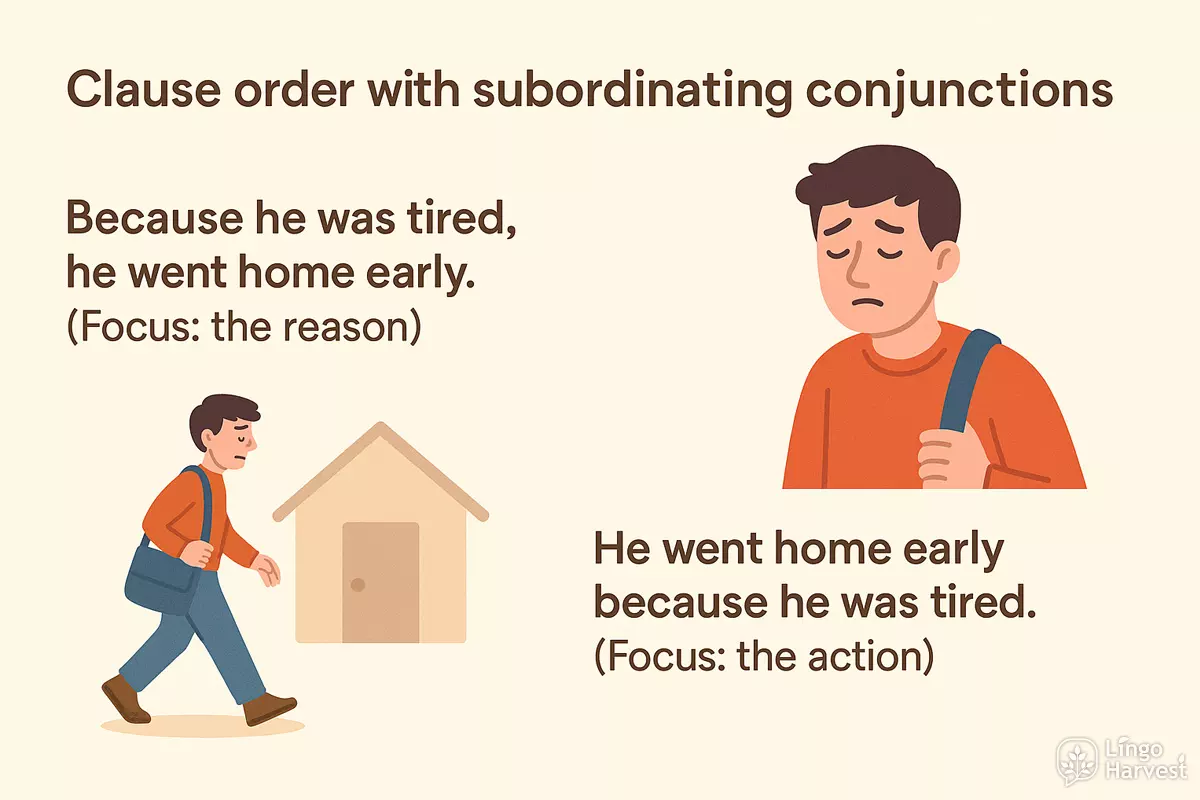
When using words like because, although, or if, you can place the dependent clause before or after the main clause. The element that comes first often receives the most attention. For example:
- Because he was tired, he went home early. (Focus: the reason)
- He went home early because he was tired. (Focus: the action)
- If you call me, I will help you. (Focus: the condition)
- I will help you if you call me. (Focus: the result)
Coordinating conjunctions and emphasis
With connectors like and, but, or so, the usual sequence is main idea first, then the related idea. However, rearranging can sometimes be used for stylistic effect, especially in creative writing or speech. Consider how the following order influences what stands out:
- She studied hard, and she passed the exam. (Neutral, chronological)
- She passed the exam, because she studied hard. (Highlights the cause)
- He was late, but he apologized. (Contrast is emphasized at the end)
Changing emphasis with inversion or fronting
In more formal or literary contexts, writers sometimes place the subordinate clause at the start, or even use inversion to stress a particular point. For example:
- Not only did she win the race, but she also set a record.
- Only if you agree, will we proceed. (Inversion for emphasis)
| Order | Effect on Emphasis |
|---|---|
| Main clause first (e.g. “I’ll call you if I’m late.”) |
Focuses on the action or result; background information comes after. |
| Subordinate clause first (e.g. “If I’m late, I’ll call you.”) |
Draws attention to the condition, cause, or contrast; sets the context up front. |
| Inverted structure (e.g. “Only if you agree will we proceed.”) |
Strongly highlights the condition or exception; formal or emphatic tone. |
| Coordinating conjunctions in middle (e.g. “He tried, but he failed.”) |
Gives equal weight to both ideas, but the second clause often leaves a stronger impression. |
Quick reference: Common patterns and their effects
- Fronting a reason or condition sets context quickly for the reader.
- Ending with a consequence makes outcomes more memorable.
- Contrast at the end (using but) is more striking.
- Starting with a concessive clause (although, even though) signals complexity early.
- Inversion is rare but powerful for emphasis or drama.
- Using so at the start is informal and can sound abrupt.
- Short initial clauses speed up the flow; long initial clauses slow it down and add suspense.
- Repetition of structure (parallelism) highlights similarities or contrasts.
- Placing the unexpected at the end increases impact.
- Combining conjunctions and word order can create nuanced shades of meaning.
Experimenting with clause order and conjunction placement gives you control over what stands out in your sentences. Whether you want to highlight a cause, a result, or a contrast, adjusting the sequence lets you guide your reader’s focus and create more effective communication.
Punctuation patterns in complex sentences with multiple clauses
Understanding how to punctuate sentences that contain several clauses is crucial for clarity and readability. The right punctuation signals how ideas are connected and helps readers follow your argument. When clauses are linked by conjunctions, the rules may shift depending on the type and placement of those conjunctions.
Commas and conjunctions: the basics
Commas are commonly used to separate clauses, especially when a subordinating or coordinating conjunction joins them. However, the placement and necessity of a comma depend on the structure:
- When a dependent clause comes before the main clause, use a comma after the dependent clause.
- If the main clause comes first and is followed by a dependent clause, a comma is usually not needed.
- Coordinating conjunctions (like and, but, or) joining two independent clauses require a comma before the conjunction.
Common punctuation patterns
Writers often encounter several scenarios when linking multiple clauses. Here are typical patterns:
- Main clause, conjunction main clause. (Comma before the conjunction)
- Dependent clause, main clause. (Comma after the dependent clause)
- Main clause conjunction dependent clause. (No comma needed)
- Main clause; main clause. (Semicolon when two clauses are closely related but not joined by a conjunction)
- Main clause: explanation or list. (Colon introduces the second clause if it explains or expands on the first)
- Main clause — interruption or afterthought. (Em dash adds emphasis or an abrupt break)
- Series of clauses, each separated by a comma, with a conjunction before the final clause.
- If clauses are lengthy or contain internal commas, use semicolons between them for clarity.
- Introductory words (however, therefore) at the start of a clause are usually set off by commas.
- Nonessential clauses (extra information) are set off by commas.
- Essential clauses (no extra commas): Do not use commas if the clause is necessary to the meaning.
- If multiple conjunctions link several clauses, be consistent with punctuation to avoid confusion.
Structured examples of clause linking and punctuation
| Pattern | Example |
|---|---|
| Independent + , + Coordinating Conjunction + Independent | She wanted to leave, but the rain kept her inside. |
| Dependent + , + Independent | Because it was late, we decided to call a taxi. |
| Independent + Dependent | We finished the project before the deadline passed. |
| Independent ; Independent | The sun had set; the air grew cooler. |
| Independent : Explanation/Expansion | He had one goal: to win the championship. |
| Independent — Extra or Interruption | I knew what I had to do — there was no other choice. |
Tips for clarity
Punctuating complex sentences is about guiding the reader smoothly through your ideas. If a sentence feels crowded or confusing, consider breaking it into two. When in doubt, read your sentence aloud; natural pauses often indicate where punctuation should go. Remember, consistency in your usage helps your writing remain clear and professional.
Strategies for avoiding overlong and confusing structures
Managing sentence complexity is essential for clear communication. When combining multiple clauses with conjunctions, writers often risk creating sentences that are difficult to follow. Here are practical ways to keep sentences both connected and accessible.
Break up lengthy sentences
If a sentence contains more than two or three linked clauses, consider splitting it into shorter ones. This not only improves clarity but also helps readers process the information more easily.
- Identify natural breaks where an idea is complete.
- Replace some conjunctions with full stops.
- Rephrase to emphasize the main point in each sentence.
Choose conjunctions carefully
Not all connectors serve the same purpose. Using the right conjunction for the relationship between clauses prevents confusion. For example, use because for reasons, although for contrast, and so for results.
Vary sentence openings
Starting every clause with a conjunction or the same word can sound repetitive. Try different introductory phrases or rearrange clauses to maintain reader interest.
Use punctuation for clarity
Strategic punctuation—such as commas, semicolons, and em dashes—can clarify relationships between clauses and prevent run-on sentences.
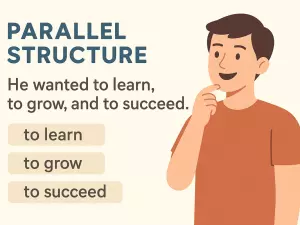
Keep parallel structure
When linking similar ideas, ensure that the clauses are grammatically parallel. This makes the sentence smoother and easier to follow.
Examples of concise vs. overloaded sentences
Below is a comparison of sentences with effective linking versus those that become tangled and hard to read:
| Effective Linking | Overlong and Confusing |
|---|---|
| She finished her work, and she went home. | She finished her work, and because she was tired, and since it was late, she went home. |
| Although it was raining, we decided to go out. | Although it was raining and it was getting dark and we were tired, we decided to go out and meet our friends and have dinner. |
| He studied hard, so he passed the exam. | He studied hard, and he wanted to do well, so he kept studying, and finally he passed the exam because he worked a lot. |
| If you call me, I will help you. | If you call me and if I am not busy and if I have my phone with me, I will try to help you as soon as I can. |
Tips for simplifying complex sentences
- Limit each sentence to one or two main ideas.
- Use pronouns or substitution to avoid repetition.
- Read sentences aloud to check for awkwardness.
- Revise by cutting unnecessary clauses or details.
- Ask someone else to read your writing for clarity.
By applying these techniques, writers can link ideas smoothly without overwhelming the reader. Clear structure supports both comprehension and engagement, making complex sentences effective rather than confusing.
Practice: build complex sentences from short clause prompts
Building longer, more nuanced sentences often starts with combining simple ideas using conjunctions. Let’s work through some practical exercises that encourage linking clauses to create complex statements. This will help you develop fluency and variety in your writing.
Task: Combine Short Clauses into Complex Sentences
Try joining the following pairs of short clauses using appropriate conjunctions (such as "because," "although," "since," "unless," "while," etc.). Think about the logical relationship between the ideas before choosing how to connect them.
- It was raining. We went for a walk.
- She studied hard. She wanted to pass the exam.
- He is allergic to nuts. He avoids eating peanut butter.
- The movie was long. I enjoyed every minute.
- You can call me. You need any help.
- The concert started late. The band apologized.
- We missed the bus. We left the house early.
- He didn’t understand the instructions. He asked for clarification.
- My friend invited me. I couldn’t attend the party.
- She was tired. She finished the project on time.
- The weather was cold. The children played outside.
- I will go to the store. I run out of milk.
- You should practice more. You want to improve.
- It’s getting dark. We should head home.
- The test was difficult. Most students passed.
- He didn’t like the meal. He thanked the host.
- They arrived early. They got good seats.
- She forgot her umbrella. She got wet.
- I don’t like coffee. I drink tea instead.
- He reads every night. He wants to expand his vocabulary.
Show answers
- Although it was raining, we went for a walk.
- She studied hard because she wanted to pass the exam.
- Since he is allergic to nuts, he avoids eating peanut butter.
- The movie was long, but I enjoyed every minute.
- You can call me if you need any help.
- The concert started late, so the band apologized.
- Even though we left the house early, we missed the bus.
- He didn’t understand the instructions, so he asked for clarification.
- Although my friend invited me, I couldn’t attend the party.
- She was tired, yet she finished the project on time.
- Even though the weather was cold, the children played outside.
- I will go to the store when I run out of milk.
- You should practice more if you want to improve.
- Since it’s getting dark, we should head home.
- The test was difficult, but most students passed.
- He didn’t like the meal, but he thanked the host.
- Because they arrived early, they got good seats.
- She forgot her umbrella, so she got wet.
- I don’t like coffee, so I drink tea instead.
- He reads every night because he wants to expand his vocabulary.
Common Conjunctions for Linking Clauses
When constructing more advanced sentences, choosing the right conjunction is key. Here’s a handy reference list of conjunctions and their typical uses:
- Because – shows reason or cause
- Although / Even though – introduces contrast
- Since – gives reason or time context
- If / Unless – expresses condition
- While / Whereas – contrasts two actions or states
- So – introduces result or consequence
- When / Whenever – relates to time
- After / Before – shows sequence
- Yet / But – indicates contrast or exception
- As – provides reason or simultaneous action
Sentence Transformation Challenge
Rewrite the following simple sentences as complex sentences using conjunctions from the list above. Be creative and vary your structure.
- He was late. He missed the bus.
- They finished the project. They celebrated.
- The teacher explained the topic. Some students still struggled.
- I will help you. You ask me.
- She studied hard. She passed the exam.
- It was raining. We stayed inside.
- He was tired. He kept working.
- We arrived early. The store was closed.
- She felt sick. She went to the doctor.
- I saw the message. I replied immediately.
Show answers
- He was late because he missed the bus.
- After they finished the project, they celebrated.
- Although the teacher explained the topic, some students still struggled.
- I will help you if you ask me.
- She studied hard, so she passed the exam.
- Since it was raining, we stayed inside.
- Even though he was tired, he kept working.
- We arrived early, but the store was closed.
- Because she felt sick, she went to the doctor.
- When I saw the message, I replied immediately.