Common Word Order Errors with Subordinators

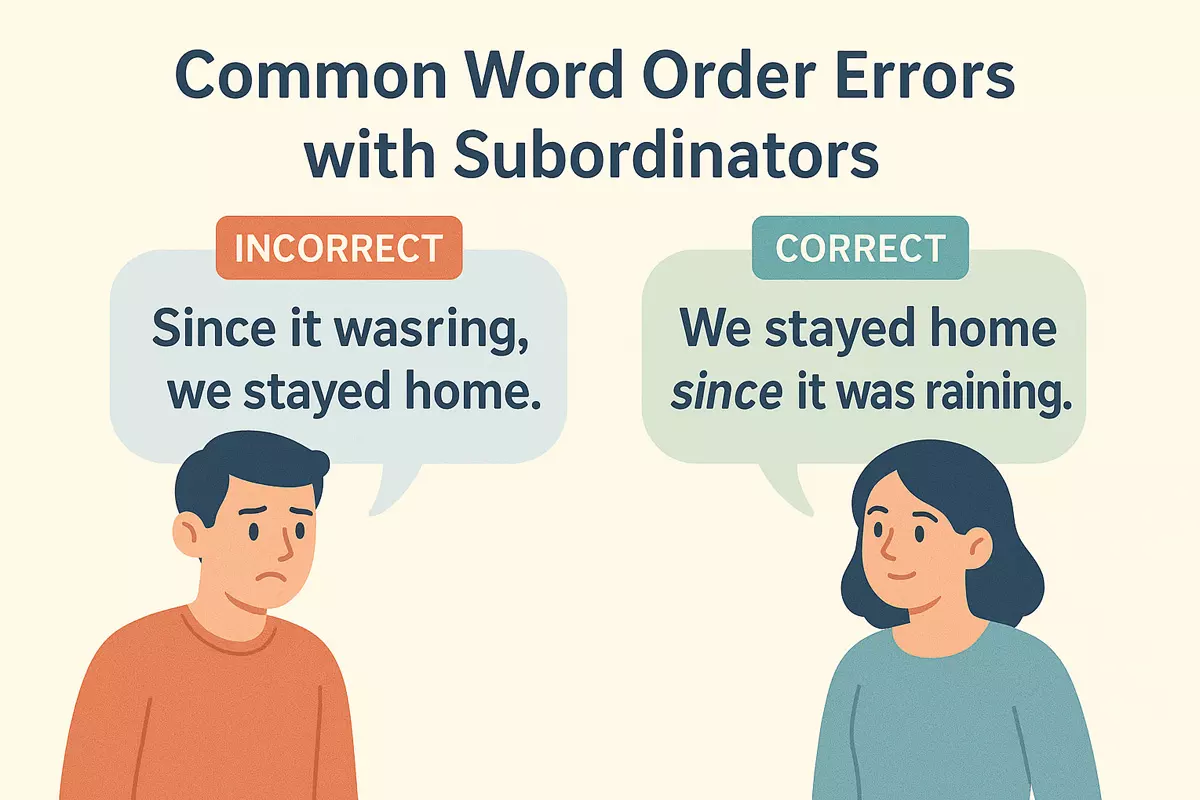 Here we sentence structure with subordinating conjunctions, common word order errors with subjects, verbs, and adverbs, differences when subordinate clauses lead, examples of confusing sentences, and provides word order practice with subordinators.
- Typical sentence structure with subordinating conjunctions
- Frequent errors with misplaced subjects and verbs
- Problems with adverb position inside subordinate clauses
- Word order differences when the subordinate clause comes first
- Examples of confusing sentences caused by bad word order
- Practice: correct word order in sentences with subordinators
Many English learners find it challenging to arrange sentences smoothly when using words such as although, because, or if, often mixing up the order of clauses and creating confusing or awkward writing. Recognizing these common mistakes is important because it allows you to express your ideas more clearly and effectively. By practicing how to use these connecting words and paying attention to sentence structure, you can improve your writing and make your meaning easier for others to understand.
Typical sentence structure with subordinating conjunctions
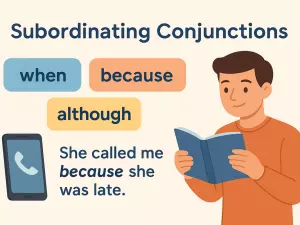
When using subordinators like "because," "although," or "when," the arrangement of clauses in a sentence is especially important. These words introduce dependent clauses, which cannot stand alone and must be paired with a main (independent) clause. The position of the subordinator and the punctuation used will change depending on the order of the clauses.
Common sentence patterns
Writers often make mistakes by confusing the order of main and dependent clauses. Here are two standard patterns to follow:
- Dependent clause, independent clause.
Example: Although it was raining, we went for a walk. - Independent clause dependent clause.
Example: We went for a walk although it was raining.
Note that a comma is required when the dependent clause comes first, but it is usually omitted when the independent clause comes first.
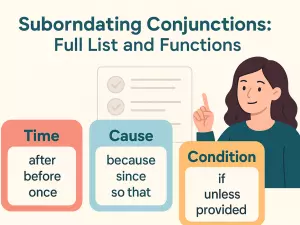
Expanded list of subordinating conjunctions
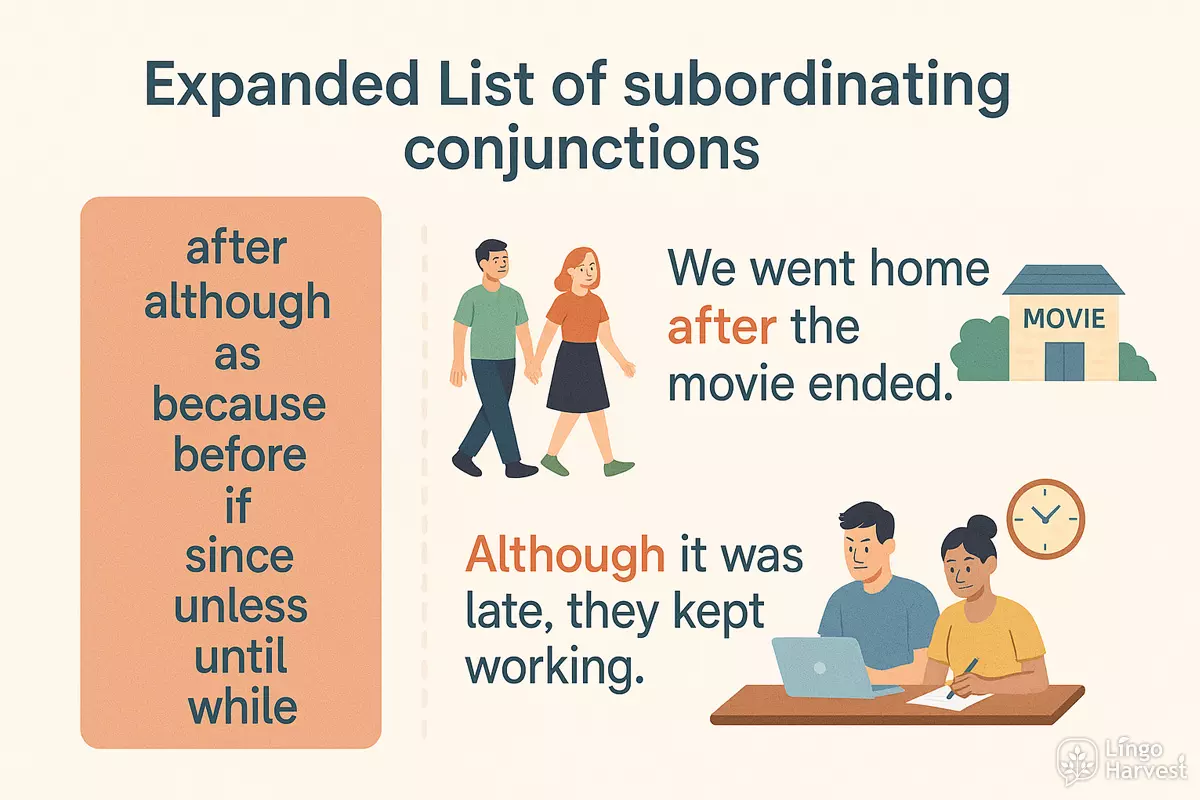
Many different words can introduce a subordinate clause. Here is a useful selection:
- after → We went home after the movie ended.
- although → Although it was late, they kept working.
- as → As it started to rain, we ran inside.
- because → She stayed home because she was sick.
- before → Wash your hands before you eat.
- even though → Even though he was tired, he finished the project.
- if → If it rains, we’ll stay inside.
- once → Once he arrived, we started the meeting.
- since → Since it’s cold, we should wear jackets.
- so that → He spoke clearly so that everyone could understand.
- than → She is taller than her brother.
- though → He tried hard, though he didn’t succeed.
- unless → You can’t go out unless you finish your homework.
- until → Wait here until I come back.
- when → Call me when you arrive.
- whenever → Whenever I see her, she’s smiling.
- where → This is the place where we met.
- wherever → Sit wherever you like.
- while → She read a book while he cooked.
Typical clause order: visual overview
The following table summarizes the two main ways to order sentences that contain subordinate clauses:
| Clause Order | Example Sentence |
|---|---|
| Subordinate clause → Main clause (comma required) |
Because she was tired, she went to bed early. |
| Main clause → Subordinate clause (no comma) |
She went to bed early because she was tired. |
Points to remember
- Do not use two main (independent) clauses with a subordinator; this creates a run-on.
- Never leave a subordinate clause by itself as a sentence (fragment).
- Watch for comma placement, which changes depending on the order of clauses.
- Some subordinators (like "because," "although," "since") are commonly misused with incorrect word order.
Understanding these structural patterns helps avoid many typical word order errors in complex sentences.
Frequent errors with misplaced subjects and verbs
Many English learners struggle with getting the order of subjects and verbs right, especially when using subordinators like because, although, and when. These mistakes often lead to sentences that sound unnatural or are difficult to understand. The issue usually comes from confusion about where to put the subject and verb in both the main and subordinate clauses.
Common patterns leading to mistakes
- Placing the verb before the subject in subordinate clauses: Because was raining, we stayed inside. ❌
- Omitting the subject after the subordinator: Although tired, finished the work. ❌
- Repeating the subject unnecessarily: When he he arrived, we started dinner. ❌
- Mixing up the order in the main clause after a subordinator: If you will come, tell me. ❌ (should be: If you come, tell me.)
- Using inversion incorrectly: Unless will you study, you won’t pass. ❌
Typical subordinator word order errors
The following table shows some of the most frequent sentence organization problems involving subordinators, along with corrected versions.
| Incorrect Example | Corrected Sentence |
|---|---|
| Because is raining, we can’t play outside. | Because it is raining, we can’t play outside. |
| Although was late, they waited for me. | Although I was late, they waited for me. |
| When comes the bus, we will leave. | When the bus comes, we will leave. |
| If will you see her, say hello. | If you see her, say hello. |
| After finished his homework, he watched TV. | After he finished his homework, he watched TV. |
| Unless doesn’t rain, we will have a picnic. | Unless it rains, we will have a picnic. |
| While was cooking, she called her friend. | While she was cooking, she called her friend. |
| Because he tired, he went home early. | Because he was tired, he went home early. |
| When will you arrive, let me know. | When you arrive, let me know. |
| Although she smart, she sometimes makes mistakes. | Although she is smart, she sometimes makes mistakes. |
How to avoid these mistakes
- Always include a subject after the subordinator unless it’s intentionally omitted (as in some reduced clauses).
- Keep the subject before the verb in both main and subordinate clauses (standard word order).
- Check for repeated or missing subjects when proofreading.
- Remember: English rarely inverts the subject and verb after subordinators.
- Practice writing full sentences with different subordinators to build confidence.
By paying attention to these common pitfalls, you can make your sentences clearer and avoid confusion for your readers or listeners. Consistent practice with sentence structure, especially when using words like if, because, and although, will help you master the correct order of subjects and verbs.
Problems with adverb position inside subordinate clauses
Placing adverbs in the correct spot within subordinate clauses often confuses both learners and native speakers. Adverbs can easily disrupt the intended meaning or create awkward sentences if not positioned thoughtfully. Typically, adverbs should be placed before the main verb in a subordinate clause, but there are exceptions and variations depending on the type of adverb and the subordinator used.
Common Placement Errors
Writers frequently misplace adverbs in these ways:
- Inserting the adverb between the subordinator and the subject (e.g., Although quickly she ran...)
- Placing the adverb after the auxiliary verb but before the subject (e.g., Because will probably he arrive late...)
- Positioning frequency adverbs at the end of the clause, which can sound unnatural (e.g., When she travels usually, she feels tired.)
General Guidelines for Adverb Placement
Adverbs of manner, frequency, and time each have preferred positions:
- Manner adverbs (e.g., quickly, carefully) usually go after the verb or verb phrase: because she answered quickly.
- Frequency adverbs (e.g., always, often, never) typically appear before the main verb: when he always studies late.
- Time adverbs (e.g., yesterday, soon) usually come at the end or beginning of the clause: while he was working yesterday.
Comparing Correct and Incorrect Adverb Placement
| Incorrect | Correct |
|---|---|
| Although suddenly she left, nobody noticed. | Although she suddenly left, nobody noticed. |
| Because usually he forgets, I remind him. | Because he usually forgets, I remind him. |
| When she will soon arrive, let me know. | When she arrives soon, let me know. |
| If always you check, mistakes will decrease. | If you always check, mistakes will decrease. |
| Since carefully he wrote, the essay was clear. | Since he wrote carefully, the essay was clear. |
Tips for Avoiding Mistakes
To prevent word order errors with adverbs in dependent clauses:
- Place adverbs of frequency and manner directly before or after the main verb, not before the subject.
- Avoid separating the subordinator from the subject with an adverb.
- Read your sentence aloud to check for natural flow.
- Look for patterns in native examples for guidance.
Understanding the typical patterns and being mindful of the differences between main and subordinate clauses can significantly improve clarity and correctness in academic and everyday writing.
Word order differences when the subordinate clause comes first
When a sentence starts with a subordinate clause, the word order often changes compared to sentences where the main clause comes first. This is especially important for learners of English, German, and other languages with strict word order rules. Placing the subordinate clause at the beginning typically means a comma separates it from the main clause, and the structure of the main clause may shift as a result.
How word order shifts in English
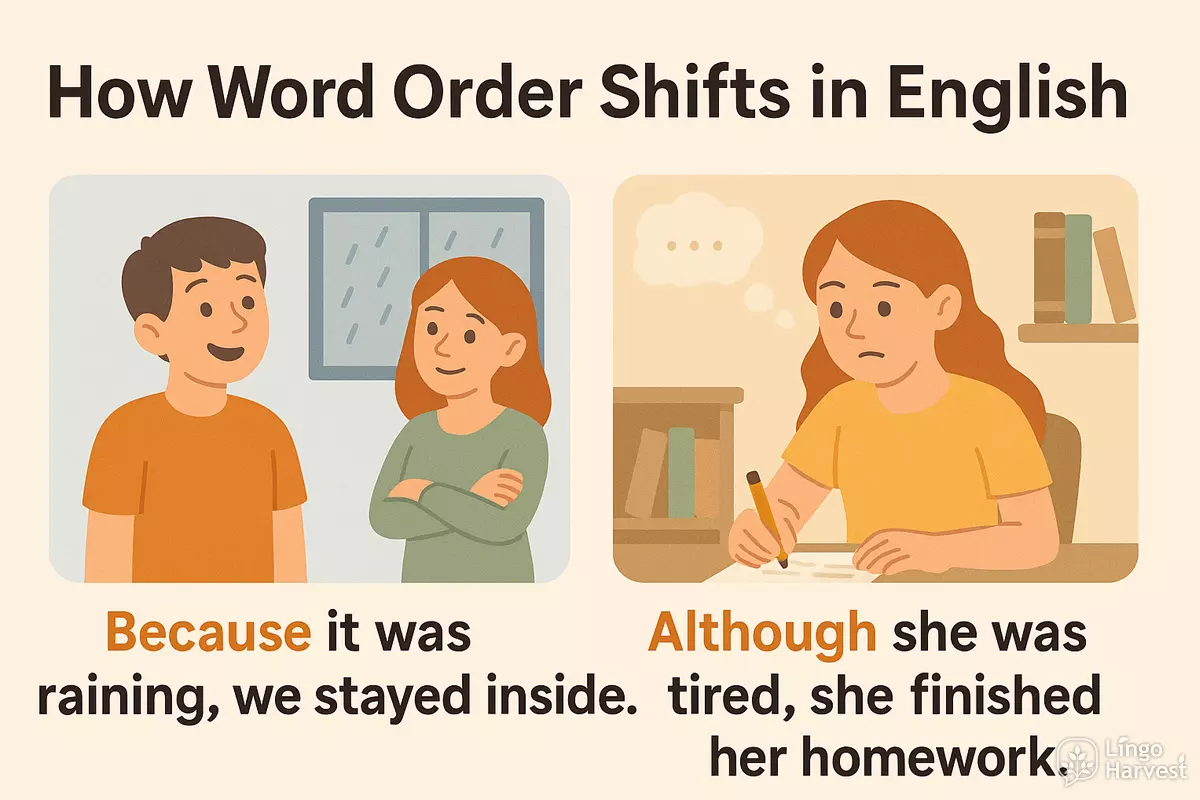
In English, the most common change is that a comma is required after the subordinate clause. The main clause usually keeps its subject-verb order, but the flow of information is different. Here are some patterns to notice:
- If you study hard, you will pass the exam.
- Because it was raining, we stayed inside.
- Although she was tired, she finished her homework.
- When the bell rings, the class will begin.
- While I was out, someone called.
- Since you asked, I’ll explain.
- Before you leave, lock the door.
- After he arrived, we started dinner.
- Unless you hurry, you’ll miss the bus.
- As soon as the sun rises, we’ll go hiking.
- Even though it’s cold, he went swimming.
- Provided that you pay now, you can have it today.
- Whenever I call, she answers.
- Once he finishes, we can leave.
- Though it seemed impossible, they succeeded.
- In case you need help, call me.
- Whereas I prefer tea, he likes coffee.
- Even if you apologize, she might not forgive you.
Common mistakes with initial subordinate clauses
Learners often forget the comma, or they may incorrectly reverse the subject and verb in the main clause, especially if their native language has different rules. For example:
- ❌ Because it was late went we home. → Because it was late, we went home.
- ❌ If you will come, we start at 8. → If you come, we will start at 8.
Comparison: English vs. German
German word order changes much more dramatically when the subordinate clause comes first. In German, the verb often comes before the subject in the main clause after the comma. Here’s a side-by-side comparison:
| English | German |
|---|---|
| If it rains, we will stay home. | Wenn es regnet, bleiben wir zu Hause. |
| Because I was tired, I went to bed early. | Weil ich müde war, ging ich früh ins Bett. |
| Although he is young, he works hard. | Obwohl er jung ist, arbeitet er hart. |
| When you arrive, we can start. | Wenn du ankommst, können wir anfangen. |
Key takeaways for learners
- Always use a comma after the initial subordinate clause in English.
- Keep the main clause subject-verb order in English, but check for verb-subject inversion in other languages like German.
- Be mindful of tense and agreement, especially if the subordinate clause changes the time or condition of the main action.
- Review patterns and practice with a variety of subordinators to avoid common errors.
Examples of confusing sentences caused by bad word order
Misplacing subordinators or switching the expected order of clauses often leads to sentences that are unclear or even misleading. Readers may have to pause and re-read, which breaks the flow of communication. Below are some common sentence patterns that tend to cause confusion when word order goes wrong.
Common Mistakes with Subordinators
- Because she was late she missed the bus. ❌ (missing comma, but also ambiguous if read quickly)
- If you study hard you will pass the test. ❌ (again, the lack of pause can confuse)
- She finished her homework after her friends left quickly. ❌ (unclear if "quickly" relates to "left" or "finished")
- Although tired, the homework was finished by John. ❌ (dangling modifier: who was tired?)
- While I was cooking, the phone rang. ✅ (correct: introductory clause is clear)
- The phone rang while I was cooking. ✅ (correct: main clause first, subordinator after)
- Unless you call me I will not know you arrived. ❌ (missing pause, possible confusion)
- Before the rain started we arrived at the station. ❌ (needs a comma, but also reads awkwardly)
- He passed the exam because he studied. ✅ (clear cause and effect)
- Because he studied he passed the exam. ❌ (acceptable, but needs a comma after "studied" to avoid confusion)
- Even though the train was late we waited. ❌ (missing comma, can sound rushed or unclear)
- After the movie ended I went home. ❌ (again, missing pause or comma leads to possible confusion)
- As he was walking the dog barked loudly. ❌ (ambiguous: is "he" or "the dog" walking?)
Why These Sentences Are Confusing
Many of the sentences above suffer from missing commas, misplaced modifiers, or ambiguous connections between clauses. Subordinators like because, although, after, and while signal relationships, so their placement is critical. When the order is unusual or punctuation is missing, the meaning can shift or become unclear. For example, "Although tired, the homework was finished by John" makes it sound like the homework was tired, not John.
Clear vs. Unclear Word Order with Subordinators
| Unclear Sentence | Clear Alternative |
|---|---|
| Because he was hungry he ate quickly. | Because he was hungry, he ate quickly. |
| After she called her friend left. | After she called, her friend left. |
| While driving the rain started. | While he was driving, the rain started. |
| Although he tried hard the result was the same. | Although he tried hard, the result was the same. |
| If you don’t hurry you’ll miss the train. | If you don’t hurry, you’ll miss the train. |
To sum up, paying attention to the placement of subordinators and the structure of clauses is essential for clarity. Even small changes in word order or punctuation can dramatically improve how easily your sentences are understood.
Practice: correct word order in sentences with subordinators
Getting comfortable with sentence structure after subordinators can be tricky, especially for learners who speak languages with different word order. This section offers hands-on exercises and clear examples to help you spot and correct common mistakes. You'll review typical patterns and practice rewriting sentences, focusing on how word order changes depending on where the subordinator appears.
Common Subordinators and Correct Sentence Patterns
Before practicing, review these frequently used subordinators and how they affect sentence structure:
- as soon as → Call me as soon as you arrive.
- whereas → She loves hiking, whereas he prefers swimming.
- in case → Take an umbrella in case it rains.
- as long as → You can stay as long as you are quiet.
- even if → I’ll help you even if I’m busy.
- provided that → You can borrow the car provided that you return it by tonight.
- on condition that → He agreed to help on condition that we finish early.
- in the event that → In the event that it snows, classes will be canceled.
- now that → Now that you’re here, we can start.
- supposing that → Supposing that he arrives late, what will we do?
- given that → Given that it’s your first day, take your time.
- so long as → You can go out so long as you text me later.
- except that → I liked the movie, except that it was too long.
- lest → Speak softly lest you wake the baby.
- in order that → He whispered in order that nobody could hear him.
Typical Word Order with Subordinators
When the subordinator comes at the beginning of a sentence, the clause usually ends with a comma, and the main clause follows. When the subordinator is in the middle, no comma is needed. The basic word order in both clauses remains: Subject + Verb + Object/Complement.
| Subordinator Position | Correct Word Order Example |
|---|---|
| Beginning of sentence | Although she was tired, she finished her homework. |
| Middle of sentence | She finished her homework although she was tired. |
| With inversion (rare, mainly in formal/written English) | Rare: Only after he had left did she notice the mistake. |
| Incorrect word order (to avoid) | ❌ Because is raining, I will stay home. ❌ She went home because was tired she. |
Exercise 1: Identify and Correct the Errors
Read the following sentences. Some have word order mistakes with subordinators. Rewrite them correctly.
- Because the train late was, I missed my meeting.
- She will come if invites you her.
- Although he studied hard, failed he the test.
- When I arrived, was it raining.
- I will call you after I finish my work.
- Unless will you hurry, you miss will the bus.
- Before leave you the house, check you must the door.
- Since tired he was, early bed to he went.
- If rains it, take you should an umbrella.
- While cooked she dinner, the table he set.
Show answers
- Because the train was late, I missed my meeting.
- She will come if you invite her.
- Although he studied hard, he failed the test.
- When I arrived, it was raining.
- I will call you after I finish my work. (Correct as is)
- Unless you hurry, you will miss the bus.
- Before you leave the house, you must check the door.
- Since he was tired, he went to bed early.
- If it rains, you should take an umbrella.
- While she cooked dinner, he set the table.
Exercise 2: Build Sentences with Subordinators
Combine the two ideas in each item into a single correct sentence using the subordinator in parentheses. Pay attention to word order.
- She finished her homework. She was tired. (although)
- He forgot his umbrella. It was raining. (because)
- You will not pass. You study hard. (unless)
- I will call you. I arrive. (when)
- She stayed home. She was sick. (because)
- He took an umbrella. It looked cloudy. (since)
- We won’t start. Everyone arrives. (until)
- He read a book. He was waiting. (while)
- I will go for a walk. I finish this task. (after)
- You can borrow my car. You drive carefully. (if)
Show answers
- Although she was tired, she finished her homework.
- He forgot his umbrella because it was raining.
- You will not pass unless you study hard.
- I will call you when I arrive.
- She stayed home because she was sick.
- He took an umbrella since it looked cloudy.
- We won’t start until everyone arrives.
- He read a book while he was waiting.
- I will go for a walk after I finish this task.
- You can borrow my car if you drive carefully.
Tips for Avoiding Mistakes
- After a subordinator, use the normal subject-verb order.
- Do not invert subject and verb (except in rare formal cases).
- When starting with a subordinator, use a comma between clauses.
- Remember: each clause (main and subordinate) should have its own subject and verb.