How Conjunctions Change Sentence Stress and Rhythm

 Here we sentence stress and rhythm for B1–B2 learners, explains how conjunctions change word grouping and stress patterns, highlights contrastive stress with but, yet, although, and guides on placing pauses. It includes practice with reading aloud.
- Basic idea of sentence stress and rhythm for B1–B2 learners
- How adding a conjunction changes grouping of words
- Stress patterns in compound and complex sentences
- Contrastive stress with but, yet, although
- Pauses and natural breaks before and after conjunctions
- Practice: read aloud short texts and mark stress and pauses
Connecting words and phrases, such as conjunctions and transitional terms, play a crucial role in shaping the flow and emphasis of our sentences. Their use can subtly alter the rhythm and stress patterns in both spoken and written language, influencing how ideas are perceived and understood. By examining the impact of these linking elements, we gain insight into the nuanced ways language conveys meaning and maintains coherence, highlighting the importance of even the smallest components in effective communication.
Basic idea of sentence stress and rhythm for B1–B2 learners
English sentences have a natural "music" or rhythm, created by the combination of stressed (strong) and unstressed (weak) words. This rhythm helps listeners understand which words are most important in a sentence. For language learners at the intermediate level, recognizing and using this rhythm improves both listening and speaking skills.
What is sentence stress?
Sentence stress means that some words in a sentence are pronounced more strongly than others. These usually include the main content words, like nouns, main verbs, adjectives, and adverbs. Less important words, such as articles, prepositions, auxiliary verbs, and conjunctions, are often unstressed and spoken more quickly or quietly.
How rhythm works in English
English is a stress-timed language. This means the time between stressed words tends to stay regular, while the number of unstressed words can change. The effect is a "beat" with strong and weak sounds, like music. When you speak, try to focus on the important words and let the rest flow more lightly.
Common stressed and unstressed words
- Stressed (content) words: cat, run, beautiful, quickly, money, idea, remember, important, always, happy
- Unstressed (function) words: and, but, or, the, a, to, of, in, for, at, is, was, were, can, will, has, have, with, from, on, as
Recognizing stress and rhythm in sentences
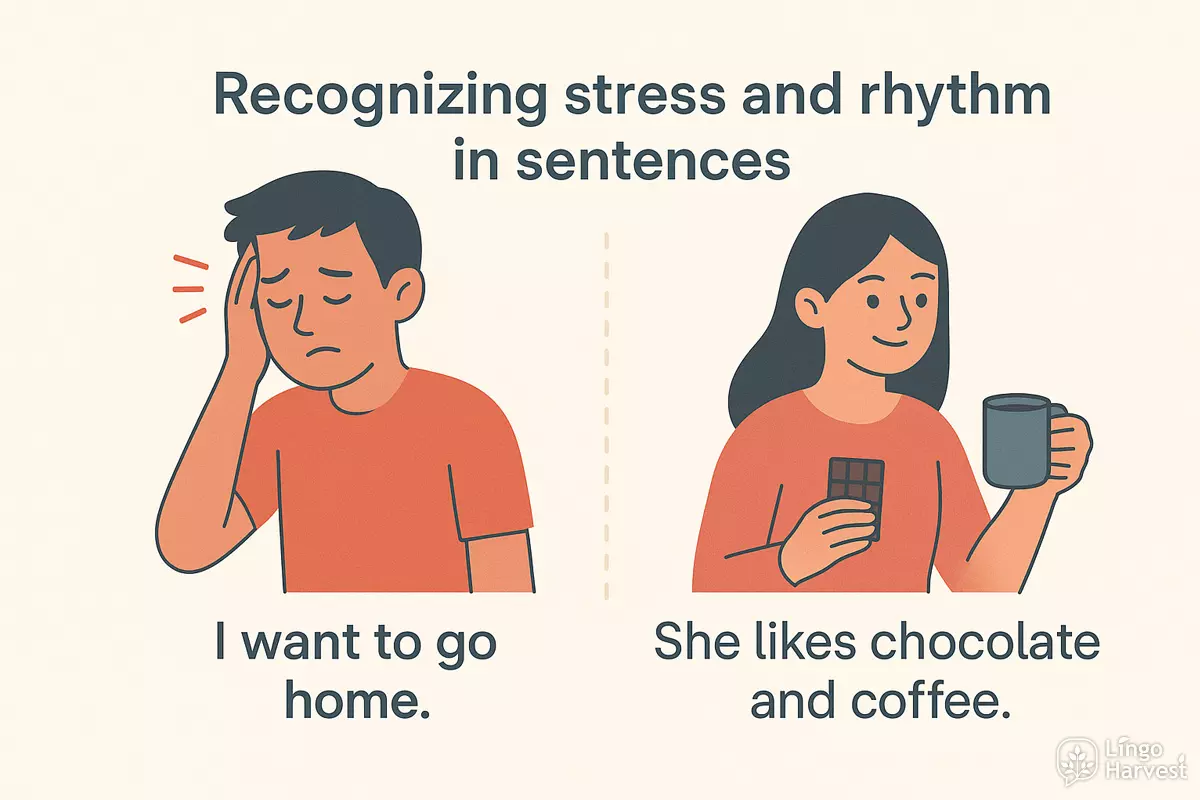
Let’s look at some examples. Stressed words are in bold:
- I want to go home.
- She likes chocolate and coffee.
- They didn’t finish the project on time.
- He needs to buy a new phone.
- We don’t understand the question.
- She works from home every day.
- I can’t find my keys anywhere.
- They want to learn English.
- He doesn’t like spicy food.
- We plan to visit them soon.
Notice how the "glue" words (to, and, the, on) are lighter and quicker.
Why stress and rhythm matter
- Helps listeners catch the main message quickly
- Makes speech sound more natural and fluent
- Improves listening comprehension, especially with native speakers
- Reduces misunderstandings in conversation
Practice: Identifying stress patterns
Try saying these sentences aloud, emphasizing the important words:
- He lives in London but works in Paris.
- I can’t find my keys.
- We went to the park and played football.
- She reads books every evening.
- They visited their grandparents last weekend.
- He drinks coffee every morning.
- We watched a movie last night.
- She practices English every day.
- They ate dinner together at 7 PM.
- He drives to work on weekdays.
Quick tips for mastering English rhythm
- Focus on stressing content words, not every word.
- Listen to native speakers and notice which words are louder or longer.
- Practice reading aloud, marking the stressed words.
- Record yourself and compare with native audio.
- Don’t rush; let the natural rhythm guide you.
Understanding which words to stress and how to keep a regular rhythm is essential for clear and natural English communication. As you progress, you’ll notice how conjunctions and other function words affect the “music” of your sentences.
How adding a conjunction changes grouping of words
When a conjunction enters a sentence, it often shifts how words are grouped and pronounced, subtly affecting the sentence’s rhythm and the way we emphasize certain ideas. Instead of treating each clause or phrase separately, conjunctions like "and," "but," or "or" encourage speakers to link ideas more closely, changing the natural breaks and stress patterns.
Grouping Words Together: The Role of Conjunctions
Adding a conjunction usually means two or more ideas get bundled into a single thought unit. This can cause a change in where we pause, how quickly we speak, and which words stand out. For example:
- Without a conjunction: "She likes tea. He likes coffee." (Two separate groups, each with its own stress and pause.)
- With a conjunction: "She likes tea and he likes coffee." (The two ideas are grouped together, often with less of a pause between them.)
Effects on Sentence Rhythm and Stress
When words are grouped with a conjunction, the stress often shifts to highlight the connection or contrast:
- The conjunction itself ("and," "but") is usually unstressed and spoken quickly.
- The words immediately before and after the conjunction may receive more emphasis, depending on meaning.
- Pauses before and after conjunctions often become shorter, smoothing the rhythm.
Common Conjunction Patterns and Groupings
Here are some typical ways that linking words affect the grouping and flow of sentences:
- Listing items: "apples, oranges, and bananas" (the conjunction signals the final item is coming, so the intonation rises and then falls)
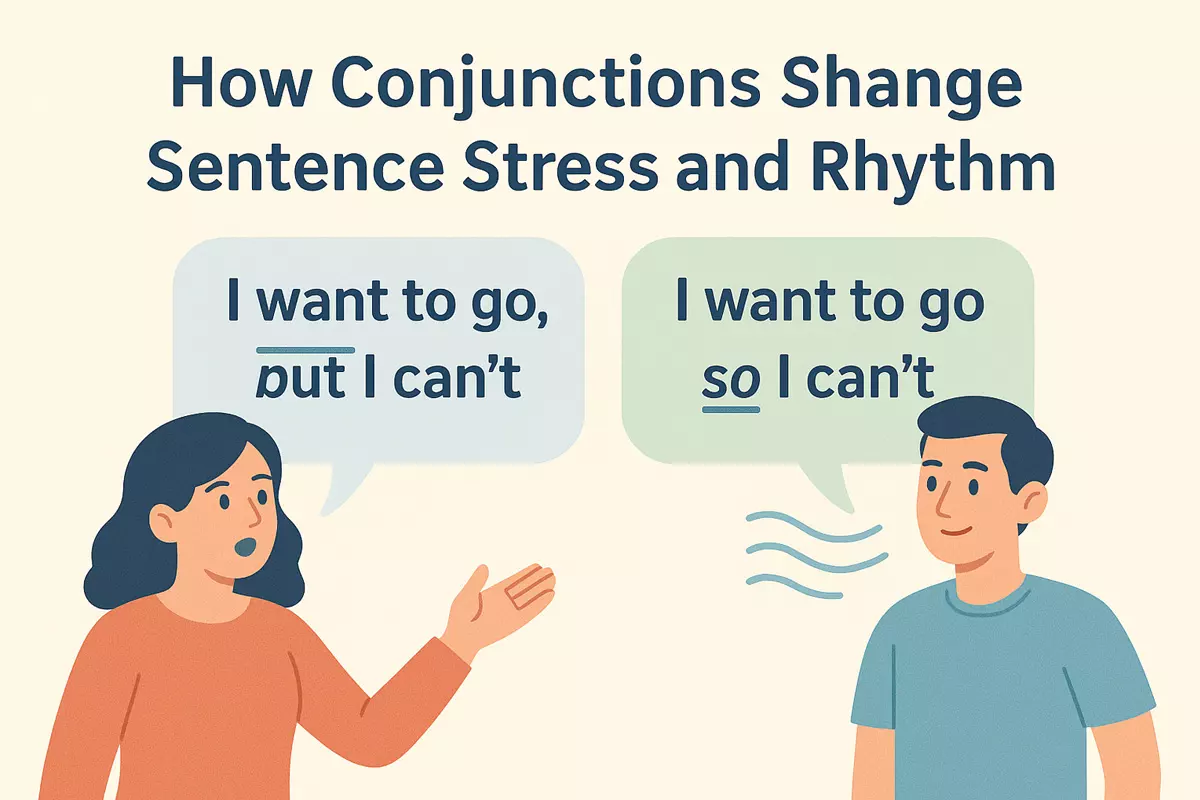
- Connecting clauses: "I wanted to go, but it was raining" (contrast is highlighted by a slight stress on "but")
- Offering choices: "You can have tea or coffee" (the options are grouped together, with "or" linking them closely)
- Adding details: "She plays the piano and sings" (both actions are grouped as related)
- Showing cause and effect: "It rained, so we stayed home" (the two ideas are presented as a single cause-effect unit)
- Emphasizing alternatives: "Either call me or send a message" (the alternatives are grouped, and the rhythm reflects the choice)
- Contrasting ideas: "He likes chocolate, but she prefers vanilla" (the contrast is marked with a stronger stress on "but")
- Joining adjectives: "a small and cozy room" (the adjectives are grouped, often with a single main stress)
- Pairing verbs: "run and jump" (treated as a set of activities)
- Connecting prepositional phrases: "on the table and under the chair" (the locations are grouped)
Visual Comparison: Sentences With and Without Conjunctions
| Without Conjunction | With Conjunction |
|---|---|
| She finished her work. She went home. | She finished her work and went home. |
| You can stay here. You can leave. | You can stay here or leave. |
| He is tired. He is hungry. | He is tired but hungry. |
| I like apples. I like oranges. | I like apples and oranges. |
Why Does This Matter?
Grouping words with conjunctions not only changes the sound and pacing of speech, but also helps listeners process information more efficiently. It clarifies relationships, signals what’s connected, and allows for smoother, more natural communication. By understanding how conjunctions influence grouping, speakers can make their sentences clearer and more expressive.
Stress patterns in compound and complex sentences
When conjunctions join clauses, the way we stress words in a sentence often shifts. Compound sentences—those linked with words like "and," "but," or "or"—tend to balance stress across the two joined ideas. In contrast, complex sentences, which use subordinators such as "because," "although," or "when," usually highlight the main clause while reducing emphasis on the subordinate one.
Main vs. subordinate clause stress
In longer sentences, listeners rely on stress to catch the most important information. The principal clause often receives stronger stress, with the dependent clause sounding less prominent. For example, in "I went outside because it stopped raining," the first part ("I went outside") is spoken with more energy, while "because it stopped raining" is typically softer and quicker.
How conjunctions affect rhythm and emphasis
Coordinating conjunctions (and, but, or, nor, for, so, yet) tend to create a rhythm with two roughly equal parts. Subordinating conjunctions (because, although, since, unless, if, when, after, before, while, even though, as, until, once, where, whereas, provided, rather than, whether, so that, though) shift the focus to the main idea, making the sentence sound uneven in pitch and emphasis.
- And: Equal stress on both sides ("She laughed and he smiled.")
- But: Slightly more stress on the contrasting idea ("I tried, but I failed.")
- Or: Equal or rising stress on alternatives ("Tea or coffee?")
- Because: Main clause stressed, reason clause de-emphasized ("She left because she was tired.")
- Although: Main clause stressed, concessive clause lighter ("Although it rained, we played outside.")
- If: Conditional clause lighter, result clause stressed ("If you call, I'll answer.")
- When: Main event highlighted, time clause less prominent ("I'll call when I arrive.")
- Since: Main clause stressed, explanation softer ("He’s happy since he passed the test.")
- While: Contrast marked by more stress in the main idea ("While I slept, she worked.")
- Unless: Condition clause lighter, result stressed ("You can’t leave unless you finish.")
- Even though: Main clause stressed, concessive clause lighter ("Even though it’s late, I’m awake.")
- So that: Purpose clause lighter, action clause stressed ("I left early so that I could help.")
- After: Main event stressed, time clause lighter ("We ate after we arrived.")
- Before: Main event stressed, time clause lighter ("Call me before you leave.")
- As: Main event stressed, background action lighter ("As I walked, I listened to music.")
- Until: Main action stressed, limit clause lighter ("Wait until I come back.")
- Once: Main event stressed, trigger clause lighter ("Once you finish, we’ll go.")
- Whereas: Contrast stressed ("She likes tea, whereas I prefer coffee.")
- Whether: Main clause stressed, choice clause lighter ("Let me know whether you agree.")
- Provided: Condition lighter, main clause stressed ("You can go provided you finish.")
Common stress patterns with conjunctions
Notice in speech how the voice rises and falls according to the importance of each clause. In everyday conversation, native speakers often compress or blend subordinate clauses, making them sound less distinct. This gives the main idea more weight and helps listeners process information quickly.
| Conjunction Type | Typical Stress Pattern |
|---|---|
| Coordinating (e.g., "and", "but") | Balanced or equal stress on both clauses |
| Subordinating (e.g., "because", "although") | Main clause receives stronger stress; subordinate clause is reduced |
| Correlative (e.g., "not only... but also") | Main focus on the key idea, with secondary stress on the correlative pair |
| Contrastive (e.g., "whereas", "while") | Stress highlights the contrast between clauses |
Mastering these patterns helps make your speech sound more natural and easier to understand, especially when expressing complex or nuanced ideas. Pay attention to how native speakers use rhythm and emphasis to guide listeners through connected thoughts.
Contrastive stress with but, yet, although
When sentences contain conjunctions like but, yet, or although, English speakers naturally adjust their intonation to highlight contrasting ideas. The main purpose of these conjunctions is to introduce an opposing or unexpected element, and this is often mirrored by shifting stress onto key words that signal the contrast. This pattern helps listeners quickly recognize the twist or contradiction in meaning.
How contrastive stress works
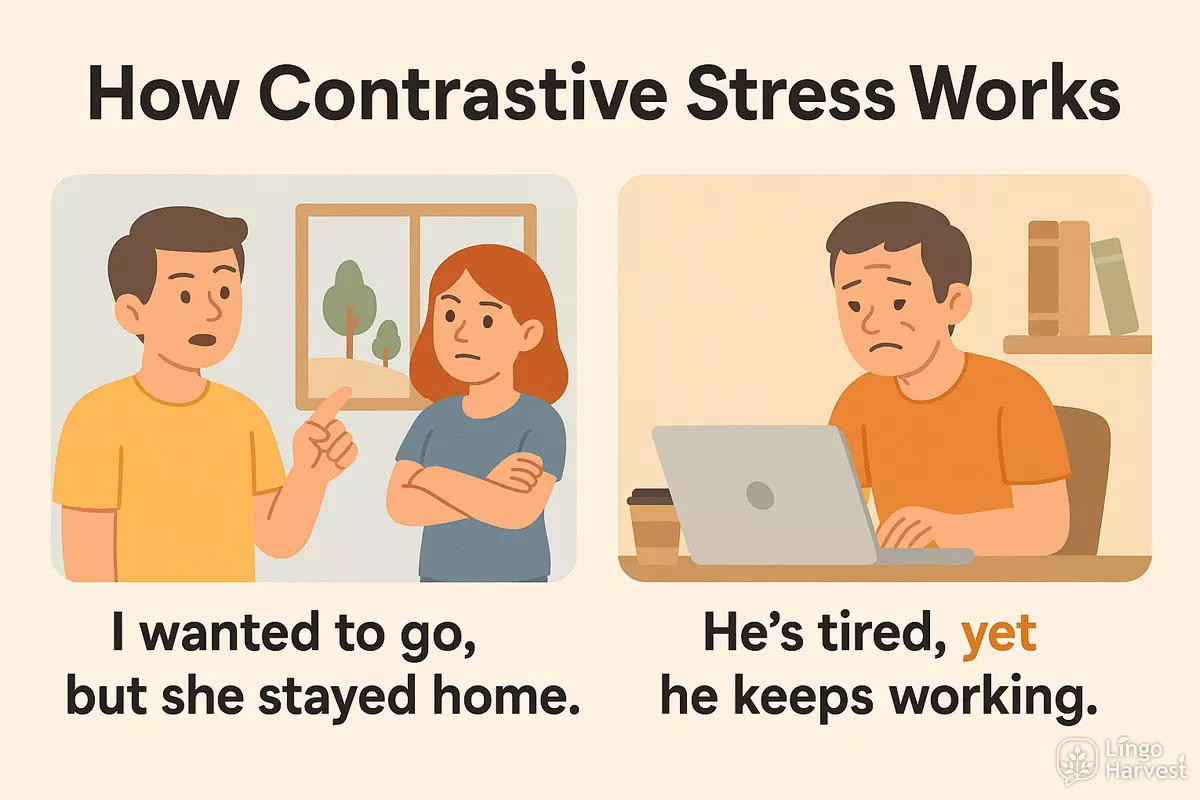
Typically, the most important or surprising information after these conjunctions receives extra emphasis. This can be a noun, verb, adjective, or even an adverb, depending on the context. The stressed word stands out in the rhythm of the sentence, making the contrast clear.
- I wanted to go, but she stayed home.
- He’s tired, yet he keeps working.
- Although it was late, they continued talking.
- She studied hard, but still didn’t pass.
- It’s expensive, yet worth every penny.
- Although he apologized, I was still upset.
- I like coffee, but not in the evening.
- He tried, yet failed the test.
- Although it rained, we went hiking.
- She’s shy, but confident on stage.
Common patterns in stress placement
Speakers usually place primary stress on the word or phrase that contrasts with what comes before. The conjunction itself (but, yet, although) is often unstressed or only lightly stressed, while the new or conflicting detail receives the main emphasis.
| Conjunction | Typical Stress Pattern |
|---|---|
| but | Low stress on “but”, strong stress on the contrasting idea that follows. She’s kind, but firm. |
| yet | “Yet” is usually unstressed; main stress falls on the unexpected outcome. He failed, yet tried again. |
| although | “Although” is often lightly stressed or reduced; stress highlights the surprising result. Although it’s cold, they swim. |
Quick tips for recognizing and using contrastive stress
- Listen for a pitch rise or louder voice on the key word after the conjunction.
- Practice reading sentences aloud, exaggerating the stress on the new or surprising information.
- Notice how reducing stress on the conjunction itself keeps the focus on the main point of contrast.
- Try substituting different words to see how the meaning and emphasis shift.
Mastering contrastive stress with these conjunctions helps make your speech clearer and more natural, especially when you want to highlight differences or unexpected outcomes.
Pauses and natural breaks before and after conjunctions
When we use conjunctions such as "and," "but," "or," or "because," the flow of a sentence often shifts. These joining words can signal a subtle pause, change in intonation, or a clear break in rhythm, depending on context and emphasis. Recognizing where these natural separations occur helps with both understanding and producing clear, expressive speech.
How pauses shape meaning and rhythm
A brief stop before or after a linking word can highlight contrast, add suspense, or clarify which parts of a sentence belong together. For instance, a speaker might pause slightly before "but" to signal a shift in thought, or after "so" to let the result stand out. These moments of silence, however short, can make spoken language more engaging and easier to follow.
Common places for natural breaks with conjunctions
- Before "but" in compound sentences: She tried her best, but she didn’t succeed.
- After "because" in explanations: They left early because it was raining.
- Before "or" when offering alternatives: Would you like tea, or coffee?
- Before "yet" to express contrast: He is talented, yet he remains humble.
- After "so" when stating a result: The alarm rang, so everyone left the building.
- Before "and" for dramatic effect or to list: She bought apples, oranges, and bananas.
- Before "nor" in negative pairings: He didn’t call, nor did he write.
- After "although" in complex sentences: Although he was tired, he finished the race.
- Before "while" to contrast two ideas: She likes jazz, while he prefers rock.
- After "if" in conditional phrases: If you hurry, you’ll catch the train.
- Before "for" when giving a reason: He stayed home, for he was unwell.
- Before "so that" for purpose: He whispered, so that no one would hear.
Comparing pause placement with different conjunctions
| Conjunction | Typical Pause Location & Effect |
|---|---|
| but | Pause usually comes before; signals contrast or opposition in ideas. |
| so | Often a pause before; emphasizes consequence or result. |
| because | Pause may follow; clarifies the reason or cause, sometimes for emphasis. |
| and | Pause before can add drama or clarity to a list; often no pause in rapid speech. |
| or | Short pause before, especially when offering alternatives or choices. |
| although | Pause often follows; highlights the contrast or concession being made. |
| yet | Pause before; marks a surprising or unexpected contrast. |
| nor | Pause before; used to continue a negative thought. |
Tips for natural rhythm in speech
- Listen for where native speakers pause before or after connectors.
- Practice reading aloud and mark where you naturally stop or change tone.
- Notice how pauses can change the focus or emotional impact of a sentence.
- Use pauses to help your audience follow complex or lengthy sentences.
- Remember, not every conjunction requires a break—context and emphasis matter.
Understanding how to use these brief silences and shifts in speech not only improves clarity but also adds expressive depth to communication.
Practice: read aloud short texts and mark stress and pauses
Reading aloud is a practical way to feel how conjunctions affect the stress and rhythm of sentences. When you encounter words like "and," "but," "because," or "although," notice how they change which words get emphasized and where natural pauses occur. For English learners, marking these features helps with fluency and comprehension.
Sample Sentences for Stress and Pause Practice
- I wanted to go for a walk, but it started raining.
- She likes coffee and he prefers tea.
- We stayed inside because it was cold.
- Although he was tired, he finished the project.
- You can call me or send an email.
- They studied hard, so they passed the exam.
- He didn’t come because he was sick.
- We can go hiking or we can stay home.
- She finished her homework, but she forgot her book.
- When the bell rang, the students left the room.
How to Mark Stress and Pauses
Try reading each sentence aloud. Mark the primary stress (the most emphasized word in a phrase) with an underline or bold, and use a slash ( / ) to indicate a pause. For example:
- We stayed inside because / it was cold.
- Although he was tired / he finished the project.
Notice how conjunctions often introduce a pause or shift the stress. Coordinating conjunctions like "and" or "but" usually come before a short pause, while subordinating conjunctions like "because" or "although" often shift stress to the clause they introduce.
Mini-Quiz: Identify Stress and Pauses
- Read the sentence: "She tried to call him but he didn’t answer." Where should the main pause be?
- In "We can stay home or go out," which word gets the most stress?
- Mark where you would pause: "Although it was late they kept working."
- Underline the stressed word: "He was hungry so he made a sandwich."
- Where is the natural pause in: "He finished his work and went to bed."?
- Which word is stressed in: "You can take the bus or walk."?
- Add a pause in the sentence: "When the movie ended we left the cinema."
- Underline the stressed word: "She was tired but she continued studying."
- Where do you pause in: "Since it was raining we stayed inside."?
- Which word is stressed in: "He didn’t see her because he was busy."?
Show answers
- After "him": "She tried to call him / but he didn’t answer."
- "Go": "We can stay home or go out."
- After "late": "Although it was late / they kept working."
- "Made": "He was hungry so he made a sandwich."
- After "work": "He finished his work / and went to bed."
- "Walk": "You can take the bus or walk."
- After "ended": "When the movie ended / we left the cinema."
- "Continued": "She was tired but she continued studying."
- After "raining": "Since it was raining / we stayed inside."
- "Busy": "He didn’t see her because he was busy."
Tips for Effective Practice
- Read each sentence slowly the first time, then at normal speed.
- Use your hand to tap out the stressed syllables.
- Record yourself and listen for natural pauses and emphasis.
- Try swapping conjunctions in the examples to see how stress and rhythm change.
By practicing with a variety of short texts, you’ll become more aware of how conjunctions guide the flow and emphasis of English sentences.