Fix the Sentence: Wrong Conjunction Chosen (B1–B2)

 Here we common errors in choosing conjunctions, provides mismatched examples, and offers steps to identify relationships like time, reason, contrast, or condition.
- Explanation of typical errors with wrong conjunction choice
- Examples of sentences where logic and conjunction do not match
- Guided steps to identify the relationship: time, reason, contrast, condition
- Practice task: choose a better conjunction for each sentence
- Longer exercise: correct a short paragraph with multiple errors
- Answer key with explanations of why each conjunction works best
Selecting appropriate connecting words is often challenging for English learners, and using the wrong ones can result in sentences that are hard to understand. This article explains how to identify and fix frequent errors with linking words, offering practical tips and examples to help you improve your writing. By learning how to use connectors such as however, therefore, although, and because correctly, you will be able to create smoother, more coherent sentences that clearly express your ideas and make your overall writing stronger.
Explanation of typical errors with wrong conjunction choice
Choosing the correct conjunction can be tricky for English learners, especially at the B1–B2 level. Many mistakes happen when students confuse the function of different linking words, such as “because,” “but,” “so,” “although,” and “and.” These errors can make sentences sound awkward or change the meaning entirely. It’s important to understand not just what each conjunction means, but also how it connects ideas in a sentence.
Common reasons for mistakes
- Translating directly from your native language, where conjunctions might work differently
- Not recognizing the specific relationship between two clauses (cause, contrast, addition, etc.)
- Confusing conjunctions that look or sound similar, like “because” vs. “so”
- Overusing a familiar conjunction instead of choosing the most accurate one
Frequent conjunction errors
Below are some typical examples of mistakes with linking words, along with a brief explanation of what often goes wrong:
- Using “because” when you need “so”: Incorrect: I was tired because I went to bed. (should be “so”)
- Mixing up “although” and “but”: Incorrect: Although it was raining, but we went outside.
- Replacing “if” with “when” (or vice versa): Incorrect: When you heat ice, it will melt. (should be “If” for condition)
- Using “and” for contrast instead of “but”: Incorrect: She is tall and her sister is short.
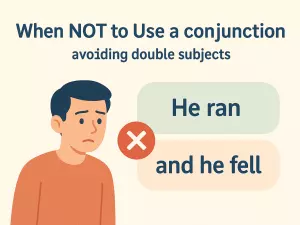
- Doubling conjunctions: Incorrect: Because he was late, so he missed the bus.
- Using “or” when you mean “and”: Incorrect: You can have tea or coffee and cake. (unclear meaning)
- Forgetting to use a conjunction at all, making two sentences instead of one connected idea
- Misplacing the conjunction at the start of a sentence when it shouldn’t be there
- Using “but” in place of “although” at the beginning of a sentence: Incorrect: But he was tired, he finished the race.
- Choosing “since” for time when it’s meant for reason (or vice versa)
Comparison of commonly confused conjunctions
| Conjunction | Typical Error | Correct Usage | Example Sentence |
|---|---|---|---|
| because / so | Confusing cause and result | “because” for reason, “so” for result | I was cold so I closed the window. I closed the window because I was cold. |
| although / but | Using both together or in the wrong place | Only one is needed to show contrast | Although it was late, we kept working. It was late, but we kept working. |
| if / when | Mixing up condition and time | “if” for condition, “when” for definite time | If it rains, we’ll stay inside. When it rains, the grass gets wet. |
| and / or | Unclear meaning or mixing addition with alternative | “and” for addition, “or” for alternatives | You can have tea or coffee. We ate pizza and salad. |
How to avoid these mistakes
To prevent errors with linking words, always check what relationship you want to express—are you adding information, showing a reason, giving a result, or contrasting ideas? Practice by reading and listening to how native speakers use conjunctions in context. If you’re unsure which word to use, try rewriting the sentence in a different way or use simple sentences until you’re more confident.
Examples of sentences where logic and conjunction do not match
Choosing the correct conjunction is essential for clear and accurate communication. Sometimes, mistakes happen when the linking word does not fit the relationship between ideas. This can confuse the reader or listener, making the sentence sound awkward or even illogical. Below, you will find typical examples where the connector does not match the intended meaning, along with short explanations.
Common mismatches between logic and conjunction
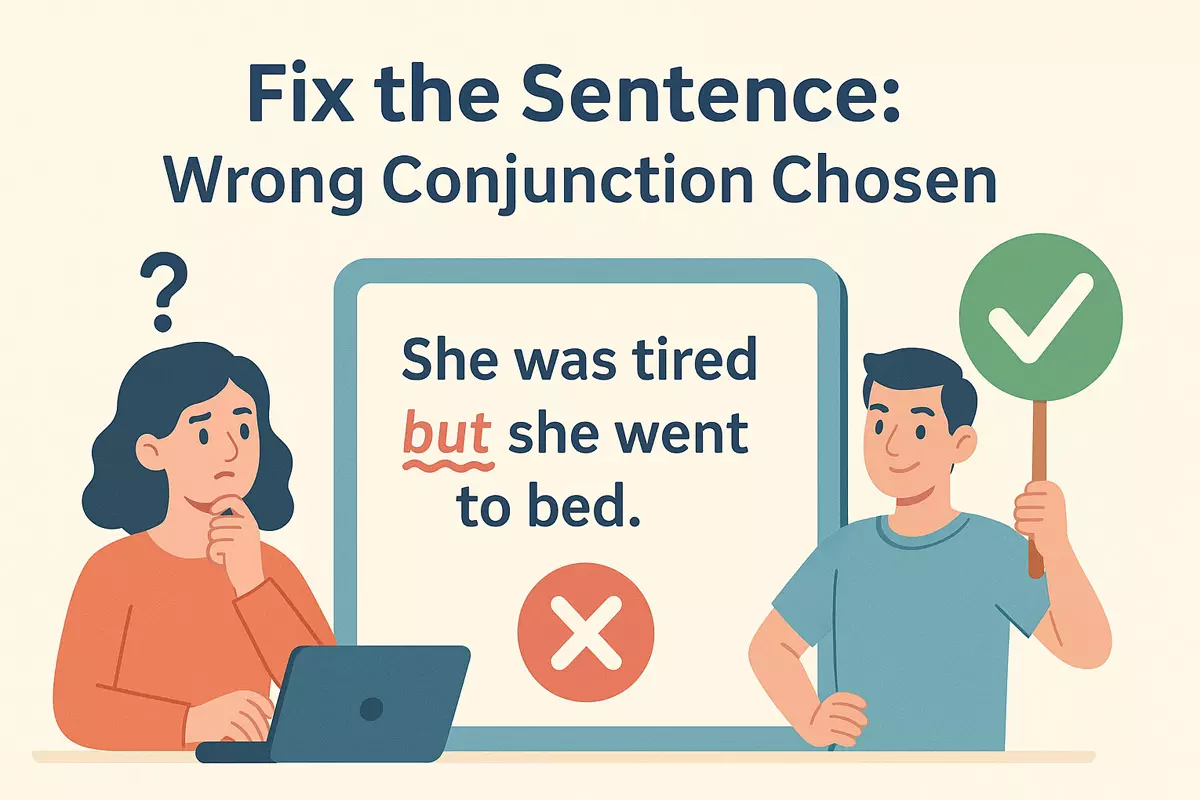
- She was tired, but she went to bed early. ❌ (but is incorrect; so fits better, as the second action results from the first.)
- He studied a lot, because he failed the test. ❌ (because is misleading here; it suggests he failed because he studied, which is illogical. although or but would be appropriate.)
- I didn’t eat breakfast, or I was late for work. ❌ (or is wrong; so or because depending on intent.)
- She loves pizza, so she doesn’t eat it often. ❌ (so implies a logical result, but here, although or but would be more accurate.)
- We can go to the park, because it’s raining. ❌ (because does not make sense; although or but would fit if you want to show contrast.)
- He didn’t call me, so I was worried. ✅ (This is correct; the conjunction matches the logic.)
- They were hungry, but they ordered food. ❌ (but suggests contrast, but there is none; so is more logical.)
- She went home, although she finished her work. ❌ (although is not logical; after or when would be better.)
- It was raining, and I took my umbrella. ✅ (This is correct; both actions are logically connected.)
- I was tired, because I went to bed early. ❌ (Implies going to bed early caused tiredness; so or although may be better.)
- She can’t swim, but she goes to the pool. ✅ (Correct use of but for contrast.)
- He went out, or it was raining. ❌ (or is not appropriate; although or even though would be clearer.)
Summary of common errors and corrections
Below is a quick reference guide showing some typical mismatches and their logical alternatives:
| Incorrect Sentence | Corrected Version |
|---|---|
| He studied a lot, because he failed the test. | He studied a lot, but he failed the test. |
| They were hungry, but they ordered food. | They were hungry, so they ordered food. |
| She loves pizza, so she doesn’t eat it often. | She loves pizza, but she doesn’t eat it often. |
| I didn’t eat breakfast, or I was late for work. | I didn’t eat breakfast, so I was late for work. |
When reviewing your writing, always check if the conjunction reflects the real relationship between ideas—contrast, cause, result, or addition. This helps your sentences sound natural and logical.
Guided steps to identify the relationship: time, reason, contrast, condition
Understanding how ideas connect in a sentence is essential when choosing the right conjunction. To avoid mistakes, focus on what links the two parts: are you talking about when something happens (time), why it happens (reason), showing differences (contrast), or describing a possible situation (condition)? Let’s break down how to recognize each type.
1. Identifying time relationships
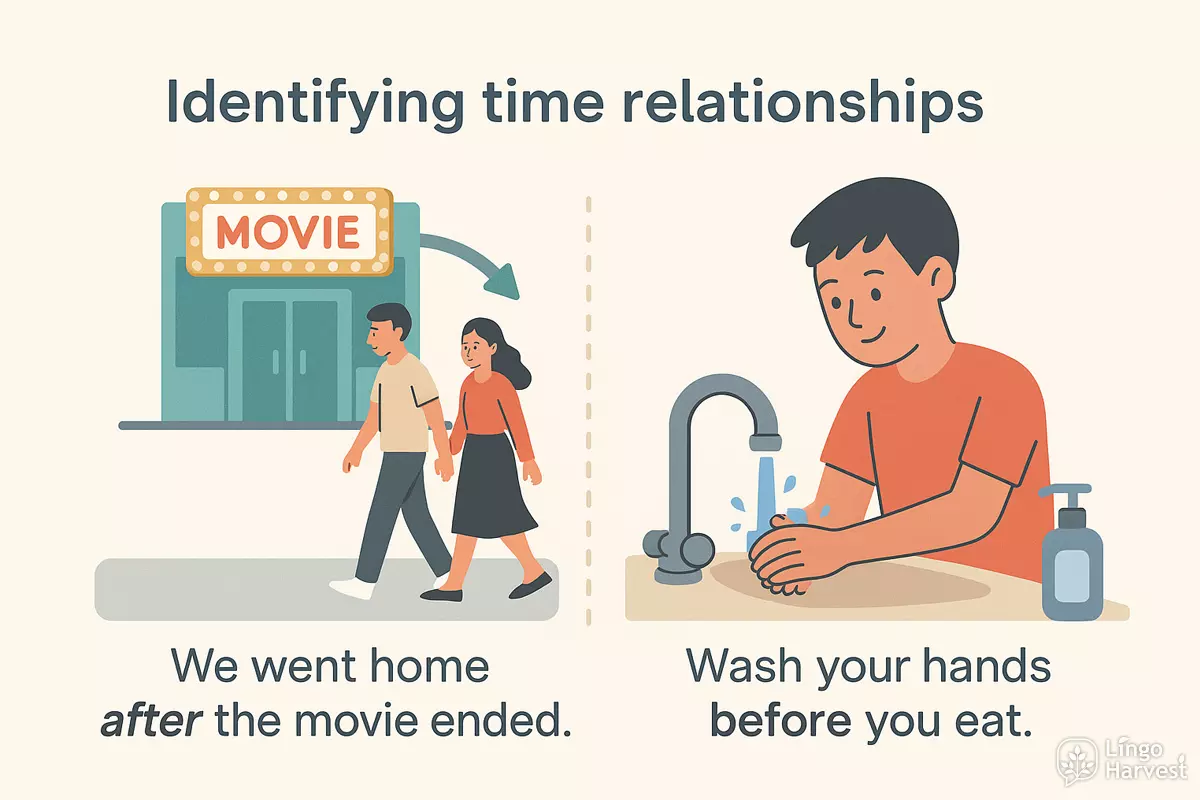
When events are related by when they happen, look for clues like actions that follow each other or happen at the same moment.
- after → We went home after the movie ended.
- before → Wash your hands before you eat.
- when → Call me when you arrive.
- while → She cooked while he cleaned.
- as soon as → Call me as soon as you’re ready.
- until → Wait here until I return.
- since → We haven’t spoken since you moved.
- once → Once he finished, he took a break.
Ask yourself: Does the sentence describe the order or timing of events?
2. Spotting reason (cause and effect)
If one part of the sentence explains why the other happens, you’re dealing with a reason.
- because → He stayed home because he felt sick.
- since → Since it was late, we went home.
- as → As it was raining, we stayed inside.
- so → It was cold, so we wore jackets.
- for → She left early, for she had a doctor’s appointment.
Try to identify if the sentence answers “Why?” or “What caused this?”
3. Recognizing contrast
Contrast shows differences or unexpected results.
- but → He wanted to join us, but he was busy.
- although → Although it was cold, they went swimming.
- though → She tried hard, though she didn’t succeed.
- even though → Even though he was tired, he kept working.
- whereas → She loves tea, whereas he prefers coffee.
- while → He is very calm, while his brother is energetic.
- however → It looked easy; however, it was difficult.
- yet → He had no experience, yet he got the job.
Ask: Is the second idea surprising or different from the first?
4. Detecting condition
Conditional relationships describe what happens if something else is true or happens.
- if → If it rains, we’ll stay inside.
- unless → You can’t leave unless you finish.
- provided (that) → You can come provided that you’re quiet.
- as long as → You can stay as long as you follow the rules.
- in case → Take an umbrella in case it rains.
- even if → I’ll help you even if I’m busy.
- only if → He will come only if you invite him.
Does the sentence talk about a situation and its possible result?
Quick reference: Common conjunctions by relationship
| Relationship | Common Conjunctions |
|---|---|
| Time | after, before, when, while, until, as soon as, since, once |
| Reason | because, as, since (cause), so, for |
| Contrast | but, although, though, even though, whereas, while (contrast), yet |
| Condition | if, unless, provided (that), as long as, in case, even if, only if |
Practical steps for sentence correction
- Read both parts of the sentence carefully.
- Decide what connects them: time, reason, contrast, or condition.
- Check which conjunction fits that relationship.
- Replace any incorrect linking word with the right one for the meaning.
- Re-read to ensure the sentence is logical and clear.
This approach helps you select the correct conjunction and avoid common mistakes.
Practice task: choose a better conjunction for each sentence
Improving your sentences often means picking the most suitable connector. Below you'll find a set of sentences where the conjunction used is not the best choice. Read each one carefully and decide which word fits best. Sometimes, more than one option could work, but try to choose the most natural or logical link for each situation.
Instructions
Read the sentences below. Each contains a conjunction that doesn’t fit well. Choose a better one from these options: and, but, because, so, although, while, since, unless, if, or, when. Write your answer in place of the incorrect word.
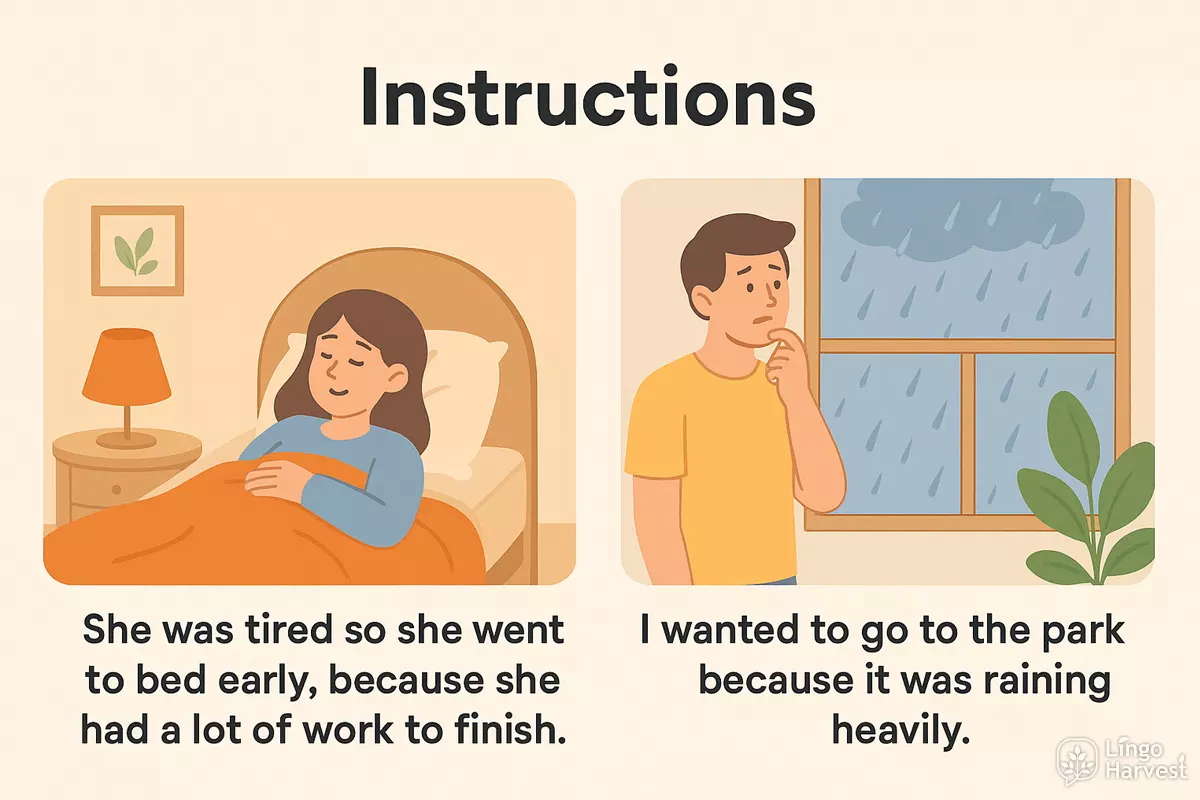
- She was tired so she went to bed early, because she had a lot of work to finish.
- I wanted to go to the park because it was raining heavily.
- We can have cake but we can have ice cream.
- He studied hard although he passed the exam with high marks.
- Call me unless you arrive at the airport.
- She wore a jacket when it was cold outside.
- They didn’t go swimming and the water was too cold.
- I will go to the party or I finish my homework.
- He was late so he missed the bus.
- You can’t enter the club because you have a ticket.
- Take an umbrella since it starts to rain.
- She likes tea but she likes coffee more.
Common conjunctions: quick reference
Here’s a list of common connectors used to join sentences or clauses, with their typical uses:
- and – adds information
- but – contrasts ideas
- or – offers alternatives
- so – shows result
- because – gives a reason
- although – shows contrast
- while – contrasts or shows simultaneous actions
- since – can mean “because” or refer to time
- unless – means “if not”
- if – introduces a condition
- when – refers to time
Show answers
- She was tired but she went to bed early, because she had a lot of work to finish.
→ but (contrast: she was tired, but went to bed early for a reason) - I wanted to go to the park but it was raining heavily.
→ but (contrast: wanted to go, but couldn’t because of rain) - We can have cake or we can have ice cream.
→ or (choice between two options) - He studied hard so he passed the exam with high marks.
→ so (result: studied hard, so he passed) - Call me when you arrive at the airport.
→ when (action to do at a specific time) - She wore a jacket because it was cold outside.
→ because (reason for wearing a jacket) - They didn’t go swimming because the water was too cold.
→ because (reason for not swimming) - I will go to the party if I finish my homework.
→ if (condition) - He was late so he missed the bus.
→ already correct - You can’t enter the club unless you have a ticket.
→ unless (condition: only if you have a ticket) - Take an umbrella if it starts to rain.
→ if (condition: only in case it rains) - She likes tea and she likes coffee more.
→ and (addition; both are true, but more for coffee)
Longer exercise: correct a short paragraph with multiple errors
When learning how to use conjunctions, it’s easy to confuse words like “and,” “but,” “or,” “so,” and “because.” This exercise helps you spot and fix mistakes in a short text where the wrong conjunctions have been chosen. Read the paragraph, identify which linking words are incorrect, and rewrite the passage with the correct ones.
Task: Find and correct the errors
Below is a paragraph with several conjunction errors. Some sentences use the wrong connector, which changes the meaning or makes the text confusing. Read carefully and decide which words should be replaced.
Paragraph:
I wanted to go to the park, but it was raining, or I stayed at home. My friend called me, so I didn’t answer because I was watching a movie and I was tired. Later, I felt bored, but I started reading a book or I enjoyed it a lot.
Instructions
- Read the paragraph above.
- Identify all the conjunctions that are used incorrectly.
- Rewrite the paragraph, replacing the wrong connectors with better choices.
Common conjunctions and their correct uses
- and – connects similar ideas
- but – shows contrast
- or – gives a choice/alternative
- so – shows result/consequence
- because – gives a reason
- although – introduces a contrast (like "but")
- while – shows contrast or simultaneous actions
- since – gives a reason or time
- if – introduces a condition
- unless – gives a negative condition
- when – indicates time
- as – gives reason or time
- yet – shows an unexpected contrast
Practice: Rewrite the paragraph
Try to rewrite the paragraph so that each sentence uses the most appropriate conjunction.
Show answers
- Corrected paragraph:
I wanted to go to the park, but it was raining, so I stayed at home. My friend called me, but I didn’t answer because I was watching a movie and I was tired. Later, I felt bored, so I started reading a book and I enjoyed it a lot. - Conjunctions replaced:
- “or” → “so” (first sentence)
- “so” → “but” (second sentence)
- “or” → “and” (third sentence)
- “but” → “so” (third sentence)
Answer key with explanations of why each conjunction works best
Choosing the appropriate conjunction is essential for clarity and logical flow in English sentences, especially at the B1–B2 level. Below, you’ll find detailed explanations for why one connector is the best fit in each example, focusing on meaning, sentence structure, and typical usage.
Common Conjunctions and Their Purposes
- And: Adds similar or related information.
- But: Shows contrast or an exception.
- Or: Offers alternatives or choices.
- Because: Explains a reason or cause.
- So: Indicates a result or consequence.
- Although: Introduces a contrast, often at the start of a sentence.
- While: Shows two actions happening at the same time or a contrast.
- If: Expresses a condition.
- Unless: Means 'if not'; used for negative conditions.
- Since: Gives a reason or shows time from a starting point.
- When: Refers to time.
- Before: Indicates something happens earlier in time.
- After: Indicates something happens later in time.
- Until: Shows something continues up to a point in time.
- Even though: Strong contrast, more emphatic than 'although'.
- As: Can mean 'because' or 'while', depending on context.
- Whereas: Highlights a difference between two facts.
- So that: Explains purpose or intention.
- Neither…nor: Connects two negative ideas.
Examples with Explanations
- She wanted to go to the party, but she was too tired.
‘But’ introduces a contrast between wanting to go and being too tired. - I can have tea or coffee with breakfast.
‘Or’ gives a choice between two options. - He didn’t call me because he lost his phone.
‘Because’ explains the reason for not calling. - It was raining, so we stayed inside.
‘So’ shows the result of the rain. - Although she studied hard, she didn’t pass the test.
‘Although’ introduces a surprising contrast. - Call me when you arrive.
‘When’ refers to the time of arrival. - We waited until he finished.
‘Until’ shows we waited up to the point he finished. - You can’t go out unless you finish your homework.
‘Unless’ sets a negative condition. - He was tired, yet he finished the race.
‘Yet’ introduces an unexpected result, similar to ‘but’ but often more formal. - I’ll take an umbrella in case it rains.
‘In case’ expresses precaution for a possible situation.
Comparison of Conjunctions in Context
| Sentence | Why this conjunction works best |
|---|---|
| I stayed at home because I was sick. | The word ‘because’ gives the reason for staying at home; it answers ‘why?’. |
| She reads a lot, so she knows many stories. | ‘So’ shows the effect or result of her reading a lot. |
| They wanted to go hiking, but it started to rain. | ‘But’ is used to introduce a contrast between their plan and the weather. |
| We can watch a movie or play a game. | ‘Or’ presents alternatives for what they can do. |
| Although it was cold, we went swimming. | ‘Although’ introduces an unexpected or surprising action given the cold weather. |
| He can’t drive unless he has his license. | ‘Unless’ sets a negative condition; if he doesn’t have his license, he can’t drive. |
| She smiled while she was talking. | ‘While’ shows two actions happening at the same time. |
| Take your keys in case you come home late. | ‘In case’ prepares for a possible situation (coming home late). |
| He left early so that he could catch the train. | ‘So that’ explains the purpose of leaving early. |
| We’ll start after everyone arrives. | ‘After’ sets the time sequence; the action starts following another event. |
In summary, selecting the right conjunction depends on the relationship between ideas: contrast, cause, result, alternative, or time. Understanding the function and nuance of each connector helps you avoid mistakes and create clear, natural sentences in English.