Discourse Conjunctions vs Grammar Conjunctions

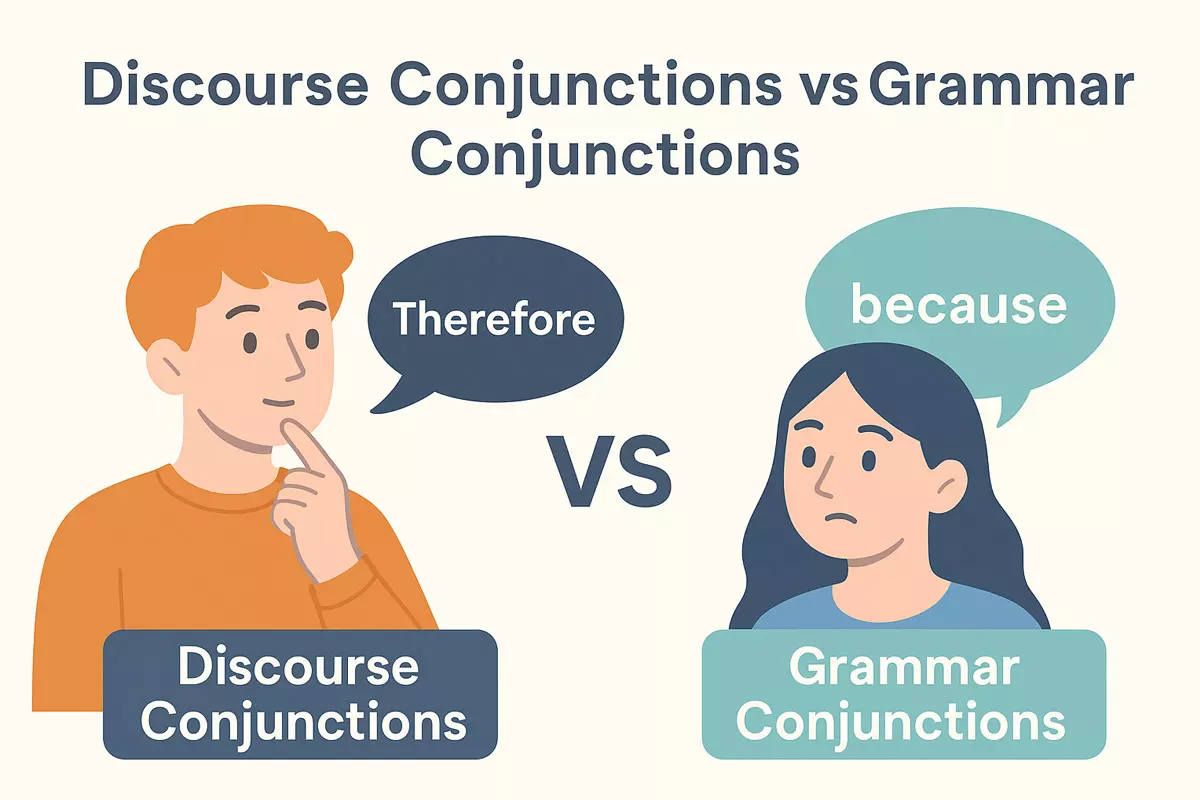 This article explains how discourse conjunctions link ideas across sentences, while grammar conjunctions connect parts within one sentence. It gives examples of each, discusses their role in cohesion, and includes a practice to categorize them.
- What discourse conjunctions do in multi-sentence structure
- How grammar conjunctions operate inside a single sentence
- Examples of discourse markers: however, therefore, meanwhile
- Examples of pure conjunctions: although, because, unless
- How each type contributes to text cohesion
- Practice: categorize linkers as discourse or grammatical
Exploring the ways we connect ideas in both speech and writing reveals that the words and expressions we use to link sentences can differ greatly between casual conversation and formal grammar. These differences are often subtle but significant, influencing not only the meaning we convey but also the flow and clarity of our communication. By examining how language shapes these connections, we gain insight into the flexibility of expression and the underlying rules that guide effective communication in various contexts.
What discourse conjunctions do in multi-sentence structure
When writers move beyond single sentences, they need tools to connect ideas across longer stretches of text. Discourse conjunctions serve this purpose by signaling logical relationships between clauses, sentences, or even entire paragraphs. Unlike grammatical conjunctions (such as "and" or "but"), discourse conjunctions often link more abstract elements: arguments, explanations, contrasts, or sequences.
How discourse conjunctions guide readers
These connectors help readers track the flow of information. For example, in academic or formal writing, words like "however," "therefore," and "meanwhile" make explicit how one idea relates to the next. This reduces ambiguity and supports comprehension, especially in complex arguments or narratives.
- However indicates contrast or exception
- Therefore signals a logical conclusion
- Meanwhile shows simultaneous events or actions
- In addition adds further information
- On the other hand introduces an alternative perspective
- As a result points to consequences
- For example introduces illustrations
- In contrast highlights differences
- Nevertheless concedes a point but continues argument
- Furthermore strengthens or expands on a previous idea
- Likewise shows similarity
- Subsequently refers to something that follows
- Therefore states an outcome or inference
- Conversely flips the viewpoint
- In summary encapsulates previous points
- To conclude signals final remarks
- For instance provides an example
- Consequently shows result or effect
- Otherwise warns of alternate outcomes
- Moreover introduces additional supporting details
Types of relationships signaled by discourse connectors
Writers use these conjunctions to clarify specific relationships, such as:
- Cause and effect: "therefore," "as a result," "consequently"
- Contrast: "however," "on the other hand," "nevertheless"
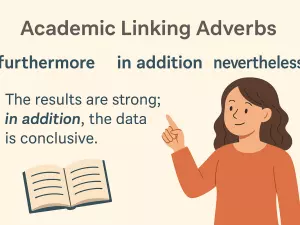
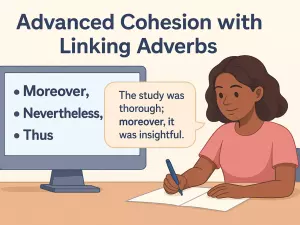
- Addition: "furthermore," "in addition," "moreover"
- Illustration: "for example," "for instance"
- Sequence: "then," "subsequently," "finally"
- Summary: "in summary," "to conclude"
Why discourse connectors matter
Clarity and cohesion are critical in multi-sentence writing. These connectors prevent misinterpretation by making explicit the logic that connects ideas. They also help readers anticipate the direction of the argument or narrative, which is especially important in academic, technical, or persuasive texts.
Discourse vs. grammar conjunctions: a quick comparison
| Discourse Conjunctions | Grammar Conjunctions |
|---|---|
| Connect full ideas, sentences, or paragraphs | Connect words, phrases, or clauses within a sentence |
| Often occur at the start of sentences | Usually appear within sentences |
| Signal logical or rhetorical relationships (e.g., cause, contrast) | Show grammatical relationships (e.g., coordination, subordination) |
| Examples: however, therefore, moreover | Examples: and, but, or, because |
In summary, discourse conjunctions are essential for organizing and clarifying connections between larger units of meaning. By making relationships explicit, they enhance readability and ensure the reader can follow the writer’s intended logic.
How grammar conjunctions operate inside a single sentence
Grammatical conjunctions serve as the essential glue that binds words, phrases, and clauses, forming coherent single sentences. Their primary function is to connect elements within the same sentence, ensuring logical flow and clarity. Unlike discourse conjunctions, which link ideas across sentences or paragraphs, grammatical conjunctions operate on a micro level, directly affecting sentence structure and meaning.
Types of grammatical conjunctions
There are three main categories, each serving a distinct purpose:
- Coordinating conjunctions – join elements of equal syntactic importance (e.g., and, but, or, nor, for, so, yet).
- Subordinating conjunctions – connect a dependent (subordinate) clause to a main (independent) clause (e.g., because, although, since, if, unless, when, while, after, before).
- Correlative conjunctions – work in pairs to link balanced elements (e.g., either...or, neither...nor, both...and, not only...but also).
How conjunctions shape sentence structure
When these connectors are used, they dictate how different parts of a sentence relate to each other. For instance, coordinating conjunctions can join two independent clauses:
- She wanted to go for a walk, but it started raining.
Subordinating conjunctions introduce a hierarchy between clauses, showing cause, time, contrast, or condition:
- Although he was tired, he finished his homework.
- We will start when everyone arrives.
Common patterns and examples
Here are some typical ways these connectors function within a single sentence:
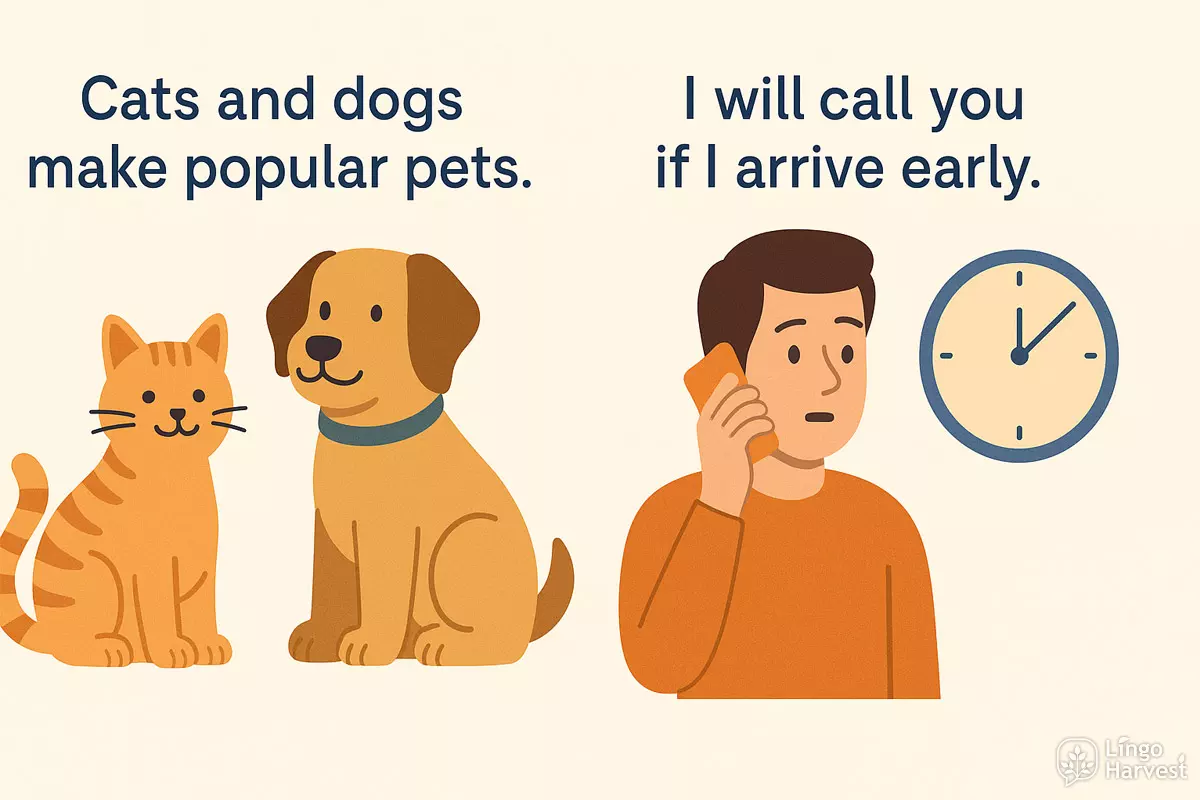
- Cats and dogs make popular pets.
- I will call you if I arrive early.
- Either you apologize or you leave.
- She sings because she is happy.
- He didn’t study, so he failed the test.
- You can have tea or coffee.
- We went inside because it was cold.
- Not only did he win, but also he set a record.
- While I like apples, I prefer oranges.
- She will succeed if she tries.
- He neither called nor messaged me.
- I wanted to go, yet I stayed home.
- Finish the report before you leave.
- We can stay unless it gets too late.
- She reads while listening to music.
- He acts as if nothing happened.
- I will visit after the meeting.
- Since you asked, I’ll explain.
Role in clarity and meaning
Using these connectors properly prevents ambiguity and run-on sentences. They indicate relationships such as addition, contrast, cause, and condition, helping readers understand the intended meaning with ease. Overusing or misplacing conjunctions can create confusion, so it’s important to match the connector with the relationship you wish to express.
Quick comparison: types and examples
| Type | Examples in a Single Sentence |
|---|---|
| Coordinating | She likes tea and coffee. |
| Subordinating | He left early because he felt sick. |
| Correlative | Either you stay or you go. |
Grammatical connectors, therefore, play a crucial role in linking ideas within one sentence, shaping not only structure but also meaning and flow. Proper use ensures that complex thoughts can be expressed clearly and efficiently.
Examples of discourse markers: however, therefore, meanwhile
Discourse markers are crucial for connecting ideas and guiding readers or listeners through an argument or narrative. Words like “however”, “therefore”, and “meanwhile” serve as signposts, signaling contrast, consequence, or a shift in time, respectively. Unlike simple grammar conjunctions (such as “and” or “but”), these expressions often stand at the beginning of sentences or clauses, adding clarity and flow to communication.
Common Discourse Markers and Their Functions
Many phrases serve as transitions between statements or sections of text. Here’s a list of frequently used discourse markers, organized by their typical function:
- Contrast: however, nevertheless, on the other hand, in contrast, yet, still, although
- Result/Consequence: therefore, thus, consequently, as a result, so, hence
- Addition: moreover, furthermore, in addition, also, besides, what’s more
- Time/Sequence: meanwhile, then, afterwards, subsequently, earlier, finally
- Example/Clarification: for example, for instance, in other words, that is
- Summary/Conclusion: in conclusion, to sum up, overall, in short
- Contrast with expectation: nevertheless, even so, still
- Emphasis: indeed, in fact, certainly
How Discourse Markers Differ from Grammatical Conjunctions
While both types can link ideas, discourse markers often appear at the start of sentences and are set off by commas. They provide commentary on the relationship between statements, rather than simply joining clauses.
Usage Examples
Here are some practical examples to illustrate their use in context:
- However, the results were not as expected.
- We missed the train; therefore, we arrived late.
- The meeting continued as planned. Meanwhile, the technicians fixed the issue.
- Moreover, this solution is cost-effective.
- On the other hand, some experts disagree.
- For instance, many people prefer working remotely.
- In conclusion, the project was a success.
- Nevertheless, we decided to proceed.
- Subsequently, the policy was revised.
- Overall, feedback has been positive.
Quick Comparison: Discourse Markers vs. Grammar Conjunctions
| Discourse Marker | Typical Use |
|---|---|
| However | Signals contrast between two statements or ideas |
| Therefore | Indicates a logical consequence or result |
| Meanwhile | Shows parallel actions or events occurring at the same time |
| And / But (Grammar conjunctions) | Directly joins clauses within a sentence |
Understanding these markers helps both writers and speakers structure arguments, tell stories, and clarify relationships between ideas. Mastering their use can significantly improve the coherence and persuasiveness of your communication.
Examples of pure conjunctions: although, because, unless
Pure conjunctions are words that function exclusively to connect clauses within a sentence, rather than linking whole sentences or sections of discourse. They serve a grammatical purpose, showing relationships of cause, contrast, or condition. Unlike discourse markers, which can link ideas across sentences, these connectors always join clauses within a single sentence.
Key Pure Conjunctions in English
Several conjunctions are used purely for grammatical linking between clauses. Some of the most common include:
- although – introduces a contrast or concession (e.g., “Although it was raining, we went outside.”)
- because – shows cause or reason (e.g., “She left because she was tired.”)
- unless – sets a condition (e.g., “You won’t pass unless you study.”)
- if – introduces a conditional situation (“If you call, I’ll answer.”)
- since – can indicate time or reason (“Since you’re here, let’s start.”)
- while – shows contrast or simultaneous actions (“While I cooked, he cleaned.”)
- before – marks time sequence (“Finish your homework before you go out.”)
- after – also marks time (“We’ll eat after they arrive.”)
- as soon as – another time conjunction (“Call me as soon as you arrive.”)
- even though – expresses stronger contrast (“Even though it’s late, I’m not tired.”)
- so that – shows purpose (“Leave early so that you aren’t late.”)
- though – similar to “although” (“He stayed, though he was tired.”)
- until – sets a time limit (“Wait here until I return.”)
- provided (that) – introduces a condition (“You can go provided you finish your work.”)
- once – indicates time or condition (“Once you finish, we can leave.”)
- as – can mean ‘because’ or ‘while’ (“As I was leaving, the phone rang.”)
- in case – introduces precaution (“Take an umbrella in case it rains.”)
- now that – indicates a new situation (“Now that you mention it, I remember.”)
How Pure Conjunctions Differ from Discourse Conjunctions
Pure conjunctions always join clauses within a sentence and cannot stand alone between sentences. For example, you cannot start a new sentence with “because” to link it to the previous one. In contrast, words like “however” or “therefore” can connect whole ideas or paragraphs.
Common Patterns with Pure Conjunctions
The placement of these connectors affects sentence structure and meaning:
- They usually appear at the start of the subordinate clause: “Although it was late, she kept working.”
- Sometimes, the order can be reversed: “She kept working although it was late.”
- They never take a comma before them when joining clauses in a compound sentence (unlike “however”).
Using these conjunctions correctly helps build complex and nuanced sentences, showing relationships like cause, contrast, time, or condition. This is essential for clear and precise communication.
How each type contributes to text cohesion
The way conjunctions function within a text significantly shapes how ideas flow and connect. Discourse conjunctions and grammar conjunctions both help readers follow the logic of a passage, but their roles differ in subtle and important ways.
Discourse conjunctions: Guiding relationships between ideas
Discourse conjunctions, sometimes called linking adverbials or discourse markers, help to organize larger stretches of language. They signal relationships between sentences or even paragraphs, making it clear when a point is being added, contrasted, explained, or summarized. These connectors often guide the reader through the writer’s argument or narrative, clarifying how each part relates to the whole.
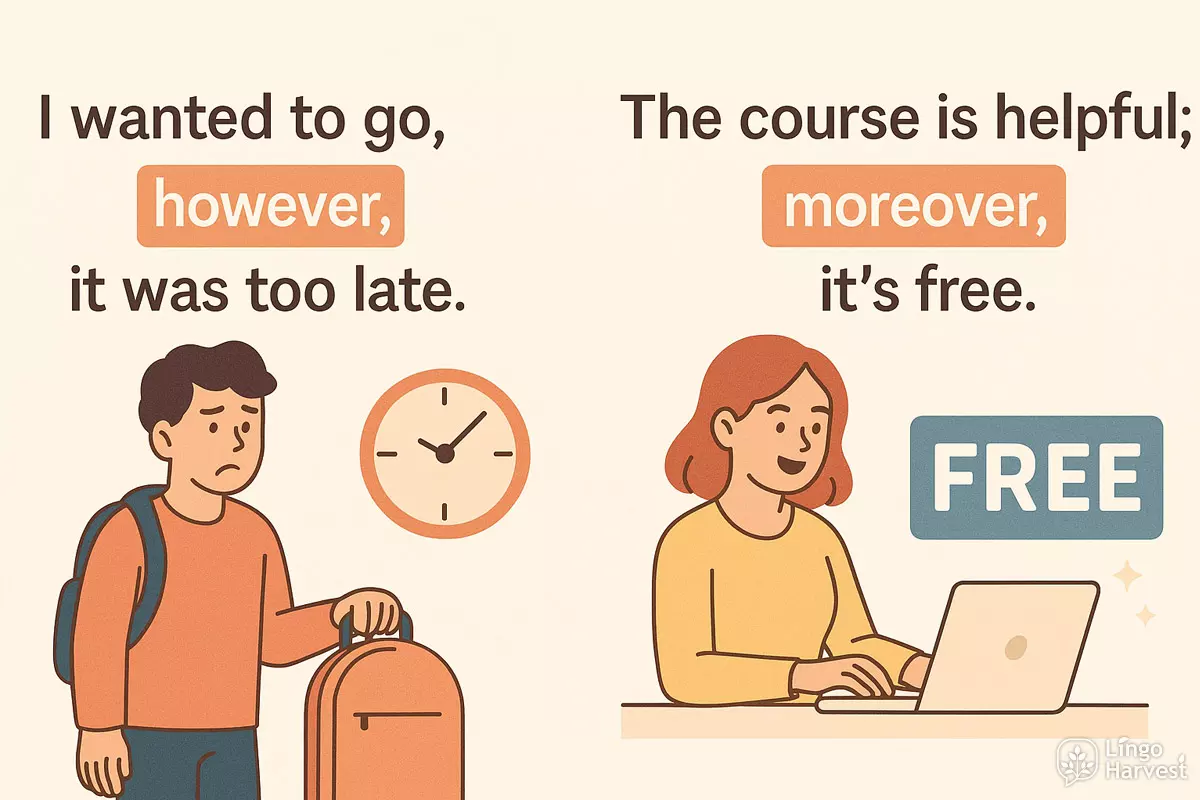
- However → I wanted to go; however, it was too late.
- Moreover → The course is helpful; moreover, it’s free.
- Therefore → She didn’t study; therefore, she failed the test.
- For example → Many fruits are healthy; for example, apples and oranges.
- On the other hand → This option is cheap; on the other hand, it’s slow.
- In addition → He speaks English; in addition, he knows Spanish.
- Meanwhile → She cooked dinner; meanwhile, he set the table.
- Consequently → It rained all night; consequently, the match was canceled.
- In fact → He looks young; in fact, he’s over 50.
- Otherwise → Hurry up; otherwise, we’ll be late.
- Thus → The evidence was clear; thus, the case was closed.
- Instead → I didn’t buy coffee; instead, I made tea.
- Furthermore → This book is useful; furthermore, it’s easy to read.
- As a result → He saved money; as a result, he bought a new laptop.
- Nevertheless → It was cold; nevertheless, they went swimming.
- For instance → Many animals migrate; for instance, birds fly south.
By using these, writers can signal shifts, highlight contrasts, or show cause and effect across sentences, which helps knit the text into a coherent whole.
Grammar conjunctions: Building sentence-level connections
Grammatical conjunctions—like and, but, and because—primarily operate within sentences to connect clauses, phrases, or words. They create smooth transitions and help avoid choppy, disconnected statements. While they often work on a smaller scale than discourse markers, their impact on clarity and readability is significant.
- And → She opened the window, and fresh air filled the room.
- But → He wanted to join us, but he was too busy.
- Or → We can stay home, or we can go for a walk.
- Nor → She didn’t call, nor did she send a message.
- Yet → It was cold, yet they continued swimming.
- So → It was getting dark, so we headed home.
- Because → They stayed inside because it was snowing.
- Although → Although he was tired, he finished the task.
- While → She cooked dinner while he set the table.
- If → If it rains, we’ll cancel the trip.
- Since → Since you’re here early, you can help us.
- Unless → You won’t improve unless you practice daily.
- Whereas → She loves horror movies, whereas he prefers comedies.
- Though → He smiled, though he was nervous.
- After → We went out for dessert after we had dinner.
- Before → Wash your hands before you eat.
Comparing their roles in cohesion
To see the difference more clearly, consider how each type creates links at different levels of text. Discourse connectors bridge ideas across sentences or sections, while grammatical conjunctions tie together words and clauses within sentences. Both are essential for creating a logical, reader-friendly flow.
| Type | How it connects text |
|---|---|
| Discourse Conjunctions | Link sentences or paragraphs; clarify logical relationships (contrast, addition, cause, result). |
| Grammar Conjunctions | Join words, phrases, or clauses within a sentence; build complex sentence structures. |
In summary, both types play vital but distinct roles in maintaining cohesion. Using them thoughtfully ensures that texts are not just grammatically correct, but also easy to follow and engaging.
Practice: categorize linkers as discourse or grammatical
Understanding the distinction between discourse and grammatical linkers helps clarify how ideas connect at different levels. Below, you’ll find practical exercises to sort common linking words based on their function. Some linkers primarily organize the flow of conversation or writing (discourse), while others strictly connect clauses within a sentence (grammatical).
Sort the following linkers
Review the list. Decide if each linker is used to connect sentences/ideas at the text level (discourse) or to join clauses grammatically within a sentence.
- however
- because
- and
- therefore
- although
- for example
- but
- furthermore
- so
- meanwhile
- since
- in addition
- if
- on the contrary
- unless
- as a result
- while
- firstly
- yet
- in conclusion
Show answers
- Discourse linkers: however, therefore, for example, furthermore, meanwhile, in addition, on the contrary, as a result, firstly, in conclusion
- Grammatical linkers: because, and, although, but, so, since, if, unless, while, yet
Identify the linker type in context
Read each sentence and decide if the highlighted word is a discourse or grammatical linker.
- He was tired; therefore, he went to bed early.
- She left because she was unwell.
- I wanted to go for a walk, but it started to rain.
- On the contrary, I believe this is a good idea.
- It was getting dark, so we decided to head home.
- Although he apologized, she was still upset.
- Since it’s important, we should discuss it now.
- However, the results were completely unexpected.
- Whereas her sister is quiet, Anna is very outgoing.
- If you need help, just let me know.
Show answers
- Discourse
- Grammatical
- Grammatical
- Discourse
- Grammatical
- Grammatical
- Grammatical
- Discourse
- Grammatical
- Grammatical
Comparison Table: Typical Functions of Linker Types
| Discourse Linkers | Grammatical Linkers |
|---|---|
| Connect ideas across sentences or paragraphs Guide the reader through argument structure Often used at the start of a sentence |
Join clauses within a sentence Show direct grammatical relationships Usually found within the sentence body |
| Examples: however, for example, in addition | Examples: and, because, although, if |
| Can be moved or omitted without breaking grammar | Essential for sentence structure |
| Often followed by a comma | Rarely followed by a comma (except in complex sentences) |
Distinguishing between these two categories will improve both your writing clarity and your reading comprehension. Practice with real texts to reinforce your understanding of how linkers function in context.