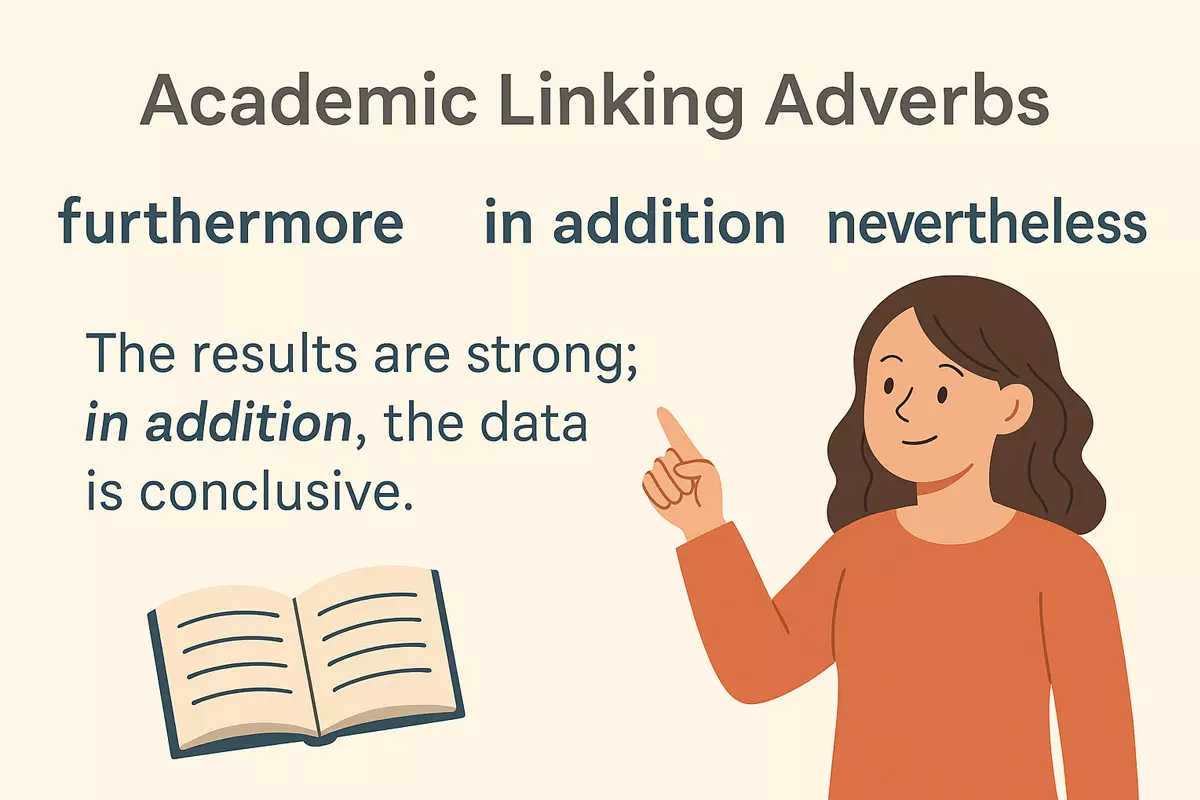
Academic Linking Adverbs: furthermore, in addition, nevertheless

 Here we the purpose of academic linking adverbs, compares contrast and addition markers, and explains formal and semi-formal usage. It also discusses their sentence position, common mistakes, and gives examples from essays and reports.
In academic writing, smoothly connecting ideas is crucial for maintaining clarity and coherence throughout your work. Transition words such as moreover, besides, and however play an important role in guiding readers from one point to the next, making arguments easier to follow and understand. These connectors not only help present additional information or contrasting viewpoints but also improve the overall flow of the writing, allowing readers to grasp complex concepts more easily and appreciate the logical progression of your ideas.
Purpose of Academic Linking Adverbs
Academic texts often require a clear, logical flow between ideas. Linking adverbs such as "furthermore," "in addition," and "nevertheless" help writers connect sentences and paragraphs, making arguments easier to follow. These connectors signal relationships like addition, contrast, or sequence, guiding readers through complex reasoning.
Clarifying Relationships Between Ideas
Writers use these adverbs to clarify how one statement relates to another. For example, "furthermore" indicates an extra point is being added, while "nevertheless" shows a contrast or unexpected outcome. This clarity is crucial in academic writing, where nuanced argumentation is valued.
- Furthermore – introduces additional support or evidence.
- In addition – adds a new, related point.
- Nevertheless – marks a contradiction or exception.
Improving Coherence and Flow
Using linking adverbs appropriately improves the cohesion of academic writing. Instead of abrupt transitions, these words smooth the reader’s journey from one assertion to the next. This helps avoid confusion and enhances the overall persuasiveness of the text.
Common Functions of Linking Adverbs
Academic linking adverbs generally serve a few core functions:
- Adding information (e.g., "furthermore," "moreover")
- Contrasting points (e.g., "nevertheless," "however")
- Showing cause and effect (e.g., "therefore," "consequently")
- Sequencing ideas (e.g., "firstly," "subsequently")
- Summarizing (e.g., "overall," "in conclusion")
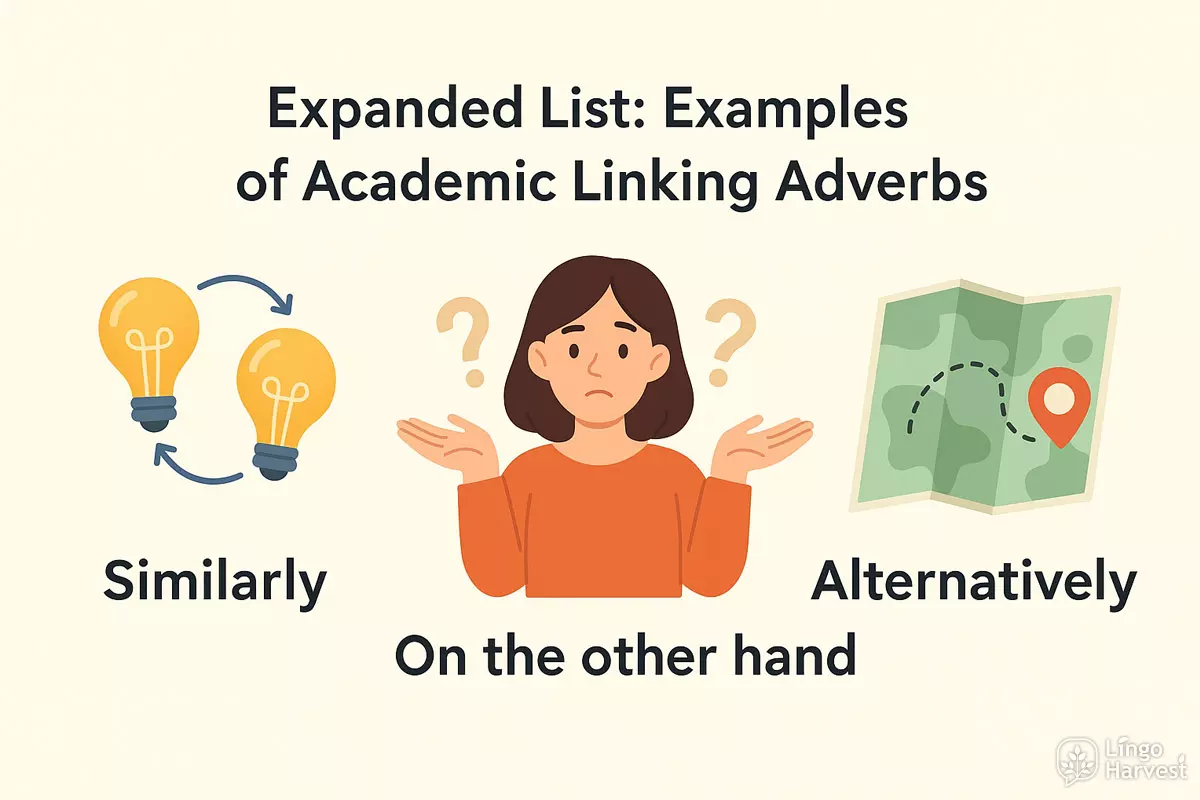
Expanded List: Examples of Academic Linking Adverbs
- Moreover → The course is challenging; moreover, it requires regular independent study.
- However → The results look promising; however, the sample size is very small.
- Consequently → The company reduced its prices; consequently, sales increased sharply.
- Thus → The data were incomplete; thus, no firm conclusion could be drawn.
- Otherwise → You must submit the form today; otherwise, your application will be delayed.
- Similarly → The first group showed high motivation; similarly, the second group worked hard.
- On the other hand → The job is stressful; on the other hand, it is very well paid.
- Alternatively → You can email your questions; alternatively, you can ask them in class.
- Additionally → Additionally, the report includes a summary of previous research.
- Nonetheless → The task was difficult; nonetheless, the team completed it on time.
- Therefore → The evidence is strong; therefore, the hypothesis is accepted.
- Subsequently → The drug was approved; subsequently, it was widely prescribed.
- Meanwhile → The adults attended a workshop; meanwhile, the children played outside.
- Conversely → Some students prefer group work; conversely, others learn better alone.
- Hence → The sample was too small; hence, the findings should be interpreted cautiously.
- Likewise → The first experiment failed; likewise, the second produced no clear results.
- In contrast → The control group showed little change; in contrast, the test group improved rapidly.
- Finally → Finally, the study suggests several directions for future research.
To analyse how varied your academic vocabulary is, you can try our lexical diversity calculator . It measures the range of different words in your writing and shows how rich your vocabulary use really is.
Why Precision Matters
Choosing the right linking adverb can significantly affect the meaning and clarity of an argument. Misusing a connector may confuse readers or misrepresent the writer’s intention. In academic contexts, this precision supports credibility and logical consistency. In summary, these adverbs act as signposts, helping readers navigate arguments and evidence. Their careful use is essential for effective academic communication, ensuring that ideas are presented logically and persuasively.
Contrast vs Addition Markers
Understanding the distinction between adverbs that signal contrast and those that add information is essential for clear academic writing. Addition markers, like "furthermore" and "in addition," help writers expand or reinforce a point, while contrast markers, such as "nevertheless," indicate a shift or an opposing idea. Each serves a unique function in structuring arguments and guiding readers through complex reasoning.
How Addition Markers Work
Addition markers are used to introduce extra points that support or elaborate on a previous statement. They help create a logical flow by showing that more evidence or examples are coming. Commonly used addition adverbs in academic writing include:
- furthermore → The experiment was carefully designed; furthermore, it was repeated three times.
- in addition → The course includes lectures; in addition, students attend weekly seminars.
- moreover → The method is efficient; moreover, it is easy to apply in practice.
- also → The survey also asked about students’ use of social media.
- besides → The project is expensive; besides, it requires a lot of staff time.
- what is more → The test was difficult; what is more, the instructions were unclear.
- additionally → Additionally, the report provides several practical recommendations.
- similarly → The first group scored highly; similarly, the second group performed well.
- not only... but also → The programme not only improves language skills but also builds confidence.
- as well as → The study examines adults as well as teenagers.
Contrast Markers: Shifting the Perspective
Contrast markers signal a difference, limitation, or exception to what has just been stated. They are crucial for presenting balanced arguments, highlighting alternative viewpoints, or acknowledging counterarguments. Typical contrast adverbs and phrases include:
- nevertheless → The evidence is limited; nevertheless, the results are encouraging.
- however → The method is popular; however, it has several clear weaknesses.
- on the other hand → The job is demanding; on the other hand, it offers great opportunities.
- in contrast → The control group showed little progress; in contrast, the test group improved quickly.
- yet → The theory is elegant, yet it fails to explain all the data.
- still → The policy has problems; still, it represents an important first step.
- nonetheless → The sample was small; nonetheless, the trend is clear.
- conversely → Older students prefer written feedback; conversely, younger students favour videos.
- even so → The task was complex; even so, the team finished on time.
- though → The results are promising, though more research is needed.
- although → Although the cost is high, the benefits may justify the investment.
- whereas → The first school focuses on exams, whereas the second emphasises creativity.
Side-by-Side Comparison
The following table highlights the core differences between these two categories of linking adverbs, focusing on their function and typical usage in academic contexts.
| Function | Examples |
|---|---|
| Addition (builds, extends ideas) | furthermore, in addition, moreover, also, additionally |
| Contrast (shows opposition, limitation) | nevertheless, however, on the other hand, yet, nonetheless |
Choosing the Right Marker
Selecting the appropriate linking word depends on your intended relationship between ideas. Use an addition marker when you want to reinforce or elaborate, and a contrast marker when you need to acknowledge a counterpoint or present a different perspective. Overusing one type can make writing seem repetitive or unbalanced, so aim for variety and clarity. In summary, mastering both addition and contrast adverbs will enhance your academic writing, making your arguments both coherent and nuanced.
Formal vs Semi-Formal Usage
When choosing linking adverbs such as furthermore, in addition, and nevertheless, it’s important to recognize how their formality level can shape your writing. Academic and professional contexts often require a more polished register, while less formal assignments or workplace communications might call for a slightly relaxed tone.
Common Contexts for Each Adverb
- Furthermore is typically reserved for formal academic writing or research papers. It adds emphasis and introduces information that strongly supports the previous point.
- In addition is versatile, suitable for both formal and semi-formal contexts. It is often used to add extra information in a neutral, clear way.
- Nevertheless signals contrast or exception. It appears most often in formal arguments or discussions but can also be used in semi-formal reports or presentations.
Comparing Usage in Different Registers
| Expression | Typical Register | Example Sentence | Notes |
|---|---|---|---|
| Furthermore | Formal | The results were significant. Furthermore, they support our initial hypothesis. | Emphasizes strong logical connection; rarely used in casual speech. |
| In addition | Formal / Semi-formal | In addition, previous research confirms these findings. | Flexible; works in essays, reports, and emails. |
| Nevertheless | Formal / Semi-formal | The method is costly. Nevertheless, it yields accurate data. | Highlights contrast; maintains an academic tone. |
| Also | Semi-formal / Informal | Also, the team agreed on the timeline. | Less formal; suitable for emails and presentations. |
When to Choose Each Linking Adverb
Writers should assess the context and audience before selecting a linking adverb. For journal articles, dissertations, or formal reports, furthermore and nevertheless are preferred for their precision and gravitas. For business emails, memos, or less formal assignments, in addition and alternatives like also or plus are more accessible and conversational.
Alternative Linking Adverbs by Formality
- Moreover → very formal
- Besides → semi-formal / informal
- However → formal / semi-formal
- Still → semi-formal / informal
- Likewise → formal / semi-formal
- On the other hand → formal / semi-formal
- Plus → informal
- Yet → semi-formal / informal
- Additionally → formal
- Consequently → formal
- Nonetheless → formal / semi-formal
- Also → semi-formal / informal
- Therefore → formal
- Even so → semi-formal
Position in Academic Sentences
Understanding where to place linking adverbs such as furthermore, in addition, and nevertheless is crucial for clear academic writing. These connectors help guide readers through arguments and information, but their impact depends on their location within a sentence or paragraph.
Typical Placements for Linking Adverbs
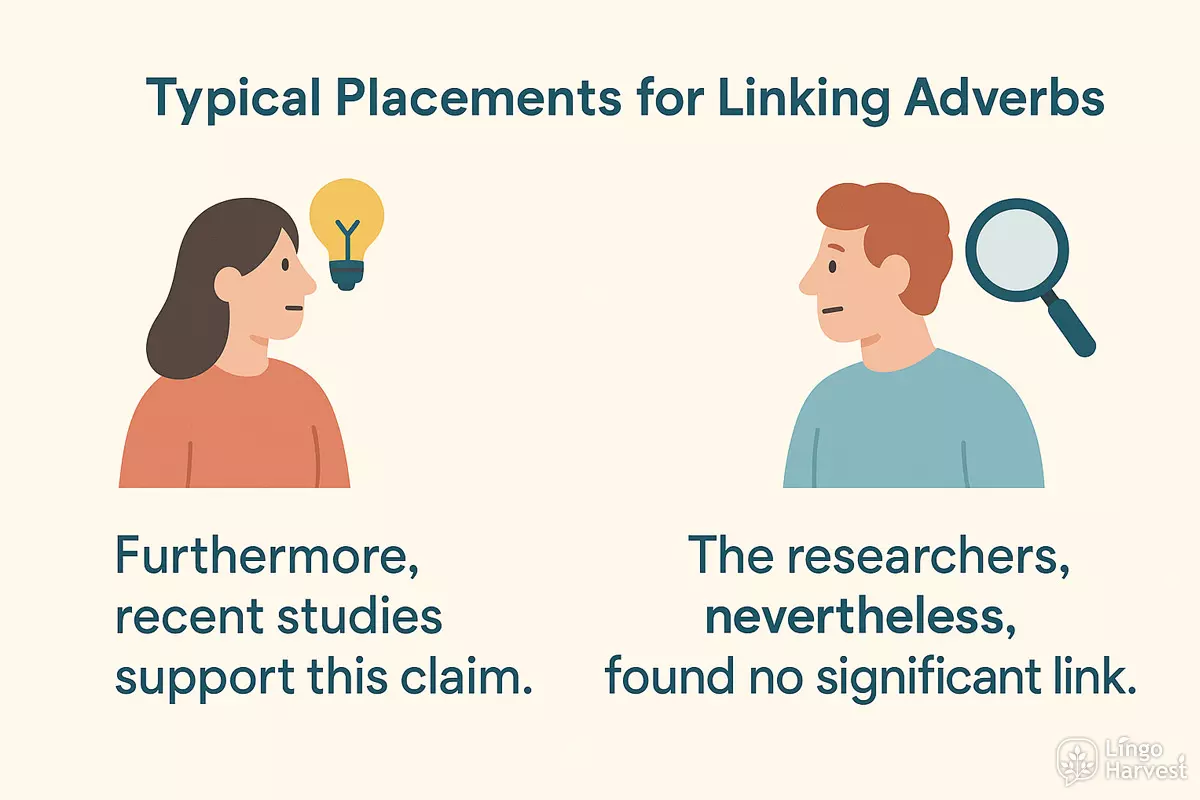
Writers can position these adverbs at the beginning, in the middle, or, less commonly, at the end of sentences. Placement often affects emphasis and flow. The initial position is most common in formal writing, especially in essays and research papers.
- At the start of a sentence: This is the standard choice in academic prose. Example: Furthermore, recent studies support this claim.
- After the subject: Sometimes used for stylistic variation. Example: The researchers, nevertheless, found no significant link.
- Before the main verb (except ‘be’): This can subtly shift focus. Example: The team has, in addition, considered alternative approaches.
- After the verb ‘be’: Example: The results are, nevertheless, inconclusive.
- At the end of a sentence: Rare in academic style, but possible for emphasis. Example: The data was not persuasive, in addition.
Comparing Positions: Examples
| Linking Adverb | Example Sentence |
|---|---|
| Furthermore | Furthermore, the analysis reveals new trends. |
| In addition | In addition, the survey included open-ended questions. |
| Nevertheless | Nevertheless, the hypothesis remains unproven. |
| Nevertheless (mid-sentence) | The results, nevertheless, were consistent. |
| In addition (mid-sentence) | The committee has, in addition, revised the timeline. |
Punctuation and Tone
These adverbs are usually set off by commas when placed at the beginning or within a sentence. Using them thoughtfully helps maintain a formal, objective tone and ensures logical progression between points.
Quick Reference: Common Patterns
- Furthermore, + [complete sentence]
- [Subject], nevertheless, [verb phrase]
- [Subject] has, in addition, [verb phrase]
- [Subject] is, nevertheless, [adjective/complement]
- [Statement], in addition.
- In addition, [subject] [verb phrase]
- Nevertheless, [subject] [verb phrase]
- [Subject] has, furthermore, [verb phrase]
- Furthermore, [subject] [verb phrase]
- [Subject] is, in addition, [adjective]
Selecting the right place for these adverbs ensures smooth transitions and reinforces the logical structure of academic arguments.
Common Mistakes to Avoid
Using linking adverbs such as "furthermore," "in addition," and "nevertheless" incorrectly can disrupt the flow of academic writing. Writers often make errors with placement, punctuation, and meaning, which can confuse readers or weaken arguments. Being mindful of how these connectors function is essential for clear communication.
Misuse and Confusion of Linking Adverbs
Writers sometimes mix up when to use each connector or use them interchangeably. Each has a specific role: "furthermore" and "in addition" both add information, while "nevertheless" introduces a contrast. Using the wrong connector can change the intended meaning.
- Using "nevertheless" where agreement is intended, instead of contrast.
- Repeating "furthermore" or "in addition" too often, making the text sound monotonous.
- Combining similar adverbs ("furthermore, in addition") in the same sentence.
- Placing adverbs incorrectly within the sentence, leading to awkward phrasing.
- Omitting necessary punctuation, such as the comma after these adverbs at the start of a sentence.
- Starting every sentence with a linking adverb, which reduces variety and weakens coherence.
- Using these connectors to join unrelated ideas, which confuses the reader.
- Employing "nevertheless" in place of "however" in all contexts, ignoring subtle differences.
- Forgetting to use these adverbs in formal writing, resulting in choppy or disconnected arguments.
- Using informal alternatives (like "also" or "but") in academic contexts where formal adverbs are expected.
Comparison of Usage and Placement
| Adverb | Typical Function & Correct Placement |
|---|---|
| Furthermore | Used to add a new, related point. Usually at the start of a sentence, followed by a comma. Example: Furthermore, recent studies confirm this trend. |
| In addition | Introduces extra information. Can appear at the beginning or after the subject, with a comma. Example: In addition, the results were consistent. |
| Nevertheless | Signals contrast or unexpected result. Typically at the start or after the subject, with a comma. Example: Nevertheless, the hypothesis was supported. |
Punctuation and Sentence Structure
Punctuation errors are common with these adverbs. When they appear at the start of a sentence, a comma should follow. Placing them mid-sentence also requires proper commas. Avoid run-on sentences by not stringing too many ideas together with connectors.
Summary Tips
- Choose the correct adverb for the relationship you want to express.
- Vary your transitions to maintain reader interest.
- Check placement and punctuation to ensure clarity.
- Read sentences aloud to test for natural flow and coherence.
Examples in Essays and Reports
Academic linking adverbs such as "furthermore," "in addition," and "nevertheless" help writers connect ideas smoothly and show logical relationships between statements. These connective words are especially useful in formal writing, where clarity and coherence are essential. Below are practical ways to incorporate these adverbs into your academic texts.
Sample Sentences Using Linking Adverbs
- The research demonstrates a clear correlation between diet and health; furthermore, it highlights the importance of regular exercise.
- Several solutions have been proposed. In addition, new technologies are being developed to address the issue.
- The hypothesis was not supported by the results. Nevertheless, the findings contribute valuable data to the field.
- Student engagement increased after the curriculum changes. Furthermore, test scores improved significantly.
- Increased funding is required to maintain current programs. In addition, staff training must be improved.
- The initial trial failed due to equipment issues. Nevertheless, the team persisted and achieved success in subsequent attempts.
- Environmental regulations are becoming stricter. Furthermore, public awareness of sustainability is growing.
- The course covers basic concepts. In addition, advanced topics are introduced in later modules.
- Some participants reported positive outcomes. Nevertheless, more research is needed to confirm these effects.
- Online learning offers flexibility. Furthermore, it can reduce costs for both institutions and students.
Comparison Table: Linking Adverbs in Context
| Adverb | Function & Example |
|---|---|
| furthermore | Adds a supporting point. “The experiment yielded accurate results. Furthermore, it provided new insights into the methodology.” |
| in addition | Introduces extra information. “The city improved public transport. In addition, it invested in cycling infrastructure.” |
| nevertheless | Contrasts with previous information. “The project faced several delays. Nevertheless, it was completed on time.” |
Tips for Using Linking Adverbs Effectively
- Place the adverb at the start of a sentence for emphasis, followed by a comma.
- Use these adverbs to clarify the relationship between points—whether adding, contrasting, or reinforcing information.
- Avoid overusing the same adverb; vary your transitions to maintain reader interest.
- Ensure the logical flow between sentences—these adverbs should reflect real connections.
Using these linking adverbs thoughtfully can improve the logical flow and persuasiveness of your academic essays and reports. They help readers follow your argument and see the relationships between your ideas.