Weak vs Strong Conjunctions in Academic Writing

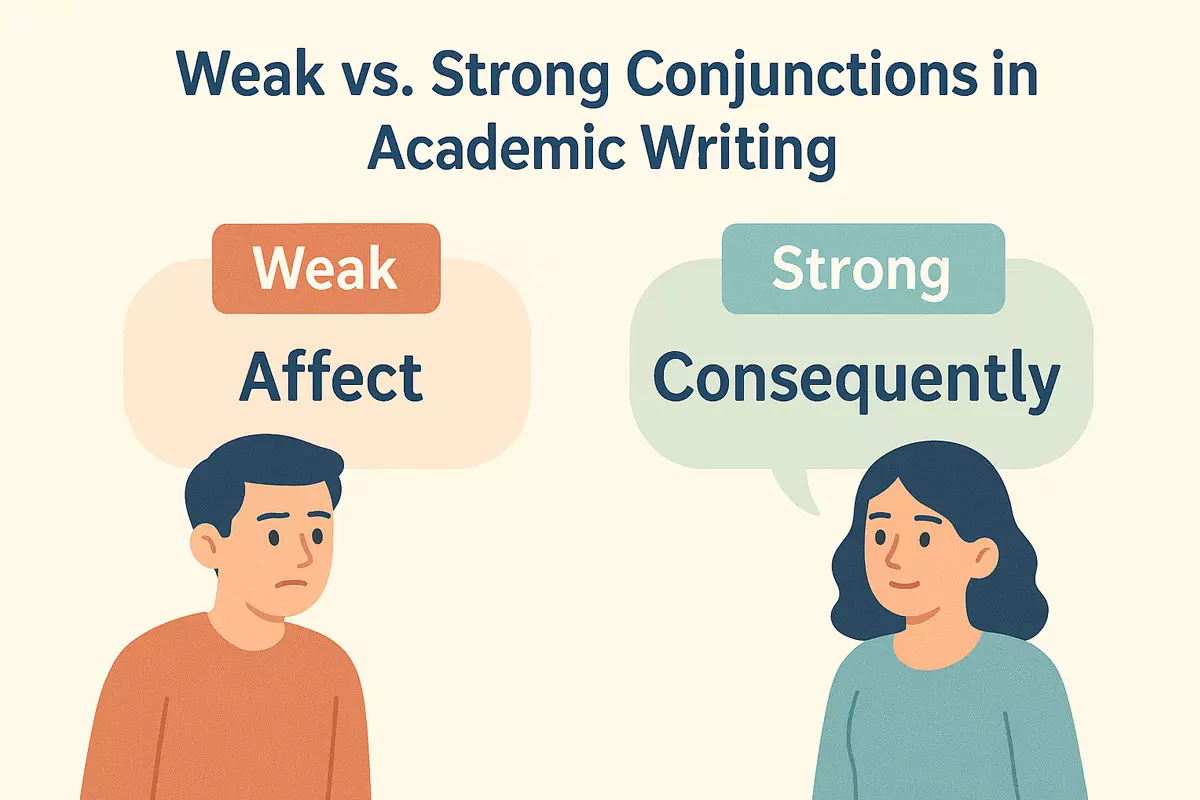 Here we why some conjunctions are weak in formal writing, gives examples of vague choices, and suggests stronger alternatives like however and moreover. It also covers how precise conjunctions improve cohesion and offers practice with sample paragraphs.
- What makes a conjunction weak or vague in formal writing
- Examples of weaker choices such as and, but, so in essays
- Stronger alternatives: however, therefore, moreover, consequently
- Choosing conjunctions that show specific logical relationships
- Improving cohesion and clarity by upgrading conjunctions
- Practice: replace weak conjunctions with more precise options in sample paragraphs
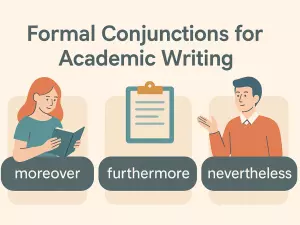
Achieving clarity and precision in scholarly writing largely depends on how well you connect your ideas, as the choice of connectors can significantly influence the strength and flow of your arguments. Subtle connectors, such as however or consequently, allow for a smooth transition between points and can convey nuance, while more emphatic linking words, like furthermore or therefore, help to highlight key arguments and emphasize relationships between concepts. By selecting connectors carefully, you can ensure that your writing remains coherent, persuasive, and easy for readers to follow.
What makes a conjunction weak or vague in formal writing
In academic writing, the precision and clarity of connections between ideas are crucial. When connectors such as conjunctions are imprecise or overused, they can make relationships between sentences or clauses seem unclear or unconvincing. This undermines the logical flow and weakens the argument.
Characteristics of Weak or Vague Conjunctions
- Ambiguity: Conjunctions like and or but may not specify the exact relationship between ideas, leaving the reader to infer meaning.
- Overuse of Simple Connectors: Relying too heavily on basic words (e.g., so, and, then) can make writing monotonous and less analytical.
- Lack of Specificity: Using connectors that do not clarify whether the relationship is causal, contrastive, additive, or sequential can confuse readers.
- Colloquial or Informal Choices: Words such as plus, also, or anyway are often too casual for scholarly contexts.
- Unnecessary Repetition: Repeating the same conjunctions can signal weak transitions and a lack of variety in reasoning.
Common Examples of Weak or Vague Conjunctions
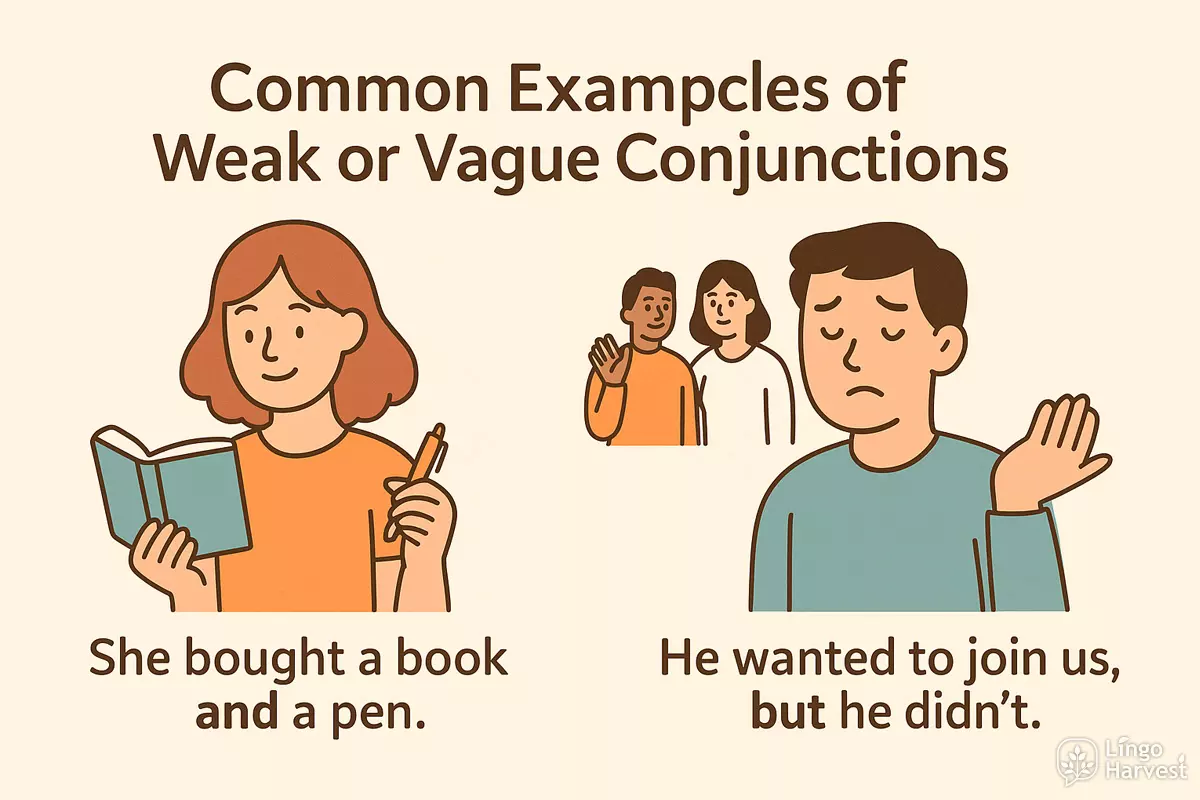
- And → She bought a book and a pen. (Adds ideas but may be too general)
- But → He wanted to join us, but he didn’t. (Shows contrast but can be vague without context)
- So → It was late, so we left. (Shows result but may lack precision)
- Also → She likes music; also, she plays violin. (Adds information but weak in academic writing)
- Then → We ate dinner, then watched TV. (Indicates sequence but not logic)
- Plus → It’s too far; plus, it’s expensive. (Informal, not ideal for clear reasoning)
- Anyway → It was difficult; anyway, we tried. (Shifts topic but unclear logically)
- Or → You can stay or leave. (Gives choices but vague without context)
- Yet → He is young, yet very talented. (Contrast, but sometimes too weak or subtle)
- Because (when used without further explanation) → He left because. (Incomplete or vague)
- Besides → I’m tired; besides, I have work to do. (Adds info but informal)
- Still → It was cold; still, she went swimming. (Shows unexpected result but can be vague)
- Even though (when relationship is unclear) → Even though… (Still vague without full logic)
- After (when temporal sequence is not the main logic) → After he arrived, he left again. (Sequence only, logic unclear)
Why Precision in Conjunctions Matters
Academic audiences expect nuanced distinctions between ideas. Weak connectors fail to provide adequate signposting, which can muddle arguments or obscure cause-effect, contrast, or sequence. Stronger alternatives—such as however, therefore, consequently, or in addition—make logical relationships explicit and support rigorous reasoning.
Indicators That a Connector Is Weak or Vague
- The reader must guess how the two ideas are related.
- The conjunction could be replaced with a more precise term without altering the meaning.
- The transition feels abrupt or incomplete.
- The writing seems less formal or more conversational than appropriate.
In summary, connectors in formal writing should clarify the relationship between clauses, not obscure it. Choosing precise, formal, and varied conjunctions strengthens scholarly communication and helps readers follow complex arguments with ease.
Examples of weaker choices such as and, but, so in essays
In academic writing, relying heavily on basic conjunctions like and, but, and so can make arguments seem simplistic or loosely connected. These words are common in casual speech, but in formal essays, overuse may signal a lack of variety and precision. More sophisticated connectors help clarify relationships between ideas and strengthen the overall flow of an argument.
Common Patterns of Weak Conjunction Use
Writers often default to simple conjunctions when linking sentences or clauses. Below are frequent patterns where basic connectors can weaken clarity or logical progression:
- And to link unrelated ideas: “The results were inconclusive, and more research is needed.”
- But for contrasts that need sharper distinction: “The experiment failed, but the hypothesis remains valid.”
- So to show cause and effect: “The sample size was small, so the findings are limited.”
- And to string together lists: “The author discusses methods, and results, and implications.”
- But following vague statements: “The theory is widely accepted, but some disagree.”
- So introducing conclusions: “The data were incomplete, so we cannot confirm the trend.”
- Sentences starting with And: “And this supports the main claim.”
- But to introduce exceptions without detail: “But there are some limitations.”
- Using So with imprecise results: “So, the study is important.”
- Connecting long, complex clauses only with and: “The survey was conducted in spring, and the analysis began in summer.”
- Stringing multiple ideas with and in a single sentence: “The participants were surveyed, and interviewed, and observed.”
How Weak Conjunctions Affect Academic Tone
When essays rely on these connectors, transitions between ideas may lack nuance, making arguments appear less rigorous. Academic readers expect precise signals about cause, contrast, addition, or result. For instance, simply using but may not fully capture the scope of an opposing viewpoint, while so often fails to indicate the strength of a conclusion or its limitations.
Comparing Basic and Advanced Connectors
| Basic Conjunction | Stronger Alternative |
|---|---|
| And | Moreover, Additionally, Furthermore |
| But | However, Nevertheless, On the other hand |
| So | Therefore, Consequently, As a result |
| And (to list) | In addition, As well as, Along with |
| But (to introduce exceptions) | Nonetheless, Despite this, Even so |
| So (to conclude) | Thus, Hence, For this reason |
While basic connectors are not incorrect, their overuse can flatten the argumentative structure of an essay. Varying transitions and selecting more precise linking words improves clarity and demonstrates critical thinking in academic prose.
Stronger alternatives: however, therefore, moreover, consequently
Academic writing demands clarity and sophistication, especially when connecting ideas. While simple conjunctions like "and" or "but" serve a purpose, more nuanced transitions—such as "however," "therefore," "moreover," and "consequently"—provide precision and signal complex relationships between statements. Choosing the right connector elevates arguments and clarifies logic for the reader.
When to Use Advanced Connectors
Writers often need to show contrast, cause and effect, or to add information. Rather than relying on basic words, consider these alternatives for a more refined presentation:
- However: Introduces a contrast or exception.
- Therefore: Signals a logical result or conclusion.
- Moreover: Adds supporting or additional information.
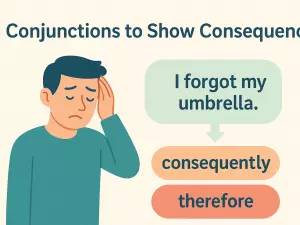
- Consequently: Indicates a direct consequence.
Examples of Effective Usage
The following list offers examples of these advanced transitions in academic sentences:
- Many studies support this theory; however, some researchers disagree.
- The experiment failed to produce results; therefore, the hypothesis was rejected.
- The data confirms previous findings; moreover, it reveals new trends.
- The sample size was too small; consequently, the results are inconclusive.
- The initial plan was flawed; however, adjustments improved outcomes.
- Participants reported higher satisfaction; therefore, the intervention was deemed successful.
- The theory has been widely accepted; moreover, it has influenced policy.
- The budget was cut; consequently, several projects were delayed.
- The solution seemed promising; however, it introduced new problems.
- The results aligned with expectations; therefore, no further analysis was required.
- The research fills a significant gap; moreover, it opens avenues for future work.
- The team missed the deadline; consequently, the client canceled the contract.
Comparing Transitional Conjunctions
The table below contrasts these advanced connectors with weaker alternatives, illustrating how stronger options clarify relationships between ideas:
| Weaker Option | Stronger Alternative & Example |
|---|---|
| But | However: The method is popular. However, it has significant limitations. |
| So | Therefore: The variables were not controlled. Therefore, the results are unreliable. |
| And | Moreover: The study confirms previous research. Moreover, it provides new insights. |
| As a result | Consequently: The system crashed. Consequently, data was lost. |
Tips for Incorporating Stronger Connectors
- Select a connector that precisely matches the relationship you want to express.
- Avoid overusing any single transition; variety improves readability.
- Place connectors at the start of sentences or clauses for emphasis, ensuring the grammar stays correct.
- Read your writing aloud to check for natural flow and clarity.
- Use nuanced transitions like "however," "therefore," "moreover," and "consequently" to express complex logical relationships.
- Choose formal connectors in academic writing to strengthen arguments and guide the reader clearly.
- Make sure each connector helps the reader understand your reasoning, not distract from it.
- Revise your text to ensure connectors are used consistently and appropriately.
Choosing conjunctions that show specific logical relationships
Academic writing often demands clarity and precision—especially when linking ideas. Selecting the right connective word can help readers follow your reasoning and understand the relationships you’re drawing between points. Different conjunctions convey different types of logic, such as cause, contrast, addition, or result. Recognizing the nuances between them allows you to construct stronger, more persuasive arguments.
Types of logical connections
Writers typically rely on several categories of connectives to express logical relationships. Here are some common types:
- Addition: furthermore, moreover, in addition, as well as, and
- Contrast: however, although, yet, whereas, nevertheless, on the other hand
- Cause and effect: because, since, therefore, thus, as a result, consequently
- Comparison: similarly, likewise, just as, in the same way
- Condition: if, unless, provided that, in case
- Concession: although, even though, though, while
- Purpose: so that, in order that, for the purpose of
- Time/sequence: before, after, when, while, as soon as, meanwhile
- Summary: in conclusion, to sum up, overall, in brief
- Example/illustration: for example, for instance, namely, such as
Matching conjunctions to the relationship
Making intentional choices about which connective to use can sharpen your argument. For instance, “because” explicitly signals a causal link, while “however” marks a clear contrast. Misusing or overusing weak conjunctions like “and” or “but” can leave your writing vague or repetitive. Stronger options clarify how your ideas fit together.
| Logical Relationship | Sample Conjunctions |
|---|---|
| Cause → Effect | because, since, thus, therefore, consequently, as a result |
| Addition | furthermore, moreover, in addition, also, likewise |
| Contrast | however, yet, although, whereas, nevertheless, on the contrary |
| Condition | if, unless, provided that, in case, only if |
| Comparison | similarly, just as, as with, likewise, in the same way |
| Concession | although, even though, though, while, granted that |
| Purpose | so that, in order that, for the purpose of |
| Time/Sequence | before, after, meanwhile, as soon as, when, while |
When drafting or revising, consider which logical relationship you need to express and choose the connective that most precisely conveys it. This approach not only strengthens your argumentation but also makes your writing more coherent and reader-friendly.
Improving cohesion and clarity by upgrading conjunctions
Academic writing benefits significantly from the use of precise, varied connectors. Instead of relying on basic conjunctions like "and," "but," or "so," writers can achieve greater logical flow and readability by choosing more sophisticated alternatives. Upgrading your linking words not only clarifies relationships between ideas but also signals your argument’s structure to the reader.
Why choose stronger conjunctions?
Using advanced connectors helps distinguish complex relationships—such as cause and effect, contrast, or addition—more clearly than simple words can. For instance, "however" indicates a sharper contrast than "but," and "consequently" specifies a result more precisely than "so." These nuanced transitions make arguments easier to follow and more persuasive.
Examples: Replacing basic with advanced conjunctions
Below are some common weak conjunctions paired with their stronger, more academic counterparts. Using these alternatives can elevate the tone and clarity of your writing:
- And → Furthermore, Moreover, In addition, Additionally
- But → However, Nevertheless, On the other hand, Conversely
- So → Therefore, Consequently, Thus, As a result
- Because → Since, As, Owing to, Due to the fact that
- Or → Alternatively, Otherwise
- Also → Moreover, Likewise, Similarly
- For example → For instance, To illustrate, Such as, Namely
- If → Provided that, In the event that, Unless
- When → Whenever, While, As soon as
- Before/After → Prior to, Subsequently, Following
- Then → Subsequently, Thereafter
Comparison of weak and strong conjunctions in context
| Weak Conjunction | Upgraded Academic Alternative |
|---|---|
| It was raining, so we stayed inside. | It was raining; therefore, we stayed inside. |
| She wanted to go, but she was tired. | She wanted to go; however, she was tired. |
| We finished the project, and we submitted it. | We finished the project; moreover, we submitted it. |
| He missed the meeting because he was ill. | He missed the meeting owing to illness. |
Tips for effective conjunction use
- Choose connectors that precisely match the relationship you wish to express.
- Avoid overusing any single transition; vary your language for better flow.
- Read your sentences aloud—strong conjunctions should make connections explicit without sounding forced.
- Use punctuation correctly with conjunctive adverbs (e.g., "however," "therefore," "moreover").
- Review your writing for repetitive patterns and swap basic links for more descriptive ones where appropriate.
Thoughtful selection of conjunctions not only strengthens arguments but also guides readers smoothly through your analysis. By consciously upgrading your transitions, your academic work will become more cohesive and engaging.
Practice: replace weak conjunctions with more precise options in sample paragraphs
Improving the clarity and sophistication of academic writing often requires choosing more specific conjunctions. Vague connectors like "and," "but," or "so" can make arguments seem simplistic or disconnected. Below, you'll find practical exercises that challenge you to identify and revise weak linking words in short academic-style passages. These activities will help you become more aware of precise alternatives and their impact on the flow of ideas.
Task 1: Spot and Replace Weak Conjunctions
Read the following sentences. Each contains one or more weak conjunctions. Replace them with a stronger, more precise alternative that clarifies the relationship between the ideas.
- The results were unexpected, and the researchers decided to repeat the experiment.
- Climate change is a global issue, but some governments have not taken action.
- The data supports the hypothesis, so the researchers published their findings.
- The new method is faster, and it is more cost-effective.
- The team worked hard, but progress was slow.
- The results were promising, so the project received more funding.
- Many people support the proposal, but others strongly disagree.
- The experiment failed, so the team redesigned the procedure.
- The technology is advanced, and it is widely used in healthcare.
- The study was complex, but the conclusions were clear.
Show answers
- The results were unexpected; consequently, the researchers decided to repeat the experiment.
- Climate change is a global issue; however, some governments have not taken action.
- The data supports the hypothesis; therefore, the researchers published their findings.
- The new method is faster as well as more cost-effective.
- The team worked hard; nevertheless, progress was slow.
- The results were promising; as a result, the project received more funding.
- Many people support the proposal; on the other hand, others strongly disagree.
- The experiment failed; thus, the team redesigned the procedure.
- The technology is advanced; in addition, it is widely used in healthcare.
- The study was complex; yet, the conclusions were clear.
Useful Alternatives to Weak Conjunctions
Below is a list of strong connectors and their typical uses in academic contexts:
| Connector | Meaning → Example |
|---|---|
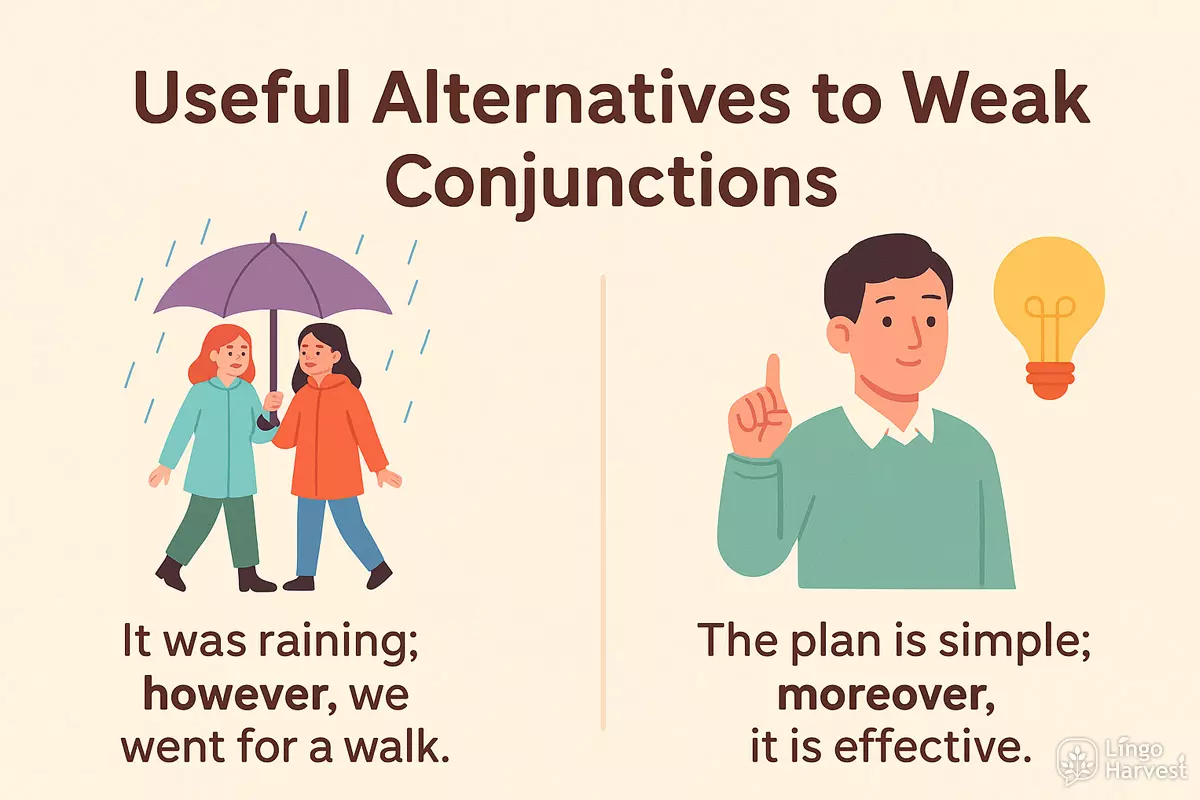
| However | contrast → It was raining; however, we went for a walk. |
| Moreover | addition → The plan is simple; moreover, it is effective. |
| Consequently | result → She didn’t study; consequently, she failed the exam. |
| Therefore | result/conclusion → The data is complete; therefore, we can proceed. |
| Although | concession → Although he was tired, he kept working. |
| In contrast | comparison → The north is cold; in contrast, the south is warm. |
| Furthermore | addition/emphasis → The method is fast; furthermore, it is reliable. |
| Nevertheless | concession/contrast → It was difficult; nevertheless, she succeeded. |
| As a result | result → He overslept; as a result, he missed the bus. |
| On the other hand | contrast → She loves cities; on the other hand, he prefers nature. |
| Whereas | comparison → She enjoys sports, whereas he enjoys reading. |
| Thus | result → The evidence was clear; thus, the case was closed. |
| Since | cause → Since it’s late, we should go home. |
| Because | reason → He stayed home because he felt sick. |
| Despite | concession → Despite the cold, they went hiking. |
| In addition | addition → The hotel is cheap; in addition, it’s near the beach. |
| Similarly | comparison → She loves cooking; similarly, her sister enjoys baking. |
| Instead | alternative/contrast → I didn’t buy coffee; instead, I made tea. |
Task 2: Revise a Paragraph
Rewrite the following paragraph by replacing all weak connectors with more precise options:
The study was limited in scope, and there were not enough participants. But the findings still provide useful insights, and future research could build on them. So, the authors suggest expanding the sample size in subsequent studies.
Show answers
The study was limited in scope; furthermore, there were not enough participants. Nevertheless, the findings still provide useful insights, and future research could build on them. Therefore, the authors suggest expanding the sample size in subsequent studies.
Common Weak vs. Strong Conjunctions
| Weak Conjunction | Stronger, More Precise Alternative |
|---|---|
| and | moreover, furthermore, in addition |
| but | however, nevertheless, on the other hand |
| so | therefore, thus, consequently, as a result |
| because | since, as, due to the fact that |
| or | alternatively, otherwise |
| if | provided that, unless, in the event that |
Practicing the replacement of generic conjunctions with more nuanced alternatives not only clarifies meaning but also strengthens your academic voice. Try applying these strategies to your own writing for better structure and persuasiveness.