Using Conjunctions to Control Paragraph Cohesion

 The article explains cohesion in advanced writing, focusing on how conjunctions link sentences and ideas. It covers choosing connectors based on paragraph goals, avoiding repetition, and includes academic examples and practice exercises.
Crafting clear and effective paragraphs relies on how smoothly ideas are linked, and using appropriate connecting words is essential for coherence. By mastering these transitional phrases, writers ensure their arguments and explanations flow logically, making the text easier for readers to understand. Strong connections between sentences and concepts not only enhance readability but also strengthen the overall message. Ultimately, thoughtful use of linking words transforms writing from a collection of separate thoughts into a unified, engaging narrative that guides the reader effortlessly from one point to the next.
What cohesion means in advanced writing
In sophisticated writing, cohesion refers to how well sentences and ideas stick together to form a logical, seamless flow. Rather than simply listing facts or opinions, effective authors weave their points into a connected whole. This is achieved through deliberate language choices, including the use of conjunctions, reference words, and structural signals that guide the reader from one idea to the next.
How cohesion shapes reader understanding
Cohesive writing allows readers to follow arguments or explanations without confusion. When transitions are smooth, the logic behind each sentence becomes clear and relationships between points are easier to grasp. Disconnected paragraphs, on the other hand, force the reader to fill in gaps, which can lead to misunderstandings or loss of interest.
Elements that build cohesion in academic and professional texts
- Logical connectors (e.g., however, therefore, furthermore)
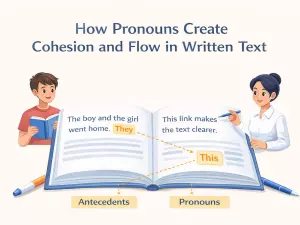
- Pronoun reference to link back to earlier ideas
- Consistent subject focus within and across paragraphs
- Parallel structure for related points
- Repetition of key terms or concepts (with moderation)
- Use of synonyms to avoid monotony but maintain clarity
- Clear topic sentences introducing paragraph focus
- Summary or concluding sentences tying points together
- Signposting phrases indicating order (e.g., firstly, in contrast)
- Ellipsis and substitution to avoid unnecessary repetition
- Explicit cause-and-effect language
- Comparison and contrast markers
- Reference to previous research or established facts
- Transition questions or rhetorical questions
- Time markers and sequence indicators
- Consistent verb tenses
Why conjunctions are vital for paragraph unity
Conjunctions act as the glue binding ideas at the sentence and paragraph level. They clarify whether a point adds information, signals a contrast, shows a result, or establishes a condition. Without these linking words, writing can feel abrupt or fragmented, making it difficult for readers to see how one idea leads to another.
| Type of Conjunction | Function in Cohesion | Examples |
|---|---|---|
| Additive | Connects similar or additional ideas | and, also, moreover, furthermore |
| Adversative | Signals contrast or opposition | but, however, on the other hand, yet |
| Causal | Shows cause, reason, or result | because, so, therefore, as a result |
| Temporal | Indicates time or sequence | then, after, finally, before |
Strong cohesion is not about overusing connectors, but about using them wisely to create a seamless, reader-friendly experience. By mastering these techniques, writers ensure that their arguments or narratives feel complete and persuasive from start to finish.
Role of conjunctions in linking sentences and ideas
Conjunctions are essential tools for connecting statements and shaping the logical flow of a paragraph. By joining clauses or whole sentences, they help readers follow the writer’s reasoning and see how ideas relate. Without them, writing can become choppy or confusing, making it difficult to understand relationships between points.
How conjunctions create cohesion
When you use conjunctions thoughtfully, you guide your audience from one thought to the next. They signal whether you’re adding information, showing contrast, explaining reasons, or presenting alternatives. This clarity lets readers grasp the structure of your arguments and the links between supporting details.
Types of relationships expressed
- Addition: Joining similar ideas (e.g., and, also, as well as).
- Contrast: Showing differences or exceptions (e.g., but, yet, however, although).
- Cause and effect: Explaining reasons or results (e.g., because, so, therefore, since).
- Choice/Alternative: Indicating options (e.g., or, either…or, neither…nor).
- Condition: Expressing requirements (e.g., if, unless, provided that).
- Time/Sequence: Showing order (e.g., when, before, after, while, until).
- Purpose: Indicating intention (e.g., so that, in order that).
- Comparison: Drawing parallels (e.g., as, just as, like, whereas).
- Emphasis: Highlighting points (e.g., even, indeed).
- Summary/Conclusion: Wrapping up ideas (e.g., thus, therefore, in conclusion).
Examples in context
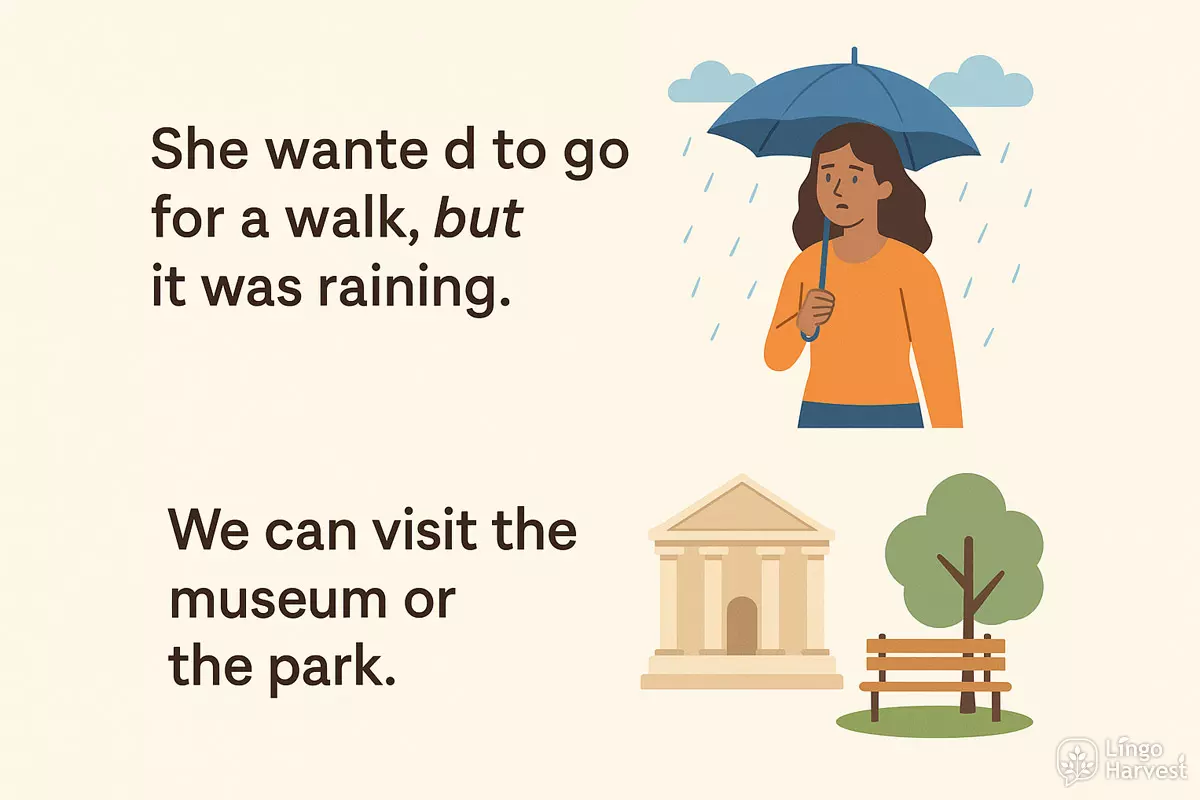
Consider these sentences:
- She wanted to go for a walk, but it was raining.
- We can visit the museum or the park.
- He studied hard so he passed the exam.
- If you call me, I will help you.
- Although it was cold, they went swimming.
Each conjunction here not only links two ideas but also clarifies how they relate, whether by contrast, choice, result, condition, or concession.
Comparing conjunction types
| Type | Common Conjunctions | Function |
|---|---|---|
| Coordinating | and, but, or, nor, for, so, yet | Joins words, phrases, or independent clauses of equal importance |
| Subordinating | because, although, if, when, since, unless | Links dependent clauses to main clauses, showing relationships like cause, time, or condition |
| Correlative | either…or, neither…nor, not only…but also, both…and | Pairs that work together to relate equal elements in a sentence |
| Conjunctive adverbs | however, therefore, moreover, meanwhile | Connects independent clauses and clarifies the relationship between ideas |
In summary, using appropriate linking words is one of the most effective strategies for building smooth, logical paragraphs. They not only connect sentences but also clarify meaning, making texts easier to read and understand.
Choosing conjunctions based on paragraph purpose
When writing a paragraph, the function of that paragraph determines which connectors make your ideas flow smoothly. Whether you’re explaining cause and effect, contrasting two ideas, or adding supporting details, the right conjunction helps clarify relationships and keeps your text cohesive for readers.
Matching conjunctions to paragraph goals
Writers often choose linking words based on the type of relationship they want to establish. For example, to show contrast, words like however or yet are useful. To add information, furthermore and in addition are common. Identifying your paragraph’s purpose makes it easier to pick a suitable connector.
Common paragraph purposes and their conjunctions
- Addition: and, also, moreover, besides, furthermore, in addition, as well as, plus
- Contrast: but, yet, however, nevertheless, although, even though, whereas, on the other hand, while
- Cause and Effect: because, since, so, therefore, thus, as a result, consequently, for this reason
- Comparison: similarly, likewise, just as, equally, in the same way
- Condition: if, unless, provided that, as long as, only if
- Time/Sequence: when, after, before, until, while, as soon as, meanwhile, then, subsequently
- Emphasis: indeed, in fact, certainly, above all, especially
- Summary/Conclusion: in conclusion, to sum up, overall, in short, finally, thus
- Example/Illustration: for example, for instance, such as, namely, to illustrate
- Purpose: so that, in order that, for the purpose of, to
Comparing conjunctions for different paragraph functions
| Paragraph Function | Typical Conjunctions & Linking Words |
|---|---|
| Addition | and, also, moreover, furthermore, besides |
| Contrast | but, yet, however, although, nevertheless, whereas |
| Cause/Effect | because, so, therefore, thus, as a result, since |
| Time/Sequence | when, after, before, then, meanwhile, subsequently |
| Condition | if, unless, as long as, provided that, only if |
Tips for effective selection
Choosing the right connector isn’t just about grammar; it’s about guiding your reader. Reflect on what your paragraph is trying to do. Are you explaining, comparing, or concluding? Test your sentence with different conjunctions and see which one best clarifies the connection. If the relationship between ideas is subtle, opt for a more specific connector instead of a general one. This attention to detail helps your paragraph achieve its intended purpose and improves overall cohesion.
Avoiding mechanical or repetitive linking
Writers often fall into the habit of starting sentences with the same conjunction, or using predictable patterns to connect ideas. This can make writing feel monotonous and artificial, even if each sentence is technically correct. Instead, strive for variety and subtlety when linking sentences and paragraphs. Not every transition needs to be overtly marked by a connector; sometimes, logical flow and context are enough.
Recognizing Overused Conjunctions
Certain words like "and," "but," and "however" are frequently chosen to begin sentences or connect clauses. While these are useful, relying on them too much can dull your writing. Identifying your most commonly used connectors is the first step toward more dynamic paragraph cohesion.
- And → She opened the window and let fresh air in.
- But → He wanted to join us, but he was too tired.
- However → It was cold; however, they still went hiking.
- Therefore → She saved money; therefore, she could buy a new laptop.
- So → It started raining, so we ran inside.
- Because → They stayed home because it was snowing heavily.
- Although → Although he was nervous, he did well on stage.
- Meanwhile → She cooked dinner; meanwhile, he cleaned the house.
- Furthermore → The course is useful; furthermore, it’s affordable.
- In addition → He speaks French. In addition, he knows Spanish.
- On the other hand → She loves cities; on the other hand, he prefers nature.
- Consequently → The company expanded rapidly; consequently, they hired more staff.
- Nevertheless → The task was difficult; nevertheless, he completed it.
- For example → Many fruits are high in vitamin C; for example, oranges and strawberries.
- Thus → The evidence was clear; thus, the conclusion was accepted.
- Yet → She trained hard, yet she didn’t win.
- Moreover → The hotel is affordable; moreover, it has great reviews.
- Afterwards → They had dinner; afterwards, they watched a movie.
- Otherwise → Wear warm clothes; otherwise, you’ll get cold.
- Instead → He didn’t buy coffee; instead, he made some at home.
Strategies to Vary Connections
To keep your text engaging, alternate between explicit connectors and more implicit forms of cohesion. Here are several practical approaches:
- Use pronouns or synonyms to refer back to earlier ideas.
- Vary sentence structure—combine short, direct sentences with longer, complex ones.
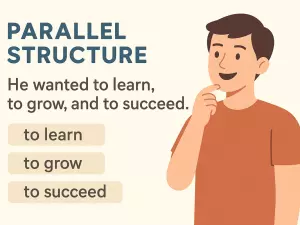
- Employ parallel structure for emphasis without repetitive linking words.
- Let context and logical order guide the reader, reducing the need for frequent transitions.
- Integrate transitional phrases within sentences, not only at the beginning.
- Occasionally omit a connector when the relationship is clear from meaning.
- Use questions to naturally bridge ideas.
- Summarize previous points before introducing new ones.
Examples: Dull vs. Dynamic Linking
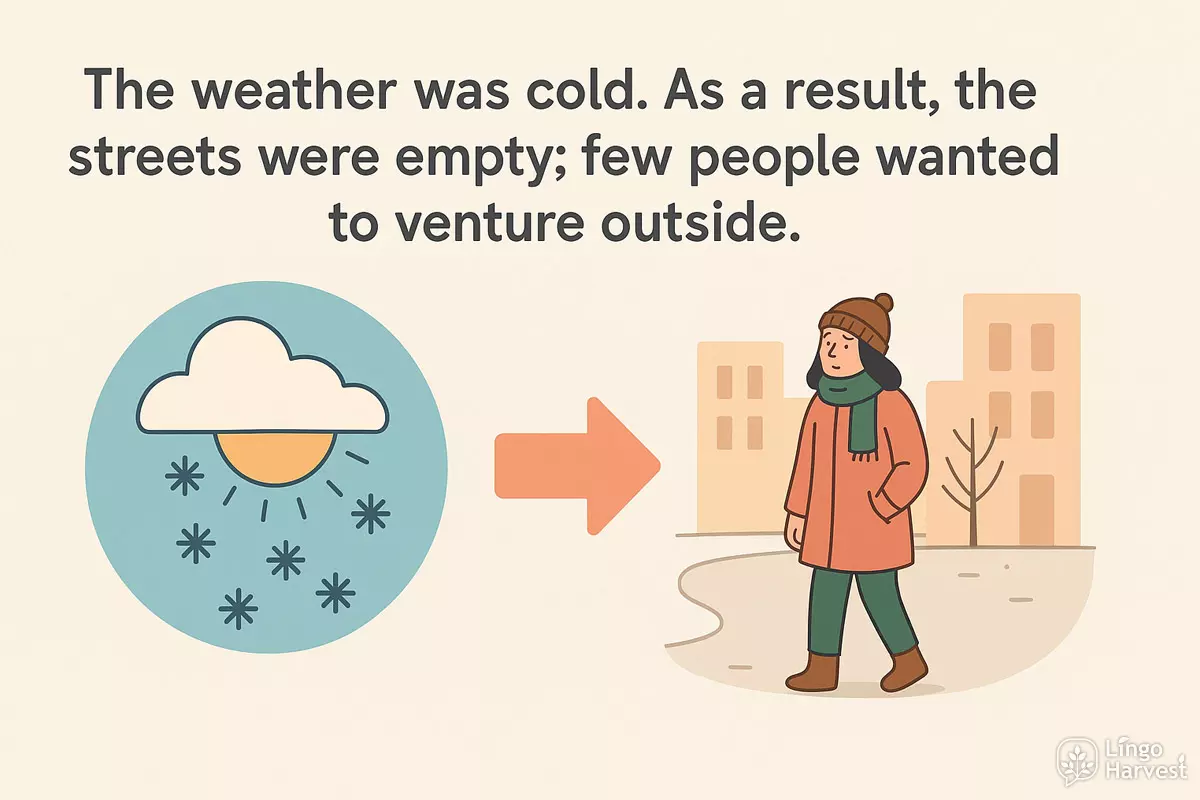
Notice how varying your approach to cohesion can significantly change the feel of a paragraph. Compare these two approaches:
| ❌ Mechanical Linking | ✅ Varied Linking |
|---|---|
| And the weather was cold. And the streets were empty. And nobody wanted to go outside. | The weather was cold. As a result, the streets were empty; few people wanted to venture outside. |
| However, she disagreed. However, her reasons were unclear. However, the discussion continued. | She disagreed, though her reasons remained unclear. The discussion, nevertheless, continued. |
| Therefore, the team decided to wait. Therefore, they postponed the meeting. Therefore, everyone went home early. | The team decided to wait, which led them to postpone the meeting and leave early. |
| But the solution was expensive. But they needed results. But time was running out. | The solution was expensive; even so, they needed results as time was running out. |
When to Use Explicit Links
Not every sentence or paragraph needs a conjunction at the start. Use explicit transitions when clarity or emphasis is needed, but trust your reader to follow logical connections elsewhere. Balancing overt and subtle linking makes your writing more natural and engaging.
Examples from well-structured academic paragraphs
Academic writing relies on clear connections between ideas, and conjunctions play a vital role in achieving cohesive, logical paragraphs. Below are authentic sentence patterns and typical uses of conjunctions that help unify academic prose. Each example demonstrates how linking words guide readers through arguments, explanations, and comparisons.
Common Patterns Using Conjunctions
Writers often use conjunctions to introduce evidence, contrast points, or add information. Here are some practical sentence openings and structures found in scholarly writing:
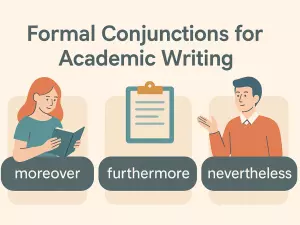
- Furthermore, recent studies support the initial hypothesis.
- However, the results did not align with previous research.
- Because the sample size was limited, the findings should be interpreted cautiously.
- In addition, the experiment included a control group to enhance reliability.
- Although the data suggest improvement, further testing is required.
- Therefore, the proposed model may be applicable to other contexts.
- For example, Smith et al. (2021) found similar outcomes in their trial.
- Nevertheless, some variables remained unaccounted for.
- Since all participants received the same treatment, bias was minimized.
- Conversely, other scholars argue for a different interpretation.
- As a result, policy changes were recommended.
- While the majority agreed, a minority expressed concerns.
- Thus, further investigation is warranted.
- Yet, limitations must be acknowledged.
- Moreover, the findings contribute to ongoing debates.
- On the other hand, alternative explanations exist.
- Even though the evidence is compelling, questions remain.
- In contrast, earlier studies reported opposite results.
- Because of this, future research should address these gaps.
- Therefore, the conclusions drawn are tentative.
Comparison of Conjunction Types in Academic Cohesion
To illustrate how different conjunctions serve distinct functions, the table below compares their typical uses in scholarly writing:
| Conjunction Type | Academic Function | Example |
|---|---|---|
| Additive (e.g., moreover, in addition) | Introduces supporting evidence or additional points | Moreover, the data confirm previous findings. |
| Adversative (e.g., however, nevertheless) | Signals contrast or exception | However, certain factors were not considered. |
| Causal (e.g., therefore, because) | Indicates cause-effect or justification | Because the sample was small, results are tentative. |
| Temporal (e.g., subsequently, meanwhile) | Shows sequence or timing | Subsequently, the researchers repeated the experiment. |
How Conjunctions Guide Readers
Linking words and phrases do more than just connect clauses—they clarify relationships and signal the flow of reasoning. By choosing appropriate conjunctions, writers ensure that each sentence builds naturally on the last, helping readers follow complex arguments without confusion. This technique is essential for writing that is both persuasive and easy to understand.
Practice: improve coherence by adjusting conjunction use
Improving the flow between sentences often depends on how well you use connecting words. Conjunctions link ideas, clarify relationships, and help readers follow your reasoning. Below, you’ll find targeted exercises and examples to help you refine your use of connectors for smoother, more logical paragraphs.
Identify and Revise Weak Connections
Read the following sentences. Consider whether the conjunctions used help ideas flow logically. Rewrite each sentence or pair to improve coherence by selecting a more accurate or precise connector.
- The report was finished late, and it was still very thorough.
- She wanted to join the team, but she missed the deadline.
- They had little experience, so they succeeded.
- He didn’t understand the instructions, yet he completed the task correctly.
- The weather was terrible, but the event was successful.
- He studied very little, and he passed the exam.
- She was offered a promotion, but she refused it.
- The restaurant was full, so we found another place.
- They disagree on many issues, but they work together.
- The film was long, and it was interesting.
Show answers
- The report was finished late, yet it was still very thorough.
- She wanted to join the team, however, she missed the deadline.
- They had little experience, but they succeeded.
- He didn’t understand the instructions, but he completed the task correctly.
- The weather was terrible; nevertheless, the event was successful.
- He studied very little; nevertheless, he passed the exam.
- She was offered a promotion; however, she refused it.
- The restaurant was full; therefore, we found another place.
- They disagree on many issues; however, they work together.
- The film was long, yet it was interesting.
Choose the Best Conjunction
For each blank, select the most appropriate conjunction to clearly express the relationship between the ideas.
- They wanted to play outside, ______ it was already dark.
- The meeting was postponed ______ the presenter was sick.
- I enjoy cooking, ______ I don’t like washing dishes.
- He failed the exam, ______ he didn’t prepare well.
- We decided to stay home, ______ the weather looked terrible.
- She bought a new phone, ______ her old one was still working.
- The restaurant was full, ______ we managed to find a table.
- He didn’t set an alarm, ______ he woke up late.
- I wanted to help, ______ I didn’t know what to do.
- They kept talking, ______ the teacher asked them to stop.
Show answers
- but
- because
- but
- because
- because
- although
- yet
- so
- but
- although
Common Conjunctions and Their Functions
Different conjunctions serve different purposes. Here’s a quick reference list to help you choose the right one for your intended meaning:
- and – adds similar ideas
- but – shows contrast
- or – presents alternatives
- so – indicates result
- because – explains reason
- although – expresses concession
- since – gives cause or time
- while – shows contrast or time
- however – introduces a contrast (often between sentences)
- therefore – shows logical result
- yet – signals unexpected contrast
- unless – gives exception
- whereas – highlights difference
- nevertheless – contrasts despite a previous point
- instead – shows alternative
- meanwhile – indicates simultaneous action
- as a result – introduces a consequence
- in addition – adds information
- otherwise – shows consequence of not doing something
- even though – emphasizes contrast
Before-and-After Paragraph Revision
Below is a short paragraph with weak or missing cohesion. Read it, then revise using more precise conjunctions to improve the flow.
Original:
The company launched a new product. The market was crowded. They hoped for success. Sales were low. They adjusted their strategy. Sales improved.
Show answers
Revised:
The company launched a new product, although the market was crowded. Nevertheless, they hoped for success. Initially, sales were low, so they adjusted their strategy. As a result, sales improved.
Compare Conjunctions for Nuance
Different connectors can subtly change the meaning or emphasis in a sentence. The table below compares several pairs of conjunctions, showing their preferred uses.
| Conjunction | Typical Use / Example |
|---|---|
| but | Shows simple contrast She was tired, but she finished the report. |
| however | Introduces a contrasting idea, often across sentences She was tired. However, she finished the report. |
| so | Expresses direct cause and effect He missed the bus, so he was late. |
| therefore | Indicates logical result, often more formal He missed the bus. Therefore, he was late. |
| although | Shows contrast within a clause Although it was raining, they played outside. |
| yet | Signals a surprising or unexpected contrast The task was difficult, yet he succeeded. |
Through regular practice and careful attention to connector choice, your paragraphs will become clearer and more cohesive for your readers.