Repairing Ambiguous Meaning Caused by Wrong Conjunction Choice

 Here we how incorrect conjunctions cause unclear meaning, how to identify hidden relationships between ideas, and ways to choose accurate conjunctions. It includes examples, guidelines, and practice for correcting ambiguous sentences.
- How incorrect conjunction choice creates unclear meaning
- Identifying hidden relationships between ideas
- Replacing vague or incorrect conjunctions with accurate ones
- Examples showing shifts in meaning after correction
- Guidelines for choosing the right logical connection
- Practice: repair ambiguous sentences in short texts
Misusing connecting words can transform a clear message into a confusing puzzle, making it difficult for readers to understand your true intent. This article explains how to recognize and correct sentences that become muddled due to the use of inappropriate conjunctions. By learning to choose the right connecting words, you can improve the clarity and effectiveness of your writing, ensuring your ideas are communicated precisely and your readers are never left guessing about your meaning.
How incorrect conjunction choice creates unclear meaning
Choosing the wrong conjunction can lead to sentences that confuse readers or listeners, making it hard to understand the relationship between ideas. Instead of clarifying connections—like cause, contrast, or addition—a misplaced conjunction might blur the intent, resulting in ambiguity or even misinterpretation.
Common ways misuse leads to confusion
- Implying a different logical relationship than intended (e.g., cause instead of contrast)
- Making it unclear whether information is being added, contrasted, or explained
- Suggesting the wrong sequence or condition
- Creating run-on sentences that lose focus
- Omitting necessary conjunctions, leading to choppy or incomplete thoughts
Examples of ambiguous meaning from incorrect conjunctions
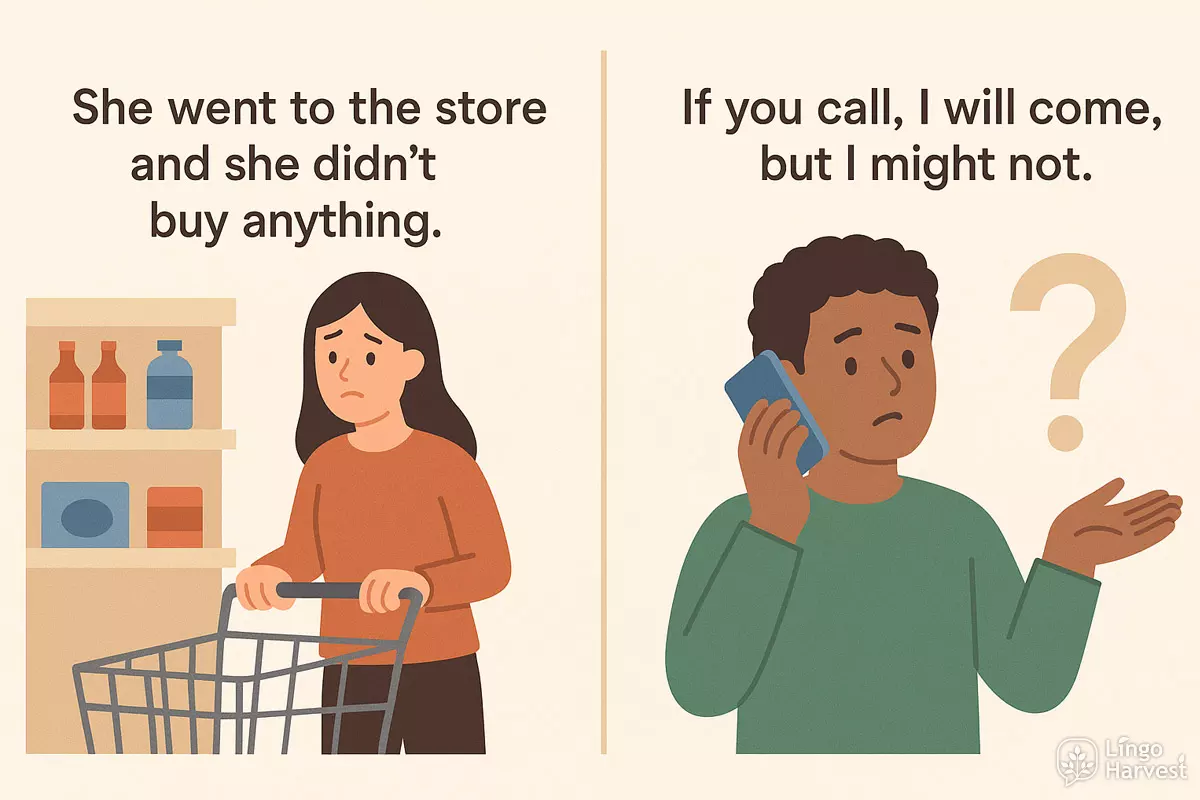
- She went to the store and she didn’t buy anything. (Does “and” show a natural sequence, or should it be “but” to show contrast?)
- If you call, I will come, but I might not. (Mixes condition and contrast, causing unclear meaning.)
- He studied hard or he failed the test. (“Or” suggests choice, but the sentence may need “yet” or “but”.)
- They can eat now because they’re hungry. (Is hunger the cause, or is it simply permission? “So” might be clearer.)
- I will go unless it rains and I forget my umbrella. (Unclear if “and” joins two conditions or if rewriting is needed.)
- We arrived early, so the doors were locked. (Is this a real result or just a coincidence? “But” may express contrast better.)
- Take your umbrella, or you’ll get wet if it rains. (Mixes alternatives and conditions, leading to confusion.)
- She’s coming to the meeting although she’s busy and tired. (“Although” shows contrast, but “and” may blend reasons awkwardly.)
- He finished his project because he wanted to watch TV. (“Because” may not show a clear causal link; “so” could be clearer.)
- We could go to the park but it’s closed or raining. (Unclear whether “or” gives reasons or alternatives.)
Comparing conjunction choices and their effects
| Original sentence | Possible interpretations |
|---|---|
| She was tired and she went home. | Does “and” mean she went home because she was tired, or are these unrelated? |
| He didn’t study, so he passed the test. | “So” suggests not studying led to passing, which may not be logical. |
| You can have tea or coffee and cake. | Unclear if “and cake” applies to both tea and coffee, or only coffee. |
| I will call you if I arrive early but not before noon. | Uncertain if “but not before noon” limits “arrive early” or the calling action. |
Why clarity matters
When conjunctions are chosen carelessly, sentences can mislead or force readers to guess the writer’s intention. This can affect academic writing, business communication, and everyday conversation, leading to misunderstandings or errors. Using the right connector ensures your message is precise, logical, and easy to follow.
Identifying hidden relationships between ideas
Understanding how ideas connect is crucial for repairing sentences where conjunctions have caused ambiguity. Often, the reason meaning gets muddled is that the logical relationship—such as cause and effect, contrast, or addition—is not clearly signaled by the chosen word. To clarify, it's helpful to look at the underlying logic between clauses before selecting a conjunction.
Spotting Implicit Connections
Writers sometimes assume readers will infer the relationship between two thoughts, but this can lead to confusion. Ask yourself questions like: Does the second idea contrast with the first? Is it a result, a condition, or just another point? Pinpointing the type of link helps avoid the trap of using vague connectors like "and" or "but" incorrectly.
- Does one idea explain or clarify the other?
- Is there a sequence or timeline implied?
- Are you introducing an exception or contrast?
- Is one idea the reason for the other?
- Are both ideas equally important, or is one subordinate?
- Do the ideas share a common cause or condition?
- Is the relationship hypothetical (if...then)?
- Does one idea provide an example for the other?
- Are you listing similar or related points?
- Is there an implied comparison?
- Does the second idea limit or restrict the first?
- Are you restating an idea in a different way?
Common Types of Relationships
Choosing the right conjunction depends on recognizing the specific link between parts of your sentence. Here are some typical relationships and the conjunctions that best express them:
| Relationship | Effective Conjunctions |
|---|---|
| Addition | and, also, furthermore, as well as |
| Contrast | but, however, yet, although |
| Cause/Effect | because, so, therefore, since |
| Condition | if, unless, provided that |
| Example/Clarification | for example, that is, namely |
| Comparison | like, as, whereas |
Practical Tips
To avoid ambiguity, always double-check which conjunction matches the real relationship between your ideas. If you’re unsure, try rephrasing the sentence or breaking it into two parts. Sometimes, a clearer structure reveals the hidden link and makes your meaning unmistakable.
Replacing vague or incorrect conjunctions with accurate ones
Choosing the right conjunction is essential for expressing clear relationships between ideas. When the wrong linking word is used, it can lead to confusion or even change the intended meaning of a sentence. It's important to understand the specific function of each conjunction and match it to the context.
Common pitfalls and how to address them
Writers sometimes pick connectors that sound correct but don’t convey the precise relationship. For example, using "while" instead of "although" can create ambiguity about contrast versus simultaneity. To prevent this, review the logic connecting your clauses and select a term that matches that logic.
- And – adds information of equal importance.
- But – introduces a contrast or exception.
- Because – explains reason or cause.
- Although – signals a concession or unexpected contrast.
- Since – can indicate time or cause (context matters).
- While – shows contrast or simultaneous actions; be clear which meaning is intended.
- So – shows result or consequence.
- If – introduces a condition.
- Unless – sets a negative condition.
- Therefore – presents a logical result or deduction.
- Whereas – emphasizes contrast between two facts.
- Yet – introduces a surprising contrast.
- For – literary/formal way to state a reason.
- Or – offers an alternative or choice.
- Nor – connects two negative ideas.
- Though – informal contrast, often at the end of a sentence.
- Even though – emphasizes a stronger contrast than "although".
- As – can mean "because" or "while"; clarify intent.
- Yet – introduces something unexpected.
- So that – expresses purpose or result.
Recognizing and revising ambiguous connectors
When editing, watch for sentences where the link between ideas is unclear or could be interpreted in more than one way. If you spot a vague joining word, consider what relationship you mean to show: reason, contrast, addition, time, or condition. Swap the ambiguous word for one that states this relationship unambiguously.
| Ambiguous/Wrong Conjunction | Clearer Alternative & Explanation |
|---|---|
| While (for contrast) | Whereas or although – Use these to clarify contrast, not just simultaneous actions. |
| Since (for time vs. cause) | Because (for cause), after (for time) – Specify the intended relationship. |
| And (before contrasting idea) | But or yet – Use to emphasize opposition or contradiction. |
| As (for reason or time) | Because (reason), while (time) – Avoid "as" if it could be misread. |
| So (unclear outcome) | Therefore or so that – Makes the result or purpose explicit. |
| Though (at sentence end) | Although (at start), yet (for contrast) – Improves clarity, especially in formal writing. |
Tips for choosing accurate conjunctions
- Identify the relationship between your clauses: is it cause, contrast, addition, time, or condition?
- Replace connectors that could signal more than one meaning with a more precise word.
- Re-read sentences aloud to check for unintended ambiguity.
- In formal writing, avoid informal connectors at the end of sentences.
- Use punctuation (like commas or semicolons) to reinforce the intended connection where necessary.
Using precise conjunctions helps your writing flow logically and reduces the risk of misinterpretation. Regularly reviewing your sentences for these issues can greatly improve clarity.
Examples showing shifts in meaning after correction
When the wrong conjunction is chosen in a sentence, it can create confusion or even completely alter the intended message. Revising these sentences by selecting the appropriate linking word often makes the meaning clearer and more precise. Below are several real-world examples where a small change in conjunction dramatically impacts interpretation.
How conjunctions shift meaning
The effect of conjunctions like "and," "but," "or," and "so" is often underestimated. Swapping one for another may signal contrast instead of addition, choice instead of consequence, or causality instead of mere sequence. Here are some illustrative pairs:
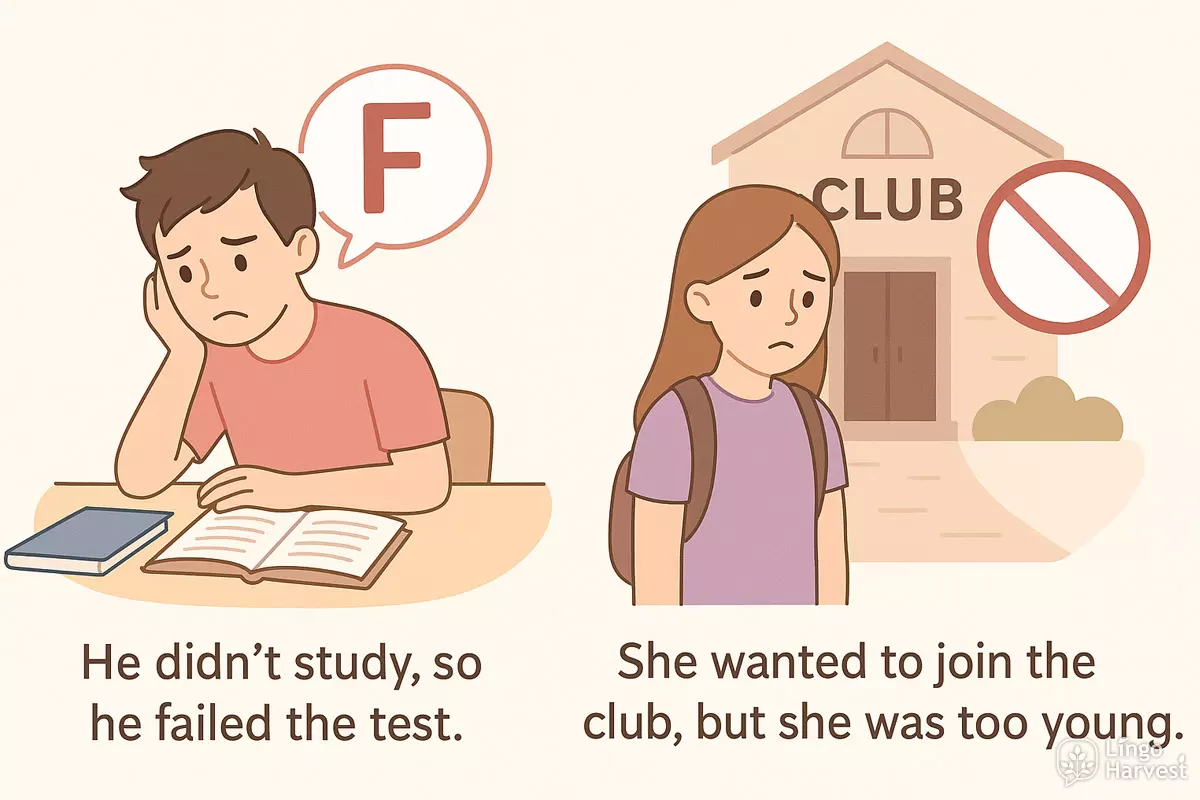
- Incorrect: He didn’t study, and he failed the test.
Corrected: He didn’t study, so he failed the test.
Shift: The first implies two unrelated facts; the second shows cause and effect. - Incorrect: She wanted to join the club, but she was too young.
Corrected: She wanted to join the club, but she was too young.
No correction needed, but if "and" were used, the meaning would lack contrast. - Incorrect: You can have tea, and coffee.
Corrected: You can have tea or coffee.
Shift: "And" implies both; "or" presents a choice. - Incorrect: We were tired, but we went home.
Corrected: We were tired, so we went home.
Shift: The conjunction changes the relationship from contrast to result. - Incorrect: He studied hard, but he passed.
Corrected: He studied hard, and he passed.
Shift: "But" suggests passing was unexpected; "and" simply links related facts. - Incorrect: Call me if you arrive, and I’ll pick you up.
Corrected: Call me if you arrive, so I can pick you up.
Shift: "And" implies parallel actions; "so" expresses purpose. - Incorrect: I will go to the store, or buy some bread.
Corrected: I will go to the store and buy some bread.
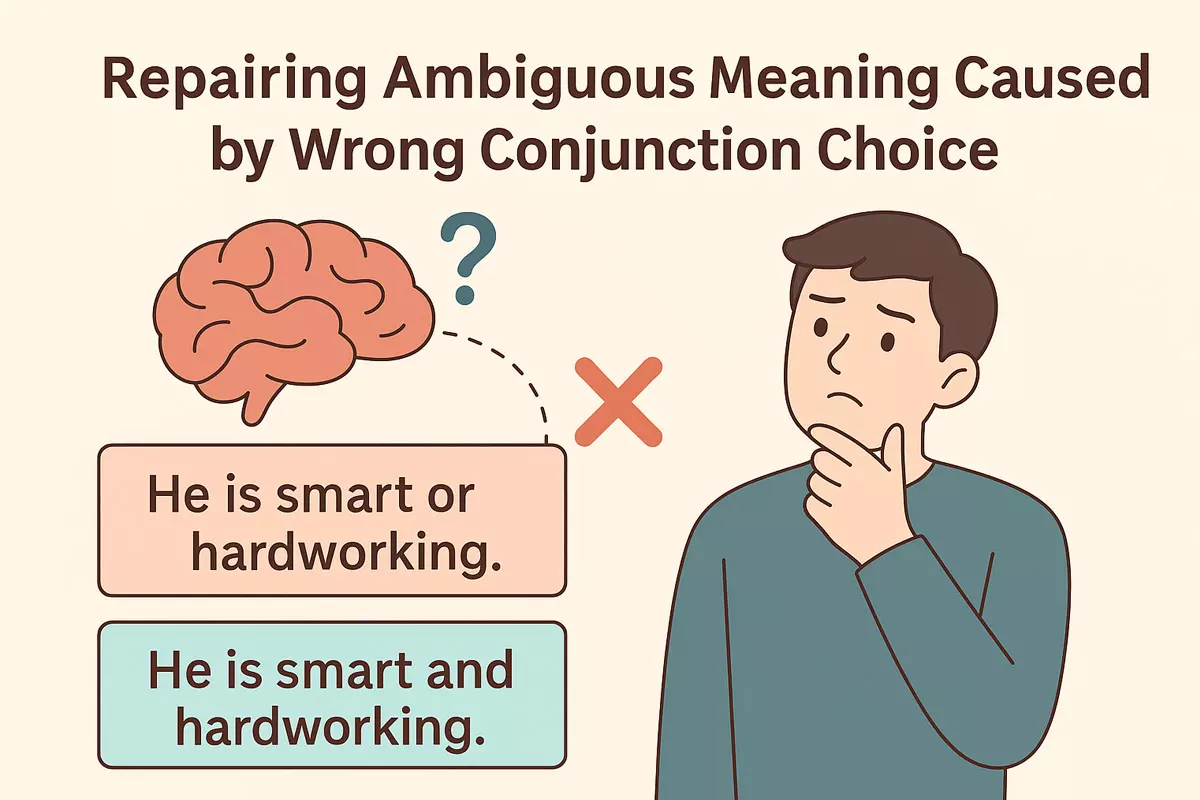
Shift: "Or" offers alternatives; "and" indicates both actions will happen. - Incorrect: She is smart, so she is hardworking.
Corrected: She is smart and hardworking.
Shift: "So" implies causality where none exists; "and" lists qualities. - Incorrect: You must hurry, but you will miss the train.
Corrected: You must hurry or you will miss the train.
Shift: "But" signals contrast; "or" expresses a consequence. - Incorrect: He is not only talented, but also dedicated.
Corrected: He is not only talented but also dedicated.
Shift: Removing the comma aligns with standard usage, avoiding ambiguity. - Incorrect: She didn’t call, and I was worried.
Corrected: She didn’t call, so I was worried.
Shift: "And" just adds information; "so" shows a result. - Incorrect: Finish your homework, and you can play.
Corrected: Finish your homework or you can't play.
Shift: "And" may sound permissive; "or" sets a condition.
Summary comparison of conjunction corrections
| Original Sentence | Meaning After Correction |
|---|---|
| I was late, and I missed the meeting. | I was late, so I missed the meeting. Clarifies cause and effect. |
| She likes apples, or she eats them often. | She likes apples, and she eats them often. Links two related facts, not alternatives. |
| You can stay, but you can leave. | You can stay or you can leave. Makes the options mutually exclusive. |
| He didn’t call, and I was upset. | He didn’t call, so I was upset. Shows that one event led to the other. |
These sample sentences highlight how a minor grammatical adjustment can resolve ambiguity and direct the reader toward the writer’s intended meaning. By carefully selecting conjunctions, writers can avoid miscommunication and produce clearer, more effective sentences.
Guidelines for choosing the right logical connection
Selecting the most appropriate conjunction is crucial for expressing clear and unambiguous relationships between ideas. Before choosing a linking word, consider what type of connection you want to convey: addition, contrast, cause, condition, or result. Misusing connectors like "but," "and," or "because" can confuse your reader and obscure your intended meaning.
Consider the relationship between ideas
Ask yourself how the two clauses or sentences relate. Are you adding similar information, showing contrast, explaining a reason, or stating a consequence? Identifying this relationship helps you pick a logical connector that matches your meaning.
- Addition: and, also, moreover, furthermore
- Contrast: but, however, although, yet, nevertheless
- Cause/Reason: because, since, as, due to
- Result/Consequence: so, therefore, thus, consequently
- Condition: if, unless, provided that, in case
- Alternative/Choice: or, either...or, whether...or
- Purpose: so that, in order that, for
- Time: when, after, before, while, as soon as
- Concession: although, even though, though
- Comparison: as...as, than, like
Common pitfalls and how to avoid them
Writers often confuse connectors with similar meanings or use them in the wrong context. For example, substituting "but" for "and" can introduce unintended contrast. Double-check whether your chosen conjunction accurately reflects the intended logic.
Quick reference: connector types and uses
| Connector Type | Typical Conjunctions & Usage |
|---|---|
| Addition | and, also, as well as, in addition, moreover |
| Contrast | but, yet, however, although, nevertheless |
| Cause/Reason | because, since, as, due to, owing to |
| Result/Consequence | so, therefore, thus, as a result, consequently |
| Condition | if, unless, provided that, in case |
| Purpose | so that, in order that, for the purpose of |
| Time | when, after, before, while, since, as soon as |
| Concession | although, even though, though, whereas |
Tips for making the right choice
- Read your sentence aloud to check for logical flow.
- Replace the conjunction with another one to see if the meaning changes.
- Be wary of words with multiple functions (e.g., "since" for time and cause).
- When in doubt, split a complex sentence into two simpler ones.
- Consult a list of conjunctions to ensure your choice fits the context.
By carefully analyzing the relationship between your ideas and reviewing your connector choices, you can avoid ambiguity and make your writing clearer and more effective.
Practice: repair ambiguous sentences in short texts
Understanding how conjunctions can create confusion is crucial for clear writing. Below, you'll find exercises that help you identify and fix sentences where the wrong conjunction leads to unclear or double meanings. Try to rewrite each sentence for clarity, paying attention to how the conjunction changes the sense of the sentence.
Common Ambiguous Sentences Caused by Wrong Conjunctions
Writers often misuse conjunctions like "and," "or," "but," and "while," which can make a sentence unclear. Here are typical patterns of ambiguity:
- Mixing "and" when contrast is intended ("but" or "while" is needed).
- Using "or" where both options are possible, but only one is meant.
- Placing "while" to mean both "at the same time" and "although," leading to confusion.
- Combining unrelated clauses with "and" instead of separating or clarifying them.
- Using "because" when the real relationship is contrast, not cause.
- Pairing "although" with a positive result, when "so" or "but" would fit better.
- Confusing "since" (time) with "since" (cause).
- Misusing "unless" to mean "if not," leading to double negatives.
- Ambiguous coordination: "She spoke to the manager and the assistant was helpful."
- Incorrect conditional: "If you call me and I am busy, I will call you back."
- Ambiguous result: "He missed the meeting because he overslept and the train was late."
- Misplaced "while": "He finished the report while he was tired."
- Using "and" instead of "so": "I was late and I missed the bus."
- Incorrect "or": "You can have tea or coffee and cake."
- Improper "but": "She is smart but hardworking."
- Ambiguous "since": "Since he left, the team improved."
- Unclear "because": "He apologized because he was rude."
- Double conjunctions: "Although she was tired but she finished the work."
- Wrong sequence: "He went home and he finished his work."
- Unclear alternatives: "We can eat now or after the movie and go home."
Exercise: Clarify Ambiguous Sentences
Read each sentence. Identify the confusion caused by the conjunction, then rewrite it to make the meaning clear.
- He missed the meeting because he overslept and the train was late.
- You can have tea or coffee and cake.
- She is smart but hardworking.
- If you call me and I am busy, I will call you back.
- He finished the report while he was tired.
- Although she was tired but she finished the work.
- Since he left, the team improved.
- We can eat now or after the movie and go home.
- He apologized because he was rude.
- I was late and I missed the bus.
Show answers
- He missed the meeting because he overslept and because the train was late. / He missed the meeting because he overslept, and the train was late. (Clarifies if both are causes or separates events.)
- You can have tea or coffee, and cake. / You can have tea and cake or coffee and cake. (Clarifies if cake is included with both drinks.)
- She is smart and hardworking. / She is smart but not hardworking. (Clarifies contrast or addition.)
- If you call me when I am busy, I will call you back. (Clarifies the condition.)
- He finished the report, even though he was tired. / He finished the report while being tired. (Clarifies time vs. contrast.)
- Although she was tired, she finished the work. / She was tired but finished the work. (Removes double conjunction.)
- Since he left, the team has improved. / The team improved after he left. (Clarifies time vs. cause.)
- We can eat now and then go home after the movie. / We can eat now or after the movie, and then go home. (Clarifies sequence.)
- He apologized for being rude. / He apologized because he realized he was rude. (Clarifies reason and action.)
- I was late, so I missed the bus. / I missed the bus, and that made me late. (Clarifies cause and result.)
Quick Review: Conjunction Correction Tips
- Always check if your conjunction expresses addition, contrast, cause, or time.
- If a sentence feels unclear, try splitting it or changing the conjunction.
- When in doubt, read the sentence aloud to spot double meanings.
- Use punctuation (commas, semicolons) to separate ideas when needed.
- Remember that "and" joins similar ideas, "but" shows contrast, "so" shows result, "or" gives alternatives, and "because" gives reasons.