Mixed Test: Coordinating + Subordinating + Correlative

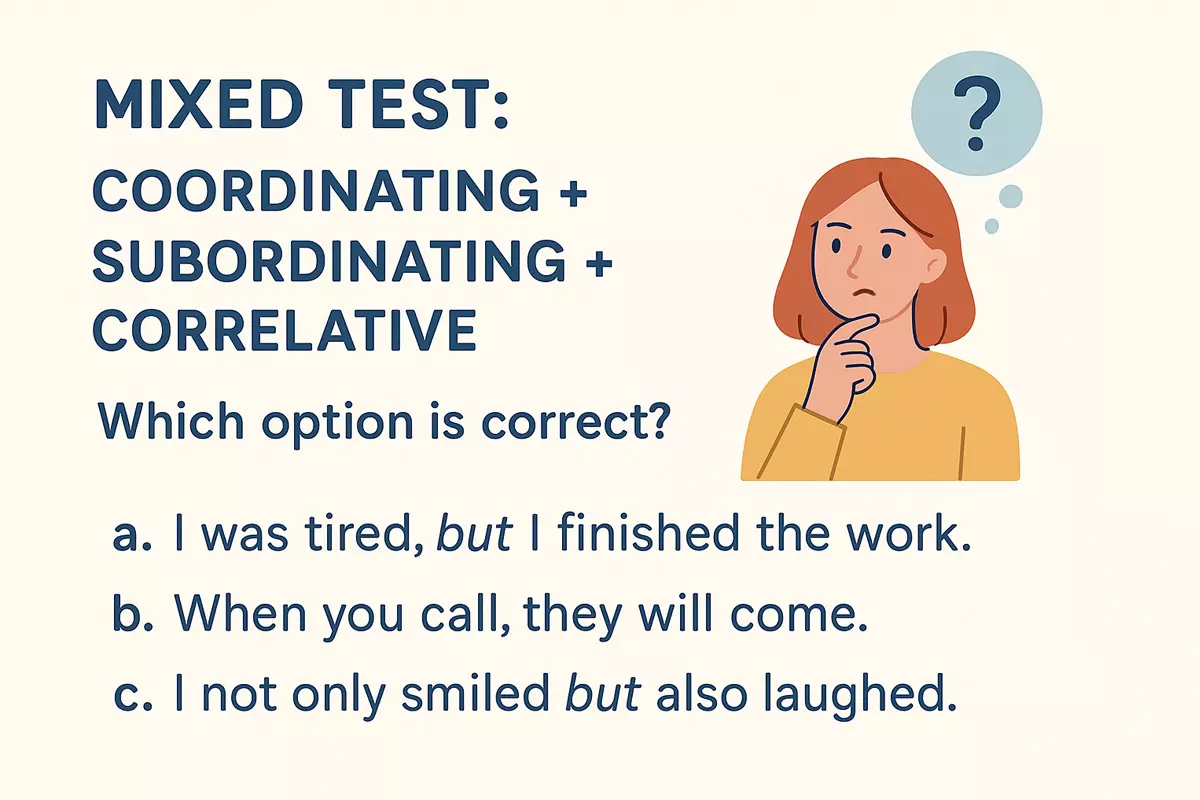 This article reviews coordinating, subordinating, and correlative conjunctions. It includes exercises to identify conjunction types, select suitable options, rewrite sentences with different conjunctions, and provides an answer key with explanations.
- Quick review of the three main types of conjunctions
- Part 1: identify the type of conjunction in each sentence
- Part 2: fill in gaps with a suitable conjunction from mixed options
- Part 3: rewrite sentences using a different type of conjunction
- Short paragraph for editing: improve conjunction choice and variety
- Answer key with classification, correct options, and sample rewrites
Understanding how various conjunctions function together enhances both writing and communication abilities. Mastering the use of linking words—whether they join equal ideas, connect clauses, or pair phrases—allows you to construct sentences that are not only more complex but also more engaging. This skill helps your writing flow smoothly, clarifies relationships between ideas, and makes your arguments or narratives more convincing. Developing a command of conjunctions ultimately leads to clearer, more dynamic, and effective expression in any context.
Quick review of the three main types of conjunctions
Understanding conjunctions is key to creating clear, complex sentences. English uses three main categories, each with a distinct function and set of examples.
1. Coordinating Conjunctions
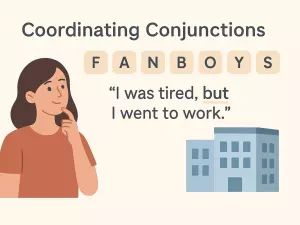
Coordinating conjunctions connect words, phrases, or independent clauses of equal grammatical rank. The classic list is remembered with the acronym FANBOYS:
- For – explains reason or purpose (“She was tired, for she had not slept well.”)
- And – adds one element to another (“He bought apples and oranges.”)
- Nor – presents a non-contrasting negative idea (“He did not call, nor did he write.”)
- But – shows contrast (“She is small but strong.”)
- Or – offers an alternative or choice (“Would you like coffee or tea?”)
- Yet – introduces a contrasting idea (“He is rich, yet unhappy.”)
- So – indicates effect, result, or consequence (“It was raining, so they stayed inside.”)
2. Subordinating Conjunctions
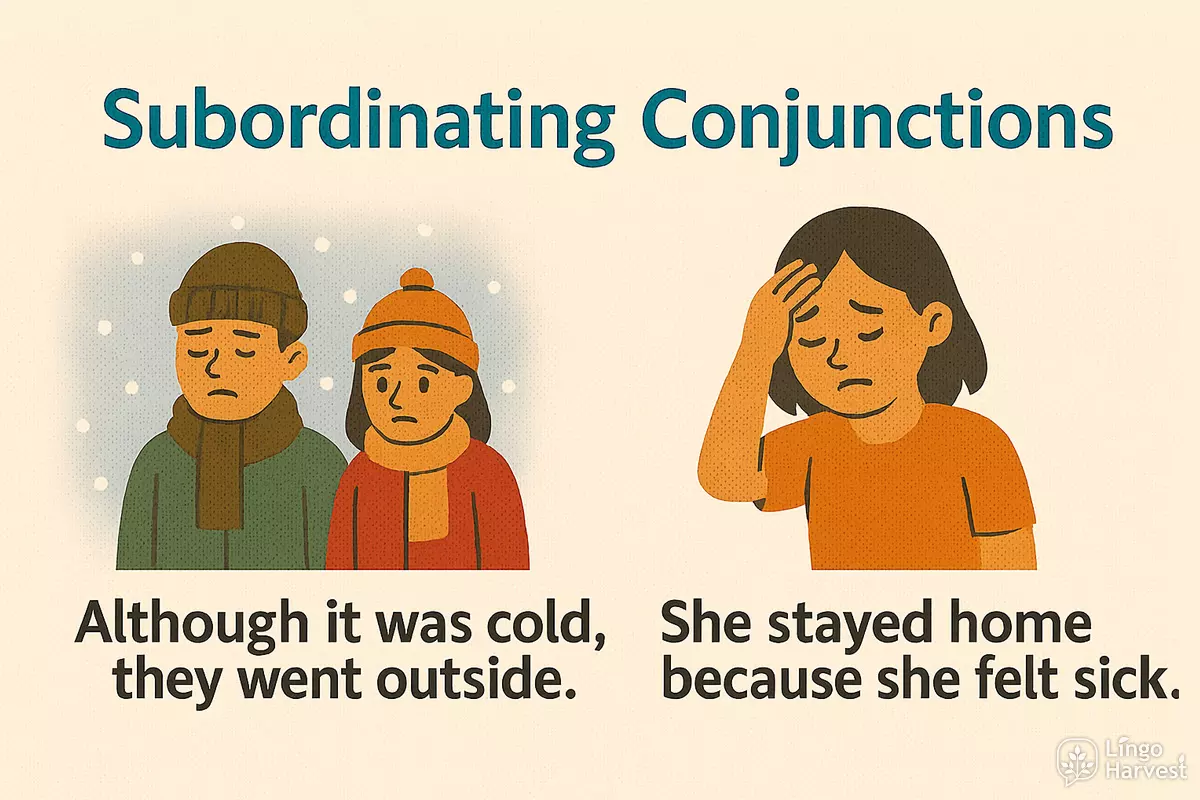
Subordinating conjunctions link a dependent (subordinate) clause to an independent clause, showing relationships like time, cause, condition, or contrast. Common examples include:
- Although → Although it was cold, they went outside.
- Because → She stayed home because she felt sick.
- If → If it rains, we’ll stay inside.
- Unless → You can’t leave unless you finish your work.
- While → He cooked while she cleaned.
- Since → Since you’re here, let’s start.
- When → Call me when you arrive.
- After → After he ate, he felt better.
- Before → Wash your hands before you eat.
- Even though → Even though he was tired, he kept working.
- As soon as → As soon as I saw her, I smiled.
- Though → He tried hard, though he failed.
- Until → Wait here until I return.
- Whereas → She loves hiking, whereas he prefers swimming.
These words introduce clauses that cannot stand alone and depend on the main clause for complete meaning.
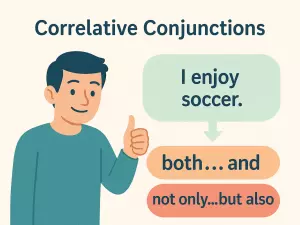
3. Correlative Conjunctions
Correlative conjunctions work in pairs to join equal elements in a sentence. They emphasize the relationship between the paired words or phrases. Some of the most used pairs include:
- Either … or (“Either you start now or you will be late.”)
- Neither … nor (“Neither the manager nor the staff were available.”)
- Both … and (“Both the teacher and the students agreed.”)
- Not only … but also (“She is not only talented but also hardworking.”)
- Whether … or (“Whether we leave now or later, we’ll arrive on time.”)
- As … as (“He is as tall as his brother.”)
Comparison Table: Three Types of Conjunctions
| Type | Main Function | Common Examples |
|---|---|---|
| Coordinating | Connects words, phrases, or clauses of equal rank | and, but, or, so, for, nor, yet |
| Subordinating | Links dependent clauses to independent clauses | because, although, if, when, since, unless, while |
| Correlative | Works in pairs to link parallel elements | either…or, neither…nor, both…and, not only…but also, whether…or |
By recognizing how each category functions and their most common examples, you can craft more nuanced and accurate sentences. This foundation is essential for mastering advanced usage and for tackling mixed tests on conjunctions.
Part 1: identify the type of conjunction in each sentence
Understanding how to distinguish different kinds of conjunctions is essential for analyzing and constructing complex sentences. In this section, you’ll explore examples and tips for recognizing coordinating, subordinating, and correlative conjunctions in context.
How to Spot Each Conjunction Type
Conjunctions function as connectors within sentences, but their roles and forms vary. Here’s a quick guide to the three main types:
- Coordinating conjunctions (e.g., and, but, or, nor, for, so, yet): These join elements of equal importance, such as two independent clauses or items in a list.
- Subordinating conjunctions (e.g., because, although, since, unless, while, after): These introduce dependent clauses and show a relationship of cause, time, condition, or contrast.
- Correlative conjunctions (e.g., either...or, neither...nor, both...and, not only...but also, whether...or): These work in pairs to connect balanced elements within a sentence.
Practice: Identify the Conjunction Type
Below are sample sentences. For each, consider which conjunction is present and what type it is:
- She wanted to go to the movies, but she had too much homework. → Coordinating
- We will leave when the rain stops. → Subordinating
- Either you apologize or you leave. → Correlative
- He studied hard, so he passed the test. → Coordinating
- Although it was cold, we went hiking. → Subordinating
- Both the manager and the staff agreed. → Correlative
- She called me after she arrived. → Subordinating
- He can have tea or coffee. → Coordinating
- You will succeed if you try. → Subordinating
- Not only did he finish early, but also he helped others. → Correlative
- She is tired, yet she continues to work. → Coordinating
- Since you’re here, let’s start. → Subordinating
- He visited Paris, and he also saw Rome. → Coordinating
- Unless you hurry, you’ll miss the train. → Subordinating
- Whether we win or lose, we’ll celebrate. → Correlative
Summary Table: Common Conjunction Types and Examples
| Conjunction Type | Examples in Sentences |
|---|---|
| Coordinating | I want pizza and salad. She was tired, but she kept going. |
| Subordinating | Because it’s late, we should go. I’ll call you after I arrive. |
| Correlative | Either you run or you walk. Not only did she win, but also she set a record. |
By practicing with various sentences and reviewing these examples, you’ll become more confident at distinguishing the type of conjunction in any context.
Part 2: fill in gaps with a suitable conjunction from mixed options
Choosing the right conjunction can connect ideas smoothly and clarify meaning. To practice, try filling in each blank with the most appropriate connector. The options may include coordinating, subordinating, or correlative conjunctions, so careful attention to logic and sentence flow is key.
Practice Sentences: Choose the Right Connector
Below is a list of sentences with missing conjunctions. For each, select from mixed options such as and, but, because, although, either…or, neither…nor, since, while, and others. This will help reinforce how these connectors function in context.
- I wanted to go hiking, ______ it started raining heavily.
- She will call you ______ she arrives at the airport.
- ______ John ______ Mary could solve the puzzle.
- The team worked hard ______ they did not win the championship.
- You can have ______ tea ______ coffee with your breakfast.
- He passed the exam ______ he studied very hard.
- Finish your homework ______ you play outside.
- ______ I had a map, I still got lost in the city.
- He was tired, ______ he continued to work late into the night.
- ______ it was cold, we went swimming in the lake.
- The store was closed, ______ we went to another one.
- She likes to read ______ listen to music in her free time.
- You should speak up ______ you disagree with the decision.
- ______ the weather improves, we will postpone the trip.
- They were hungry, ______ they had not eaten all day.
Show answers
- I wanted to go hiking, but it started raining heavily.
- She will call you when she arrives at the airport.
- Neither John nor Mary could solve the puzzle.
- The team worked hard, yet they did not win the championship.
- You can have either tea or coffee with your breakfast.
- He passed the exam because he studied very hard.
- Finish your homework before you play outside.
- Although I had a map, I still got lost in the city.
- He was tired, yet he continued to work late into the night.
- Although it was cold, we went swimming in the lake.
- The store was closed, so we went to another one.
- She likes to read and listen to music in her free time.
- You should speak up if you disagree with the decision.
- Unless the weather improves, we will postpone the trip.
- They were hungry, since they had not eaten all day.
Common Conjunction Choices and Their Uses
Understanding which conjunction fits best depends on the relationship you wish to show between the clauses. Here's a quick reference table for some frequent connectors and their typical functions:
| Conjunction | Typical Use / Example |
|---|---|
| and | Adding similar ideas She likes apples and oranges. |
| but | Contrasting ideas He is rich, but unhappy. |
| because | Showing reason She left early because she was tired. |
| although | Unexpected contrast Although it rained, we went hiking. |
| either...or | Presenting alternatives Either you come now or you miss the bus. |
| neither...nor | Negative alternatives Neither Mark nor Lisa was invited. |
| since | Reason or time Since you’re here, let’s start. |
| while | Contrast or time While I cooked, he cleaned. |
Tips for Filling in Gaps
- Consider the relationship between the two ideas: addition, contrast, cause, time, or choice.
- Look for clue words (like “not”, “still”, “so”) to guide your choice.
- Remember that correlative conjunctions (like either…or, neither…nor) come in pairs and must be balanced on both sides.
- Use subordinating conjunctions (such as although, because, since) to introduce dependent clauses.
- Check whether the conjunction answers why, when, or under what condition something happens.
- Choose connectors that make the sentence clearer and more logical.
- Practice with many sentence types to get comfortable with different conjunctions.
Part 3: rewrite sentences using a different type of conjunction
Switching between conjunction types helps you express ideas more flexibly. Instead of always using the same linking words, try reworking sentences with coordinating, subordinating, or correlative conjunctions. This practice not only improves your grammar but also makes your writing more engaging and precise.
Practice: Transforming Sentences with Different Conjunctions
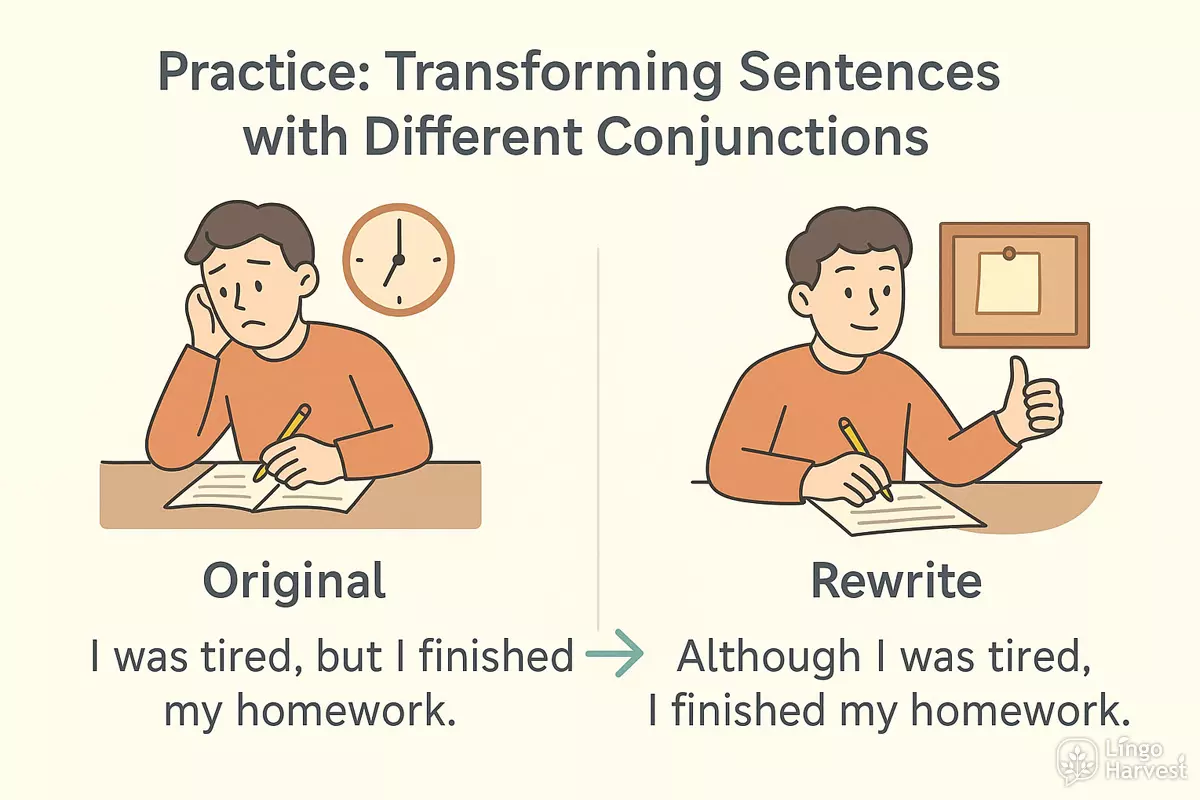
Below are several sentences rewritten using another category of conjunction. Notice how the meaning is preserved, but the structure changes.
- Original: I was tired, but I finished my homework.
Rewrite: Although I was tired, I finished my homework. - Original: She can come early, or she can arrive after lunch.
Rewrite: Whether she comes early or arrives after lunch, she will join us. - Original: Both the test and the homework are due tomorrow.
Rewrite: Not only is the test due tomorrow, but the homework is as well. - Original: He missed the bus because he woke up late.
Rewrite: He woke up late, so he missed the bus. - Original: If you study hard, you will succeed.
Rewrite: Study hard, and you will succeed. - Original: She not only sings, but also dances.
Rewrite: She sings and she dances. - Original: I will call you after I arrive.
Rewrite: I will call you once I arrive. - Original: You can have coffee or tea.
Rewrite: You can have either coffee or tea. - Original: Since it was raining, we stayed indoors.
Rewrite: It was raining, so we stayed indoors. - Original: Unless you hurry, you will be late.
Rewrite: Hurry, or you will be late. - Original: Both my brother and my sister like to read.
Rewrite: My brother likes to read, and my sister does too. - Original: I will go to the park if the weather is nice.
Rewrite: I will go to the park provided that the weather is nice. - Original: He didn’t call because he forgot.
Rewrite: He forgot, so he didn’t call. - Original: Neither the manager nor the assistant was present.
Rewrite: The manager was not present, and the assistant was not present either. - Original: While she was cooking, I set the table.
Rewrite: She was cooking, and I set the table at the same time.
Summary Table: Changing Conjunction Types
| Initial Conjunction Type | Rewritten with | Example |
|---|---|---|
| Coordinating | Subordinating | I was tired, but I finished my homework. → Although I was tired, I finished my homework. |
| Subordinating | Coordinating | Because he forgot, he didn’t call. → He forgot, so he didn’t call. |
| Correlative | Coordinating | Both the test and the homework are due tomorrow. → The test is due tomorrow, and the homework is due tomorrow. |
| Coordinating | Correlative | You can have coffee or tea. → You can have either coffee or tea. |
Experimenting with various conjunctions in your sentences sharpens your ability to express complex or nuanced relationships. As you practice, you’ll notice which connections feel most natural for different contexts.
Short paragraph for editing: improve conjunction choice and variety
When revising a short passage, one effective strategy is to enhance the use of conjunctions for greater sentence variety and clarity. Writers often rely too heavily on “and” or “but,” which can make prose sound repetitive or simplistic. By incorporating a broader selection of coordinating, subordinating, and correlative conjunctions, the paragraph becomes more engaging and precise.
Original Example Paragraph
She finished her homework and she watched television. She was tired but she wanted to see her favorite show. She went to bed after the show was over.
Suggestions for Improvement
- Replace repetitive “and” with alternatives like “then,” “so,” or “as soon as.”
- Combine sentences using subordinating conjunctions such as “because,” “although,” or “since” for added depth.
- Use correlative pairs like “not only...but also,” “either...or,” or “neither...nor” for balance and emphasis.
Revised Example
After she finished her homework, she watched television because she wanted to relax. Although she was tired, she stayed up since her favorite show was on. As soon as it ended, she went to bed.
Common Conjunctions to Expand Your Sentences
- Coordinating: and, but, or, nor, for, yet, so
- Subordinating: because, although, since, unless, while, after, before, if, even though, as soon as
- Correlative: either...or, neither...nor, not only...but also, both...and, whether...or
Tips for Choosing the Right Conjunction
- Match the conjunction to the logical relationship between ideas (contrast, cause, choice, etc.).
- Vary your sentence openings to avoid monotony.
- Read your paragraph aloud to notice repetitive patterns.
- Mix different types of conjunctions for a more natural flow.
Answer key with classification, correct options, and sample rewrites
Understanding how to distinguish between coordinating, subordinating, and correlative conjunctions is essential for mastering complex sentence structures. Below you’ll find a breakdown of each type, the correct answers for sample items, and suggested ways to rewrite sentences for clarity or variety.
Conjunction Types and Sample Answers
- Coordinating Conjunctions: Join two independent clauses (e.g., and, but, or, nor, for, so, yet).
- Subordinating Conjunctions: Link an independent clause with a dependent clause (e.g., because, although, since, unless, when, while, after, before, if).
- Correlative Conjunctions: Work in pairs to connect balanced words or phrases (e.g., either...or, neither...nor, not only...but also, both...and, whether...or).
Correct Options and Classification Table
| Sentence | Type | Correct Option ✅ |
|---|---|---|
| I wanted to go, but it was raining. | Coordinating | but |
| Although she was tired, she finished her work. | Subordinating | Although |
| Either you start now, or you’ll miss the train. | Correlative | Either...or |
| He stayed home because he was sick. | Subordinating | because |
| She will call when she arrives. | Subordinating | when |
| She likes both tea and coffee. | Correlative | both...and |
Sample Rewrites for Practice
Varying sentence structure helps reinforce understanding and improves writing. Here are suggested rewrites for each conjunction type:
- Original: I wanted to go, but it was raining.
Rewrite: It was raining, so I didn’t go. - Original: Although she was tired, she finished her work.
Rewrite: She finished her work even though she was tired. - Original: Either you start now, or you’ll miss the train.
Rewrite: You’ll miss the train unless you start now. - Original: He stayed home because he was sick.
Rewrite: He was sick, so he stayed home. - Original: She will call when she arrives.
Rewrite: After she arrives, she will call. - Original: She likes both tea and coffee.
Rewrite: She likes tea as well as coffee.
Common Conjunctions by Type
- Coordinating: and, but, or, nor, for, so, yet
- Subordinating: because, although, since, unless, while, after, before, if, as, until
- Correlative: either...or, neither...nor, both...and, not only...but also, whether...or
Practice identifying and using these conjunctions to build more sophisticated and varied sentences. Use the answer explanations and rewrites above as a reference for your own writing or teaching.