Mini Test: Avoid Run-on Sentences with Correct Conjunctions

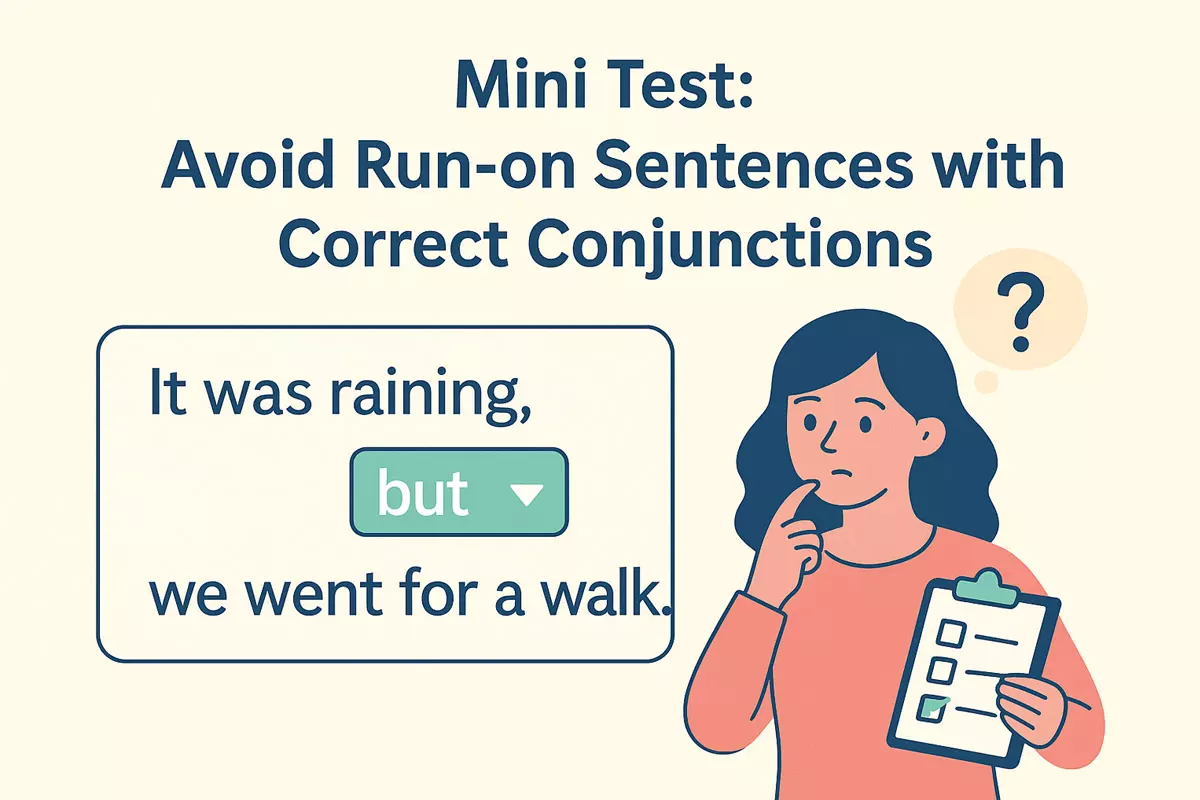 This article explains common causes of run-on and comma-splice errors, how to use conjunctions to link clauses, and when to use punctuation or separate sentences. It includes a test, a paragraph rewrite task, and answer explanations.
- Common causes of run-on and comma-splice errors
- How conjunctions prevent run-ons by linking clauses correctly
- Choosing between conjunctions, punctuation, and separate sentences
- Short test: identify and repair run-on sentences
- Extended task: rewrite a paragraph with proper clause connections
- Answer key with explanations
Many writers find it challenging to avoid overly long sentences, which can make their ideas difficult to understand. Using appropriate linking words is crucial for presenting thoughts clearly and logically. Mastering this skill not only improves the flow of your writing but also ensures that your readers can easily follow your arguments. To help you practice, take on this brief challenge and see how effectively you can connect ideas with suitable linking words, enhancing both clarity and coherence in your writing.
Common causes of run-on and comma-splice errors
Writers often make sentence boundary mistakes when they're unsure how to correctly connect independent clauses. These errors usually happen because of missing punctuation, improper conjunction use, or a lack of awareness about sentence structure. By understanding the frequent triggers, you can quickly recognize and fix these issues in your own writing.
Misunderstanding Independent Clauses
Many people combine two complete thoughts without realizing each one could stand alone as a sentence. When two independent clauses are joined without the right punctuation or connector, a run-on or comma splice results. For instance, simply using a comma between two sentences creates a comma splice, while leaving out all punctuation forms a run-on.
Incorrect or Missing Conjunctions
Writers may forget to use coordinating conjunctions (like and, but, or, so) or misuse them. Without a conjunction or with the wrong type, ideas run together without clear separation.
Common Patterns Leading to Errors
- Using only a comma between sentences → She finished her work, she went home. (Incorrect — comma splice)
- Omitting connectors completely → He likes music he plays guitar. (Incorrect — needs a conjunction or punctuation)
- Confusing dependent and independent clauses → Because it rained, we stayed inside we watched movies. (Incorrect — two clauses improperly joined)
- Trying to link too many ideas at once without proper punctuation → Sentences become confusing or grammatically incorrect.
- Overusing transitional adverbs with just a comma → I wanted to leave, however, it was too late. (Incorrect — needs a semicolon or period)
- Not recognizing where one thought ends and another begins → Leads to run-on sentences.
- Assuming a pause in speech equals a comma in writing → Spoken rhythm doesn’t always match grammar rules.
- Unfamiliarity with semicolons as connectors → Semicolons correctly join related independent clauses.
- Writing long sentences to sound sophisticated → Often reduces clarity instead of improving style.
- Relying on spoken rhythm instead of grammatical rules → Causes incorrect punctuation choices.
Examples: Error Types and Their Fixes
| Mistake Example | How to Fix |
|---|---|
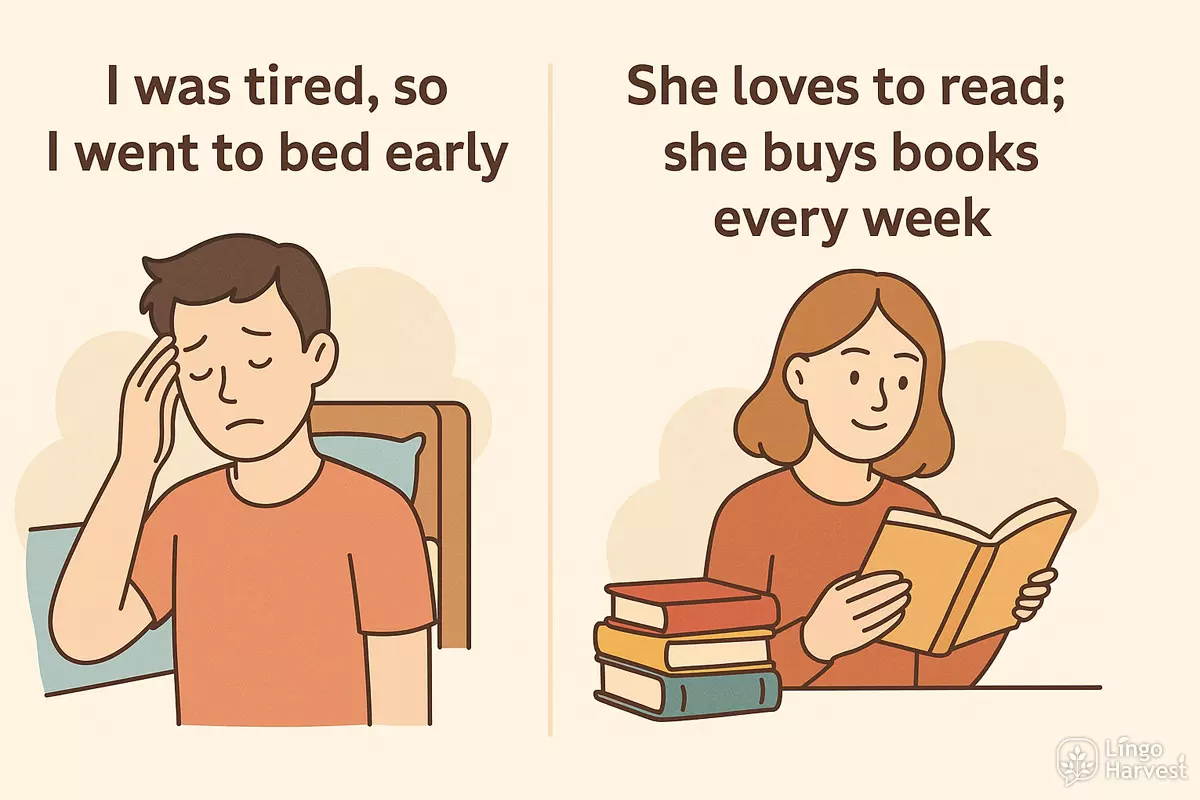
| I was tired I went to bed early. | I was tired, so I went to bed early. → Add a coordinating conjunction. |
| She loves to read, she buys books every week. | She loves to read; she buys books every week. → Use a semicolon between two related sentences. |
| It's raining, however, I will still go out. | It's raining; however, I will still go out. → Use a semicolon before a transitional adverb. |
| We finished our meal we paid the bill we left the restaurant. | We finished our meal, paid the bill, and left the restaurant. → Combine with commas and conjunctions. |
Recognizing these common scenarios helps you avoid sentence boundary issues. Practice spotting where sentences need stronger connectors or proper punctuation to keep your writing clear and effective.
How conjunctions prevent run-ons by linking clauses correctly
Using the right conjunctions is essential for joining two independent clauses in a sentence. Without them, sentences can become run-ons—long, confusing chains of thoughts that are difficult to read. By inserting a conjunction, you provide a clear signal to the reader and ensure each clause stands on its own while still being linked logically to the next.
Why run-ons happen and how conjunctions fix them
A run-on sentence often occurs when two complete thoughts are joined without proper punctuation or a connecting word. Conjunctions, especially coordinating ones like and, but, and so, act as bridges that clarify relationships between clauses. This not only improves readability but also helps avoid grammatical errors.
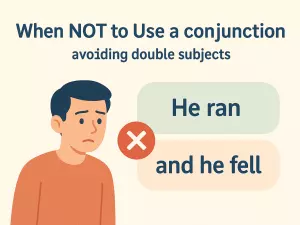
- Incorrect: I finished the test I left the room. ❌
- Correct: I finished the test, and I left the room. ✅
Types of conjunctions for combining clauses
Different conjunctions serve different purposes when connecting sentences. Here are the main types you’ll encounter:
- Coordinating conjunctions: for, and, nor, but, or, yet, so
- Subordinating conjunctions: because, although, since, unless, after, while, before, if
- Correlative conjunctions: either…or, neither…nor, not only…but also, both…and
Common conjunctions and their uses
The following list shows how various conjunctions can be used to prevent sentence fragments and fused sentences. These words are the most frequent tools for linking ideas smoothly:
- and → She cooked dinner and he set the table.
- but → I wanted to go out, but it was too late.
- or → You can take the bus or you can walk.
- so → It was cold, so we stayed inside.
- yet → He is young, yet very wise.
- for → She stayed home, for she wasn’t feeling well.
- nor → He didn’t call, nor did he write.
- because → They stayed home because it started raining.
- although → Although it was noisy, she kept reading.
- since → We left early since the roads were closing.
- after → After he finished work, he went for a walk.
- before → Wash your hands before you eat.
- if → If it snows, school may close.
- unless → I won’t go unless you come with me.
- while → She cooked while he cleaned.
- when → Call me when you arrive.
- even though → Even though he was tired, he continued working.
- as soon as → I’ll text you as soon as I get home.
Comparison: Run-on vs. Corrected with Conjunction
| Run-on Example | Corrected with Conjunction |
|---|---|
| She loves to read she goes to the library often. | She loves to read, so she goes to the library often. |
| We wanted to eat out it was raining. | We wanted to eat out, but it was raining. |
| I will call you you arrive. | I will call you when you arrive. |
| The test was difficult I studied hard. | The test was difficult, but I studied hard. |
Mastering conjunctions allows writers to join ideas clearly and avoid the confusion of run-on sentences. Practicing with different linking words helps build confidence in constructing accurate and effective sentences.
Choosing between conjunctions, punctuation, and separate sentences
When you’re faced with two complete thoughts in a sentence, you have several options for connecting or separating them. Using the right method depends on the relationship between the ideas and the flow you want in your writing. Deciding whether to link clauses with a conjunction, use appropriate punctuation, or break them into distinct sentences can clarify your message and prevent run-on errors.
When to Use Conjunctions
Conjunctions such as and, but, or, so, yet, and for join two independent clauses smoothly. This is a good choice when the clauses are closely related and you want to show a specific connection between them (such as contrast, reason, or addition).
- I wanted to go for a walk, but it started to rain.
- She studied hard, so she passed the test.
- You can have tea, or you can have coffee.
Using Punctuation Correctly
Punctuation can also separate ideas without a conjunction. A semicolon (;) links two related independent clauses, while a period (.) creates two separate sentences. Commas alone are not enough—this is a common run-on mistake.
- I finished my homework; then I watched a movie.
- The weather was cold. We stayed inside.
- ❌ Incorrect: He loves to swim, he goes to the pool every day.
- ✅ Correct: He loves to swim, and he goes to the pool every day.
Breaking into Separate Sentences
Sometimes, two ideas are independent enough that separating them is clearer. Short, direct sentences can improve readability and avoid confusion, especially when the connection between ideas isn’t strong.
- The concert ended. Everyone left quickly.
- She forgot her umbrella. It rained all afternoon.
| Method | Example | Best Use |
|---|---|---|
| Conjunction | He was tired, but he finished his work. | Showing relationship (contrast, cause, addition) |
| Semicolon | She wanted to leave; he wanted to stay. | Connecting closely related independent clauses |
| Period | It was late. We went home. | Clear separation of distinct ideas |
| Comma Splice (Incorrect) | We finished the project, we celebrated. | Don’t use — this creates a run-on! |
Tips for Deciding
- Ask if the two ideas are equally important and closely linked—if yes, use a conjunction or semicolon.
- If the second idea explains, illustrates, or results from the first, consider a semicolon or conjunction.
- For unrelated or loosely connected thoughts, use separate sentences.
- Avoid using only a comma to join two independent clauses—this is a run-on sentence.
- Read your sentences aloud; if you naturally pause, a period or semicolon may be needed.
Mastering these choices helps you write sentences that are clear, correct, and easy to follow, eliminating run-on errors in your work.
Short test: identify and repair run-on sentences
Strong writing means connecting ideas clearly. Sometimes, sentences run together without proper punctuation or conjunctions, creating confusion. Below, you'll find a quick exercise to spot and fix these errors. The aim is to recognize sentences that need separation, or the right joining words, for clarity.
Instructions
Read each sentence below. Decide if it’s a run-on (two or more clauses incorrectly joined). If so, repair it using a conjunction, semicolon, or by separating into two sentences. For some, more than one correction is possible.
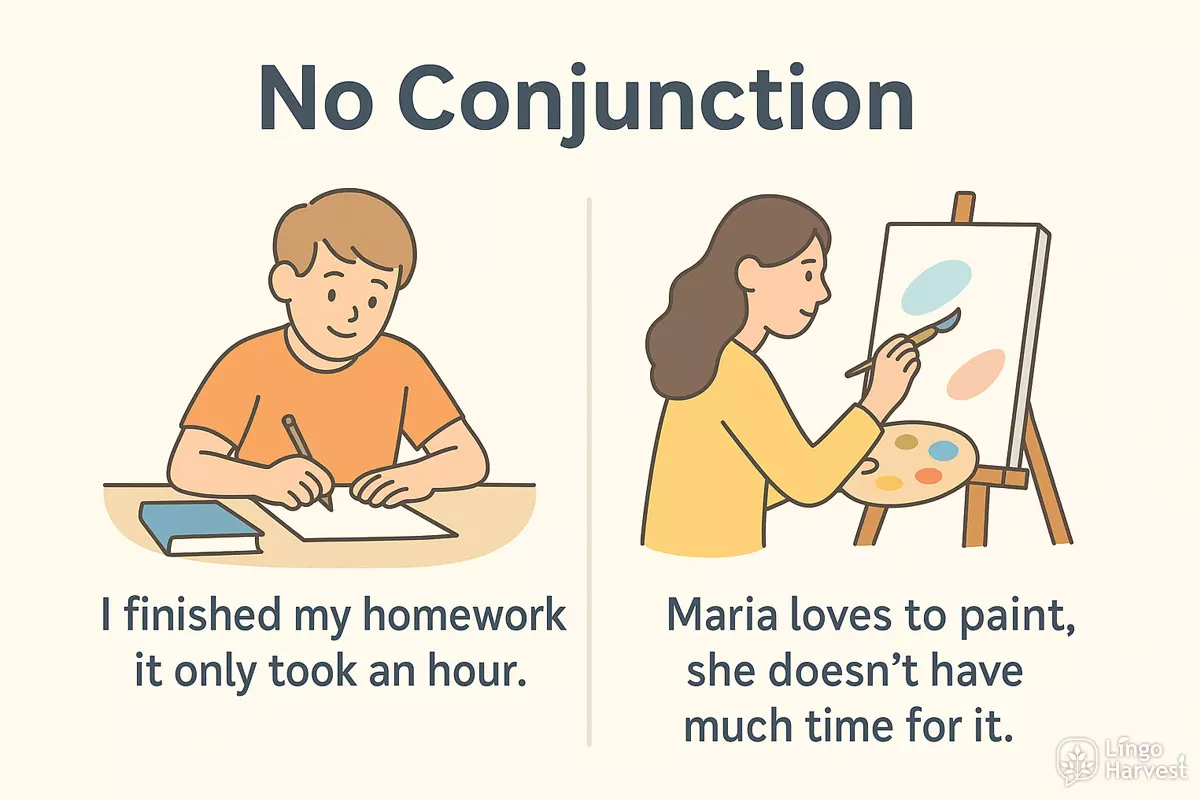
- I finished my homework it only took an hour.
- Maria loves to paint, she doesn't have much time for it.
- The library was closed, we went to the café instead.
- Jake called his friend they talked about the trip.
- It started to rain, we forgot our umbrellas.
- The movie was long it was very interesting.
- Sam wanted to go home he was feeling tired.
- The test was difficult but I did my best.
- She enjoys hiking she also likes biking.
- We left early, the roads were empty.
Common ways to fix run-on sentences
- Use a period to make two separate sentences.
- Add a comma and a coordinating conjunction (for, and, nor, but, or, yet, so).
- Use a semicolon if the clauses are closely related.
- Restructure the sentence with a subordinating conjunction (because, although, since, etc.).
Quick reference: Coordinating conjunctions
- for
- and
- nor
- but
- or
- yet
- so
Show answers
- I finished my homework. It only took an hour.
→ Or: I finished my homework, and it only took an hour. - Maria loves to paint, but she doesn't have much time for it.
- The library was closed, so we went to the café instead.
- Jake called his friend. They talked about the trip.
→ Or: Jake called his friend, and they talked about the trip. - It started to rain, but we forgot our umbrellas.
- The movie was long, but it was very interesting.
→ Or: The movie was long; it was very interesting. - Sam wanted to go home because he was feeling tired.
→ Or: Sam wanted to go home. He was feeling tired. - ✅ The test was difficult, but I did my best. (Already correct.)
- She enjoys hiking, and she also likes biking.
- We left early because the roads were empty.
→ Or: We left early. The roads were empty.
Tips for recognizing run-ons
- Look for two complete thoughts jammed together without a joining word or punctuation.
- If you can split a sentence into two and both parts make sense, check if they should be joined differently.
- Remember: a comma alone is not enough to connect two independent clauses (avoid comma splices).
Extended task: rewrite a paragraph with proper clause connections
Connecting clauses correctly is essential for clear, effective writing. When clauses are simply joined with commas or run together without proper conjunctions or punctuation, sentences can become confusing or grammatically incorrect. In this exercise, you will practice identifying run-on sentences and revising them using appropriate conjunctions or punctuation marks to ensure each idea flows logically and smoothly.
Practice: Identifying and Fixing Run-on Sentences
Below is a short paragraph that contains several run-on sentences. Your task is to rewrite the paragraph, connecting the clauses correctly by using coordinating conjunctions (such as and, but, or, nor, for, so, yet), subordinating conjunctions (like because, although, since, if, when, while), or proper punctuation (such as a semicolon or period).
Original Paragraph:
Sarah loves to read she goes to the library every week she borrows many books she reads them quickly she returns them before the due date the librarian knows her well they often talk about new books.
Your task: Rewrite the paragraph so that all sentences are properly connected, avoiding run-ons. Use a variety of conjunctions and punctuation to improve flow and clarity.
Show answers
Sample Revision: Sarah loves to read, so she goes to the library every week. She borrows many books and reads them quickly. Because she always returns them before the due date, the librarian knows her well, and they often talk about new books.
Useful Clause Connections: Coordinating and Subordinating Conjunctions
To help you connect clauses effectively, here is a list of common conjunctions and their uses:
- and – adds similar ideas
- but – contrasts ideas
- or – presents alternatives
- so – shows result or effect
- yet – introduces a surprising contrast
- for – indicates reason (less common in modern usage)
- because – explains cause
- although – introduces concession
- since – gives a reason or time
- while – expresses contrast or simultaneity
- when – indicates time
- if – introduces condition
- unless – introduces exception
- because of – shows a cause (followed by a noun)
- as – indicates reason or time
- after – introduces a sequence
- before – shows prior action
- since – can indicate time or cause
- so that – expresses purpose
- even though – introduces a strong contrast
Quick Check: Which Sentences Are Correct?
Read each sentence. Decide if it is properly connected or if it is a run-on.
- Maria finished her homework she went outside to play.
- Tom wanted to see the movie, but he didn’t have enough money.
- I like apples I do not like oranges.
- We can go to the park, or we can stay home.
- She was tired she kept working until midnight.
- He studied for hours, yet he didn’t feel ready.
- They wanted to travel they didn’t have enough time.
- You can take the bus, or you can walk.
- The food was cold it still tasted good.
- I wanted to call you, but my phone died.
Show answers
- ❌ Run-on — Correct: Maria finished her homework, so she went outside to play.
- ✅ Correct
- ❌ Run-on — Correct: I like apples, but I do not like oranges.
- ✅ Correct
- ❌ Run-on — Correct: She was tired, but she kept working until midnight.
- ✅ Correct
- ❌ Run-on — Correct: They wanted to travel, but they didn’t have enough time.
- ✅ Correct
- ❌ Run-on — Correct: The food was cold, but it still tasted good.
- ✅ Correct
Mastering clause connections will help you avoid run-on sentences and make your writing clearer and more professional. Practice regularly to develop a strong sense of when and how to join ideas effectively.
Answer key with explanations
Understanding how to correctly join clauses is essential for avoiding run-on sentences. Below, you'll find clear answers for each test item, along with explanations that clarify why each conjunction or punctuation mark is appropriate. This should help reinforce the rules for combining sentences smoothly and correctly.
Common Errors and Correct Conjunctions
Many run-on sentences occur when independent clauses are joined without proper punctuation or linking words. To fix these, you can use coordinating conjunctions (for, and, nor, but, or, yet, so), subordinating conjunctions (because, although, since, etc.), or appropriate punctuation.
- and – Connects two related ideas of equal importance.
Example: She finished her homework, and she went to bed. - but – Shows contrast between two ideas.
Example: He tried hard, but he didn’t succeed. - so – Expresses a result or consequence.
Example: It was raining, so they stayed inside. - because – Indicates reason.
Example: She was late because the bus broke down. - although – Introduces a contrast or exception.
Example: Although he was tired, he finished the race. - or – Presents an alternative.
Example: You can call me, or you can send an email. - yet – Adds a surprising contrast.
Example: The problem was difficult, yet she solved it quickly. - nor – Connects two negative ideas.
Example: He didn’t call, nor did he write. - while – Shows simultaneous actions or contrast.
Example: She read a book while waiting for the bus. - since – Can mean “because” or indicate time.
Example: Since you’re here, let’s start the meeting.
Sample Mini Test Answers with Explanations
- Incorrect: I love to read I rarely have time.
Correct: I love to read, but I rarely have time.
Explanation: Two independent clauses need a conjunction or proper punctuation. - Incorrect: The sun set we went home.
Correct: The sun set, so we went home.
Explanation: “So” shows cause and effect between the two ideas. - Incorrect: She was tired she kept working.
Correct: She was tired, yet she kept working.
Explanation: “Yet” introduces a surprising contrast. - Incorrect: We can watch a movie we can play a game.
Correct: We can watch a movie, or we can play a game.
Explanation: “Or” presents alternatives.
Quick Conjunction Reference Table
| Conjunction | When to Use |
|---|---|
| and | To add similar ideas or actions |
| but / yet | To show contrast or exception |
| so | To express result or consequence |
| or / nor | To present choices or negative alternatives |
| because / since | To explain reasons |
| although / while | To show contrast or simultaneous actions |
Key Takeaways
To prevent run-on sentences, always join independent clauses with the correct conjunction or punctuation. Review your writing for places where two complete sentences are joined without proper linking, and use the strategies above to correct them. This approach will make your writing clearer and more professional.