Adding, Contrasting, Choosing: Conjunctions by Function

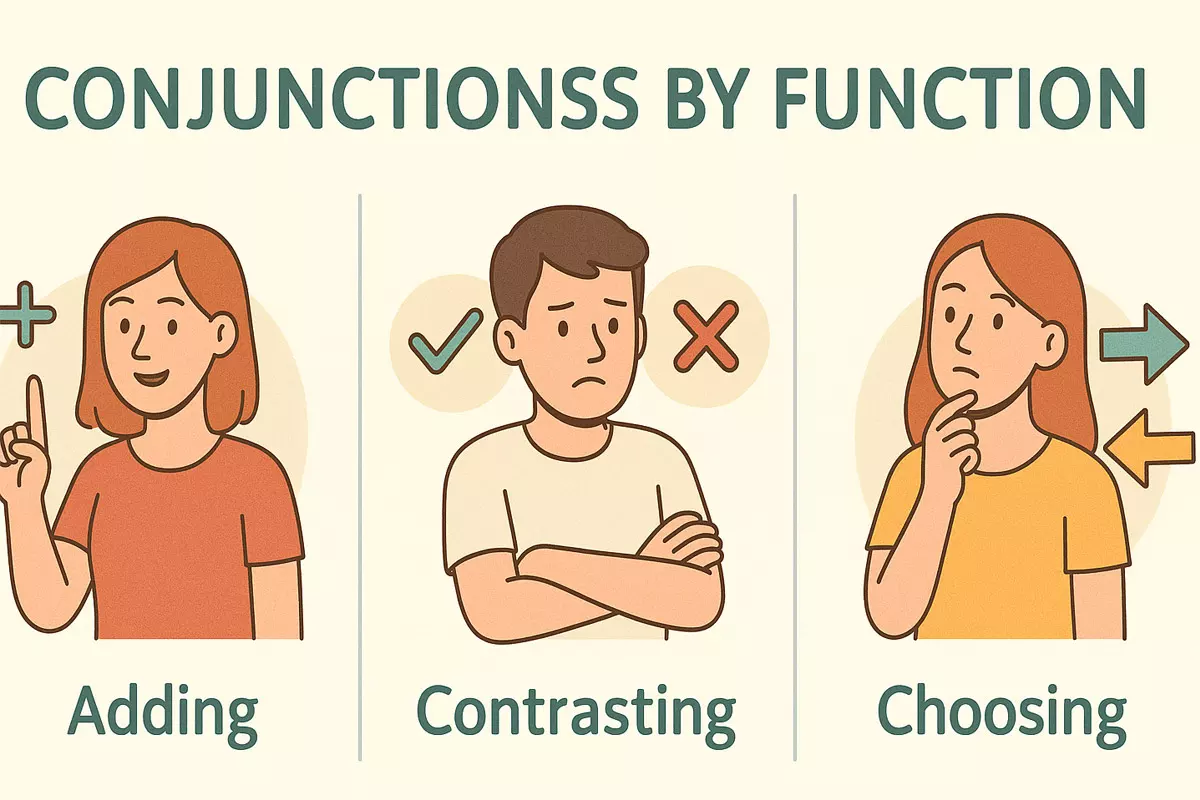 This article explains how to use conjunctions like and, also, but, although, or, either...or, because, and so. It covers adding ideas, showing contrasts, giving options, linking causes and results, and improving sentence flow.
The words you choose to connect sentences are essential in shaping the meaning of your writing, whether you are linking similar ideas, emphasizing contrasts, or deciding between alternatives. By mastering how to effectively join, contrast, and select information, you ensure your writing flows smoothly and your message remains clear to the reader. The appropriate use of connecting words not only improves coherence but also guides your audience through your thoughts in a logical and engaging manner.
Add Ideas (and, also)
When you want to include extra information or combine similar thoughts, certain conjunctions help you stack ideas together. These connectors are especially useful for building more detailed, nuanced sentences. Words like and and also are the most familiar, but there are quite a few others that let you add, reinforce, or continue a point.
Common Conjunctions for Adding Information
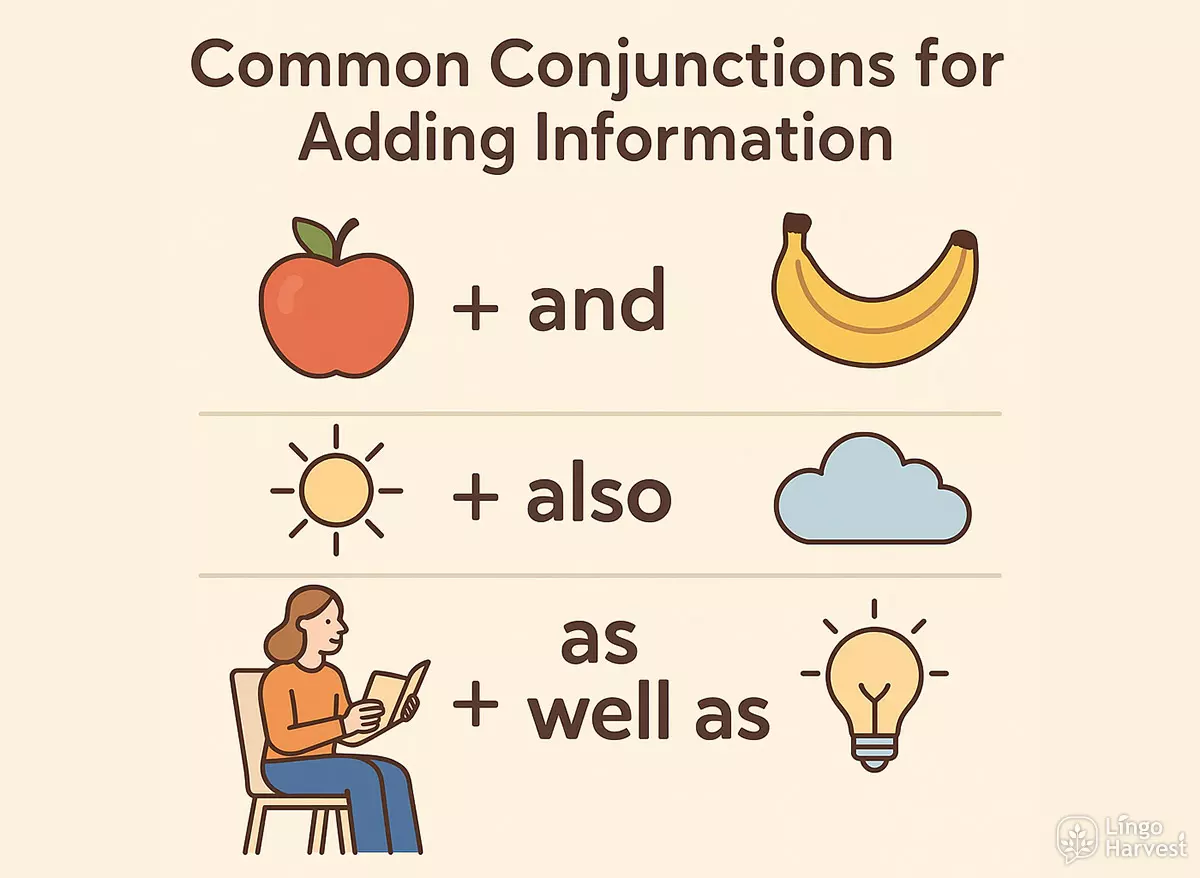
- and – joins two or more items or ideas directly.
- also – introduces an additional point, often at the start or middle of a sentence.
- as well as – combines things, emphasizing both equally.
- in addition – signals something extra, often in formal writing.
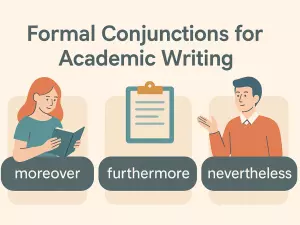
- furthermore – adds emphasis when expanding on a previous point.
- moreover – pushes the idea further, usually in formal contexts.
- besides – brings in another point, sometimes as an afterthought.
- plus – informal way to add something extra.
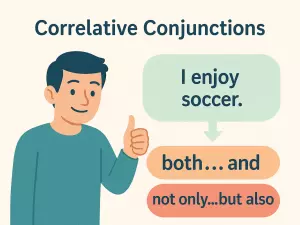
- not only... but also – pairs two items for emphasis.
- what’s more – introduces an additional, often surprising, detail.
- additionally – offers a further supporting idea.
- along with – joins items, often in lists.
- too – typically used at the end of a sentence.
- as well – similar to "too," but sometimes comes mid-sentence.
- on top of that – informal, emphasizes another addition.
Examples in Context
- She writes poetry and paints landscapes.
- We visited the museum. Also, we stopped by the park.
- He speaks French as well as Spanish.
- In addition, the report includes new statistics.
- It was raining; moreover, it was cold.
- I enjoy hiking. Besides, it keeps me healthy.
- Not only did she finish early, but also helped others.
- They brought snacks along with drinks.
- You can come, too.
- She’s a talented musician as well.
Comparing Additive Conjunctions
| Connector | Typical Usage | Formality | Position in Sentence |
|---|---|---|---|
| and | Combining similar ideas | Neutral | Between items/clauses |
| also | Adding another point | Neutral | Start/middle |
| furthermore | Emphasizing an additional point | Formal | Start of sentence |
| besides | Adding as an afterthought | Informal | Start/middle |
| not only... but also | Pairing two ideas for emphasis | Neutral | Parallel structures |
Choosing the right additive connector depends on your context, the level of formality, and how strongly you want to link your ideas. Practice combining points in different ways to make your writing or speech clearer and more engaging.
Show Contrast (but, although)
Conjunctions like but and although help us express differences or unexpected results between two ideas. These words are essential when we want to highlight how two statements do not align or when something happens that is surprising based on the first idea.
How to Use "but" and "although"
But is a coordinating conjunction. It usually joins two independent clauses, showing a clear contrast. Although is a subordinating conjunction. It introduces a dependent clause and often comes at the beginning or in the middle of a sentence, leading to a main clause that contrasts with the first part.
- I like tea, but I don't like coffee.
- Although it was raining, we went for a walk.
- She is very talented, but she can be shy.
- Although he studied hard, he didn't pass the exam.
- Tom wanted to help, but he was too busy.
- Although the task was difficult, they finished it on time.
- We tried to call, but nobody answered.
- Although she was tired, she kept working.
- He is friendly, but sometimes impatient.
- Although the food looked good, it tasted bland.
- The movie was long, but interesting.
- Although I arrived early, the meeting had already started.
Comparing "but" and "although"
While both words show opposition, their grammar and placement differ. The table below compares their typical usage:
| Conjunction | Example Sentence |
|---|---|
| but (coordinating) | She wanted to go, but she had no time. |
| although (subordinating) | Although he was tired, he finished the project. |
| but (mid-sentence) | They offered help, but we declined. |
| although (sentence-initial) | Although it looks easy, it is quite complex. |
Key Points to Remember
- But links two equal parts; use a comma before it if both sides are full sentences.
- Although introduces a dependent idea and is often followed by a comma when it starts a sentence.
- Both help make your writing and speech more nuanced by showing contrast or unexpected outcomes.
Mastering these connectors allows you to communicate differences and surprises clearly and naturally in English.
Give Options (or, either...or)
When you want to present alternatives or choices in English, special conjunctions help structure these options clearly. The most common words used for this purpose are or and the paired structure either...or. These connect two (or more) possibilities, signaling that only one can be selected or that any could apply.
How "or" and "either...or" Work
- Or joins words, phrases, or clauses to offer alternatives.
- Either...or is used for emphasizing a choice between two distinct options.
- Both can be used in questions and statements to clarify possible outcomes.
Examples in Sentences
- Would you like tea or coffee?
- You can call me or send an email.
- Either you apologize or you leave.
- We can travel by train or by bus.
- Is it Monday or Tuesday today?
- She will either come early or not at all.
- Do you want the window seat or the aisle seat?
- You can have soup or salad as a starter.
- This book is either lost or misplaced.
- Will you walk or take a taxi?
- He will either accept the offer or decline it.
- Should I wear the blue shirt or the white one?
- We can meet now or after lunch.
- Either you finish your homework or you don’t go out.
- Do you prefer cats or dogs?
- Please choose: soup or salad.
- You can either wait here or come back later.
- Should I stay or should I go?
Common Patterns and Tips
- Use or when listing alternatives, especially in informal speech.
- Place either before the first choice and or before the second.
- For clarity, avoid double negatives with either...or.
- In negative sentences, neither...nor is used instead.
| Form | Example |
|---|---|
| or (simple alternative) | Do you want pizza or pasta? |
| either...or (emphasized choice) | Either you pay now or you lose your reservation. |
| or in questions | Is the meeting at 2 or at 3? |
| either...or in statements | She will either call you or send a message. |
Choosing between options is a key function of these conjunctions. Mastering their use helps you communicate alternatives and decisions more precisely, whether in daily conversation, writing, or formal contexts.
Cause/Result Linkers (because, so)
Explaining why something happens or showing what happens as a result is a core part of clear communication. Two of the most common words for connecting reasons and results in English are because and so. Each has a specific job in a sentence, and understanding the difference helps speakers build more natural, logical statements.
How They Work
Because introduces a reason. It answers the question "Why?" and is followed by a full clause. So introduces a result or consequence, telling us what happened due to a previous statement. The order of ideas changes depending on which word is used.
- because → gives the cause/reason
- so → introduces the result/consequence
Patterns and Examples
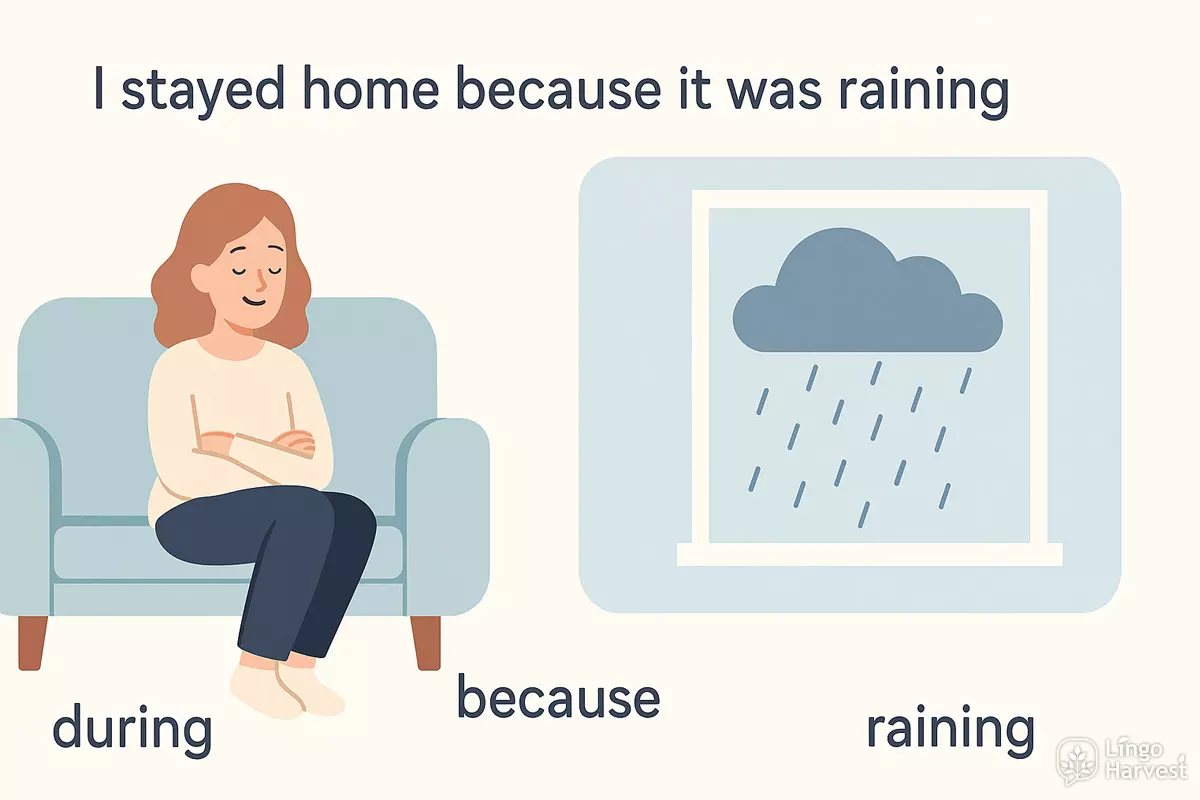
Here are some common ways to use these connectors in sentences:
- I stayed home because it was raining.
- She was tired, so she went to bed early.
- We missed the bus because we were late.
- They didn’t study, so they failed the test.
- He left early because he felt sick.
- The shop was closed, so we went somewhere else.
- She laughed because the joke was funny.
- It was cold, so I wore a jacket.
- The team won because they worked together.
- I brought an umbrella because I thought it might rain.
- The class was cancelled, so everyone went home.
- He didn’t eat lunch because he wasn’t hungry.
- The movie started late, so we waited outside.
- She smiled because she got good news.
- It was noisy, so I couldn’t concentrate.
Comparing Function and Word Order
Notice how the structure changes depending on whether you present the cause first or the result first. The table below shows the difference in sentence construction:
| Reason First (because) | Result First (so) |
|---|---|
| He was tired because he didn’t sleep well. | He didn’t sleep well, so he was tired. |
| We left early because the weather was bad. | The weather was bad, so we left early. |
| She took an umbrella because it looked like rain. | It looked like rain, so she took an umbrella. |
| I missed the train because I woke up late. | I woke up late, so I missed the train. |
Tips for Using These Linkers
- Don’t use because and so together in the same clause (e.g., He was late because so he missed the meeting ❌).
- Because can start a sentence, but it often sounds better in informal conversation to put it after the main clause.
- So is never used at the beginning of a sentence to show a result in formal writing, but it’s common in speech.
- These connectors help make writing and speaking more logical and clear, especially when explaining reasons or outcomes.
Improving Sentence Flow
Clear, engaging writing relies on more than just correct grammar—it’s also about how ideas connect. Conjunctions serve as bridges, guiding readers smoothly from one thought to the next. By selecting the right linking words, you can avoid awkward jumps and create a sense of progression or contrast between sentences and clauses.
How Conjunctions Enhance Coherence
When used thoughtfully, conjunctions prevent choppy or disconnected statements. They help readers follow your logic, especially when you add new information, highlight differences, or present choices. For example, using and to join similar ideas, but to introduce contrast, or or to show alternatives clarifies relationships between points.
Common Patterns for Smoother Writing
- Addition: and, also, as well as, moreover, furthermore, in addition
- Contrast: but, yet, however, although, nevertheless, on the other hand, still
- Choice: or, either…or, neither…nor, alternatively, otherwise
- Result: so, therefore, thus, consequently, as a result
- Purpose: so that, in order that, for the purpose of
- Condition: if, unless, provided that, as long as, in case
- Time: when, while, after, before, until, since, as soon as
- Reason: because, since, as, for, due to
- Comparison: as…as, than, like, just as
- Emphasis: even, indeed, especially, above all
Comparing Sentence Connections
| Function | Example Sentences |
|---|---|
| Adding ideas | She likes apples and oranges. He finished his work; moreover, he helped others. |
| Contrasting points | I wanted to go, but it was raining. They studied hard; however, they didn’t pass. |
| Offering choices | Would you like tea or coffee? You can call me, or send an email. |
| Showing results | It was late, so we went home. She didn’t study; therefore, she failed the test. |
Tips for Natural Transitions
- Vary conjunction types to avoid monotony.
- Read sentences aloud to check for smoothness.
- Combine short, related sentences with appropriate conjunctions.
- Be mindful not to overuse linking words; clarity comes first.
- Pay attention to the logical relationship you want to express—don’t force a conjunction where a period would work better.
Mastering conjunctions by function lets your writing flow effortlessly, making arguments clearer and narratives more engaging for readers.
Practice: Choose the Best Connector
Test your understanding of how conjunctions function to add information, show contrast, or express a choice. Read each sentence and pick the most suitable connecting word from the options provided. Think about the meaning and relationship between the ideas before you decide.
Fill in the Blanks
- She wanted to go for a walk, ______ it was raining heavily.
- a) and
- b) but
- c) or
- You can have coffee ______ tea with your breakfast.
- a) and
- b) but
- c) or
- He is allergic to nuts, ______ he still eats peanut butter sometimes.
- a) although
- b) so
- c) and
- Not only did she sing, ______ she also played the piano.
- a) but
- b) or
- c) so
- Would you prefer to visit the museum ______ the art gallery?
- a) or
- b) and
- c) but
Show answers
- 1. b) but
- 2. a) and
- 3. a) although
- 4. a) but
- 5. a) or
Connector Functions at a Glance
Here are common connectors grouped by their typical function. Use this for quick reference when deciding which conjunction fits best.
| Function | Common Connectors |
|---|---|
| Addition | and, also, as well as, moreover, furthermore, not only... but also |
| Contrast | but, although, though, however, yet, whereas, while, nevertheless |
| Choice | or, either...or, neither...nor, whether...or |
| Result | so, therefore, thus, consequently |
Identify the Connector Type
Decide if the connector in each sentence is used for adding, contrasting, or choosing.
- He likes both apples and oranges.
- We could take a taxi or walk.
- She studied hard, but she didn't pass.
- Not only did he win, but he broke a record.
- Although it was late, they kept working.
Show answers
- Addition
- Choice
- Contrast
- Addition
- Contrast
Practicing with real examples helps you see how each conjunction shapes the meaning of a sentence. Review the table above and test yourself by creating your own sentences with different connectors for each function.