Formal and Informal Verb Forms in English

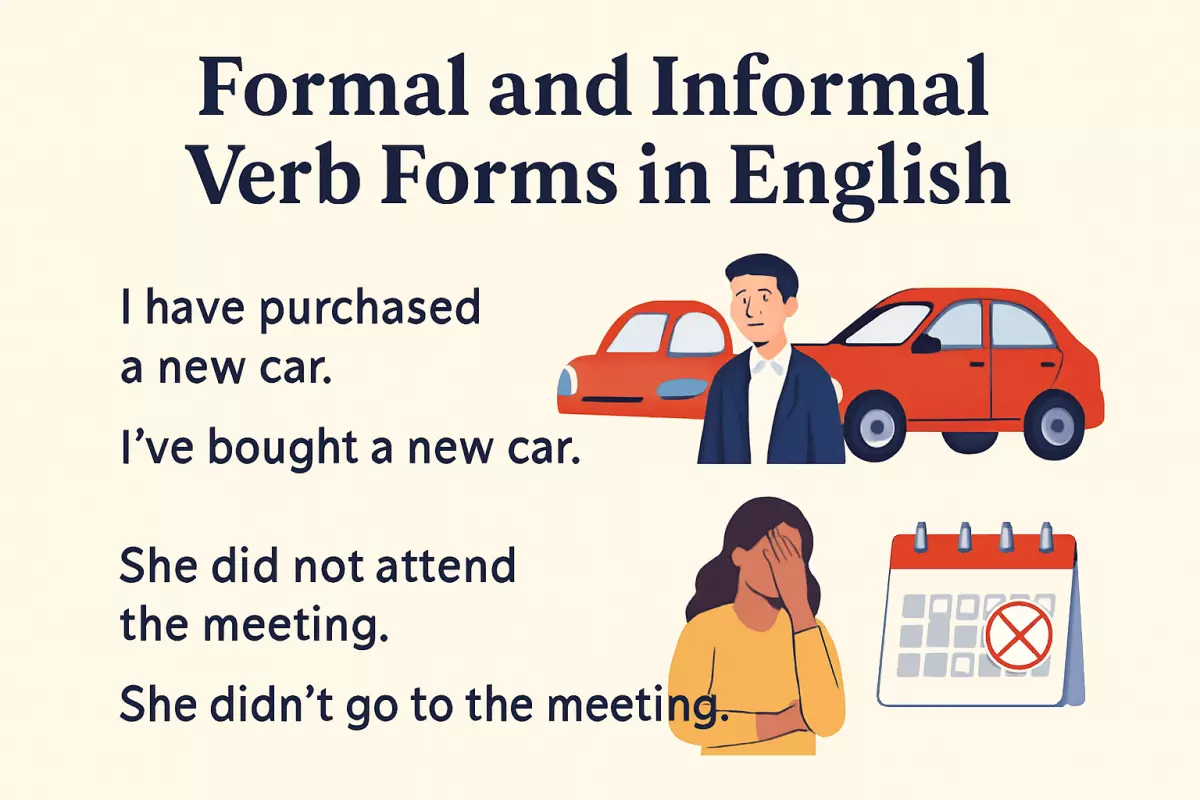 Learn what makes verbs sound formal or informal, with common casual choices and stronger writing alternatives. Compare register in speech vs text, avoid typical learner mistakes, get clarity tips, and practice with rewrite homework.
Choosing between polite and casual verbs in English can change your tone right away. This guide shows how to pick the right style for emails, chats, class, and the workplace, so your message matches the situation and sounds natural. You will learn what polite wording signals, when casual verbs feel friendly rather than careless, and simple tips to avoid sounding too stiff or too informal.
What makes a verb formal or informal
Verb choice sounds more formal or more casual depending on the setting, the relationship between speakers, and the kind of writing. In practice, the difference usually comes from predictable patterns: which verb you pick (Latinate vs. everyday), how direct you are, and whether you rely on contractions, phrasal verbs, or vague “general-purpose” verbs.
Common signals of formality in verb forms
- Latinate single-word verbs often feel more formal than everyday equivalents: assist (help), purchase (buy), commence (start), terminate (end).
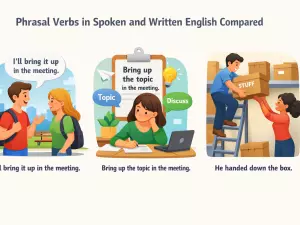
- Phrasal verbs (verb + particle) tend to sound more informal in many contexts: put off, find out, bring up, get over. In formal writing, a single-word alternative is often preferred: postpone, discover, raise, recover.
- Contractions usually make the tone less formal: don’t, can’t, we’ve, it’s. Full forms (do not, cannot, we have, it is) read more formal, especially in academic or legal contexts.
- Direct imperatives can sound blunt in formal situations: ❌ Send me the file today. → ✅ Please send the file by 5 p.m. or Could you send the file by 5 p.m.?
- Hedging and softening verbs raise formality and politeness: suggest, recommend, propose, request, advise.
- Reporting verbs in formal writing are often specific rather than casual: argue, demonstrate, indicate, observe, conclude rather than say or talk about.
- Precise “action” verbs feel more formal than broad, flexible verbs like do, get, make, put, take. Compare obtain vs. get, construct vs. make.
- Passive voice can increase formality by focusing on the action or result: The report was submitted on Monday. It is common in academic and official writing, but can sound impersonal if overused.
- “Dummy” subjects like There is/There are and It is can sound more neutral and formal when used to present information: It appears that..., There remains a risk that...
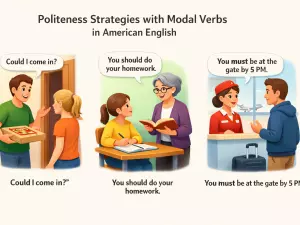
- Modal verbs shift tone: must and shall can sound formal or official; can and will often feel more conversational; would and could soften requests.
- Fixed formal verbs in institutional language signal formality because they belong to set phrases: hereby agree, acknowledge receipt, comply with, adhere to.
- Verb + preposition patterns can sound more formal than phrasal-verb alternatives: discuss (not ❌ discuss about), request (not ❌ ask for in very formal notices), inform (not let you know).
- Ellipsis and short replies are common in speech and casual writing: Seen it., Got it. Full clauses are more formal: I have seen it., I understand.
- Slangy or trendy verbs quickly lower formality: hang out, chill, ghost, flex, crash (sleep).
- Overly emotional or dramatic verbs may feel informal or biased in formal writing: love, hate, freak out, blow up. More neutral choices fit formal contexts: prefer, dislike, react strongly, escalate.
Patterns to watch in real sentences
- Everyday verb → more formal alternative: help → assist; start → commence; end → conclude; use → utilize (best used when it truly means “use for a specific purpose”).
- Phrasal verb → single-word alternative: look into → investigate; bring up → raise; put off → postpone; work out → resolve.
- Blunt request → softened request: Send the invoice. → Please send the invoice when convenient. / Could you send the invoice by Friday?
- Casual reporting → academic reporting: The study says... → The study indicates... / The results suggest...
Formality is not “better” by default; it is a match between verb style and situation. A useful rule is to notice clusters: contractions plus phrasal verbs plus short clauses usually read informal, while precise verbs, full forms, and careful request language usually read formal.
Common informal verbs and phrases
Everyday English often relies on short, flexible verbs and set expressions that sound natural in conversation but may be too casual for formal writing. These items frequently use phrasal verbs (a verb + particle like up, out, off) and conversation-friendly patterns such as softeners, vague language, and quick responses.
High-frequency informal verbs (especially phrasal verbs)
- hang out = spend time socially: We hung out after class.
- chill (out) = relax: Let’s chill for a bit.
- catch up = share news after time apart: We should catch up soon.
- head out = leave: I’m going to head out.
- drop by / pop in = visit briefly: Drop by later if you’re free.
- pick up = collect; learn casually: I’ll pick you up at 7. / I picked up some Spanish.
- put off = postpone: Don’t put it off too long.
- figure out = understand/solve: We’ll figure it out.
- find out = discover: I found out yesterday.
- work out = exercise; succeed/resolve: It’ll work out.
- mess up = make a mistake: I messed up the time.
- freak out = react with strong worry/shock: Don’t freak out.
- run into = meet unexpectedly: I ran into my old boss.
- get along (with) = have a good relationship: They get along well.
- get over = recover from (illness/emotion): She’s getting over a cold.
- set up = arrange; create: I’ll set up the meeting.
- check out = look at; investigate: Check out this video.
- turn down = refuse; reduce volume: He turned down the offer.
Informal phrases that soften requests and opinions
- Do you wanna…? (want to) for casual invitations: Wanna grab lunch?
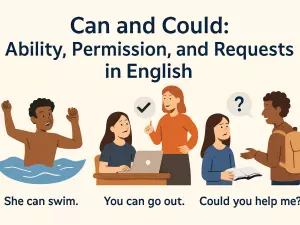
- Can you…? for friendly requests: Can you send it over?
- Could you…? slightly more polite but still conversational: Could you help me with this?
- Do you mind…? for gentle requests: Do you mind waiting a sec?
- I was wondering if… for extra softness: I was wondering if you’re free later.
- kind of / sort of to reduce certainty: I’m kind of tired.
- maybe / probably to avoid sounding too direct: Maybe we should leave early.
- I guess… to show hesitation or mild agreement: I guess that works.
- to be honest to introduce a frank view: To be honest, I didn’t like it.
- no worries to accept an apology or ease tension: No worries, it’s fine.
Typical patterns to watch (and when to avoid them)
- Reduced forms in speech: gonna (going to), wanna (want to), gotta (have got to). These are normal in conversation but usually avoided in formal writing. ✅ I’m going to call you. ❌ I’m gonna call you.
- Vague verbs like do, get, make: useful for quick speech, but they can sound imprecise in formal contexts. → Replace with a specific verb when clarity matters (e.g., obtain, create, resolve).
- Casual intensifiers such as really, super, pretty (meaning “quite”): common in informal tone, but may sound too chatty in academic or professional writing.
- Short response phrases like Sounds good, Works for me, Fair enough: efficient and friendly in messages, but often replaced by more explicit wording in formal emails.
Formal alternatives in writing
In academic, professional, and official contexts, writers often choose verb forms and structures that sound more neutral, precise, and less conversational. This usually means avoiding contractions, reducing “spoken” verbs like get, and using reporting or hedging verbs to control tone and certainty.
Common shifts from conversational to more formal verb choices
- Avoid contractions: write do not, cannot, it is instead of don’t, can’t, it’s.
- Prefer specific verbs over get: use receive, obtain, become, arrive, understand depending on meaning.
- Replace phrasal verbs with single-word verbs when clarity and tone matter: continue (carry on), investigate (look into), postpone (put off).
- Use “one” or passive structures to avoid direct address: prefer One may conclude… or It can be concluded… over You can see… in formal reports.
- Choose measured reporting verbs: suggest, indicate, demonstrate, observe often fit better than say or tell.
- Use cautious modality where claims must be limited: may, might, could, appears to, tends to (instead of absolute will or proves when evidence is not definitive).
- Prefer objective stance verbs: It appears that…, The results indicate…I think… in many academic styles.
- Use “be + past participle” for process focus: The data were analyzed emphasizes the method, not the person.
- Choose formal request verbs: request, require, recommend, advise can be more appropriate than ask in policies or instructions.
- Use structured obligation language: must (strong), is required to (regulatory), should (recommendation) to match the intended force.
- Prefer “there is/are” sparingly and revise for precision: Several factors influence…There are several factors that influence….
- Use nominalization carefully: evaluate can be more direct than carry out an evaluation; however, nominalizations can help when describing procedures (implementation, assessment).
Side-by-side patterns (informal → more formal)
| More conversational wording | More formal written option |
|---|---|
| We found out the cause. | We determined the cause. |
| Please fill out this form. | Please complete this form. |
| The team will look into the issue. | The team will investigate the issue. |
| The meeting was put off. | The meeting was postponed. |
| We set up a new process. | We established a new process. |
| The figures don’t add up. | The figures are inconsistent. |
| This shows that costs are rising. | This indicates that costs are rising. |
| We need to check the records. | We must verify the records. |
Practical usage notes
- Match formality to purpose: an internal email may accept mild informality, while policies, proposals, and academic writing usually benefit from more neutral verb choices.
- Keep meaning constant: not every phrasal verb has a perfect one-word substitute; choose the option that preserves the original sense (for example, carry out often maps to conduct, but carry on maps to continue).
- Use passive voice selectively: it is useful for methods and procedures, but overuse can make sentences vague. When responsibility matters, keep an active subject.
- Control certainty with modals: use may/might for cautious claims, and reserve will/must for rules, requirements, or strongly supported conclusions.
Register differences in speech and text
Spoken English and written English often choose different verb forms because they serve different goals. Speech prioritizes speed, interaction, and shared context, so it frequently uses contractions, shorter structures, and flexible phrasing. Writing (especially academic, legal, and professional writing) tends to prioritize clarity, permanence, and careful tone, so it often favors fuller forms, more explicit grammar, and fewer “in-the-moment” shortcuts.
Common patterns in speech
- Contractions are the default: I’m, we’re, they’ve, she’d, it’ll are typical in conversation.
- Negative contractions are frequent: don’t, can’t, won’t, isn’t, haven’t often sound more natural than full negatives in casual talk.
- Reduced question forms appear in fast interaction: Coming?, You okay?, Want some? (elliptical questions without auxiliaries).
- Informal imperatives are common: Come in, Take a seat, Give me a sec, often softened by intonation or small add-ons like just or please.
- “Going to” often becomes “gonna” in casual speech: I’m gonna call him later (informal, spoken). In careful speech, speakers may keep going to.
- “Want to” and “got to” reductions: wanna, gotta are common in dialogue but usually avoided in formal writing.
- Short coordination beats complex subordination: I called and he didn’t answer, so I texted is more typical than long, nested clauses.
- Tag questions and confirmation checks support interaction: …isn’t it?, …right?, …you know? They influence verb choice by keeping clauses short and responsive.
- Hedges and softeners shape tone: I think, I guess, maybe, kind of. These often appear before verbs: I think we should leave.
- Preference for “get” over more formal verbs in casual talk: get (receive/obtain/become) instead of receive/obtain/become where meaning allows.
Common patterns in writing
- Fewer contractions in formal documents: many reports and academic texts prefer do not over don’t, and it is over it’s, especially when a neutral or authoritative tone is needed.
- More explicit auxiliary verbs for precision: The results do not indicate… can feel clearer and more deliberate than a contracted negative.
- More careful modal choices: must, shall, may, and should are selected for specific meanings (obligation, permission, recommendation) and consistent policy tone.
- More passive voice where focus is on process or results: The samples were analyzed is common in technical writing when the actor is less important than the action.
- More nominal style (verbs turned into nouns) appears in formal registers: implementation, evaluation, approval. This can reduce the number of finite verbs and make sentences denser.
- Fewer ellipses: writing usually supplies missing auxiliaries and subjects, so Are you coming? is preferred over Coming? in formal contexts.
- More consistent tense sequencing across longer passages: written narratives and arguments often maintain tense more strictly to guide the reader.
- More formal reporting verbs: state, indicate, demonstrate, suggest often replace casual say in academic and professional texts.
- More cautious claims through modal and evidential verbs: may, might, appear to, tend to help match the expected level of certainty.
- Clearer sentence boundaries: where speech may rely on pauses and intonation, writing uses punctuation and more explicit clause structure to show relationships.
Quick contrasts to guide verb-form choices
- Contractions: ✅ I can’t attend (speech, informal) → ✅ I cannot attend (formal writing) ❌ I can’t attend (very formal letter).
- Requests: ✅ Can you send it over? (conversation) → ✅ Could you please send it at your earliest convenience? (formal email).
- Permission and policy: ✅ You can park here (casual) → ✅ Visitors may park here (signs, rules, official tone).
- Obligation: ✅ You’ve got to submit it today (informal) → ✅ You must submit it today (formal instruction).
- Future plans: ✅ We’re gonna review it tomorrow (spoken, casual) → ✅ We will review it tomorrow (formal writing).
- Precision vs. friendliness: ✅ I was wondering if you could… (polite, semi-formal) → ✅ Please provide… (direct, formal).
Choosing verbs for the right context
Verb choice signals how you relate to the reader or listener: respectful distance, neutral professionalism, or relaxed familiarity. In English, this often comes from selecting more formal verbs (and structures) for public, academic, or workplace settings, and more casual verbs for everyday conversation.
Decide the level of formality first
Before you pick a verb, identify the situation and the relationship. A small shift in wording can make a message sound appropriately professional or unintentionally blunt.
- Audience: clients, managers, teachers, or strangers usually call for more formal verb choices than close friends.
- Purpose: requests, refusals, complaints, and apologies typically benefit from softer, more formal phrasing.
- Channel: emails, reports, and presentations tend to be more formal than chats and text messages.
- Risk level: when accuracy matters (policies, instructions, agreements), prefer precise verbs over vague ones.
Common verb patterns that sound more formal
Formal English often uses Latinate verbs, avoids slang, and relies on structures that create distance or politeness. These patterns are especially common in business writing and academic contexts.
- Prefer precise verbs over general ones: use require, recommend, confirm instead of need, say, check when you want a formal tone.
- Use “would/could” for polite requests: “Could you confirm…” is usually smoother than “Confirm…”
- Use passive voice when the doer is unknown or irrelevant: “The form must be submitted by Friday.”
- Use reporting verbs for neutral distance: state, note, indicate, suggest.
- Use “be + adjective + to-infinitive” for formal framing: “We are pleased to inform you…”
- Use “request” and “advise” for institutional tone: “We request that you…” “We advise you to…”
- Avoid contractions when you need a formal register: “We do not accept…” (instead of “We don’t accept…”)
Common verb patterns that sound more informal
Informal English favors shorter verbs, phrasal verbs, contractions, and directness. It can sound friendly and efficient, but it may also feel too casual in formal settings.
- Use phrasal verbs for everyday speech: find out, set up, put off, pick up.
- Use contractions to sound natural: “I’ll send it later.” “We can’t make it.”
- Use simple request verbs: “Can you send me…?” “Let me know…”
- Use conversational reporting: “He said…” “She told me…”
- Use short verbs for quick coordination: help, fix, check, ask.
- Use friendly softeners: “Just checking…” “Quick question…” (better in chats than in formal letters)
Side-by-side verb choices (formal vs informal)
| More formal | More informal |
|---|---|
| assist | help |
| inquire | ask |
| purchase | buy |
| obtain | get |
| commence | start |
| terminate | end / stop |
| inform | tell |
| confirm | check / make sure |
| request | ask for |
| postpone | put off |
| investigate | look into |
| tolerate | put up with |
Keep the grammar level consistent
Mixing registers can sound awkward: a very formal verb next to casual slang, or a casual phrasal verb inside a highly formal sentence. Aim for one consistent level across the whole message.
- ✅ “We recommend that you submit the form by Friday.”
- ❌ “We recommend you hand in the form ASAP.”
- ✅ “Can you send the file when you’re ready?”
- ❌ “Can you dispatch the file when you’re ready?”
Adjust verbs to soften requests and refusals
Many context problems come from verbs that are too direct. Modal verbs and indirect structures help you sound polite without being unclear.
- Direct: “Send the report today.” → Polite: “Could you send the report today?”
- Blunt refusal: “We can’t do that.” → More tactful: “We may not be able to accommodate that request.”
- Strong obligation: “You must…” → Softer: “You may need to…” or “Please…” (depending on authority and context)
Typical learner mistakes with register
Register problems often happen when a verb form sounds grammatically correct but sends the wrong social signal. The patterns below show where learners commonly mix formal and informal choices, especially in emails, requests, and academic writing.
1) Overusing casual forms in professional contexts
- Using gonna / wanna / gotta in business or academic writing. ❌ I wanna discuss the report. → ✅ I would like to discuss the report.
- Using gimme or other clipped imperatives. ❌ Gimme the details. → ✅ Could you send me the details?
- Starting requests with Tell me… to a superior or client, which can sound abrupt. Prefer Could you tell me… or Please let me know…
- Using OK as the main response in formal email threads; alternatives include Understood, That works for me, Agreed, depending on tone.
- Using Thanks where a more formal closing is expected. In some settings, Thank you or Many thanks fits better.
2) Sounding too direct because of imperative verbs
- Writing commands instead of requests. ❌ Send the file today. → ✅ Could you send the file today?
- Using Do this / Do that with colleagues you do not know well; soften with Please, modals (could, would), or a reason: Could you…, so we can…
- Using Answer me or Reply ASAP, which can sound demanding; prefer When you have a moment, could you… or Could you reply by…
- Using Give me for services or information; in formal situations, Could you provide… or Could you share… is usually safer.
3) Mixing “polite” modals with informal grammar
- Combining would with casual reductions. ❌ I’d like ya to… → ✅ I’d like you to…
- Using can for permission in formal requests when could or may is expected. ❌ Can you confirm receipt? → ✅ Could you confirm receipt?
- Using could you but keeping an abrupt ending. ❌ Could you send it. Thanks. → ✅ Could you send it when you have a chance? Thank you.
4) Over-formality that sounds unnatural in everyday conversation
- Using whom, shall, or very formal passives in casual speech. ❌ Whom are you meeting? → ✅ Who are you meeting?
- Using I would be grateful if you would… with friends; it can sound distant. In informal settings, Could you…? or Can you…? is enough.
- Choosing heavy “report style” verbs in friendly messages. ❌ I regret to inform you… → ✅ Just letting you know…
5) Confusing contractions with informality
- Avoiding all contractions in speech, which can sound stiff. In conversation, I’m, we’re, don’t are normal and not rude.
- Using contractions in very formal documents where a consistent formal tone is required. In some academic or legal contexts, do not may be preferred over don’t.
- Mixing styles within one message: I do not in one sentence and don’t in the next. Consistency signals control of tone.
6) Choosing the wrong verb pattern for formal reporting
- Using casual reporting verbs in academic writing. ❌ The study says… → ✅ The study indicates/suggests…
- Overusing think and feel in formal arguments; alternatives include argue, maintain, propose, consider, depending on meaning.
- Using get for formal processes. ❌ We got approval. → ✅ We received approval.
7) Misjudging “please” placement and tone
- Placing please after an imperative can still sound sharp in some contexts. ❌ Send it today, please. → ✅ Please could you send it today? or Could you please send it today?
- Using Please repeatedly in one short email, which can feel impatient. Use it once, then rely on modal verbs and clear deadlines.
8) Using informal question tags and fillers in formal writing
- Adding right?, yeah?, you know in emails or reports. ❌ You can finish by Friday, right? → ✅ Can you confirm you can finish by Friday?
- Using like as a filler in presentations; it weakens clarity even if grammar is correct.
Style tips for clear communication
Choose verb forms based on the relationship, the setting, and how much distance you want to create. Clear writing comes from keeping the level of formality consistent, using standard verb patterns, and avoiding sudden shifts between casual and formal phrasing.
Match the verb form to the situation
- Work emails and academic writing: prefer complete forms and neutral verbs (e.g., request, confirm, recommend) over slangy alternatives.
- Customer-facing messages: use polite modals (could, would, may) to soften requests and reduce pressure.
- Texts and friendly chats: contractions and shorter clauses are normal, but keep the message unambiguous.
- Instructions and policies: choose direct, consistent structures (often imperative or must/should) and avoid mixing tones within the same paragraph.
Keep register consistent within a sentence
- Avoid pairing very formal verbs with very casual add-ons in the same clause (e.g., We hereby inform you… + …kinda).
- If you use contractions (we’re, don’t), keep them throughout the message; if you avoid them, avoid them throughout.
- Do not switch between can and may randomly. Use may for permission in formal contexts; use can for ability or informal permission.
- Keep pronouns stable: do not move from one to you to we without a reason.
Use modals to control politeness and certainty
- Requests: Could you…? / Would you…? tends to sound more courteous than Can you…?
- Suggestions: might and could are softer than should.
- Obligation: must is strong; have to is common and slightly less forceful; need to is direct but often neutral.
- Probability: will sounds more certain than should; may/might signals uncertainty.
Prefer standard verb patterns (and avoid common mismatches)
- ✅ I would like to ask… → ❌ I want to ask… (when writing formally to someone you do not know well).
- ✅ Could you please send… → ❌ Send me… (unless the relationship allows direct imperatives).
- ✅ We regret to inform you… → ❌ We’re sorry to tell you… (more formal tone vs. more conversational tone).
- ✅ I was wondering if you could… → ❌ I wonder can you… (avoid nonstandard modal order).
- ✅ Do you mind if I…? → ❌ Do you mind if I will…? (use present, not will).
- ✅ Would you mind + -ing…? → ❌ Would you mind to…? (use gerund after mind).
- ✅ I look forward to hearing from you. → ❌ I look forward to hear from you. (use -ing after to as a preposition).
- ✅ Please let me know whether… → ❌ Please let me know if or not… (use whether with or not).
- ✅ We have not received… → ❌ We didn’t receive… (present perfect often fits ongoing relevance in formal updates).
- ✅ If you have any questions, please contact… → ❌ If you will have any questions… (avoid will in the if-clause).
- ✅ It is recommended that he be informed. → ❌ It is recommended that he is informed. (subjunctive is common in formal AmE).
- ✅ I suggest that we meet on Tuesday. → ❌ I suggest us to meet on Tuesday. (use a clause after suggest).
Choose active or passive voice for clarity, not “formality”
- Use active voice when the doer matters and you want directness: We approved your request.
- Use passive voice when the action matters more than the actor, or when the actor is unknown: Your request was approved.
- Avoid overusing passive structures in short messages; too many passives can hide responsibility and reduce readability.
Control distance with openings and closings
- More formal openings: I am writing to…, I would like to inquire about…, Thank you for your message regarding…
- More informal openings: Hi…, Just checking in about…, Thanks for getting back to me…
- More formal closings: Please let me know if you require further information., Thank you for your assistance.
- More informal closings: Let me know what you think., Thanks!
Edit for simplicity when formality increases
- Replace stacked nouns with clearer verbs: make a decision → decide.
- Avoid long “polite” chains that bury the main verb: keep the request close to the start of the sentence.
- Prefer one main clause plus one supporting clause; too many subordinate clauses can sound heavy and unclear.
- Check tense consistency in multi-sentence updates (especially present perfect vs. past simple).
Homework: formal and informal rewriting tasks
These rewriting exercises build control over register: choosing verb forms and structures that sound natural in a casual message versus an email, report, or academic context. Focus on patterns such as contractions vs. full forms, phrasal verbs vs. single-word verbs, and direct requests vs. softened, indirect wording.
Task 1: Rewrite into a more formal style
Rewrite each sentence so it would fit a professional email or a report. Keep the meaning the same, but adjust verb forms and phrasing.
- I can’t make it to the meeting tomorrow.
- Can you send me the file when you get a sec?
- We’re gonna look into it and get back to you.
- I found out the server’s down.
- They didn’t finish the work, so we had to do it.
- We’ve put off the launch because stuff came up.
- Let’s talk about it later.
- I need you to sign this ASAP.
- She said she’d help, but she didn’t show up.
- We can’t figure out why the numbers don’t match.
Show answers
- I am unable to attend the meeting tomorrow.
- Could you please send me the file when you have a moment?
- We will investigate the matter and respond as soon as possible.
- I have learned that the server is currently unavailable.
- They did not complete the work, so we were required to do it.
- We have postponed the launch due to unforeseen circumstances.
- Let us discuss this at a later time.
- Please sign this at your earliest convenience.
- She said she would help; however, she did not attend.
- We are unable to determine why the figures do not match.
Task 2: Rewrite into a more informal style
Rewrite each sentence so it would sound natural in a friendly chat message. Use contractions where appropriate and choose everyday verbs.
- I will not be able to join the call this afternoon.
- Could you please provide an update when convenient?
- We have not received the documents you referenced.
- I would appreciate it if you could confirm receipt.
- We will proceed once we have obtained approval.
- The issue has been resolved, and normal service has resumed.
- I do not understand what you mean by that statement.
- Please refrain from making changes until further notice.
- We regret to inform you that the request has been declined.
- I will review the draft and respond shortly.
Show answers
- I can’t make the call this afternoon.
- Can you give me an update when you get a chance?
- We didn’t get the docs you mentioned.
- Let me know when you get it, please.
- We’ll move forward once we get the okay.
- It’s fixed now, and everything’s back to normal.
- I don’t get what you mean by that.
- Don’t change anything for now.
- Sorry, they said no.
- I’ll look over the draft and get back to you soon.
Task 3: Pattern-focused mini rewrites (choose one change per sentence)
For each item, rewrite the sentence twice: (A) a more formal version and (B) a more informal version. Keep the content the same, but apply the specific pattern named in parentheses.
- We can’t rule out delays. (contractions → full forms)
- They looked into the complaint. (phrasal verb → single-word verb)
- I’ll send it over. (informal verb + particle → neutral/formal verb)
- Can you help me? (direct request → softened request)
- We need more time. (blunt → diplomatic)
- She didn’t say yes. (negative → more neutral phrasing)
- Tell me what happened. (imperative → indirect question)
- We’re meeting on Friday. (spoken → written scheduling)
- It’s not working. (vague → specific, formal)
- I’m sorry for the late reply. (formal apology → casual apology)
- We’ll fix it. (promise → formal commitment)
- He got back to me. (phrasal verb → single-word verb)
Show answers
- A: We cannot rule out delays. B: We can’t totally rule out delays.
- A: They investigated the complaint. B: They checked out the complaint.
- A: I will send it to you. B: I’ll send it over to you.
- A: Could you please assist me? B: Can you help me out?
- A: We require additional time. B: We just need a bit more time.
- A: She did not provide confirmation. B: She didn’t really confirm.
- A: Could you tell me what happened? B: So what happened?
- A: The meeting is scheduled for Friday. B: We’re meeting Friday.
- A: The system is not functioning as expected. B: It’s not working right.
- A: Please accept my apologies for the delayed response. B: Sorry for the slow reply.
- A: We will ensure the issue is resolved. B: We’ll sort it out.
- A: He responded to me. B: He got back to me.
Checklist for self-editing (what to look for)
- Contractions: informal writing often uses I’m, we’ll, can’t; formal writing often prefers I am, we will, cannot.
- Verb choice: informal style favors phrasal verbs (put off, find out, get back); formal style often uses single-word verbs (postpone, discover, respond).
- Requests: formal requests commonly use Could you…, Would you mind…, Please + verb; casual requests use Can you…, When you get a chance….
- Tone softeners: formal register uses hedging (may, might, appears to) and diplomatic phrasing (at your earliest convenience).
- Clarity: formal sentences often specify subjects and conditions (The server is currently unavailable) instead of vague statements (It’s down).