Using Determiners with Measurements and Percentages

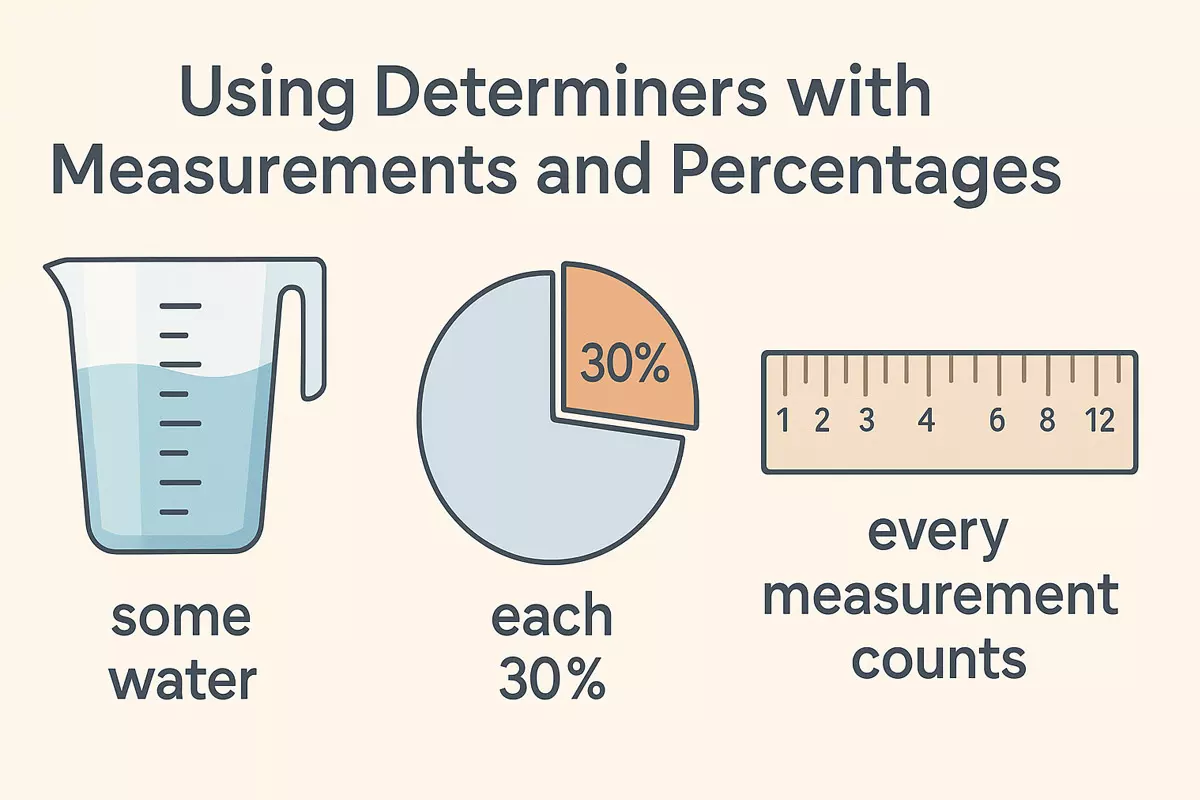 This article explains how to use determiners like a, the, this, that, every, each, and per with size, weight, length, time, distance, and percentages. It covers word order, common errors, and includes practice with measurement phrases.
- How we talk about size, weight, and length with determiners
- Using a, the, this, that with basic measurements
- Using every, each, and per with time and distance
- Talking about percentages with a, the, and zero article
- Word order in noun phrases with numbers and units
- Common mistakes with determiners in measurement phrases
- Practice: complete measurement sentences with correct determiners
Understanding how to correctly use articles and quantifiers before numbers is essential for clear and accurate communication, particularly when dealing with statistics or measurements. For example, we typically say "a hundred people" rather than "the hundred people" unless we are referring to a specific group. Similarly, quantifiers like "about," "approximately," or "more than" often precede numbers to express estimation or comparison, as in "about 50 kilometers" or "more than 20 percent." Mastering these rules helps avoid confusion and ensures that your intended meaning is conveyed precisely.
How we talk about size, weight, and length with determiners
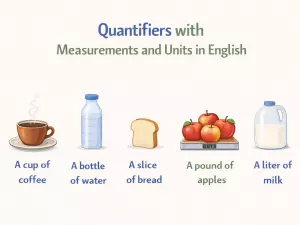
When discussing physical properties like dimension, mass, or extent, determiners help clarify exactly what and how much we mean. Words such as a, an, the, this, each, or quantifying phrases like many and several often precede measurements to make statements precise and natural.
Common Patterns with Measurements
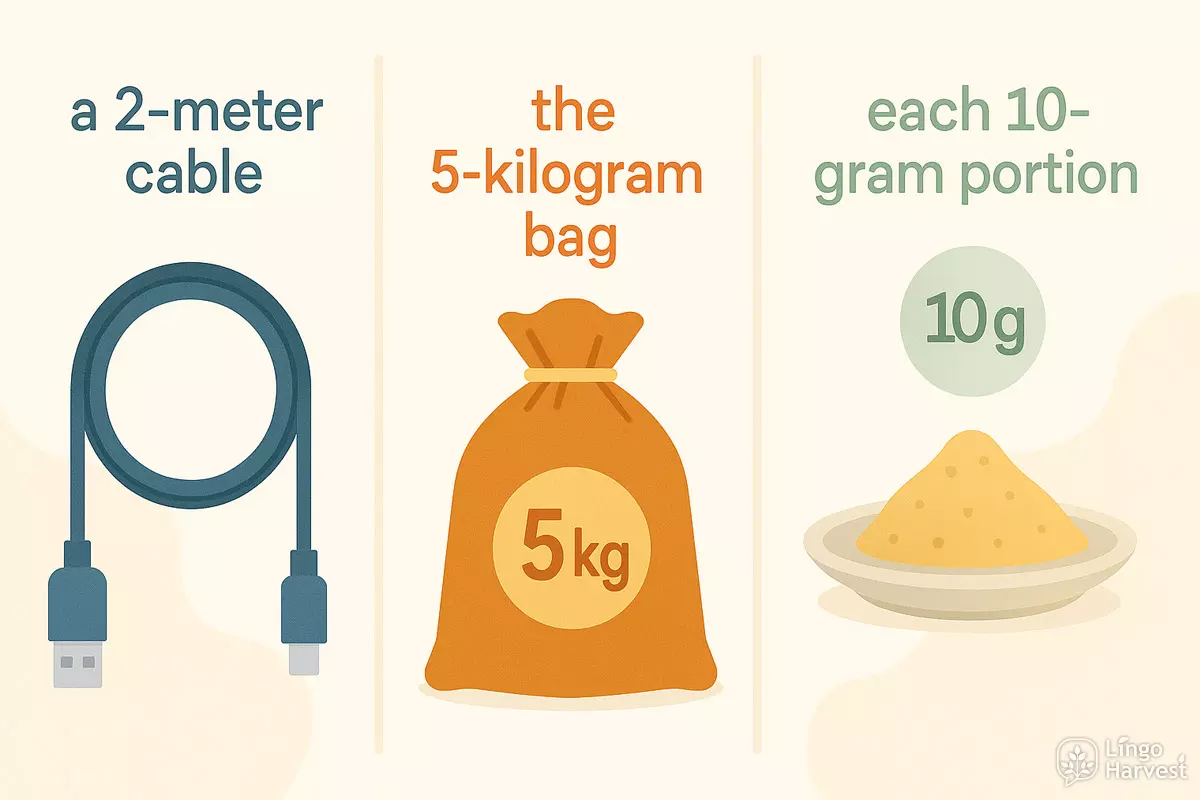
We usually place a determiner before a measurement noun or phrase. This can signal whether we’re talking about a specific item, a general idea, or making a comparison. Here are some typical structures:
- a 2-meter cable
- the 5-kilogram bag
- each 10-gram portion
- this 3-liter bottle
- every 20-centimeter increase
- an 8-ounce glass
- some 4-meter planks
- these 12-inch rulers
- that 50-kilogram package
- a few 6-foot ladders
- another 1-liter carton
- many 100-gram bars
- several 5-meter ropes
- one 2-kilogram weight
- the last 10 meters
Singular and Plural Forms
The choice of determiner often depends on whether the measurement is singular or plural. For instance, a 5-kilogram box (singular) versus several 5-kilogram boxes (plural). We also drop the s from the unit in the singular form but use it in the plural:
| Singular Example | Plural Example |
|---|---|
| a 3-meter pipe | three 3-meter pipes |
| an 8-inch cake | two 8-inch cakes |
| the 1-liter bottle | those 1-liter bottles |
| this 10-kilogram weight | these 10-kilogram weights |
Using Determiners with Percentages and Fractions
When referring to parts of a whole, determiners help specify the portion. For example:
- the last 20% of the journey
- a quarter of the cake
- every 50% increase in weight
- this half-liter bottle
Choosing the right determiner for size, weight, and length allows us to communicate measurements clearly and accurately, whether we’re describing a single item or making broader generalizations.
Using a, the, this, that with basic measurements
When we talk about measurements—such as length, weight, temperature, or volume—choosing the correct determiner helps clarify meaning and context. Articles like a and the, as well as demonstratives like this and that, each serve different purposes when paired with quantities and units.
General rules for articles and demonstratives with measurements
- a/an is used when referring to any single unit of measurement, often in general statements or instructions: “Add a teaspoon of salt.”
- the points to a specific measurement already mentioned or known: “Pour in the two liters of water you measured earlier.”
- this/that emphasize a particular measurement, either near (this) or more distant/previous (that): “Use this cup for sugar.”
Example Patterns
Below are typical ways these determiners appear with basic measurements. Notice how the choice changes the focus or specificity:
- He ran a mile every morning.
- She bought a kilogram of apples.
- Can you pass me the ruler?
- Check the temperature before you leave.
- Pour this liter into the bowl.
- Don’t forget that tablespoon of oil.
- Take a minute to think.
- Replace the batteries every six months.
- Add this pinch of salt now.
- Remember that measurement from earlier?
- He needs a few centimeters more.
- Stir for the recommended time.
Choosing the right determiner: quick comparison
| Determiner | Usage Example |
|---|---|
| a/an | “a liter of milk” (any single unit, not specific) |
| the | “the five meters you measured” (known or unique) |
| this | “this inch on the ruler” (close, immediate context) |
| that | “that gram you weighed yesterday” (more distant or previous) |
Context determines which word to use. For instance, in instructions, “Add a cup of water” means any cup, while “Add the cup of water” refers to a specific one already mentioned. Demonstratives like “this” and “that” often help clarify which measurement or object is meant, especially during hands-on activities or when referring to something visible or previously discussed.
Using every, each, and per with time and distance
Expressions like every, each, and per are frequently used to describe regularity, frequency, or distribution in measurements of time and distance. Knowing how to use these words helps you communicate schedules, rates, and intervals more precisely.
How "every" and "each" work with intervals
The words every and each are often used interchangeably to show how often something happens. However, "every" is more common for regular, repeated intervals, while "each" focuses on individual units or occurrences. For time, "every" is typical: "The bus arrives every 10 minutes." For distance, both can be used: "There is a sign each mile" or "There is a sign every mile."
- We have a meeting every Monday.
- The train leaves every hour.
- There is a streetlight every 100 meters.
- Take one pill each day.
- There’s a bench each kilometer along the path.
Using "per" to express rates
The word per is commonly found in more formal or scientific contexts. It’s used to indicate a rate or ratio, and is often seen with measurements and statistics. For example, "The speed limit is 50 kilometers per hour" or "She earns $20 per day." In these cases, "per" means "for each."
- 60 beats per minute
- 10 liters per 100 kilometers
- Two breaks per shift
- 5 emails per hour
- Four exams per semester
Comparison of usage
While "every," "each," and "per" can all describe frequency and distribution, their usage depends on context and formality. The table below summarizes their typical patterns with time and distance:
| Word | Typical Usage | Example |
|---|---|---|
| every | Regular intervals (time/distance); informal or neutral | every 30 minutes, every 5 miles |
| each | Individual units; often with objects or occurrences | each hour, each mile marker |
| per | Rates and ratios; formal or scientific | per day, per kilometer |
Quick tips ✅
- Use every for schedules or regular events ("every morning," "every 5 kilometers").
- Choose each when emphasizing individual elements ("each stop," "each lap").
- Apply per for rates or ratios, especially in formal writing ("per hour," "per liter").
Selecting the right word helps clarify frequency and distribution, whether you’re describing how often a bus comes, the spacing of road signs, or the rate of payment.
Talking about percentages with a, the, and zero article
Understanding which article to use with percentages depends on context and the specific noun that follows. Sometimes, no article is needed at all; in other cases, "the" or "a" helps clarify meaning or specify a particular group.
When to use no article
Most often, percentages are mentioned with zero article, especially in general statements or when describing data trends:
- 10% of students passed the exam.
- 25% of water evaporates in the first hour.
- 60% of the population owns a smartphone.
No article is needed because the percentage applies broadly to the group or substance described.
Using "the" for specificity
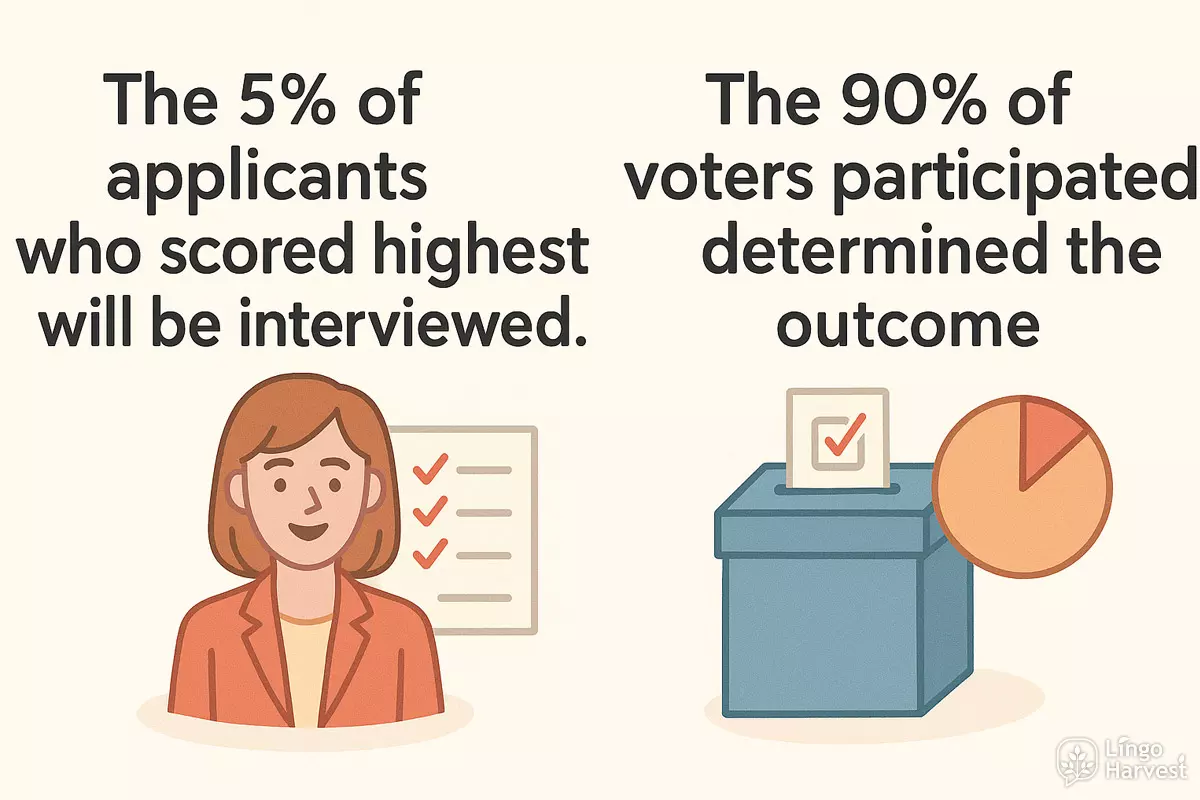
"The" is used when referencing a specific, previously mentioned group or a unique subset:
- The 5% of applicants who scored highest will be interviewed.
- The 90% of voters who participated determined the outcome.
- The 20% increase was unexpected.
Here, "the" signals that you are referring to a particular group already identified or known.
Using "a" with percentages
"A" is less common but can appear when talking about a single instance or example of a percentage:
- A 10% rise in sales was reported last quarter.
- A 50% chance of rain is forecast tomorrow.
- A 30% discount applies to all items.
This construction treats the percentage as a countable event or change.
Quick reference: Articles with percentages
Below is a summary showing how different articles are used with percentages in various situations:
| Article | Example & Usage |
|---|---|
| Zero article | 70% of employees work remotely. (General statement, no article needed) |
| The | The 15% who disagreed were surveyed separately. (Specific group already mentioned) |
| A | A 25% reduction in costs was achieved. (Describing a single instance or change) |
Summary of patterns
To decide which article works best with a percentage, consider:
- Use no article for general or broad statements.
- Use "the" for specific, previously defined groups or changes.
- Use "a" when referring to a singular occurrence or example.
Choosing the right article clarifies whether you are speaking generally or about something specific, and helps your meaning come through clearly.
Word order in noun phrases with numbers and units
When describing measurements, quantities, or percentages in English, the typical sequence within noun phrases is important for clarity and correctness. Generally, the order is: number + unit (if present) + noun. This structure helps readers or listeners immediately understand the quantity and what it refers to.
Common patterns for measurements and percentages
Native speakers instinctively place numbers and units before the noun they describe. For example, we say “two liters of water,” not “water two liters.” This rule applies to both countable and uncountable nouns, as well as percentages and fractions.
- 5 kilograms of rice
- 10 meters of cable
- 3 hours of sleep
- 20 percent increase
- 75% chance of rain
- 4 cups of flour
- 12-inch screen
- 6-month contract
- 100-page report
- 7-day forecast
- 50-mile radius
- 8-ounce glass
- 30-minute break
- 1.5-liter bottle
- 2-ton truck
- 200-gram bar
- 15% discount
- 60-watt bulb
Details about determiners and modifiers
If you add a determiner (such as “a,” “the,” “this,” or “my”), it usually comes at the very start, before the number and unit. For example: “a 10-kilometer race,” “the 50-page document,” or “my 2-liter bottle.” Adjectives describing the noun (like “heavy” or “old”) also come before the noun, but after the number and unit: “a 5-kilogram heavy box.”
Comparing correct and incorrect order
To see the typical sequence at a glance, compare these forms:
| Correct Form | Incorrect Form |
|---|---|
| three liters of milk | milk three liters |
| a 20-percent drop | drop 20-percent a |
| the 12-page letter | letter 12-page the |
| five-hour meeting | meeting five-hour |
Special cases and exceptions
Compound adjectives (like “10-minute” or “100-meter”) often use a hyphen and appear before singular nouns, especially in technical or descriptive writing (“a 10-minute call”). For plural or general references, “of” phrases are common: “ten minutes of rest.” Be aware that spoken English sometimes drops the unit: “a five-year plan” instead of “a plan of five years.” Understanding how to arrange numbers, units, determiners, and adjectives in these groups ensures your meaning is clear and grammatically correct, whether you’re writing about ingredients, statistics, or scientific data.
Common mistakes with determiners in measurement phrases
Understanding how to use determiners correctly with measurements and percentages can be tricky, especially for English learners. People often mix up articles, quantifiers, or omit necessary words, which can change the meaning or make a sentence sound unnatural. Let’s look at where errors commonly occur and how to avoid them.
Omitting the Article or Using the Wrong One
Leaving out “a,” “an,” or “the” is a frequent slip, especially with singular countable units. For example, saying “She ran mile” instead of “She ran a mile” sounds incomplete. Also, using “the” when talking about general quantities (e.g., “the 10 percent of water is lost” instead of “10 percent of water is lost”) can confuse the reader.
Mixing Up “A” and “One”
While “a” and “one” can both be used with measurements, they are not always interchangeable. “A kilogram of apples” is natural, but “one kilogram of apples” emphasizes the exact amount. Overusing “one” can make speech sound robotic or overly precise.
Incorrect Pluralization
Another common issue is using the singular form with measurements that require plurals, or vice versa. For example:
- Incorrect: “five mile walk”
- Correct: “five-mile walk” (as a compound adjective) or “five miles” (as a measurement)
Similarly, “two liters of milk” is correct, not “two liter of milk.”
Confusing “Much” and “Many” with Quantities
“Much” is used for uncountable nouns (“much water”), while “many” is for countable nouns (“many liters”). Mistakes often happen when these are swapped.
Using “Of” Incorrectly
After percentages or fractions, “of” is needed before the noun: “50 percent of the class,” not “50 percent class.”
Comparison Table: Correct vs. Incorrect Usage
| Incorrect Example | Correct Example |
|---|---|
| He ran mile yesterday. | He ran a mile yesterday. |
| She drank two liter of water. | She drank two liters of water. |
| Ten percent students passed. | Ten percent of students passed. |
| Much bottles were empty. | Many bottles were empty. |
| One hundred kilometers is long distance. | One hundred kilometers is a long distance. |
Other Frequent Pitfalls
- Forgetting “of” after fractions: “One third cake was eaten” → “One third of the cake was eaten.”
- Using “the” unnecessarily: “The 50 kilometers is a long way” should be “Fifty kilometers is a long way.”
- Wrong order of words: “A water bottle of 2 liters” → “A 2-liter water bottle.”
- Redundant determiners: “The a liter of milk” is never correct.
- Mixing singular/plural after numbers: “Three piece of bread” instead of “three pieces of bread.”
- Missing article in prices: “This costs dollar” → “This costs a dollar.”
- Incorrect with “each” or “per”: “Each five kg bag” → “Each five-kg bag.”
- Wrong with percentages: “A 70 percent of students” (omit “a”).
- Unnecessary determiners: “Every two liters of water” (use “every two liters” or “every liter”).
- Using “some” incorrectly: “Some five liters” is awkward unless emphasizing uncertainty.
Paying attention to these patterns will help you sound more natural and precise when talking about quantities, amounts, and percentages.
Practice: complete measurement sentences with correct determiners
Understanding how to use determiners such as "a," "an," "the," "some," "each," "every," "this," and "those" with numbers, measurements, and percentages is essential for clear and accurate communication. In this section, you'll find exercises to help you choose the correct word for different contexts involving quantities and statistics.
Fill in the blanks: Choose the correct determiner
Read each sentence and select the most appropriate determiner from the options in parentheses.
- ______ five percent of the class failed the test. (A, The, Some)
- ______ liter of water weighs one kilogram. (A, The, Each)
- ______ six meters of rope is needed for this project. (A, An, The)
- ______ fifty percent of the respondents agreed with the statement. (A, The, Some)
- ______ kilogram of apples costs less than last year. (A, The, Each)
- ______ two-thirds of the cake has been eaten. (A, The, Some)
- ______ hour isn’t enough to finish this work. (A, An, The)
- ______ five liters of paint will be enough to cover the wall. (A, The, Some)
- ______ percent of people enjoy reading in their free time. (The, A, Some)
- ______ hundred meters is a common distance for a sprint race. (A, The, Each)
Show answers
- Some
- A
- The
- About
- A
- Two-thirds
- An
- The
- Some
- A
Recognizing patterns with determiners and measurements
The following examples illustrate typical phrases where determiners naturally combine with measurements and percentages:
- A meter of fabric
- The last ten percent
- Every five kilometers
- Some thirty students
- Each kilogram of rice
- All the liters needed
- This one percent increase
- Those twenty centimeters
- Another three hours
- Half a liter
- One hundred percent
- Several millimeters
- Few grams
- Each portion contains
- Per kilogram
- About ten percent
Multiple choice: Determiners in measurement sentences
Choose the correct determiner for each sentence.
- ______ mile is longer than a kilometer.
(A, The, Each) - ______ twenty percent of the employees were absent.
(A, Some, The) - ______ glass of water contains about 200 milliliters.
(The, A, Some) - ______ four liters of milk are enough for the recipe.
(A, The, Some) - ______ hundred people attended the concert.
(A, The, Some) - ______ majority of the students passed the exam.
(A, The, Some) - ______ couple of questions remain unanswered.
(A, The, Each) - ______ three liters of juice in the fridge are enough for the party.
(A, The, Some) - ______ piece of equipment needs to be checked.
(Each, A, The) - ______ ten percent discount is available this week.
(A, The, Some)
Show answers
- A
- Some
- A
- The
- A
- The
- A
- The
- Each
- A
Practicing with these sample sentences will help you gain confidence in using the right determiner with measurements and percentages. Pay attention to context and whether the noun is singular, plural, specific, or general to guide your choice.