Using Determiners for Precision in Arguments and Debates

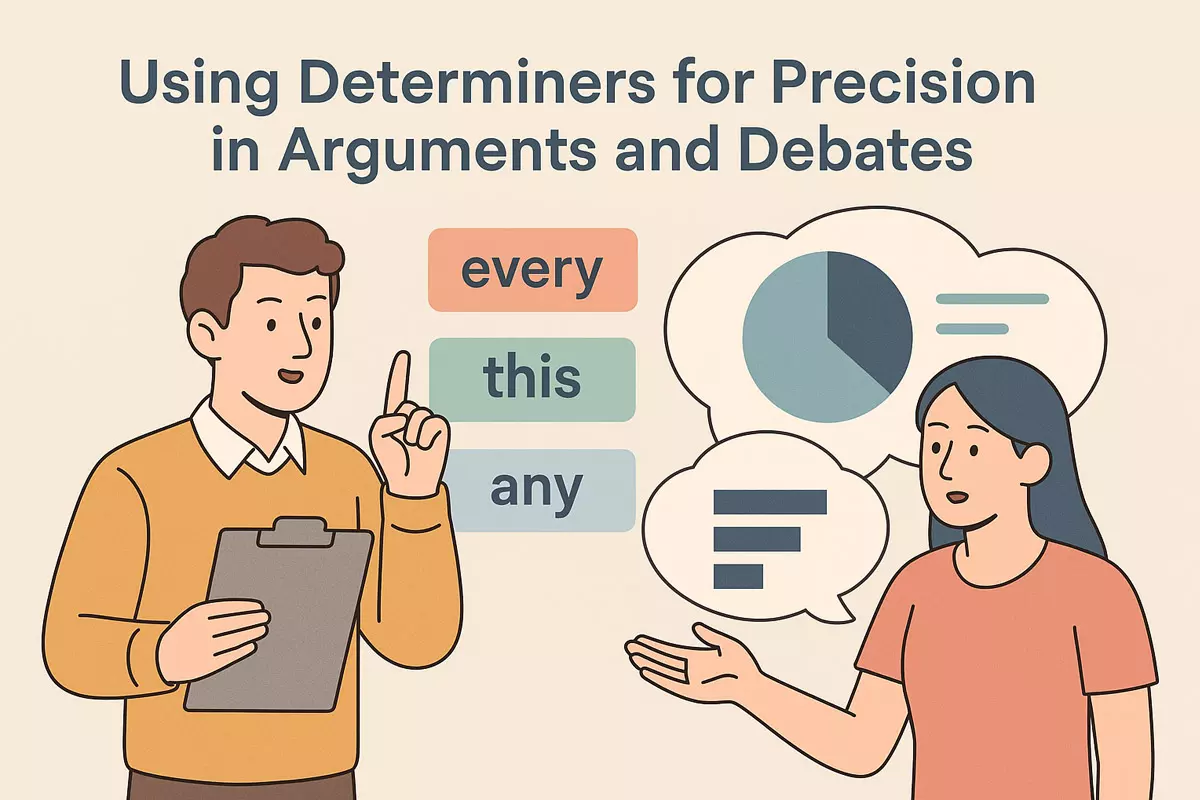 Here we how determiners clarify arguments by framing claims, describing groups accurately, and signaling exceptions. It includes real examples and practice to help you avoid vague language and overgeneralizations when presenting opinions.
- How determiners help make arguments more precise
- Using this and that to frame claims and counterclaims
- Using some, many, most, and all to describe groups carefully
- Avoiding overgeneralization with vague determiners
- Signaling limits and exceptions with certain, particular, specific
- Examples from opinion pieces and discussions
- Practice: adjust determiners to make arguments clearer and fairer
Selecting precise words is essential when presenting a case or defending a viewpoint, as the language used shapes how clearly others understand our arguments. Using specific terms and avoiding vague language helps ensure our perspectives are communicated accurately and persuasively. By carefully choosing our words, we reduce the risk of misunderstandings and strengthen our ability to convey complex ideas, making our positions more compelling and effective in any discussion or debate.
How determiners help make arguments more precise
Clarity in debates and discussions often hinges on how specifically you refer to people, things, or ideas. Determiners—words like “some,” “every,” “this,” or “those”—play a crucial role in narrowing or expanding the scope of your statements. By selecting the right determiner, speakers avoid vagueness and make their claims easier to understand and evaluate.
Specifying Quantity and Scope
Using determiners, you can make it clear whether you’re talking about one item, several, or all. This prevents misinterpretation and strengthens your position. For instance, “All students must submit the form” is much firmer than “Students must submit the form,” which leaves room for exceptions.
- All solutions were considered. ✅
- Some experts disagree. → Not everyone, but a specific subset.
- No evidence supports that claim. ❌ Absolute exclusion.
- Each participant received instructions.
- Many people believe this is true.
- Few alternatives exist.
- Several studies suggest otherwise.
- Neither argument is convincing.
- Every attempt failed.
- Any solution is welcome.
Focusing Attention with Specificity
Picking the right determiner helps you direct your audience’s attention. For example, using “this” or “these” singles out particular ideas, while “that” or “those” can reference previous points or opposing arguments. This prevents confusion and keeps the discussion on track.
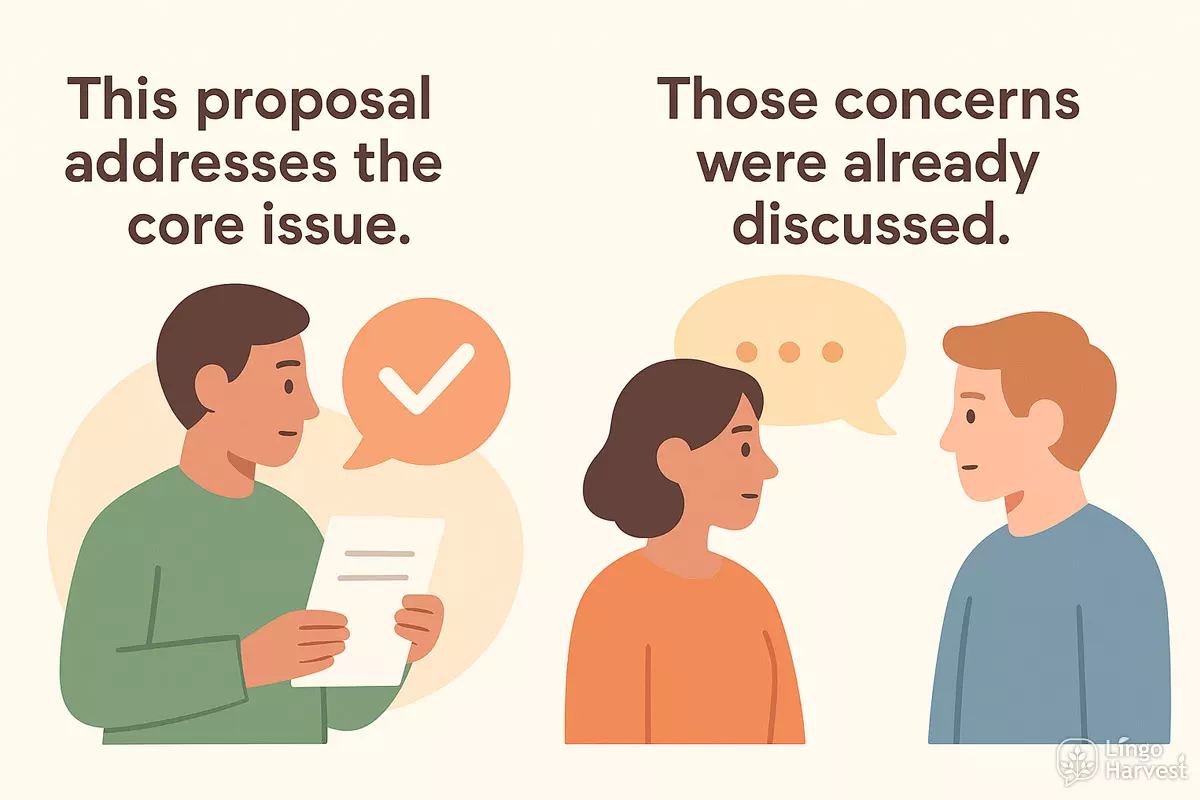
- This proposal addresses the core issue.
- Those concerns were already discussed.
- Such claims require evidence.
- That approach is outdated.
Comparing Determiner Choices
Different determiners can change the strength or nuance of your argument. Consider the following table, which compares how certain words adjust the precision and impact of statements:
| Determiner | Effect on Statement |
|---|---|
| All | Includes every instance, no exceptions |
| Some | Refers to a subset, not the whole group |
| Most | Indicates a majority, but not all |
| No | Excludes every possible instance |
| Each | Highlights individuals one by one |
| Any | Opens up to any member of a group |
Reducing Ambiguity in Arguments
When you use clear determiners, your audience is less likely to misunderstand your intent. Ambiguous phrases like “people disagree” can be made more meaningful by specifying “many people” or “a few people.” This level of detail can be the difference between a persuasive point and a weak, unsupported claim. In summary, careful choice of determiners lets you control the precision, clarity, and impact of your arguments—helping you avoid miscommunication and making your reasoning more persuasive.
Using this and that to frame claims and counterclaims
Demonstratives like "this" and "that" are powerful tools for structuring arguments. They help speakers and writers signal agreement, distance, or contrast between ideas, making debates clearer and more precise. By referencing specific points with "this" or "that," participants can highlight what they support or oppose, avoid ambiguity, and direct attention to particular claims or evidence.
Clarifying Positions with Demonstratives
When constructing arguments, using "this" generally signals alignment or emphasis with a current point, while "that" often creates distance or opposition. For example, "This argument is supported by recent data," suggests endorsement, whereas "That claim overlooks key evidence," marks disagreement. Such choices subtly influence how audiences interpret the speaker’s stance.
Examples of Framing Claims and Counterclaims
- This solution addresses the root of the problem.
- That perspective ignores critical details.
- This proposal is both practical and efficient.
- That assumption is unproven.
- This evidence supports our conclusion.
- That argument relies on outdated research.
- This approach has been successful elsewhere.
- That criticism lacks context.
- This fact cannot be dismissed.
- That example is not representative.
- This data demonstrates a trend.
- That interpretation is misleading.
- This result confirms our hypothesis.
- That explanation oversimplifies the issue.
Comparing the Use of "This" and "That"
| When to use "this" | When to use "that" |
|---|---|
| Referring to a point just mentioned or being emphasized | Referring to a previous point, often to distance or challenge it |
| Highlighting agreement or support | Signaling disagreement or critique |
| Introducing a claim, reason, or evidence | Introducing a counterclaim or opposing view |
| Drawing attention to something present or immediate in the discussion | Drawing attention to something more distant, either in time or logic |
Tips for Effective Use in Debates
- Use "this" to reinforce your argument or evidence.
- Choose "that" to respectfully challenge opposing views.
- Be explicit about what "this" or "that" refers to, especially in complex discussions.
- Combine demonstratives with specific nouns for greater clarity (e.g., "this proposal," "that criticism").
- Monitor your tone—"that" can sound dismissive if overused.
Selecting the right determiner not only adds precision but also shapes the tone of the interaction. Thoughtful use of "this" and "that" ensures your claims and counterclaims are both clear and persuasive.
Using some, many, most, and all to describe groups carefully
Precision in language is crucial, especially when making claims about groups during debates or discussions. Words like "some," "many," "most," and "all" help indicate the size or scope of the group being discussed, but each has a distinct meaning and implication. Overgeneralizing can weaken an argument, so it’s important to select these quantifiers thoughtfully.
Understanding the differences
Choosing the right determiner can help avoid exaggeration or misleading statements. For example:
- Some suggests a minority or a non-specific, but limited, portion of a group.
- Many indicates a large number, but not necessarily a majority.
- Most refers to the majority, but not everyone.
- All means every member without exception.
Why careful quantification matters
Misusing group quantifiers risks weakening your credibility. For instance, claiming "All students dislike homework" is rarely accurate, while "Many students dislike homework" is more defensible and likely to be accepted by listeners. Avoiding sweeping statements shows intellectual honesty and awareness of diversity within groups.
Common pitfalls and tips
- Avoid using "all" unless you are certain there are no exceptions.
- Be prepared to support claims with evidence, especially for "most" and "many."
- If unsure of the exact proportion, "some" is generally safer.
- Clarify estimates if possible (e.g., "Most—about 70%—of respondents agreed").
- Be aware of how different quantifiers may affect interpretation and emotional response.
Examples of careful group description
| Quantifier | Sample Statement |
|---|---|
| Some | Some employees prefer flexible hours. |
| Many | Many participants found the instructions confusing. |
| Most | Most voters support the new policy. |
| All | All applicants must submit a resume. |
When in doubt, be specific
Whenever possible, replace vague quantifiers with more precise information. For example, instead of "Many people enjoy outdoor activities," specify "68% of survey respondents enjoy outdoor activities." This approach increases clarity and persuasiveness. In summary, using quantifiers like "some," "many," "most," and "all" thoughtfully allows you to express group characteristics accurately, avoid overstatements, and strengthen your arguments.
Avoiding overgeneralization with vague determiners
Precision in argumentation often hinges on how specifically you present your claims. Using imprecise quantifiers like "some," "many," or "few" can unintentionally lead to sweeping statements or unsupported generalizations. These vague determiners blur boundaries, making it harder for your audience to grasp the exact scope of your point.
Why vague determiners weaken arguments
When you rely on uncertain quantifiers, your statements may sound less credible and more open to challenge. For instance, saying "Many people disagree" leaves listeners wondering: how many is "many"? Is it a handful or a majority? Without clear boundaries, such phrases can inadvertently inflate or understate the reality, opening your argument to criticism.
Common vague determiners to watch for
- Some → Some students stayed after class.
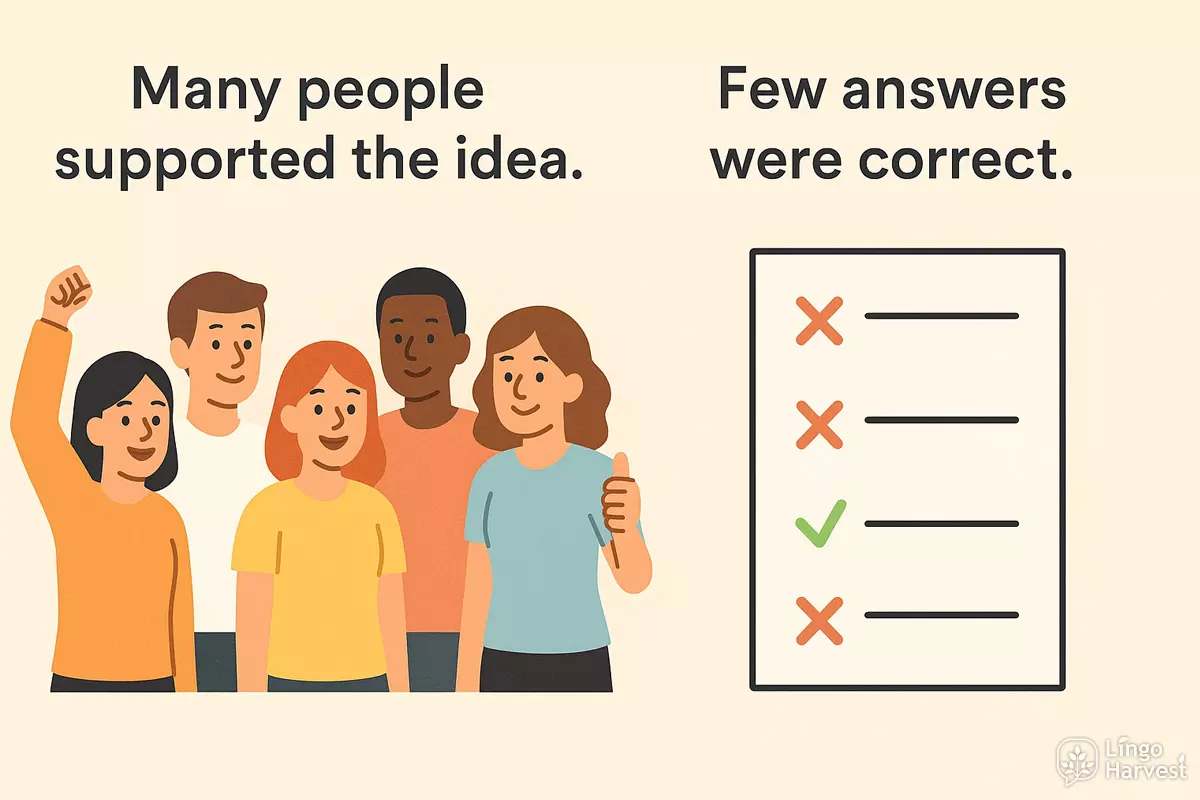
- Many → Many people supported the idea.
- Few → Few answers were correct.
- Several → Several guests arrived early.
- Most → Most children enjoy playing outside.
- Much → There isn’t much time left.
- Almost all → Almost all the seats were taken.
- Hardly any → Hardly any money was spent.
- Plenty of → We have plenty of food for everyone.
- Various → Various problems were discussed.
- A lot of → She has a lot of work to finish.
- Numerous → Numerous mistakes were found.
- Scarcely any → Scarcely any light came through the window.
- Countless → She has heard the story countless times.
- Any → Do you have any questions?
- All → All students must register.
- No → No visitors were allowed inside.
- Each → Each child received a prize.
- Every → Every morning starts with coffee.
- Either → You can choose either option.
Clarifying intent with precise language
To bolster your credibility, try to swap out ambiguous determiners for more concrete alternatives. Instead of "many," specify an actual number or percentage if available. If an exact figure isn't possible, contextualize your determiner: "A recent survey found that 65% of respondents..." is much clearer than "Most people think..."
| Vague Determiner Example | More Precise Alternative |
|---|---|
| Many students struggle with math. | According to school records, 40% of students struggle with math. |
| Some countries have adopted the policy. | Five countries, including France and Japan, have adopted the policy. |
| Few experts agree on this point. | Only 2 out of 15 experts agreed on this point. |
| Most people support the proposal. | Survey results show 78% support for the proposal. |
| Almost all participants finished the race. | 98 out of 100 participants finished the race. |
Tips for reducing overgeneralization
- Replace vague quantifiers with specific data whenever possible.
- Qualify statements with context (who, where, when), not just quantity.
- If precision is impossible, acknowledge the uncertainty directly: "Exact figures are unavailable, but estimates suggest..."
- Challenge your own statements—ask: "Could someone misinterpret this scope?"
By favoring clarity over vagueness, your arguments will be more persuasive and less likely to be dismissed as overgeneralizations. Thoughtful use of determiners sharpens your message and fosters trust with your audience.
Signaling limits and exceptions with certain, particular, specific
In debates and formal arguments, the ability to narrow the scope of a claim or highlight exceptions is essential for clarity. Words like certain, particular, and specific serve as determiners that help you carve out limited cases, focus on notable subgroups, or draw attention to exceptions within a broader category.
How these determiners add precision
Using these terms allows speakers and writers to avoid overgeneralization. For example, saying “Certain policies are effective” signals that not all policies work equally well, while “Particular studies contradict this claim” suggests that exceptions exist within a broader trend. This type of language is especially useful when you want to avoid absolute statements or when you need to highlight nuances.
Common uses and patterns
You’ll often encounter these determiners in academic, legal, and policy discussions to introduce exceptions, boundaries, or to focus on subcategories. Here are some typical patterns:
- Certain individuals prefer remote work.
- The law applies only to particular cases.
- Specific examples illustrate this point.
- Certain foods can trigger allergies.
- Only a particular group was surveyed.
- Specific rules govern this process.
- Certain areas are prone to flooding.
- They focused on particular variables in the experiment.
- Only specific data sets were analyzed.
- Certain assumptions underlie the argument.
- We are discussing a particular instance, not the general case.
- Specific circumstances may require exceptions.
Comparing the nuances
While these words all narrow the scope, they aren’t interchangeable in every context. Their shades of meaning can impact the precision of your argument. The table below compares their typical usages:
| Determiner | Typical Function | Example Usage |
|---|---|---|
| Certain | Highlights some but not all; signals exceptions or subsets | Certain candidates were favored in the interview process. |
| Particular | Emphasizes one or more distinct cases or items | This regulation targets particular industries. |
| Specific | Draws attention to clearly defined or named instances | Specific guidelines must be followed. |
Choosing the right determiner helps you make precise claims, acknowledge exceptions, and maintain credibility in arguments. It’s a subtle but powerful way to show that your reasoning is careful and nuanced.
Examples from opinion pieces and discussions
Writers and speakers often rely on determiners to convey a clear scope or degree of certainty in arguments, especially in editorials and debates. Whether discussing policies, social trends, or scientific findings, the careful choice of words like “some,” “many,” “all,” or “no” can sharpen claims and minimize ambiguity. Below are several real-world example patterns illustrating how determiners shape the strength or precision of statements.
Common Determiner Patterns in Argumentation
- All citizens deserve equal rights. ✅ (Universal claim)
- Some experts disagree with the proposed solution. (Partial agreement)
- Most studies show a correlation. (Majority, not absolute)
- No evidence supports this theory. ❌ (Total negation)
- Every case must be considered individually. (Without exception)
- Any reduction in funding could have consequences. (Non-specific, hypothetical)
- Few politicians address this issue directly. (Minority, negative emphasis)
- Several participants raised concerns. (Indefinite, but more than two)
- Each perspective offers unique insight. (Individualizing, distributive)
- The current policy is flawed. (Specific reference)
- These examples highlight the problem. (Demonstrative, plural)
- That argument lacks nuance. (Demonstrative, singular)
- Neither proposal addresses the root cause. (Negative, dual)
- Much debate surrounds this topic. (Uncountable, quantity)
- Both options have drawbacks. (Dual, inclusive)
- Another factor to consider is timing. (Additional, singular)
- One solution could be increased funding. (Singular, indefinite)
- Little evidence supports this claim. (Negative, uncountable)
- Those who disagree raise valid points. (Demonstrative, plural)
- Our research suggests otherwise. (Possessive, specific group)
How Determiners Affect Argument Precision
The strategic use of determiners helps authors avoid overgeneralization and clarify intent. For example, stating “all experts agree” is much stronger (and riskier) than “some experts agree.” Choosing the right determiner makes positions more defensible and nuanced.
| Determiner Choice | Implication in Argument |
|---|---|
| All | Absolute, leaves no exceptions |
| Some | Partial, allows for exceptions |
| Most | Majority, but not universal |
| No | Complete negation |
| Few | Minority, suggests rarity |
| Each | Focus on individuals within a group |
Writers in opinion columns and public forums frequently select determiners to either reinforce the breadth of their claims or introduce necessary caution. This not only improves the credibility of their arguments but also helps readers interpret the intended scope and weight of each statement.
Practice: adjust determiners to make arguments clearer and fairer
Careful selection of determiners can significantly influence how convincing and balanced your statements sound in debates or discussions. Overusing absolute terms such as “all,” “none,” or “every” often leads to overgeneralizations, while more measured language (“some,” “many,” “several”) can help present arguments more accurately and persuasively.
Common Determiners That Affect Clarity and Fairness
- All – implies no exceptions; often leads to sweeping claims.
- Some – suggests partial inclusion; adds nuance.
- Many – indicates a significant number, but not total.
- Few – highlights a minority without excluding the majority.
- Every – similar to “all,” covers each item in a group.
- No – absolute exclusion; risks inaccuracy if exceptions exist.
- Most – more than half, but not complete; useful for general trends.
- Several – more than a couple, but less than many.
- Each – emphasizes individuals within a group.
- Any – open inclusion, but context-dependent.
- Only – restricts scope; can strengthen or weaken a claim.
- Either – presents alternatives or options.
- Neither – negates both options.
- Much – non-count nouns; indicates a large amount.
- Little – non-count nouns; indicates a small amount.
- Another – adds one more, often used in examples.
- Both – refers to two items together.
- Various – highlights diversity or range.
- Several – more than two, but not many; helpful for moderate claims.
- Numerous – stresses a large quantity.
Adjusting Determiners: Before and After Examples
Observe how changing determiners alters the tone and precision of each statement:
| Original Statement | Improved with Adjusted Determiner |
|---|---|
| All teens are careless on social media. | Many teens are careless on social media. |
| No scientists disagree about climate change. | Few scientists disagree about climate change. |
| Every politician lies. | Some politicians lie. |
| None of the students understood the assignment. | Several students struggled with the assignment. |
| All technology is harmful to children. | Certain technologies can be harmful to children. |
| Everyone prefers working remotely. | Many people prefer working remotely. |
| No one benefits from standardized tests. | Some students benefit from standardized tests. |
| Every solution has been tried. | Various solutions have been tried. |
| All diets fail in the long term. | Many diets fail in the long term. |
| None of the evidence supports the claim. | Little evidence supports the claim. |
Practice: Revise These Statements
Replace the determiners in these sentences to make the arguments more balanced. Try to avoid absolutes unless truly justified.
- All video games are a waste of time.
- No adults enjoy animated movies.
- Every city has a pollution problem.
- None of the proposals were effective.
- All students need the same teaching style.
- No one likes working under pressure.
- Every test is difficult.
- All teenagers are addicted to their phones.
- None of the books were interesting.
- Every job is stressful.
Show answers
- Many video games can be a waste of time.
- Few adults enjoy animated movies.
- Most cities have a pollution problem.
- Several proposals were not effective.
- Some students need the same teaching style.
- Few people like working under pressure.
- Some tests are difficult.
- Many teenagers are addicted to their phones.
- Few of the books were interesting.
- Many jobs are stressful.
Tips for Choosing the Right Determiner
- Ask yourself if your claim truly applies to every case, or just some.
- Use quantifiers (“some,” “many,” “most”) to avoid overgeneralization.
- Be ready to provide evidence if you use absolute determiners.
- When in doubt, choose a more cautious determiner for fairness.