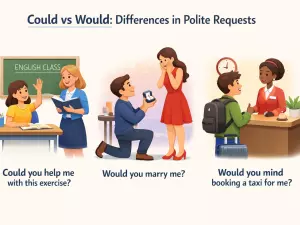
Modal Verbs Commonly Used in Advice Columns

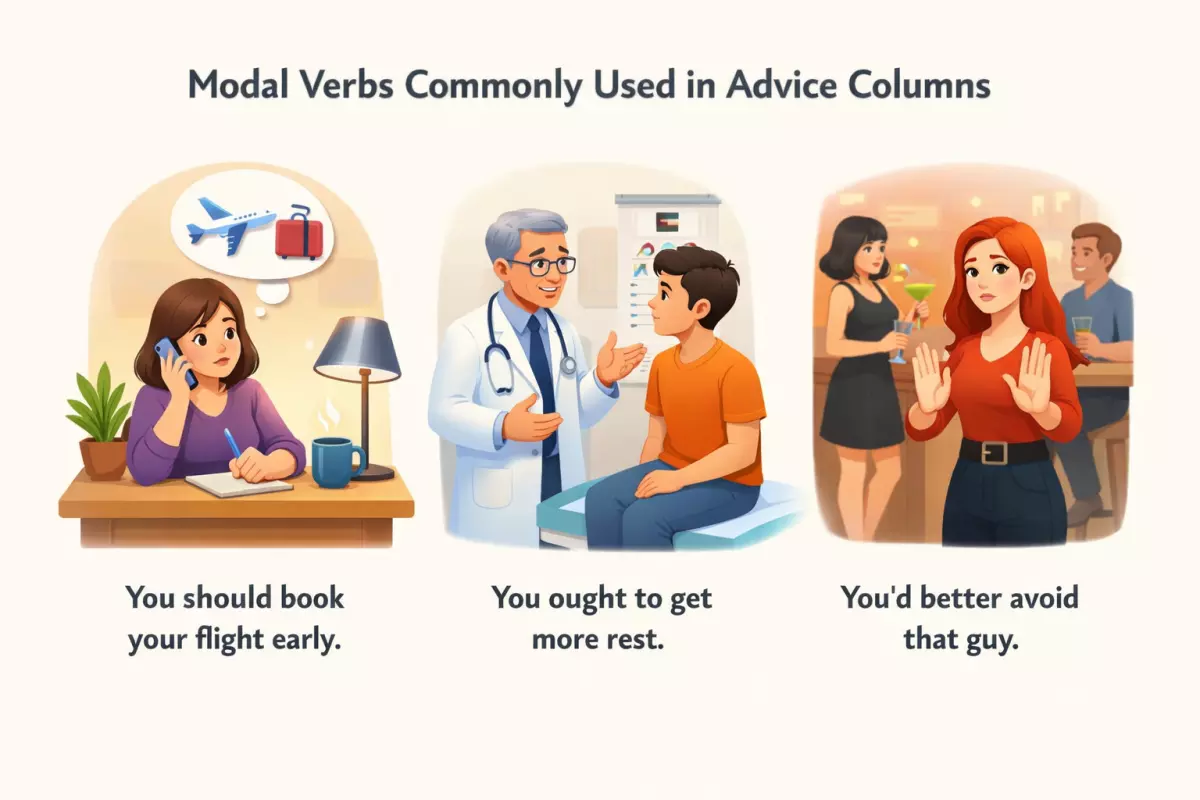 This article explains why advice columns lean on modal verbs, which ones show up most when suggesting solutions, and how writers offer several options. It compares should, could, and might with examples, shows how they soften criticism and change tone, and ends with practice exercises.
- Why advice columns rely heavily on modal verbs
- Modal verbs commonly used when suggesting solutions to problems
- How advice writers present several possible options
- Examples of responses using should, could, and might
- How modal verbs soften criticism while offering guidance
- How tone changes depending on the modal verb chosen
- Exercises and practice activities writing advice with modal verbs
In newspapers and online help pages, writers often use modal verbs to guide readers without sounding harsh. Words like should, could, and might allow them to suggest options, highlight possible risks, or soften a firm opinion so it feels supportive rather than bossy. This article explains how these small choices shape tone and help you interpret what the writer truly intends.
Why advice columns rely heavily on modal verbs
Advice writing needs language that is helpful without sounding like an order. Modal verbs do that job well because they let the writer adjust strength, politeness, and certainty while still guiding the reader toward a next step.
What modals help an advice writer do
- Soften directives: “You should talk to your manager” feels less forceful than “Talk to your manager.”
- Offer options instead of one “right” answer: “You could try…” frames a suggestion as a choice.
- Signal urgency or importance: “You must address this now” marks a non-negotiable boundary or safety issue.
- Express probability and realistic expectations: “This may take time” prepares the reader for outcomes without overpromising.
- Reduce blame and keep tone supportive: “You might be reacting to stress” sounds less accusatory than a direct claim.
- Build empathy through conditional framing: “It can be hard to…” normalizes the reader’s situation.
- Set boundaries clearly: “You shouldn’t accept insults” communicates limits while staying advisory.
- Give permission and reassurance: “You can say no” validates the reader’s right to choose.
- Suggest low-risk experiments: “You could start with a short message” encourages manageable action.
- Keep claims appropriately cautious: “That could be a red flag” avoids stating uncertain judgments as facts.
- Balance competing priorities: “You may want to protect your privacy, but you should document…” shows layered guidance.
- Maintain a respectful distance: modals help the writer avoid sounding like they are taking control of the reader’s life.
Common modal patterns in advice columns
- You should + base verb: “You should apologize.” (general recommendation)
- You could + base verb: “You could ask for clarification.” (one possible option)
- You might + base verb: “You might feel relieved afterward.” (tentative prediction)
- You may want to + base verb: “You may want to set a deadline.” (gentle suggestion)
- You need to + base verb: “You need to stop sharing passwords.” (strong necessity; not a true modal, but used similarly)
- You must + base verb: “You must leave if you feel unsafe.” (absolute necessity)
- You can + base verb: “You can decline the invitation.” (ability/permission)
- You can’t + base verb: “You can’t control their reaction.” (limits; reality-check)
- It may be + adjective + to-infinitive: “It may be best to wait.” (measured evaluation)
- It might help to + base verb: “It might help to write it down.” (soft, practical tip)
- It can be + adjective + to-infinitive: “It can be difficult to confront someone.” (empathy + realism)
- If you + present, you might + base verb: “If you ask directly, you might get a clearer answer.” (conditional outcome)
- Would + base verb: “I would start by…” (modeling a plan without commanding)
- Would you be willing to + base verb?: “Would you be willing to talk with a counselor?” (polite invitation)
- Should you + base verb…: “Should you decide to leave, plan your finances first.” (formal conditional)
- May + base verb (formal): “You may find that boundaries help.” (more formal, less conversational)
How modals shape the reader’s perception
- Strength ladder: might/could (light) → should (recommended) → need to (strong) → must (absolute).
- Politeness control: would and could often sound more tactful than bare imperatives.
- Certainty control: may/might/could keep predictions realistic when the writer lacks full context.
- Agency preservation: phrases like “you can” and “you could” keep the decision with the reader.
Modal verbs commonly used when suggesting solutions to problems
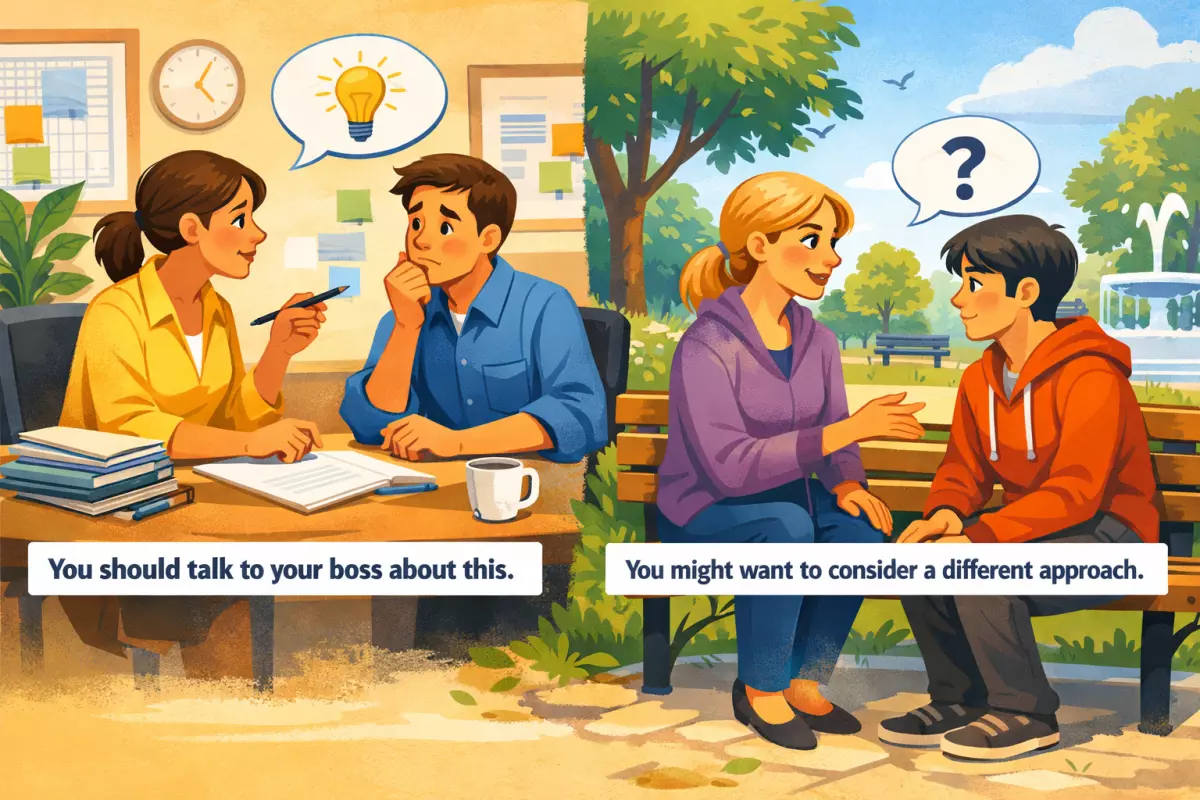
When an advice writer proposes a fix, the modal verb signals how strong the recommendation is and how much choice the reader has. Some modals sound firm and practical, while others keep the tone gentle or exploratory. The patterns below show how advice columns typically frame solutions with clear levels of obligation, likelihood, and permission.
Common modals and the solution patterns they create
- should + base verb: the standard recommendation for a sensible next step.
Example: “You should talk to your manager privately before escalating.” - could + base verb: a low-pressure option that leaves room for alternatives.
Example: “You could ask for a trial period to see if the new schedule works.” - can + base verb: focuses on ability or a practical method; often used for actionable tips.
Example: “You can set a boundary by ending the call after ten minutes.” - might + base verb: a cautious suggestion, useful when outcomes are uncertain.
Example: “You might get better results if you put the request in writing.” - may + base verb: formal, careful possibility; common when the writer avoids overpromising.
Example: “You may find it easier to start with a short, neutral message.” - need to + base verb: strong necessity, often used for non-negotiable steps.
Example: “You need to document the incidents before you file a complaint.” - have to + base verb: external obligation (rules, deadlines, policies).
Example: “You have to submit the form by Friday to keep your benefits.” - must + base verb: very strong requirement; best reserved for safety, ethics, or clear rules.
Example: “You must stop sharing passwords, even with friends.” - ought to + base verb: similar to “should,” slightly more formal or moral in tone.
Example: “You ought to apologize directly, without adding excuses.” - will + base verb: used to describe the expected result of a solution (a confident prediction).
Example: “A short script will help you stay calm in the meeting.” - would + base verb: polite, indirect recommendation; common in tactful columns.
Example: “I would start by acknowledging their concern before explaining your side.” - shall + base verb: rare in modern advice writing; sometimes used in very formal or legal-style guidance.
Example: “You shall receive a response within ten business days.”
High-utility structures for giving solutions
- Modal + base verb: “You should clarify what you’re asking for.”
- Modal + not + base verb (warning/limit): “You shouldn’t respond while you’re angry.”
- Modal + be + adjective/noun (state-focused guidance): “It might be helpful to bring notes.”
- Modal + have + past participle (past evaluation, used carefully): “You should have asked earlier.” (Often sounds critical; many columns prefer future-focused wording.)
- Modal + be + past participle (passive, policy/process): “The request must be submitted in writing.”
- If-clause + modal (conditional solution): “If they refuse, you may need to involve HR.”
- Modal + want/need + to (softening or strengthening): “You might want to rehearse what you’ll say.” / “You’ll need to set a clear deadline.”
Choosing the right strength (and avoiding common slips)
- Match the modal to the stakes: use must and have to for rules and safety; prefer should for general best practice; use could/might to offer options.
- Keep the verb form consistent: ✅ “You should call them.” ❌ “You should to call them.”
- Avoid mixed signals in one sentence: ✅ “You should consider setting boundaries.” ❌ “You must consider maybe setting boundaries.”
- Use would for tact, not certainty: “I would…” sounds polite; it does not guarantee results.
- When giving multiple fixes, vary modals to show priority: lead with need to for essential steps, then add could for optional improvements.
How advice writers present several possible options
Advice columns often lay out a small menu of choices rather than pushing a single solution. Modal verbs help writers signal which actions are merely possible, which are recommended, and which are off-limits, while still leaving room for the reader’s context.
Common option-setting patterns with modals
- Offer two or three paths with parallel structure: “You could talk to your manager, or you could ask HR to mediate.”
- Use “could” for low-pressure suggestions: “You could start by sending a short message to clear the air.”
- Use “might” to acknowledge uncertainty: “You might find that a direct conversation solves it faster than email.”
- Use “may” for permission or formal-sounding possibility: “You may want to keep the note brief and factual.”
- Use “can” to describe practical feasibility: “You can set a boundary without giving a long explanation.”
- Use “should” to mark the strongest recommendation among options: “If there’s a safety issue, you should document it.”
- Use “must” sparingly for non-negotiables: “You must prioritize your safety and leave if you feel threatened.”
- Use “would” to propose a tactful script: “I would say, ‘I can’t commit to that timeline.’”
- Use “could” + time markers to stage choices: “You could try once more this week; if nothing changes, you could escalate.”
- Use “might” + outcomes to compare consequences: “If you confront them publicly, it might escalate the conflict.”
- Use “can” + conditions to keep options realistic: “You can agree to help if the scope is limited.”
- Use “should” + priority language to rank options: “You should start with the least disruptive step.”
- Use “don’t have to” to remove pressure: “You don’t have to respond immediately.”
- Use “can’t” to state clear boundaries: “You can’t control their reaction, only your response.”
- Use “shouldn’t” to warn against a tempting but risky move: “You shouldn’t share private messages with coworkers.”
- Use “may not” / “might not” to soften a caution: “That approach may not work if they’re already defensive.”
How writers signal choice, ranking, and trade-offs
- Neutral menu: “You could A, you could B, or you could C,” where each option is grammatically similar so none sounds automatically “correct.”
- Gentle ranking: “You could try A, but you should consider B if the pattern continues,” using “should” to elevate one option without dismissing the others.
- Conditional branching: “If X happens, you might…; if not, you can…,” which frames decisions as responses to evidence.
- Risk labeling: “You can do A, but it might backfire,” pairing “can” (possible) with “might” (uncertain outcome).
- Boundary-first framing: “You don’t have to agree; you can offer an alternative,” which presents refusal and compromise as equally valid moves.
- Escalation ladder: “You could start privately; you could escalate later,” showing progression from softer to stronger steps.
Mini-templates readers can reuse
- “You could ___, or you could ___; it depends on ___.”
- “You might try ___ first. If that doesn’t work, you can ___.”
- “You don’t have to ___. You can ___ instead.”
- “You can ___, but you should ___ if ___.”
- “You may want to ___, especially if ___.”
- “You shouldn’t ___; you could ___.”
Examples of responses using should, could, and might
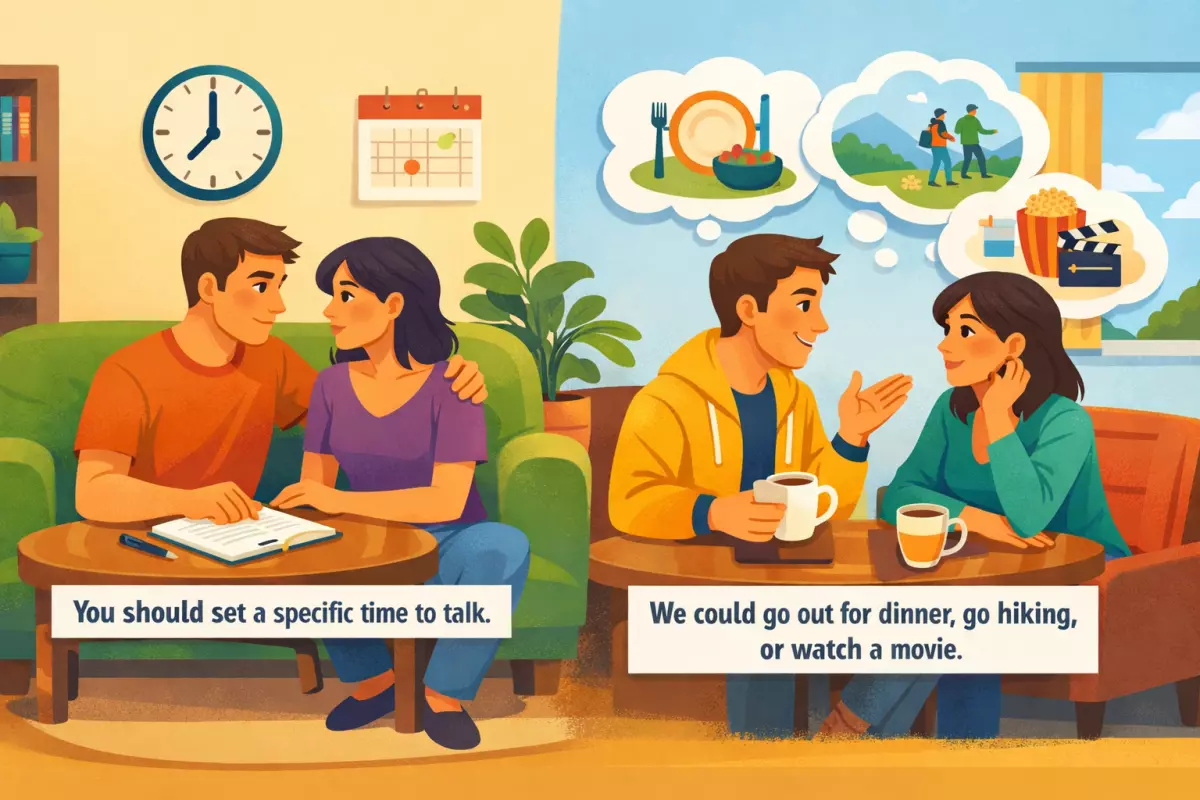
Advice writing often balances clarity with tact. The modal verbs should, could, and might help you control that balance: should sounds firm and guiding, could offers options, and might suggests possibilities without pressure. The examples below show common sentence patterns you can reuse.
Using should for clear guidance and priorities
- You should set a specific time to talk when you’re both calm.
- You should be honest about what you can and can’t commit to right now.
- You should apologize for the impact, even if the intent was different.
- You should stop replying in the heat of the moment and revisit the message later.
- You should ask for clarification instead of assuming the worst.
- You should put your boundary in one sentence and repeat it consistently.
- You should consider whether this pattern has happened before, not just this one incident.
- You should talk to a professional if safety or coercion is part of the situation.
Using could to offer practical options and alternatives
- You could start by naming one concrete example of what bothered you.
- You could suggest a compromise that protects your time and their needs.
- You could write down your main points so you don’t get pulled off track.
- You could ask for a trial period: “Let’s try this for two weeks and reassess.”
- You could delegate one task rather than trying to fix everything at once.
- You could offer two meeting times instead of leaving scheduling open-ended.
- You could use “I” statements to keep the focus on your experience.
- You could pause the conversation if it turns into name-calling or sarcasm.
Using might to soften claims and explore possibilities
- It might help to separate what happened from what you fear it means.
- You might be taking on responsibility that isn’t yours.
- They might not realize how their comments land, even if the effect is real.
- It might be worth asking what they need before proposing solutions.
- You might feel less stuck if you define what “good enough” looks like.
- This might be a sign that your expectations need to be stated explicitly.
- You might decide to step back if the same issue repeats after a clear conversation.
- There might be a mismatch in values rather than a simple misunderstanding.
Common patterns and quick form checks
- Modal + base verb: “You should talk,” “You could try,” “You might wait.” (Not “should to talk.”) ✅ “You should talk.” ❌ “You should to talk.”
- Hedged recommendation: “You might want to…” and “You could consider…” reduce pressure while still guiding action.
- Condition + modal: “If they refuse to discuss it, you might…” / “If you’re overwhelmed, you could…” keeps advice tied to circumstances.
- Negative forms for boundaries: “You shouldn’t keep apologizing for the same mistake,” “You could not respond until tomorrow,” “You might not get closure from them.”
- Stronger vs. softer: “You should” (strong) → “You could” (option) → “You might” (possibility).
- Past advice (regret/critique): “You should have asked earlier” is common but can sound blaming; many columns prefer “You could have…” or “Next time, you might…” for a gentler tone.
How modal verbs soften criticism while offering guidance
Advice writing often needs to correct a reader without sounding harsh. Modal verbs help by reducing certainty, lowering the emotional temperature, and turning a blunt judgment into a practical next step. The result is feedback that feels like support rather than a scolding.
Common softening patterns with modals
- Hedging a strong claim: use might or may to suggest a possibility instead of declaring a fact.
- ✅ “That comment might have come across as dismissive.”
- ❌ “That comment was dismissive.”
- Turning blame into impact: pair a modal with an effect verb (seem, sound, feel, come across).
- “It may sound like you’re not listening.”
- “This might feel unfair to your partner.”
- Offering a gentler recommendation: use could for options rather than commands.
- “You could start by apologizing for the tone.”
- “You could ask what they need from you this week.”
- Framing advice as a reasonable expectation: use should for norms, but soften it with context.
- “You should set a boundary, especially if this keeps happening.”
- “It should be possible to discuss money without insults.”
- Reducing pressure: use can to describe ability or permission, not obligation.
- “You can take a break from the conversation and return later.”
- “You can say no without over-explaining.”
- Making a firm limit without sounding punitive: use need to or have to sparingly and attach a clear reason.
- “You need to stop reading their messages if it’s harming your sleep.”
- “You have to leave if there’s violence.”
Useful sentence frames (ready-to-adapt)
- “You might be assuming ____ when they mean ____.”
- “It may help to ____ before you ____.”
- “They might interpret ____ as ____.”
- “You could try ____ and see whether ____ changes.”
- “You could ask, ‘____?’ instead of ‘____?’”
- “It might be worth considering ____ if ____.”
- “You should be able to ____ without ____.”
- “You should clarify ____ so you’re not guessing.”
- “You can acknowledge ____ while still insisting on ____.”
- “You can set a boundary and still be kind.”
- “If you want to repair this, you might start with ____.”
- “To keep it calm, you could say ____.”
- “You may need more information before deciding ____.”
- “That might be a sign that ____ isn’t working.”
- “It could be useful to write down ____ before you talk.”
Choosing the right modal for the tone you want
- Use “might/may” when you want to suggest an interpretation, flag a risk, or introduce uncertainty without accusing the reader.
- Use “could” when you want to offer multiple routes forward, brainstorm alternatives, or invite experimentation.
- Use “should” when you want to state a standard or a healthy expectation; add a brief reason to keep it from sounding preachy.
- Use “can” when you want to emphasize agency, permission, or practical capability.
- Use “need to/have to” when safety, legality, or a non-negotiable boundary is involved; keep the wording direct and specific.
How tone changes depending on the modal verb chosen
The modal you pick signals how strong the advice is, how much choice the reader has, and whether the writer is speaking as an authority or as a supportive peer. In advice columns, small shifts (for example, from should to could) can move a sentence from directive to collaborative.
Common modals and the tone they create
- Should: the default “recommended” tone. It implies a sensible standard without sounding like an order.
- “You should talk to your manager before the deadline.”
- Pattern: should + base verb for clear guidance.
- Ought to: similar to should but slightly more moral or duty-leaning, and a bit more formal.
- “You ought to apologize directly, not through a friend.”
- Pattern: ought to + base verb.
- Could: option-giving and non-pushy. It frames advice as one possible move among several.
- “You could start by asking what outcome you both want.”
- Pattern: could + base verb to suggest alternatives.
- Can: practical and capability-focused. It often reads as “here’s what is possible” rather than “here’s what you must do.”
- “You can set a boundary without explaining every detail.”
- Common use: offering tools, scripts, or permission.
- May: polite and slightly formal; useful when the writer wants distance or tact.
- “You may find it helps to write down what you want to say first.”
- Often used to soften sensitive topics.
- Might: even softer than may; it signals uncertainty and respects the reader’s autonomy.
- “You might feel better if you limit contact for a few weeks.”
- Good for emotionally charged situations where certainty would sound dismissive.
- Need to: urgent and high-stakes. It implies a requirement for well-being, safety, or consequences.
- “You need to stop sharing passwords, even with a partner.”
- Works best when paired with a reason: “because…”
- Have to: stronger and more external-sounding than need to; it can feel like a rule or unavoidable constraint.
- “You have to decide whether you’re willing to stay if nothing changes.”
- Use carefully; it can sound like the writer is taking control away.
- Must: the most forceful; it reads as an instruction or a non-negotiable standard.
- “You must contact a professional if you’re in immediate danger.”
- Best reserved for safety, legality, or clear ethical lines.
- Will: confident and predictive; it can reassure or, if overused, sound like the writer is overpromising.
- “If you keep the message brief, it will be easier to follow through.”
- Often paired with “if” to avoid sounding absolute.
- Would: tactful and hypothetical; it’s common in gentle recommendations and “in your place” framing.
- “I would tell them once, clearly, and then stop debating.”
- Pattern: would + base verb to model a choice without commanding it.
Usage patterns that soften or strengthen advice
- Conditionals soften: “If you can, you should…” sounds less absolute than “You should…”
- Layering increases pressure: “You really should…” is stronger than “You should…”, and may feel scolding if the reader is already anxious.
- Questions reduce authority: “Could you try…?” invites cooperation more than “You should try…”.
- Reason clauses justify stronger modals: “You need to leave because…” reads as care and logic, not control.
- Time markers calibrate intensity: “You might…” + “for now” suggests a temporary experiment; “You must…” + “immediately” signals urgency.
- Negative forms change the emotional temperature: “You shouldn’t blame yourself” comforts; “You can’t do that” can sound punitive unless clearly explained.
- Hedging avoids overcertainty: “This may be worth considering” keeps space for the reader’s context.
- Permission framing feels supportive: “You can say no” often lands as empowering rather than directive.
- One clear modal per sentence reads cleaner: stacking (“You might should…”) sounds uncertain or dialectal and is usually avoided in edited columns.
- Match strength to stakes: use must/need to for safety and boundaries; use could/might for preferences, communication style, and experimentation.
Exercises and practice activities writing advice with modal verbs
Build control of advice language by practicing three things: (1) choosing the right modal for the level of pressure, (2) using the correct grammar pattern after the modal, and (3) adding softeners that keep the tone supportive rather than commanding.
1) Pattern drills: choose the correct structure
Use these reminders while you write. The goal is to make the form automatic so you can focus on the message.
- Modal + base verb: ✅ You should talk to your manager. ❌ You should to talk…
- Modal + not + base verb: You shouldn’t ignore the symptoms.
- Modal questions: Should I apologize now or wait?
- Modal + be + adjective/noun phrase: It might be helpful to set boundaries.
- Modal + have + past participle (past advice/regret): You should have asked for clarification.
- Ought to + base verb: You ought to tell the truth. (More formal)
- Had better + base verb (strong warning): You’d better back up your files.
- Could for options: You could try writing a short message first.
- Might for gentle suggestions: You might want to pause before replying.
- Must for firm necessity (use carefully in advice columns): You must stop driving if you’re dizzy.
- Have to for external rules/requirements: You have to submit the form by Friday.
- Need to for necessity with a practical tone: You need to sleep more this week.
2) Rewrite practice: adjust the strength of advice
Rewrite each sentence three ways: (a) gentle, (b) neutral, (c) strong. Keep the meaning similar, but change the pressure level by switching modals and adding brief softeners (e.g., “if possible,” “in most cases,” “it may help to”).
- Talk to your roommate about the noise.
- Stop checking your ex’s social media.
- Ask for a raise.
- Tell your friend you can’t lend more money.
- See a doctor about the pain.
- Apologize for the comment you made.
- Make a weekly budget.
- Take a break from group chats.
Show answers
- (a) You might want to talk to your roommate about the noise. (b) You should talk to your roommate about the noise. (c) You need to talk to your roommate about the noise.
- (a) You could try muting or limiting what you see for a while. (b) You shouldn’t keep checking your ex’s social media. (c) You have to stop checking your ex’s social media if it’s hurting you.
- (a) You could consider asking for a raise after you document your results. (b) You should ask for a raise when your next review comes up. (c) You need to ask for a raise if your pay is far below the market rate.
- (a) You might say you can’t lend more money right now. (b) You should tell your friend you can’t lend more money. (c) You must stop lending money if it’s damaging the friendship.
- (a) It might be a good idea to get the pain checked. (b) You should see a doctor about the pain. (c) You must see a doctor if the pain is severe or sudden.
- (a) You could send a short apology and then give them space. (b) You should apologize for the comment you made. (c) You need to apologize directly and avoid excuses.
- (a) You could start with a simple weekly budget. (b) You should make a weekly budget. (c) You have to make a budget if you’re missing payments.
- (a) You might want to take a short break from group chats. (b) You should take a break from group chats for a few days. (c) You need to step back if the chats are affecting your sleep or work.
3) Choose the best modal for the context
For each mini-situation, write one sentence of advice using the modal in brackets. Keep the tone appropriate for an advice column: clear, respectful, and specific.
- A reader feels overwhelmed by commitments. (should)
- A reader is considering quitting without another job lined up. (might)
- A reader wants to rebuild trust after lying once. (need to)
- A reader is unsure how to start a difficult conversation. (could)
- A reader keeps procrastinating on a small task. (had better)
- A reader is dealing with a safety issue at home. (must)
- A reader feels guilty for setting boundaries. (don’t have to)
- A reader regrets sending an angry email. (should have)
Show answers
- You should choose one or two priorities and say no to the rest for now.
- You might want to secure another offer first, unless your situation is truly unbearable.
- You need to be consistent over time and answer questions honestly when they come up.
- You could start by naming the goal of the conversation and asking if now is a good time.
- You’d better set a 10-minute timer and finish the first step today.
- You must get to a safe place and contact the appropriate services if you’re in danger.
- You don’t have to explain every boundary; a simple “I can’t” is enough.
- You should have waited until you were calm, but you can still follow up with a brief correction.
4) Add softeners to avoid sounding harsh
Practice turning direct commands into supportive guidance by adding one softener and, when possible, one reason. Keep the sentence short.
- Use a hedge: “might,” “may,” “could,” “tend to,” “often.”
- Add a condition: “if you feel safe,” “if it’s possible,” “if this keeps happening.”
- Offer a choice: “You could A, or you could B.”
- Limit the claim: “In many cases…,” “For most people…,” “In the short term…”
- Include a purpose: “so that you can…,” “to reduce…,” “to protect…”
- Use a respectful opener: “It may help to…,” “One option is to…,” “A reasonable next step is to…”
- Avoid overusing “must” unless it’s about safety, legality, or urgent health concerns.
5) Mini writing task: draft a short advice reply
Write a 90–130 word response to this letter. Include at least four different modals (for example: should, could, might, need to, don’t have to, shouldn’t, ought to). Aim for a balanced mix of suggestion and clear guidance.
- “I keep agreeing to help coworkers, and now I’m behind on my own work. I feel guilty saying no. What should I do?”