Determiners in Sets and Classifications

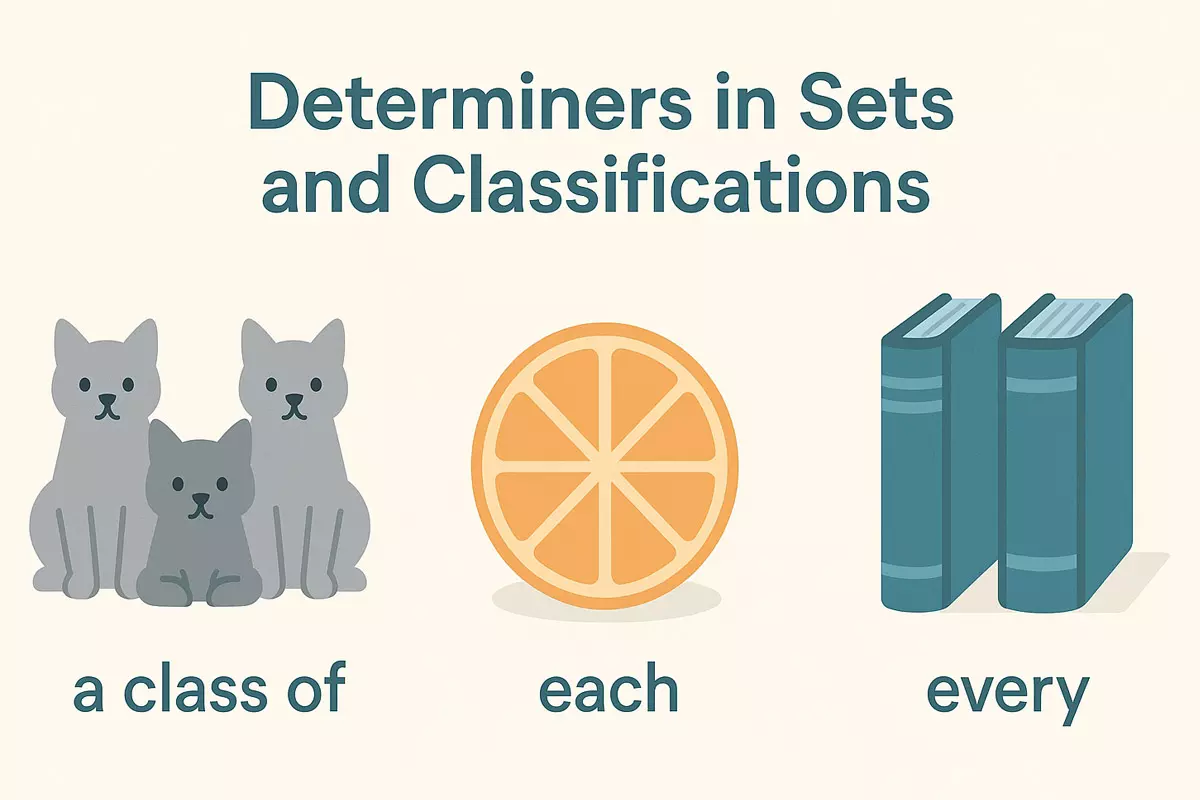 Here we how determiners like a, an, one, the, each, every, and all show group membership or refer to whole classes. It includes examples from science, education, and daily language, and provides practice with classification sentences.
- How determiners show membership in a set or group
- Using a, an, and one to introduce class members
- Using the to talk about a whole class of things
- Expressions with each, every, and all in classifications
- Talking about typical examples vs all cases
- Examples from science, education, and everyday language
- Practice: complete classification sentences with suitable determiners
Clear communication often depends on our ability to signal specific items or groups within broader categories. This article examines the language we use to identify, highlight, or generalize elements as we organize information. By understanding the words and expressions that help us single out particular items or refer to entire groups, we can convey our ideas more precisely and avoid confusion. The discussion covers common terms and structures that allow speakers and writers to effectively distinguish between individual elements and larger sets, enhancing both clarity and accuracy in communication.
How determiners show membership in a set or group
Determiners play a crucial role in indicating whether something belongs to a specific collection, classification, or category. By choosing the right word at the beginning of a noun phrase, speakers can clarify whether they mean all, some, or just one member of a group. This helps listeners instantly understand if the reference is broad or narrow, inclusive or exclusive. For example, words like “each,” “every,” “all,” and “some” often point to inclusion within a group, while “no,” “neither,” or “none” indicate exclusion. These choices are not just grammatical—they reflect how we organize and communicate information about the world.
Common determiners for expressing group membership
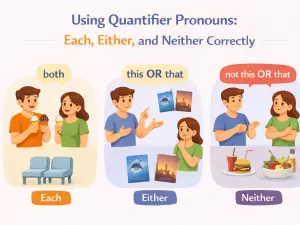
- Each — focuses on individual members within the whole (e.g., Each student must sign in.)
- Every — refers to all members of a set, with an emphasis on uniformity (e.g., Every apple was fresh.)
- All — signals the entire group collectively (e.g., All dogs bark.)
- Some — highlights an unspecified subset (e.g., Some books are missing.)
- Any — can refer to one, some, or all members, often used in questions or negatives (e.g., Do you have any questions?)
- No — excludes all members (e.g., No cars are allowed here.)
- Neither — used when only two items are involved and both are excluded (e.g., Neither answer is correct.)
- Both — includes two items together in a set (e.g., Both sisters attended.)
- Several — refers to more than a few, but not all (e.g., Several options are available.)
- Many — signals a large, but indefinite portion (e.g., Many students passed.)
- Few — indicates a small number (e.g., Few people know the truth.)
- Most — covers the majority of the set (e.g., Most birds can fly.)
- Each of — followed by a plural noun, but still refers to individuals (e.g., Each of the players scored.)
- None of — excludes all members within a specified group (e.g., None of the keys fit.)
- Either — used for one of two possible members (e.g., Either route works.)
- Another — signals an additional member (e.g., Another guest has arrived.)
- Much — used for uncountable nouns in a group sense (e.g., Much information was lost.)
- Other — identifies different members within the set (e.g., Other cities are larger.)
- Only — limits reference to a single member (e.g., Only John passed the test.)
- One — specifies a single member (e.g., One apple is enough.)
Patterns and functions
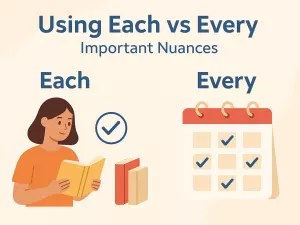
The choice of determiner can subtly shift the meaning of a sentence by including, excluding, or specifying the relationship of the noun to a larger group. For instance, “any” is often used in negative sentences or questions to suggest openness or lack of restriction, while “all” is definitive and encompassing. The difference between “each” and “every” is nuanced: “each” treats members separately, while “every” emphasizes the group as a whole.
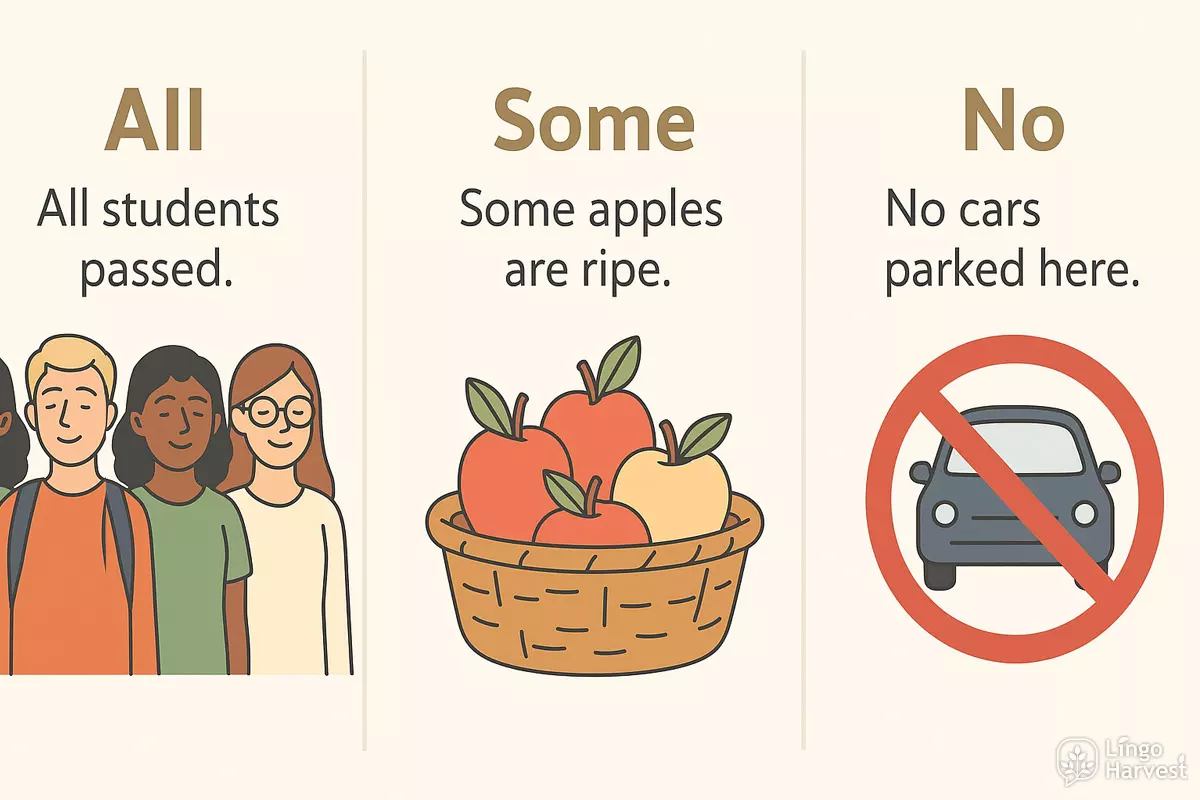
Visual overview: Determiners and group reference
| Determiner | Membership Indication | Example |
|---|---|---|
| All | Entire set | All students passed. |
| Some | Subset of set | Some apples are ripe. |
| No | Excludes set | No cars parked here. |
| Each | Individual in set | Each child received a toy. |
| Any | Any member or all | Any answer is acceptable. |
| Most | Majority of set | Most birds migrate. |
Understanding which determiner to use helps clarify whether you’re speaking about an entire group, a specific member, or a subset. This subtlety is key to accurate and effective communication, especially in contexts where precision matters.
Using a, an, and one to introduce class members
When English speakers talk about a single member of a group or category, they often choose between "a," "an," and "one." Each of these words points out an individual within a set, but their usage depends on meaning and context.
General Reference vs. Specific Number
The articles "a" and "an" are indefinite and signal any one example of a class, not a specific item. For example, saying "a cat" means any member of the cat category, not a particular feline. In contrast, "one" emphasizes the exact quantity—used when highlighting the number or insisting on singularity.
- a dog – any dog, not a particular one
- an apple – any apple, not a specific piece of fruit
- one book – precisely a single book, not two or more
Choosing Between "a" and "an"
The choice between "a" and "an" comes down to pronunciation: "a" appears before words beginning with a consonant sound, while "an" is used before vowel sounds.
- a car
- a university (because "university" begins with a "y" sound)
- an elephant
- an hour (because "hour" starts with a silent "h" and a vowel sound)
Comparing "a/an" and "one"
To see how these determiners work in context, examine their typical uses:
| Form | Usage Example & Context |
|---|---|
| a/an | She wants a cookie. (Any cookie, not a specific one.) |
| one | She wants one cookie. (Exactly one, not more.) |
| a/an | I saw an owl. (Any owl, not a particular individual.) |
| one | I saw one owl, not two. (Emphasizes the number.) |
Common Patterns and Examples
These determiners are common in sentences describing single, nonspecific class members. Here are more examples:
- a teacher → She wants to become a teacher.
- an engineer → Her brother is an engineer.
- a banana → I ate a banana for breakfast.
- an umbrella → Take an umbrella, it’s raining.
- one pencil → I only need one pencil for the exam.
- one chair → Please bring one chair from the kitchen.
- a hotel → We stayed at a hotel near the beach.
- an orange → He gave me an orange after lunch.
- one solution → There is only one solution to this problem.
- a student → She is a student at this university.
- an idea → That’s an interesting idea.
- one answer → There is only one correct answer.
Summary
To sum up, "a" and "an" introduce any single member of a group, while "one" is used to specify a particular quantity. Understanding these subtle differences helps in expressing ideas with clarity and precision when referring to individual items in a broader category.
Using the to talk about a whole class of things
Sometimes, English speakers use “the” before a singular noun to represent an entire category or species, not just one example. This approach helps generalize about all members of a group by treating a single, representative noun as the symbol for the whole set. For example, when someone says “the lion is a fierce animal,” they are referring to lions as a species, not one particular lion.
How it Works in Practice
When we use “the” plus a singular, countable noun, we often mean the whole class that noun represents. This is common in scientific writing, encyclopedias, and when making general statements about types of people, animals, inventions, or objects. Some examples include:
- The elephant is the largest land animal. (All elephants, as a species)
- The computer has changed the way we work. (Computers in general)
- The French enjoy long meals. (French people as a group)
- The bicycle is an efficient means of transport. (All bicycles)
- The rose is a beautiful flower. (Roses as a type of flower)
- The whale is a mammal. (Whales as a species)
- The Internet connects people worldwide. (The Internet as a whole)
- The piano is a complex instrument. (Pianos in general)
- The teacher shapes young minds. (Teachers in general)
- The mobile phone is everywhere. (Mobile phones as a category)
Comparing “the + singular noun” and Plurals
Both “the + singular noun” and plural nouns without “the” can refer to general classes, but there are subtle differences. Using “the” with a singular noun is more formal or literary, while plural nouns are common in everyday speech. See the comparison below:
| Form | Example Sentence |
|---|---|
| the + singular noun | The horse is a noble animal. |
| plural noun (no “the”) | Horses are noble animals. |
| the + adjective (for groups of people) | The elderly need extra care. |
| uncountable noun (general idea) | Water is essential for life. |
When to Use This Construction
This usage is best for:
- Stating facts about an entire group or species
- Making universal statements in scientific or academic contexts
- Describing inventions, tools, or concepts as a whole
- Talking about nationalities or social groups (e.g., “the English”)
Understanding this pattern helps you write more formally and precisely, especially when discussing categories rather than specific examples.
Expressions with each, every, and all in classifications
When we group or classify items, words like each, every, and all help us describe how members of a set relate to one another. These determiners are common in English when talking about categories, rules, or shared characteristics.
How each, every, and all differ in meaning
- Each focuses on individuals within a group, often implying attention to one at a time.
- Every emphasizes the whole group by highlighting that something is true for all members, usually without exception.
- All refers to the group as a collective unit, stressing total inclusion.
Typical patterns in set classifications
You’ll often see these determiners in statements about categories, generalizations, or group rules. Here are some common structures:
- Each student in the class has a textbook.
- Every animal in this group is a mammal.
- All the birds in this region migrate south for winter.
Expanded examples in context

- Each planet in our solar system orbits the sun.
- Every page in this book contains a diagram.
- All employees must wear identification badges.
- Each color represents a different category on the chart.
- Every country in the union follows the same regulations.
- All entries must be submitted before the deadline.
- Each answer will be checked carefully.
- Every participant received a certificate.
- All the ingredients are listed on the label.
- Each number in the sequence increases by five.
- Every member of the team contributed to the project.
- All students are required to attend the seminar.
Comparison of usage in classification statements
| Determiner | Example in Classification |
|---|---|
| Each | Each element in this set has a unique property. |
| Every | Every item on the list meets the safety standards. |
| All | All objects in this category are recyclable. |
| Each vs. All | Each participant filled out a form. → All participants filled out forms. |
Talking about typical examples vs all cases
When using determiners to describe sets or classifications, it’s important to distinguish between statements about general trends and claims about every possible instance. The way we choose determiners—such as “some,” “most,” “all,” or “no”—signals whether we’re referring to a broad pattern, a representative example, or an absolute rule. This distinction shapes how clearly and accurately we communicate about groups or categories.
How determiners change the scope of statements
Some determiners are used to highlight typical features or common members of a group, while others indicate exceptions or universal truths. For instance, “a dog barks” suggests a typical behavior, whereas “all dogs bark” claims there are no exceptions.
- Some – points to a subset, not the whole group
- Most – refers to the majority, but allows for exceptions
- All – includes every member without exception
- No – excludes every member
- Any – can mean “every one (of any kind)” or “at least one,” depending on context
- Each – emphasizes individuals within a group, often implying all
- Every – stresses the totality, similar to “all”
- Few – highlights a small number, often with a negative nuance
- Many – indicates a large, but not total, portion
- Typical (used with “a”/“the”) – suggests a representative or average case
- None – another way to express exclusion of all cases
- Another – refers to an additional, but not all, case
- Several – more than two, but not a majority
- Much – non-countable, large amount
- Little – non-countable, small amount
- Neither – not one or the other (of two)
- Either – one or the other (of two), sometimes meaning any
- The – can specify a particular or representative example
- A/An – often introduces a typical or non-specific example
Comparing statements: typical vs universal
The following table illustrates how determiners affect the meaning of statements when describing sets or classifications:
| Formulation | Scope & Implication |
|---|---|
| A penguin swims. | A typical penguin; describes a common trait, not necessarily every penguin. |
| Most penguins swim. | Majority, but allows for exceptions (e.g., injured penguins). |
| All penguins swim. | Absolute; no exceptions allowed, very strong claim. |
| No penguins fly. | Universal negative; excludes every member from the action. |
| Some penguins live in Antarctica. | Only a portion; does not apply to the entire group. |
| Any penguin can swim well. | Suggests swimming is a general ability, but context may vary meaning. |
Why this distinction matters
Confusing a typical example with a claim about all instances can lead to misunderstandings or inaccurate generalizations. For instance, “A teacher gives homework” is about what often happens, not what every teacher always does. In contrast, “All teachers give homework” is an absolute statement that’s easily challenged by a single counterexample. Being precise with determiners helps avoid overgeneralization and supports clearer, more nuanced communication about sets and categories.
Examples from science, education, and everyday language
Determiners play a crucial role in how sets and classifications are communicated across various fields. Whether in scientific writing, classroom discussions, or daily speech, these linguistic tools help specify, quantify, and distinguish members within groups.
Scientific contexts
In science, determiners clarify which elements or groups are being discussed. For instance:
- All mammals are warm-blooded. (Describes the entire set)
- Some bacteria are beneficial. (Refers to a subset)
- Each sample was tested for purity. (Individual members of a group)
- Any hypothesis must be tested. (Non-specific members)
- No two snowflakes are identical. (Negation within a set)
- Every cell contains DNA. (Universal inclusion)
Classroom and educational language
Teachers and textbooks often use determiners to guide learning and categorize concepts:
- This chapter covers photosynthesis.
- Those problems require a calculator.
- Many students found the topic challenging.
- Few experiments failed to produce results.
- Another example is provided below.
- Neither answer is correct.
Everyday language and communication
In daily conversations, determiners help people refer to objects, groups, or categories in context:
- Some cookies are left in the jar.
- Most people enjoy music.
- Each of the kids got a balloon.
- Several options are available.
- Both roads lead to the park.
- Either solution works.
- All of these ideas are interesting.
- None of the answers were correct.
Comparing determiners in different contexts
| Determiner | Usage Example | Context |
|---|---|---|
| All | All elements react with oxygen. | Scientific |
| Some | Some students passed the test. | Educational |
| None | None of the buses are running. | Everyday |
| Each | Each participant received a certificate. | General |
| Many | Many theories explain gravity. | Scientific |
| Few | Few people know this fact. | Everyday |
These examples show how determiners help us navigate groups, categories, and sets, providing clarity and precision no matter the domain. Their use is fundamental for expressing generalizations, exceptions, and specific references in both formal and informal situations.
Practice: complete classification sentences with suitable determiners
Understanding how to use determiners is essential when describing and classifying sets or groups. Determiners such as "each," "every," "some," "no," "all," "any," "many," "few," "several," and "most" help us specify the quantity and identity of elements within a category. Let's explore some practical exercises and examples to strengthen your command of these words in classification contexts.
Fill in the Blanks: Classification Sentences
Read each sentence and choose the most appropriate determiner from the list provided. Think about whether the sentence refers to the whole set, part of it, or a specific number.
- ________ bird in this aviary can sing beautifully. (each, some, no)
- ________ of the students in this group has completed the assignment. (all, any, few)
- ________ mammal gives birth to live young. (every, some, no)
- ________ insects are beneficial to gardens. (many, every, all)
- ________ of the books on this shelf belong to the library. (most, no, every)
- ________ planet in our solar system orbits the sun. (each, any, few)
- ________ car in the lot was washed this morning. (every, some, no)
- ________ of the answers were correct. (all, most, no)
- ________ student can participate in the contest. (any, every, few)
- ________ of these apples are ripe. (some, most, all)
Show answers
- Each
- All
- Every
- Many
- Most
- Each
- Every
- Most
- Any
- Some
Choose the Best Determiner for Classification
For each sentence, select the determiner that best fits the meaning of the sentence. Consider whether the group is being referred to as a whole, in part, or individually.
- ________ cat in this breed has blue eyes. (every, some, few)
- ________ of the paintings in the gallery are modern. (most, no, all)
- ________ friend of mine enjoys hiking. (every, some, no)
- ________ teacher here speaks two languages. (every, any, few)
- ________ students understood the explanation. (all, few, no)
- ________ of the water in the bottle is gone. (most, many, every)
- ________ book on that shelf belongs to the library. (every, some, several)
- ________ people know the full story. (few, every, much)
- ________ child in the class received a gift. (every, some, few)
- ________ of my relatives live abroad. (most, every, no)
Show answers
- Every
- Most
- Some
- Every
- All
- Most
- Every
- Few
- Every
- Most
Quick Reference: Common Determiners for Sets
Here are some of the most frequent determiners used in classification, along with example phrases:
- All animals in the zoo
- Each member of the team
- Every page of the book
- Some parts of the machine
- Most of the questions
- Few students in the class
- Several types of fruit
- No entries in this category
- Any participant
- Many theories in science
Practicing with a variety of determiners helps you describe and classify sets and groups with precision and clarity. Try making your own sentences using these examples as a guide.