No One vs None: Subtle Meaning and Usage Differences

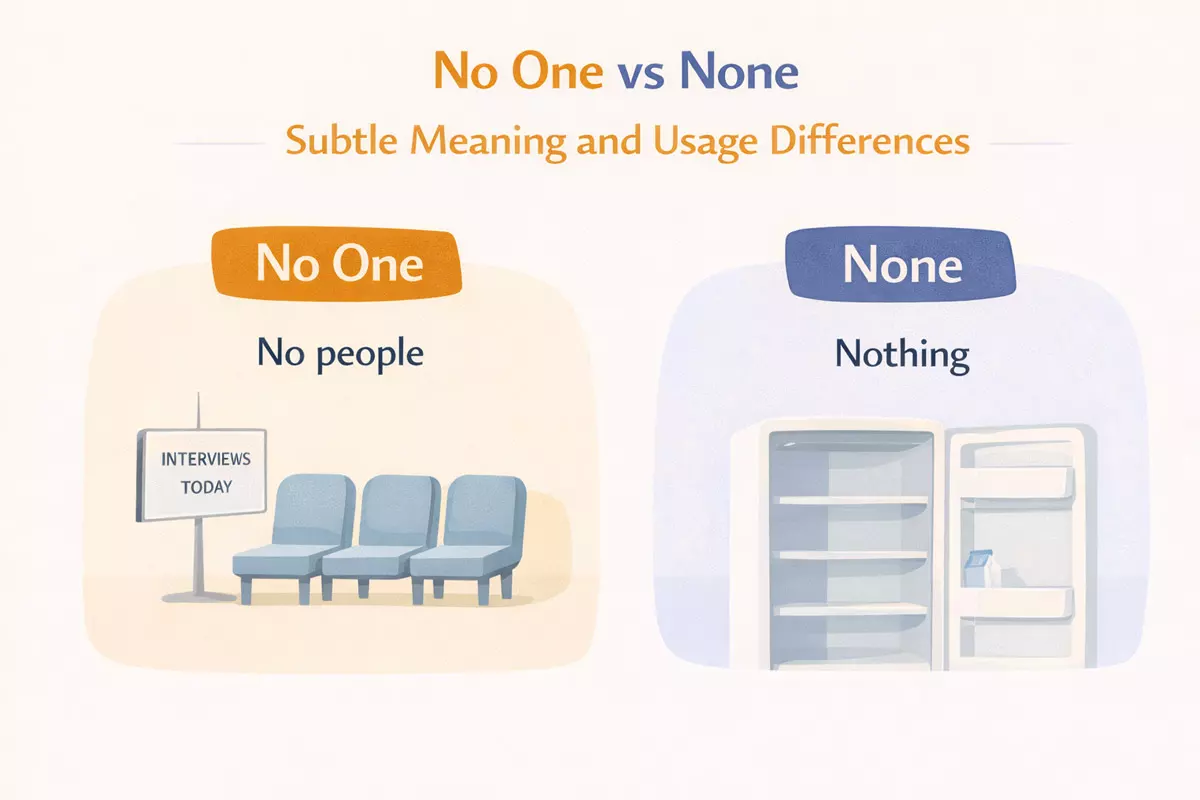 Here we how to use no one and none, detailing their meanings, when to use each for people or things, verb agreement, formal and informal usage, common learner errors, possible ambiguities, examples, and practice choosing the correct word.
Have you ever hesitated while speaking or writing, uncertain whether to use "no one" or "none"? Although these terms might seem interchangeable, they actually serve different grammatical purposes. "No one" is used to refer to not a single person, while "none" refers to not any of a group of people or things. Understanding the distinction helps ensure clarity and precision in your communication, preventing common mistakes that even experienced writers occasionally make.
Core meaning of no one and none
Understanding the difference between "no one" and "none" starts with their basic definitions and how they function in sentences. While both express the absence of people or things, they are used in different grammatical contexts and carry slightly distinct nuances in meaning.
What does "no one" mean?
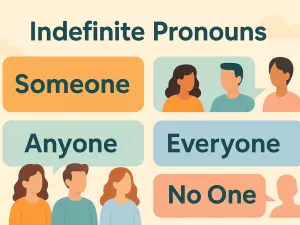
"No one" is an indefinite pronoun used exclusively to refer to people. It means not a single person, or nobody. Typically, it stands alone as the subject or object in a sentence. For example, "No one answered the phone." Here, it makes clear that zero people responded.
How is "none" different?
"None" is also an indefinite pronoun but is broader in application. It can refer to people, things, or even abstract concepts, and it means not any or not one. "None" can function as a subject, object, or complement, and is often followed by "of" + noun. For instance, "None of the books are missing." In this case, it points to zero items from a group.
Basic usage patterns
- "No one" is only about people and never about objects or animals.
- "None" can refer to people, objects, or concepts, depending on the context.
- "No one" is always two words (never "noone").
- "None" can stand alone or with "of," as in "None of them."
- Both are singular in meaning, but "none" may pair with singular or plural verbs depending on what it refers to.
- "No one" cannot be used with "of" (e.g., "no one of them" is incorrect).
- "None" is more flexible in formal and informal writing.
- Both terms avoid specifying identity or quantity beyond "zero."
Quick comparison
| Expression | Typical Use | Refers to | Example Sentence |
|---|---|---|---|
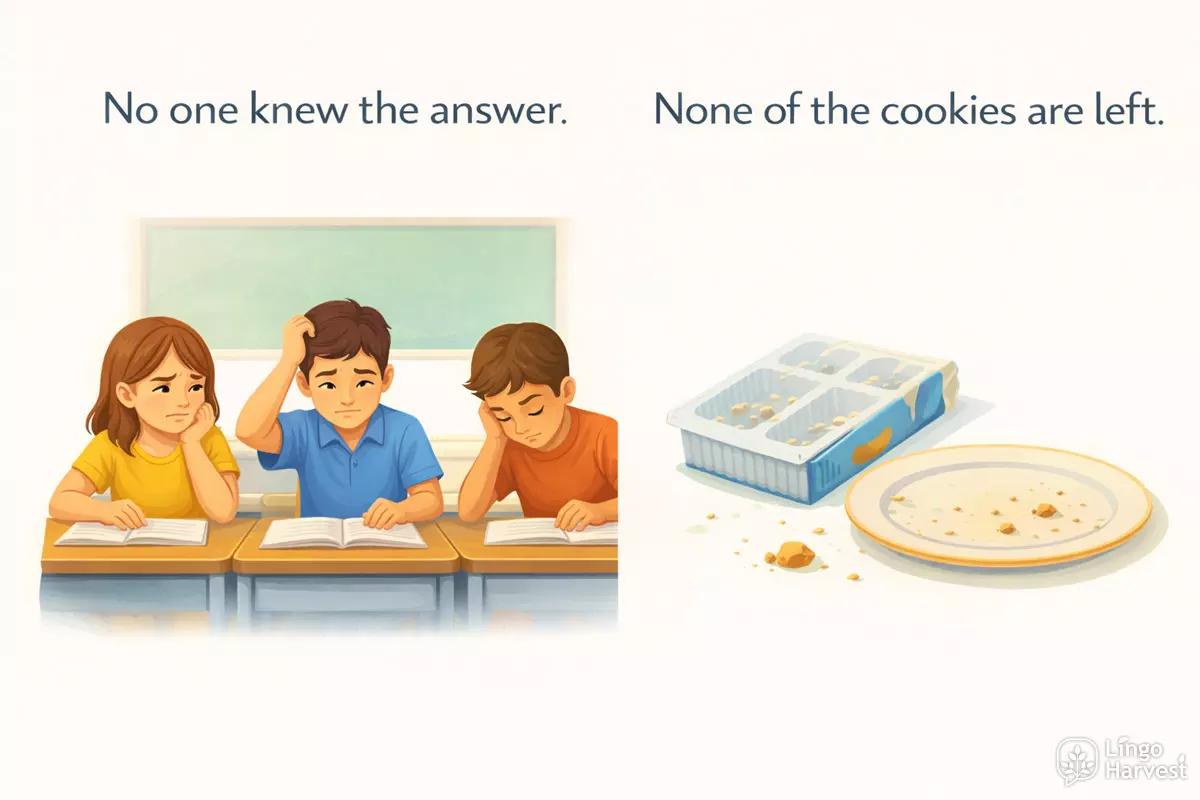
| No one | Subject/Object pronoun | People only | No one knew the answer. |
| None | Subject/Object/Complement | People, things, or ideas | None of the cookies are left. |
Summary of subtle distinctions
Both "no one" and "none" communicate absence, but "no one" is restricted to people and is always used by itself. "None," meanwhile, is more versatile, covering both people and things, and often appears with "of." Choosing the right word depends on what you are referring to and the grammatical structure of your sentence.
People vs things distinction
When choosing between “no one” and “none,” it’s important to consider whether you’re referring to people or objects. “No one” is reserved exclusively for human beings or, sometimes, animals considered as individuals. “None,” on the other hand, can refer to both people and inanimate things, but is more common when talking about objects, quantities, or groups in general. This distinction isn’t just a matter of grammar—it shapes the tone and clarity of your sentences.
When to use “no one”
Use “no one” when you explicitly mean human beings or individual animals. It’s never used for things or abstract concepts. Here are some typical scenarios:
- Describing a group of people: No one attended the meeting.
- Emphasizing lack of human action: No one answered the phone.
- Talking about responsibility: No one is to blame.
- Referring to individuals: No one in the class knew the answer.
When to use “none”
“None” is much more flexible. It can refer to both people and things, but is most often used for objects, quantities, and abstract ideas. Some examples include:
- Things: None of the cookies are left.
- Quantities: None of the water remains.
- Groups including people: None of the students passed.
- Abstract: None of that matters now.
Comparison of Usage
| Expression | Typical Use | Example |
|---|---|---|
| No one | Humans or individual animals | No one saw the accident. |
| None | Things, quantities, or groups (can include people) | None of the books are missing. None of them called back. |
Quick reference: Which to use?
If you’re unsure, ask whether you’re talking about people specifically. If yes, “no one” is the safest choice. If your subject is a group (including people or things) or an amount, “none” is usually appropriate.
- People only → no one
- Things, amounts, or mixed groups → none
Understanding the nuance between these terms helps you write with precision and avoid awkward or unclear sentences.
Verb agreement with none
Choosing the right verb form after none can be surprisingly tricky. The word itself is technically singular (derived from "not one"), yet it often refers to plural ideas. This flexibility leads to confusion, especially in formal writing. Understanding when to use singular or plural verbs with none depends on both meaning and context.
Singular or plural: What determines the choice?
The verb that follows none can be either singular or plural. The decision hinges on what none refers to:
- Singular verb: Use when none clearly means “not one” or refers to a singular noun.
- Plural verb: Use when it stands for “not any” among a group or refers to a plural noun.
Examples in context
Below are common patterns showing how verb agreement shifts depending on the intended meaning:
- None of the cake is left. (Cake is uncountable—singular verb.)
- None of the answers are correct. (Answers—plural, so plural verb.)
- None was available at the time. (Refers to a singular thing.)
- None of the students have finished yet. (Students—plural.)
- None of the information is useful. (Information—uncountable/singular.)
- None has been delivered. (Singular, possibly a package or message.)
- None of them are coming. (Them—plural group.)
- None of the money is missing. (Money—singular/uncountable.)
- None have arrived yet. (Refers to several items or people.)
- None of the equipment is functioning. (Equipment—singular/uncountable.)
- None of the players were injured. (Players—plural.)
- None of the water was wasted. (Water—singular/uncountable.)
Traditional vs. modern usage
Traditionally, many grammarians insisted on a singular verb after none. However, modern usage is more flexible. Both singular and plural verbs are now widely accepted, especially in casual or conversational English. The key is to match the verb to the noun that follows of, or to use what sounds natural in context.
| Context | Recommended Verb |
|---|---|
| None of the books | are |
| None of the cake | is |
| None of the children | are |
| None of the information | is |
| None was found | was |
| None have arrived | have |
Quick tips for writers
- When in doubt, look at the noun after of—if it’s plural, a plural verb is usually fine.
- For formal or academic writing, consider using the singular if you mean “not one.”
- Clarity and consistency matter more than rigid rules; aim for what reads naturally and clearly conveys your meaning.
Formal vs informal preferences
When choosing between "no one" and "none," the context and tone of your writing often guide the decision. In professional or academic documents, certain conventions tend to dominate, while everyday conversation or casual writing allows for more flexibility. Understanding where each term fits best can help avoid awkward phrasing or unintended ambiguity.
Contextual tendencies in speech and writing
"No one" is generally considered more formal and is a staple in academic, legal, and official contexts. It's clear, direct, and leaves little room for misinterpretation. By contrast, "none" is more versatile but can be less personal. It’s frequently used in both formal and informal settings, but its tone can shift depending on sentence structure and emphasis.
| Usage Context | Preferred Term | Example Sentence |
|---|---|---|
| Formal writing (reports, essays) | No one | No one attended the scheduled meeting. |
| Informal conversation | None | None showed up for the game. |
| Legal or official documents | No one | No one is permitted beyond this point. |
| Short responses or answers | None | How many questions were answered? None. |
| Emphasizing absence of people | No one | No one knows the answer. |
| Referring to objects or abstract concepts | None | None of the options are suitable. |
Patterns and nuances in everyday use
In spoken English, "no one" often feels more natural when referring specifically to people, while "none" can reference both people and things. However, "none" is rarely used when you want to stress individuality or a complete lack of participants. Consider these common examples where one form is favored over the other:
- No one answered the phone. ✅
- None of the lights were on. ✅
- No one was interested in the proposal. ✅
- None of the above apply. ✅
- No one can predict the future. ✅
- None left any trace. ✅
- No one volunteered. ✅
- None were available for comment. ✅
- No one but Sarah noticed the mistake. ✅
- None of the tickets remain. ✅
The choice is also influenced by rhythm and sentence flow. "No one" tends to sound smoother at the start of a sentence, while "none" fits naturally after prepositions or quantifiers, especially in lists or after "of."
Summary of preferences
If you’re aiming for clarity and a formal tone, especially when referring to people, "no one" is usually the safer option. In contrast, "none" works well for both people and things, and is particularly handy for short responses or when referring to groups and collections. Ultimately, both words are correct in many situations, but adjusting your usage based on formality and context will make your communication more effective and precise.
Common learner substitutions
Learners often mix up "no one" and "none" because their meanings can overlap in negative statements, yet their grammatical roles differ. These words are not interchangeable, and using one in place of the other can make sentences sound awkward or incorrect. Below are some frequent patterns where confusion arises, along with explanations and examples.
Frequent mix-ups and why they happen
Many English learners substitute "no one" and "none" due to their similar negative sense. The confusion is especially common when referring to the absence of people or things. Here are some typical scenarios:
- Using "none" instead of "no one" for people: None came to the meeting (should be No one came to the meeting).
- Using "no one" instead of "none" for objects or quantities: No one of the apples is ripe (should be None of the apples is ripe).
- Replacing "nobody" with "none": None knows the answer (should be No one knows the answer or Nobody knows the answer).
- Forgetting that "none" can be plural: None of the students was late (acceptable, but None of the students were late is also correct in modern English).
- Wrongly adding "of" after "no one": No one of us agreed (should be None of us agreed or No one agreed).
Common incorrect substitutions and correct forms

Learners may also invent hybrid forms or use "noone" (incorrect spelling) instead of "no one." The confusion extends to sentences where the subject or object is omitted or implied. Here are more examples of typical substitutions:
- Incorrect: None called me last night.
Correct: No one called me last night. - Incorrect: No one of the cakes is left.
Correct: None of the cakes is left. - Incorrect: I invited five people, but none came.
Correct: I invited five people, but no one came. - Incorrect: None knows the truth.
Correct: No one knows the truth. - Incorrect: Noone was present. (Spelling error)
Correct: No one was present. - Incorrect: None of them was/None of them were (missing completion).
Correct: None of them was interested. - Incorrect: No one of my friends likes sushi.
Correct: None of my friends likes sushi. - Incorrect: None can help you now.
Correct: No one can help you now. - Incorrect: No one of the answers is correct.
Correct: None of the answers is correct. - Incorrect: None is here for the meeting.
Correct: No one is here for the meeting.
At a glance: when to use "no one" vs. "none"
| Use | Example |
|---|---|
| Referring to people (as subject) | No one answered the phone. |
| Referring to things or people in a group | None of the cookies are left. None of my friends came. |
| Standalone negative (things or people, after "of") | None of them were ready. |
| Incorrect: "No one of..." | ❌ No one of us knows the answer. Correct: None of us knows the answer. |
Tips to avoid confusion
Remember, "no one" is used only for people and never followed by "of." "None" can refer to people or things, but is almost always followed by "of" when specifying a group. Avoid the spelling "noone," and check if you are talking about people specifically — if so, "no one" is usually correct. If you are talking about quantities, groups, or objects, "none" is the better choice.
Ambiguity caused by incorrect choice
Misusing "no one" and "none" can introduce confusion in both written and spoken English. The difference between the two terms is subtle but important: "no one" refers specifically to people, while "none" can refer to people, things, or an abstract absence. When the wrong word is chosen, the sentence’s meaning may become unclear, or even unintentionally humorous.
Common scenarios where confusion arises
Writers and speakers sometimes select "none" when they mean "no one," or vice versa, especially in sentences where the subject is implied or where brevity is valued. This can lead to readers or listeners pausing to interpret intent.
- Talking about people: "No one" is the standard, but "none" occasionally slips in, resulting in awkward phrasing.
- Describing absence: "None" is broader, but if used about people, it can sound formal or stilted.
- Negative replies: Using the wrong word in short answers may sound abrupt or unnatural.
- Mixing contexts: In complex sentences with both people and objects, choice of word can obscure meaning.
Examples of ambiguous or unclear sentences
Sometimes, a sentence may sound odd or ambiguous simply because the wrong term is used. Here are several examples where the distinction is important:
- "No one of the books was interesting." ❌ (Should be "None of the books was interesting.")
- "None answered the phone." ❌ (Should be "No one answered the phone.")
- "No one of us have tickets." ❌ (Should be "None of us have tickets.")
- "None attended the meeting." (Technically correct, but "No one attended the meeting." is clearer for people.)
- "No one of the options is correct." ❌ (Should be "None of the options is correct.")
- "None can help you now." (Correct, but may sound formal; "No one can help you now." is more conversational.)
- "No one of them arrived on time." ❌ ("None of them arrived on time.")
- "None knew the answer." (Acceptable, but "No one knew the answer." is more direct.)
- "No one of these is necessary." ❌ ("None of these is necessary.")
- "None saw what happened." (Possible, but "No one saw what happened." is preferred for clarity.)
Table: Comparing usage in ambiguous cases
| Sentence | Clarity & Correctness |
|---|---|
| No one called yesterday. | ✅ Clear (refers to people) |
| None called yesterday. | ❌ Ambiguous (could refer to people or things; less natural) |
| None of the cookies were eaten. | ✅ Clear (refers to things) |
| No one of the cookies was eaten. | ❌ Incorrect (awkward and unclear) |
| No one replied to the email. | ✅ Clear (refers to people) |
| None replied to the email. | ❌ Unclear (unusual for people) |
Practical tips for avoiding mix-ups
To prevent misunderstandings, remember these guidelines:
- Use "no one" when talking exclusively about people.
- Choose "none" for things, quantities, or groups (including people, but less commonly in conversation).
- If a sentence sounds odd with one word, try the other and see if it reads more naturally.
- When in doubt, rephrase to avoid ambiguity—clarity is more important than brevity.
Choosing the correct term helps your meaning come through clearly, avoiding misunderstandings and awkwardness in communication.
Examples in spoken and written English
When distinguishing between “no one” and “none,” context and register play an important role. In casual conversation, each is used in slightly different ways, while written language often follows stricter grammar conventions. Below, you’ll find practical examples and usage notes for both terms, illustrating their nuances.
Common usage patterns
- No one is typically used to mean “not a single person.” Example: No one knew the answer to the question.
- None refers to “not any” and can apply to people, things, or other nouns. Example: None of the cookies are left.
- In questions, “none” is more likely: How many tickets are left? None.
- “No one” cannot refer to objects or animals, while “none” is flexible: None of the dogs barked.
- Both can convey absence, but “no one” is restricted to people: No one remembered his birthday.
- “None” is often used with “of”: None of them arrived on time.
- In formal writing, “none” tends to sound more impersonal: None were available for comment.
- “No one” is rare in negative questions: Didn’t no one see him? (Usually avoided; “Didn’t anyone see him?” is preferred.)
- “None” can be singular or plural, depending on what it refers to: None of the information is useful. / None of the students are present.
- Contractions with “no one” are uncommon and often considered informal or incorrect.
Comparison in context
| Spoken Example | Written Example |
|---|---|
| “No one called while you were out.” | No one has submitted the application yet. |
| “None of those options work for me.” | None of the proposals were accepted by the committee. |
| “No one wants to go first.” | No one in the group objected to the plan. |
| “None are left in stock.” | None of the evidence was convincing. |
Usage tips
- If you mean “not a single person,” use no one.
- If you refer to “not any” of a group (people or things), use none.
- In formal writing, avoid double negatives involving “none” or “no one.”
- Remember that “none” can act as a pronoun for both singular and plural references, depending on the noun.
These examples show the subtle choices native speakers make. Listening for these patterns in everyday speech and reading carefully in formal texts will help you master the distinction.
Practice: choose no one or none correctly
Understanding when to use "no one" and when to choose "none" can be tricky, but practice helps solidify the difference. "No one" refers to people and is always singular, while "none" can refer to people or things and may be singular or plural depending on the context. Below you'll find exercises and tips to test your grasp of these subtle distinctions.
Fill in the Blank: Choose the Right Word
Read each sentence and decide whether "no one" or "none" best completes it.
- ______ of the students finished the assignment on time.
- ______ knew the answer to the last question.
- When I arrived, ______ was at the meeting room.
- ______ of my friends like pineapple on pizza.
- ______ can predict the future.
- He looked for his keys, but ______ were in his bag.
- ______ of these options are correct.
- ______ believed her story at first.
- ______ of the invitations were sent out yet.
- ______ expected the surprise announcement.
Show answers
- None
- No one
- No one
- None
- No one
- None
- None
- No one
- None
- No one
Quick Reference: Usage Differences
Here's a simple guide to help you remember when to use each form.
| Expression | Usage Example |
|---|---|
| No one | Used for people only: No one was late to the meeting. |
| None | Used for people or things (singular or plural): None of the cookies are left. |
| None | Often followed by "of": None of the answers were correct. |
| No one | Never used with "of" directly: Not No one of the students, but None of the students. |
Spot the Error
Identify and correct the mistakes in the following sentences:
- No one of the apples are ripe yet.
- None knew how to solve the riddle, so the teacher helped.
- None was at the party when I arrived.
- No one of the answers is correct.
- No one of the students have finished the test.
- None of my friends was online last night.
- No one of the cookies were left on the plate.
- None are here to help us.
- No one of the seats are available.
- None of the information are accurate.
Show answers
- Incorrect: “No one of the apples are ripe yet.”
Correct: “None of the apples are ripe yet.” - Incorrect: “None knew how to solve the riddle, so the teacher helped.”
Correct: “No one knew how to solve the riddle, so the teacher helped.” - Incorrect: “None was at the party when I arrived.”
Correct: “No one was at the party when I arrived.” - Incorrect: “No one of the answers is correct.”
Correct: “None of the answers is correct.” - Incorrect: “No one of the students have finished the test.”
Correct: “None of the students have finished the test.” - Incorrect: “None of my friends was online last night.”
Correct: “No one was online last night.” - Incorrect: “No one of the cookies were left on the plate.”
Correct: “None of the cookies were left on the plate.” - Incorrect: “None are here to help us.”
Correct: “No one is here to help us.” - Incorrect: “No one of the seats are available.”
Correct: “None of the seats are available.” - Incorrect: “None of the information are accurate.”
Correct: “None of the information is accurate.”
Summary Tips
- Use "no one" when referring to people only and as a subject.
- Use "none" for both people and things, often with "of" and as a subject or object.
- Remember that "none" can be singular or plural; "no one" is always singular.
- Never write "noone" as one word; it's always two words: "no one".