Using Quantifier Pronouns: Each, Either, and Neither Correctly

 Here we how quantifier pronouns work, differences between each and every, using either and neither with choices and verb agreement, common mistakes, spoken versus written forms, and provides practice in selecting the right pronoun.
Mastering the subtle distinctions between certain pronouns can make your English sound more natural and precise. Many learners struggle with words like each, either, and neither, as their correct use is not always obvious. Understanding when to use each term is important for expressing choices, preferences, and distinctions accurately. With careful practice and attention to context, you can gain confidence in using these pronouns, making your spoken and written English clearer and more effective.
What quantifier pronouns express
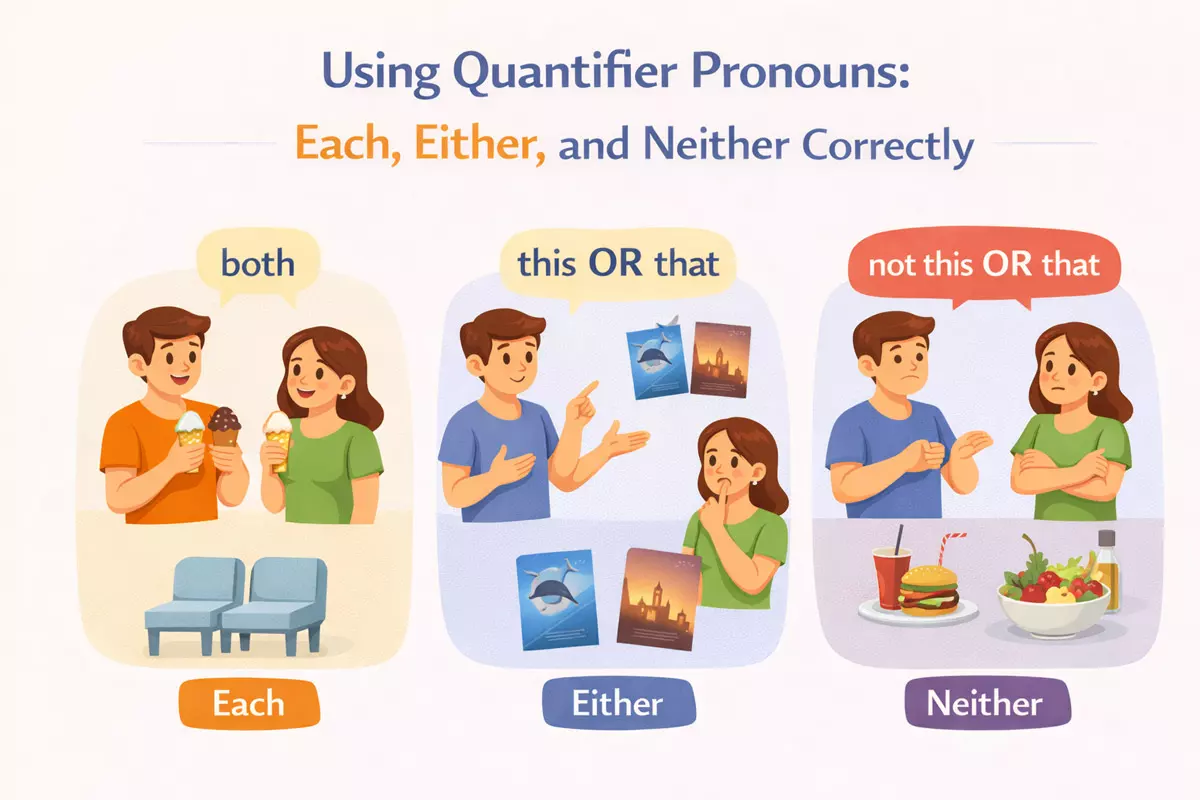
Quantifier pronouns like each, either, and neither are used to indicate quantity or selection among a set of people or things. These words help clarify exactly how many or which members of a group are being referred to, often when the group is small (usually two). Their function is to specify inclusion, exclusion, or choice, so the listener or reader understands the scope of the statement.
Indicating individuals or options
When using these pronouns, the speaker is pinpointing individuals or alternatives:
- Each singles out every member of a group, emphasizing them one by one.
- Either refers to one member or the other, but not both, in a pair.
- Neither means not one and not the other; it excludes both options from consideration.
Clarifying meaning in context
Quantifier pronouns can be subtle, especially in English. They can affect the meaning of a sentence by making it clear how many or which people or things are included or excluded. This is particularly important for precision in instructions, agreements, or descriptions.
| Pronoun | What it expresses | Example |
|---|---|---|
| Each | Every single item/person in a group, considered separately | Each child received a gift. |
| Either | One or the other (but not both) from a pair | Either answer is acceptable. |
| Neither | Not one and not the other in a pair | Neither road leads to the city. |
Common ways to use quantifier pronouns

- Assigning tasks: “Each of you has a role.”
- Offering choices: “You can choose either option.”
- Expressing exclusion: “Neither candidate was selected.”
- Describing distribution: “Each ticket costs $10.”
- Clarifying alternatives: “You may sit on either side.”
- Rejecting all options: “Neither solution works for us.”
- Stating universal inclusion: “Each participant must sign in.”
- Highlighting a binary situation: “Either door will take you outside.”
- Emphasizing no valid options: “Neither answer is correct.”
- Confirming individual treatment: “Each guest was greeted personally.”
In summary, these pronouns are essential for expressing selection, distribution, and exclusion in a clear and concise way. They help avoid ambiguity, especially when discussing pairs or small sets, and ensure that your meaning is easily understood.
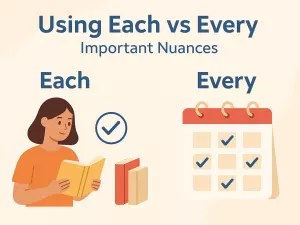
Each vs every: individual focus
When talking about a group, both each and every refer to all members, but they do so with slightly different emphases. Each highlights individuals one by one, while every sees the group as a collective, emphasizing uniformity. This distinction can sometimes change the nuance of your sentence or even affect which word is appropriate.
How "each" singles out members
Each draws attention to the individuality of items or people. It’s used when you want to focus on members separately, often to describe actions, characteristics, or experiences that apply to them one at a time.
- Each student received a unique project.
- She gave each guest a personal thank-you note.
- Each of the cookies tastes different.
- Each participant must sign the form.
- He checked each door to make sure it was locked.
- Each ticket includes a meal voucher.
How "every" emphasizes the group as a whole
Every is used when all members of a group are considered together, especially when the statement applies equally and without exception. It tends to convey a sense of regularity, totality, or repetition.
- Every child in the class wore a costume.
- He runs every morning before work.
- Every answer was correct.
- Every seat was taken.
- She visits her grandmother every Sunday.
- Every student must submit the assignment.
Comparing "each" and "every"
To illustrate the difference more clearly, consider how sentences change meaning depending on which word you use. The table below highlights key contrasts in usage and effect:
| Example with "each" | Example with "every" |
|---|---|
| Each book on the shelf is a different genre. | Every book on the shelf is new. |
| Each employee received feedback individually. | Every employee attended the meeting. |
| I spoke to each neighbor about the event. | Every neighbor was invited. |
| Each apple was weighed separately. | Every apple was fresh. |
Quick tips for usage
- Use each for emphasis on individuality or separate actions.
- Choose every when referring to all members of a group collectively.
- Each can refer to two or more; every is used for three or more.
- With small numbers, each is more common ("Each hand" not "Every hand").
Understanding these distinctions helps you express details precisely, especially when describing actions, characteristics, or requirements for individuals within a group.
Either and neither in choices of two
When you’re faced with two options, English offers specific pronouns to express your preference, rejection, or acceptance: either and neither. These quantifiers are only used when exactly two items or people are involved. Understanding how to use them clearly can make your speech and writing more precise.
Understanding the difference
Either refers to one or the other of two choices. It’s positive or neutral, meaning both options are possible, but only one is selected at a time. Neither means not one and not the other—essentially, zero out of two. This is inherently negative.
| Usage | Example Sentence |
|---|---|
| Either (affirmative/choice) | You can have either tea or coffee. |
| Neither (negative/rejection) | Neither answer is correct. |
| Either (any of two, often with "of") | Either of the books is fine. |
| Neither (not one nor the other, with "of") | Neither of the buses stops here. |
| Short response with either | “Would you like soup or salad?” “Either, thank you.” |
| Short response with neither | “Do you want apples or oranges?” “Neither, I’m not hungry.” |
Common patterns and tips
- Either…or pairs two alternatives: “You can ride either the red bike or the blue bike.”
- Neither…nor links two negatives: “Neither Sam nor Alex was invited.”
- With of, use a plural noun or pronoun: “Either of the doors is open.” / “Neither of them is ready.”
- “Either” is used for offers or possibilities; “neither” is for rejecting both.
- Don’t use these pronouns when talking about more than two options—use “any” or “none” instead.
Expanded examples
- Either candidate would make a good leader.
- Neither movie appeals to me.
- Either of us can help you.
- Neither of the answers was correct.
- Take either seat you like.
- Neither child wanted to leave early.
- Either jacket fits perfectly.
- Neither solution solves the problem completely.
- Would you like either dessert?
- Neither option works for my schedule.
- Either parent can sign the form.
- Neither team scored in the final half.
- Either of these pens will do.
- Neither of the keys fits the lock.
- Would you prefer either morning or afternoon?
- Neither answer was accepted by the teacher.
In summary, use either when you want to refer to just one of two possibilities, and neither when you want to exclude both. Remember, these quantifiers are never used for groups larger than two.
Verb agreement with each, either, neither
Understanding how verbs agree with quantifier pronouns like each, either, and neither can make your writing and speaking clearer. These words often refer to individuals in a group of two or more, but the verb form they take depends on how they are used in a sentence. Let's break down the patterns and rules so you can use them with confidence.
General Agreement Rule
When each, either, or neither serve as the subject, they are considered singular. This means the verb that follows should also be singular, even though the pronoun might refer to two or more people or things.
- Each student is responsible for their own work. ✅
- Either option is acceptable. ✅
- Neither answer was correct. ✅
A common mistake is to use a plural verb because the pronoun seems to refer to more than one person or thing. However, these words always take a singular verb when they are the subject.
Examples: Correct and Incorrect Usage
- Each of the players was given a trophy. ✅
- Each of the players were given a trophy. ❌
- Neither of the solutions works for me. ✅
- Neither of the solutions work for me. ❌
- Either of the books is fine. ✅
- Either of the books are fine. ❌
Special Note: When Used with "Of"
When these pronouns are followed by "of" plus a plural noun, the verb still remains singular. For example:
- Each of the girls has a ticket.
- Neither of the answers is correct.
- Either of the roads leads to the station.
Quick Reference Table
| Pronoun | Correct Verb Agreement |
|---|---|
| Each | Singular verb (e.g., Each is, Each has) |
| Either | Singular verb (e.g., Either is, Either was) |
| Neither | Singular verb (e.g., Neither is, Neither was) |
Quick Tips
- If in doubt, remember: each, either, and neither are grammatically singular.
- Watch for "of" phrases; the verb should still be singular.
- For negative sentences, use neither with a singular verb: "Neither of them is ready."
- Don’t be misled by the plural noun after "of"; the verb agrees with the pronoun, not the noun.
Mastering this aspect of grammar will help you sound more natural and precise in both writing and conversation.
Either/neither with or and nor
Understanding how to pair "either" and "neither" with the conjunctions "or" and "nor" is essential for writing clear, grammatically correct sentences. These combinations help express choices and exclusions between two options. The pattern you choose affects both the structure and meaning of your sentence.
Pairings and Their Meanings
"Either" is generally linked with "or" to present two possible alternatives, indicating that one (but not both) of the options is possible. On the other hand, "neither" is paired with "nor" to show that none of the options are true or available.
- Either...or: Used to offer two choices or possibilities.
- Neither...nor: Used to negate both choices, stating that neither applies.
Usage Patterns and Examples

To illustrate these patterns, here are common sentence types using these pairings:
- Either you can stay here or you can go home. → Presents a choice between two actions.
- We can have either tea or coffee. → Only one beverage will be chosen.
- Neither the manager nor the assistant was available. → Both individuals were unavailable.
- She likes neither apples nor oranges. → She dislikes both fruits.
- Either John or Mary will answer the phone.
- Neither the rain nor the wind stopped the event.
- You can either email or call me.
- Neither my brother nor my sister attended the meeting.
- Either the keys are on the table or in your bag.
- He speaks neither French nor German.
- Either you apologize or you leave.
- Neither the movie nor the book impressed him.
Quick Reference Table
The following table summarizes the main pairings and their functions:
| Pairing | Function |
|---|---|
| Either...or | Presents two alternatives; one is true or possible |
| Neither...nor | Negates both alternatives; neither is true or possible |
Common Mistakes to Avoid
- Don’t mix "either" with "nor" or "neither" with "or"; these pairings are not standard in English.
- Keep sentence structure parallel: follow "either" and "neither" with the same part of speech on both sides of the conjunction (e.g., noun with noun, verb with verb).
- Use a singular verb when "either...or" or "neither...nor" join two singular nouns (e.g., "Neither the cat nor the dog is hungry.").
Mastering these combinations will help you create precise and fluent sentences when discussing alternatives or exclusions.
Common learner errors and corrections
Many English learners find the use of each, either, and neither challenging, especially when it comes to agreement, word order, and meaning. Mixing up these quantifier pronouns can lead to confusion or sentences that sound unnatural. Below, we explore typical mistakes and how to fix them.
Agreement with verbs and pronouns
One of the most frequent issues is using the wrong verb form or possessive pronoun. Since these words are singular, they should be followed by singular verbs and pronouns. For example:
- ❌ Each of the students have their own book.
- ✅ Each of the students has his or her own book.
- ❌ Neither of the answers are correct.
- ✅ Neither of the answers is correct.
Confusing meaning and usage
Another pitfall is misunderstanding what these pronouns refer to. Each means every single one in a group, either refers to one or the other of two, and neither means not one nor the other. Learners often swap either and neither or use them with groups larger than two.
| Incorrect Example | Correction |
|---|---|
| Either of the three options is fine. | Any of the three options is fine. Either of the two options is fine. |
| Neither students passed the test. | Neither student passed the test. Neither of the students passed the test. |
| Each students received a prize. | Each student received a prize. |
| Neither of the books are interesting. | Neither of the books is interesting. |
Position in the sentence
Placing these pronouns incorrectly is another stumbling block. Each can go before a singular noun (each book) or after a plural noun with of (each of the books). Either and neither usually need of before plural nouns.
- ❌ Each of books is new.
- ✅ Each of the books is new.
- ❌ Neither boys were late.
- ✅ Neither of the boys was late.
Summary of frequent mistakes
- Using plural verbs or pronouns with these singular quantifiers
- Applying either or neither to groups larger than two
- Omitting of where it is required
- Confusing either (one or the other) with neither (not one or the other)
- Incorrect word order or sentence placement
Careful attention to these points will help learners use each, either, and neither accurately and naturally in conversation and writing.
Spoken vs written usage
Everyday conversations and formal writing often treat quantifier pronouns like "each," "either," and "neither" differently. In casual speech, people lean toward simpler structures and may even drop words for the sake of speed or clarity. Writing, especially in formal contexts, tends to be more precise and follows stricter grammatical conventions.
Common Differences in Usage
- Contractions: In spoken English, contractions such as "neither's" or "either's" appear more frequently, while writing usually avoids them in formal settings.
- Omission of objects: Speakers may leave out the noun if it’s understood from context ("Either is fine"), whereas writing often restates the noun for clarity ("Either option is fine").
- Word order: People sometimes use less formal word order when speaking ("Each have their own style"), but writing requires agreement ("Each has its own style").
- Ambiguity: Spoken language relies on context, tone, and gestures to clarify meaning, but written text must be explicit to avoid confusion.
Examples: Spoken vs. Written Patterns
Here are some common examples showing how these pronouns might appear in conversation compared to formal writing:
- Spoken: "Either works for me." → Written: "Either alternative is acceptable to me."
- Spoken: "Neither of them wanna go." → Written: "Neither of them wants to go."
- Spoken: "Each got their own problems." → Written: "Each has his or her own problem."
- Spoken: "You can take either." → Written: "You may choose either option."
- Spoken: "Neither's right." → Written: "Neither answer is correct."
- Spoken: "Each are different." → Written: "Each is different."
- Spoken: "Either one's fine." → Written: "Either one is acceptable."
- Spoken: "Neither of those work." → Written: "Neither of those works."
- Spoken: "Each of them got their own room." → Written: "Each of them has his or her own room."
- Spoken: "Either's okay." → Written: "Either option is acceptable."
Summary Table: Key Differences
| Spoken English | Written English |
|---|---|
| Contracted forms common (e.g., "neither's") |
Rarely uses contractions in formal contexts |
| May omit repeated nouns ("Either is fine") |
Repeats nouns for clarity ("Either choice is fine") |
| Verb agreement errors more likely ("Each have") |
Strict subject-verb agreement ("Each has") |
| Context fills in missing information | Explicit language preferred to avoid ambiguity |
Choosing the right form depends on your audience. While spoken English often prioritizes efficiency and ease, written communication values accuracy and clarity, especially when using quantifier pronouns. Being mindful of these distinctions helps ensure your message is both natural in conversation and precise in writing.
Practice: select the correct quantifier pronoun
Understanding when to use "each," "either," or "neither" can make your English more precise and natural. Let's test your knowledge with various sentences where you need to pick the right quantifier pronoun. Think about whether the context refers to one, both, or none, and whether the emphasis is on choice or exclusion.
Choose the correct quantifier pronoun
Read each sentence and select the best option: "each," "either," or "neither."
- _________ of the books on the table belongs to me. (All books are mine, considered individually.)
- You can sit on _________ side of the table. (It doesn’t matter which one.)
- _________ of the answers is correct. (Both are wrong.)
- There are two cakes; _________ looks delicious. (Both look good, considered separately.)
- Would _________ of you like some coffee? (Addressing two people, offering to both.)
- She tried calling both numbers, but _________ was in service. (Neither number worked.)
- We can meet on _________ Monday or Tuesday. (You can choose one.)
- _________ of the students completed the assignment on time. (All did, individually.)
- _________ of the options appeal to me. (I don’t like any of the two.)
- _________ parent attended the meeting. (Both parents came, considered individually.)
Show answers
- Each
- Either
- Neither
- Each
- Either
- Neither
- Either
- Each
- Neither
- Each
Common patterns and usage notes
- Each emphasizes individuality within a group of two or more.
- Either means "one or the other" when there are two choices.
- Neither is used to indicate that none of the two options is true or chosen.
Form and meaning comparison
| Quantifier Pronoun | Typical Usage | Example |
|---|---|---|
| Each | Refers to all members of a group individually (two or more) | Each student received a certificate. |
| Either | Refers to one of two options | You can choose either dessert. |
| Neither | Refers to none out of two options | Neither answer is correct. |
Try these mini-tasks
- Rewrite: “Both shirts are nice.” using each.
- Respond: “Do you want tea or coffee?” using either.
- Negate: “One of the doors is open.” using neither.
- Rewrite: “Both students passed the exam.” using each.
- Respond: “Which option do you prefer?” using either.
- Negate: “One of the answers is correct.” using neither.
- Rewrite: “Both plans require approval.” using each.
- Respond: “Should we meet on Monday or Tuesday?” using either.
- Negate: “One of the restaurants is open.” using neither.
- Rewrite: “Both candidates deserve a chance.” using each.
Show answers
- Each shirt is nice.
- Either is fine.
- Neither of the doors is open.
- Each student passed the exam.
- Either option works for me.
- Neither of the answers is correct.
- Each plan requires approval.
- Either day is fine.
- Neither of the restaurants is open.
- Each candidate deserves a chance.
With regular practice, distinguishing between these quantifier pronouns becomes much easier. Review the examples and explanations above to build confidence in your usage.