Using Each vs Every: Important Nuances

 The article clarifies the core meanings of each and every, explains their grammar with singular nouns and verbs, compares their use for individuals or groups, lists common collocations and mistakes, and includes practice choosing the correct word.
- Core meaning of each and every in simple terms
- Grammar patterns with singular nouns and verbs
- When each highlights individuals within a group
- When every refers to an entire group collectively
- Common collocations with each and with every
- Typical learner mistakes and how to avoid them
- Tone and emphasis differences in real contexts
- Practice: choose either each or every in sample sentences
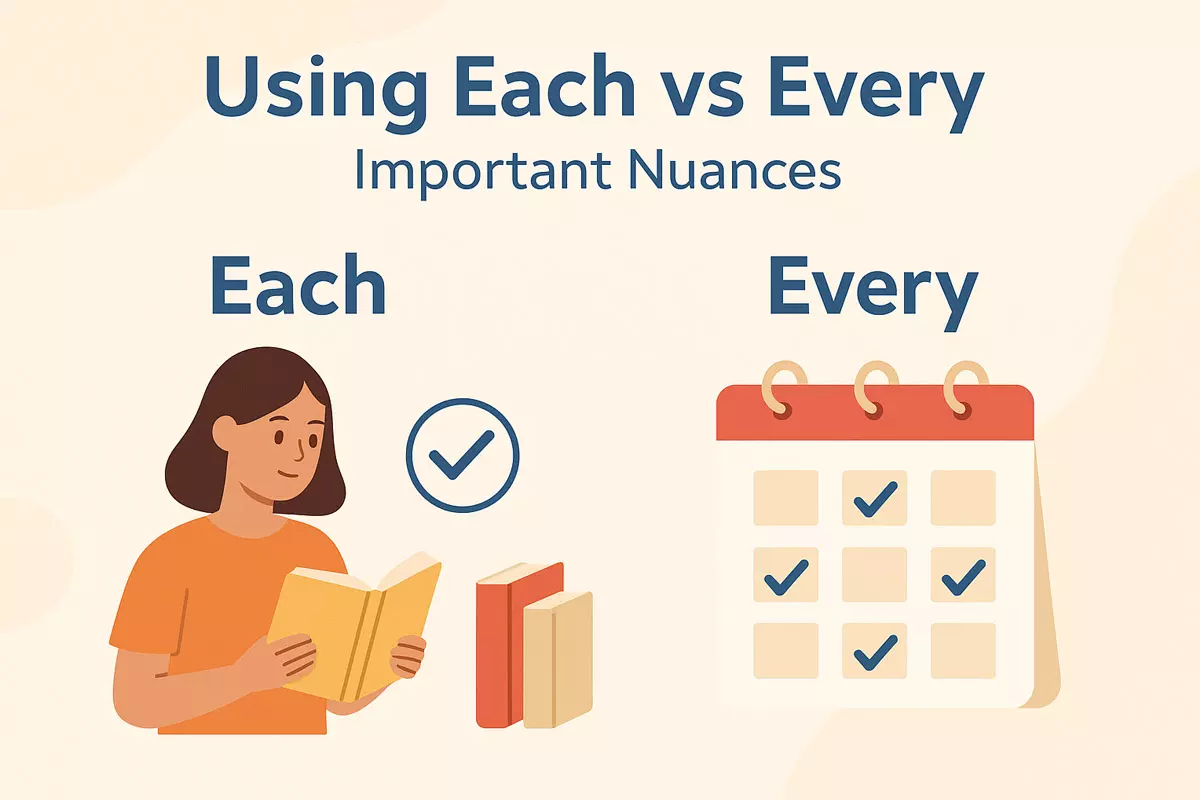
Deciding whether to use each or every can be trickier than it seems, as these words have subtle but important differences that affect the meaning of your sentences. Each is typically used when referring to individual items in a group, emphasizing them separately, while every refers to all items in a group collectively, highlighting uniformity or repetition. By understanding how to use each and every correctly, you can communicate your ideas in English more clearly and accurately.
Core meaning of each and every in simple terms
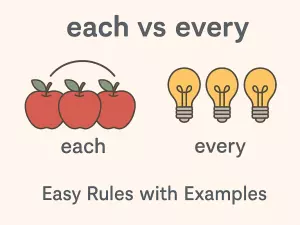
The words each and every are often used when talking about groups, but they focus on slightly different ideas. Each refers to individual members of a group, one at a time. It highlights the single units within the whole. In contrast, every refers to all the members of a group as a whole, emphasizing the group’s completeness or totality.
How they work in sentences
When you use each, you are thinking about the items separately, even if they belong to the same group. With every, you consider all items together, but still mean all the single items in the group.
- Each student received a certificate. (Focus on the students one by one.)
- Every student received a certificate. (All students, no exceptions.)
- Each apple is red. (Looking at apples individually.)
- Every apple is red. (All apples, as a group, are red.)
Key distinctions at a glance
| Word | Main Idea | Typical Usage |
|---|---|---|
| Each | Individual focus; one at a time | Small groups, two or more items; often with singular nouns |
| Every | Group focus; all members as a whole | Larger groups (three or more); always with singular nouns |
Quick reference: When to use each one
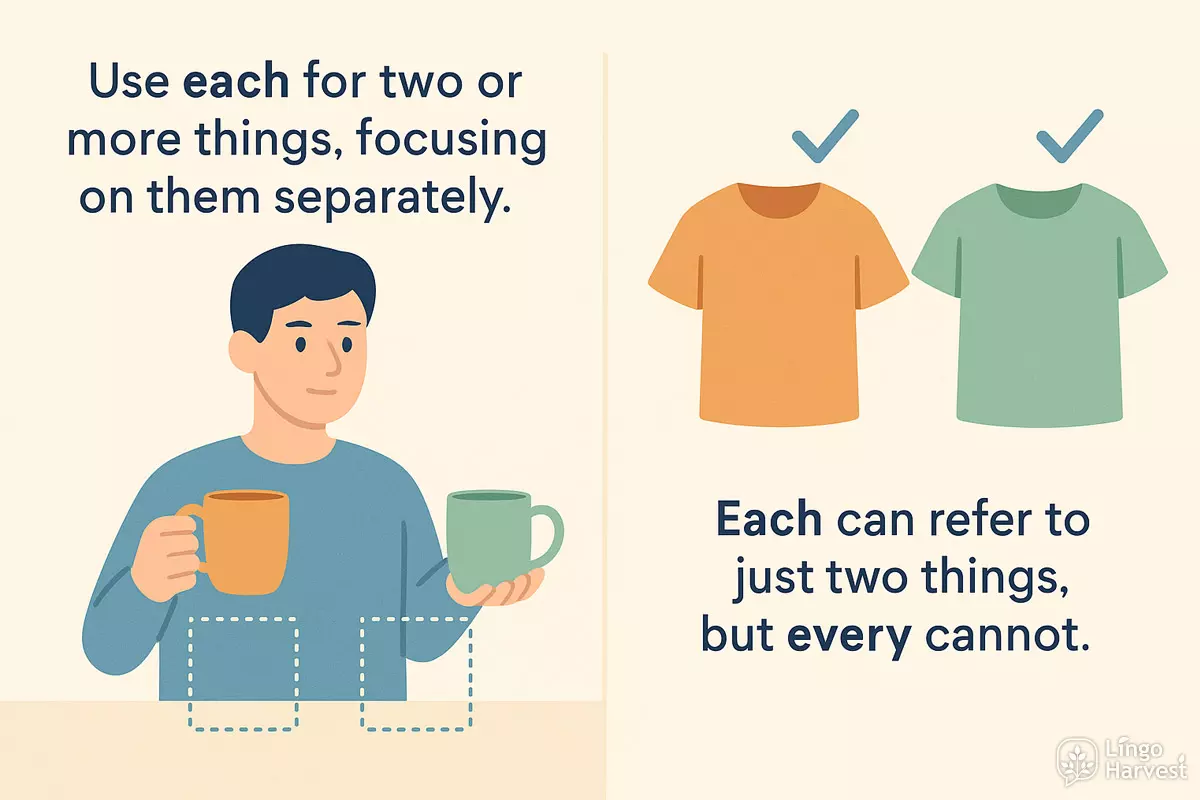
- Use each for two or more things, focusing on them separately.
- Use every for three or more, when you mean all items in the group.
- Each can refer to just two things, but every cannot.
- Every is not used for very small groups.
- Both words are followed by a singular noun: each book, every book.
- They cannot be used with plural nouns: each books ❌, every books ❌.
- Each can stand alone: “Each received a prize.”
- Every almost always needs a noun after it: “Every received a prize” ❌.
- You can use each of or every one of before plural nouns: “Each of the students,” “Every one of the students.”
Understanding these basic ideas helps you choose the right word depending on whether you want to highlight individuals or the group as a whole.
Grammar patterns with singular nouns and verbs
When using "each" and "every," it's important to remember that both words are followed by singular countable nouns and take singular verbs. This is a key rule in English grammar that affects how sentences are constructed. Although "each" and "every" often have similar meanings, their usage in sentences follows specific patterns that help clarify meaning and avoid confusion.
Core structure with "each" and "every"
Both "each" and "every" are typically placed before a singular noun, and the verb that follows should also be in the singular form. Here are some common examples:
- Each student is responsible for his or her own work.
- Every book has a unique cover.
- Each employee receives an ID badge.
- Every answer counts toward your final grade.
- Each ticket allows one person entry.
- Every meal includes a drink.
- Each question requires careful thought.
- Every lesson begins with a review.
- Each room has a window.
- Every participant gets a certificate.
- Each day brings new opportunities.
- Every child needs encouragement.
- Each car has its own parking space.
- Every rule applies to all members.
- Each member pays a fee.
- Every student receives feedback.
Notable exceptions and reminders
While "each" can sometimes be used after the noun (e.g., "They gave the students each a pencil"), the verb still remains singular if "each" is the true subject. However, such structures are less common in formal writing. "Every" is almost always placed before the noun.
Comparing patterns: "each" vs "every"
Below is a comparison of how these words function in sentence structures, focusing on their placement and agreement with verbs.
| Pattern | Example |
|---|---|
| Each + singular noun + singular verb | Each visitor receives a guidebook. |
| Every + singular noun + singular verb | Every applicant must fill out a form. |
| "Each" after the noun (less formal) | The players each wear a uniform. ❌ (plural verb) The players each wears a uniform. ✅ (if rephrased: "Each player wears...") |
| Negative forms | Not every student understands the material. |
Key takeaways
- Always use a singular noun after "each" or "every."
- Pair with a singular verb form for grammatical accuracy.
- Remember that "each" allows for slightly more flexible placement, but the verb agreement rule stays the same.
- These patterns help express individual attention within a group, which is essential for clear communication.
When each highlights individuals within a group
The word each is often used to focus on members of a set one by one, rather than treating the group as a single unit. This usage brings attention to the individuality of every member, even when they belong to a larger collective. It’s especially helpful when you want to emphasize separate actions, characteristics, or responsibilities assigned to every single person or item in a group.
Emphasizing Separate Actions or Qualities
Consider a scenario where several people are involved, but you want to stress that something applies to them individually. Here, each makes it clear that the action or attribute is not shared collectively, but is experienced separately.
- Each student received a different assignment.
- Each guest brought their own dish to the party.
- Each runner started at a different time.
- Each book on the shelf is written by a different author.
- Each member of the team has a unique role.
- Each answer was checked for accuracy.
- Each window in the building is decorated differently.
- Each child wore a different color.
- Each participant must sign the waiver.
- Each cat has its own favorite spot.
- Each chair in the room is occupied.
- Each applicant was interviewed separately.
- Each envelope contains a surprise.
- Each question was answered in turn.
- Each employee gets a yearly review.
- Each painting was hung with care.
Comparing “each” and “every” in context
While both each and every can refer to all members of a group, their nuance changes the focus. Each highlights the individual nature or experience of group members, whereas every often treats the group as a whole, without as much emphasis on individuality. This distinction is subtle but important in conveying your intended meaning.
| Usage | Example Sentence |
|---|---|
| Individual focus (each) | Each player received a medal. (Medals handed out one by one) |
| Collective focus (every) | Every player must wear a uniform. (Uniform rule applies to the whole group) |
| Separate actions (each) | Each employee submitted their own report. (Reports are individual) |
| General rule (every) | Every employee attends the meeting. (All attend as a group) |
In summary, use each when you want to shine a light on the distinct experiences or contributions of individuals within a group. This subtle distinction helps clarify your intent and prevents ambiguity in communication.
When every refers to an entire group collectively
In English, "every" can sometimes highlight the idea that an entire set is being considered as a unified whole. Rather than focusing on individuals, it suggests that the statement applies to the group in its entirety, with no exceptions. This is especially common in statements about rules, schedules, or repeated events, where no member of the group is excluded.
Understanding the collective sense of "every"
When "every" is used in this way, the emphasis is not on each item by itself, but on the completeness: all members are included, and the group acts as a unit. For example, "Every student must wear a uniform" means the rule applies to all students, not just separately but as a comprehensive requirement.
- Every door was locked before midnight. (All doors—none left open.)
- Every guest received a thank-you note. (No guest was missed.)
- Every Monday, the team meets to discuss progress. (The pattern covers all Mondays.)
- Every child in the class participated in the project. (Participation was universal.)
- Every answer in the test was checked twice. (No answer overlooked.)
- Every employee is expected to attend the meeting. (Attendance is mandatory for the group.)
- Every house on the street was decorated for the festival. (Collective participation.)
- Every page of the book was carefully illustrated. (Nothing skipped.)
- Every ticket sold out within hours. (All tickets, not just some.)
- Every country in the region signed the agreement. (The entire region is included.)
- Every rule has an exception. (All rules, considered together.)
- Every attempt was made to resolve the issue. (No effort spared.)
- Every plant in the garden was watered. (The watering covered the whole group.)
- Every member of the team contributed ideas. (No one left out.)
- Every report is due by Friday. (All reports, as a group, share the same deadline.)
How "every" differs from "each" in collective statements
While "each" often singles out members one by one, "every" in these examples pulls them together, making the statement about the whole set. "Every" is rarely used for small numbers or when the focus is on individuals acting separately. Instead, it works best for larger groups or repeated events, where the collective effect is more important than the individual instances.
Summary: Key features of "every" in collective contexts
- Emphasizes totality: no exceptions within the group.
- Applies to all members as a set, especially in rules, schedules, and universal statements.
- Common in habitual or regular actions (e.g., "Every Friday...").
- Less personal or individualizing than "each."
Common collocations with each and with every
Understanding which words and phrases frequently pair with “each” and “every” helps you use them more naturally. While both terms refer to all members of a group, their common partners in sentences often differ. Some combinations sound natural only with one, not the other.
Typical phrases with “each”
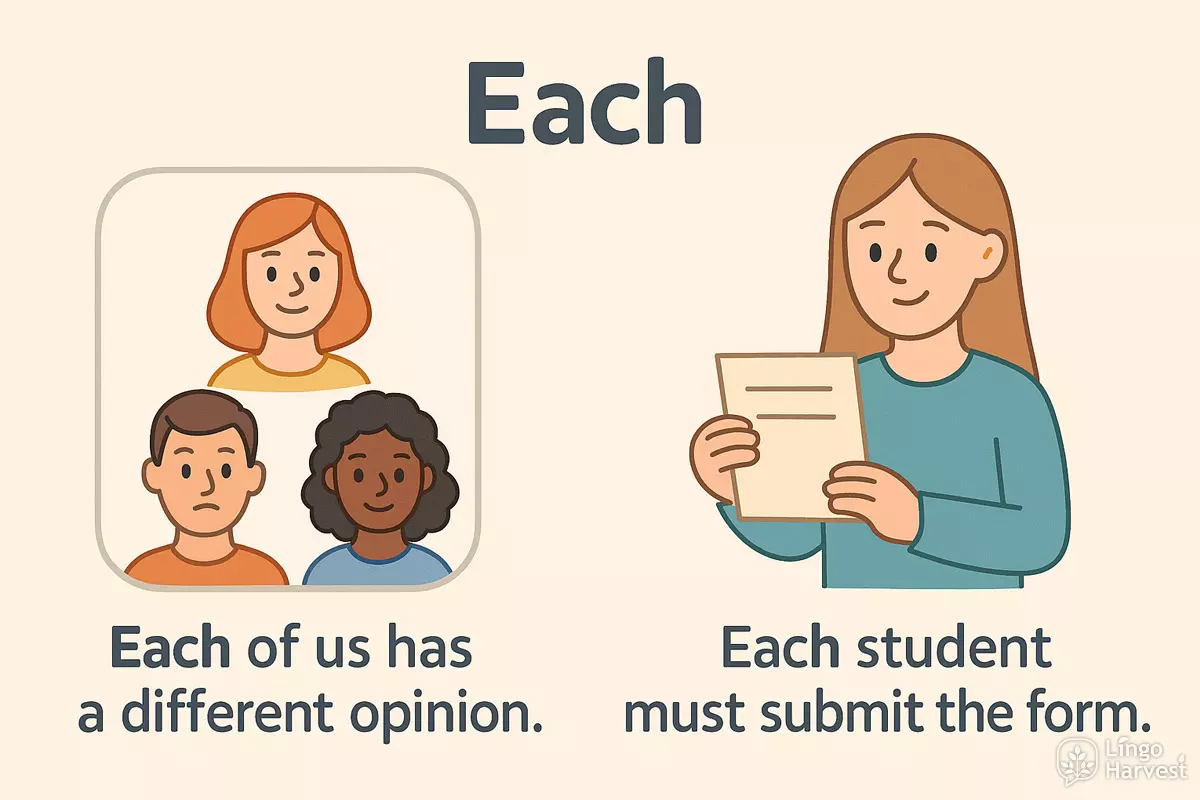
“Each” is commonly used when emphasizing individuality or when referring to members of a group separately. You’ll often see it with singular countable nouns and in contexts that highlight distinction. Here are some widely used examples:
- each person → Each person received a certificate.
- each time → Each time I call her, she is busy.
- each of us → Each of us has a different opinion.
- each student → Each student must submit the form.
- each day → I practice English each day.
- each item → Each item was carefully checked.
- each side → There is a door on each side of the building.
- each one → Each one of the answers is correct.
- each member → Each member agreed with the decision.
- each piece → Each piece of the puzzle fits perfectly.
- each participant → Each participant signed the document.
- each child → Each child received a small gift.
You’ll also find “each” after plural objects, as in “They gave us each a gift.” → They gave us each a gift before we left.
Frequent patterns with “every”
- every day → I go for a walk every day.
- every time → Every time it rains, the street floods.
- every person → Every person deserves respect.
- every student → Every student passed the exam.
- every chance → He takes every chance to practice.
- every opportunity → She uses every opportunity to learn.
- every year → We travel abroad every year.
- every reason → There is every reason to be proud.
- every part → Every part of the machine was tested.
- every country → Every country has its own traditions.
- every effort → Every effort was made to help them.
- every minute → Every minute counts in an emergency.
- every detail → He noticed every detail in the report.
Side-by-side comparison of usage
Some collocations work with both “each” and “every,” but their meaning or nuance may change. The table below highlights typical usage patterns for clarity:
| With “each” | With “every” |
|---|---|
| each child received a present | every child deserves love |
| each side of the argument | every side was considered |
| each of the books on the shelf | every book in the series |
| each time I call, she answers | every time I visit, it rains |
| each participant shared an idea | every participant must register |
Observations and practical tips
Choosing between “each” and “every” often depends on whether you’re focusing on individuals or the group as a whole. Remember, “each” is more likely to appear with “of” and plural objects (“each of them”), while “every” rarely does. Also, “every” is common with time expressions (“every week,” “every morning”), while “each” is preferred when actions are distributed individually. By noting these common combinations, you’ll be able to select the right form and sound more fluent in your writing and speech.
Typical learner mistakes and how to avoid them
When it comes to “each” and “every,” many English learners confuse their usage, especially in sentences describing groups, frequency, or individuals within a set. Misunderstandings often arise from translating directly from other languages, or from not noticing subtle differences in meaning and grammar.
Common confusion points
- Treating “each” and “every” as fully interchangeable: While both refer to all members of a group, “each” focuses more on individuals, and “every” emphasizes the group as a whole.
- Using incorrect verb forms: Both “each” and “every” take singular verbs, but mistakes happen when learners incorrectly use plural forms.
- Wrong placement with pronouns: Learners often misuse “each” and “every” with pronouns, such as “each of them” vs. “every of them” (the latter is incorrect).
- Incorrect use with time expressions: “Every” is common with repeated intervals (“every day”), but “each day” can sound unnatural in some contexts.
- Redundancy: Phrases like “each and every” are sometimes overused or used inappropriately for emphasis.
Examples of mistakes and how to fix them
| Mistake ❌ | Correction & Explanation ✅ |
|---|---|
| Every students has a book. | Every student has a book. Use singular noun with “every.” |
| Each of the children are happy. | Each of the children is happy. “Each” takes a singular verb. |
| Every of them passed the test. | Each of them passed the test. Only “each of” is correct, not “every of.” |
| I go to the gym each Monday. (Unusual) | I go to the gym every Monday. “Every” is standard with days or repeated events. |
| Each and every student must brings their book. | Each and every student must bring their book. “Brings” should be “bring” (modal verb + base form). |
| Each students finished their work. | Each student finished their work. Use singular after “each.” |
| Every of these apples tastes good. | Each of these apples tastes good. “Each of” is correct; “every of” is not. |
| I have checked every the items. | I have checked every item. Do not use “every the.” |
| Each people has a ticket. | Each person has a ticket. Use singular countable noun after “each.” |
| Every child and each teacher are present. | Every child and each teacher is present. Both “each” and “every” need singular verbs. |
Tips to avoid these errors
- Remember: both “each” and “every” require singular nouns and verbs.
- Use “each” when emphasizing individuals in a group; use “every” for the group as a whole or for regular intervals.
- Never use “every of”; use “each of” for referring to specific members of a group.
- With time expressions, prefer “every” (“every year,” “every morning”).
- Be cautious with “each and every”—it is emphatic and not for all situations.
By being mindful of these distinctions in context and grammar, you can confidently choose between “each” and “every” and avoid the most common mistakes.
Tone and emphasis differences in real contexts
Choosing between "each" and "every" affects not just grammar, but also the feeling and focus of a sentence. While both refer to all items in a group, they subtly shift the listener’s attention. "Each" often highlights individuals within a group, making statements feel more personal or detailed. In contrast, "every" tends to present things as a collective, emphasizing uniformity or regularity. For instance, saying "Each student received a certificate" draws attention to individuals and their unique experiences, whereas "Every student received a certificate" stresses that no one was left out, focusing on the group as a whole. This distinction can change the emotional impact or clarity of your message.
How "each" and "every" shape tone
- Personal focus: "Each" singles out items or people, making communication more individualized.
- Collective emphasis: "Every" groups things together, giving a sense of completeness or totality.
- "Each" can suggest careful attention or a step-by-step process.
- "Every" often conveys consistency or routine.
- Using "each" may feel more formal or precise in some contexts.
- With "every," the tone can be more inclusive or broad.
- In instructions, "each" can add clarity by highlighting separate actions.
- Advertisements or motivational statements often use "every" to inspire a sense of belonging.
- Storytelling may prefer "each" to evoke empathy for individual characters.
- Rules or policies typically use "every" to convey fairness and general applicability.
- "Each" is common in technical or scientific writing when describing discrete elements.
- "Every" is favored in schedules or habitual actions ("every Monday").
- Questions about individuals ("Did each guest enjoy the meal?") use "each" for specificity.
- Affirmative generalizations ("Every child can learn") employ "every" for encouragement.
Comparing real-world examples
| Context | Effect of "Each" | Effect of "Every" |
|---|---|---|
| Instructions | "Place each item in a separate box." Highlights separation and individuality. |
"Place every item in the box." Focuses on total inclusion. |
| Motivation | "Each of you has unique talents." Directs encouragement personally. |
"Every one of you can succeed." Applies encouragement to all as a group. |
| Schedules | "Each session lasts 30 minutes." Describes individual sessions. |
"Every Monday we meet." Emphasizes routine or regularity. |
| Feedback | "Each comment was helpful." Appreciates contributions individually. |
"Every comment matters." Stresses collective importance. |
As you can see, the nuance between these words can shift the perspective, making your communication either more individualized or more universal. Being aware of these effects helps you match your language to your intent.
Practice: choose either each or every in sample sentences
Understanding the subtle differences between “each” and “every” is best achieved through practical examples. Below you’ll find a selection of sentences where you must decide which word completes the meaning most accurately. Pay close attention to context—sometimes both choices seem possible, but only one fits the nuance.
Fill in the Blank: Select the Correct Word
Read the sentences below and decide whether “each” or “every” fits best. Consider whether the statement refers to individuals in a group (often “each”) or to the group as a whole (often “every”).
- ______ student in the class must submit the assignment by Friday.
- The teacher gave ______ child a sticker for good behavior.
- I visit my grandparents ______ Sunday.
- She placed a flower on ______ plate at the table.
- ______ book on the shelf belongs to the library.
- He shook hands with ______ person in the room.
- ______ time I see her, she’s smiling.
- They checked ______ bag before boarding the plane.
- ______ of the answers was correct.
- We have meetings ______ week.
- ______ guest received a welcome gift.
- She answered ______ question carefully.
- ______ window in the house was cleaned.
- He runs five kilometers ______ morning.
- The instructions were given to ______ participant individually.
Show answers
- Every student in the class must submit the assignment by Friday.
- The teacher gave each child a sticker for good behavior.
- I visit my grandparents every Sunday.
- She placed a flower on each plate at the table.
- Every book on the shelf belongs to the library.
- He shook hands with each person in the room.
- Every time I see her, she’s smiling.
- They checked each bag before boarding the plane.
- Each of the answers was correct.
- We have meetings every week.
- Each guest received a welcome gift.
- She answered every question carefully.
- Every window in the house was cleaned.
- He runs five kilometers every morning.
- The instructions were given to each participant individually.
Common Patterns: “Each” vs “Every” in Context
Notice how these words appear in frequent English expressions. Review the examples and observe the patterns:
- ______ of the students received a certificate. (Used with “of” + plural noun)
- ______ single day brings new challenges. (Emphasizes frequency or entirety)
- She greeted ______ guest personally. (Focus on individuals)
- He goes jogging ______ morning. (Regular repetition)
- ______ one of us has a role to play. (With “one of” for individuals in a group)
- ______ child in the class received a book. (Individual focus)
- She checks her email ______ hour. (Repeated action)
- ______ of the answers was marked carefully. (With “of” + plural noun)
- ______ team member must sign the form. (Individual responsibility)
- We meet ______ Friday to discuss progress. (Regular routine)
Show answers
- Each of the students received a certificate.
- Every single day brings new challenges.
- She greeted each guest personally.
- He goes jogging every morning.
- Each one of us has a role to play.
- Each child in the class received a book.
- She checks her email every hour.
- Each of the answers was marked carefully.
- Each team member must sign the form.
- We meet every Friday to discuss progress.
By practicing with these examples, you’ll start to recognize which situations call for “each” (emphasizing individuals in a group) and which for “every” (emphasizing the whole group or regularity). Try creating your own sentences for further mastery.