Open and Closed Word Classes Explained

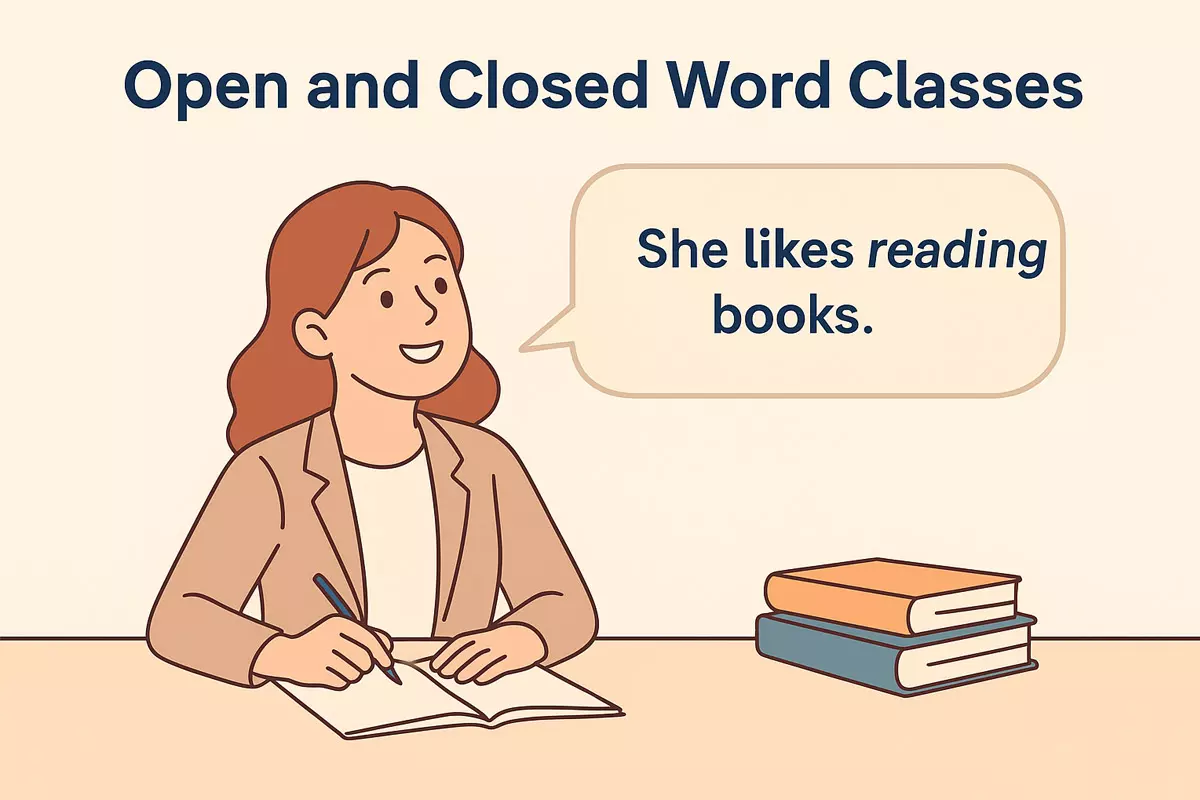 Here we the basics of open and closed word classes in English, explains how they differ, gives examples, and discusses why the distinction is important. It also points out typical learner mistakes and offers practice in classifying words.
Some words in English, such as verbs or nouns, often welcome new additions, reflecting the evolving needs and experiences of speakers, while others, like pronouns or conjunctions, tend to remain stable over time. This contrast highlights how language adapts to cultural and technological changes by expanding certain word groups, while preserving others to maintain clarity and structure. By observing which words change and which remain constant, we gain valuable insight into the dynamic nature of English and the ways communication evolves.
Introduction to Word Classes
Understanding how words function within sentences is essential for exploring the structure of language. Linguists categorize words into groups based on their roles—these are known as word classes or parts of speech. Each class shares grammatical features and patterns of use, helping us make sense of how language is organized and how it evolves.
What Are Word Classes?
A word class is a group of words that behave in similar grammatical ways. Commonly, these categories include nouns, verbs, adjectives, and adverbs, but there are several others with more specialized functions. Some classes are called open because they regularly accept new words, while others are closed, rarely changing over time.
Main Types of Word Classes
- Nouns — names of people, places, things, or ideas (e.g., cat, London, freedom)
- Verbs — indicate actions, states, or processes (run, think, exist)
- Adjectives — describe or modify nouns (happy, tall, green)
- Adverbs — modify verbs, adjectives, or other adverbs (quickly, very, well)
- Pronouns — replace nouns (she, it, themselves)
- Prepositions — express relationships in space, time, or other connections (in, after, between)
- Conjunctions — link clauses, phrases, or words (and, but, although)
- Determiners — specify or quantify nouns (the, some, each)
- Interjections — express emotions or exclamations (oh, wow, ouch)
- Numerals — indicate quantity or order (three, second)
How Do Word Classes Differ?
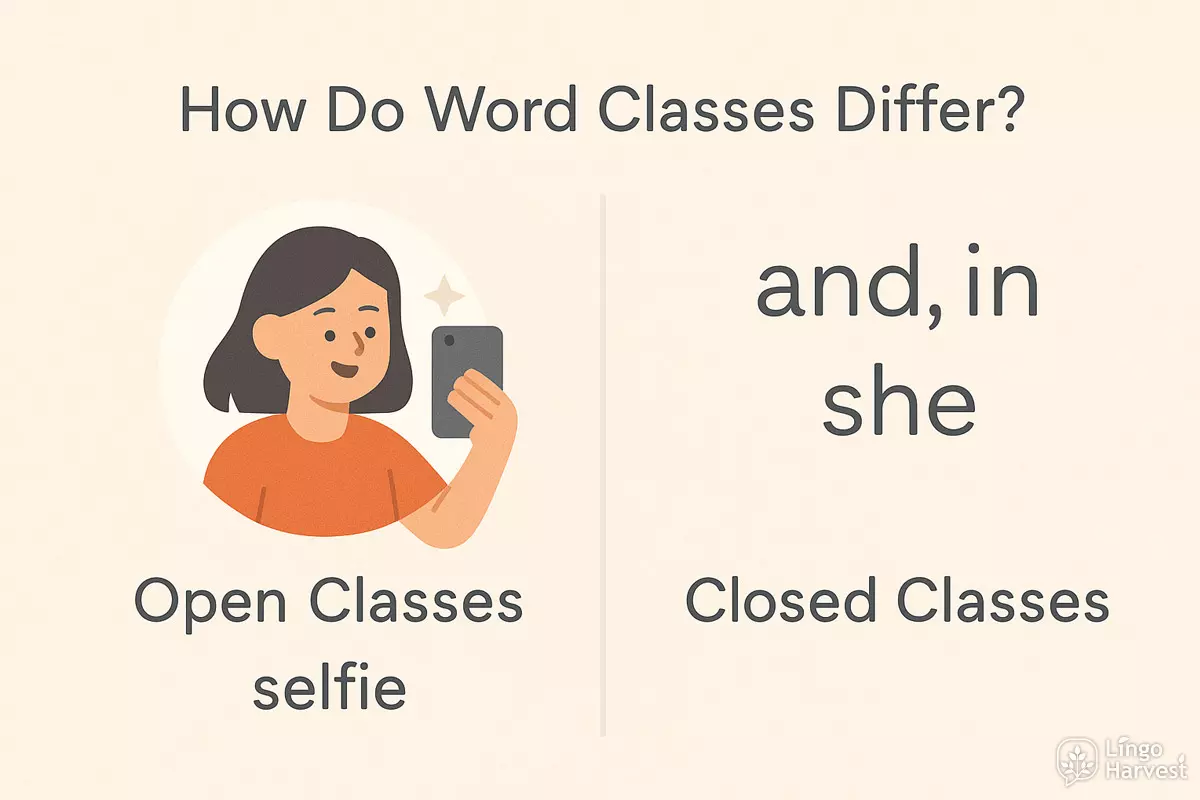
Not all word classes are equally flexible. Some, like nouns and verbs, are continually expanding as new terms are coined or borrowed. Others, such as conjunctions and prepositions, remain stable and rarely gain new members. This distinction is crucial for understanding how vocabulary adapts to cultural and technological change.
| Type of Class | Typical Features |
|---|---|
| Open Classes | Easily accept new words; include nouns, verbs, adjectives, adverbs. Examples: blog, selfie, to google. |
| Closed Classes | Rarely change; include pronouns, prepositions, conjunctions, determiners. Examples: and, in, she. |
Recognizing the differences between these categories helps in analyzing sentence structure and understanding why some parts of the vocabulary are dynamic, while others are remarkably resistant to change. This foundation is key for further exploration of how open and closed classes shape the way we communicate.
What Are Open Classes?
Open word classes are categories in language that regularly welcome new members. These groups consist of words that can be freely created, borrowed, or adapted as communication evolves. Unlike more fixed categories, their membership is not strictly limited. This flexibility allows languages to respond to cultural changes, technological advances, and creativity.
Core Types of Open Word Classes
The main open classes in English and many other languages include:
- Nouns (e.g., "laptop," "emoji," "podcast")
- Verbs (e.g., "google," "stream," "text")
- Adjectives (e.g., "viral," "eco-friendly," "pixelated")
- Adverbs (e.g., "digitally," "locally," "instantly")
Each of these groups is receptive to innovation. For instance, new products or phenomena often lead to the creation of fresh nouns and adjectives, while new actions or processes give rise to verbs.
How Do Words Enter Open Classes?
Words can be added to these categories in several ways:
- Coining: Inventing entirely new words (e.g., "selfie").
- Borrowing: Adopting terms from other languages (e.g., "sushi," "café").
- Compounding: Combining existing words (e.g., "smartphone," "workout").
- Derivation: Using prefixes or suffixes (e.g., "unfriend," "happiness").
Examples of Recent Additions
To illustrate how open classes evolve, here is a list of words that have entered common usage over the past few decades:
- App
- Binge-watch
- Blog
- Cryptocurrency
- Hashtag
- Influencer
- Livestream
- Microplastic
- Photobomb
- Podcast
- Reboot (as a verb)
- Selfie
- Spam (as a verb)
- Unfriend
- Vlog
- Wi-Fi
- Zero-waste
Why Are Open Classes Important?
These adaptable groups make language dynamic and expressive. They allow speakers to describe new realities and express subtle differences in meaning. Without such flexibility, communication would stagnate and fail to keep pace with the world.
Comparing Open and Closed Classes
To clarify the distinction, here’s a comparison of open and closed word classes:
| Open Classes | Closed Classes |
|---|---|
| New words frequently added | Rarely accept new words |
| Nouns, verbs, adjectives, adverbs | Pronouns, prepositions, conjunctions, determiners |
| Reflect cultural and technological change | Change slowly, if at all |
| Examples: "blog," "tweet," "greenwash" | Examples: "and," "the," "she" |
In summary, open classes ensure that language remains responsive and relevant, providing the tools we need to name, describe, and discuss our ever-changing world.
What Are Closed Classes?
In linguistics, some groups of words rarely change or accept new members. These are called closed word classes, and they serve essential grammatical roles in sentences. Unlike open classes (such as nouns and verbs), these categories are highly resistant to new additions, and their membership remains stable over time.
Core Features of Closed Classes
Closed classes are characterized by their fixed set of words and their function in structuring language rather than conveying specific content or meaning. They act as the "glue" that holds sentences together, helping to express grammatical relationships and clarify meaning.
- Stable Membership: New words are almost never added.
- Functional Role: They provide structure, not new concepts.
- Grammatical Importance: Essential for sentence construction and meaning.
Common Types of Closed Classes
Most languages contain several categories that fit this description. In English, the most notable examples include:
- Pronouns (e.g., I, you, he, she, it, we, they)
- Prepositions (e.g., in, on, at, by, with, from, about, under, over, between, through)
- Conjunctions (e.g., and, but, or, nor, yet, so, although, because, if, while, unless, since, though)
- Determiners (e.g., the, a, an, this, that, these, those, each, every, some, any, no, much, many)
- Auxiliary Verbs (helping verbs such as be, have, do, will, can, may, shall, must)
- Articles (the, a, an)
- Quantifiers (some, many, few, all, both, either, neither, several)
- Interrogative Words (who, what, where, when, why, how, which, whose)
Comparison: Open vs. Closed Classes
| Feature | Open Class | Closed Class |
|---|---|---|
| Can new words be added? | Yes ✅ | No ❌ |
| Main function | Convey content | Provide structure |
| Examples | Nouns, verbs, adjectives, adverbs | Pronouns, prepositions, conjunctions |
| Change over time | Frequent | Rare |
Why Are Closed Classes Important?
These word groups are vital for clear communication. They help link ideas, indicate relationships between words, and clarify who or what is involved in an action. While their vocabulary remains static, their usage is crucial for expressing complex thoughts and grammatical accuracy. Understanding these categories deepens your grasp of how sentences are built and how meaning is constructed in language.
How They Differ
Open and closed word classes play distinct roles in language structure and development. Open classes, such as nouns and verbs, are flexible and easily accept new additions as the language evolves. In contrast, closed classes—like prepositions and pronouns—rarely change and resist new entries, keeping the grammatical framework stable.
Flexibility and Change
Open categories are dynamic; they grow as society invents new objects, concepts, or phenomena. For example, technological advances have introduced terms like "selfie," "hashtag," and "podcast" into everyday speech. Closed categories, however, stay almost the same for generations, making them essential for maintaining sentence structure and meaning.
Function within Sentences
Open-class words usually carry the main content and meaning in a sentence. They answer questions such as "who?", "what?", and "how?". In contrast, closed-class words create connections, express relationships, or clarify meaning, often functioning as grammatical glue.
| Open Word Classes | Closed Word Classes |
|---|---|
| Nouns Verbs Adjectives Adverbs |
Pronouns Prepositions Conjunctions Determiners |
| Easily accept new words Carry main meaning Often expanded by borrowing or invention Can be inflected (e.g. plural, tense) |
Rarely change Serve grammatical functions Limited set Usually not inflected |
Examples to Illustrate the Contrast
- Open class additions: blog, emoji, app, influencer, email, webinar, vlogger, meme, binge-watch, drone
- Closed class stability: in, at, by, and, or, but, he, she, it, the, a, an
Summary of Key Distinctions
Open word groups are the source of linguistic creativity and adaptation, constantly expanding to reflect new realities. Closed categories provide consistency and clarity, anchoring the language’s basic structure. Understanding these distinctions helps clarify why some words seem to appear overnight, while others remain unchanged for centuries.
Examples of Each Type
Open and closed word classes differ in how easily new words can be added to them, and this is reflected in the kinds of words they contain. Let’s look at some typical representatives from both categories to clarify the distinction.
Open Word Classes
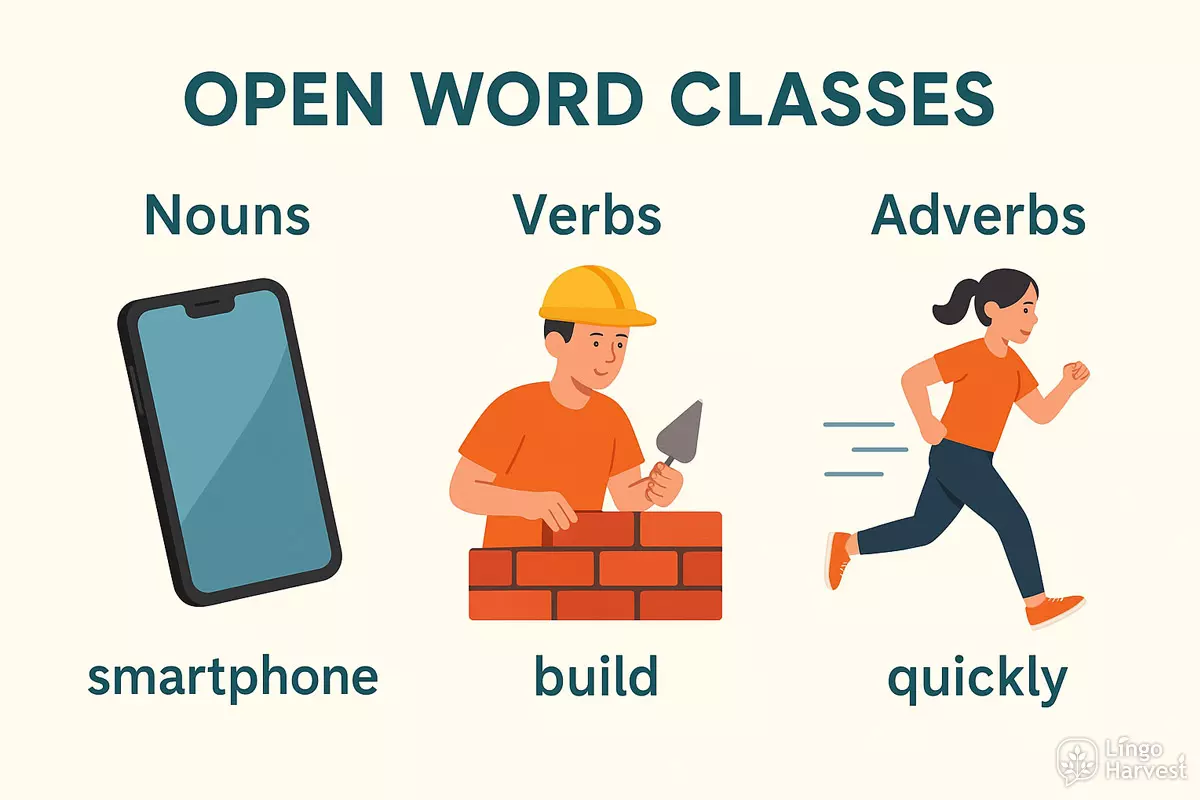
Open classes are flexible and constantly expanding as new concepts and inventions arise. The primary open classes in English are nouns, verbs, adjectives, and adverbs. Here are some examples for each:
- Nouns: cat, smartphone, democracy, pizza, river, astronaut, blog, mountain, happiness, robot
- Verbs: run, email, google, imagine, build, tweet, dance, jump, program, whisper
- Adjectives: blue, gigantic, affordable, digital, spicy, ancient, trendy, creative, silent, magnetic
- Adverbs: quickly, very, silently, always, tomorrow, digitally, easily, barely, somewhere, boldly
Because new technology and cultural trends introduce fresh terms, these categories are always growing. For example, “selfie” and “to google” only entered common usage in recent years.
Closed Word Classes
Closed classes resist new additions and serve more structural or grammatical roles within sentences. These include pronouns, prepositions, conjunctions, determiners, and interjections. Some common examples are:
- Pronouns: he, she, it, they, we, you, who, anyone, themselves, which
- Prepositions: in, on, at, by, with, under, between, about, over, through
- Conjunctions: and, but, or, because, although, if, unless, while, since, yet
- Determiners: the, a, some, many, this, those, each, every, no, any
- Interjections: oh, wow, hey, ouch, hmm, uh, alas, aha, oops, yikes
Unlike open classes, these are rarely updated or expanded. For instance, the set of English prepositions has stayed almost the same for centuries.
Summary Table: Open vs. Closed Classes
| Open Class Examples | Closed Class Examples |
|---|---|
| cat, smartphone, jump, trendy, quickly | he, in, and, the, wow |
| river, blog, build, spicy, tomorrow | she, under, but, this, ouch |
| robot, imagine, creative, silently, program | they, with, or, each, hmm |
| pizza, tweet, magnetic, always, happiness | it, about, because, many, aha |
This selection highlights the variety and adaptability of open categories compared to the fixed nature of closed ones. Recognizing which group a word belongs to can help in understanding how the English language evolves and functions.
Why the Difference Matters
Understanding open and closed word classes isn’t just an academic exercise—it directly shapes how we use and learn language. Open classes, such as nouns and verbs, are flexible and constantly evolving. New words are added to them as society changes, allowing speakers to describe new concepts, technologies, or trends. Closed classes, like prepositions or conjunctions, remain relatively fixed; their roles are structural, helping us glue sentences together but rarely admitting new entries.
The Impact on Language Learning and Use
For language learners, distinguishing between these categories helps prioritize vocabulary acquisition. Open classes are where most new words will appear, so learners and writers often focus here to expand their expressive range. In contrast, mastering closed classes is about understanding patterns and rules rather than memorizing endless lists.
- Open: Nouns (e.g., "selfie," "podcast")
- Open: Verbs (e.g., "google," "stream")
- Open: Adjectives (e.g., "gluten-free," "viral")
- Open: Adverbs (e.g., "digitally," "locally")
- Closed: Pronouns (e.g., "she," "they")
- Closed: Prepositions (e.g., "in," "on")
- Closed: Conjunctions (e.g., "and," "but")
- Closed: Determiners (e.g., "the," "some")
Why This Distinction Is Important
Writers, teachers, and linguists rely on the open/closed classification to analyze language change and stability. It explains why you might invent a new noun but can’t simply add a new pronoun into everyday speech. This difference also affects how dictionaries are updated: entries for open classes grow rapidly, while closed-class lists hardly change.
| Open Class Features | Closed Class Features |
|---|---|
| New words added frequently ✅ Creative expansion ✅ Major carriers of meaning |
Rarely admit new words ❌ Stable set ✅ Grammatical structure |
| Examples: nouns, verbs, adjectives, adverbs | Examples: prepositions, pronouns, conjunctions, determiners |
| Essential for vocabulary growth | Essential for sentence construction |
| Subject to trends and innovation | Resistant to change |
Grasping this distinction empowers anyone studying or teaching language to focus their efforts more effectively, appreciate how communication evolves, and see why some parts of speech are dynamic while others are foundational.
Typical Learner Mistakes
When exploring open and closed word classes, learners often stumble over boundaries and usage rules. Many confuse which words can take new forms or meanings, and which are fixed. This can cause awkward phrasing or incorrect sentence structure, especially when experimenting with vocabulary.
Confusing Open with Closed Classes
A frequent error is misclassifying words like "but" or "the" as flexible, assuming they can be altered or expanded like nouns and verbs. In reality, these function words (like conjunctions, articles, and prepositions) rarely change or accept new additions.
Overgeneralizing Word Formation
Students sometimes attempt to create new prepositions or conjunctions, not realizing these categories resist new entries. For example, inventing "despite of" or "altho" as if they fit the same rules as "blog" or "to google" (nouns/verbs).
Incorrectly Modifying Closed-Class Words
Problems arise when learners try to pluralize or conjugate words that shouldn't change. For instance, adding "s" to "and" or "in" ("ands," "ins") is never acceptable in standard usage.
Mixing Up Function and Content Words
Mistaking function words (closed class) for content words (open class) leads to errors in both grammar and meaning. Learners may attempt to use prepositions as nouns or vice versa.
Sample Problem Areas
- Adding -ed or -ing to prepositions: "onning," "withing"
- Trying to create comparative/superlative forms: "mores," "mosts"
- Using conjunctions as verbs: "to and," "to but"
- Attempting to create new pronouns: "theys," "herselfs"
- Inventing new articles: "an a," "thee"
- Pluralizing determiners: "theses," "thoses"
- Assuming all adjectives are open class (words like "own" are closed)
- Using interjections as regular nouns: "an ouch," "many wows"
- Forgetting that most prepositions and conjunctions are fixed and cannot be expanded upon
- Adding prefixes/suffixes to closed-class words: "pre-the," "over-but"
Quick Reference: Open vs. Closed Word Classes
| Open Class Examples | Closed Class Examples |
|---|---|
| Nouns (cat, innovation), Verbs (run, email), Adjectives (blue, digital), Adverbs (quickly, happily) | Pronouns (she, it), Prepositions (at, from), Conjunctions (and, but), Determiners (the, some), Articles (a, an, the) |
| New words regularly added: "selfie," "to text," "flexitarian," "googling" | Rarely, if ever, expanded; forms are fixed and not open to new members |
| Can change forms: "dogs," "running," "friendlier," "faster" | Do not change form: "the," "and," "in" remain unchanged |
| Meaning can be broad and creative | Function is grammatical, not creative |
Summary Advice
Pay close attention to whether a word serves a grammatical function or carries content meaning. This distinction helps avoid most errors—remember, open classes are creative and evolving, while closed classes are stable and limited in form and number.
Practice: Classify the Words
Understanding how different types of words function in language is key to mastering grammar. Let’s put your knowledge to the test by sorting various examples into open and closed word classes. Read each item and decide whether it belongs to an open class (like nouns, verbs, adjectives, adverbs) or a closed class (such as pronouns, conjunctions, prepositions, determiners, etc.).
Task 1: Identify the Word Class
Review the list below. For each word, decide which type of class it belongs to: open or closed. Think about whether the word is part of a category that can easily accept new members, or if it comes from a more 'fixed' group.
- quickly
- the
- run
- she
- under
- beautiful
- but
- idea
- because
- those
- innovation
- and
- cat
- his
- if
- between
- delightful
- will
- they
- imagine
Show answers
- Open class: quickly, run, beautiful, idea, innovation, cat, delightful, imagine
- Closed class: the, she, under, but, because, those, and, his, if, between, will, they
Task 2: Spot the Pattern
Consider the following. Which of these characteristics usually marks a word as belonging to a closed class?
- It can easily accept new members.
- It tends to have grammatical rather than lexical meaning.
- It describes actions, things, or qualities.
- It is limited in number and rarely changes.
Show answers
- 2 and 4: Closed classes have grammatical meaning and are limited in number.
Comparison Table: Open vs Closed Classes
Here’s a side-by-side look at typical examples and features of each type:
| Open Word Classes | Closed Word Classes |
|---|---|
| Nouns (cat, innovation, river) | Pronouns (she, they, his) |
| Verbs (run, imagine, build) | Prepositions (under, between, with) |
| Adjectives (beautiful, delightful, green) | Conjunctions (and, but, if, because) |
| Adverbs (quickly, silently, often) | Determiners (the, those, this, some) |
Reflection Challenge
Think of three new words you’ve encountered in recent years (for example, "selfie", "podcast", "emoji"). Which class do they belong to? Why do you think new additions are more common in certain classes?
Show answers
Most new words are nouns (like "selfie"), verbs ("to google"), or adjectives ("viral"). They belong to open classes because these categories expand as society and technology evolve.