Ambiguity Caused by Determiner Choice: how to avoid it

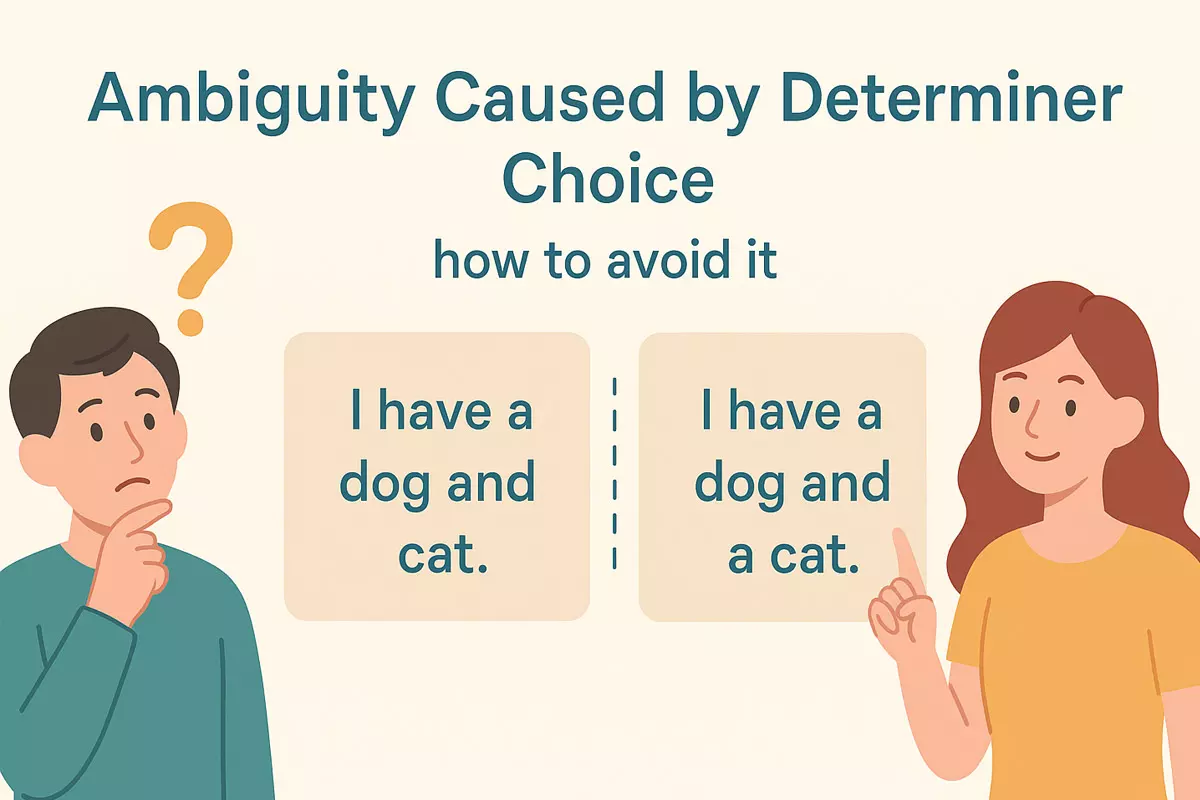 Here we how determiners can create ambiguity, with examples of unclear meaning from missing or incorrect determiners.
- What ambiguity is and how determiners can create it
- Examples where missing or wrong determiners confuse meaning
- Conflicts between singular, plural, and generic reference
- Problems with some, any, and no in instructions and rules
- Strategies for choosing more specific determiners
- Checking sentences for possible double interpretations
- Practice: rewrite sentences to remove ambiguity from determiners
Misunderstandings in communication frequently occur due to the subtle choices of words that introduce nouns, which can create confusion for both writers and readers. By becoming aware of how such choices influence the meaning of a sentence, you can improve clarity and reduce the risk of unintended vagueness. Careful attention to these details in your writing not only helps you convey your ideas more precisely but also makes it easier for your audience to grasp your intended message without ambiguity.
What ambiguity is and how determiners can create it
Ambiguity occurs when a sentence or phrase can be understood in more than one way. In grammar, this often happens when a word or structure allows for multiple interpretations, leaving the reader or listener unsure of the intended meaning. Determiners—words like some, any, the, a, each, and every—play a crucial role in specifying which noun is meant. However, their misuse or vague application can result in confusion.
How determiners contribute to unclear meaning
Choosing the wrong determiner, or using one that is too broad or too narrow, can blur the message. For example, saying "I saw the dog" may leave it unclear which dog is meant, especially if more than one is present. On the other hand, "I saw a dog" introduces a different kind of uncertainty: is it any dog, or a specific but previously unmentioned one? This lack of precision can make sentences difficult to interpret, especially in contexts like instructions, contracts, or academic writing.
Common sources of ambiguity with determiners
- Indefinite articles (a, an) vs definite article (the)
- Quantifiers that are not specific enough: some, few, several
- Universal determiners: every, all
- Ambiguous pronouns: this, that, these, those
- Possessives that don’t clarify ownership: his, her, their
- Negative determiners: no, none, neither
- Numbers without context: one, two, many
- Unclear distribution: each vs every
- Partitives: some of, most of, half of
- Double determiners: "the my book" (incorrect structure)
- Overlapping reference: other, another
- Unspecified group: any, either
- Context-dependent determiners: such, certain
Examples of ambiguous sentences due to determiners
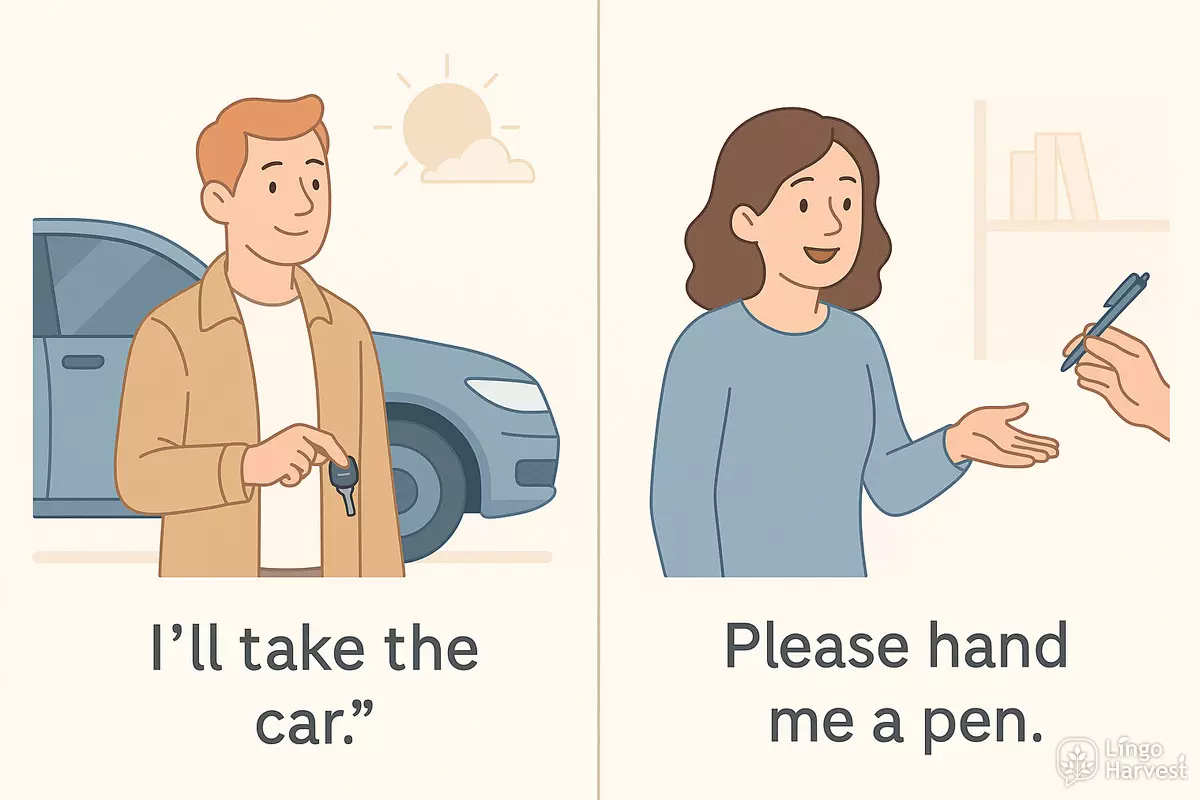
- "I’ll take the car." (Which car?)
- "Please hand me a pen." (Any pen, or a specific one?)
- "All students must submit their papers." (Does 'all' refer to every student individually or as a group?)
- "She gave her friend a gift." (Whose friend? Hers or someone else’s?)
- "He didn’t see any problems." (Were there no problems, or did he fail to notice them?)
How different determiners change interpretation
| Sentence | Possible Interpretations |
|---|---|
| "I spoke to a manager." | Any manager; not specific, possibly one of many. |
| "I spoke to the manager." | A specific manager, usually known to both speaker and listener. |
| "Each student received a book." | Every individual got one book; books may differ. |
| "All students received a book." | Entire group received books, but unclear if same or different ones. |
When writing or speaking, being aware of how determiners affect clarity is essential. Carefully choosing these small but powerful words can help prevent misinterpretation and ensure your message is understood as you intend.
Examples where missing or wrong determiners confuse meaning
Leaving out or misusing determiners can easily lead to ambiguity, making sentences unclear or even changing their intended meaning. Determiners like “the,” “a,” “some,” and “this” specify what or how many things you’re talking about. When these words are missing or incorrect, listeners or readers may misunderstand the message.
Common Situations Where Determiners Matter
- Unclear quantity: “I saw dog in park.” (Is it one dog? Any dog? A specific dog?)
- Specificity confusion: “Please hand me pen.” (Which pen?)
- Generalization vs. specific case: “Artist painted mural.” (Any artist, or a known one?)
- Possessive mix-ups: “She forgot keys.” (Her keys? Someone else’s?)
- Missing articles in instructions: “Close window before leaving.” (Any window or a particular one?)
- Misplaced determiners: “An elephants are large.” (Should be “Elephants are large” or “An elephant is large.”)
- Using “the” for general statements: “The dogs are friendly.” (All dogs, or a group already mentioned?)
- Incorrect demonstratives: “This apples are fresh.” (Should be “These apples are fresh.”)
- Unclear reference: “Take car to mechanic.” (Which car?)
- Omitting “some” or “any”: “There are apples in fridge.” (How many apples?)
- Wrong “a/an” usage: “He is engineer.” (Should be “He is an engineer.”)
- Plural vs. singular confusion: “She adopted cat.” (One cat, or more?)
- Unclear ownership: “Teacher collected assignments.” (All assignments or just a few?)
- Mixing up “this/that” and “these/those”: “These book is interesting.” (Should be “This book is interesting.”)
- Leaving out determiners in lists: “Bring pen, paper, eraser.” (Each item needs a determiner for clarity.)
- Comparing without specifics: “The coffee is better than tea.” (Which coffee? Which tea?)
- Misusing “each” and “every”: “Each students has a book.” (Should be “Each student has a book.”)
- Ambiguous superlative reference: “She is smartest student.” (Should be “the smartest student.”)
Side-by-Side Comparison
| With Missing/Wrong Determiner | Clear Version |
|---|---|
| I saw cat. | I saw a cat. |
| Give me apple. | Give me the apple. |
| She found keys. | She found her keys. |
| This books are old. | These books are old. |
| Bring umbrella. | Bring an umbrella. |
| He is doctor. | He is a doctor. |
| The water is in bottle. | The water is in the bottle. |
Even small changes in determiners can shift the meaning or create confusion. Paying attention to these little words is essential for clear and accurate communication.
Conflicts between singular, plural, and generic reference
Choosing determiners can lead to confusion when it’s unclear whether a noun refers to one thing, multiple things, or a general category. These distinctions matter because the meaning of a sentence can change dramatically depending on the reference intended. English often relies on subtle cues—like the use of "a," "the," or no article at all—to signal whether we’re talking about a specific item, a group, or an entire class.
Common sources of ambiguity
Writers and speakers sometimes unintentionally blur the line between a single item and a group, or between a concrete example and a general rule. Consider these typical points of confusion:
- Using "the cat" vs. "cats" vs. "a cat" when discussing pet behavior in general
- Switching between "an apple" and "apples" when talking about diet recommendations
- Employing "the student," "students," or "a student" in classroom policies
- Statements like "A dog is loyal" (refers to any dog, generically), versus "Dogs are loyal" (all dogs, more generally)
- Instructions that say "The user clicks the button" vs. "Users click the button"
- Describing inventions: "The airplane changed travel" vs. "Airplanes changed travel"
- Scientific facts: "A whale is a mammal" vs. "Whales are mammals"
- Advice: "A child needs sleep" vs. "Children need sleep"
- Rules: "A driver must obey the speed limit" vs. "Drivers must obey the speed limit"
- Generalizations: "The computer has changed society" vs. "Computers have changed society"
How determiners affect meaning
The choice of determiner, or whether to use one at all, influences how readers interpret scope and specificity. For example, "the lion" often means a particular lion or the species as a whole, depending on context. "Lions" is generally used for the species but can mean some or all lions. Without careful phrasing, readers may not know which interpretation to adopt.
Strategies to avoid confusion
Writers can minimize ambiguity by:
- Choosing plural forms for general truths (e.g., "Cats are independent animals")
- Using singular forms with "a/an" for generic reference, but ensuring context makes this clear (e.g., "A cat makes a good pet")
- Preferring clear pluralization for policies or instructions aimed at all (e.g., "Employees must sign in" instead of "The employee must sign in")
- Clarifying when a statement is about a specific individual or group by specifying "this," "that," or using proper nouns
- Rewriting sentences to avoid ambiguous determiners when possible
Illustrative examples
| Form | Implied Meaning |
|---|---|
| A dog is loyal | Any dog, in general (generic) |
| Dogs are loyal | All dogs, general statement (generic/plural) |
| The dog is loyal | Specific dog or sometimes the species (context-dependent) |
| Dog is loyal | Usually incorrect/awkward in English; lacks clear reference |
Problems with some, any, and no in instructions and rules
Misunderstandings often arise when “some,” “any,” or “no” are used in guidelines, warnings, or procedures. These determiners can easily introduce ambiguity, especially for English learners or in international settings where clarity is crucial. The choice between them affects whether a rule sounds permissive, restrictive, or unclear.
How ambiguity happens
Choosing the wrong determiner can make it unclear whether something is allowed, required, or forbidden. For example, “No food in the lab” is clear: food is not allowed. But “Any food in the lab must be labelled” might confuse—does this mean food is allowed if labelled, or that all food must be labelled if present?
Common sources of confusion
- “Some” can sound optional: “Use some gloves” → How many? Must I use them?
- “Any” sometimes means “every” and sometimes “at least one”: “Report any error” → Is every error to be reported, or just one?
- “No” is generally clear, but can be softened or misread: “No mobile phones” (strict), but “No mobile phones while working” (when exactly is this?)
Typical ambiguous instruction examples
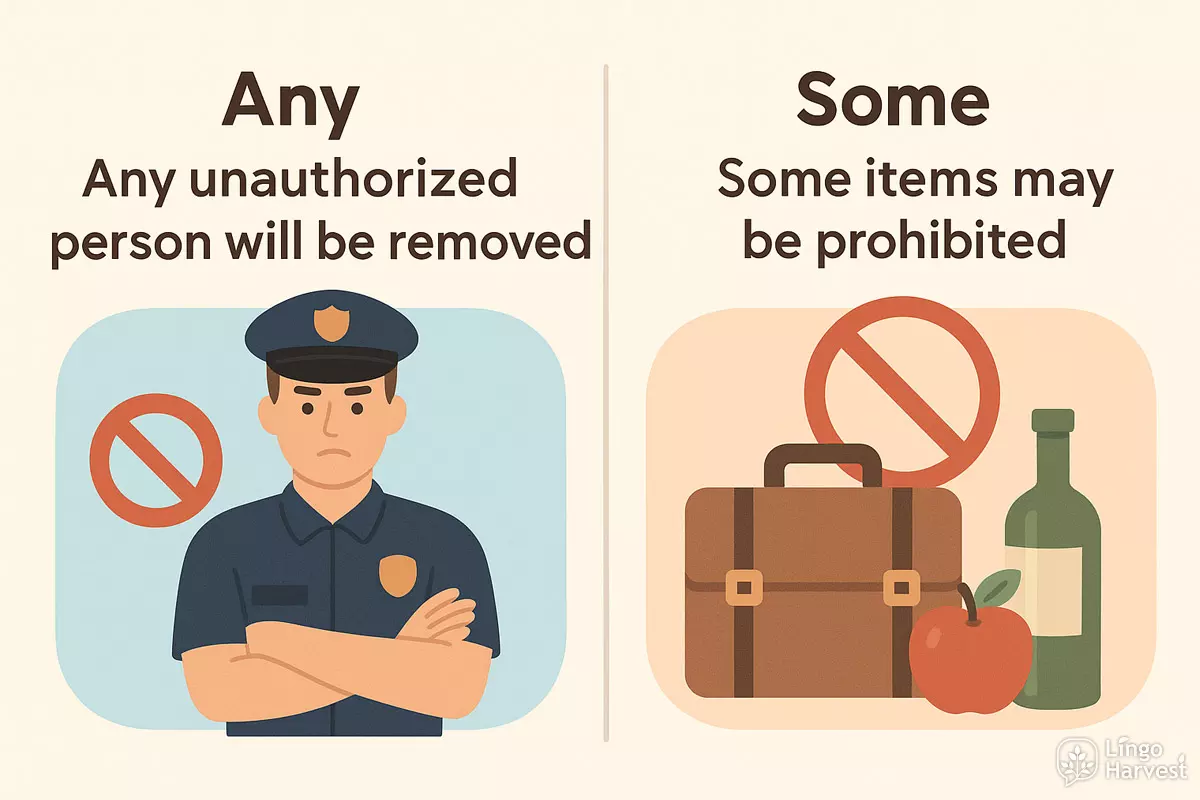
- “Any unauthorized person will be removed.” (Does “any” mean all or just one?)
- “No liquids in this area.” (Clear, but sometimes people ask if this includes water.)
- “Some items may be prohibited.” (Which ones? Who decides?)
- “If you have any questions, ask.” (Should I ask all my questions or just one?)
- “No food or drink allowed.” (Does this include chewing gum?)
- “Use some caution.” (How much caution is enough?)
- “Any bags left unattended will be removed.” (Every bag? What about small ones?)
- “Some equipment requires training.” (Which equipment?)
- “No dogs except guide dogs.” (What about other service animals?)
- “Any changes must be approved.” (Every change or only major ones?)
- “No children under 12.” (Does this include age 12?)
- “Any materials found will be confiscated.” (All materials or just some?)
- “Some areas are restricted.” (Which areas?)
- “No entry without authorization.” (What counts as authorization?)
How to avoid ambiguity
Specify exactly what is permitted or forbidden, and avoid vague determiners if possible. Rephrase for clarity:
- Instead of “Some items may be prohibited,” use “The following items are prohibited: knives, lighters, and aerosols.”
- Rather than “Any changes must be approved,” try “All changes, including minor edits, must be approved by the supervisor.”
- Replace “Use some caution” with “Always wear gloves and safety glasses.”
Clear, direct language helps instructions and rules achieve their purpose and prevents misinterpretation. When drafting guidance, consider how every reader—native or not—will understand the determiners you choose.
Strategies for choosing more specific determiners
Choosing the right determiner can clarify your meaning and prevent misunderstandings. Rather than relying on vague words like “some” or “any,” it’s helpful to pick more precise options based on what you want to express. Consider context, the exact quantity, and whether you’re referring to a particular item or a general group.
Analyze the context and intended meaning
Start by asking yourself what you want the reader to know. Are you referring to a single, known item, a group, or an indefinite amount? For example, “the apple” points to a specific apple, while “an apple” means any apple. This basic step helps you avoid ambiguity and choose a determiner that fits your message.
Replace vague determiners with precise alternatives
Vague determiners can easily lead to confusion. Consider these approaches:
- Use “each,” “every,” or “either” for individual items in a group.
- Try “this,” “that,” “these,” or “those” for clear reference to specific items.
- Choose “many,” “several,” “a few,” or “numerous” instead of “some” to indicate quantity.
- Use “my,” “your,” “his,” “her,” “our,” “their” for possession or association.
- Opt for exact numbers when possible: “three books,” “ten minutes.”
- Pick “all,” “none,” or “most” to clarify the extent of a group.
- Use “another” or “the other” to distinguish between alternatives.
- Select “certain,” “particular,” or “specific” for emphasis on distinction.
- Try “much” or “little” for uncountable nouns to indicate degree.
- Use “first,” “last,” “next,” or “previous” for order or sequence.
Compare common determiners and their clarifying effects
Sometimes, small changes in wording make a big difference in clarity. The table below illustrates how more specific determiners can remove ambiguity:
| Vague Determiner | More Specific Option |
|---|---|
| some students | three students, several students, those students |
| any book | this book, the red book, one of the books |
| their car | their blue car, their old car, their family car |
| these documents | these financial reports, these signed forms, these two documents |
| a solution | the best solution, a practical solution, an immediate solution |
Checklist for clearer determiner use
When editing your writing, run through this quick mental checklist:
- Am I referring to something specific or general?
- Can I indicate number, order, or ownership more clearly?
- Is there a risk the reader will misinterpret which item I mean?
- Could I swap a generic determiner for a more informative one?
Being deliberate about your determiner choices leads to clearer, more effective communication.
Checking sentences for possible double interpretations
When reviewing your writing for unclear meanings caused by determiners, it's useful to slow down and ask yourself how a reader might interpret each phrase. Ambiguous determiner use can easily slip by unnoticed, especially in sentences where context is minimal or a noun could refer to more than one thing. To spot these issues, try reading your sentences aloud or paraphrasing them in different ways; this process often highlights where confusion may arise.
Common Patterns Leading to Ambiguity
Writers often run into trouble with determiners when they use words like "some," "any," "the," or "a" without specifying what is being referred to. This can create uncertainty about number, specificity, or which particular item is meant. Below are some patterns that tend to produce unclear interpretations:
- Using “a” or “an” when “the” is needed for specificity
- Referring to “some” without clarifying quantity or identity
- Omitting determiners completely in contexts that require them
- Switching between singular and plural forms inconsistently
- Using “any” in affirmative sentences, leading to confusion about scope
- Placing “each” or “every” where “all” or “some” would be more precise
- Combining possessives with determiners (e.g., “my the book”)
- Leaving out context for “this” or “that”
- Using “no” or “none” ambiguously
- Choosing between “few” vs. “a few,” or “little” vs. “a little”
- Ambiguous use of “either” and “neither”
- Unclear references with “such” or “certain”
Practical Steps for Reviewing Your Sentences
To minimize the risk of double meanings from determiner choices, consider these strategies:
- Ask yourself: could someone else interpret this noun phrase in a different way?
- Replace the determiner with another and see if the sentence’s meaning changes significantly.
- Check if your sentence would be clearer with a more specific determiner or an added noun modifier.
- Read the sentence without the determiner to see if it still makes sense or becomes vague.
- Imagine your sentence in a different context—does the reference hold up?
Examples of Ambiguous vs. Clear Determiner Use
Below is a comparison of sentences that could be misunderstood due to determiner choice, alongside clearer alternatives:
| Ambiguous Sentence | Clearer Version |
|---|---|
| She gave a report to the manager. | She gave the report to the manager. (referring to a specific report) |
| Bring some chairs. | Bring four chairs. (specifies how many) |
| Any student can answer. | Every student can answer. (clarifies scope) |
| He saw the dog with the telescope. | He used the telescope to see the dog. (removes ambiguity) |
| I need a key for the door. | I need the key for the door. (specific key) |
| She didn’t invite any friends. | She invited no friends. (removes ambiguity with negatives) |
| Take a book from the shelf. | Take the book from the shelf. (if only one book is meant) |
| He gave a gift to a teacher. | He gave a gift to his English teacher. (specifies recipient) |
| They found some evidence. | They found conclusive evidence. (clarifies type/quality) |
| This solution is better. | This solution is better than the previous one. (adds comparison) |
Careful attention to determiners can dramatically improve clarity and prevent confusion. By actively seeking out potential ambiguities, you ensure your meaning comes through precisely as intended.
Practice: rewrite sentences to remove ambiguity from determiners
Understanding how determiners can introduce confusion is key to clearer communication. This section offers hands-on exercises to help you identify and correct ambiguous uses of determiners in sentences. The focus is on real-world examples where vague or imprecise determiners can alter meaning or leave readers puzzled.
Common ambiguous determiner situations
Many sentences become unclear because of words like “some,” “any,” “each,” or “all.” Sometimes, it’s not obvious whether a determiner refers to one item, several, or the whole group. Try to spot and fix these ambiguities by providing more context or choosing a more precise word.
- “She gave her friend a book.” (Whose friend? Whose book?)
- “Every report was reviewed by the manager.” (Did the manager review all reports, or did each report have a different manager?)
- “They offered some advice to students.” (Which students? What advice?)
- “I saw the dogs in the park.” (Which dogs? All the dogs, or only some?)
- “Any child can win the prize.” (Is the prize for one child or can multiple children win?)
- “Several teachers discussed the problem.” (Which teachers? Which problem?)
- “Their answers were correct.” (Whose answers?)
- “Many people like this movie.” (How many is 'many'?)
- “Our results differ from theirs.” (Whose results are 'theirs'?)
- “Take the blue pen.” (Which blue pen?)
- “He spoke to a student.” (Which student?)
- “All documents must be signed.” (By whom?)
- “Some participants left early.” (Which participants?)
- “Both proposals were accepted.” (Which proposals?)
- “Few employees know the answer.” (How few?)
- “Each solution has its advantages.” (Which solutions?)
- “His comments surprised everyone.” (Whose comments?)
- “Those results are impressive.” (Which results?)
- “No student failed the test.” (Was every student tested?)
- “My friend saw a cat.” (Which friend? Which cat?)
Practice: clarify ambiguous sentences
Try rewriting these sentences to make them clearer and more specific. Focus on specifying ownership, quantity, or identity where the original is vague.
- She gave her friend a book.
- Every report was reviewed by the manager.
- They offered some advice to students.
- I saw the dogs in the park.
- Any child can win the prize.
- He sent his parents a message.
- Each student completed the task.
- We found several mistakes in the document.
- The teacher explained the rules to the class.
- Some guests arrived early.
Show answers
- She gave her friend, Maria, the book she borrowed last week.
- The manager personally reviewed every report submitted by the team.
- They offered detailed advice to the graduating students.
- I saw the two brown dogs that belong to Mrs. Smith in the park.
- Any child who participates in the contest can win one prize each.
- He sent his parents a long message explaining the situation.
- Each student completed the task before the deadline.
- We found several serious mistakes in the final version of the document.
- The teacher carefully explained the rules to the entire class.
- Some guests arrived early to help with the preparations.
Tips for rewriting to reduce ambiguity
- Specify the noun: Replace “the” or “a” with a more descriptive phrase.
- Clarify ownership: State whose item is being discussed.
- Indicate quantity: Use specific numbers or quantifiers.
- Give context: Add information about time, place, or group.
- Replace general determiners (“some,” “any”) with details when possible.
By practicing these strategies, you’ll develop an eye for spotting unclear determiners and learn how to make your writing more precise and reader-friendly.