How to Express Ability in English with Modal Verbs

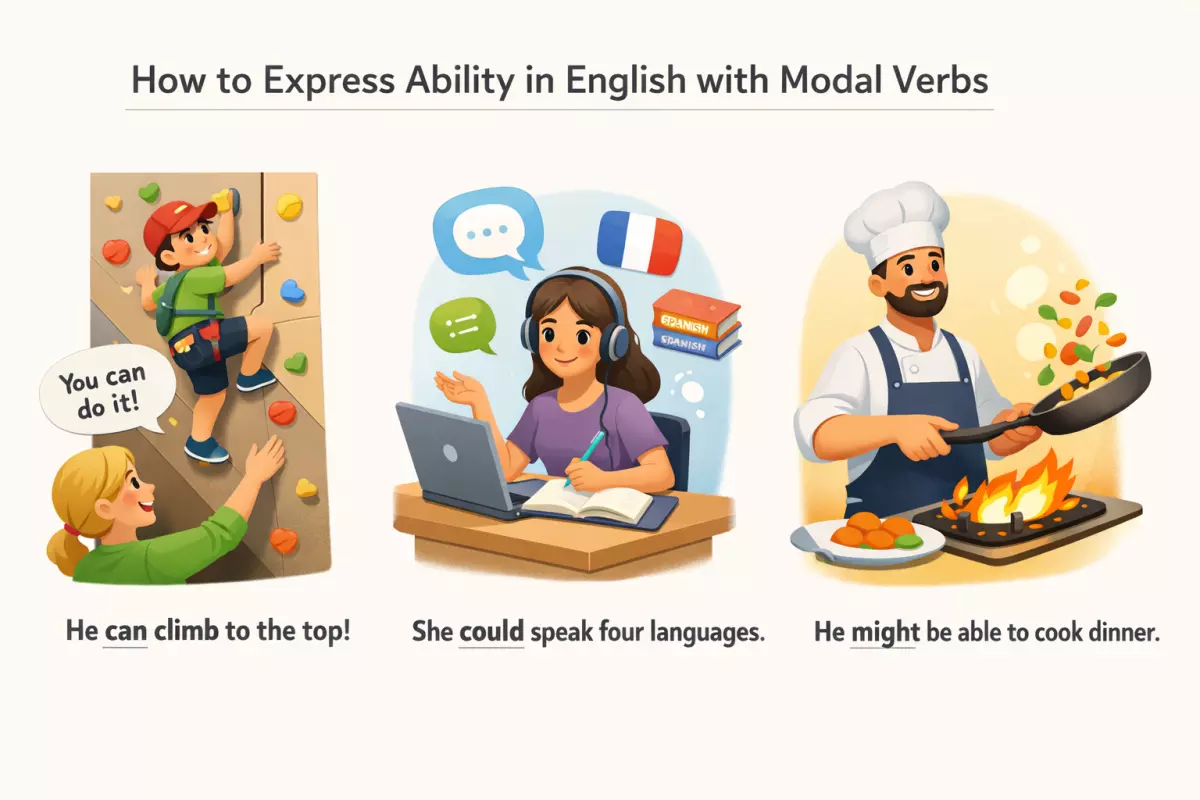 Learn how English shows ability with modal verbs. Youll compare can, could, and be able to, use can for present skills, could for past or general ability, and see when be able to fits other tenses. Includes everyday examples, common mistakes, and practice exercises.
- How English expresses ability using modal verbs
- The difference between can, could, and be able to
- Using can to describe present skills and abilities
- How could refers to past ability or general capability
- When be able to replaces can in certain tenses
- Examples of ability expressions in everyday situations
- Common learner mistakes when talking about ability
- Exercises and practice activities for expressing ability with modal verbs
Talking about what you can do comes up every day, and English often uses modal verbs to express ability, permission, and possibility in a simple, natural way. This article shows you how to choose the right form for each situation, whether you are describing a skill, offering help, asking for permission, or admitting a limitation, so your meaning stays clear and confident in real conversations.
How English expresses ability using modal verbs
English often signals ability through a small set of modal verbs and fixed patterns. The choice depends on whether you mean general skill, a specific situation, permission-like “being able,” or ability in the past.
Core patterns for ability
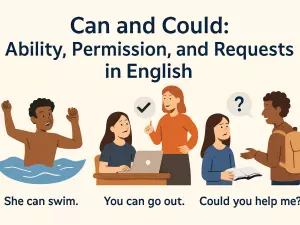
- can + base verb for present or general ability: “I can swim.”
- can’t / cannot + base verb for inability: “She can’t hear you.”
- could + base verb for past general ability: “When I was younger, I could run fast.”
- be able to + base verb for ability in many tenses: “I’ll be able to help tomorrow.”
- manage to + base verb for success in a difficult specific situation: “We managed to find a taxi.”
- can / could + base verb for ability in a specific moment (context decides): “I can’t open this jar.”
Choosing the right modal: meaning and time
- General ability now: use can. “He can speak Japanese.”
- General ability in the past: use could. “They could read by age four.”
- One successful action in the past: prefer was/were able to or managed to, not could.
- ✅ “I was able to fix it yesterday.”
- ❌ “I could fix it yesterday.” (often sounds like general ability, not one completed success)
- Future ability: use will be able to (not “will can”). ✅ “You’ll be able to log in later.”
- Ability across perfect tenses: use have/has been able to. “She has been able to work from home.”
Form rules you need for accurate sentences
- Modal + base verb (no “to” after can/could): ✅ “I can drive.” ❌ “I can to drive.”
- No -s in third person: ✅ “He can swim.” ❌ “He cans swim.”
- Questions: modal comes first. “Can you lift this?” / “Could she join us?”
- Negatives: add not. “I cannot come.” / “We couldn’t finish.”
- Short answers: “Yes, I can.” “No, she can’t.” “Yes, they could.”
Common ability uses with practical examples
- Physical ability: “I can’t reach the top shelf.”
- Learned skill: “She can type very fast.”
- Language ability: “We can understand most of the lecture.”
- Technical capability: “This phone can run the app.”
- Availability (practical ‘can’): “I can meet after 6.”
- Ability limited by circumstances: “I can’t talk right now; I’m driving.”
- Past ability with a time frame: “At 10, he could play the piano.”
- Improvement over time: “After practice, I can do it without help.”
- Temporary inability: “I can’t concentrate today.”
- Ability after a change: “With the update, you can export files.”
- Achievement in one past event: “We were able to get tickets in the end.”
- Difficulty + success: “She managed to stay calm.”
In practice, can and could cover most everyday ability statements, while be able to is the flexible option for future and perfect tenses and for describing a single successful past action clearly.
The difference between can, could, and be able to

These three forms all express ability, but they behave differently in time (present/past/future), in grammar (what forms are possible), and in meaning (general ability vs. a specific successful action). Choosing the right one often depends on whether you need a modal verb or a full verb phrase.
| Form | Typical meaning | Time reference | Grammar pattern | Example |
|---|---|---|---|---|
| can | General ability; sometimes permission | Present (and general facts) | can + base verb | I can swim. |
| could | Past general ability; polite/softened ability; conditional ability | Past, or hypothetical/conditional | could + base verb | When I was five, I could read. |
| be able to | Ability with flexible tense; often used for specific achievement | Present, past, future, perfect, -ing forms | be (am/is/are/was/were/been/being) + able to + base verb | She will be able to join us tomorrow. |
| was/were able to | Successful action in a specific past situation | Past (specific event) | was/were able to + base verb | We were able to fix it in time. |
1) Use can for present ability and general truths
Can is the most common choice for ability “now” or as a general fact. It is followed by the base form of the verb (no to).
- Present ability: I can drive.
- General ability: She can speak three languages.
- Negative: He can’t hear you.
- Question: Can you lift this?
- With stative verbs: I can understand the instructions.
- With senses (common in speech): I can see the problem now.
2) Use could for past general ability, and for “softer” meaning
Could often describes what someone was capable of in the past in a general way. It is also used to sound less direct (especially in requests) or to talk about ability in unreal/conditional situations.
- Past general ability: When I was younger, I could run fast.
- Past general ability (negative): I couldn’t swim until I was ten.
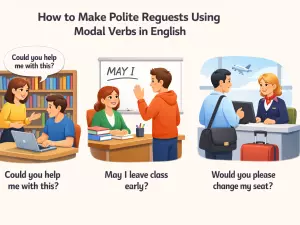
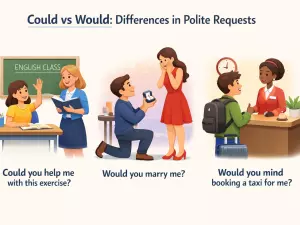
- Polite/softened: Could you help me with this file?
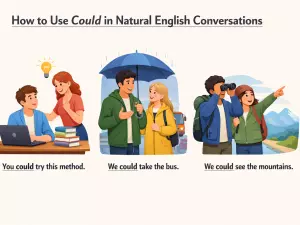
- Conditional ability: I could finish today if you send the data now.
- Hypothetical: With more time, we could do it properly.
3) Use be able to when you need a tense that can doesn’t have
Modal verbs have limited forms. Can does not have an infinitive, -ing form, or most perfect/future forms, so English uses be able to to fill those gaps.
- Infinitive: I want to be able to travel more.
- After another modal: We might be able to meet later.
- Future: You will be able to access the report tomorrow.
- Present perfect: I’ve been able to contact her at last.
- Past perfect: They had been able to save enough money.
- -ing form: Being able to concentrate is important.
4) Specific past success: prefer was/were able to (often not could)
For a single completed event in the past where someone managed to do something, was/were able to is usually clearer than could. In many contexts, could sounds like “had the ability” rather than “succeeded.”
- ✅ We were able to get tickets at the last minute. (we succeeded)
- ❌ We could get tickets at the last minute. (often sounds like a general possibility/ability)
- ✅ She was able to restart the computer after the crash.
- ✅ I was able to find my keys in the dark.
- Exception (common): With verbs of perception, could often works for a specific moment: I could hear someone outside.
5) Quick pattern reminders
- can/could + base verb: can swim, could swim (not “can to swim”).
- be able to + base verb: am able to swim, was able to swim, will be able to swim.
- Negative forms: can’t / couldn’t / isn’t able to / wasn’t able to.
- Questions: Can you…? Could you…? Are you able to…? (the last one is less common in everyday speech).
Using can to describe present skills and abilities
Use can to say that someone has the ability to do something now, or that they generally have the skill. It is common for learned skills (languages, sports, instruments) and practical abilities (driving, cooking, using software). The basic pattern is subject + can + base verb.
Core form and meaning
- Affirmative: Subject + can + base verb (no
to
). Example:She can swim.
- Negative: Subject + can’t/cannot + base verb. Example:
He can’t drive.
- Question: Can + subject + base verb? Example:
Can you cook?
- Short answers:
Yes, I can.
/No, I can’t.
- General vs. right now: With skill verbs,
can
often means a general ability; time words can make it clearly present:I can meet today.
Common patterns learners need
- No -s in third person: ✅
She can sing.
❌She cans sing.
- No
to
after can: ✅They can speak French.
❌They can to speak French.
- Use an adverb to show level:
He can type quickly.
/She can speak clearly.
- Use
very well
,pretty well
,a little
for proficiency:I can play the piano a little.
- Use
can’t
for inability:I can’t understand this accent.
- Use
can
+ object for practical skills:She can use Excel.
/He can fix bikes.
- Use
can
with sense verbs for immediate perception:I can hear music.
/We can see the station.
- Use
can
withmanage
for successful ability in a situation:Can you manage on your own?
Examples you can model
I can swim, but I can’t dive.
She can speak Spanish and Italian.
He can cook dinner in 20 minutes.
Can you drive a manual car?
They can read music, but they can’t sing in tune.
We can meet after work.
I can’t remember his name.
Can she use this software?
I can hear you now.
He can run fast, but he can’t run far.
Can you lift this box?
She can explain it clearly.
I can write reports, but I can’t design slides.
Can they solve this problem?
We can’t access the file.
Typical context words
- For general skill:
in general
,usually
,pretty well
,very well
- For present situation:
today
,right now
,at the moment
,this week
- For contrast:
but
,however
,yet
(useful when combining ability and limitation in one sentence)
How could refers to past ability or general capability
Use could to talk about what someone was able to do in the past, or what was possible in general at an earlier time. It often describes skills, capacities, or conditions that existed then, without focusing on one specific successful event.
Core patterns
- Subject + could + base verb: “She could swim.”
- Subject + could not / couldn’t + base verb: “He couldn’t hear the announcement.”
- Could + subject + base verb? (question): “Could you read when you were four?”
- Wh- word + could + subject + base verb?: “What could they do to help?”
- Could + base verb after time markers: “When I was younger, I could run for miles.”
Past ability: general skill or capacity
For learned skills and long-term abilities, could is a natural choice. It suggests the ability existed over a period of time.
- “By age six, she could read simple books.”
- “I could speak a little French in college.”
- “They could play the song from memory.”
- “He could type very fast back then.”
- “We could see the mountains clearly from our old apartment.”
- “My grandfather could fix almost anything.”
- “As a teenager, I could stay up all night.”
- “She could solve those puzzles in minutes.”
General capability in a past situation
Could also describes what was possible because of past circumstances (rules, technology, access, conditions). It’s less about a personal skill and more about what the situation allowed.
- “In those days, you could buy a ticket at the door.”
- “Before the renovation, you could park right outside.”
- “With the old software, we could export the data easily.”
- “When the river froze, you could walk across it.”
- “From that spot, you could hear the band clearly.”
- “During the sale, you could get everything at half price.”
Important limitation: single completed events
For one specific past event where someone succeeded once, English often prefers was/were able to (or managed to) rather than could. Using could in these cases can sound like general ability instead of a single achievement.
- ✅ “We were able to get tickets yesterday.” → one successful event
- ❌ “We could get tickets yesterday.” → sounds like it was possible in general
- ✅ “She managed to unlock the door.”
- ❌ “She could unlock the door.” → suggests she had the skill, not that she did it then
Negative forms: couldn’t for failure in a specific moment
In negative sentences, couldn’t works well for both general inability and failure in a particular situation.
- General: “I couldn’t swim when I was a child.”
- Specific: “We couldn’t find the address last night.”
- Specific: “He couldn’t open the jar, even with a towel.”
- General: “They couldn’t afford a car at the time.”
When be able to replaces can in certain tenses
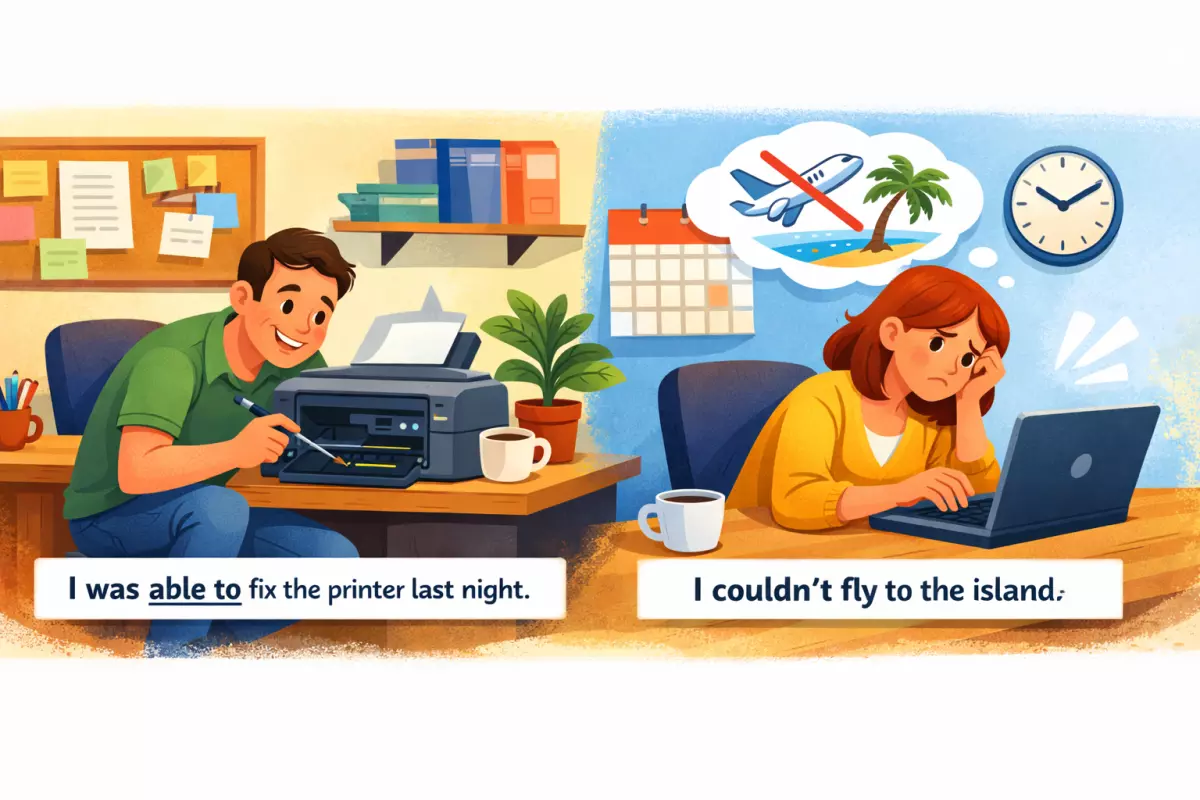
Use be able to when you need an ability expression in a verb form that can does not have. Unlike can, it can appear in many tenses and structures (infinitives, -ing forms, perfect forms), so it often fills the “missing” grammar slots.
Key situations where be able to is the natural choice
- Past ability for a specific successful action (often with “managed to” meaning): ✅ I was able to fix the printer last night. → (I succeeded)
❌ I could fix the printer last night. (This can sound like general ability, not necessarily success.) - Present perfect (ability up to now): ✅ She has been able to work from home recently.
❌ She has could work from home recently. - Past perfect (ability before another past point): ✅ They had been able to save enough money before they moved.
- Future forms (including “will,” “going to,” and future time references): ✅ I will be able to join the meeting tomorrow.
✅ We’re going to be able to finish on time.
❌ I will can join the meeting tomorrow. - Infinitives after other verbs (want, hope, need, plan, try, etc.): ✅ I need to be able to concentrate.
✅ She hopes to be able to study abroad.
❌ I need to can concentrate. - After prepositions (because you need a noun-like form): ✅ He left early without being able to say goodbye.
✅ They’re interested in being able to access the files offline. - -ing forms for ongoing or developing ability: ✅ I’m finally being able to sleep better. (Less common, but possible in context)
More natural in many cases: ✅ I’m finally able to sleep better. - With modal-like meanings that require a different modal (ability combined with obligation, advice, etc.): ✅ You should be able to finish this in an hour.
✅ We might be able to get tickets. - In conditional structures with “would”: ✅ I would be able to help if I had more time.
❌ I would can help if I had more time. - In passive constructions (ability + passive voice): ✅ The file was able to be recovered.
Often more natural: ✅ We were able to recover the file. - When you need a clear “success” meaning in the past (especially in narratives): ✅ After an hour, she was able to reach customer support.
✅ At the last minute, we were able to find a taxi.
Useful patterns to memorize
- Present: am/is/are able to + base verb (I am able to log in.)
- Past: was/were able to + base verb (They were able to solve it.)
- Future: will be able to + base verb (You’ll be able to see the results.)
- Perfect: have/has been able to + base verb (I’ve been able to practice more.)
- Infinitive: to be able to + base verb (She wants to be able to drive.)
- After a modal: might/should/must + be able to + base verb (We might be able to reschedule.)
In short, keep can for simple present ability and informal, quick statements, but switch to be able to whenever the grammar needs a tense or structure that can cannot take, or when you want to highlight a successful result in the past.
Examples of ability expressions in everyday situations
Ability is often expressed by choosing a modal that matches the time (present, past, future) and the meaning (general skill, specific success, permission-like “allowed,” or a polite request). The patterns below show common, natural ways to talk about what someone is capable of doing in daily life.
Common patterns you’ll hear and use
- General ability (present):
can + base verb→ “I can drive.” / “She can speak Spanish.” - General ability (past):
could + base verb→ “When I was younger, I could run fast.” - Ability in a specific situation (present):
be able to + base verb→ “I’m not able to join the call today.” - Specific success in the past:
was/were able to + base verb→ “We were able to fix it after lunch.” - Negative ability:
can’t / couldn’t / wasn’t able to→ “I can’t hear you.” / “I couldn’t log in.” - Polite request using ability language:
Can/Could you + base verb?→ “Could you open the window?” - Asking about someone’s skills:
Can you + base verb?→ “Can you swim?” / “Can you cook?” - Ability due to circumstances:
can/can’twith a reason → “I can’t come tonight because I’m working late.”
Everyday example sentences (with typical contexts)
- At home: “I can’t find my keys.”
- At home (helpful offer): “I can carry that for you.”
- In the kitchen (skill): “He can make really good pasta.”
- Technology (temporary problem): “I can’t connect to the Wi‑Fi.”
- Work (availability/ability): “I’m not able to take calls right now.”
- Work (past success): “We were able to finish the report before the deadline.”
- School (general ability): “She can understand math quickly.”
- Travel (practical ability): “Can you read this sign?”
- Travel (polite request): “Could you tell me where the station is?”
- Health (current limitation): “I can’t lift heavy boxes right now.”
- Sports (past ability): “I could do ten push-ups easily last year.”
- Social plans (circumstances): “I can’t make it on Friday, but I can on Saturday.”
- Customer service (problem-solving): “I can help you reset your password.”
- Meeting (audio issue): “I can’t hear you—can you speak louder?”
- Languages (skill + time marker): “I can read French, but I can’t speak it well.”
- Directions (ability question): “Can you show me on the map?”
Quick usage notes to avoid common mistakes
- ✅ “I can drive.” ❌ “I can to drive.” (After modals, use the base verb without
to.) - ✅ “I can’t come.” ❌ “I don’t can come.” (Use
can’t, notdon’t can.) - ✅ “I was able to fix it.” (Often best for one completed past success.)
- ✅ “I could swim when I was five.” (Common for general past ability.)
Common learner mistakes when talking about ability
When learners describe what someone is able to do, errors often come from mixing modal verbs, tense, and meaning. The patterns below focus on the most frequent problems and how to fix them in real sentences.
1) Using “can” for past ability in all situations
Can works for general present ability, but it does not always work for past ability. Use could for general past ability, and use was/were able to for a single successful action in the past.
- ❌ Yesterday I could fix the printer (single completed success). → ✅ Yesterday I was able to fix the printer.
- ✅ When I was a child, I could swim very well (general ability in the past).
- ✅ She could read at four (general past ability).
- ✅ We weren’t able to open the door (single event: no success).
2) Confusing ability with permission
Can is used for both ability and permission, so context matters. In formal situations, may is often preferred for permission, while can stays common in everyday speech.
- ❌ Can I leave early? (If you want formal permission.) → ✅ May I leave early?
- ✅ Can you drive? (ability)
- ✅ Can I use your phone? (permission in everyday speech)
- ✅ You can’t park here. (permission/rules, not physical ability)
3) Mixing “can” and “be able to” incorrectly
Be able to is useful when you need an infinitive, a gerund, or different tenses. Learners often use can where grammar requires another form.
- ❌ I want can speak English better. → ✅ I want to be able to speak English better.
- ❌ She enjoys can sing. → ✅ She enjoys being able to sing.
- ❌ I have can finish today. → ✅ I have been able to finish today / I can finish today (meaning changes).
- ✅ I can help now. / I will be able to help tomorrow.
4) Wrong negative forms and contractions
Negative ability is usually can’t or cannot. Learners sometimes build negatives with “don’t can” or use nonstandard forms.
- ❌ I don’t can swim. → ✅ I can’t swim.
- ❌ He cann’t come. → ✅ He can’t come.
- ✅ I cannot access the file. (more formal)
- ✅ We couldn’t hear you. (past negative)
5) Using “could” when you mean “can” (or vice versa)
Could can describe past ability, but it also softens requests and suggestions. This politeness use can confuse learners into choosing the wrong time meaning.
- ✅ Could you open the window? (polite request, present/future)
- ✅ I could run fast when I was younger. (past ability)
- ❌ I could do it now (if you mean you have the ability now, not a tentative option). → ✅ I can do it now.
- ✅ I could do it now, but I’m busy. (possible option, not pure ability)
6) Overusing “can” for future ability
For future situations, will be able to is often clearer than can, especially when you mean ability that becomes possible later.
- ❌ I can meet you next week (may sound like permission/availability only). → ✅ I will be able to meet you next week.
- ✅ After the update, you will be able to export the report.
- ✅ I can call you tomorrow (common, but can be ambiguous).
7) Forgetting that “can” has no infinitive or -ing form
Because can is a modal, it does not take to, and it does not change form. Use be able to when you need those structures.
- ❌ I hope to can join. → ✅ I hope to be able to join.
- ❌ Canning speak clearly is important. → ✅ Being able to speak clearly is important.
- ❌ She cans drive. → ✅ She can drive.
8) Confusing “can’t” (ability) with “mustn’t” (prohibition)
Can’t can mean “not possible” or “not allowed,” depending on context. Mustn’t is strong prohibition (a rule), not lack of skill.
- ✅ You can’t enter without a badge. (not allowed)
- ✅ I can’t lift this. (not physically possible for me)
- ❌ You mustn’t park here because the car is too big. → ✅ You can’t park here (rule) / You can’t fit here (space).
9) Mismatching meaning: “manage to” vs. “can”
Manage to and be able to often imply difficulty or effort. Learners sometimes use can and lose that meaning.
- ✅ I managed to finish on time (it was difficult).
- ✅ We were able to get tickets (success in a specific situation).
- ✅ I can finish today (simple ability/possibility, no effort implied).
10) Word order mistakes with modals
Modal verbs follow a fixed pattern: modal + base verb. Avoid adding to or using the wrong verb form after the modal.
- ❌ She can to swim. → ✅ She can swim.
- ❌ He can swims. → ✅ He can swim.
- ❌ Can you to help me? → ✅ Can you help me?
Exercises and practice activities for expressing ability with modal verbs
Use the activities below to build accuracy with common patterns like can/can’t (general ability), could/couldn’t (past ability), be able to (flexible across tenses), and manage to (success in a specific situation). Focus on form first (subject + modal + base verb), then on meaning (general skill vs. one-time achievement).
1) Choose the best option (can / could / be able to / managed to)
- When I was five, I ______ read very well, but I loved books.
- I’m busy now, but I ______ help you after 6 p.m.
- She ______ speak three languages fluently.
- We didn’t think we would finish on time, but we ______ submit the report before the deadline.
- He hurt his hand yesterday, so he ______ open the jar.
- In my last job, I ______ work from home twice a week.
- Sorry, I ______ come to the meeting tomorrow; I’m traveling.
- They finally ______ find a parking space near the station.
- By the end of this course, you will ______ write clearer emails.
- I tried to call you earlier, but I wasn’t ______ reach you.
Show answers
- couldn’t
- can
- can
- managed to
- couldn’t
- was able to
- can’t
- managed to
- be able to
- able to
2) Correct the sentence (fix the modal pattern)
Rewrite each sentence so it is grammatical. Keep the meaning as close as possible.
- ❌ She can to drive. → ______
- ❌ I don’t can swim. → ______
- ❌ Did you can finish it? → ______
- ❌ He could to speak French when he lived in Paris. → ______
- ❌ We are can meet on Friday. → ______
- ❌ I didn’t could hear you. → ______
- ❌ She can sings very well. → ______
- ❌ They haven’t can solve the problem. → ______
- ❌ I can to not remember his name. → ______
- ❌ He managed finish the task. → ______
Show answers
- ✅ She can drive.
- ✅ I can’t swim. / ✅ I cannot swim.
- ✅ Could you finish it? / ✅ Were you able to finish it?
- ✅ He could speak French when he lived in Paris.
- ✅ We can meet on Friday. / ✅ We are able to meet on Friday.
- ✅ I couldn’t hear you.
- ✅ She can sing very well.
- ✅ They haven’t been able to solve the problem.
- ✅ I can’t remember his name.
- ✅ He managed to finish the task.
3) Past ability: general skill vs. one-time success
Choose the option that best matches the meaning. Use could for general past ability, and prefer was/were able to or managed to for a single completed event (especially when it was difficult).
- When she was a teenager, she ______ run 10 km easily. (could / was able to)
- Although the signal was weak, we ______ call a taxi. (could / managed to)
- In primary school, I ______ play the piano a little. (could / managed to)
- The door was stuck, but he ______ open it after a few minutes. (could / was able to)
- They trained for months, and on race day they ______ finish the marathon. (could / were able to)
- My grandfather ______ cook very well. (could / was able to)
- I lost my key, but I ______ get into the apartment through the back entrance. (could / managed to)
- Before the update, the app ______ work offline. (could / managed to)
Show answers
- could
- managed to
- could
- was able to
- were able to
- could
- managed to
- could
4) Build sentences from prompts (keep the correct structure)
Make one complete sentence for each prompt. Pay attention to negatives and question forms.
- (she / can / solve / the puzzle) ______
- (they / can’t / attend / tonight) ______
- (you / can / hear / me / ?) ______
- (I / be able to / join / next week) ______
- (he / couldn’t / remember / the password) ______
- (we / manage to / find / a cheaper flight) ______
- (when I was younger / I / could / stay up late) ______
- (by 2030 / many people / be able to / work remotely) ______
- (she / not be able to / come / yesterday) ______
- (how / you / manage to / do / that / ?) ______
Show answers
- She can solve the puzzle.
- They can’t attend tonight.
- Can you hear me?
- I’ll be able to join next week.
- He couldn’t remember the password.
- We managed to find a cheaper flight.
- When I was younger, I could stay up late.
- By 2030, many people will be able to work remotely.
- She wasn’t able to come yesterday.
- How did you manage to do that?
5) Mini-scenarios (choose the most natural form)
Pick the best completion. Think about whether the sentence describes a general skill, a temporary limitation, or success in a difficult moment.
- I’m free now, so I ______ talk for a few minutes. (can / managed to)
- After the accident, he ______ walk for two months. (couldn’t / didn’t manage to)
- She practiced daily, and eventually she ______ play the piece without mistakes. (could / was able to)
- We ______ see the stage from our seats, so we watched the screen. (couldn’t / didn’t manage to)
- Despite the noise, I ______ understand what he said. (managed to / could)
- In my hometown, you ______ drink the tap water safely. (can / managed to)
- I called three times, but I ______ reach him. (couldn’t / didn’t manage to)
- When the system crashed, the team ______ restore the data from backups. (managed to / can)
Show answers
- can
- couldn’t
- was able to
- couldn’t
- managed to
- can
- couldn’t
- managed to
6) Quick pattern reminders to apply while practicing
- After can/could, use the base verb: ✅ can swim ❌ can to swim ❌ can swims
- Negative: ✅ can’t / couldn’t + base verb (not “don’t can”)
- Questions: ✅ Can you…? / Could you…? (modal before the subject)
- Use be able to when you need other tenses: ✅ have been able to, will be able to, wasn’t able to
- Use managed to for a difficult but successful result: ✅ managed to fix it (one specific situation)