Using Determiners in Negative Statements: no vs any

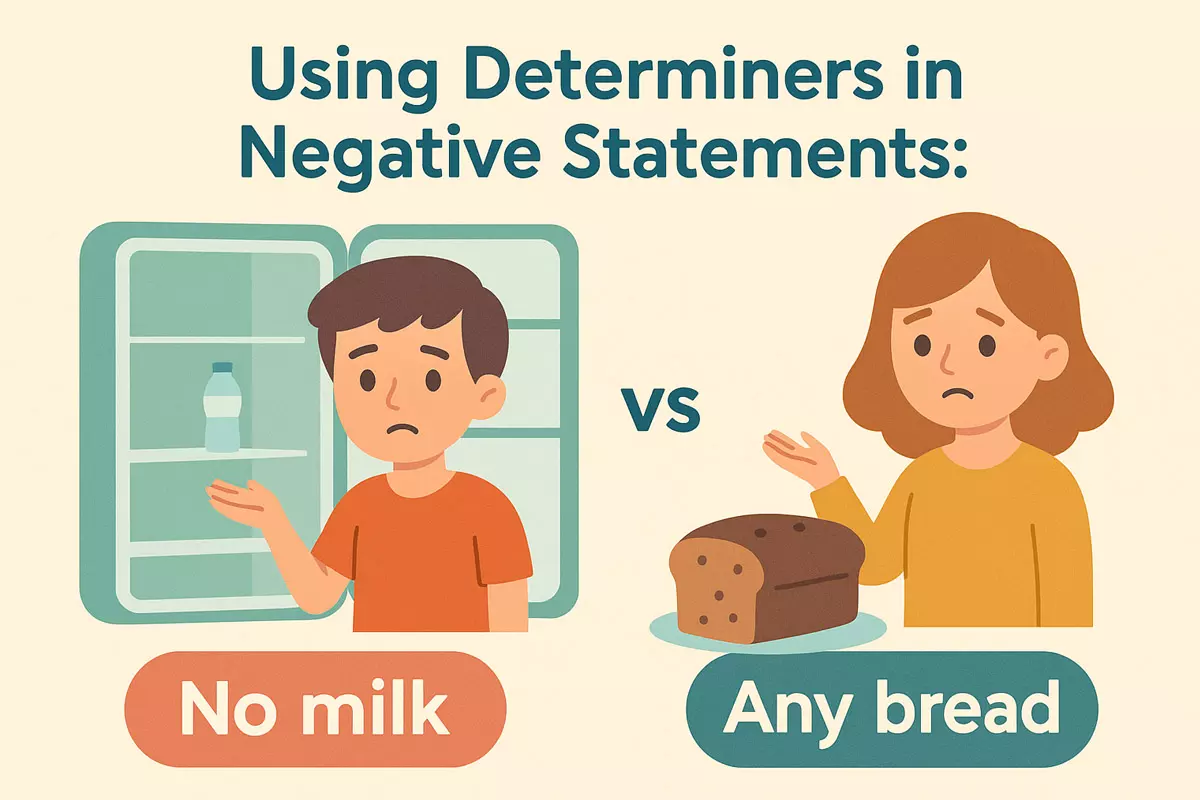 Here we how to use negative verbs and determiners, explains when to use any or no in negative sentences and questions, highlights tone differences, warns against double negatives, introduces common fixed expressions, and offers practice exercises.
- Basic patterns with negative verbs and determiners
- Using any in negative sentences and questions
- Using no for stronger or more direct negative meaning
- Difference in tone between no and not any
- Avoiding double negatives with determiners
- Fixed expressions like no problem, no doubt, no way
- Practice: rewrite sentences using either no or any correctly
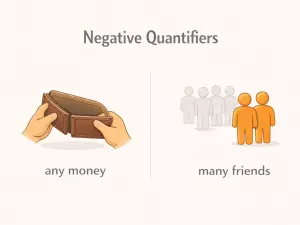
Understanding when to use "no" versus "any" in negative sentences is challenging for many English learners, but mastering this distinction is essential for clear and correct communication. Generally, "no" is used in affirmative sentences to create a negative meaning, as in "There are no apples left," while "any" is typically used with negative verbs, such as "There aren't any apples left." Paying attention to this difference not only improves your grammar but also helps you express yourself more precisely in both spoken and written English.
Basic patterns with negative verbs and determiners
Understanding how to combine negative verbs with determiners like no and any is essential for clear English sentences. The choice between these words often depends on sentence structure and the intended emphasis. Generally, no is used in affirmative structures to express a negative meaning, while any accompanies negative verbs like don’t, doesn’t, or can’t.
Common sentence structures
You will see two main patterns:
- Affirmative verb + no + noun
Example: She has no friends. - Negative verb + any + noun
Example: She doesn’t have any friends.
Usage notes and typical mistakes
Mixing no with a negative verb is considered a double negative in standard English and is generally avoided in formal writing. For instance, She doesn’t have no friends is nonstandard, while She doesn’t have any friends is correct.
Expanded examples for practice
Here are more examples showing how no and any are used with different negative verbs and determiners:
- There is no milk in the fridge. ❌
- There isn’t any milk in the fridge. ✅
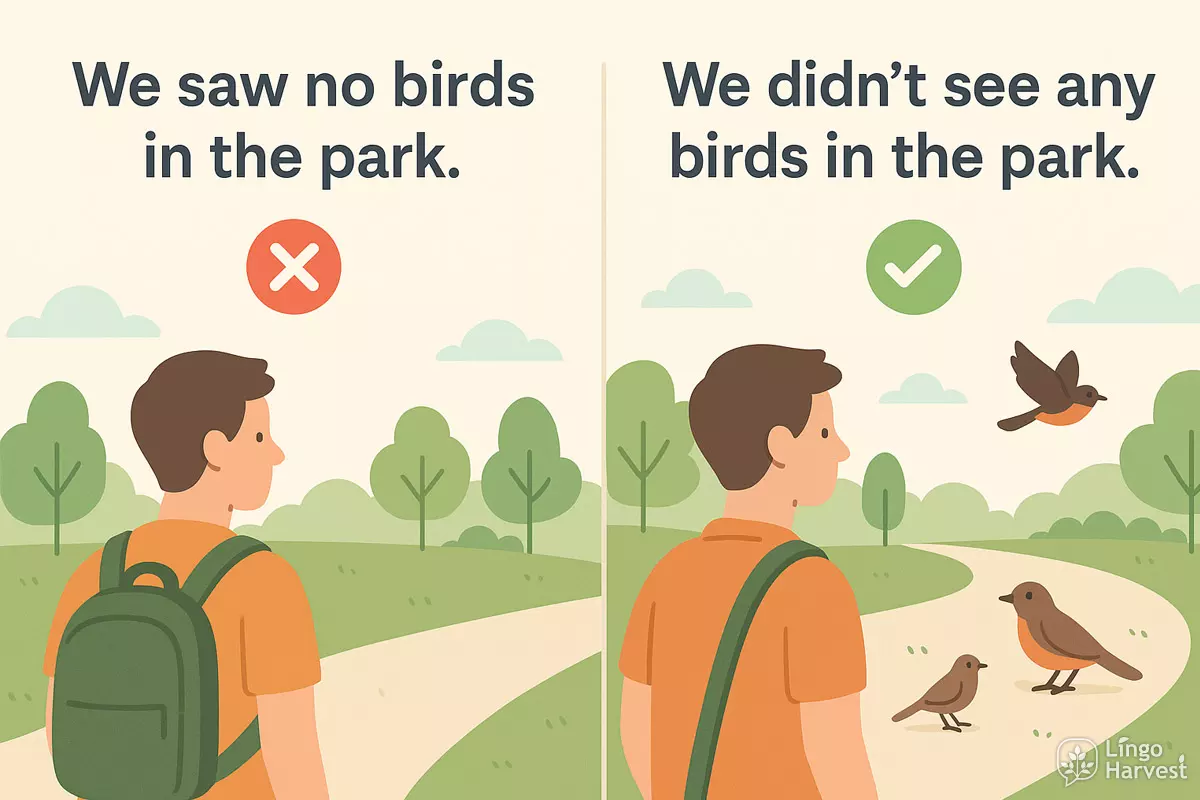
- We saw no birds in the park. ❌
- We didn’t see any birds in the park. ✅
- I have no money left. ❌
- I don’t have any money left. ✅
- They found no mistakes in the report. ❌
- They didn’t find any mistakes in the report. ✅
- There was no answer. ❌
- There wasn’t any answer. ✅
- She brought no food to the party. ❌
- She didn’t bring any food to the party. ✅
- He made no comment. ❌
- He didn’t make any comment. ✅
- I see no difference. ❌
- I don’t see any difference. ✅
- We have no plans for tomorrow. ❌
- We don’t have any plans for tomorrow. ✅
Quick comparison
The table below summarizes the core difference between these two approaches:
| Pattern | Example Sentence |
|---|---|
| Affirmative verb + no + noun | He has no time. |
| Negative verb + any + noun | He doesn’t have any time. |
| Affirmative verb + no + plural noun | We saw no errors. |
| Negative verb + any + plural noun | We didn’t see any errors. |
Summary
In short, use no after affirmative verbs for a strong, direct sense of nothing or none. Use any with negative verbs to form standard negative sentences. This distinction helps sentences sound natural and avoids errors with double negatives.
Using any in negative sentences and questions
The word any is frequently used in English when forming negative statements and questions. Unlike no, which directly negates the noun, any appears alongside negatives like not or in interrogative forms. This structure is common in both spoken and written English, helping avoid double negatives and making sentences clearer.
Negative Sentences with any
When you want to express absence or lack, use any after a negative verb. This pattern is especially useful with plural countable nouns and uncountable nouns. Notice how any modifies the noun to indicate a zero quantity or absence:
- We don’t have any bread.
- She didn’t see any mistakes.
- There isn’t any water left.
- He hasn’t got any friends here.
- The shop doesn’t sell any magazines.
- I can’t find any answers in the book.
- You won’t get any help from them.
- We haven’t received any emails today.
- They didn’t buy any apples.
- She doesn’t want any advice.
Questions with any
In questions, any is used to ask about the existence or availability of something. It suggests uncertainty about whether the thing exists or is available. Here are some typical patterns:
- Do you have any questions?
- Is there any milk in the fridge?
- Did he bring any snacks?
- Have you seen any good movies lately?
- Are there any tickets left?
- Can I get any information about the event?
- Has anyone found any keys?
- Did you hear any noise last night?
- Are there any messages for me?
- Will you need any help?
Comparing no and any in Negatives
It’s important to note the difference between using no and any with a negative verb. While both express a similar idea, their structure and emphasis differ. See the comparison below:
| With no | With any + negative verb |
|---|---|
| There is no bread. | There isn’t any bread. |
| She has no time. | She doesn’t have any time. |
| We found no errors. | We didn’t find any errors. |
| He has no friends here. | He hasn’t got any friends here. |
Using any in negative and interrogative sentences is a standard way to ask about or deny the presence of something, especially when you want to sound neutral or polite. This pattern helps avoid confusion and keeps your English natural.
Using no for stronger or more direct negative meaning
When you want to make a negative statement sound clear, emphatic, or leave no doubt, “no” is often the best choice. Unlike “any,” which can sound more tentative or polite, “no” adds force to your message. It’s common in both spoken and written English, especially when you want to highlight the complete absence of something.
For example, compare these two sentences:
- There aren’t any tickets left. (neutral, factual)
- There are no tickets left. (stronger, more final)
The second sentence, with “no,” sounds much more definite. It suggests a situation that cannot be changed.
Where to use “no” for emphasis
You’ll often use “no” with nouns to stress that something does not exist or is unavailable. It can be placed before singular or plural countable nouns, as well as uncountable nouns. Here are some typical contexts:
- “There is no milk in the fridge.”
- “She has no friends in this city.”
- “They have no idea what happened.”
- “We found no evidence of damage.”
- “The library had no chairs available.”
- “I have no time to waste.”
- “He made no attempt to apologize.”
- “There is no hope left.”
- “The recipe uses no sugar.”
- “The answer makes no sense.”
- “She got no response to her question.”
- “There are no buses after midnight.”
Comparing “no” and “any” in negative statements
Both “no” and “any” can create negative meanings, but they differ in formality and strength. Below is a comparison:
| With “no” | With “any” + negative verb |
|---|---|
| There is no water. | There isn’t any water. |
| She has no money. | She doesn’t have any money. |
| I see no reason to wait. | I don’t see any reason to wait. |
| They have no children. | They don’t have any children. |
Key points to remember
- “No” gives your statement a stronger, more direct tone.
- It can sometimes sound abrupt or too strong in polite conversation—choose carefully depending on the context.
- “Any” is often safer for questions or when you want to sound less blunt.
- “No” is never used with another negative verb (“don’t,” “isn’t,” etc.) in the same clause.
To sum up, using “no” helps you express total absence or impossibility, making your negative statements stand out as clear and unambiguous.
Difference in tone between no and not any
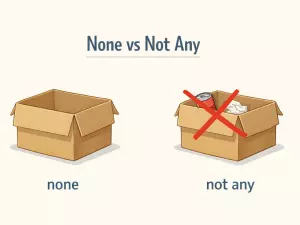
When choosing between "no" and "not any" in negative sentences, the feeling and impact can subtly shift. "No" often sounds stronger, more direct, and sometimes a bit more final. In contrast, "not any" tends to feel softer, more neutral, or even less assertive. The choice can affect both the mood of the sentence and how a listener interprets the speaker’s intent.
Directness and Emphasis
Using "no" typically puts the negative right at the front of the statement, making it more emphatic. For example, "There is no milk left" feels more absolute than "There isn’t any milk left." The second version, with "not any," is less abrupt and can feel more polite or less confrontational.
Typical Usage and Register
- "No" is common in both written and spoken English, especially when you want to be clear and decisive.
- "Not any" is often used in questions and negative statements, especially in more formal or cautious speech.
- In conversation, "no" might sound blunt, while "not any" can seem more tentative or indirect.
Examples of Tone Differences
- "No cookies are available." → Strong, final, possibly disappointing.
- "There aren’t any cookies available." → Softer, more neutral.
- "No students attended the meeting." → Emphasizes complete absence, may suggest surprise or criticism.
- "Not any students attended the meeting." → More formal, less forceful.
- "No reason to worry." → Very direct reassurance.
- "There isn’t any reason to worry." → Gentle, less abrupt reassurance.
- "No time left." → Urgent, decisive.
- "There isn’t any time left." → Slightly less dramatic, more explanatory.
- "No evidence was found." → Firm, straightforward.
- "Not any evidence was found." → Rare, but more neutral and indirect.
Summary Table: Comparing Tone and Use
| Form | Typical Tone & Context |
|---|---|
| "no" | Direct, emphatic, sometimes blunt or final; often used for strong statements or quick responses. |
| "not any" | Softer, more neutral or indirect; common in explanations, questions, or when trying to avoid sounding harsh. |
Choosing the Right Form
Consider your audience and the effect you want. If you want to be clear and leave no room for doubt, "no" is usually your best bet. If you’re aiming for politeness, subtlety, or a less forceful tone, "not any" may be preferable. Both forms are grammatically correct, but the nuance can make a difference in how your message is received.
Avoiding double negatives with determiners
When building negative sentences in English, it’s important to avoid the confusion that double negatives can cause, especially with determiners like "no" and "any." Double negatives (using two negative words in the same clause) are usually non-standard in English and often make the meaning unclear or even the opposite of what you intend.
How double negatives happen with determiners
A common mistake is combining a negative verb (like "don’t" or "can’t") with "no" as a determiner. For example, saying "I don’t have no money" actually suggests that you do have money, because the two negatives cancel each other out in standard English. The correct approach is to use either a negative verb with "any," or a positive verb with "no," but not both.
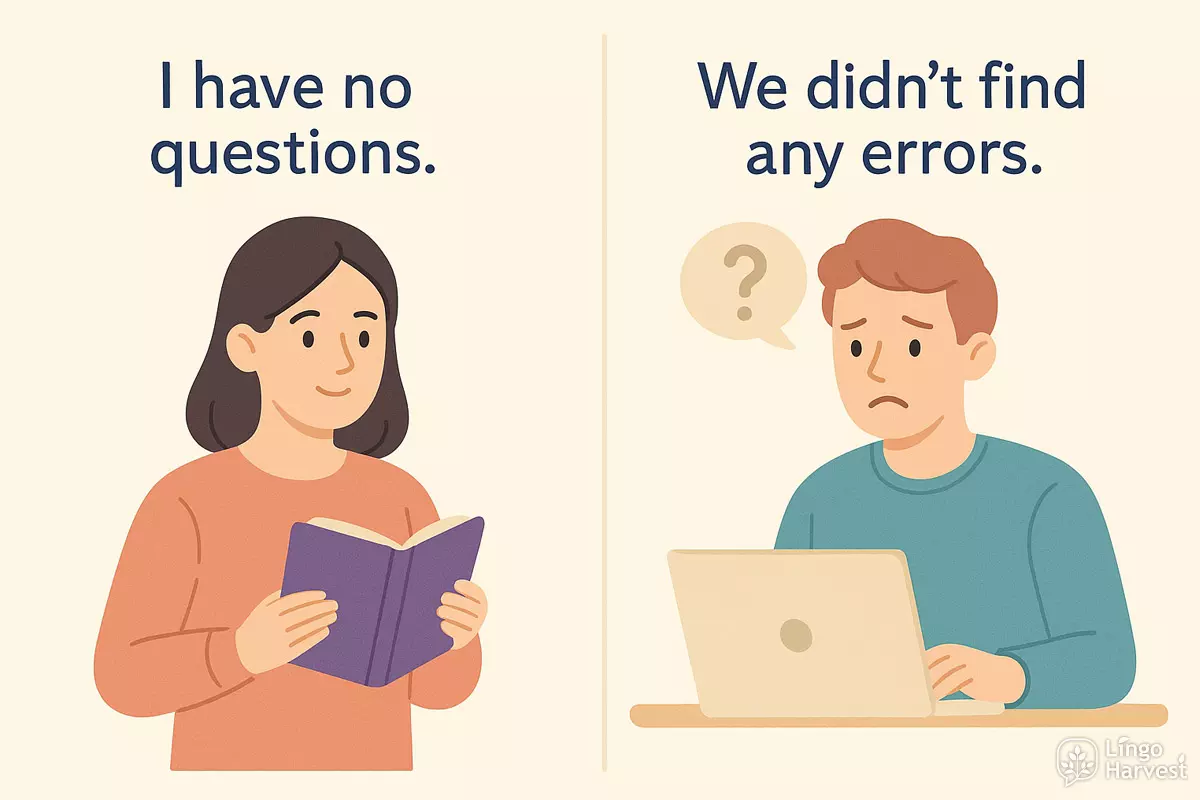
- "I don’t have any questions." ✅ (Correct)
- "I have no questions." ✅ (Correct)
- "I don’t have no questions." ❌ (Incorrect)
- "She can’t see any solution." ✅
- "She sees no solution." ✅
- "She can’t see no solution." ❌
- "We didn’t find any errors." ✅
- "We found no errors." ✅
- "We didn’t find no errors." ❌
- "They won’t buy any tickets." ✅
- "They will buy no tickets." ✅
- "They won’t buy no tickets." ❌
- "He doesn’t want any help." ✅
- "He wants no help." ✅
- "He doesn’t want no help." ❌
- "You shouldn’t make any noise." ✅
- "You should make no noise." ✅
- "You shouldn’t make no noise." ❌
Summary: Choosing the right negative structure
It’s easy to remember: use "any" with negative verbs ("don’t," "can’t," "won’t," etc.), and "no" with affirmative verbs. Mixing both a negative verb and "no" creates a double negative, which is considered incorrect in standard English.
| Negative Verb + Any | Affirmative Verb + No |
|---|---|
| I don’t have any idea. | I have no idea. |
| She didn’t see any mistakes. | She saw no mistakes. |
| We can’t find any solution. | We found no solution. |
| They won’t give any answers. | They gave no answers. |
| He doesn’t need any advice. | He needs no advice. |
By following these patterns, you’ll keep your negative statements clear and grammatically correct, ensuring your meaning comes across without ambiguity.
Fixed expressions like no problem, no doubt, no way
Many set phrases in English use "no" at the beginning and have become standard responses or comments in conversation. These expressions are not just negative sentences; they function as idiomatic chunks with specific meanings. Often, you can’t simply swap "no" for "any" in these phrases, nor can you reword them without changing their tone or clarity.
Common idiomatic phrases with "no"
You’ll notice that these fixed expressions are used to quickly express certainty, denial, or reassurance. Here are some typical examples:
- No problem – used to say something is not an issue or to respond to thanks.
- No way – expresses strong refusal or disbelief.
- No doubt – shows certainty or high probability.
- No chance – means something is impossible or very unlikely.
- No worries – reassures someone that everything is fine.
- No offense – signals you don’t intend to insult someone.
- No comment – used when someone doesn’t want to answer.
- No kidding – expresses surprise or emphasizes truthfulness.
- No kidding – expresses surprise or emphasizes truthfulness.
- No wonder – indicates something isn’t surprising.
- No harm done – reassures that a mistake caused no real damage.
- No strings attached – means there are no special conditions.
- No big deal – downplays the importance of something.
- No hard feelings – says there is no resentment after a conflict.
- No turning back – signals a point of commitment or finality.
- No pain, no gain – emphasizes that effort is needed for results.
- No offense taken – responds to “no offense,” confirming no hurt feelings.
- No sweat – another informal way to say something is easy or not a problem.
Why "any" doesn’t work in these patterns
These phrases are memorized as a whole and don’t follow the usual grammar rules for negative statements. For example, "no way" means "absolutely not," but "any way" would have a completely different meaning. Similarly, "no problem" is a formulaic response, while "any problem" would be a question or a different kind of statement entirely.
Quick reference: "no" fixed phrases vs. "any" alternatives
| Common "no" phrase | Can you use "any"? | Meaning/Notes |
|---|---|---|
| No problem | ❌ "Any problem" is not equivalent | Means "It’s OK" or "You’re welcome." |
| No way | ❌ "Any way" is different | Strong refusal or disbelief |
| No doubt | ❌ "Any doubt" changes the meaning | Expresses certainty |
| No offense | ❌ "Any offense" is not the same | Used before/after a potentially rude remark |
| No big deal | ❌ "Any big deal" is incorrect | Means "It’s not important" |
| No worries | ❌ "Any worries" is not a set phrase | Reassuring; similar to "no problem" |
| No comment | ❌ "Any comment" has a different use | Refuses to answer |
| No harm done | ❌ "Any harm done" is a question, not a fixed phrase | Means there’s no damage or problem |
When learning these idioms, it’s best to treat them as vocabulary items rather than trying to analyze them with regular grammar rules. Using "any" in place of "no" in these contexts will almost always sound unnatural or change the meaning completely. If you want to sound fluent and natural, memorize these expressions as they are and use them in the appropriate situations.
Practice: rewrite sentences using either no or any correctly
Applying the determiners "no" and "any" accurately in negative statements can be challenging, especially for learners aiming for natural-sounding English. Below you'll find a set of practical exercises. Read each sentence and revise it using the correct form, either "no" or "any," to express negation according to standard usage.
Rewrite the following sentences to use "no" or "any" where appropriate
- There isn't some milk left in the fridge.
- She doesn't have some idea about the topic.
- We have not got friends in this city.
- I saw nothing interesting at the museum.
- They don't want apples.
- He has not got money for the ticket.
- There are not cookies on the plate.
- You don't have reasons to worry.
- We don't see problems with your plan.
- My bag doesn't contain books.
- I have got some messages for you.
- She hasn't got pencils in her case.
- There aren't students in the classroom.
- We don't need help right now.
- He doesn't have time for a meeting today.
Show answers
- There isn't any milk left in the fridge. / There is no milk left in the fridge.
- She doesn't have any idea about the topic. / She has no idea about the topic.
- We have not got any friends in this city. / We have no friends in this city.
- I saw nothing interesting at the museum. / I didn't see anything interesting at the museum.
- They don't want any apples. / They want no apples.
- He has not got any money for the ticket. / He has no money for the ticket.
- There are not any cookies on the plate. / There are no cookies on the plate.
- You don't have any reasons to worry. / You have no reason to worry.
- We don't see any problems with your plan. / We see no problems with your plan.
- My bag doesn't contain any books. / My bag contains no books.
- I haven't got any messages for you. / I have no messages for you.
- She hasn't got any pencils in her case. / She has no pencils in her case.
- There aren't any students in the classroom. / There are no students in the classroom.
- We don't need any help right now. / We need no help right now.
- He doesn't have any time for a meeting today. / He has no time for a meeting today.
Quick Tips for Choosing Between "No" and "Any"
- "No" is used for direct, emphatic negatives, often at the start of a noun phrase (e.g., There are no chairs here).
- "Any" is common in negative sentences with "not," "doesn't," "haven't," etc. (e.g., I don't have any questions).
- For more formal or emphatic statements, "no" is preferred (e.g., We have no objections).
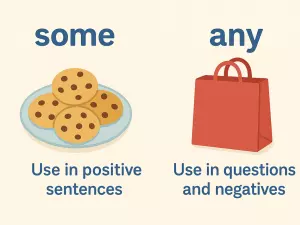
- In questions or offers, use "any" (e.g., Do you have any advice?).
Common Patterns to Practice
- There is/are no ...
- There isn't/aren't any ...
- I have no ... / I don't have any ...
- She has no ... / She doesn't have any ...
- We need no ... / We don't need any ...
Practicing these structures will help you choose the right determiner for negative statements and sound more natural in English conversations and writing.