Questions with Have and Have Got: Rules and Examples

 The article explains how to use have and have got, form questions with do/does and have got, and notes British versus American usage. It covers yes/no and WH-questions, short answers, common mistakes, and offers practice exercises for self-check.
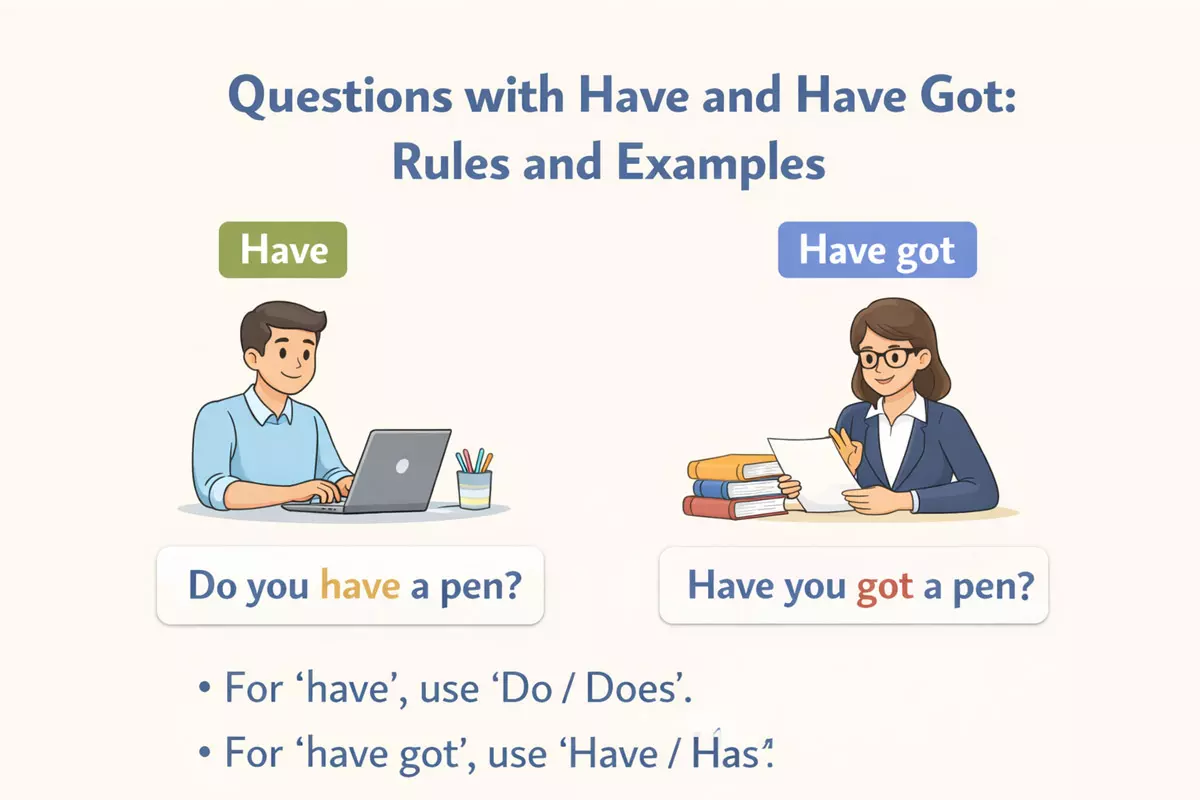
Learning to form questions with "have" and "have got" is important for clear communication in English. Both forms are used to express possession, but their structures differ slightly. For "have," questions often use "do" or "does," as in "Do you have a pen?" For "have got," the structure is "Have you got a pen?" Mastering these patterns helps learners ask and answer questions naturally in daily conversations, making interactions smoother and more confident.
Have and Have Got Overview
Understanding how to use "have" and "have got" is essential for forming questions about possession, relationships, characteristics, and more in English. Both forms are common, but their usage can depend on regional preferences, the level of formality, and grammatical structure. "Have" is used in both American and British English, while "have got" is especially frequent in British English, particularly in informal conversation.
Key Differences Between "Have" and "Have Got"
Although both structures express similar meanings, there are some important distinctions in their forms and how questions are made. "Have" can be used as a main verb in simple present, while "have got" acts more like a present perfect form but with a distinct meaning of possession or relationship.
| Form | Example Sentence | Typical Question Form | Notes |
|---|---|---|---|
| Have (as main verb) | I have a car. | Do you have a car? | Common in American English; needs "do/does" support in questions. |
| Have got | I have got a car. | Have you got a car? | Frequent in British English; forms questions without "do/does". |
| Has (third person singular) | She has a sister. | Does she have a sister? | Present tense for he/she/it; uses "does" in questions. |
| Has got (third person singular) | She has got a sister. | Has she got a sister? | Similar meaning, but more informal and British; no "does" needed. |
When to Use Each Structure
- American English: "Have" is preferred in both spoken and written forms, especially for questions and negatives.
- British English: "Have got" is widely used in informal contexts, particularly in speech.
- Both forms can be used to talk about possessions, family, illnesses, and personal characteristics.
- "Have" is also used for actions (e.g., have breakfast), while "have got" is not.
Examples of Usage
- Do you have any brothers or sisters?
- Has he got a new job?
- Does she have a pet?
- Have you got any questions?
- I don’t have a computer.
- We haven’t got enough time.
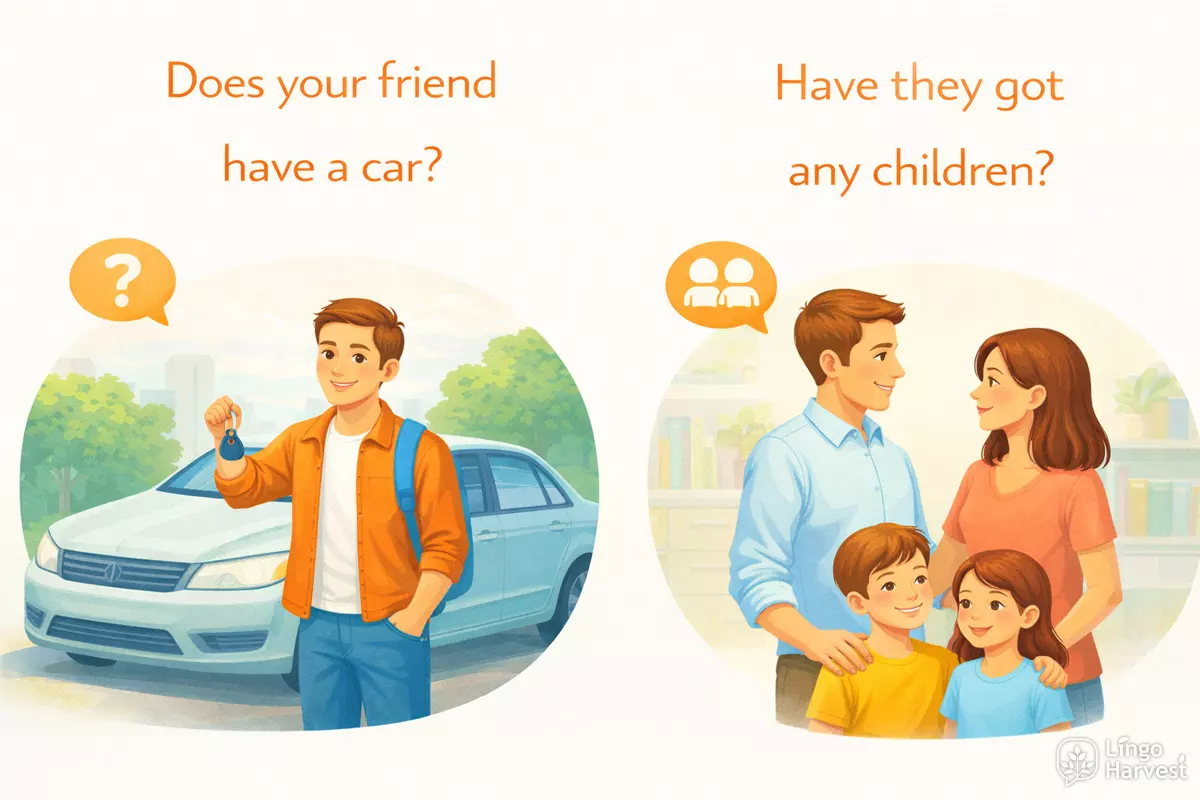
- Does your friend have a car?
- Have they got any children?
- She has a cold.
- He has got blue eyes.
- Do they have a reservation?
- Has your teacher got the results?
Knowing when and how to use these forms helps you ask and answer questions smoothly, and makes your English sound more natural in different contexts.
Questions with Have (Do/Does)
When using "have" to ask about possession, daily routines, or experiences, English speakers often form questions with the auxiliary verbs "do" or "does." This structure is common in American English and in situations where "have" is used as a main verb, rather than as an auxiliary for perfect tenses. The basic pattern is: Do/Does + subject + have + object?
Forming Questions with "Have" Using "Do" and "Does"
The auxiliary "do" is used with plural subjects and "I/you/we/they," while "does" is used with singular third person subjects ("he/she/it"). The main verb "have" remains in its base form. This approach is used for possessions, characteristics, and sometimes for scheduled events.
| Subject | Question Form | Example |
|---|---|---|
| I/you/we/they | Do + subject + have + ...? | Do you have a pen? |
| he/she/it | Does + subject + have + ...? | Does she have a car? |
| plural nouns | Do + plural noun + have + ...? | Do cats have whiskers? |
| singular noun | Does + singular noun + have + ...? | Does the dog have a collar? |
Examples of Questions Using "Have" with "Do/Does"
- Do you have any questions? → No, I don’t.
- Does he have a brother? → Yes, he does.
- Do they have enough money? → Yes, they do.
- Does it have a name? → Yes, it does.
- Do we have class tomorrow? → Yes, we do.
- Does your sister have a pet? → Yes, she does.
- Do the children have their homework? → Yes, they do.
- Do I have time to finish this? → Yes, you do.
- Does the store have apples? → Yes, it does.
- Do both teams have uniforms? → Yes, they do.
- Does your phone have a camera? → Yes, it does.
- Do these shoes have laces? → Yes, they do.
- Does Mark have your address? → Yes, he does.
- Do you have any siblings? → Yes, I do.
- Does she have a favorite book? → Yes, she does.
Short Answers to "Have" Questions
When responding, use "Yes, I do" or "No, I don't" for questions with "do," and "Yes, he/she/it does" or "No, he/she/it doesn't" for "does." The main verb "have" is not repeated in the short answer.
- ✅ Do you have a map? Yes, I do.
- ❌ Does he have a ticket? No, he doesn't.
Common Mistakes
- Adding "s" to "have" after "does" (incorrect: Does she has a dog?)
- Using "has" instead of "have" in the question form
- Omitting "do/does" (incorrect: You have a car? in formal English)
This structure is especially frequent in American English. In British English, both this form and the "have got" pattern are widely used, but with slight differences in formality and context.
Questions with Have Got
Forming questions using "have got" is common in British English, especially in informal situations. The structure is slightly different from questions with just "have." In these cases, "have" or "has" moves to the front of the sentence, and "got" stays after the subject. This pattern is typically used when talking about possessions, relationships, or characteristics.
How to Form Questions with "Have Got"
- Start with "Have" or "Has" (depending on the subject).
- Add the subject (I, you, he, she, it, we, they).
- Follow with "got."
- Finish with the object or information you are asking about.
For example, to ask if someone owns a car, you would say, "Have you got a car?" This structure is not used for actions, but rather for things someone possesses or characteristics they have.
| Affirmative Statement | Question Form |
|---|---|
| I have got a brother. | Have I got a brother? |
| You have got a key. | Have you got a key? |
| She has got a pet cat. | Has she got a pet cat? |
| They have got any questions. | Have they got any questions? |
| He has got a new phone. | Has he got a new phone? |
| We have got enough time. | Have we got enough time? |
Common Examples of "Have Got" in Questions
- Have you got any siblings? → Yes, I have.
- Has she got a driving license? → Yes, she has.
- Have they got a reservation? → Yes, they have.
- Has he got your email address? → Yes, he has.
- Have I got the right answer? → Yes, you have.
- Have we got everything we need? → Yes, we have.
- Has it got a battery? → Yes, it has.
- Have you got time to talk? → Yes, I have.
- Has your friend got a ticket? → Yes, he has.
- Have the children got their homework? → Yes, they have.
- Have your parents got a car? → Yes, they have.
- Has the dog got a collar? → Yes, it has.
- Have you got any questions? → No, I haven’t.
- Has the shop got your size? → Yes, it has.
Notice that in short answers, we usually respond with just "Yes, I have" or "No, I haven't," omitting "got." This construction is especially popular in casual conversation, and helps keep questions concise and clear.
British vs American Usage
When forming questions with have and have got, English speakers on both sides of the Atlantic often use different patterns. The main differences relate to word order, auxiliary verbs, and whether have got is common or even acceptable in certain contexts. Understanding these contrasts can help you sound more natural, whether you're aiming for British or American English.
Question Formation Patterns
In the UK, it's very common to use have got for possession in both spoken and informal written English. Americans, meanwhile, tend to prefer just have. The way questions are made reflects these preferences:
| British English | American English |
|---|---|
| Have you got a pen? | Do you have a pen? |
| Has she got any brothers? | Does she have any brothers? |
| Have they got enough time? | Do they have enough time? |
| Have we got everything we need? | Do we have everything we need? |
| How many pets have you got? | How many pets do you have? |
Typical Usage Notes
- British English often uses have got for present possession, especially in conversation.
- American English usually sticks to have + do/does for questions and negatives.
- Have got is much less frequent in American English, and sometimes even avoided in formal contexts.
- For past and future, both varieties use have with auxiliary verbs (Did you have…? or Will you have…?), not have got.
- In both dialects, got is not used for habits, states, or repeated actions—only for present possession or relationships.
Key Takeaways
Remember, if you're speaking British English, it's perfectly natural to say, "Have you got any questions?" In the United States, "Do you have any questions?" is the default. Both forms are understood internationally, but adjusting your usage can help you fit in better with local speakers.
Yes/No and WH-Questions
Forming questions with "have" and "have got" depends on the structure and the variety of English you are using. Both forms can ask about possession, experiences, or relationships, but their question patterns differ slightly. Understanding how to build both types of questions helps you communicate clearly, whether you need a simple confirmation or more detailed information.
How to Form Yes/No Questions
To ask a question that expects a "yes" or "no" answer, you need to invert the subject and the auxiliary verb. With "have," use an auxiliary ("do/does" in American English), while "have got" uses "have" itself as the question word, especially in British English. Here are some typical patterns:
- Have (for American English):
Do you have a car? - Have got (for British English):
Have you got a car? - Third person singular:
Does she have any pets? / Has she got any pets? - Negative forms:
Don't you have a ticket? / Haven't you got a ticket?
Building WH-Questions
When seeking specific information (not just yes or no), start with a WH-word (who, what, where, when, why, how), then follow the same structure as above. The WH-word comes first, followed by the auxiliary and the subject.
- What do you have? → I have a laptop and a notebook.
- Who has got the keys? → John has got the keys.
- How many siblings do you have? → I have two siblings.
- Where have you got your backpack? → I’ve got it in my car.
- Why does he have so many books? → Because he loves reading.
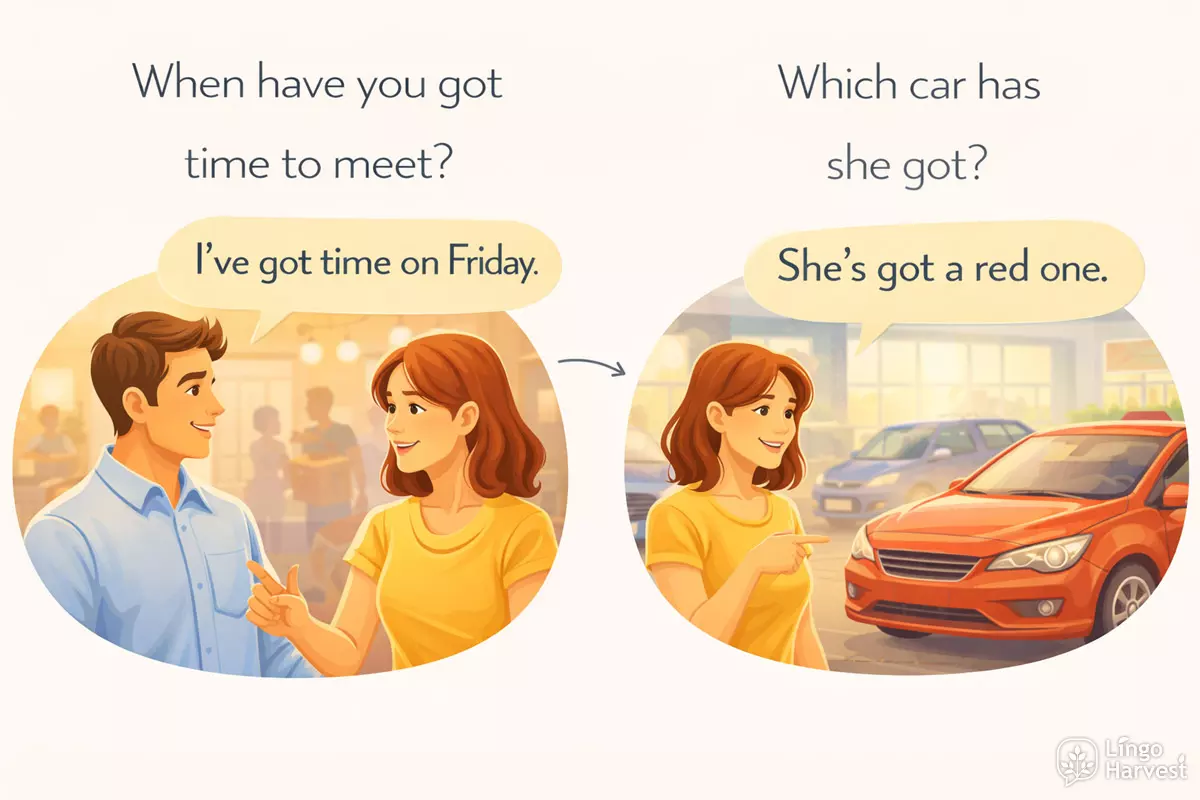
- When have you got time to meet? → I’ve got time on Friday.
- Which car has she got? → She’s got a red one.
- How long have you had your phone? → I’ve had it for two years.
Comparing Structures: "Have" vs. "Have Got"
The main difference is in question formation. The following table shows how the two forms compare for both types of questions:
| Type | Have (American English) | Have Got (British English) |
|---|---|---|
| Yes/No | Do you have a pen? | Have you got a pen? |
| WH-Question | What do they have? | What have they got? |
| Third Person | Does she have a dog? | Has she got a dog? |
| Negative | Don’t you have time? | Haven’t you got time? |
Useful Patterns and Examples
These question forms work for a range of topics, not just possessions. Here are more sample questions using both "have" and "have got":
- Have you got any brothers or sisters? → Yes, I have two.
- Do you have any plans this weekend? → Yes, I do.
- Has your friend got a new job? → Yes, he has.
- Does it have a warranty? → Yes, it does.
- Have they got enough chairs? → Yes, they have.
- Do we have everything we need? → Yes, we do.
- Has he got any allergies? → Yes, he has.
- Do you have a moment to talk? → Yes, I do.
- Have you got a minute? → Yes, I have.
- Does your house have a garden? → Yes, it does.
- What have you got in your bag? → I’ve got my wallet and keys.
- Who do you have on your team? → I have five people.
- How much time have we got? → We’ve got about ten minutes.
- Why do they have so many questions? → Because they are confused.
- Where has she got her phone? → She’s got it in her pocket.
- Which one do you have? → I have the blue one.
Mastering these question types helps you sound more natural in conversation and ensures you can both ask and answer effectively in different situations.
Short Answers in Have Questions
When answering questions that use have or have got, English speakers often use short replies instead of repeating the full sentence. These concise responses help keep conversations natural and efficient. The form of the short answer depends on whether the question uses have as a main verb or as part of have got.
How Short Answers Work
For questions like "Do you have a pen?" or "Have you got a pen?", the short answer repeats the auxiliary verb (do/does/did, or have/has) or the verb got, along with "yes" or "no" and a pronoun. Note that the structure changes slightly depending on which form of "have" is used.
| Question | Short Answer (Yes/No) |
|---|---|
| Do you have a car? | Yes, I do. / No, I don't. |
| Does she have any pets? | Yes, she does. / No, she doesn't. |
| Have you got your keys? | Yes, I have. / No, I haven't. |
| Has he got a ticket? | Yes, he has. / No, he hasn't. |
| Did they have enough time? | Yes, they did. / No, they didn't. |
| Have we got everything? | Yes, we have. / No, we haven't. |
| Do the children have homework? | Yes, they do. / No, they don't. |
| Has it got a battery? | Yes, it has. / No, it hasn't. |
| Did she have a good trip? | Yes, she did. / No, she didn't. |
| Have you got a minute? | Yes, I have. / No, I haven't. |
Key Patterns and Tips
- Use do/does/did in short answers for "Do you have…?" questions.
- Use have/has for "Have you got…?" short replies.
- Don't use "got" in the short answer itself—just the auxiliary verb.
- Match the auxiliary verb in the question (for example: "Have they got tickets?" → "Yes, they have.").
- Use contractions in negative short answers for natural speech: "No, I don't," "No, she hasn't."
Common Mistakes to Avoid
- Don't mix forms: avoid "Yes, I have" as a reply to "Do you have…?" (it should be "Yes, I do").
- For "have got" questions, don't answer with "Yes, I do"—use "Yes, I have."
- Keep the pronoun consistent with the question subject.
- Remember: the verb in the short answer matches the auxiliary or modal in the question, not the main verb.
Practicing these short answer forms will make your English sound more fluent and natural, especially in everyday situations. Use the examples above as a guide when responding to questions with "have" or "have got."
Common Learner Mistakes
Learners often face challenges when forming questions with "have" and "have got" due to differences in grammar rules and usage. Mistakes typically occur with word order, auxiliary verbs, contractions, and in distinguishing between American and British English patterns. Recognizing these pitfalls can help you avoid confusion and build confidence in conversation.
Mixing Up Question Forms
One frequent issue is using the wrong structure for questions. "Have" (without "got") and "have got" follow different patterns, especially in questions. For example, "Do you have a car?" (American English) versus "Have you got a car?" (British English). Learners sometimes create incorrect hybrids like "Do you have got a car?" ❌.
Incorrect Use of Auxiliaries
Another stumbling block is adding or omitting auxiliary verbs unnecessarily. Questions with "have" usually need "do/does" as an auxiliary, while "have got" does not. Getting these right is essential for clear communication.
| Correct | Incorrect |
|---|---|
| Do you have any pets? | Have you any pets? |
| Have you got a pen? | Do you got a pen? |
| Does she have a sister? | Has she got a sister? |
| Has he got a car? | Does he has got a car? |
Common Patterns to Watch For
- Using "do/does" with "have got" (e.g., "Do you have got...?")
- Dropping the auxiliary in American English (e.g., "You have a car?")
- Misplacing "got" in "have" questions (e.g., "Have got you a book?")
- Confusing "have" as a main verb vs. auxiliary (e.g., "Have you homework?")
- Mixing up subject-auxiliary inversion (e.g., "You have got a dog?")
- Incorrect negative forms (e.g., "He hasn't a car" instead of "He doesn't have a car")
- Overusing contractions where not appropriate (e.g., "Hasn't he got...?")
- Using "got" in formal writing when "have" alone is preferred
- Switching between "have" and "have got" inconsistently within the same context
- Forgetting to agree the auxiliary with the subject (e.g., "Do she have...?")
Confusing British and American Usage
It’s easy to mix up which form is standard in different varieties of English. "Have got" questions are more common in British English, while American English typically uses "do/does + have." Being aware of these differences can help learners choose the right form for their audience.
Tips to Avoid Errors
Practice forming questions with both "have" and "have got" separately. Pay attention to auxiliary verbs and word order. When in doubt, check which version fits the context—American or British English. Regularly reviewing common error patterns can make your questions much more natural and accurate.
Practice Exercises and Self-Check
Ready to reinforce your understanding of forming questions with "have" and "have got"? The following activities will help you review the main rules and apply them in real examples. Try to answer each task before checking the solutions provided at the end of each section.
1. Complete the Questions
Rewrite these statements as questions, using either "have" or "have got" as appropriate. Pay attention to word order and auxiliary usage.
- You have a new phone.
- She has got any brothers.
- They have a reservation.
- He has got a car.
- We have an appointment at 10.
- Your parents have a house.
- She has got a passport.
- They have enough time.
- He has got a question.
- You have any messages.
Show answers
- Do you have a new phone?
- Has she got any brothers?
- Do they have a reservation?
- Has he got a car?
- Do we have an appointment at 10?
- Do your parents have a house?
- Has she got a passport?
- Do they have enough time?
- Has he got a question?
- Do you have any messages?
2. Identify the Correct Form
Choose which form is correct in these questions: "Do/Does ... have" or "Has/Have ... got".
- ______ you got a minute?
- ______ he have a driving license?
- ______ they got any pets?
- ______ your sister have a job?
- ______ we got enough time?
- ______ she have any questions?
- ______ your friends got tickets?
- ______ it have a screen?
- ______ he got a problem?
- ______ you have a plan?
Show answers
- Have you got a minute?
- Does he have a driving license?
- Have they got any pets?
- Does your sister have a job?
- Have we got enough time?
- Does she have any questions?
- Have your friends got tickets?
- Does it have a screen?
- Has he got a problem?
- Do you have a plan?
3. Compare: "Have" vs. "Have Got"
The table below shows how questions are formed in the present tense with both forms. Notice the differences in auxiliary verbs and word order.
| Subject | Do/Does ... have | Has/Have ... got |
|---|---|---|
| I / You / We / They | Do you have a pen? | Have you got a pen? |
| He / She / It | Does she have a ticket? | Has she got a ticket? |
| Negative (I / You / We / They) | You don't have a car. | You haven't got a car. |
| Negative (He / She / It) | He doesn't have a key. | He hasn't got a key. |
4. Short Answer Practice
Give short answers to the following questions using the same form ("have" or "have got") as in the question.
- Do you have a passport?
- Has she got a bicycle?
- Does it have a warranty?
- Have they got any children?
- Do you have a driver’s license?
- Has he got a job?
- Does your phone have internet access?
- Have we got enough time?
- Do your parents have a car?
- Has the hotel got free Wi-Fi?
Show answers
- Yes, I do. / No, I don’t.
- Yes, she has. / No, she hasn’t.
- Yes, it does. / No, it doesn’t.
- Yes, they have. / No, they haven’t.
- Yes, I do. / No, I don’t.
- Yes, he has. / No, he hasn’t.
- Yes, it does. / No, it doesn’t.
- Yes, we have. / No, we haven’t.
- Yes, they do. / No, they don’t.
- Yes, it has. / No, it hasn’t.
5. Spot the Mistake
Find and correct the mistakes in the following questions.
- Does she has a pet?
- Have he got a brother?
- Do you got any money?
- Has they got a car?
- Does your sister have got a job?
- Have she got any friends here?
- Do he have a ticket?
- Has we got enough chairs?
- Do your phone have a camera?
- Have it got a name?
Show answers
- Does she have a pet?
- Has he got a brother?
- Do you have any money?
- Have they got a car?
- Does your sister have a job?
- Has she got any friends here?
- Does he have a ticket?
- Have we got enough chairs?
- Does your phone have a camera?
- Has it got a name?
By working through these exercises, you can check your grasp of forming questions and negatives with both "have" and "have got". Regular practice will help you use these structures confidently in everyday English.