Scarcely Any vs Hardly Any vs Barely Any: Usage Explained

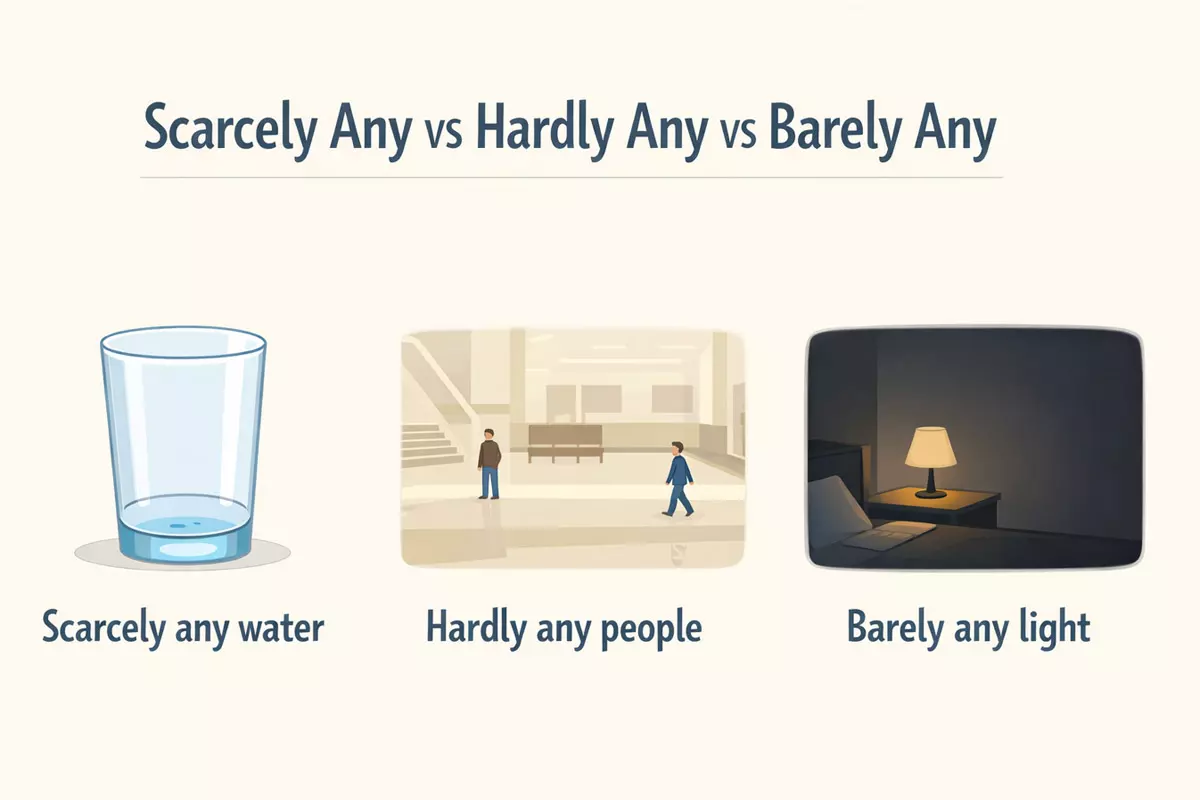 Here we how scarcely any, hardly any, and barely any convey scarcity, highlights their tone and sentence placement, compares their use with different nouns and in formal or neutral contexts, and provides examples and practice for clarity.
- Overall meaning and degree of emphasis
- Subtle differences in tone and implication
- Position in a sentence
- Use in formal vs neutral contexts
- Interaction with countable and uncountable nouns
- Common learner confusion and errors
- Examples with real-life situations
- Practice: rewriting sentences for precision
Phrases such as barely any, hardly any, and scarcely any all indicate a very small amount of something, but each has a slightly different nuance and is suited to particular contexts. Barely any often emphasizes that something exists, but only just enough to be noticed. Hardly any tends to stress the insufficiency or lack of something, suggesting it is almost absent. Scarcely any conveys a sense of rarity or extreme limitation, often used in more formal or literary contexts. Understanding these subtle differences can help you choose the most appropriate phrase for what you want to express.
Overall meaning and degree of emphasis
When comparing "scarcely any," "hardly any," and "barely any," the distinctions lie in both their overall sense and the degree of restriction or limitation they express. All three phrases communicate that there is a very small quantity of something, but the nuance and strength of the limitation can vary. Understanding these subtle differences helps you choose the most precise phrase for your context.
Shared sense: minimal quantity
Each of these expressions signals that something exists in a very limited amount—almost none, but not quite zero. They all answer the question: “Is there enough?” with a strong suggestion that there is not. However, how forceful or formal they sound depends on which phrase you use.
Emphasis spectrum
The degree of emphasis differs slightly among the three:
- Barely any – Strongest emphasis; suggests you are right on the edge of having none at all.
- Hardly any – Slightly less intense; still means very little, but can sound a touch more casual.
- Scarcely any – Often considered the most formal or literary; implies almost none, often in more refined or written contexts.
| Expression | Degree of Emphasis | Typical Tone/Usage |
|---|---|---|
| Barely any | Strongest | Informal, conversational |
| Hardly any | Moderate | Neutral, everyday speech |
| Scarcely any | Least forceful | Formal, literary or descriptive |
Examples in context
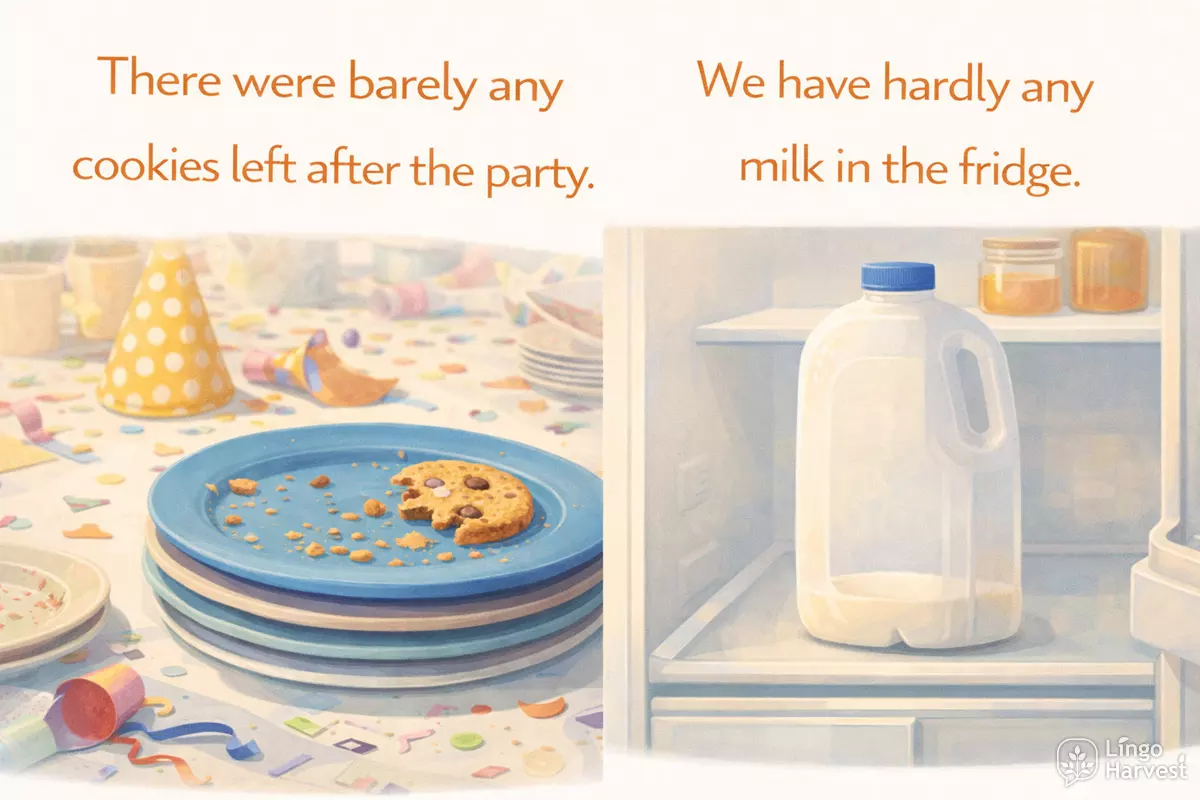
- There were barely any cookies left after the party.
- We have hardly any milk in the fridge.
- There were scarcely any cars on the road at dawn.
- He made barely any progress on his assignment.
- She has hardly any friends in the city.
- The team scored scarcely any points in the first half.
- We received barely any feedback on our survey.
- There’s hardly any difference between the two models.
- Scarcely any birds were singing after the storm.
- I have barely any energy left.
In summary, while all three phrases indicate an extremely small quantity, "barely any" is the most emphatic and informal, "hardly any" is common in everyday language, and "scarcely any" is more formal or literary in tone. Choosing the right one depends on how strong you want your statement to be and the context in which you are speaking or writing.
Subtle differences in tone and implication
While scarcely any, hardly any, and barely any all suggest a very small quantity, each phrase subtly shapes the message in a different way. These distinctions often go unnoticed but can affect how a sentence is interpreted in terms of intensity, formality, and emotional undertone.
Nuances in Emphasis and Emotion
- Scarcely any tends to have a slightly formal or literary tone. It often implies a sense of surprise, rarity, or something being almost nonexistent.
- Hardly any is more conversational and neutral. It often simply states a fact about limited quantity, without strong emotional coloring.
- Barely any carries a hint of struggle or effort. It suggests that what little exists is almost not enough, sometimes with a sense of frustration or disappointment.
Contextual Implications
Choosing among these expressions can subtly shift the listener’s perception. For example, saying “There were scarcely any volunteers” might sound more dramatic or literary, whereas “There were hardly any volunteers” is plain and direct. “There were barely any volunteers” might imply the speaker expected more or found the low number problematic.
| Phrase | Typical Tone/Implication | Example Sentence |
|---|---|---|
| Scarcely any | Formal, literary, rare or surprising | There were scarcely any clouds in the sky. |
| Hardly any | Neutral, conversational, factual | There’s hardly any milk left in the fridge. |
| Barely any | Suggests effort, insufficiency, mild frustration | We have barely any time to finish this. |
Quick Reference Examples
- Scarcely any evidence was found.
- Hardly any people showed up to the meeting.
- Barely any sunlight reached the forest floor.
- She had scarcely any reason to doubt him.
- There’s hardly any difference between the two models.
- Barely any money remained after the repairs.
- Scarcely any animals live at that altitude.
- We received hardly any complaints.
- Barely any progress was made overnight.
- He has scarcely any memory of the event.
- There are hardly any tickets left for the show.
- Barely any students passed the difficult exam.
In summary, the choice between these phrases can subtly color your message. Consider the tone you wish to convey and the context in which you’re speaking or writing to select the most fitting expression.
Position in a sentence
Understanding where to place "scarcely any," "hardly any," and "barely any" is key to using them naturally in English. These phrases typically act as quantifiers, modifying nouns to express a very small amount or number. They almost always appear before the noun they describe, but the sentence structure can shift slightly depending on what you want to emphasize or the formality of the context.
Typical placement
You’ll most often see these expressions just before the noun, in the subject or object position. They can be used with both countable and uncountable nouns, though the meaning remains the same: a minimal quantity.
- There were scarcely any cookies left in the jar.
- She has hardly any free time these days.
- We saw barely any traffic on the way home.
Sometimes, especially in more formal or literary writing, these phrases may appear at the beginning of a sentence for emphasis. In such cases, inversion is used (the verb comes before the subject):
- Scarcely any students attended the optional lecture.
- Hardly any evidence was found at the scene.
- Barely any hope remained after the storm.
Comparison of patterns
The three expressions are generally interchangeable in terms of their position, but subtle differences in tone or emphasis exist. Here’s a quick look at their placement in different contexts:
| Phrase | Example (before noun) | Example (sentence start, inversion) |
|---|---|---|
| Scarcely any | We have scarcely any milk left. | Scarcely any milk remains in the fridge. |
| Hardly any | They own hardly any property. | Hardly any property was sold last year. |
| Barely any | I ate barely any breakfast. | Barely any breakfast was served. |
Other grammatical notes
- These phrases do not usually follow the verb directly; instead, they precede the noun or noun phrase.
- They can be used in both affirmative and negative sentences, but the meaning is already negative or minimal, so avoid double negatives (e.g. There isn’t hardly any is nonstandard).
- When used in questions, they still come before the noun: Did you find hardly any mistakes?
In summary, "scarcely any," "hardly any," and "barely any" are typically placed directly before the noun they quantify, or at the start of a sentence for emphasis with inversion. Their placement is flexible but follows these common patterns for clear, natural English.
Use in formal vs neutral contexts
Choosing between "scarcely any," "hardly any," and "barely any" often depends on the situation and the desired level of formality. Each phrase conveys a similar sense of very little or almost none, but their tone and frequency in formal or everyday language can differ.
General Tendencies
- "Scarcely any" is the most formal of the three. It often appears in written English, academic texts, or formal speeches.
- "Hardly any" is common in both spoken and written English. It’s considered neutral and works well in informal, semi-formal, and most formal settings.
- "Barely any" is the most informal. It’s frequently used in conversation and casual writing, and less so in strictly formal contexts.
Contextual Examples
- "There were scarcely any objections to the proposal." (formal report)
- "We have hardly any milk left." (neutral, everyday speech)
- "There’s barely any time before the deadline." (casual conversation)
Comparative Overview
| Expression | Typical Contexts | Formality Level | Example Sentence |
|---|---|---|---|
| Scarcely any | Academic writing, formal letters, news articles | High | There were scarcely any mistakes in her essay. |
| Hardly any | Everyday speech, business emails, textbooks | Neutral | We have hardly any information about the topic. |
| Barely any | Spoken English, informal messages, casual blogs | Low | There’s barely any food left in the fridge. |
When to Choose Each Phrase
- For official documents or academic papers, "scarcely any" fits best.
- In professional emails or general writing, "hardly any" is safe and widely accepted.
- For texting, chatting with friends, or informal notes, "barely any" sounds most natural.
In summary, while all three expressions communicate a similar idea, their suitability varies with audience and setting. Matching your language to the context helps ensure your message comes across as intended.
Interaction with countable and uncountable nouns
Understanding how "scarcely any," "hardly any," and "barely any" interact with both countable and uncountable nouns is essential for natural English usage. These expressions all convey the idea of a very small quantity, but they function the same way whether the noun is something you can count (like "apples") or something you can't count (like "water"). The distinction between countable and uncountable nouns determines which noun form to use, but not the choice among these three phrases.
Usage with Countable Nouns

When used with nouns that can be counted individually, such as "books," "cars," or "friends," these phrases indicate an extremely limited number. Here are some examples to clarify:
- There were scarcely any chairs left in the room.
- We had hardly any apples in the basket.
- They found barely any mistakes on the test.
- She has scarcely any coins in her purse.
- There are hardly any buses running tonight.
Usage with Uncountable Nouns
With substances or concepts that aren’t counted individually, like "milk," "information," or "hope," these phrases express the idea of a nearly non-existent amount. Here are further illustrations:
- There's barely any sugar left in the jar.
- We have hardly any time to finish the project.
- She gave scarcely any thought to the consequences.
- There is barely any evidence to support the claim.
- He has hardly any patience for delays.
Comparison Table: Examples with Both Noun Types
| Expression | With Countable Noun | With Uncountable Noun |
|---|---|---|
| Scarcely any | Scarcely any tickets were sold. | Scarcely any hope remained. |
| Hardly any | Hardly any people attended. | Hardly any rain fell last night. |
| Barely any | Barely any cookies are left. | Barely any light entered the room. |
Key Patterns and Points
- All three phrases work with both countable and uncountable nouns without change in form.
- They are followed directly by the noun (no need for "of the" or similar constructions).
- The meaning remains consistent: an extremely small amount or number.
- You can use them to express scarcity in conversation and writing, regardless of noun type.
Choosing among "scarcely any," "hardly any," and "barely any" depends mostly on style and tone, not on the countability of the noun. All three effectively emphasize how little of something is present, whether it’s objects you can count or substances you cannot.
Common learner confusion and errors
English learners often mix up scarcely any, hardly any, and barely any because these phrases seem similar but have subtle differences in usage and tone. Understanding when and how to use each can be tricky, especially since they all express the idea of "almost none" or "very little," but are not always interchangeable.
Mixing Up Context and Formality
One frequent source of misunderstanding is the level of formality. For example, scarcely any is more formal and is found more often in written English, while hardly any and barely any are common in everyday conversation. Learners sometimes use the wrong expression for the context, making their language sound either too stiff or too casual.
Incorrect Substitution and Meaning
Students may substitute one phrase for another without considering slight differences in nuance. For instance, barely any often emphasizes a minimal amount as just above zero, sometimes with a sense of struggle or effort, while scarcely any can suggest rarity or unusualness.
Common Mistakes and Misunderstandings
- Placing the phrase in the wrong part of the sentence (e.g., "Any people scarcely came" instead of "Scarcely any people came").
- Using double negatives (e.g., "There wasn’t hardly any food" ❌ instead of "There was hardly any food" ✅).
- Confusing the phrases with almost any, which actually means "nearly all" rather than "almost none."
- Applying the wrong phrase to countable vs. uncountable nouns (e.g., "barely any informations" ❌ instead of "barely any information" ✅).
- Misinterpreting tone: "scarcely any" can sound dramatic, while "hardly any" is more neutral.
- Overusing these phrases, making speech sound repetitive or unnatural.
- Assuming all three are always negative; sometimes, context can flip the meaning.
- Forgetting subject-verb agreement: "Scarcely any students were present," not "was present."
- Using after auxiliary verbs incorrectly ("There can hardly any be left" ❌ vs. "There can hardly be any left" ✅).
- Adding unnecessary modifiers, e.g., "very hardly any" ❌ (redundant).
Side-by-side Usage Comparison
| Phrase | Example Sentence | Typical Tone/Context |
|---|---|---|
| Scarcely any | Scarcely any rain fell last month. | Formal, written, emphasizes rarity or exception |
| Hardly any | There was hardly any coffee left. | Neutral, common speech, everyday language |
| Barely any | I had barely any time to finish. | Casual, sometimes stresses difficulty or effort |
Being aware of these patterns and the context in which each phrase is used helps learners avoid typical pitfalls and communicate more naturally and accurately.
Examples with real-life situations
Understanding how to use "scarcely any," "hardly any," and "barely any" can be easier when you see them applied to daily scenarios. These phrases all indicate a very small quantity, but they often appear in slightly different contexts. Here, you'll find various real-world situations that illustrate their typical usage, helping you grasp the subtle distinctions between each expression.
Common scenarios and sample sentences
- After the party, there was scarcely any food left on the table.
- During the drought, the river had hardly any water flowing through it.
- He was so tired that he had barely any energy to climb the stairs.
- When I looked in my wallet, I found scarcely any cash remaining.
- The teacher noticed that hardly any students had completed the assignment.
- After a long illness, she could eat barely any solid food.
- There was scarcely any traffic on the road this morning.
- We had hardly any rain all summer.
- He spoke so softly that barely any of his words were audible.
- The old phone had scarcely any battery life left.
- By the end of the month, there was hardly any money in their account.
- After the blackout, barely any lights were visible in the city.
- She had scarcely any time to prepare before the meeting.
- The shop had hardly any customers during the storm.
- He received barely any support for his proposal.
Side-by-side comparison in context
To clarify the distinctions and similarities, here’s a comparison of the three phrases in similar sentences:
| Phrase | Example in context |
|---|---|
| Scarcely any | There was scarcely any milk left in the fridge after breakfast. |
| Hardly any | There was hardly any milk left in the fridge after breakfast. |
| Barely any | There was barely any milk left in the fridge after breakfast. |
While all three expressions communicate a minimal amount, "barely any" can sound slightly more dramatic or urgent, "hardly any" is more neutral, and "scarcely any" is more formal or literary in tone. Choosing the right phrase depends on your intent and the setting.
Practice: rewriting sentences for precision
Choosing between “scarcely any,” “hardly any,” and “barely any” can subtly change the tone or clarity of a statement. In this section, you’ll have the opportunity to practice selecting the most accurate phrase by rewriting sentences for better precision. Consider the context and the degree of scarcity you want to convey.
Sentence Revision Exercise
Below are several sentences that use vague or imprecise quantifiers. Rewrite each one, replacing the general phrase with “scarcely any,” “hardly any,” or “barely any” as most appropriate. Pay attention to the nuance and whether the sentence sounds natural.
- There were almost no cookies left in the jar.
- We found very few people at the station after midnight.
- He got just a small amount of sleep last night.
- The team received almost no support from the crowd.
- She had almost nothing to say during the meeting.
- There was almost no milk in the fridge.
- The movie had almost no exciting scenes.
- The instructions included only a tiny bit of detail.
- We saw almost no improvement in the test results.
- The plants received almost no sunlight this week.
Show answers
- There were hardly any cookies left in the jar.
- We found scarcely any people at the station after midnight.
- He got barely any sleep last night.
- The team received hardly any support from the crowd.
- She had scarcely anything to say during the meeting.
- There was barely any milk in the fridge.
- The movie had hardly any exciting scenes.
- The instructions included barely any detail.
- We saw scarcely any improvement in the test results.
- The plants received hardly any sunlight this week.
Comparing Usage for Clarity
Sometimes, more than one of these phrases could fit, but the nuance may shift. Compare their usage in similar contexts:
| Context | Best phrase | Effect/Nuance |
|---|---|---|
| Measuring a person’s energy after a long day | Barely any | Emphasizes an extremely small amount remaining |
| Commenting on audience attendance | Hardly any | Natural in casual speech, suggests very few people |
| Reviewing scientific data with minimal change | Scarcely any | More formal, highlights almost no change detected |
| Describing food left at a party | Hardly any | Common in everyday English, friendly tone |
| Reporting on rainfall during a drought | Scarcely any | Emphasizes rarity or near absence in a formal way |
Challenge: Make Your Own Sentences
Try writing three original sentences—one with each phrase (“scarcely any,” “hardly any,” “barely any”). Focus on clear, specific contexts and check that your usage matches the intended meaning.
Show answers
- Scarcely any wildflowers bloomed this spring due to the cold weather.
- Hardly any of my friends could make it to the reunion.
- There was barely any signal deep inside the tunnel.