None vs Not Any: Formal and Informal Usage Compared

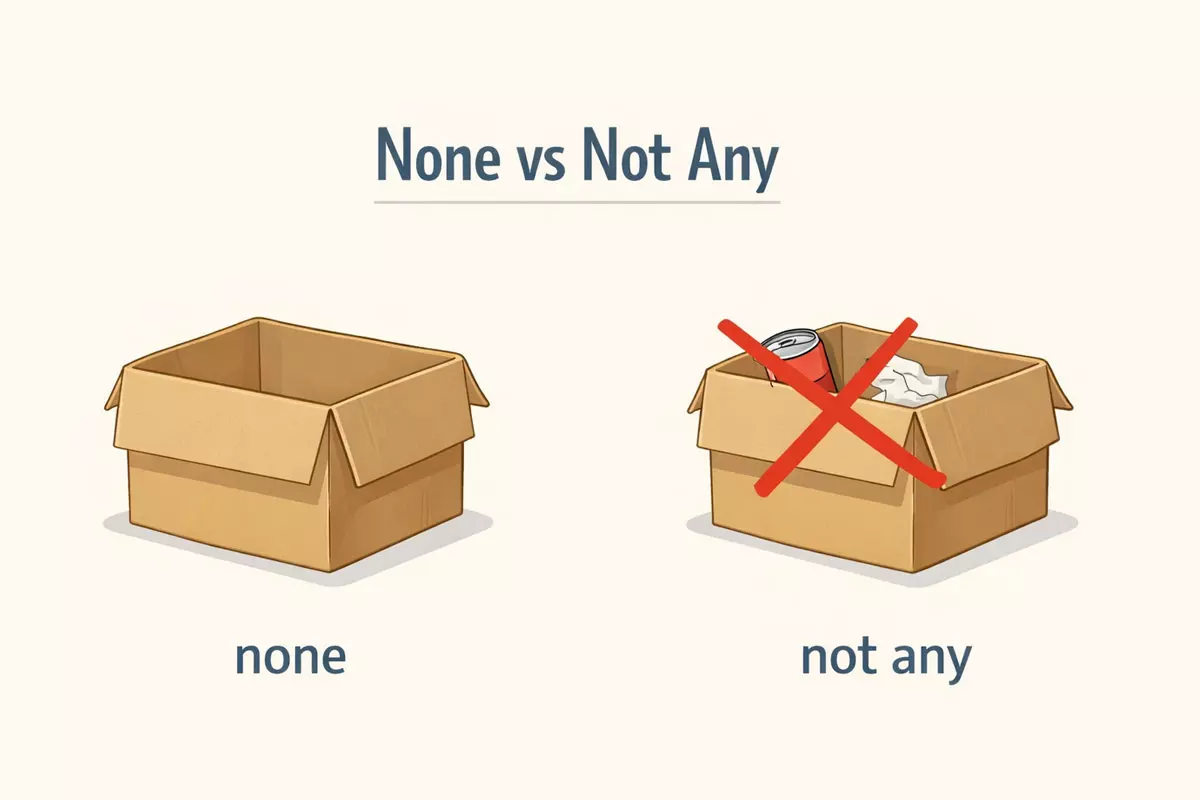 The article clarifies the meanings of none and not any, compares their use as pronoun or determiner, addresses tone and formality, explains sentence patterns and verb agreement, points out common mistakes, and gives practice choosing the right form in context.
- Core meaning of none and not any
- Difference between pronoun and determiner usage
- Formality and tone in spoken vs written English
- Sentence position and grammatical patterns
- Agreement with singular and plural verbs
- Common learner mistakes and double negatives
- Contextual examples showing natural choice
- Practice: choosing none or not any appropriately
Deciding whether to use "none" or "not any" depends on the context and the level of formality you want to convey. "None" is often more direct and concise, making it suitable for both formal and informal situations, while "not any" can sound more emphatic or slightly more formal, and might be used when you want to stress the complete absence of something. Being aware of these nuances allows you to choose the expression that best fits the tone and clarity needed for your message.
Core meaning of none and not any
Understanding how "none" and "not any" function is key to expressing absence or zero quantity in English. Both serve to indicate that something does not exist or is not present, but their usage and tone can differ depending on context and formality.
How "none" is used
"None" acts as a pronoun, standing in for nouns that have already been mentioned or are understood from context. It means "not one" or "not any" of a group or amount. "None" is concise and often feels more formal or neutral in tone.
Examples:
- None remained after the storm.
- Of all the suggestions, none were chosen.
- None of the cookies are left.
How "not any" is used
"Not any" is a phrase typically used for emphasis or when clarity is needed. It is often found in negative constructions, especially in more formal or written contexts. This phrase can be more explicit and sometimes a bit wordier than "none."
Examples:
- There are not any tickets available.
- He has not any reason to complain.
- We found not any evidence of damage.
Comparing the two forms

While both expressions point to the absence of something, their roles in sentences and the style they convey can differ. "None" is more flexible—it can stand alone or be followed by "of" plus a noun phrase. "Not any" usually precedes a noun and is used to make the negation especially clear.
| Expression | Example Sentence | Typical Use |
|---|---|---|
| none | None of the guests arrived on time. | Pronoun; formal or neutral |
| not any | There are not any clean plates left. | Phrase; emphatic, explicit |
| none (stand-alone) | How many apples are left? None. | Short, direct answer |
| not any (within negative) | She did not bring any snacks. | Common in negative statements |
Typical patterns and contexts
- Answering questions about quantity: "None" is often used for short, direct responses.
- Written or formal English: "Not any" can sound more explicit and is common in formal writing.
- Emphasis: "Not any" stresses the total absence, sometimes adding emotional weight.
- With "of": "None of the students passed the test." (group reference)
- In negatives: "He does not have any experience."
- Standalone: "None." (as an answer)
- In relative clauses: "There were not any that matched."
In summary, both "none" and "not any" communicate the idea of nothing or zero, but they differ in structure, tone, and flexibility. Choosing between them often depends on sentence flow, emphasis, and the desired level of formality.
Difference between pronoun and determiner usage
Understanding how "none" and "not any" function as pronouns or determiners is key to using them naturally. While both can express a lack or absence, their grammatical roles and placement in sentences can differ, especially in both formal and informal English.
How "none" works as a pronoun and determiner
"None" is most often used as a pronoun. It stands in for nouns already mentioned or understood from context. For example:
- Many students applied, but none were selected. (pronoun)
- Have you got any apples? — None left. (pronoun, informal omission of verb)
As a determiner, "none" is rare and usually sounds very formal or archaic. Most modern usage avoids "none" directly before a noun.
How "not any" is used
"Not any" always acts as a determiner. It must come before a noun or a noun phrase:
- There are not any cookies left.
- She has not any intention of leaving. (very formal; usually replaced by "no" or "any" in negatives)
In informal English, "not any" is often replaced by "no" or by using "any" in negative sentences.
Comparing usage in context
Placement and structure differ between these forms. "None" can stand alone or be followed by "of" plus a noun or pronoun, while "not any" must be attached directly to a noun. Here’s a comparison:
| Function | Example |
|---|---|
| Pronoun: "none" replaces a noun | We have several options, but none are suitable. |
| Determiner: "not any" before a noun | There are not any answers available. |
| "None of" + noun/pronoun | None of the tickets remain. |
| "Not any" with mass/plural nouns | I have not any information to share. (formal) |
Summary of key points
- "None" is usually a pronoun; rarely a determiner.
- "Not any" serves only as a determiner.
- "None" can be used alone, with "of", or at the end of a sentence.
- "Not any" must precede a noun or noun phrase.
- In casual speech, "none" is more common than "not any".
- For negative emphasis, "not any" is more formal and less frequent in conversation.
Choosing between these forms depends on sentence structure, level of formality, and emphasis needed.
Formality and tone in spoken vs written English
Choosing between "none" and "not any" often depends on the context—especially whether you are speaking or writing, and the level of formality required. These two expressions can convey the same meaning, but their tone and appropriateness may shift depending on the situation.
Spoken English: Everyday Use and Informality
In casual conversation, speakers tend to favor shorter, more direct forms. "None" is frequently used in everyday speech because it is concise and natural. "Not any" can sound awkward or overly emphatic in informal situations. For instance, a quick response like "I have none" feels less stiff than "I do not have any."
- "Do you have any questions?" — "No, none."
- "Are there cookies left?" — "No, there aren't any."
- "Have you got any money?" — "Sorry, none."
- "Is there any milk in the fridge?" — "No, not any."
Written English: Formality and Structure
In more formal, especially written, contexts, "not any" may be preferred to avoid ambiguity or to add emphasis. Academic writing, official documents, and professional correspondence often require full, explicit forms. "None" is still correct but can seem curt in highly formal settings.
- "There are not any outstanding issues with the report."
- "None of the candidates met the criteria."
- "The committee found that there were not any objections."
- "None of the evidence supports the claim."
Comparing Use in Different Contexts
The table below summarizes typical preferences in various scenarios, helping clarify when each form is more suitable.
| Context | Preferred Expression |
|---|---|
| Casual conversation | "None" |
| Informal writing (texts, notes) | "None" |
| Formal writing (reports, essays) | "Not any" |
| Emphatic denial | "Not any" (for stronger emphasis) |
| Short answers | "None" |
| Legal or technical documents | "Not any" |
Summary of Tone and Register
In summary, "none" is typically neutral or informal, fitting for everyday talk and brief written responses. "Not any" is more formal, often used for emphasis or clarity in structured writing. Being aware of these subtle differences helps you choose the most natural and effective expression for any situation.
Sentence position and grammatical patterns
Understanding where "none" and "not any" fit within a sentence, and how they interact with verbs and objects, helps clarify their appropriate usage in both formal and informal contexts. Their placement can subtly change the tone or emphasis of a statement.
Typical placements and patterns
"None" most often appears as a pronoun, frequently at the beginning or in the subject or object position. In contrast, "not any" usually modifies a noun and appears within the predicate or object, often making the sentence slightly longer and more formal.
- None can act as the subject: None were chosen.
- None as an object: We received none.
- Not any modifies nouns: There were not any mistakes.
- Negative answers: Do you have any questions? — None. vs. — Not any. (rare, more formal or emphatic)
- With countable and uncountable nouns: None of the water was wasted. / There was not any water left.
- Emphatic denial: I want none of it. / I do not want any of it.
- With modal verbs: None can enter. / You must not bring any food.
- Short answers: None. is common; Not any. is rarely used alone.
- Interrogative responses: How many tickets are left? — None.
- With prepositional phrases: None of them agreed. / There were not any among the group.
- Comparative statements: None were faster than her. / There were not any faster runners.
Comparison of structures
The grammatical flexibility and sentence integration of "none" and "not any" differ, especially in written English. The table below summarizes some of the most common patterns:
| Pattern | Example Sentence |
|---|---|
| Subject position | None of the answers were correct. |
| Object position | We found none in the box. |
| Modifier with countable noun | There were not any apples left. |
| Modifier with uncountable noun | She did not have any information. |
| Short response | None. |
| Negative with modal | None can be used here. |
| Emphatic negative | He wants none of your excuses. |
| Predicate negative | She does not have any siblings. |
Summary of practical differences
To sum up, "none" is more concise and flexible, often preferred in short answers and as a subject or object. "Not any" tends to be more formal and is generally used within the predicate to modify nouns. Choosing between them can depend on the desired level of formality, sentence structure, and clarity.
Agreement with singular and plural verbs
Understanding whether to use a singular or plural verb with "none" and "not any" can be confusing, especially since both can refer to zero quantity. The choice often depends on the noun that follows and the formality of the sentence. While both expressions indicate the absence of something, their grammatical agreement patterns differ in subtle ways.
Using "none" with verbs
"None" can be treated as either singular or plural. In formal writing, singular verbs are more common, especially when referring to a collective or uncountable noun. However, when "none" refers to countable nouns in the plural, a plural verb is often acceptable—and even preferred in informal contexts.
- None of the information is available. (singular, uncountable noun)
- None of the cookies are left. (plural, countable noun, informal)
- None of the students was late. (singular, formal)
- None of them were interested. (plural, more conversational)
"Not any" and verb forms
"Not any" is typically followed by a plural noun and takes a plural verb. This construction is less ambiguous, as it clearly refers to more than one item and so agrees with plural verbs.
- There are not any apples left.
- She does not have any friends here.
- We did not find any errors.
- He hasn't had any problems.
Quick comparison
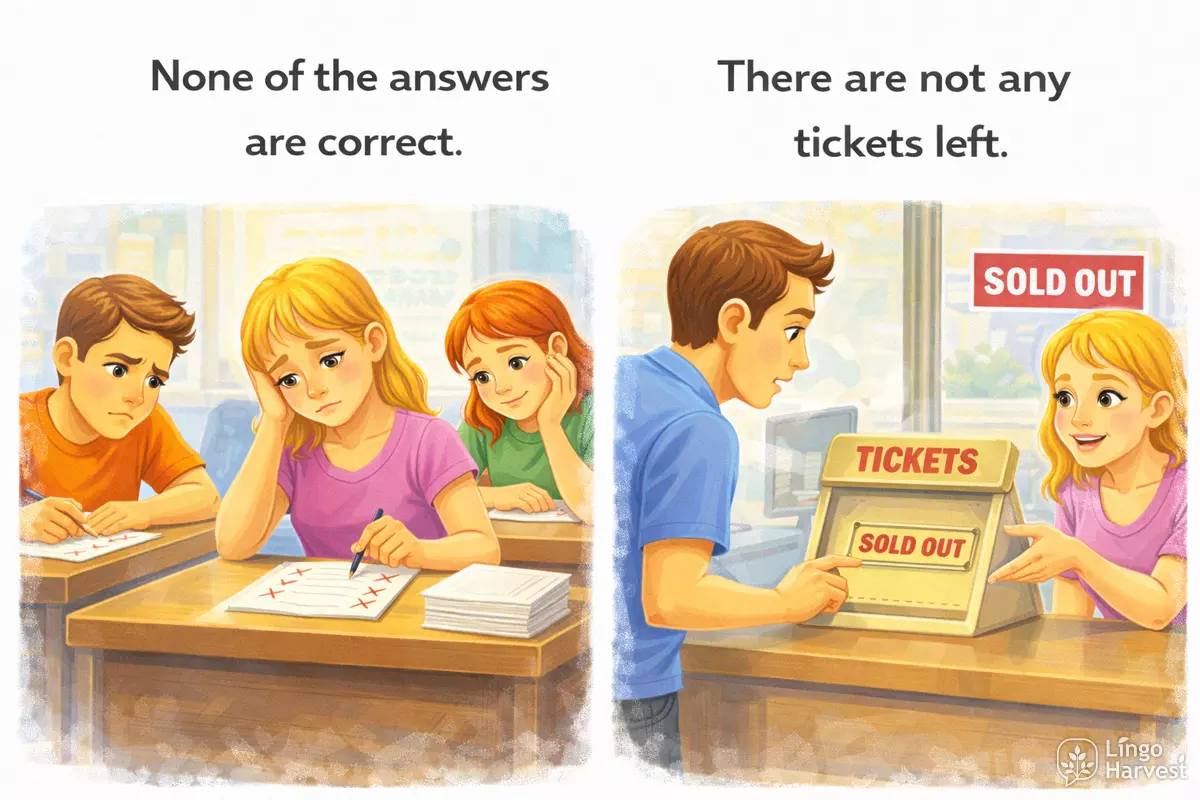
To help clarify, here's a side-by-side look at how "none" and "not any" work with verbs in typical contexts:
| Expression | Typical Verb Agreement | Example Sentence |
|---|---|---|
| None (uncountable noun) | Singular | None of the water is drinkable. |
| None (countable, formal) | Singular | None of the team was present. |
| None (countable, informal) | Plural | None of the answers are correct. |
| Not any (plural noun) | Plural | There are not any tickets left. |
| Not any (uncountable noun) | Singular | She doesn't have any money. |
Summary tips
- With "none," use a singular verb for uncountable or collective nouns, or to sound more formal.
- Plural verbs with "none" are common in everyday speech, especially with plural countable nouns.
- "Not any" generally follows the noun’s natural agreement—plural noun with plural verb, singular noun with singular verb.
Choosing between singular and plural verbs after these expressions depends on context, formality, and whether the noun is countable or uncountable. When in doubt, consider the noun and the tone you want to convey.
Common learner mistakes and double negatives
When learners compare none and not any, several pitfalls often appear, especially with sentence structure and negative forms. One frequent issue is confusion about when each expression is appropriate, particularly in formal versus informal settings. It’s also easy to slip into double negatives, which can make sentences unclear or grammatically incorrect.
Typical errors with none and not any
- Using both none and not any in the same sentence, leading to redundancy: “There is none of not any left.”
- Choosing none where not any is required for clarity in formal writing: “None of the books are available” vs. “There are not any books available.”
- Omitting necessary auxiliary verbs: “There not any cookies” instead of “There are not any cookies.”
- Forming questions incorrectly: “Do you have none apples?” instead of “Do you have any apples?”
- Using none with a plural noun directly: “None apples left” instead of “No apples left” or “There are none left.”
- Switching between informal and formal registers inconsistently within the same context.
- Creating awkward emphasis by doubling negatives for effect: “There aren’t none left.”
- Misplacing none at the start of sentences, causing ambiguity: “None I saw today were ripe.”
- Overusing not any where a simple no would be clearer: “There are not any problems” vs. “There are no problems.”
- Incorrectly pairing none with countable nouns: “None chairs” instead of “No chairs” or “There are none.”
Understanding double negatives
Double negatives occur when two negative words are used in the same clause, often leading to confusion or a meaning opposite to what the speaker intends. In standard English, double negatives are usually considered incorrect, though some dialects use them for emphasis. With none and not any, double negatives can sneak in if learners aren’t careful.
| Incorrect Double Negative | Correct Form |
|---|---|
| I don’t have none left. | I don’t have any left. → I have none left. |
| There aren’t not any cookies. | There aren’t any cookies. → There are no cookies. |
| She hasn’t got none of the answers. | She hasn’t got any of the answers. → She has none of the answers. |
| We can’t find none of the files. | We can’t find any of the files. → We found none of the files. |
Tips to avoid these issues
- Use none as a pronoun, not directly before plural nouns.
- Reserve not any for negative statements, especially after there is/are or modal verbs.
- Check for unintended double negatives by reading your sentence aloud.
- Remember that none is generally more formal, while not any fits both formal and informal English.
- When in doubt, simplify: “no” or “none” is often clearer than “not any.”
Mastering these subtle points helps learners sound more natural and prevents miscommunication, especially in writing or formal conversations.
Contextual examples showing natural choice
Choosing between none and not any often depends on the formality of the situation, the structure of the sentence, and the nuance the speaker wishes to convey. Seeing these expressions in real sentences can clarify when one sounds more natural than the other. Below, you’ll find a range of scenarios that highlight which phrase fits best and why.
Everyday situations: Choosing what sounds natural
- Formal written English: "None of the participants responded to the survey."
- Informal conversation: "I don’t have any snacks left."
- Neutral statement: "There aren’t any tickets available."
- Blunt refusal (casual): "Nope, none left."
- Emphasizing absence (spoken): "Not any of my friends could come."
- Short answer: "None."
- With a countable noun: "She didn’t get any answers right."
- With a mass noun: "There isn’t any milk in the fridge."
- Negative question: "Didn’t any of them call you?"
- Emphatic denial: "None whatsoever."
- Group reference: "None of us were invited."
- Polite refusal (formal): "Thank you, but I’ll have none."
Comparing usage in different registers
| Situation | Natural Expression |
|---|---|
| Business email | None of these options meet our requirements. |
| Text message to a friend | I don’t have any left. |
| Academic writing | None of the studies found significant results. |
| Spoken casual | There aren’t any cookies left. |
| Emphatic spoken denial | None at all! |
| Questioning absence | Are there any tickets left? |
Summary: Deciding between "none" and "not any"
Generally, none fits best in concise replies or when emphasizing total absence, especially in formal or written contexts. Not any and related forms (like aren’t any, didn’t have any) are more likely in spoken English and informal writing, particularly when paired with negatives or questions. Context, register, and the structure of the sentence all influence which expression will sound most natural.
Practice: choosing none or not any appropriately
Selecting between none and not any depends on sentence structure, tone, and the level of formality you wish to convey. To build confidence in making the right choice, let’s look at usage patterns, then try a set of exercises to test your understanding.
Common Usage Patterns
- None is often used as a pronoun to refer to “not one” or “not any” among a group, especially in more formal or concise contexts.
- Not any works well for emphasis or clarity, especially in negative statements and questions, and is more typical in spoken, informal English.
- Both can sometimes be used interchangeably, but none is more succinct, while not any can sound more emphatic or even awkward in formal writing.
Examples in Context
- “None of the students passed the test.” (concise, neutral or formal)
- “There are not any cookies left in the jar.” (emphatic, conversational)
- “None were available at the store.” (short, direct)
- “He did not have any experience.” (emphasizes total lack)
- “None of my friends could attend.”
- “She found that there were not any seats left.”
- “None is required for entry.”
- “We do not have any information yet.”
- “None remain after the sale.”
- “They did not receive any replies.”
Quick Comparison Table
- _____ of the answers were correct.
- We do _____ have any bread left.
- _____ of the invitations were accepted.
- She could _____ find any mistakes.
- _____ remain after the event.
- He has _____ friends in this city.
- _____ of the messages were delivered.
- They do _____ have any time to wait.
- _____ of the rooms are available.
- I could _____ see any difference.
Show answers
- None
- Not any
- None
- Not any
- None
- Not any
- None
- Not any
- None
- Not
Practice Exercise: Fill in the Blank
- _____ of the books were damaged during shipping.
- We did _____ receive any instructions.
- _____ of the applicants met the criteria.
- The box contained _____ useful items.
- We could _____ see any stars because of the clouds.
- _____ of the tickets are available now.
- She has _____ reason to worry.
- There are _____ apples left in the basket.
- _____ of the answers were correct.
- He did _____ make any mistakes.
- _____ of the rooms were clean.
- They found _____ evidence to support the claim.
- We have _____ time to discuss this now.
- _____ of the emails were answered.
- I could _____ hear any noise.
Show answers
- None
- Not
- None
- Not any
- Not
- None
- Not any
- None
- None
- Not
- None
- Not any
- Not any
- None
- Not
Tips for Choosing the Right Form
- If you want brevity or formality, none is usually the better choice.
- If you need to stress the absence of something, especially in speech, not any can be more forceful.
- When in doubt, read the sentence aloud: if “none” feels too abrupt, try “not any.”
- Consider the subject: “none” often replaces nouns easily; “not any” usually works with countable or uncountable nouns after verbs.