Determiners in Academic Writing: precision and clarity

 Here we how determiners shape academic style, focusing on clear definite and indefinite reference, avoiding ambiguity in complex noun phrases, and maintaining consistent reference. It includes examples and practice for refining academic sentences.
- Role of determiners in academic style
- Using definite and indefinite reference clearly
- Avoiding ambiguity in complex noun phrases
- Choosing specific vs general determiners
- Consistent reference across paragraphs
- Examples from research articles and essays
- Practice: refine academic sentences using determiners
Selecting precise words to define and specify information is essential for clear scholarly communication, as it helps writers avoid ambiguity and makes their arguments easier to understand. By mastering this important aspect of language, writers can convey their ideas more effectively and enhance the overall quality of their academic work. Careful word choice not only clarifies meaning but also demonstrates a strong command of the subject, contributing to more persuasive and credible writing.
Role of determiners in academic style
Determiners play a crucial part in shaping how ideas are presented in scholarly texts. They help writers specify reference, manage scope, and avoid ambiguity—qualities essential in academic communication. Selecting the right determiner can clarify whether a statement is general, specific, or limited in some way, directly impacting the reader’s interpretation.
Conveying Precision and Limitation
Academic writing often requires authors to define the boundaries of their claims. Using determiners such as “some,” “many,” “the,” or “every” allows a writer to signal whether the information applies universally or only to particular cases. For example, “the results” refers to a specific set of findings, while “results” alone could imply a broader or less defined group.
Reducing Ambiguity
Omitting determiners or using them imprecisely can lead to confusion. For instance, “students found the article challenging” is clearer than “students found article challenging.” The inclusion of “the” makes it evident which article is under discussion.
Common Determiners in Scholarly Prose

Writers frequently use certain determiners to achieve accuracy and nuance. Here’s a list of typical options found in academic work:
- the → The book on the table is mine.
- a → I saw a cat in the garden.
- an → She bought an umbrella.
- this → This problem is easy.
- these → These shoes are new.
- that → That idea sounds good.
- those → Those houses are very old.
- each → Each student received a certificate.
- every → Every child needs support.
- some → I need some water.
- any → Do you have any questions?
- several → Several people called today.
- many → Many tourists visit this city.
- few → Few students understood the task.
- much → There isn’t much time left.
- all → All answers were correct.
- most → Most people agree with this idea.
- either → You can choose either option.
- neither → Neither answer is correct.
- no → There is no sugar left.
Comparing Definite and Indefinite Reference
Precision in academic writing often depends on the distinction between definite and indefinite reference. Here is a structured comparison of how different types of determiners function in scholarly contexts:
| Definite Determiners | Indefinite Determiners |
|---|---|
| the (e.g., the study) | a/an (e.g., a study) |
| this, these, that, those | some, any |
| each, every, all, most | several, many, few, much |
| possessives (e.g., her findings) | either, neither, no |
Supporting Cohesion and Argument Structure
Beyond reference, determiners help knit together arguments by linking ideas across sentences and paragraphs. Phrases like “these results” or “that theory” create coherence by clearly connecting back to earlier content. Effective use of determiners is thus fundamental for organizing information and guiding the reader through complex reasoning.
Using definite and indefinite reference clearly
Clear reference to nouns is essential in academic writing, as it helps readers follow arguments and understand exactly which concepts or entities are being discussed. The choice between definite and indefinite determiners—such as "the," "a," "an," "this," or "these"—signals whether you are referring to something specific or something more general or previously unmentioned.
Definite Reference
Definite determiners, including "the," "this," "that," "these," and "those," indicate that the noun refers to a particular item known to both writer and reader. This usually means the noun has already been mentioned, is unique in context, or is defined by a limiting phrase. For example:
- The experiment revealed significant results. (Refers to a specific experiment previously discussed.)
- This theory contradicts earlier findings. (Indicates a theory the reader is now being introduced to as important or relevant.)
Using definite forms too early, before readers know what is being referenced, can cause confusion.
Indefinite Reference
Indefinite determiners, such as "a" and "an," introduce a noun that is not previously specified or is one example among many. They are used when mentioning something for the first time or when the specific identity is not important. For example:
- A study was conducted to test the hypothesis. (First mention; not yet clear which study.)
- Participants completed an online survey. (Any online survey, not a specific one.)
Once introduced, the noun can then be referred to with a definite determiner.
Common Pitfalls and How to Avoid Them
Writers sometimes misuse determiners by switching between definite and indefinite forms inconsistently or too abruptly. To help you select the right form, consider these guidelines:
- Use an indefinite article for first mentions; switch to the definite for subsequent references.
- If only one entity exists or is implied in the context, use the definite article.
- When generalizing, omit the article or use the plural form without a determiner.
- Be cautious with abstract nouns—sometimes no article is needed.
Examples of Determiner Use
To illustrate how precise article choice shapes meaning, see the table below:
| Example Sentence | Reference Type |
|---|---|
| A researcher presented new data. | Indefinite (first mention, nonspecific) |
| The researcher later published the findings. | Definite (already introduced) |
| Students must submit an assignment by Friday. | Indefinite (one of possible assignments) |
| The assignment will be graded next week. | Definite (specific assignment previously mentioned) |
| Innovation is essential in technology. | General/Abstract (no article) |
Checklist for Clarity
- Is the noun already known to the reader? Use a definite determiner.
- Is this the first mention or a general concept? Use an indefinite or no article.
- After introducing an item, refer to it with definite forms to maintain coherence.
- Pay close attention to plural and abstract nouns, as they often require no article at all.
Attentive use of definite and indefinite forms enhances academic writing by making arguments unambiguous and easy to follow.
Avoiding ambiguity in complex noun phrases
Academic writing often features lengthy noun groups that can lead to confusion if determiners are not used thoughtfully. Determiners such as "the," "a," "each," and "these" help clarify which entities are being discussed, but when several nouns are strung together, meaning can become unclear.
Common sources of confusion
Writers frequently encounter ambiguity in multi-word noun strings. For example, phrases like "student performance evaluation methods" or "data analysis techniques report" can be interpreted in multiple ways. The absence or misplacement of determiners can make it unclear which noun is being described or modified.
Strategies to clarify meaning
Improving clarity in complex noun phrases often relies on careful determiner placement and restructuring. Here are some practical approaches:
- Insert articles or demonstratives: the student performance evaluation methods vs. student performance evaluation methods
- Use prepositions: techniques for data analysis
- Add hyphens to form compound adjectives: long-term research projects
- Break up long noun strings: Instead of "teacher training program effectiveness," use "the effectiveness of teacher training programs"
- Be consistent with singular/plural forms: "a model of population growth" vs. "models of population growth"
- Specify with quantifiers: "each experiment result" vs. "all experiment results"
- Use possessives where appropriate: "students' performance" instead of "student performance"
- Add relative clauses: "the methods that evaluate student performance"
- Reorder for emphasis: "evaluation methods for student performance" instead of "student performance evaluation methods"
- Restate for clarity when needed: "the report on techniques used for data analysis"
Examples of ambiguous and clarified noun phrases
Below are examples showing how determiners and restructuring can eliminate confusion:
- Ambiguous: teacher training program results
- Clear: the results of the teacher training program
- Ambiguous: climate change impact study data
- Clear: data from the study on the impact of climate change
- Ambiguous: patient health outcome measures
- Clear: measures of patients' health outcomes
Summary of best practices
To enhance precision and readability in academic prose, always review complex noun groups for possible confusion. Ask yourself whether a reader unfamiliar with your subject would interpret your phrase as intended. Adjust articles, quantifiers, and structure as needed to avoid misinterpretation. This attention to detail ensures your arguments and findings are communicated with maximum clarity.
Choosing specific vs general determiners
Selecting between precise and broad determiners is crucial for clarity in academic writing. The choice affects how readers interpret the scope and certainty of statements. Specific determiners point to particular items or quantities, while general ones refer to nonspecific or unlimited entities.
Understanding the difference
Specific determiners identify exactly which thing or group is meant. Words like the, this, those, my, and each are used when the noun is known or has been mentioned. General determiners, such as a, an, some, any, and many, introduce nouns more generally, often when the reader is not expected to know the exact reference.
Common examples
- The theory (refers to a specific theory)
- A solution (any solution, not specified)
- This result (the result just mentioned)
- Some participants (an unspecified subset)
- Each variable (every individual variable within a set)
- Any evidence (all possible evidence, non-specific)
- Those models (models previously discussed or known)
- My hypothesis (the writer’s own hypothesis)
- All cases (the entire set of cases)
- Another approach (an additional, unspecified approach)
- Every student (all students individually)
- No data (zero data, general)
- Many studies (a large, but unspecified, number of studies)
- These findings (findings previously referenced)
- Its impact (the impact belonging to a specific thing)
When to use each type
Writers should use more precise determiners when referencing information familiar to the reader or previously introduced. For background context, general determiners often make sense, especially when introducing new or indefinite concepts. For instance, in a literature review, the study refers to a specific work already discussed, while a study introduces a new one.
Impact on meaning
The distinction affects both accuracy and interpretation. Using a general determiner where a specific one is needed may cause ambiguity. Conversely, overusing specific determiners can make writing seem repetitive or overly narrow.
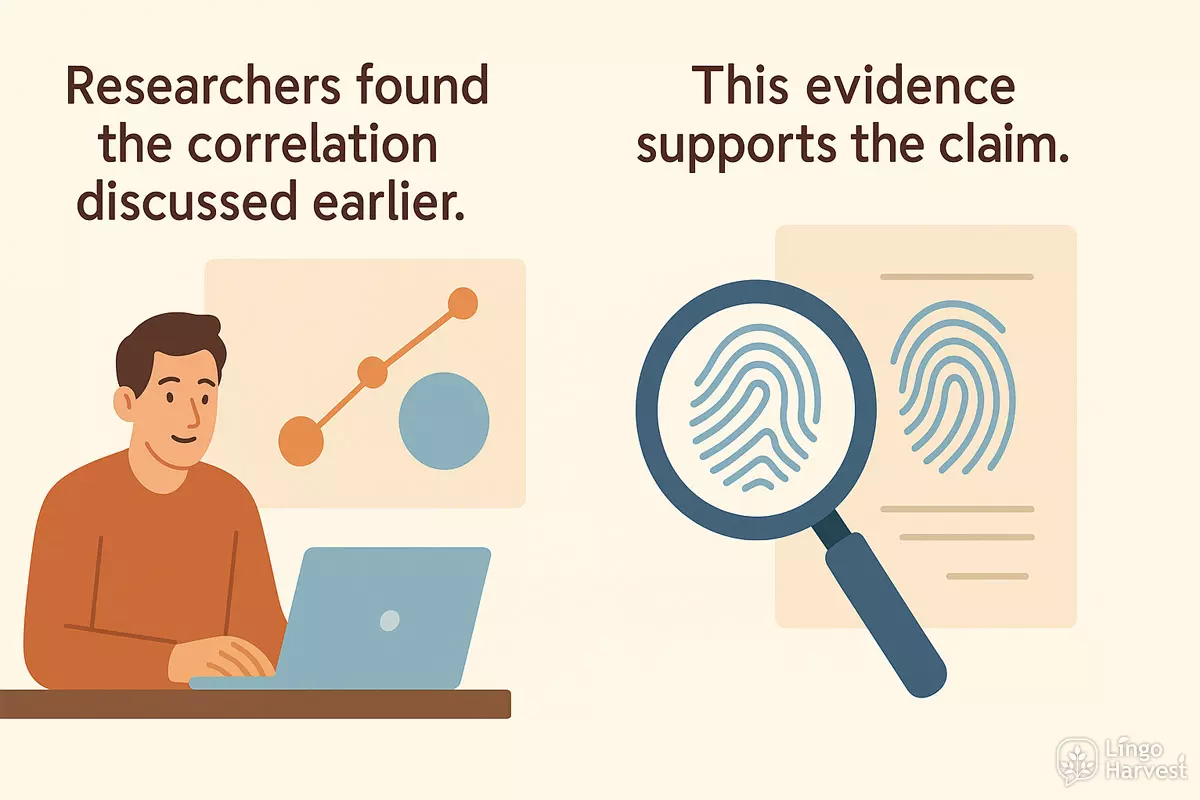
| General Determiner Example | Specific Determiner Example |
|---|---|
| Researchers found a correlation. | Researchers found the correlation discussed earlier. |
| Some evidence supports the claim. | This evidence supports the claim. |
| Many factors influence results. | These factors influence results. |
| Any solution is acceptable. | My solution is acceptable. |
| Another study explored the topic. | That study explored the topic. |
Tips for academic writing
- Use specific determiners to refer back to known concepts or items.
- Choose general determiners when introducing new or undefined ideas.
- Check that your determiner matches the context and intended meaning.
- Vary determiner use to avoid monotony and enhance precision.
Careful selection of determiners helps ensure both accuracy and readability in scholarly texts.
Consistent reference across paragraphs
Maintaining clear and stable referents for determiners is fundamental when writing academic texts. Readers must be able to identify what nouns like “this,” “these,” “such,” or “the” denote, even as the discussion progresses from one paragraph to the next. Ambiguous or shifting references can cause confusion, especially in longer or more complex arguments.
Why it matters
If determiners point to different concepts without clear signaling, arguments may become hard to follow. For example, using “these results” at the beginning of a paragraph should clearly continue referencing the same findings discussed previously. Without this clarity, your reader might lose track of the line of reasoning.
Common pitfalls and solutions
Writers sometimes introduce new ideas or data but continue using determiners as if their referents are obvious. To avoid this, make sure each determiner has an unmistakable noun or concept attached to it, either by explicit restatement or clear context.
- Restate the noun occasionally, especially after a paragraph break.
- Use more specific determiners when several possible referents exist (e.g., “these survey results” instead of “these results”).
- Establish clear antecedents for pronouns and demonstratives.
- Vary language to clarify connections, such as “the aforementioned theory” or “this finding from Experiment 2.”
Examples of referential clarity
Writers can improve coherence by ensuring every determiner points to a clear, recent, and specific noun. Consider these examples:
- “These findings suggest...” → Clearly refers to findings in the previous sentence.
- “Such methods have limitations.” → “Such” should refer to a type of method just described.
- “This approach differs from the one discussed above.” → “This approach” is defined in the preceding context.
- “The results were significant. These results support the hypothesis.” → “These results” unambiguously refer to the previously mentioned results.
Common determiners and referential patterns
Below is a table showing typical determiners, what they often refer to, and guidance for maintaining clarity across multiple paragraphs:
| Determiner | Best practice for reference |
|---|---|
| This/These | Use for immediate, recent, or specifically stated items; restate if the referent is not in the same paragraph. |
| Such | Clarify what “such” refers to by repeating key features or the noun itself. |
| The | Ensure it signals a unique, previously identified item; avoid overuse without redefinition. |
| That/Those | Use for items set apart from the current subject or for contrast; specify if ambiguity might arise. |
| Each/Every | Make clear which group or category is intended, especially after transitions. |
| Another | State the first item or example clearly before introducing “another.” |
Attending to referential precision with determiners not only supports logical flow but also demonstrates attention to detail—a key aspect of effective academic communication.
Examples from research articles and essays
Understanding how determiners function in scholarly writing is easier with concrete illustrations. Academic texts rely on determiners to add specificity, indicate quantity, or clarify reference. Below, you’ll find authentic sample sentences and patterns, each demonstrating a different role for these words in formal contexts.
Sample Sentences Demonstrating Determiners
- The results indicate a significant difference between the groups.
- Several studies have addressed this phenomenon.
- This approach provides a new perspective on the issue.
- Each participant completed a survey.
- Some data were excluded due to inconsistencies.
- Another limitation concerns the sample size.
- Many authors argue for a broader interpretation.
- No evidence supports the alternative hypothesis.
- Every experiment was conducted under controlled conditions.
- These findings suggest further research is needed.
- All participants gave informed consent.
- Few scholars dispute this conclusion.
- Our analysis confirms the initial hypothesis.
- Those results should be interpreted with caution.
- Any deviation from protocol was documented.
- Both methods yielded comparable outcomes.
- Much of the literature focuses on quantitative data.
- Her research addresses a significant gap.
- Their conclusions align with previous work.
- One possible explanation is methodological bias.
Comparing Determiner Use for Precision
Writers often choose determiners based on the level of detail or generalization required. The table below compares how different determiners can shift the meaning or precision of a statement in academic prose.
| Example Phrase | Effect on Meaning |
|---|---|
| All participants | Refers to the entire group without exception |
| Some participants | Suggests only a subset is involved |
| Each participant | Emphasizes individual actions or responses |
| That participant | Specifies a single, previously mentioned person |
| Another participant | Introduces an additional, distinct person |
| Few participants | Implies only a small number, possibly insufficient |
| Many participants | Indicates a large but indefinite quantity |
| No participant | States none in the group meet the criteria |
Patterns in Academic Usage
Writers in research and essay contexts use determiners to:
- Distinguish between general and specific entities (e.g., “a theory” vs. “the theory”).
- Signal quantity or scope (e.g., “several factors,” “each outcome”).
- Reference previous information (“this result,” “those findings”).
- Clarify ownership or attribution (“her analysis,” “their model”).
- Express limitations or exceptions (“no evidence,” “few studies”).
These strategies help ensure that academic arguments remain clear, precise, and appropriately nuanced.
Practice: refine academic sentences using determiners
Effective use of determiners can dramatically improve the precision and professionalism of academic writing. Determiners help clarify which noun is being discussed, indicate quantity, and specify relationships. Below, you'll find targeted exercises to help you identify and revise sentences for greater clarity using appropriate determiners.
Task 1: Identify the missing determiners
Choose the most suitable determiner for each blank in the sentences below:
- _____ data suggest that the hypothesis is valid.
- _____ students who completed the survey reported positive outcomes.
- There are _____ reasons to question the results.
- _____ research supports the proposed methodology.
- _____ of the participants were familiar with the topic.
- _____ evidence was presented during the discussion.
- _____ experts agree with this conclusion.
- _____ results were unexpected.
- _____ information is missing from the report.
- _____ of the responses were incomplete.
Show answers
- The
- Most
- Several
- Recent
- Some
- New
- Many
- Some
- Important
- Several
Task 2: Refine academic sentences
Below are sentences lacking precise determiners. Rewrite each sentence to improve specificity and clarity.
- Authors argue that methodology is effective.
- Study examined effects of intervention.
- Findings highlight importance of feedback.
- Results indicate need for further research.
- Participants completed questionnaire.
Show answers
- The authors argue that the methodology is effective.
- The study examined the effects of the intervention.
- The findings highlight the importance of feedback.
- The results indicate a need for further research.
- The participants completed the questionnaire.
Before-and-after comparison: improving sentences with determiners
Compare the following pairs to see how determiners sharpen meaning and eliminate ambiguity:
| Original Sentence | Refined with Determiner |
|---|---|
| Results suggest intervention is effective. | The results suggest the intervention is effective. |
| Researchers analyzed data from participants. | The researchers analyzed the data from the participants. |
| Feedback was provided to students. | Feedback was provided to all students. |
| Study highlights importance of context. | The study highlights the importance of context. |
| Researchers identified variables. | The researchers identified several variables. |
Quick check: which determiner fits best?
Fill in the blank with a suitable determiner:
- _____ evidence supports the claim.
- _____ students failed to complete the assignment.
- _____ of the options is correct.
- _____ research was conducted last year.
- _____ data were excluded from the final analysis.
- _____ participants withdrew from the study.
- _____ of the experiments produced reliable results.
- _____ findings contradict earlier assumptions.
- _____ surveys were returned incomplete.
- _____ information is still required.
Show answers
- The
- Some / Many
- Neither
- This / That
- Some
- Several
- Most
- Some
- Many
- More
Regular practice with real academic sentences will help you master the use of determiners and consistently produce clear, precise academic writing.