Nouns Expressing Limitation and Scope in Clear Communication

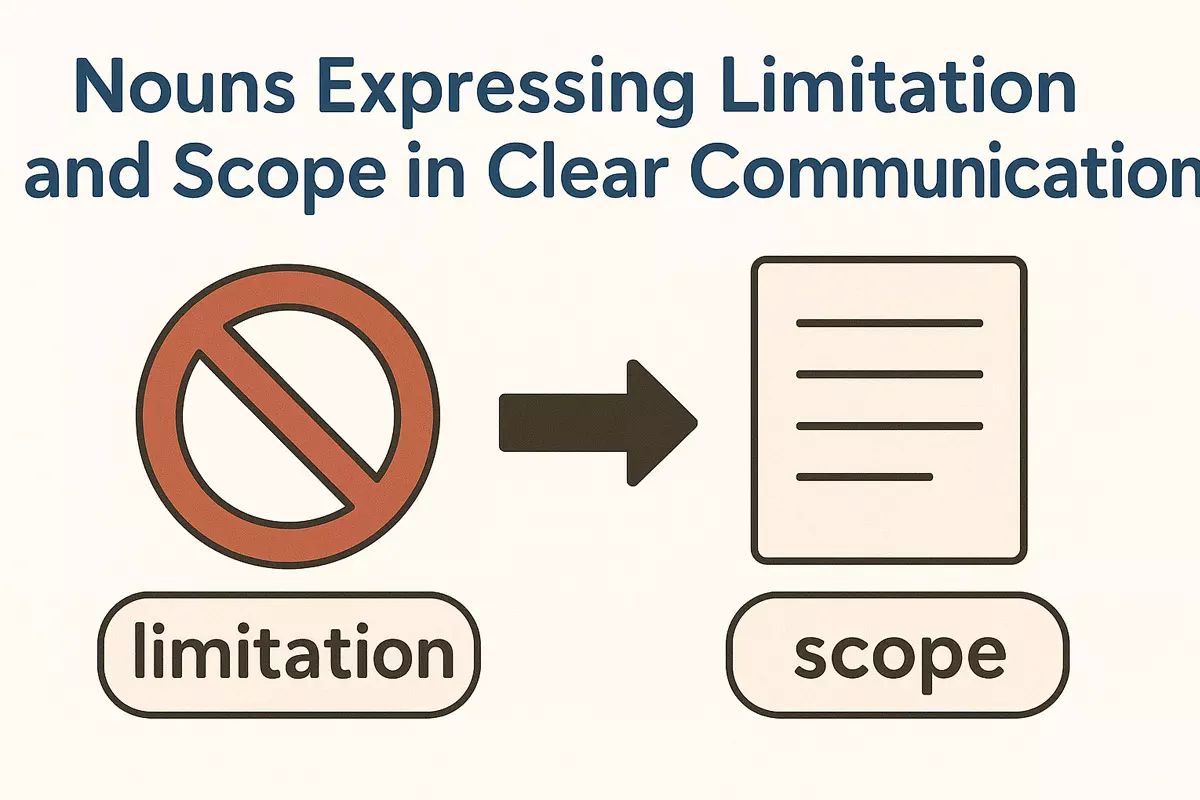 This article explains how nouns like limit, boundary, range, extent, field, and area describe limitation and scope. It covers their use in explanations, formal and informal contexts, common mistakes, and offers practice for clarity.
- What limitation and scope nouns describe
- Common limitation nouns like limit, boundary, and range
- Scope nouns like extent, field, and area
- Using limitation and scope nouns in explanations
- Formal vs informal scope expressions
- Typical learner mistakes with abstract scope nouns
- Practice: clarify limits and scope using precise nouns
Precision in language relies heavily on selecting the most appropriate words to define the boundaries and extent of our ideas, which in turn shapes how messages are conveyed and interpreted. By examining how specific terms establish the parameters of communication, we can better appreciate their essential role in promoting clarity and understanding. Thoughtful word choice not only enhances the accuracy of our statements but also ensures that listeners or readers grasp the intended meaning without confusion, ultimately strengthening effective communication.
What limitation and scope nouns describe
When discussing clear communication, certain nouns play a key role in specifying boundaries, extents, and restrictions. These terms help readers or listeners grasp exactly how far an idea, rule, or condition applies. By choosing precise nouns related to limitation and scope, communicators clarify what is included, excluded, or defined within a context.
Defining Boundaries and Extents
Words in this category often indicate where something begins or ends. For example, terms like "limit," "boundary," and "extent" make it clear how much or how far something reaches. These nouns allow for unambiguous statements, such as describing the scope of a project or the restrictions placed on a process.
- Boundary – marks the edge or border of an area or concept
- Limit – defines the maximum or minimum allowed
- Extent – expresses how much space or range is covered
- Restriction – indicates a rule or condition that narrows possibilities
- Constraint – shows a limiting factor or requirement
- Range – describes the span between two points
- Parameter – sets a fixed condition or guideline
- Threshold – specifies a point at which something begins or changes
- Scope – covers the breadth or focus of an activity or subject
- Quota – refers to a fixed share or allowable amount
- Allowance – details a permitted quantity or degree
- Criteria – lists standards or measures for inclusion
- Specification – gives detailed requirements or features
- Exclusion – marks what is left out or not considered
- Capacity – shows the maximum that can be contained or handled
- Coverage – indicates the area or subjects affected
- Duration – defines the length of time something lasts
- Proportion – gives the relative amount within a whole
How Limitation and Scope Nouns Function in Sentences
These terms serve to anchor meaning. For instance, using "restriction" in a sentence makes it clear that certain actions are not allowed, whereas "scope" signals the breadth of a discussion or project. Choosing the right noun allows for accuracy and cuts down on ambiguity.
Comparison of Limitation vs. Scope Nouns
| Limitation Nouns | Scope Nouns |
|---|---|
| Limit | Scope |
| Restriction | Coverage |
| Constraint | Extent |
| Threshold | Range |
Understanding and applying these nouns enhances clarity. They allow writers and speakers to define what is relevant, what is possible, and where lines are drawn. This is essential for contracts, instructions, academic writing, and any context where ambiguity could lead to confusion or errors.
Common limitation nouns like limit, boundary, and range
The English language offers a variety of nouns to express restriction, extent, or scope in both everyday and technical contexts. Words such as limit, boundary, and range allow speakers and writers to clearly communicate the edges or confines of an idea, object, or action. These terms help set expectations, clarify definitions, and prevent misunderstandings by precisely marking where something starts, ends, or operates.
Usage in Communication
When discussing rules, capacities, or areas of influence, choosing the right noun for limitation is crucial. For example, limit often refers to the maximum or minimum allowed, while boundary implies a dividing line or border, and range highlights the interval between two points. Each term brings a slightly different nuance, so selecting the appropriate word can make statements more accurate and less ambiguous.
- Limit – the furthest point or amount permitted
- Boundary – a real or imagined line marking the edge or border of something
- Range – the area between upper and lower values; a span or scope
- Threshold – the level or point at which something begins or changes
- Confine – a restriction or border enclosing something
- Extent – the degree or scope to which something stretches
- Frontier – the extreme limit of understanding or achievement
- Restriction – an imposed rule or boundary limiting action
- Parameter – a measurable factor that defines a system or sets conditions
- Bracket – a category or grouping defined by limits
- Perimeter – the continuous line forming the boundary of a space
- Ceiling – the upper limit, especially in terms of quantity or capability
- Floor – the minimum value or lower limit
- Margin – the edge or border, often indicating a buffer zone
- Cutoff – a designated point at which something ends or is no longer included
- Span – the full reach between two limits
- Quota – a fixed share or maximum number allowed
- Cap – an upper boundary, often used for numbers or costs
- Scope – the extent of the area or subject matter that something deals with
- Border – the dividing line between two areas or groups
Comparing Nuances and Contexts
These nouns are not always interchangeable. For instance, limit is common in mathematics and regulations, while boundary is frequently used in geography and personal space. Range is typical in scientific measurements and statistics. Understanding their subtle differences helps avoid confusion and tailors your communication to the intended audience.
| Term | Typical Context | Example Sentence |
|---|---|---|
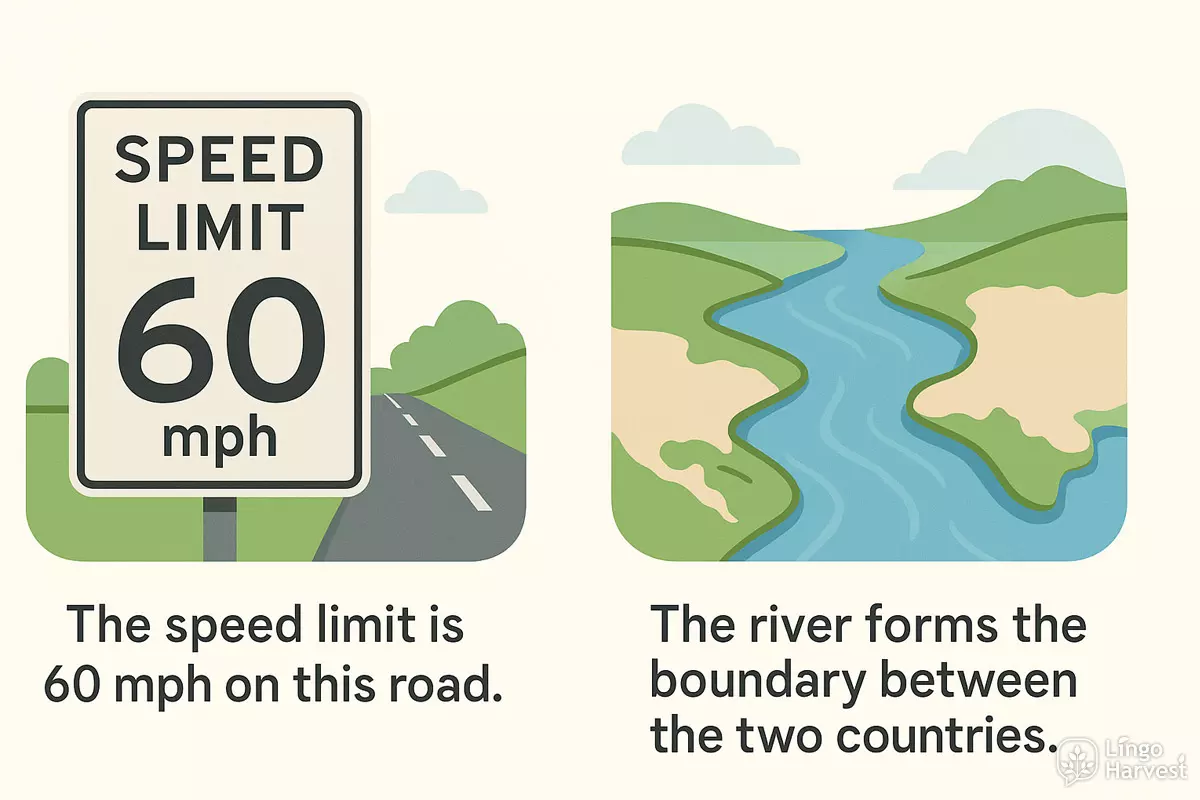
| Limit | Rules, capacity, mathematics | The speed limit is 60 mph on this road. |
| Boundary | Geography, property, personal space | The river forms the boundary between the two countries. |
| Range | Statistics, science, measurement | The temperature range this week is 10–20°C. |
| Threshold | Starting points, change, finance | Her pain tolerance has a high threshold. |
| Parameter | Technical, scientific, systems | We adjusted the parameters of the experiment. |
| Margin | Business, voting, measurement | The candidate won by a narrow margin. |
| Ceiling | Finance, capacity | The company set a ceiling on annual bonuses. |
| Quota | Work, production, trade | Each team must meet a daily quota of calls. |
Choosing from this range of nouns enhances clarity and precision. By matching the word to the situation, you can convey not just the idea of restriction, but exactly how, where, and why the constraint exists.
Scope nouns like extent, field, and area
When discussing the boundaries or range of a subject, certain nouns help clarify what is being limited or described. Words such as extent, field, and area specify the reach, domain, or sphere of activity. These terms are especially useful in technical, academic, and professional writing, where clear communication about limitations and coverage is essential.
Commonly used nouns for boundaries and domains
Writers and speakers often rely on a set of nouns to establish the scope of their topic or argument. Each term carries subtle differences in meaning and usage. Here are some frequently encountered examples:
- Extent – refers to the degree, range, or amount covered (e.g., "the full extent of the damage")
- Field – denotes a branch of study or area of professional activity (e.g., "the field of linguistics")
- Area – describes a region, sector, or topic (e.g., "an area of research")
- Scope – outlines the boundaries or limits of an activity or study
- Range – indicates the span between limits, often used for measurable quantities
- Domain – implies a sphere of knowledge or control
- Sphere – suggests a social or intellectual environment
- Sector – often used for divisions within industries or economies
- Bracket – refers to a specific grouping, especially in statistics or age groups
- Category – means a class or division within a system
- Boundary – the defining edge or limit
- Limit – the maximum or minimum allowed
- Framework – a structured boundary for concepts or activities
- Territory – literal or figurative area under control or influence
- Discipline – a branch of learning or scholarly instruction
- Segment – a distinct part or section
- Division – a formal separation within a larger whole
- Capacity – the maximum amount something can contain or do
- Bracket – a specific range, often numeric
- Realm – a domain or field, often used in a formal or literary context
Comparing usage: Extent, field, and area
The following table highlights differences in common contexts, helping to choose the right noun for precise communication.
| Term | Typical Use | Example Phrase |
|---|---|---|
| Extent | Describes degree, amount, or range | “The extent of the problem” |
| Field | Branch of study or profession | “The field of medicine” |
| Area | Topic, region, or sector | “Area of expertise” |
| Scope | Defined boundaries/coverage | “Scope of the project” |
Why these nouns matter for clarity
Choosing the right noun for boundaries or coverage helps prevent misunderstandings. For example, specifying the scope of research sets expectations, while identifying the field narrows the context. In technical documentation, these words reduce ambiguity and ensure that readers understand exactly what is included—or excluded—in a discussion. In summary, nouns like extent, field, and area are practical tools for expressing limitation and range in communication. Their careful use leads to greater clarity and precision.
Using limitation and scope nouns in explanations
Clarity in communication often relies on specifying boundaries and extents. When explaining a process, result, or idea, nouns indicating restriction or range help set realistic expectations and prevent misunderstandings. Words such as boundary, restriction, extent, and range are invaluable for drawing lines around what is included—and what is not. This makes explanations more precise and easier to follow.
Common nouns for expressing limits and scope
Writers and speakers use a variety of terms to signal constraints or coverage. Here’s a list of useful nouns you might encounter or use:
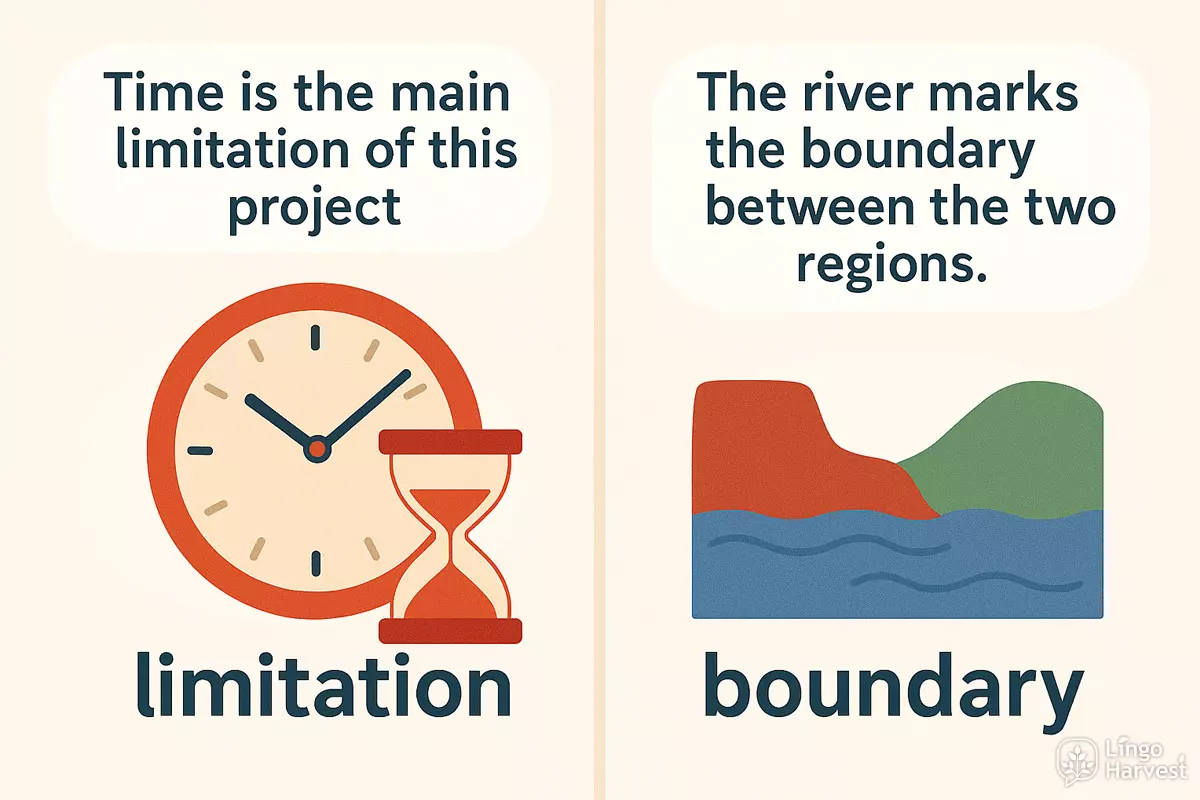
- Limitation → Time is the main limitation of this project.
- Boundary → The river marks the boundary between the two regions.
- Scope → The scope of the study is clearly defined.
- Restriction → There is a restriction on file size.
- Extent → The extent of the damage is still unknown.
- Parameter → Age is an important parameter in the survey.
- Range → The price range is affordable.
- Framework → The policy operates within a legal framework.
- Threshold → He did not meet the minimum threshold.
- Margin → There is a small margin of error.
- Quota → The company set a sales quota.
- Ceiling → There is a spending ceiling for this year.
- Cap → The government introduced a cap on prices.
- Exclusion → This plan includes several exclusions.
- Allowance → Employees receive a travel allowance.
- Confine → The rules confine access to authorized users.
- Coverage → Insurance coverage is limited.
- Specification → The device meets the required specifications.
- Criteria → The candidates must meet strict criteria.
- Restriction → A new restriction was added to the policy.
Choosing the right term for clear explanations
Selecting the appropriate noun depends on context. For example, parameter is common in technical or scientific writing, while boundary or margin are often used in general discussions. Using these nouns thoughtfully helps readers or listeners quickly grasp the scope of your explanation.
Comparison of limitation and scope nouns in context
| Noun | Typical Use in Explanations |
|---|---|
| Limitation | Describes what is not possible or allowed (e.g., "A limitation of this study is sample size.") |
| Scope | Defines the overall range or coverage (e.g., "The scope of this report includes...") |
| Boundary | Marks the dividing line between included and excluded elements (e.g., "The boundary of the project is...") |
| Parameter | Specifies a measurable factor or condition (e.g., "This analysis uses temperature as a parameter.") |
| Threshold | Indicates a minimum or maximum point (e.g., "The threshold for detection is 5 units.") |
| Quota | Sets a fixed number or limit (e.g., "The quota for participation is 100 people.") |
| Framework | Describes an overarching structure or set of guidelines (e.g., "Within this framework, we consider...") |
Tips for effective use
- Be specific: Choose nouns that accurately reflect the nature of the limitation or range.
- Combine terms where necessary: Sometimes, pairing nouns (like "scope and limitation") clarifies the message.
- Use examples: Illustrate the boundaries or coverage to make explanations more relatable.
- Avoid overuse: Relying too much on these nouns can make writing dense; balance with clear, active language.
Formal vs informal scope expressions
Understanding the distinction between precise and casual language is essential when expressing the boundaries or limitations of a topic. The choice between more official and everyday nouns can shape the clarity and tone of your message, especially in professional, academic, or conversational settings.
Recognizing the Differences
Formal nouns are often used in academic papers, legal documents, and technical writing. They tend to be unambiguous and carry specific meanings, which helps avoid misinterpretation. Informal nouns, on the other hand, are common in daily conversation, emails, or less structured writing, and may be more flexible but sometimes vague.
| Formal Scope Nouns | Informal Scope Nouns |
|---|---|
| limitation | limit |
| restriction | cap |
| parameter | range |
| constraint | boundary |
| extent | edge |
| framework | field |
| provision | rule |
| exemption | leeway |
| scope | area |
| exception | case |
Choosing the Right Expression
Selecting between a formal or informal noun depends on your audience and intent. For example, in a research proposal, you might specify the "parameters of the study," while in a team chat, you could refer to the "limits of our project." Using a precise term can prevent misunderstandings, but overly technical language may alienate readers in a casual setting.
- Use formal nouns when clarity, professionalism, or legal precision is required.
- Choose informal nouns for approachability and ease in everyday conversations.
- Match your scope noun to the formality of your document or discussion.
- When in doubt, prioritize clarity over complexity.
Impact on Communication
Formal scope nouns often carry authority and specificity, while informal choices can foster relatability and quick understanding. Recognizing this balance helps ensure your message is both clear and appropriate for your context.
Typical learner mistakes with abstract scope nouns
Learners often run into trouble when using nouns that describe boundaries, extent, or limitations, especially in more formal or academic communication. These abstract nouns—such as "limit," "extent," "range," "capacity," and "scope"—can be deceptively tricky. Confusion arises around both meaning and grammar, leading to unclear or awkward sentences.
Common pitfalls with scope-related nouns
Many English learners misuse these nouns by confusing their meanings or by pairing them with the wrong prepositions or verbs. For example, confusing "limit" with "limitation" can subtly change the intended message, while using "scope" in place of "range" can make a sentence sound odd or imprecise.
- Using "scope" when "range" is meant: The scope of temperatures was 10–20°C ❌ → The range of temperatures was 10–20°C ✅
- Mixing up "limit" (a boundary) and "limitation" (a restriction): This is a limitation of the machine vs. This is the limit of the machine
- Incorrect prepositions: Within the scope to this project ❌ should be Within the scope of this project ✅
- Forgetting articles: Scope of project is broad ❌ should be The scope of the project is broad ✅
- Confusing "capacity" (ability/volume) with "capability" (potential/skill)
- Overusing abstract nouns, leading to vague statements
- Using plural forms incorrectly: "scopes" or "ranges" when not needed
- Redundancy: "maximum limit" (limit is already a maximum)
- Direct translation from a learner's native language, which may not match English usage
- Ambiguous phrasing: The extent is unclear (extent of what?)
- Omitting necessary modifiers: Range was exceeded (which range?)
- Replacing a countable noun with an uncountable one: "a scope" instead of "the scope"
- Incorrect verb-noun collocations: "do a limitation" instead of "set a limitation"
- Inconsistent noun use within the same paragraph, causing confusion
Comparison of commonly confused scope nouns
| Noun | Typical Use/Meaning | Example |
|---|---|---|
| Limit | Boundary or maximum/minimum point | The speed limit is 60 km/h. |
| Limitation | Restriction or something that makes progress difficult | The main limitation of this method is cost. |
| Scope | Extent or range of a subject, activity, or responsibility | The scope of the research is broad. |
| Range | Span between two points, often numerical | The temperature range is 15–25°C. |
| Capacity | Maximum amount something can hold or do | The hall has a capacity of 200 people. |
Tips to avoid these mistakes
To communicate clearly, always double-check the meaning of the noun you intend to use. Pay attention to collocations and prepositions, and if possible, look at authentic examples. When in doubt, rephrase your sentence to test if your chosen word fits the context. Practicing with feedback helps build confidence and accuracy in using these abstract nouns.
Practice: clarify limits and scope using precise nouns
Understanding how to specify boundaries and define scope with exact nouns is crucial for effective communication. To develop this skill, focus on choosing terms that unambiguously set parameters, categories, or quantities. This helps readers or listeners immediately grasp what is included—and what is not—within your statement.
Identifying Imprecise vs. Precise Nouns
Broad nouns like "things," "problems," or "resources" often leave your meaning open to interpretation. Replacing them with specific alternatives clarifies your intent and prevents misunderstandings. Consider these pairs:
- equipment → microscopes, pipettes, centrifuges
- rules → attendance policy, dress code, safety guidelines
- data → survey responses, temperature readings, sales figures
- materials → copper wire, glass sheets, polymer resin
- support → technical assistance, financial aid, emotional counseling
- documents → invoices, contracts, user manuals
- issues → software bugs, delivery delays, compliance violations
- activities → testing, packaging, reporting
- limitations → budget cap, time restriction, access control
- tasks → proofreading, data entry, system configuration
- requirements → minimum GPA, two years’ experience, certification
- participants → undergraduate students, team leaders, external reviewers
- locations → conference room B, warehouse 3, main lobby
- permissions → editing rights, export privileges, admin access
Task: Choose the Most Accurate Noun
For each sentence, select the noun that best narrows the scope or limit. Write your answer in the blank.
- The ____________ must submit attendance records by Friday.
a) staff
b) employees
c) shift supervisors - Access is restricted to ____________ only.
a) people
b) managers
c) authorized personnel - We are analyzing ____________ collected from the last quarter.
a) information
b) feedback forms
c) documents - Budget limitations affect purchase of ____________.
a) supplies
b) toner cartridges
c) items - The report focuses on ____________ related to customer complaints.
a) issues
b) situations
c) billing errors - Only ____________ are allowed to approve expenses.
a) workers
b) supervisors
c) department heads - The training covers ____________ required for the job.
a) things
b) skills
c) technical procedures - The system stores ____________ securely.
a) data
b) files
c) customer records - The inspection identified ____________ in the equipment.
a) problems
b) issues
c) safety defects - Please submit ____________ before the deadline.
a) papers
b) forms
c) tax documents
Show answers
- c) shift supervisors
- c) authorized personnel
- b) feedback forms
- b) toner cartridges
- c) billing errors
- c) department heads
- c) technical procedures
- c) customer records
- c) safety defects
- c) tax documents
Comparing Broad and Specific Nouns for Clarity
| General Noun | Precise Alternative |
|---|---|
| project | website redesign |
| report | monthly sales summary |
| group | graduate research assistants |
| problem | network outage |
| support | IT troubleshooting session |
| deadline | June 30 submission date |
Quick Practice: Rewrite for Precision
Revise these sentences by replacing the underlined word with a more specific noun:
- The materials were delivered late.
- We need to address the issues quickly.
- Only certain people can enter this area.
- The equipment was damaged during transport.
- Several documents are missing.
- The items were placed on the table.
- They discussed various problems in the meeting.
- The things on the list must be completed today.
- We received some information this morning.
- The staff were notified about the change.
Show answers
- The steel beams were delivered late.
- We need to address the login errors quickly.
- Only certain security staff can enter this area.
- The medical equipment was damaged during transport.
- Several signed contracts are missing.
- The display samples were placed on the table.
- They discussed various budget shortfalls in the meeting.
- The action items on the list must be completed today.
- We received some customer feedback this morning.
- The teaching staff were notified about the change.
By consistently choosing precise nouns, your writing and speech will more effectively communicate boundaries and expectations—minimizing confusion and making your message easier to act on.