Using Determiners in Instructions and Technical Manuals

 This article explains how determiners like the and a clarify procedural writing. It covers their use for specific steps, introducing new items, avoiding vagueness, linking steps, and includes examples and practice for clearer technical instructions.
- How determiners create clarity in procedural writing
- Using the for specific steps and components
- Using a or an when introducing new items
- Avoiding vague reference in safety instructions
- Reference chains across multi-step procedures
- Examples from manuals and user guides
- Practice: improve clarity in technical instructions
Using clear and precise language is essential when writing instructions or technical guides because carefully chosen words help specify or limit meaning, ensuring readers interpret information correctly. By mastering these linguistic tools, you can make your documentation more effective, reducing misunderstandings and helping users achieve their goals efficiently. Focusing on clarity not only supports better comprehension but also contributes to a more positive experience for anyone relying on your guidance.
How determiners create clarity in procedural writing
Clear instructional writing depends on readers knowing exactly which item, step, or part is being discussed. Words like the, each, these, and that (known as determiners) give readers the specific guidance they need to follow directions without confusion. When used well, determiners point out the correct components, sequence, or amount, reducing ambiguity and preventing mistakes in technical documentation.
Why precision matters in instructions
Procedural documents often describe complex processes. If a manual says “attach handle to door,” readers might wonder which handle or which door—especially in contexts with multiple options. Specifying “attach the handle to the left door” removes doubt. This level of detail is essential for safety, reliability, and user confidence.
Common determiners for technical accuracy
- The (refers to a specific item: “Insert the battery.”)
- A/an (introduces a non-specific item: “Select a screwdriver.”)
- Each (emphasizes individual action: “Tighten each bolt.”)
- Every (covers all items in a group: “Check every connection.”)
- This/that (points to a particular object or step: “Press this button.”)
- These/those (refer to specific plural items: “Connect these wires.”)
- Any (allows choice: “Use any available port.”)
- Some (indicates an unspecified quantity: “Add some lubricant.”)
- Both (refers to two items together: “Secure both panels.”)
- Another (introduces an additional item: “Select another fuse.”)
- First/next/last (sequence instructions: “Remove the first screw.”)
- Much/many (quantify uncountable/countable nouns: “Do not use much force.”)
- Each of the (clarifies a subset: “Test each of the sensors.”)
- All (covers the whole set: “Check all indicators.”)
- Either (choice between two: “Install either bracket.”)
- No (excludes items: “No tools are required.”)
- Such (specifies type: “Avoid such errors.”)
- Whichever (offers options: “Connect whichever cable fits.”)
- Few (small number: “Only a few adjustments are needed.”)
- Several (more than two but not many: “Repeat for several cycles.”)
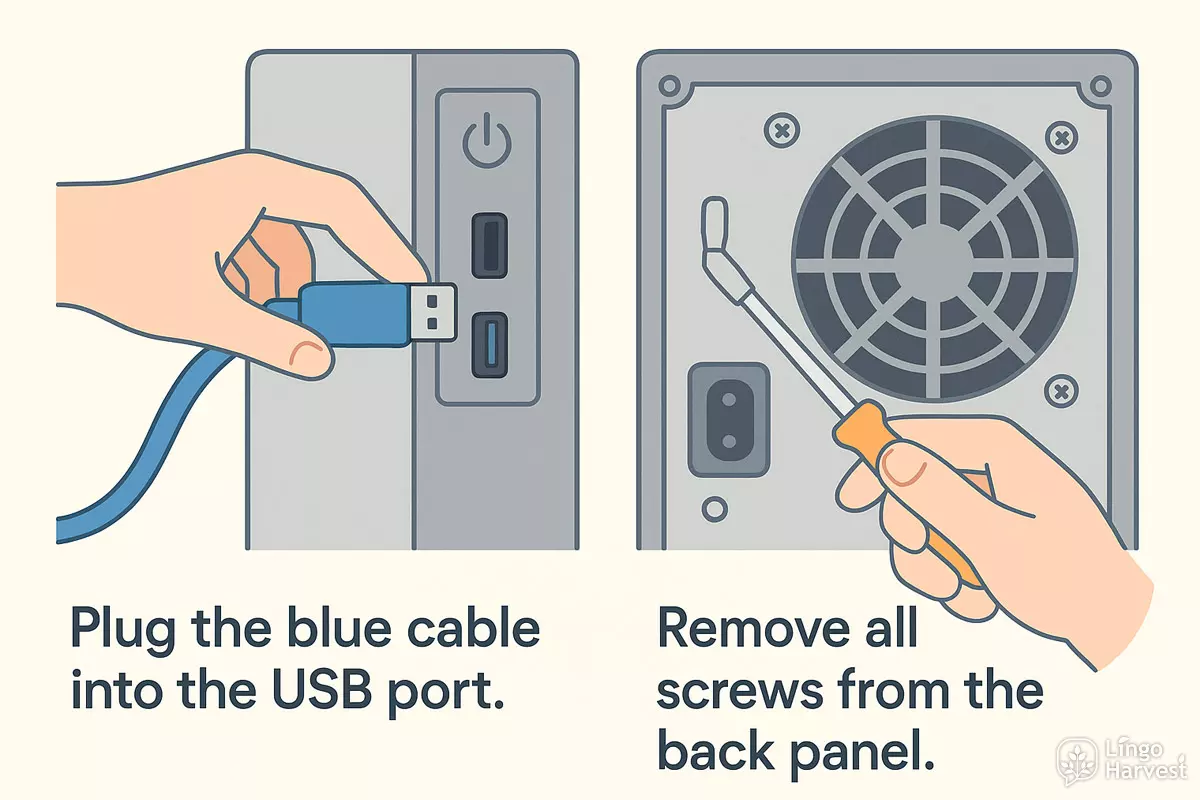
Comparing vague and precise instructions
| Vague phrasing | Precise with determiners |
|---|---|
| Plug cable into port. | Plug the blue cable into the USB port. |
| Remove screws. | Remove all screws from the back panel. |
| Attach handle. | Attach the handle to the right side. |
| Turn knob. | Turn the temperature knob to the “High” setting. |
Tips for effective use
- Choose determiners that eliminate doubt about which item or step is meant.
- Be consistent with terminology and reference points throughout the document.
- When describing sequences, use “first,” “next,” and “last” for chronological clarity.
- In lists or repeated actions, specify “each,” “all,” or “every” as needed.
- When alternatives are possible, clarify with “either,” “any,” or “whichever.”
By carefully selecting determiners, writers make instructions more user-friendly and reliable, reducing errors and saving time for everyone involved.
Using the for specific steps and components
When writing instructions or technical manuals, definite articles play an important role in clarifying which elements or actions are being addressed. The word the is used to refer to specific items, steps, or components that have either been previously mentioned or are uniquely identified within the context. This helps the reader understand exactly what is required at each stage of a procedure.
Identifying When to Use "the"
Use the to indicate a particular item or action that is distinct from others. For example, after introducing a part, subsequent references should use the to avoid confusion. This practice is essential for clarity, especially when multiple similar components exist.
- After you install a bracket, refer to it as the bracket in following steps.
- When several screws are present, specify the screw that holds a unique position, such as the top screw.
- Use the when only one instance exists in the context: "Tighten the main valve."
Common Phrases in Instructions
Writers often rely on certain phrases that use the to direct attention to precise steps or parts. Here are typical examples found in technical documentation:
- Align the connector with the socket.
- Press the power button to start the device.
- Remove the cover before proceeding.
- Insert the cable into the port.
- Check the indicator light for errors.
- Secure the panel using the supplied screws.
- Replace the filter every six months.
- Verify the settings before launching the test.
- Lock the lever in place.
- Clean the sensor with a dry cloth.
- Turn the knob to adjust the temperature.
- Slide the drawer back into position.
- Check the display for confirmation.
- Hold the button for five seconds.
- Attach the label to the package.
- Disconnect the device from the power source.
- Open the app to continue setup.
- Replace the battery as needed.
Why Definite Articles Matter in Technical Writing
Choosing the correct determiner is not just a matter of grammar—it helps prevent ambiguity. For instance, omitting the could suggest any item of a type, rather than the exact one needed. This can cause errors or misunderstandings, particularly in environments where precision is critical.
Comparing "the" with Other Articles
Sometimes, confusion arises about whether to use the, a/an, or no article at all. The table below highlights key distinctions for clarity:
| Article | When to Use |
|---|---|
| The | For a specific step, part, or item already defined or unique in context. Example: "Tighten the screw." |
| A/An | For introducing a new, non-specific item. Example: "Insert a battery." |
| No article | For general instructions or plural forms. Example: "Wear gloves." |
Using definite articles intentionally ensures readers know exactly which step or component is being referenced, reducing the risk of mistakes and improving the usability of your manuals and guides.
Using a or an when introducing new items
When writing instructions or technical manuals, it’s important to clearly signal when something is being mentioned for the first time. Indefinite articles (a or an) are used for this purpose. Choosing between them depends on the sound that begins the following word, not just the spelling. This helps the reader understand that the item is new and not previously referenced, which reduces confusion, especially in step-by-step guides.
How to choose between “a” and “an”
Use a before words that start with a consonant sound, and an before words that start with a vowel sound. This applies even if the spelling looks different (for example, “an hour” because the “h” is silent).
- a cable → Please connect a cable to the device.
- an adapter → I bought an adapter for my laptop.
- a USB port → This computer has a USB port on the side.
- an engineer → She works as an engineer in a tech company.
- a tool → You need a tool to fix this part.
- an instruction → Follow an instruction on the screen.
- a screwdriver → Pass me a screwdriver, please.
- an option → This is an option you can choose.
- a monitor → He uses a monitor for video editing.
- an update → There is an update available for the software.
- a label → Attach a label to the package.
- an error message → An error message appeared on the display.
- a manual → Read a manual before using the machine.
- an example → She gave an example to explain the rule.
- a brief pause → Let’s take a brief pause before continuing.
- an item → Each item must be checked carefully.
Common pitfalls and tricky cases
Some words can be confusing because the first letter does not match the first sound. For instance, “an honor” is correct because the h is silent, while “a user” is correct because “user” starts with a y sound.
| Correct Usage | Explanation |
|---|---|
| an hour | Silent 'h', starts with a vowel sound |
| a user | 'u' sounds like 'you', a consonant sound |
| a unique tool | 'unique' starts with 'yu-', a consonant sound |
| an error | Starts with a vowel sound |
Avoiding vague reference in safety instructions
Clear and precise language is essential when writing safety instructions. Vague references, such as unclear pronouns or ambiguous determiners, can create confusion and lead to dangerous misunderstandings. When technical manuals use phrases like "it," "these," or "this" without clear antecedents, users may misinterpret what action to take or which part to handle, increasing the risk of accidents.
Why specificity matters in safety messages
Ambiguity can undermine the primary goal of safety documentation: protecting users. If instructions refer to components or actions in a non-specific way, readers might apply steps incorrectly or overlook important warnings. For example, "Remove it carefully" leaves users guessing what "it" refers to, potentially resulting in harm or equipment damage.
Common vague references to avoid
Writers should be mindful of words that can cause uncertainty. Some of the most frequent sources of confusion include:
- Unclear pronouns: it, they, these, those, this, that
- General determiners: some, any, each, either
- Non-specific nouns: item, part, thing, component
- Ambiguous instructions: "Do this," "Handle carefully," "Check it," "Replace as needed"
- Referencing previous steps without restating context
- Using "the" without clarifying which object is meant
- Omitting the subject in imperative sentences
- Relying on context that may not be obvious to the reader
- Reusing the same term for multiple objects in close proximity
- Failing to specify quantities or locations ("Turn off the switch" when multiple switches exist)
Strategies for clarity in technical manuals
Writers can reduce ambiguity by applying several practical techniques:
- Use specific nouns instead of pronouns (e.g., "the left power cable" instead of "it").
- Restate the object or action if there is any chance of confusion.
- Number or label steps and refer to these explicitly ("Refer to Step 3").
- Identify components by color, label, or position when possible.
- Avoid using "the" or "this" unless the reference is unmistakable.
- Clarify quantities and locations ("Turn off both main switches" instead of "Turn off the switch").
- Test instructions with someone unfamiliar with the equipment to check for clarity.
- Use diagrams or images to supplement written references.
- Highlight changes in context when shifting from one component to another.
- Consistently use the same term for the same object throughout the document.
- Provide definitions for any potentially ambiguous term in a glossary.
Examples: Vague vs. Specific Safety Instructions
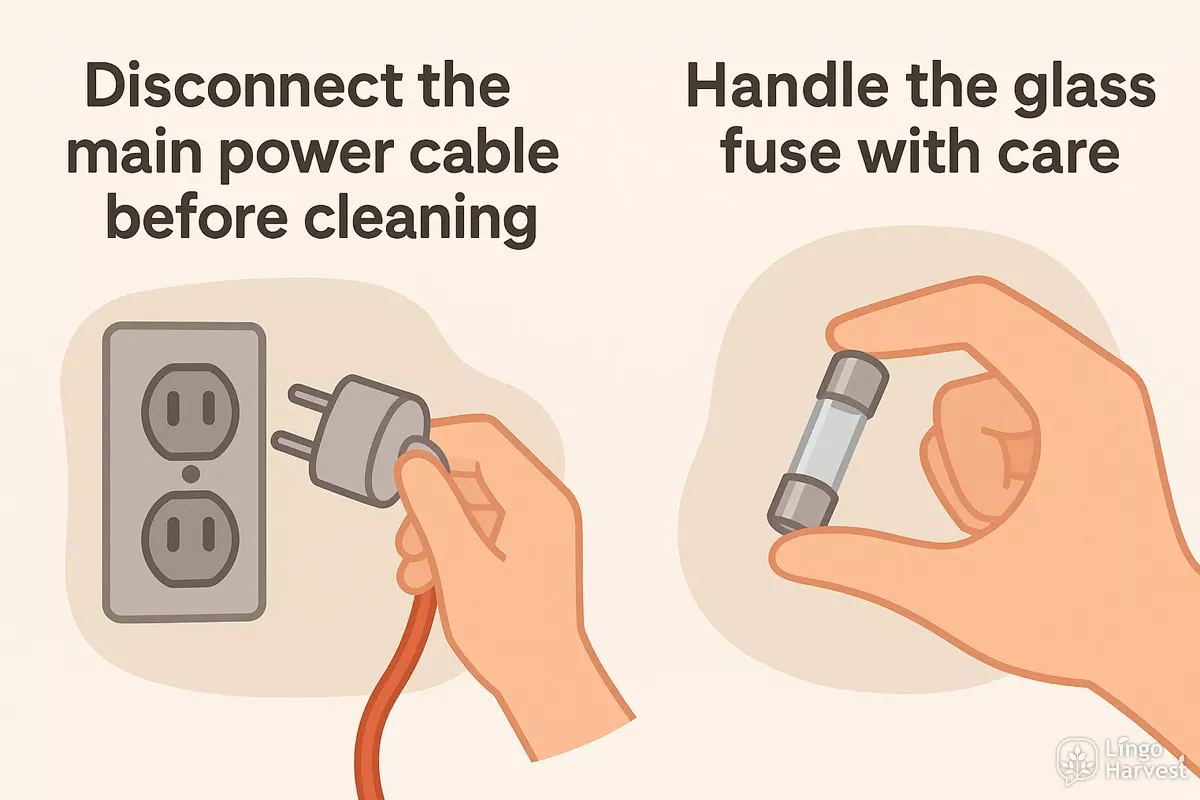
| ❌ Vague Reference | ✅ Clear, Specific Reference |
|---|---|
| Disconnect it before cleaning. | Disconnect the main power cable before cleaning. |
| Handle this with care. | Handle the glass fuse with care. |
| Check if it is secure. | Check if the safety guard is secure. |
| Replace it if damaged. | Replace the filter cartridge if damaged. |
| Turn it off in an emergency. | Turn off the red emergency power switch in an emergency. |
| Remove these before starting. | Remove the protective covers before starting the machine. |
| Ensure this is locked. | Ensure the access panel is locked. |
| Do not touch them during operation. | Do not touch the rotating blades during operation. |
| Store it in a safe place. | Store the battery pack in a dry, secure location. |
| Check that it is off. | Check that the compressor switch is off. |
Choosing precise determiners and nouns in safety documentation ensures that instructions are easy to follow, minimizing risk and supporting safe use of equipment.
Reference chains across multi-step procedures
Clear and consistent use of determiners is crucial when instructions span several steps, especially when items or actions are referenced again after intervening details. Technical manuals often require users to keep track of components, tools, or results introduced earlier. The challenge is to maintain clarity so the reader does not lose track of the objects or actions being discussed as they progress through a sequence.
Maintaining clarity in multi-step instructions
Writers must ensure that references to previously mentioned elements remain unambiguous. This involves careful use of determiners such as "the," "this," "that," and "each" to guide the reader. For example, after introducing "a screw," subsequent mentions should specify "the screw" or "this screw" to prevent confusion, especially if multiple similar items are involved.
- the (definite article): Refers back to a previously mentioned object, e.g., "Insert a bolt. Tighten the bolt."
- this/that: Emphasizes proximity or distinction, e.g., "Set aside this panel. Do not use that panel yet."
- each: Used for repeated actions across multiple items, e.g., "Repeat the process for each cable."
- these/those: For groups introduced earlier, e.g., "Attach these wires to their connectors."
- another: Indicates an additional item, e.g., "Take another filter."
- its/their: Shows possession for singular/plural antecedents, e.g., "Tighten the nut on its bolt."
- such: Refers to a type already described, e.g., "Use such screws for metal parts."
- both: When referencing two items, e.g., "Align both brackets."
- either/neither: Used for choices or exclusions, e.g., "Connect either cable."
- same/other: For distinctions, e.g., "Repeat on the other side."
Common pitfalls and best practices
Ambiguities often arise when multiple similar items are in play and determiners are dropped or misused. For example, referring to "the screw" when several screws have been introduced without distinction can confuse users. To avoid this, writers should:
- Use specific determiners ("this lever," "the upper bracket") when reintroducing items after several steps.
- Clarify references if a new but similar item appears ("another cable," "the second switch").
- Maintain consistency in terminology; avoid switching between synonyms mid-procedure unless clearly defined.
- Summarize or restate the referent after a long interval or when context may be forgotten.
Examples of referencing patterns in multi-step procedures
Consistent referencing improves comprehension. Here are typical reference chains found in technical instructions:
- Install a washer. Place the nut onto the washer.
- Remove the cover. Set it aside for later.
- Locate the two buttons. Press each button in sequence.
- Attach the hose. Ensure this hose is secure before proceeding.
- Insert the memory card. Close the slot cover.
- Take a sample. Label this sample with the date.
- Identify the output port. Connect the cable to that port.
- Open the access panel. After inspection, replace the panel.
- Pull out a fuse. If the fuse is damaged, replace it.
- Align both rails. Tighten their screws.
- Repeat the cleaning process for each filter.
- Check the light. If it is not working, replace the bulb.
Reference determiners: Summary table
| Determiner | Typical Use in Procedures |
|---|---|
| the | Refers to a specific, previously mentioned item ("the panel") |
| this/that | Highlights proximity, distinction, or sequence ("this switch," "that lever") |
| each | Indicates repetition over several items ("each screw") |
| another | Introduces an additional or different item ("another cable") |
| its/their | Shows possession or relation for singular/plural items ("its slot," "their connectors") |
Effective use of determiners in multi-step instructions helps readers track items and actions without confusion. By structuring reference chains carefully, writers can ensure users follow procedures accurately, even in complex manuals.
Examples from manuals and user guides
When writing instructions or technical documentation, determiners help clarify what the user should do, which items to use, and how to proceed step-by-step. Clear reference to specific objects, quantities, or steps is essential for avoiding confusion. Below are typical ways determiners appear in procedural texts, with examples drawn from real-world guides.
Common Determiner Patterns in Instructions
- the (definite article): Indicates a specific item already mentioned or known to the reader.
Example: "Press the power button to turn on the device." - a/an (indefinite articles): Refers to any single item not previously specified.
Example: "Connect a USB cable to the port." - this/these: Directs the user’s attention to something near or just introduced.
Example: "Insert these batteries as shown." - that/those: Refers to items farther away or previously mentioned.
Example: "Remove those screws from the panel." - each: Emphasizes individual attention to every item in a group.
Example: "Tighten each bolt securely." - every: Refers to all items in a set, collectively.
Example: "Check every connection." - any: Allows for flexibility or choice.
Example: "If any error occurs, restart the process." - some: Indicates an unspecified quantity, often when the exact number is not important.
Example: "Add some lubricant to the gears." - all: Means the total set must be included.
Example: "Remove all packaging materials." - no: Specifies that something must not be present.
Example: "Ensure no wires are exposed."
Side-by-Side Comparison of Determiner Usage
| Instruction | Explanation |
|---|---|
| Plug the cable into the socket. | Refers to a specific cable previously identified, reducing ambiguity. |
| Replace a filter if it is dirty. | Any one filter, not a particular one; useful for interchangeable parts. |
| Check each screw for tightness. | Emphasizes action on every individual screw, not just a few. |
| Ensure no liquids are present. | Indicates that zero liquids should be found, a safety precaution. |
| Install those brackets on the left side. | Directs attention to specific brackets, likely shown in a previous step or diagram. |
Quick Reference: Typical Phrases with Determiners
- Open the cover carefully.
- Attach all connectors.
- Turn this knob to adjust the temperature.
- Insert an SD card to begin recording.
- Remove any obstructions from the slot.
- Check every fuse before proceeding.
- Use some water to clean the filter.
- Do not press that button during operation.
- Replace each battery with a new one.
- Store the device in a dry place.
By choosing the right determiner, technical writers make instructions clearer and help users avoid mistakes. The examples above illustrate how subtle differences in wording can guide users to the correct action, improve safety, and enhance the usability of guides and manuals.
Practice: improve clarity in technical instructions
Clear technical documentation often depends on precise use of determiners such as “the,” “a,” “each,” or “this.” To communicate instructions without ambiguity, writers must choose determiners that direct the reader’s attention to the correct object or step at every stage. This section offers hands-on practice and guidance for selecting the most appropriate determiners in technical contexts.
Common Determiner Pitfalls in Manuals
Writers sometimes use vague or inconsistent references, which can lead to confusion. Typical issues include:
- Omitting necessary determiners, making it unclear which item to select or operate.
- Using “the” too early, implying a specific item before it has been introduced.
- Failing to distinguish between singular and plural items, leading to misinterpretation.
- Overusing “this” or “that,” which can confuse readers if multiple objects are present.
Improving Instructions: Determiner Selection
Consider the following pairs of instruction examples. Choose the version that offers greater clarity, then check your answers below.
- Insert the battery into a compartment.
Insert a battery into the compartment. - Connect each cable to its port.
Connect the cables to the ports. - Turn this knob clockwise.
Turn the knob clockwise. - Press a button to start.
Press the button to start.
Show answers
- Insert a battery into the compartment.
Reason: The compartment has usually been specified, but the battery could be any one that fits. - Connect each cable to its port.
Reason: “Each” emphasizes individual matching, reducing ambiguity. - Turn the knob clockwise.
Reason: Use “the” if there is only one knob or it has been introduced. - Press the button to start.
Reason: “The button” implies a specific, previously identified button.
Useful Determiner Patterns for Technical Writing
Here are determiners and phrases that frequently improve precision in manuals and procedures:
- the (for specific, previously mentioned items: “the lever”)
- a/an (when introducing a non-specific item: “a module”)
- each (for actions repeated on every item: “each screw”)
- every (for repeated steps: “every connection”)
- this/that (when referring to a nearby or previously mentioned object: “this switch”)
- these/those (for plural references: “these wires”)
- any (when the choice is not limited: “any slot”)
- all (for collective actions: “all components”)
- its/their (for possessive clarity: “its label,” “their covers”)
- another (for repeating actions with a different item: “another tray”)
- no (for negative instructions: “no cables should be loose”)
- both (when referring to two items: “both panels”)
- either (when a choice is possible: “either port”)
- each of the (to specify items from a known set: “each of the bolts”)
- the first/next/last (for sequence: “the next step”)
Quick Editing Exercise
Revise the following instruction fragments for greater clarity by adding or improving determiners as needed:
- Attach cable to port.
- Insert disk into drive.
- Check indicator light for errors.
- Replace cover and tighten screws.
- Turn switch to power on position.
- Connect device to network.
- Adjust volume using control knob.
- Remove battery from compartment.
- Align connector with socket.
- Secure panel with bolts.
Show answers
- Attach the cable to the port.
- Insert the disk into the drive.
- Check the indicator light for errors.
- Replace the cover and tighten the screws.
- Turn the switch to the power on position.
- Connect the device to the network.
- Adjust the volume using the control knob.
- Remove the battery from the compartment.
- Align the connector with the socket.
- Secure the panel with the bolts.
Summary Table: Determiner Choices in Context
| Determiner | Typical Use in Instructions |
|---|---|
| the | Use for a specific, known item (“the main switch”) |
| a/an | Use when introducing an item for the first time (“a cable”) |
| each | For repeated actions on individual items (“each connector”) |
| this/that | For immediate or previously mentioned items (“this button”) |
| all | Denotes collective action (“all components”) |
| no | For negative instructions (“no wires should remain exposed”) |
Applying these patterns and distinctions can make technical instructions more precise, reducing errors and user frustration.