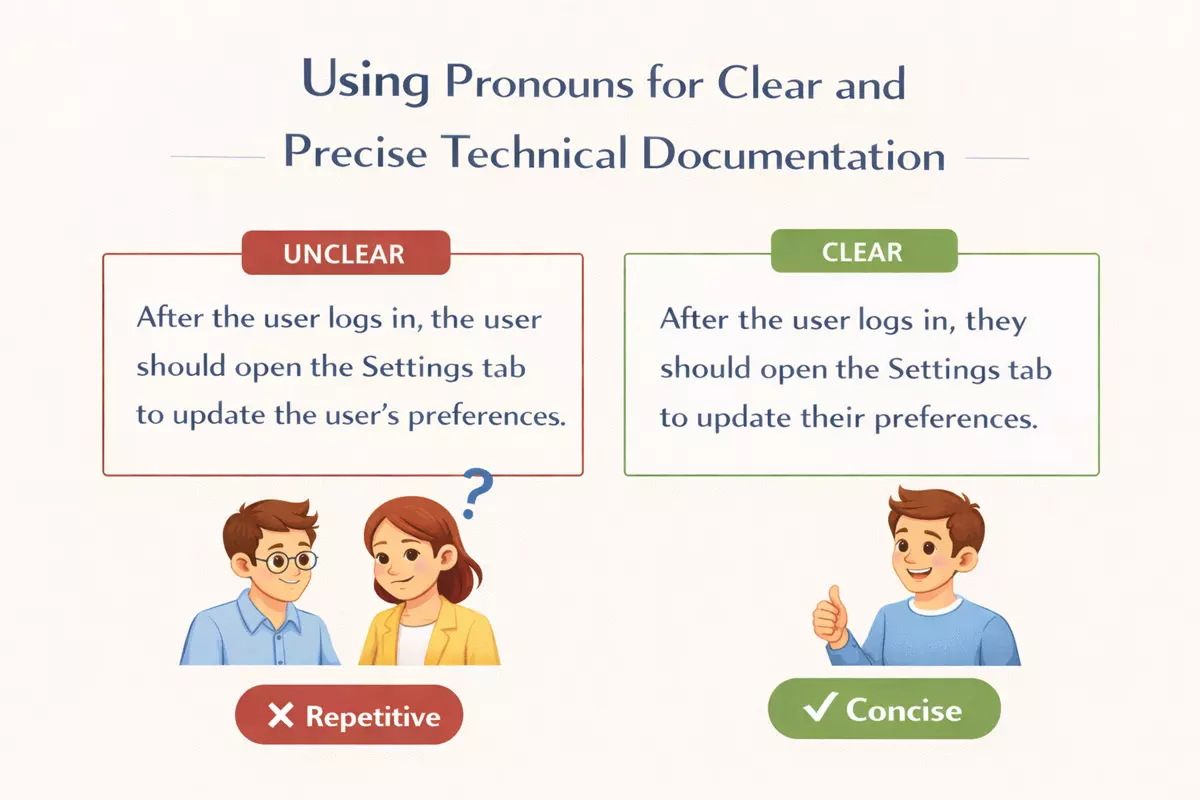
Using Pronouns for Clear and Precise Technical Documentation

 Here we clarity in technical documentation, including how to track references, use pronouns in procedures, avoid ambiguous terms, maintain consistency, focus on user needs, and apply an editing checklist to enhance clarity in technical writing.
- Clarity requirements in technical documentation
- Tracking reference across instructions
- Pronouns in step-by-step procedures
- Avoiding it/this ambiguity in manuals
- Consistency of reference terms
- User-centered writing considerations
- Editing checklist for documentation
- Practice: improve clarity in technical text
Creating technical documentation that is clear and easy to follow depends greatly on careful word choice, particularly when referencing people or objects. Using appropriate pronouns enhances the precision of instructions and helps readers avoid misunderstandings. By choosing pronouns thoughtfully, writers can ensure that their documentation is accessible and straightforward, ultimately improving the reader’s ability to comprehend and apply the information presented.
Clarity requirements in technical documentation
Clear technical writing is essential for reducing misunderstandings and ensuring that every reader, regardless of background, can follow instructions or concepts accurately. When documentation lacks precision, users may misinterpret steps, leading to errors or inefficient use of a product. For this reason, technical documents must be both unambiguous and accessible.
Core elements for unambiguous communication
- Consistency: Use the same terminology and phrasing throughout to prevent confusion.
- Specificity: Avoid vague references; be direct about who or what is being discussed.
- Conciseness: Remove unnecessary words that might distract from key instructions.
- Logical structure: Present information in a sequence that matches user expectations or workflows.
- Audience awareness: Adapt explanations to the reader’s likely level of expertise.
- Active voice: Prefer active constructions to clarify the actor and the action.
- Correct pronoun use: Choose pronouns that clearly refer to their antecedents, avoiding ambiguity.
- Visual aids: Integrate diagrams or screenshots where textual instructions might be misinterpreted.
- Terminology explanations: Define specialized terms when first introduced.
- Standard conventions: Follow established formats for commands, code, or references.
- Revision and peer review: Have others check for unclear or confusing passages.
- Internationalization: Consider non-native speakers and avoid idioms that might be misunderstood.
Common sources of confusion in pronoun usage

Pronouns are a frequent cause of ambiguity in manuals and guides. If it’s unclear what a word like "it" or "they" refers to, users may perform the wrong action or misinterpret a warning. The table below contrasts effective and problematic pronoun use in sample sentences.
| Ambiguous Example | Clear Alternative |
|---|---|
| After installing the driver, restart it. | After installing the driver, restart your computer. |
| If it fails, check the connection. | If the update fails, check the network connection. |
| When they are ready, proceed to the next step. | When the files are ready, proceed to the next step. |
| Replace it if necessary. | Replace the filter if necessary. |
Best practices for clarity
- Always identify the subject before using a pronoun.
- Repeat the noun if there’s any chance of confusion.
- Use singular or plural forms intentionally to match the antecedent.
- Test instructions with new users to uncover unclear references.
- Update documentation when product features or terminology change.
- Combine text with labels or callouts in images for added clarity.
Applying these principles ensures that documentation is not only technically accurate but also user-friendly, minimizing the risk of costly mistakes or frustration.
Tracking reference across instructions
Maintaining clarity when referring to previous steps or objects is essential in technical documentation. As instructions grow more complex, writers must ensure readers can easily follow which item, process, or action each pronoun or reference points to. Ambiguous references can lead to confusion, errors, or wasted time as users try to determine what “it” or “they” means in a given context.
Common Challenges with Pronoun Reference
Technical writers often face difficulties ensuring that pronouns refer unambiguously to the correct entity. Problems typically arise when:
- Multiple similar items are introduced in quick succession
- Steps are separated by intervening instructions or notes
- Lists or tables introduce several possible antecedents
- Sections reference objects described much earlier in the document
- Singular and plural forms are mixed in the same paragraph
- Readers are expected to remember specific configurations or selections
Strategies for Maintaining Clear Reference
To avoid ambiguity, apply the following strategies when referring back to earlier instructions or objects:
- Repeat the noun or phrase when there is any risk of confusion (e.g., “the installation directory” instead of “it”)
- Use descriptive noun phrases for clarity (e.g., “the blue cable” vs. “the cable”)
- Limit the number of steps between an object’s introduction and its next reference
- Number or label items that will be referenced later (“Connector 1,” “Button A”)
- Restate the context if a reference might be ambiguous (“After saving the file, close the application”)
- Use definite articles (“the button” vs “a button”) only when the item is uniquely identified
- Avoid using “this,” “that,” “these,” or “those” without a clear noun following (e.g., write “this setting” instead of just “this”)
- Introduce a summary table or diagram when tracking multiple components
- Keep instructions concise to reduce memory load on the reader
- Test your instructions by asking someone unfamiliar with the process to follow them
Reference Patterns and Their Effectiveness
The table below compares common forms of reference and their clarity in multi-step procedures:
| Reference Pattern | Clarity ✅ / Ambiguity ❌ |
|---|---|
| “Click the ‘Install’ button. It will start the process.” | ❌ (Unclear if “it” refers to the button or process) |
| “Click the ‘Install’ button. The installation process will start.” | ✅ (Clear reference) |
| “Connect the cables. They should be secured tightly.” | ✅ (Clear if only cables are mentioned) |
| “Attach the sensor to the panel. Then secure it with the screws.” | ❌ (“It” could mean sensor or panel) |
| “Attach the sensor to the panel. Then secure the sensor with the screws.” | ✅ (Eliminates ambiguity) |
Summary Tips
- Always consider the reader’s perspective—assume they do not remember prior context perfectly
- Favor explicit references when documenting multi-step or multi-object procedures
- Review and revise instructions to minimize pronoun ambiguity
By carefully managing how objects and actions are referenced, technical documentation remains accessible and reduces the risk of user error.
Pronouns in step-by-step procedures
When writing instructions, the choice and placement of pronouns can significantly affect clarity. Using the right pronouns helps avoid ambiguity about who should perform each action, especially in multi-step guides or technical walkthroughs. Carefully chosen references ensure users don’t have to guess whether “you,” “they,” or “it” applies to them or to a system component.
Using second-person vs. third-person
Most technical guides use the second-person pronoun “you” to address the user directly, making instructions more direct and actionable. However, in documentation for APIs or automated systems, third-person pronouns like “it” or “they” may be more appropriate when referring to components or processes.
- “You” for user actions: “Click the Submit button to continue.”
- “It” for software or hardware: “After installation, it will restart automatically.”
- “They” for plural elements: “If the files are missing, they must be restored before proceeding.”
Common pronoun pitfalls in instructions
Unclear pronoun references can confuse readers, especially when several items are mentioned in quick succession. To avoid this, always ensure the antecedent (the noun the pronoun refers to) is obvious. Repeating the noun occasionally, instead of relying solely on pronouns, can help maintain precision.
- Avoid ambiguous “it” after mentioning multiple objects.
- Don’t switch between “you” and passive voice in the same procedure without clear reasoning.
- Use gender-neutral pronouns or rephrase to avoid unnecessary gendering.
Examples of pronoun usage in procedural steps
Here’s a comparison of pronoun choices in step instructions:
| Instruction | Pronoun Use |
|---|---|
| Click the icon to open the menu. Then select your preferred option. | Direct second-person (“your”) |
| Once the application finishes loading, it will display the dashboard. | Third-person singular (“it”) |
| Verify all cables are connected. If they are loose, reconnect them securely. | Third-person plural (“they” / “them”) |
| When prompted, enter your password and press Enter. | Implied second-person (“your”) |
| If the settings have changed, restore them to their default values. | Third-person plural (“them” / “their”) |
Best practices for pronoun clarity
- Prefer “you” for user-directed steps unless addressing a system or object.
- Repeat nouns when multiple entities are involved to avoid confusion.
- Maintain consistency in pronoun use throughout a procedure.
- Review each step for possible ambiguous references, especially after edits.
- Opt for clear, concise sentences—brevity helps reduce pronoun ambiguity.
Effective pronoun use in instructional writing ensures that each step is easy to follow and free from misinterpretation. This attention to detail helps users complete tasks efficiently and with confidence.
Avoiding it/this ambiguity in manuals
Clear technical documentation relies on precise references, especially when pronouns like "it" and "this" might confuse readers. Ambiguity often arises when these pronouns point to multiple possible nouns or actions, leaving users uncertain about the subject. To ensure instructions are always understood as intended, technical writers can adopt several practical strategies.
Replace Vague Pronouns with Specific Nouns
One of the simplest ways to enhance clarity is to substitute ambiguous pronouns with the exact term they represent. This approach is particularly effective in procedural steps or troubleshooting guides, where multiple items or actions are discussed.
- Replace "it" with the device name: "Turn off the router" instead of "Turn it off."
- Use the actual process: "Repeat the calibration procedure" instead of "Repeat it."
- Specify the component: "Tighten the left bolt" instead of "Tighten it."
Consistent Terminology and Referencing
Maintaining uniform naming conventions throughout a manual ensures readers always know what is being referred to. Introducing each component or process with a clear label helps avoid confusion later.
- Define terms at first use, then use them consistently.
- Numbering steps or labeling sections can provide clear reference points.
- When multiple similar items are present, assign unique identifiers (e.g., "Button A," "Button B").
Examples of Clear vs. Ambiguous Usage
To illustrate how specific language improves clarity, consider the following comparison:
| Ambiguous Example | Revised for Clarity |
|---|---|
| After connecting the cable, plug it in. | After connecting the cable, plug the power cord into the outlet. |
| Press the button, then turn it to the left. | Press the release button, then turn the adjustment knob to the left. |
| If it fails, restart it. | If the printer fails, restart the printer. |
| When it is complete, remove it. | When the installation is complete, remove the USB drive. |
Additional Tips for Reducing Ambiguity
Writers can further minimize misunderstandings by adopting these habits:
- Limit each instruction to a single action or subject per sentence.
- Re-read instructions from a user’s perspective to spot potential confusion.
- Use diagrams or callouts to visually reinforce textual references.
- Review and revise whenever multiple nouns or actions appear before a pronoun.
- Solicit feedback from testers who are unfamiliar with the product or process.
By proactively identifying and eliminating vague pronoun references, manuals become more accessible and reduce the risk of user error. Consistency, specificity, and user testing are key to producing documentation that communicates effectively.
Consistency of reference terms
Choosing and sticking with the same words when referring to tools, features, or components is crucial in technical writing. Shifting between different labels or pronouns for the same concept can confuse readers, especially in complex documentation. By maintaining a uniform approach to reference words, writers help users track the subject through long explanations, reducing the cognitive load.
Why uniformity in references matters
Switching terms mid-instruction—like alternating between “the application,” “this tool,” and “it”—can create ambiguity. A clear and repeated reference lets users know exactly what each pronoun or noun points to, especially when multiple entities are involved. This is particularly important when instructions involve steps that refer back to previously introduced elements.
Common pitfalls in reference usage
- Alternating between singular and plural forms for the same item (e.g., “the user” vs. “users”)
- Mixing specific names and generic pronouns without clear antecedents
- Inconsistent capitalization or spelling of product names
- Using “it,” “they,” or “this” without clarifying the subject
- Introducing abbreviations without explanation, then using them interchangeably with full terms
- Switching between technical and colloquial terms (e.g., “repository” vs. “repo”)
- Referring to the same function as both “feature” and “module”
- Changing the person perspective (e.g., “you,” “the user,” “users”)
- Using different terms for the same interface element (e.g., “button,” “icon,” “control”)
- Describing the same process with different verbs (e.g., “submit,” “send,” “upload”)
Examples of Consistent Reference in Technical Writing

Each example highlights the preferred reference term in bold and shows how repeating it prevents confusion.
- To install the application, download the application and run the installer.
- Open the Settings panel, then update the Settings panel to enable notifications.
- Click the Export button and wait until the Export button finishes processing the file.
- Enable two-factor authentication and keep two-factor authentication active for all admin accounts.
- Create a backup file before changes, and store the backup file in a separate location.
- Connect to the database server, then restart the database server after applying the update.
- Open the repository in your IDE, and commit changes to the repository only after tests pass.
- Submit the support request through the portal, and track the support request using the ticket ID.
Strategies for maintaining clarity
Writers can avoid confusion by establishing terminology early and using it consistently. If a pronoun is introduced, ensure its antecedent is unmistakable. For complex documents, consider including a glossary or a terminology table for reference. Consistency also applies to grammar and sentence structure—when you start with a certain form, keep it throughout a section or document.
| Reference Term | Recommended Usage |
|---|---|
| the application | Use for all mentions of the software; avoid switching to “the tool” or “it” without context. |
| user | Stick with “the user” or “users” throughout, not “you” or “they,” unless addressing the reader directly. |
| repository (repo) | Introduce abbreviation once, then use it consistently; do not alternate with other terms. |
| submit | Choose one verb for an action (e.g., “submit the form”) and avoid synonyms like “send” or “upload” unless they mean something different. |
Quick tips for reference consistency
- Define key terms at the start of your documentation.
- Reuse established terminology for the same concept throughout.
- Minimize pronoun use when multiple entities are present.
- Check for inadvertent synonym swaps during editing.
- Apply style guides or glossaries for team consistency.
Ultimately, a predictable pattern of reference words helps readers follow instructions with less effort, increasing the precision and reliability of technical documents.
User-centered writing considerations
Adapting pronoun usage in technical documentation involves careful attention to the needs and backgrounds of intended readers. Writers should focus on clarity, accessibility, and inclusivity while ensuring instructions are easy to follow. For example, deciding when to use "you," "we," or passive constructions can directly affect how users interpret steps, responsibilities, and expected outcomes.
Matching pronoun choice to audience expertise
Selecting the right pronouns depends on understanding your users’ familiarity with the material. For beginners, direct address ("you") can make instructions more approachable, while advanced readers may prefer concise or impersonal phrasing. Consider the following approaches:
- Use "you" for step-by-step guides to foster engagement (e.g., "You can save your file by...").
- Employ passive voice when the actor is unimportant or obvious (e.g., "The file is saved automatically.").
- Switch to "we" in collaborative or team-oriented contexts (e.g., "We recommend updating your software regularly.").
- Avoid ambiguous pronouns that could confuse which entity is performing an action.
Reducing ambiguity and enhancing precision
Clear technical writing relies on pronouns that unambiguously refer to the correct object or actor. Vague references, especially in complex processes, can mislead users. Consider these strategies:
- Repeat the noun instead of relying on "it" or "they" if multiple items are present.
- Limit the use of "this" or "that" when referencing previous steps unless context is obvious.
- Be specific when describing user actions and system responses.
Inclusivity and tone
The tone set by pronoun usage can influence whether documentation feels welcoming or distant. Modern documentation often avoids gendered language and strives for inclusivity. Here are some recommended practices:
- Use singular "they" when referring to a generic user instead of "he/she."
- Favor direct address ("you") for a conversational but professional tone.
- Be mindful of cultural or language differences that may affect pronoun interpretation.
- Avoid jargon or idiomatic expressions that may be unclear to non-native speakers.
Common pronoun patterns in technical documentation
Writers often rely on a set of standard pronoun patterns to maintain consistency. The table below summarizes typical uses, advantages, and potential pitfalls:
| Pattern | Usage Notes |
|---|---|
| "You" | Direct and user-focused; ideal for instructions and tutorials. ✅ Engaging, but may not suit reference materials. |
| "We" | Collaborative tone; appropriate for team settings or when representing the organization. Use sparingly to avoid confusion. |
| Passive voice | Removes the actor; useful for objective descriptions. → Can obscure responsibility if overused. |
| Impersonal ("the system," "the user") | Clarifies roles in complex workflows; helpful in multi-user or system documentation. |
Balancing these considerations ensures documentation remains clear, precise, and approachable for diverse audiences. By anticipating user needs and thoughtfully selecting pronouns and structures, writers can significantly improve the usability and effectiveness of technical content.
Editing checklist for documentation
When reviewing technical content, it’s important to confirm that pronoun use supports clarity and precision. Consistent, thoughtful reference helps readers understand instructions and avoids ambiguity. Editors should focus on how pronouns connect to their antecedents, whether they introduce confusion, and if they reflect the intended audience and usage context.
Key points to review when editing pronouns
- Identify every pronoun and ensure its antecedent is clear and unambiguous.
- Check if pronouns are appropriate (e.g., “it,” “they,” “this,” “that”) for the technical context.
- Replace vague references (e.g., “it” or “they” with unclear meaning) with specific nouns when needed.
- Ensure consistency in pronoun use, especially in instructions or procedural steps.
- Evaluate the use of “you” (second-person) versus passive or impersonal constructions for user guidance.
- Avoid unnecessary gendered pronouns; use neutral alternatives or repeat the noun if possible.
- Scan for pronouns that might be interpreted differently by international audiences or non-native speakers.
- Verify that plural and singular forms are used correctly to match their antecedents.
- Check for unintentional personification of inanimate objects (e.g., “the system updates itself”).
- Review for excessive repetition of nouns where pronouns could improve flow, but balance with clarity needs.
- Remove redundant pronouns or double subjects (e.g., “The application it will…” ❌).
- Confirm pronouns do not create ambiguity in multi-step procedures or lists.
- Assess whether demonstrative pronouns (“this,” “these,” etc.) clearly refer to the correct concept or item.
- Check for pronoun shifts within the same section or document (e.g., switching from “you” to “the user”).
- Ensure pronoun use aligns with the documentation’s voice and audience expectations.
Common pronoun pitfalls and preferred alternatives
| Problematic Usage | Preferred Alternative |
|---|---|
| “It must be configured before you use it.” (Unclear what “it” refers to) | “The device must be configured before use.” |
| “They can reset it by pressing the button.” (“They” is ambiguous) | “Users can reset the device by pressing the button.” |
| “He or she should check the logs.” (Unnecessarily gendered) | “The administrator should check the logs.” or “Check the logs.” |
| “This will fail if not updated.” (“This” is vague) | “The installation will fail if not updated.” |
Final review tips
- Read sentences aloud to catch awkward or unclear pronoun references.
- Ask a colleague to review for possible ambiguities you may have missed.
- Consider the perspective of a first-time reader: is every pronoun’s meaning obvious without prior knowledge?
- Use search tools to scan for common pronouns (“it,” “they,” “this,” etc.) and review each in context.
Careful attention to these aspects helps ensure technical documentation remains accessible, accurate, and easy to follow for all users.
Practice: improve clarity in technical text
Clear and precise language is essential in technical documentation. Ambiguous pronouns, unclear references, and overly complex sentences can confuse readers and introduce errors. This section presents actionable strategies, common pitfalls, and hands-on exercises to help you refine your technical writing by using pronouns thoughtfully.
Guidelines for Using Pronouns Effectively
- Always identify the antecedent: Make sure it’s obvious what each pronoun refers to.
- Avoid chains of pronouns: Use nouns again if the reference might be unclear.
- Be specific with “it,” “they,” and “this/that”: Consider replacing these with the actual noun if ambiguity is possible.
- Keep sentences concise: Shorter sentences reduce the chance of pronoun confusion.
- Use gender-neutral language: Prefer “they” or repeat the noun to avoid unnecessary gendering.
- Limit pronoun use in steps or lists: Repeat the subject for clarity in procedures.
- Check for pronoun consistency: Don’t switch from singular to plural or vice versa without reason.
- Review after editing: Changes in sentence order may break clear pronoun references.
- Use “which” and “that” carefully: Ensure they refer to the correct noun.
- Consider the reader’s perspective: If a reader might pause and wonder, reword the sentence.
Common Pronoun Mistakes and Improvements
| Problematic Example | Improved Version |
|---|---|
| Install the driver on the device. Then restart it. | Install the driver on the device. Then restart the device. |
| When the server receives the request, it sends a response. | When the server receives the request, the server sends a response. |
| After compiling the code, save it. | After compiling the code, save the compiled file. |
| Users must enter their name and password before they can continue. | Users must enter their name and password before continuing. |
| The files are copied to the directory. They are then indexed. | The files are copied to the directory. The system then indexes the files. |
Practice Tasks: Spot and Fix Ambiguous Pronouns
- Read each sentence and identify any pronoun that could be misunderstood. Rewrite the sentence for clarity.
- Attach the cable to the port before you tighten it.
- When the application starts, it checks for updates and installs them.
- After reviewing the document, submit it to your supervisor.
- If the disk is full, delete files from it.
- The administrator updated the policy, which improved security.
- Press the button and hold it for five seconds.
- When the server restarts, it loads the configuration automatically.
- Save the file before you close it.
- If an error appears, report it to the support team.
- The system generated a report, and it was sent to management.
Show answers
- Attach the cable to the port before you tighten the cable.
- When the application starts, the application checks for updates and installs the updates.
- After reviewing the document, submit the document to your supervisor.
- If the disk is full, delete files from the disk.
- The administrator updated the policy. The update improved security.
- Press the button and hold the button for five seconds.
- When the server restarts, the server loads the configuration automatically.
- Save the file before you close the file.
- If an error appears, report the error to the support team.
- The system generated a report. The report was sent to management.
Checklist for Reviewing Pronoun Use
- Is every pronoun’s reference obvious to someone unfamiliar with the content?
- Could any sentence be clearer by repeating the noun?
- Have you avoided unnecessary gendered pronouns?
- Does each step in a process make sense on its own?
- Have you checked for consistency in singular/plural usage?
Making small changes to pronoun usage can significantly improve the clarity and accuracy of your documentation. Practice these techniques regularly to write instructions and explanations that are easy for all readers to follow.