Determiners in Scientific Writing: specificity vs generality

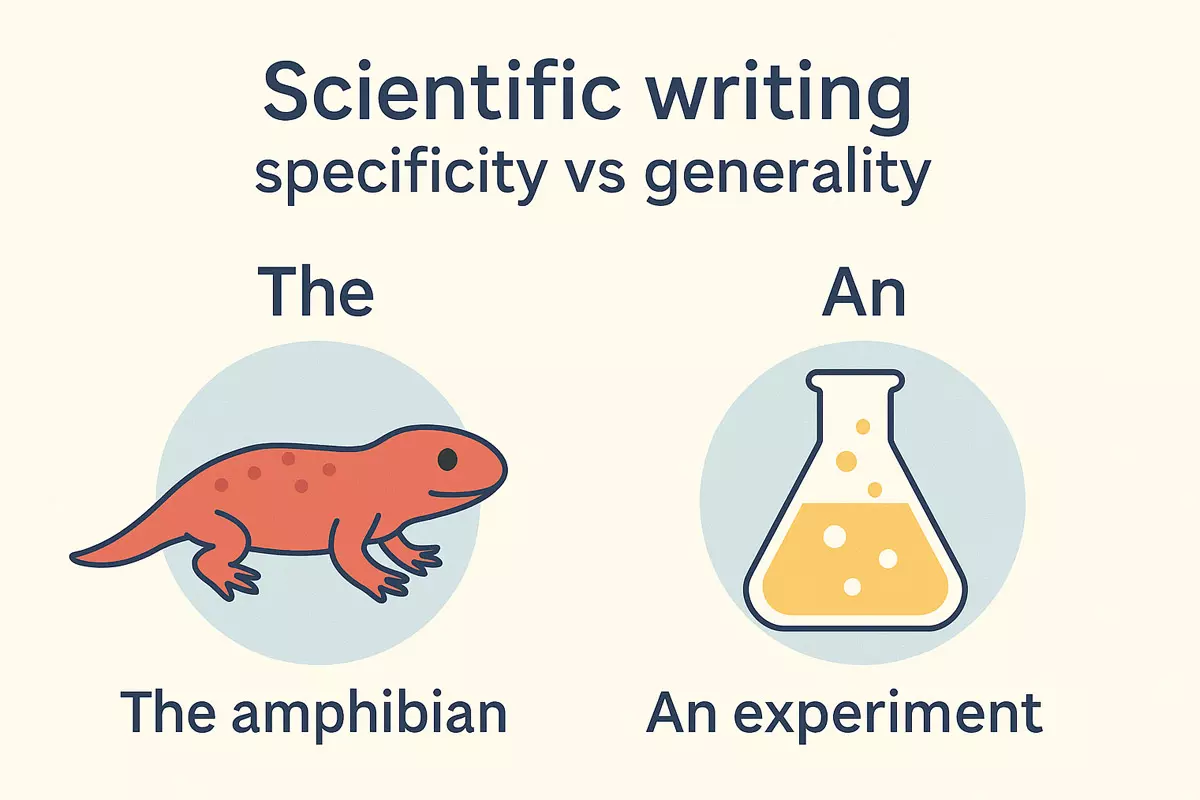 This article explains how to use the, a/an, and zero article in scientific writing. It covers referencing established concepts, introducing new variables, making general statements, common errors, examples from journals, and practice exercises.
- Why scientific writing needs precise reference
- Using the for established concepts or datasets
- Using a/an for new variables or examples
- Zero article for general statements about phenomena
- Common errors in scientific abstracts and methods
- Examples from journals and research reports
- Practice: adjust determiners for accuracy in scientific text
Selecting precise language to indicate whether you are referring to something specific or something more general can greatly influence the clarity and impact of your research communication. In academic writing, even small changes in wording that define the scope of your discussion can shape how readers interpret your work and contribute to the overall effectiveness of your paper. Being intentional with your choice of words ensures that your message is conveyed accurately and that your arguments are understood as intended.
Why scientific writing needs precise reference
Clarity and accuracy are essential in scientific communication. When authors choose between specific and general determiners, the meaning of their statements can change dramatically. For instance, “the enzyme” refers to a particular enzyme already introduced, while “an enzyme” could mean any enzyme of a given type. This difference is not trivial—misusing determiners may lead to confusion, misinterpretation, or even errors in replication.
How determiners shape scientific interpretation
Readers rely on precise language to understand experimental design, results, and conclusions. Ambiguous references—such as using “the” instead of “a,” or vice versa—can obscure which data or concepts are being discussed. This is especially important in fields where small distinctions have major consequences, such as pharmacology or molecular biology.
- “A sample” introduces one among many; “the sample” points to a specific one.
- “These results” refers to findings just mentioned; “those results” may point to outcomes discussed earlier or in another context.
- “Any solution” invites a broad interpretation, while “this solution” narrows the focus.
- “Some studies” implies an unspecified subset; “the studies” signals ones already defined.
- “One approach” introduces a new method; “the approach” means a previously described method.
- “Each experiment” emphasizes individual trials; “the experiment” singles out a particular one.
- “Another variable” suggests alternatives; “the variable” is definite.
- “Such conditions” links to earlier descriptions; “these conditions” means the present context.
- “All participants” is inclusive; “the participants” may be limited to a group already introduced.
- “Their findings” refers to results from other researchers; “our findings” to those of the authors.
Why precision matters for reproducibility and credibility
Scientific claims must be reproducible. If references within a paper are vague or inconsistent, other researchers may not be able to repeat the work or accurately interpret the conclusions. Choosing the correct determiner ensures that readers know exactly what material, methods, or data are being discussed. This not only supports transparency but also strengthens a study’s credibility.
Common pitfalls with determiners in science
- Using “the” before introducing a concept or object, creating false specificity.
- Switching between “this” and “that” without clear antecedents.
- Overusing general determiners (“some,” “any”) where specificity is required.
- Failing to signal shifts from general discussion to specific data.
Ultimately, careful selection of determiners is a cornerstone of effective scientific writing. It helps ensure that every claim, method, and result stands on a solid foundation of clear reference, supporting both understanding and scientific progress.
Using the for established concepts or datasets
When referring to concepts, theories, or datasets that are already well-defined in the literature or within your article, the definite article the is essential. This usage signals to readers that you are discussing a specific, previously identified entity rather than introducing something new or general. In scientific writing, this distinction helps maintain clarity and directs the reader’s attention to shared knowledge or agreed-upon frameworks.
Signaling Shared Knowledge
Writers often use the to indicate that a concept or dataset has been defined earlier in the text or is widely recognized by the field. For example, after introducing a dataset in the methods section, subsequent mentions should use the to refer back to it, establishing that it is not just any dataset, but the one under discussion.
- the Standard Model (in physics, after its initial definition)
- the control group (when it has been previously described)
- the 2010 census data (if referenced before)
- the results (following a results section introduction)
- the experiment (once the specific experiment is described)
- the survey responses (after outlining survey methodology)
- the regression model (after its parameters are specified)
- the training dataset (when distinguished from other data)
- the hypothesis (once the main hypothesis is stated)
- the literature review (following an overview of sources)
- the algorithm (after detailing its structure)
- the findings (when discussing previously summarized outcomes)
- the observed phenomenon (once it is clearly identified)
- the proposed solution (after it is introduced)
- the baseline measurement (when it is uniquely defined)
Comparison: Definite vs. Indefinite Reference
Authors must be careful: using the too early or with unfamiliar items can confuse readers. The following table compares contexts where the is appropriate to cases where it is not yet warranted:
| Appropriate Use (the) | Not Appropriate (omit the) |
|---|---|
| the data collected from participants in Study 1 | data collected from participants (when first mentioned) |
| the analysis described above | an analysis (when introducing a new analysis) |
| the algorithm implemented in this research | an algorithm (when presenting multiple options) |
| the results shown in Table 2 | results (when discussing results in general) |
When to Transition from "a/an" to "the"
A common pattern in scientific manuscripts is to introduce a new concept with a or an, then switch to the for all subsequent references. This progression helps the reader track which ideas are newly introduced and which are now established within the scope of discussion.
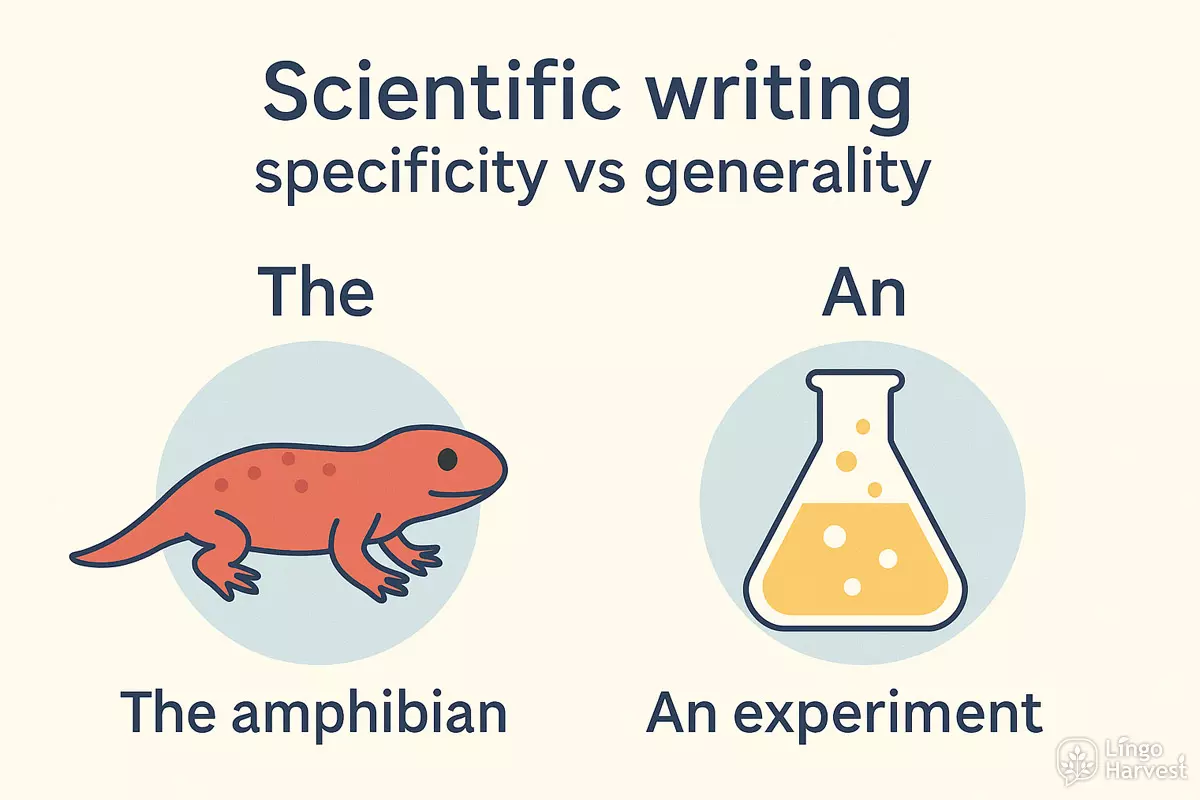
- First mention: “A new catalyst was synthesized.”
Subsequent: “The catalyst was characterized by X-ray analysis.” - First mention: “We developed an algorithm.”
Subsequent: “The algorithm improved classification accuracy.”
Careful use of the in this way signals to your audience that you are referring to a specific, established item, thus ensuring precision and coherence throughout your scientific writing.
Using a/an for new variables or examples
Introducing new elements—such as variables, hypothetical objects, or general cases—often requires indefinite articles like a or an. This signals to readers that the entity is not previously defined, and that it could represent any member of a broader category. In scientific writing, this approach helps clarify when you are presenting a generic instance rather than referring to something specific.
Introducing Variables and Hypotheticals
When establishing a new variable or concept, writers use a or an to highlight its non-specific, general nature. This practice is especially common in mathematics, logic, and empirical research. For example:
- Let a be a positive integer.
- Suppose an enzyme accelerates the reaction.
- Consider a function f(x) that is continuous on [0,1].
- Assume a sample is drawn randomly from the population.
- Let us define a parameter k.
- Imagine a particle moving along a straight line.
- If a solution exists, it must satisfy the equation.
- Let a and b be real numbers.
- Suppose an observer records the data.
- Consider a dataset with n entries.
- Take a random variable X.
- Let a matrix A be invertible.
- Suppose an error occurs during transmission.
- Imagine a scenario in which the temperature drops suddenly.
- Let a constant c represent the speed of light.
- Assume a function is differentiable.
- Suppose a hypothesis is tested under these conditions.
- Consider a solution y to the equation.
- Let a sequence {a_n} be defined as follows.
- Take a sample of size 100.
Clarifying Generality with Indefinite Articles
Choosing indefinite articles over definite ones (like the) indicates that the example or variable is not unique or previously discussed. This distinction is crucial in research contexts, where ambiguity can lead to misinterpretation.
Common Patterns in Academic Writing
Writers frequently use this strategy to introduce entities that will be defined or specified later. The following table presents common phrases and their functions:
| Phrase with a/an | Purpose |
|---|---|
| Let a function f be continuous | Introduce a generic function for subsequent discussion |
| Suppose a sample is selected | Present a hypothetical or random selection |
| If an error occurs | Describe a possible, unspecified event |
| Consider a case where... | Introduce a scenario for illustration or argument |
| Let a constant c denote... | Assign a value or symbol for later reference |
Summary
Using indefinite articles to introduce new variables or examples is a subtle but important strategy in scholarly communication. It signals generality, supports clear logic, and helps readers distinguish between unique entities and hypothetical or illustrative cases. This approach is fundamental for precision and clarity in technical and scientific texts.
Zero article for general statements about phenomena
In scientific writing, omitting articles is often the clearest way to make broad, universal statements about natural processes, materials, or abstract concepts. This usage signals that the writer is not referring to any particular instance, but to a phenomenon or substance in general. For example, when discussing water as a substance, or gravity as a force, the absence of "the" or "a" highlights their generality.
When to Use No Article
Writers typically leave out articles before uncountable nouns and plural count nouns when referring to them in a general sense. This approach is common in research papers, reviews, and theoretical discussions, where the focus is on general properties or behaviors rather than specific examples.
- Photosynthesis converts light energy into chemical energy.
- Proteins perform various functions in cells.
- Gravity affects all objects with mass.
- Information can be transmitted electronically.
- Errors may arise during data processing.
- Cells divide by mitosis.
- Oxygen is essential for respiration.
- Light travels faster than sound.
- Plants require sunlight for growth.
- Enzymes catalyze biochemical reactions.
- Antibiotics combat bacterial infections.
- Heat flows from warmer to cooler objects.
- Electrons orbit the nucleus.
- Viruses mutate rapidly.
- Pressure influences boiling point.
Comparison: Zero Article vs. Definite/Indefinite Articles
The choice between no article, "the," or "a/an" changes the scope of the statement. Consider the following patterns:
| Formulation | Context and Meaning |
|---|---|
| No article (e.g., Water boils at 100°C.) |
General truth or phenomenon; applies universally, not a specific instance. |
| The (e.g., The water in this flask is boiling.) |
Refers to a specific, previously mentioned or identified case or sample. |
| A/An (e.g., A solution was prepared.) |
Indicates one example or an unspecified instance among many possibilities. |
| Plural without article (e.g., Enzymes act as catalysts.) |
Generalizes about all members of the group, not specific ones. |
Typical Nouns That Take Zero Article
Many scientific terms naturally occur without an article when used to describe general phenomena or materials:
- Energy, matter, radiation, temperature
- Cells, atoms, molecules, organisms
- Water, air, soil, iron
- Gravity, magnetism, inertia
- Photosynthesis, respiration, combustion
This convention helps maintain clarity and precision, especially when distinguishing between universal scientific laws and specific experimental details. Recognizing when to use the zero article is essential for conveying generality and upholding the conventions of academic style.
Common errors in scientific abstracts and methods
Precision in the use of determiners—words like "the," "a," "this," and "some"—plays a crucial role in communicating scientific results. However, researchers often make recurring mistakes when drafting abstracts and methods sections, especially regarding specificity and generality. These issues can lead to ambiguity, misinterpretation, or lack of clarity for readers.
Ambiguity from vague determiners
Writers sometimes use general determiners when a specific one is needed, or vice versa. For instance, using "a solution" instead of "the solution" may suggest any solution, not the one just described. Such choices can obscure meaning and weaken the scientific statement.
- Overuse of "the" where "a" or "an" is appropriate
- Omitting determiners entirely, causing confusion (e.g., writing "experiment was conducted" instead of "an experiment was conducted")
- Using "this" or "these" without a clear antecedent
- Switching between specific and general determiners in the same context
- Unintentional generalization (e.g., "Researchers used method" instead of "The researchers used the method")
- Excessive use of "some" or "several" without quantification
- Failing to signal novelty or established knowledge (e.g., "a method" vs. "the method previously described")
- Misleading use of singular/plural forms with determiners
- Using "any" when "all" or "each" is meant
- Inconsistent references to the same entity (e.g., alternating between "the sample" and "a sample")
Common patterns of misuse: specificity vs generality
Writers often struggle with whether to signal a unique instance or a broader category. Choosing the wrong determiner can drastically change the meaning. Here are some frequent pitfalls:
- Describing a general principle with "the" (e.g., "the water boils at 100°C" instead of "water boils at 100°C")
- Presenting a specific result with "a" (e.g., "a increase was observed" instead of "an increase was observed")
- Using "this" to refer to a concept not previously introduced
- Employing "these" for singular items
- Switching between "the" and "a" for the same object across sections
- Generalizing findings by omitting determiners (e.g., "cells responded" instead of "the cells responded")
Examples of correct and incorrect determiner usage
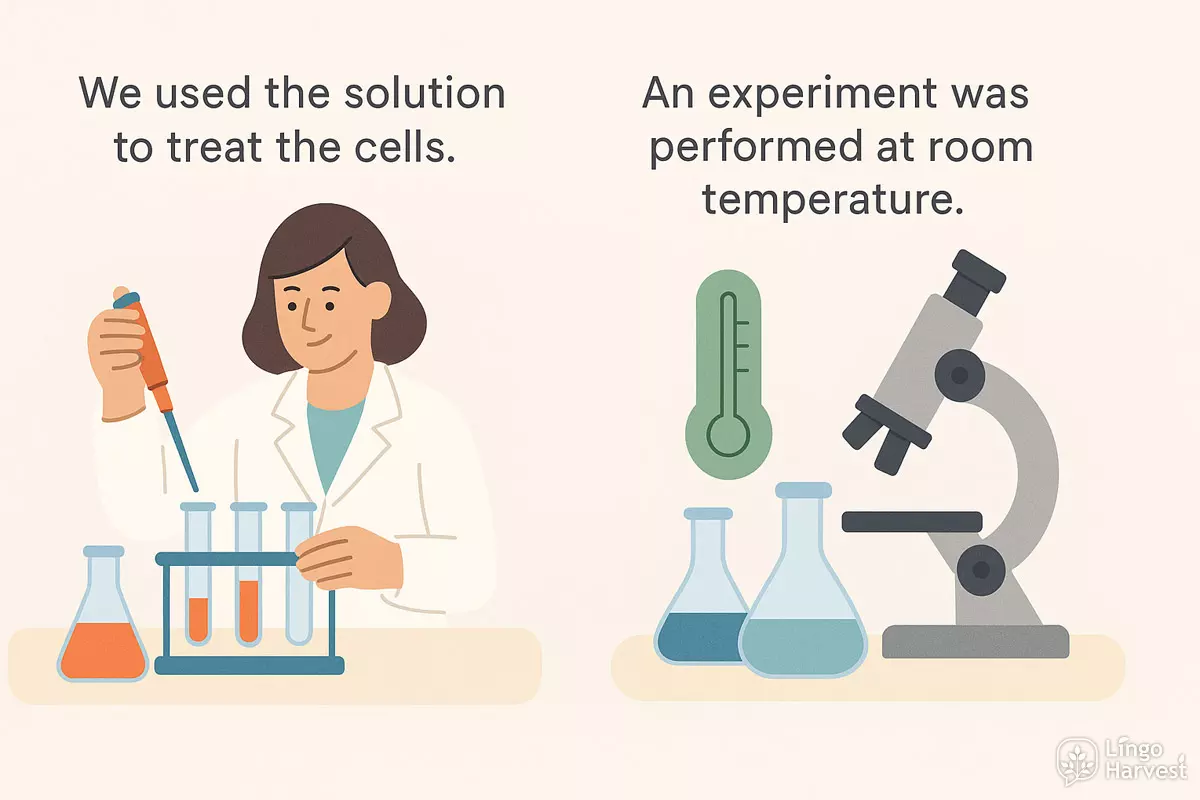
To illustrate how determiner choice affects clarity and meaning, consider these examples:
| Incorrect Usage | Corrected Version |
|---|---|
| We used solution to treat cells. | We used the solution to treat the cells. |
| Experiment was performed at room temperature. | An experiment was performed at room temperature. |
| This results suggest a trend. | These results suggest a trend. |
| The method can be applied to any sample. | The method can be applied to a sample. |
| Researchers observed the increase in activity. | Researchers observed an increase in activity. |
| Cells were washed with buffer. | Cells were washed with the buffer. |
| We propose a approach for analysis. | We propose an approach for analysis. |
| The protein was isolated from a lysate. | The protein was isolated from the lysate. |
| Results show method is effective. | Results show the method is effective. |
| Some data was excluded due to error. | Some of the data was excluded due to error. |
Strategies to avoid determiner errors
Careful proofreading and awareness of context can help prevent these issues. Before finalizing your abstract or methods section, consider:
- Checking if each noun phrase needs a determiner
- Ensuring consistency with specific or general references
- Clarifying antecedents for demonstratives like "this" or "these"
- Reading sentences aloud to catch awkward or ambiguous phrases
- Comparing with published examples in reputable journals
In summary, attention to determiners helps ensure clarity, precision, and professionalism in scientific communication.
Examples from journals and research reports
Researchers and academic writers often select determiners with care to highlight either specificity or generality in their claims. By examining extracts from peer-reviewed articles, we can see how language choices subtly influence the perceived precision and scope of scientific statements.
Common Patterns in Scientific Literature
Writers in scientific disciplines use determiners to clarify whether they refer to a unique entity, a subset, or a general class. Consider the following examples, each illustrating a different rhetorical effect:
- The results indicate a significant change. → Refers to specific, previously mentioned results.
- A study was conducted to investigate... → Introduces an unspecified or new study.
- Some participants reported side effects. → Refers to an unspecified subset.
- All samples were stored at -20°C. → Indicates totality, leaving no exceptions.
- Each experiment was repeated three times. → Emphasizes individual treatment.
- Many previous reports suggest... → Conveys generality, not exact numbers.
- This method improves accuracy. → Points to a specific method just described.
- These findings support the hypothesis. → Refers back to specific findings discussed.
- Any deviation was recorded. → Stresses inclusiveness within possible deviations.
- Few researchers have addressed... → Highlights rarity or exceptionality.
- No significant differences were found. → Denies the existence of differences.
- Several mechanisms may explain... → Suggests more than two, but not all.
- Another explanation is possible. → Introduces an alternative among several.
- Most patients responded well. → Indicates a majority, but not all.
- Such mutations are rare. → Refers to a type or class just described.
Comparing Specificity and Generality in Published Sentences
The table below presents real-world contrasts between determiner usage for specificity versus generality, based on published research excerpts.
| Specific Reference | General Reference |
|---|---|
| This experiment demonstrates a clear effect. | Experiments demonstrate clear effects. |
| The protein was isolated from the sample. | Proteins can be isolated from samples. |
| Each participant completed the survey. | Participants complete surveys in most studies. |
| The observed mutation led to resistance. | Mutations can lead to resistance. |
| These data support our hypothesis. | Data often support hypotheses in similar research. |
Summary of Usage in Academic Writing
Writers select determiners not only for grammatical correctness but to shape how readers interpret evidence. Specific determiners (such as the, this, each) are common in the discussion of concrete results or methods, while general ones (all, many, some) are prevalent in literature reviews or when making broader claims. This careful calibration is essential for clarity and appropriate scientific hedging.
Practice: adjust determiners for accuracy in scientific text
Scientific writing demands precision, especially when it comes to expressing generality or specificity. The choice between determiners like the, a/an, this, these, some, and all can significantly influence the clarity and accuracy of your statements. Below you'll find exercises and guidance designed to help you refine your use of determiners in a research context.
Common Determiner Choices in Scientific Texts
- The: Refers to a specific, previously mentioned, or well-known item.
- A/An: Introduces a non-specific, singular noun.
- Some: Indicates an unspecified quantity or subset of a group.
- All: Refers to every member of a group, without exception.
- Each: Emphasizes individual members within a group.
- Every: Similar to "all," but used with singular countable nouns.
- Many/Few/Several: Quantify but are less precise than "all" or "each."
- Those/These: Refer to specific items, often in relation to the writer’s or reader’s context.
- No: Expresses the absence of any items in a group.
- Much/Little: Quantify uncountable nouns.
- Any: Used in questions or negatives to refer to one or more items, without specifying which.
- Another/Other: Distinguish between different items or groups.
Exercise: Improve Determiner Use
Revise the following sentences by replacing or adding determiners to increase scientific accuracy and clarity.
- Cell divides rapidly under certain conditions.
- Researchers observed increase in temperature.
- Results suggest protein is essential for process.
- Experiment was repeated three times.
- Data indicate solution is unstable.
- Conclusions were based on evidence from study.
- Authors propose new mechanism for reaction.
- Analysis revealed presence of contaminants in sample.
- Findings may not apply to populations.
- Model predicts outcome accurately.
Show answers
- The cell divides rapidly under certain conditions.
- Researchers observed an increase in temperature.
- The results suggest that the protein is essential for the process.
- The experiment was repeated three times.
- The data indicate that the solution is unstable.
- The conclusions were based on evidence from the study.
- The authors propose a new mechanism for the reaction.
- The analysis revealed the presence of contaminants in the sample.
- The findings may not apply to all populations.
- The model predicts the outcome accurately.
Comparison of Determiners: Specificity vs Generality
| General Determiner | Specific Determiner |
|---|---|
| All cells | The cells (in this experiment) |
| A protein | This protein (identified previously) |
| Some samples | These samples (collected on Day 2) |
| Any result | The result (from Figure 3) |
| Every experiment | The experiment (described above) |
| Many studies | Those studies (with similar methodology) |
| No evidence | The evidence (from this trial) |
| Other factors | Another factor (that influenced outcome) |
Quick Practice: Identify the Appropriate Determiner
Choose the most precise determiner for each blank.
- ______ authors concluded that their hypothesis was correct. (the, some, all)
- ______ data supports the alternative model. (this, these, a)
- ______ experiment failed to yield significant results. (an, the, every)
- ______ samples contained trace impurities. (several, a, that)
- ______ researchers were invited to the international conference. (many, much, a)
- ______ methodology was approved by the ethics committee. (the, any, several)
- ______ evidence strongly supports the original theory. (no, many, a)
- ______ participant completed the survey correctly. (each, few, many)
- ______ results were published in a leading journal. (the, a, an)
- ______ variables were controlled during the experiment. (all, much, a)
Show answers
- The authors concluded that their hypothesis was correct.
- This data supports the alternative model.
- The experiment failed to yield significant results.
- Several samples contained trace impurities.
- Many researchers were invited to the international conference.
- The methodology was approved by the ethics committee.
- No evidence strongly supports the original theory.
- Each participant completed the survey correctly.
- The results were published in a leading journal.
- All variables were controlled during the experiment.
By practicing these distinctions and making careful determiner choices, you can produce clearer, more reliable scientific writing that accurately reflects your intended meaning.