Avoiding Pronoun Ambiguity in Research Papers

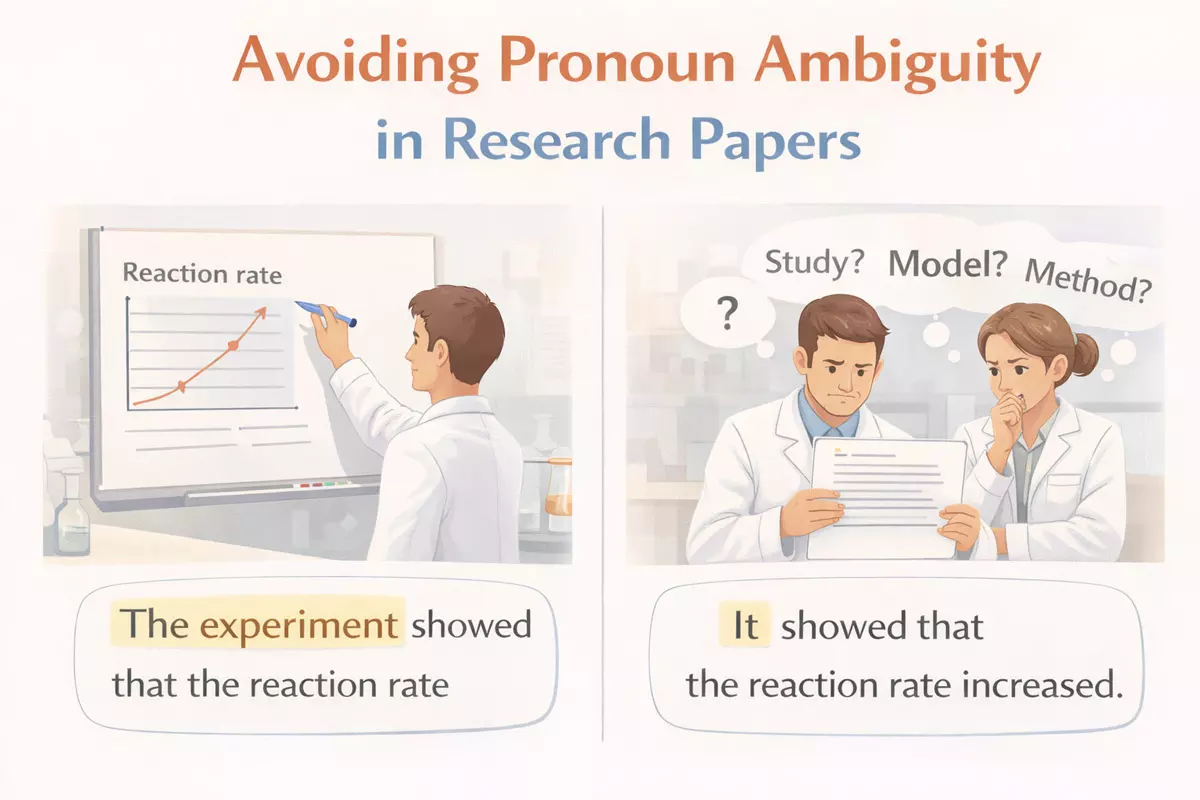 Here we pronoun ambiguity in research writing, covering unclear antecedents, pronouns referring to ideas, strategies to restate nouns, editing methods for long paragraphs, clear vs ambiguous examples, a proofreading checklist, and practice exercises.
- What pronoun ambiguity looks like in research writing
- Unclear antecedents in complex arguments
- Pronouns referring to whole ideas or clauses
- Strategies to restate nouns for clarity
- Editing techniques for long paragraphs
- Examples of ambiguous vs clear reference
- Checklist for final proofreading
- Practice: fix ambiguity in research-style sentences
Clear communication is essential in academic writing because unclear references to people or things can easily confuse readers and undermine the effectiveness of your argument. To maintain precision and avoid misinterpretation, it is important to ensure that every pronoun clearly and unmistakably refers to the correct subject. By carefully reviewing your writing for ambiguous references and revising sentences where necessary, you help readers follow your ideas more easily and strengthen the overall clarity of your scholarly work.
What pronoun ambiguity looks like in research writing
In academic manuscripts, unclear pronoun usage often leads to confusion about which subject or object is being discussed. This typically happens when it’s not obvious what a word like “it,” “they,” or “this” refers to, especially in dense technical paragraphs or when multiple nouns are introduced close together. Such ambiguity can make even well-researched arguments difficult to follow, as readers must guess the intended meaning.
Common ways ambiguous pronouns appear
Authors sometimes assume their references are obvious, but this isn’t always the case. Here are some typical patterns where unclear pronouns can slip into scholarly writing:
- Using “it” after mentioning several potential antecedents.
- Referring to entire processes or results with “this” or “these.”
- Switching between singular and plural pronouns without clear context.
- Relying on “he,” “she,” or “they” when multiple people or groups are discussed.
- Placing a pronoun at the start of a new paragraph without a clear link to the previous noun.
- Using “which” or “that” to refer to unclear things in complex sentences.
- Presenting data or figures, then using “they” or “these” without specifying what is meant.
- Summarizing previous findings with “this,” “such,” or “those” without context.
- Employing “its” or “their” when multiple items are described in the same sentence.
- Introducing abbreviations, then using pronouns before the abbreviation is established.
- Switching subjects between sentences but keeping the same pronoun.
- Using “we” or “our” without clarifying if it refers to the authors, the field, or another group.
Examples of pronoun ambiguity in context
To illustrate, consider these sentences:
- “The experiment was repeated with the new solution and the control. It showed a significant difference.” (What does “it” refer to—the experiment, the solution, or the control?)
- “The samples were incubated overnight and then analyzed. They were unexpected.” (Were the samples or the results unexpected?)
- “Smith et al. compared the two groups and found that they responded differently.” (Does “they” refer to the groups, the authors, or another subject?)
Typical ambiguous pronouns and their pitfalls
The following table highlights frequently used pronouns in scholarly writing and the potential confusion they can cause when the reference is unclear:
| Pronoun | Potential Ambiguity |
|---|---|
| it | May refer to any singular noun mentioned recently (method, result, subject, etc.) |
| they | Could indicate multiple items, groups, or even people, depending on context |
| this/these | Often used to refer to entire processes, findings, or arguments without clear linkage |
| which/that | Ambiguous if the antecedent is several clauses or items |
| we/our | Unclear whether referring to authors, the research community, or another group |
Why this matters in academic writing
Ambiguity from unclear pronouns can obscure your main points, cause misinterpretation, and reduce the credibility of your work. Careful attention to what each pronoun references helps ensure that readers can accurately follow your arguments and findings.
Unclear antecedents in complex arguments
When research papers present intricate ideas, pronouns often refer ambiguously to multiple possible nouns, making it hard for readers to track exactly what is meant. This is especially problematic in dense theoretical discussions, long chains of reasoning, or when several entities are discussed in close proximity. Careless use of “it,” “they,” or “this” can force readers to guess the intended reference, leading to confusion or misinterpretation of the argument.
Common scenarios where antecedents become ambiguous
- Describing several variables or theories in a single paragraph
- Mixing singular and plural nouns before using “they” or “it”
- Switching between topics without clear transitions
- Using “this,” “that,” or “these” to refer to entire processes or results
- Introducing multiple authors or studies before a pronoun
- Referencing both data and methodology in the same sentence
- Comparing two or more models side by side
- Summarizing previous findings with “these” or “such”
- Embedding conditional clauses that separate pronouns from their nouns
- Presenting lists of results and then using “they” or “those”
How to clarify pronoun references in complex arguments
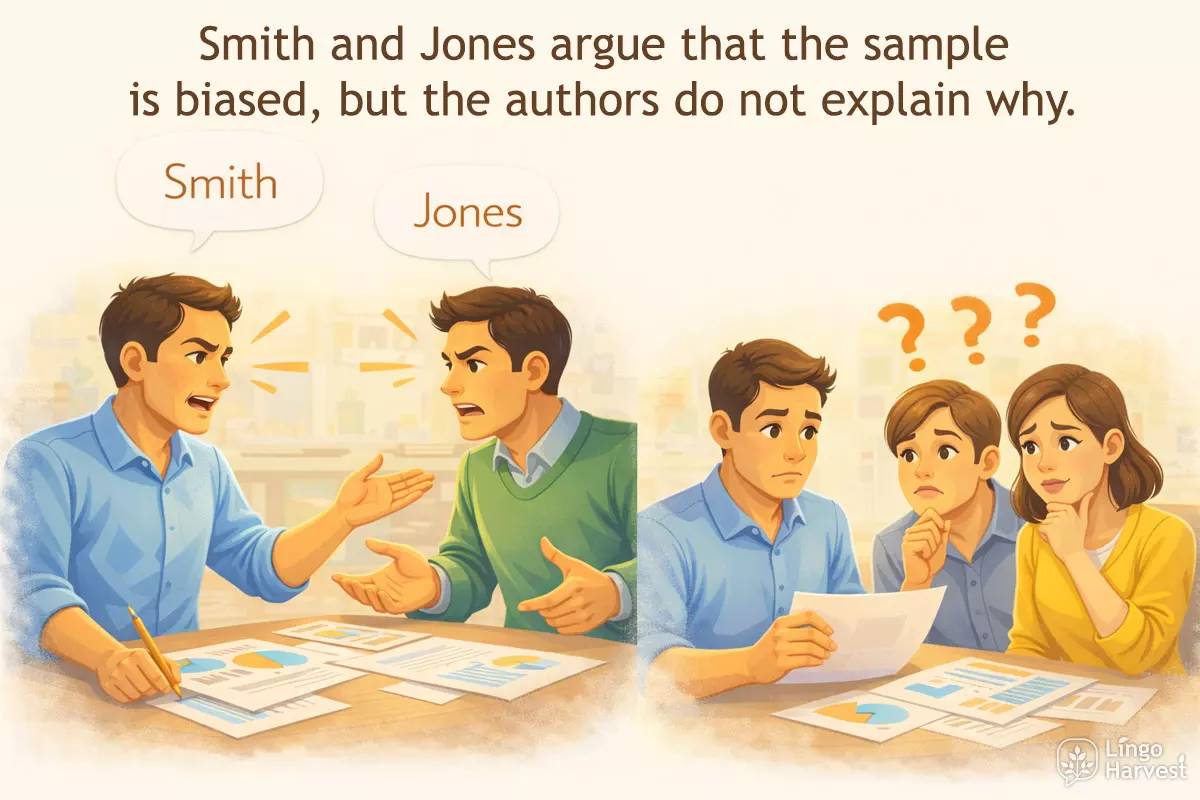
Writers can prevent confusion by making antecedents explicit whenever there is any doubt about the pronoun’s target. This may require repeating nouns, restructuring sentences, or using more descriptive phrases. Below is a comparison of ambiguous and clear pronoun usage in research writing:
| Ambiguous Example | Clear Revision |
|---|---|
| The model and the algorithm were tested. It performed well. | The algorithm performed well when tested. |
| Smith and Jones argue that the sample is biased, but they do not explain why. | Smith and Jones argue that the sample is biased, but the authors do not explain why. |
| The results contradict the hypothesis. This suggests further investigation is needed. | The contradiction between the results and the hypothesis suggests further investigation is needed. |
| After reviewing the literature and conducting experiments, it was clear the approach was effective. | After reviewing the literature and conducting experiments, the researchers found the approach was effective. |
| Several factors influenced the outcome, but they are not discussed here. | Several factors influenced the outcome, but these factors are not discussed here. |
Tips for avoiding ambiguous pronouns in complex writing
- Repeat the specific noun if there is any potential for confusion
- Use descriptive phrases (“this hypothesis,” “these results”) instead of bare pronouns
- Keep sentences concise to reduce the distance between pronoun and noun
- Structure complex arguments so that each pronoun clearly follows its referent
- Revise sentences where multiple possible antecedents are present
- Ask a colleague to read for clarity; outside readers often spot ambiguity quickly
Clarity in pronoun reference ensures that complex arguments remain accessible and precise, allowing readers to follow your reasoning without unnecessary obstacles.
Pronouns referring to whole ideas or clauses
In academic writing, pronouns like this, that, which, it, and these often stand in for an entire statement, argument, or process described earlier. While this can make sentences more concise, it also introduces the risk of ambiguity if it is unclear what the pronoun actually refers to. Readers may struggle to identify whether a pronoun points to the previous sentence, a specific concept, or a broader claim. To ensure clarity in research papers, it is important to use such pronouns carefully and, when needed, clarify their reference.
Common pronouns referencing ideas or clauses
- This — frequently used to refer to the immediately preceding statement or result.
- That — can point to a prior idea, sometimes with contrastive meaning.
- It — may refer to an entire process, outcome, or argument, not just a noun.
- Which — in non-restrictive clauses, can summarize an earlier point.
- Such — often combines with nouns to refer back to a described phenomenon.
- These — plural, for multiple preceding statements or findings.
- Those — plural, sometimes for comparison or contrast to other ideas.
Strategies to avoid ambiguity
To prevent confusion, writers can reinforce the pronoun with a brief summary noun—sometimes called a "summary word" (e.g., this finding, that assumption, it as it suggests that). This practice makes it much easier for readers to track the logical flow of the argument.
- Follow pronouns with a clarifying noun: This result, These observations.
- Restate key terms when introducing a new idea, even if it feels repetitive.
- Use explicit references for complex or multi-sentence ideas (e.g., This suggests that the previous method is unreliable).
- Limit the distance between the pronoun and its antecedent.
- Avoid using it or this to refer to an entire paragraph or section unless the context is unmistakable.
Examples of ambiguous vs. clear references
- Ambiguous: The experiment failed to produce results. This was unexpected.
- Clear: The experiment failed to produce results. This outcome was unexpected.
- Ambiguous: The samples were contaminated, and the data were incomplete. It was problematic.
- Clear: The samples were contaminated, and the data were incomplete. This combination of issues was problematic.
Pronouns and their reference patterns
| Pronoun | Typical Reference |
|---|---|
| This | Most recent idea, result, or statement |
| That | Prior idea, often with emphasis or contrast |
| It | General concept, process, or situation |
| Which | Summarizes or comments on a preceding clause |
| These | Multiple ideas or items just mentioned |
| Those | Multiple ideas, often in contrast to others |
| Such | Refers to a type or category previously described |
Checklist for clear references
- Does the pronoun unmistakably point to a single idea or statement?
- Is a summary noun needed to clarify meaning?
- Could a reader misinterpret what is being referenced?
- Would rephrasing or repeating a key term help?
By being deliberate with pronouns that refer to entire statements or arguments, writers can help readers follow the logic of their research and avoid misinterpretation.
Strategies to restate nouns for clarity
When writing research papers, it’s crucial to ensure that readers never lose track of which noun a pronoun is replacing. Ambiguity can easily arise when multiple nouns are present, and a pronoun like “it” or “they” is introduced. By thoughtfully rephrasing or repeating nouns, you can maintain precision and prevent confusion. Here are some practical approaches to make your writing clearer and more reader-friendly.
Repeat nouns when context shifts
If a pronoun could refer to more than one noun, restate the original noun instead of using the pronoun. This is especially important after discussing multiple subjects or when introducing new information.
- After introducing two or more concepts, use the full noun instead of "it" or "they".
- When starting a new paragraph, restate the noun to anchor the reader.
- In sentences with multiple clauses, repeat the noun for clarity.
Use synonyms and descriptive phrases
Variety in word choice can help keep your writing engaging while also clarifying meaning. Substitute pronouns with synonyms or expanded noun phrases where appropriate.
- Alternate between the full name and an accepted abbreviation.
- Use a descriptive phrase (e.g., “the experimental apparatus” instead of “it”).
- Employ context-specific synonyms (e.g., “the solution”, “the mixture”, “the compound”).
Explicit noun repetition patterns
Certain patterns make noun repetition feel natural and unobtrusive. Here are some common forms:
- “The enzyme was added to the solution. The enzyme catalyzed the reaction.”
- “Participants completed the survey. The participants then received compensation.”
- “The data were analyzed. The data revealed significant trends.”
Comparing ambiguous and clarified sentences
Below is a table contrasting ambiguous pronoun use with revised sentences that restate nouns for better clarity.
| Ambiguous Sentence | Clarified Sentence |
|---|---|
| The sample was heated and then it was tested. | The sample was heated and then the sample was tested. |
| The solution was mixed with the reagent before it was analyzed. | The solution was mixed with the reagent before the solution was analyzed. |
| After the cells were stained, they were observed under a microscope. | After the cells were stained, the cells were observed under a microscope. |
| The committee reviewed the proposal and they approved it. | The committee reviewed the proposal and the committee approved the proposal. |
Tips for effective noun restatement
- Balance clarity and conciseness; restate nouns when ambiguity is likely, but avoid excessive repetition.
- Read sentences aloud to check for potential confusion.
- Ask a colleague to review your draft for unclear pronoun references.
- Consider your audience’s familiarity with the subject—more technical readers may require fewer restatements, but clarity should always be a priority.
By thoughtfully repeating or rephrasing nouns, you help ensure that every reader can follow your argument without stumbling over unclear references. This practice is especially vital in scientific and academic writing, where precision is paramount.
Editing techniques for long paragraphs
Refining lengthy paragraphs is essential for ensuring clarity, especially when discussing pronouns or complex research concepts. Dense blocks of text can obscure meaning, making it harder for readers to track referents and arguments. Breaking up these passages helps prevent confusion and supports more precise communication.
Strategies for streamlining lengthy passages
- Identify multiple ideas: Look for shifts in topic or argument within a paragraph. Each distinct idea often deserves its own paragraph.
- Rephrase for clarity: Rewrite sentences to be more direct, and ensure pronouns unmistakably refer to their antecedents.
- Insert transition sentences: Use bridging phrases to guide readers smoothly from one point to the next.
- Reduce redundancy: Remove repeated information, especially when it clouds the relationship between pronouns and nouns.
- Vary sentence structure: Mix short and long sentences to maintain reader engagement and avoid monotony.
- Use bullet points or lists: When presenting several related items, lists can clarify relationships and reduce ambiguity.
- Check for pronoun clarity: After editing, verify that every pronoun’s reference is unmistakable, especially near paragraph breaks.
- Employ active voice: Sentences in active voice tend to be clearer and make pronoun references more obvious.
- Remove filler words: Eliminate unnecessary qualifiers or vague language that can obscure antecedents.
- Read aloud: Reading the text out loud can highlight confusing sections and ambiguous pronoun use.
Common paragraph issues and possible edits
| Issue | Editing Solution |
|---|---|
| Multiple subjects with unclear pronouns | Rephrase sentences to repeat the subject or use specific nouns in place of pronouns |
| Paragraph covers unrelated ideas | Divide into separate paragraphs, each with a clear focus |
| Pronoun at the start of a new paragraph | Restate the noun before introducing a pronoun for the first time |
| Excessive length makes tracking references difficult | Shorten sentences and use transition phrases to clarify connections |
| List of actions or items hidden in text | Convert to a bulleted or numbered list for visibility and clarity |
Quick tips for revision
- Check each pronoun’s antecedent after edits.
- Ask a colleague to review for possible ambiguities.
- Use paragraph breaks to emphasize important distinctions.
- Keep paragraphs focused on a single research aspect or argument.
Applying these approaches not only improves readability but also helps readers follow your logic and avoid misinterpreting references, which is crucial in academic writing.
Examples of ambiguous vs clear reference
Clear communication in research writing often depends on how pronouns are used. When it’s not obvious what a pronoun like "it," "they," or "this" refers to, readers may become confused or misinterpret the intended meaning. Below, you’ll find typical scenarios where unclear pronoun use leads to ambiguity, as well as how to revise these sentences for clarity.
Common Patterns of Ambiguous Pronoun Reference
- Multiple possible antecedents: When more than one noun could be the pronoun’s referent.
- Remote antecedents: When the pronoun is too far from the noun it represents.
- Implied subjects: When a pronoun is used without a clear, previously mentioned noun.
- Vague demonstratives: Using "this," "that," "these," or "those" without specifying what is meant.
Illustrative Sentences: Ambiguous vs. Clear
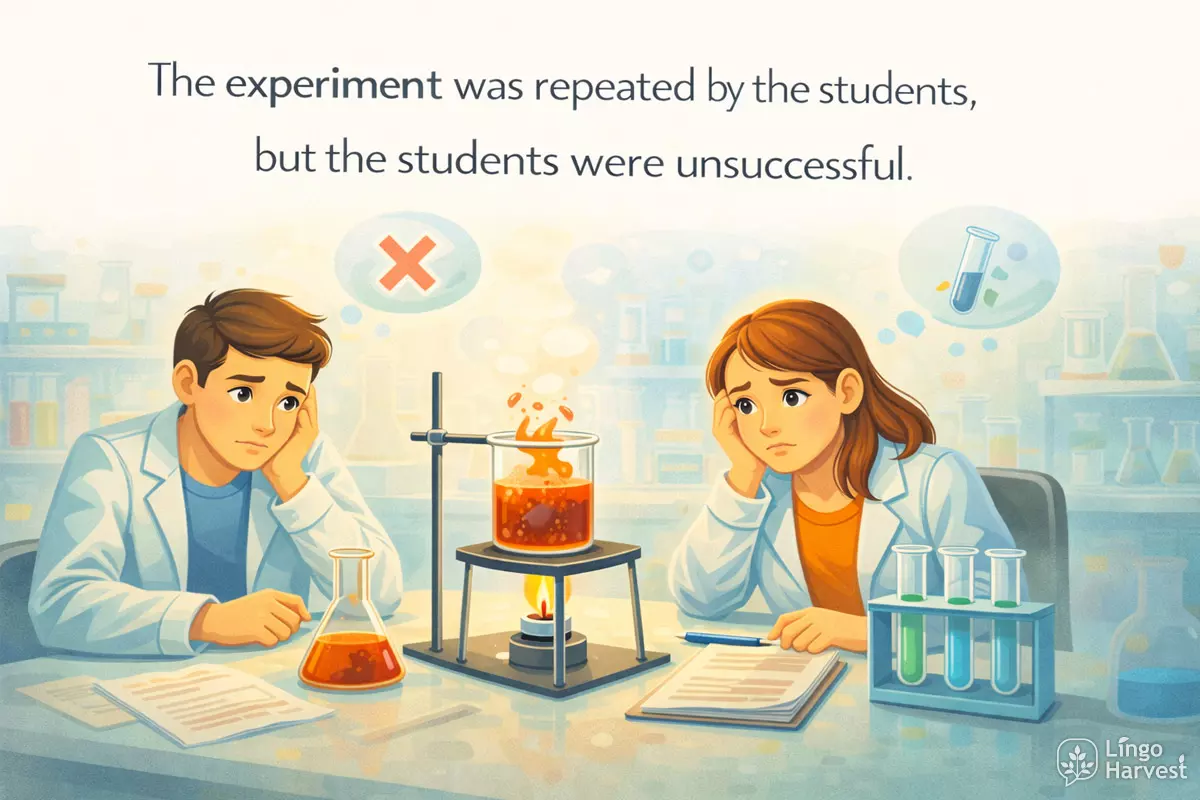
The following examples show how a small change can resolve confusion and make your writing more precise.
| Ambiguous Reference | Clear Reference |
|---|---|
| The experiment was repeated by the students, but they were unsuccessful. | The experiment was repeated by the students, but the students were unsuccessful. |
| When the data were analyzed alongside the model, it was flawed. | When the data were analyzed alongside the model, the model was found to be flawed. |
| Smith and Jones argued for different methods, but he was more convincing. | Smith and Jones argued for different methods, but Smith was more convincing. |
| The solution was filtered and placed in a flask, which was then heated. | The filtered solution was placed in a flask, and the flask was then heated. |
| This shows a significant improvement. | This result shows a significant improvement. |
| After reviewing the proposal, they decided to revise it. | After reviewing the proposal, the committee decided to revise the document. |
| The samples were compared with the controls, and they were found to be defective. | The samples were compared with the controls, and the samples were found to be defective. |
| Although the test was repeated, it was still inconclusive. | Although the test was repeated, the results were still inconclusive. |
| The cells were treated with the drug before they were analyzed. | The cells were treated with the drug before the cells were analyzed. |
| Jones criticized Smith’s method because he believed it was unreliable. | Jones criticized Smith’s method because Jones believed Smith’s method was unreliable. |
Tips for Ensuring Reference Clarity
- Repeat the specific noun instead of using a pronoun when ambiguity is possible.
- Place pronouns close to their antecedents whenever feasible.
- Use demonstratives with a noun (e.g., "this approach," "these results") for added precision.
- Revise sentences with multiple nouns to clarify which is being discussed.
- Read sentences aloud to check if the referent is immediately clear.
Paying close attention to pronoun reference helps make academic writing more precise and reader-friendly. A careful review for ambiguous pronouns during editing can greatly improve the clarity of a research manuscript.
Checklist for final proofreading
Before submitting your research manuscript, a careful review to catch ambiguous references is essential. Pronoun clarity is often overlooked in the final stages, even though it significantly affects your reader’s understanding. Use this guide to systematically identify and correct unclear pronouns as you complete your editing process.
Common issues to watch for
Ambiguous pronouns most often occur when it’s not clear which noun a pronoun refers to, or when several possible antecedents are present in a sentence or paragraph. During your last review, pay close attention to these pitfalls:
- Sentences with multiple possible referents for "it," "this," or "they"
- Long stretches between a pronoun and its noun
- Use of "he," "she," or "they" without clear context
- Switching between singular and plural forms unexpectedly
- Generic use of "it" or "they" at the start of sentences
Step-by-step review process
To ensure your research writing is free from vague references, follow these steps:
- Read each paragraph aloud, pausing at every pronoun to check if its meaning is instantly clear.
- Highlight all pronouns. For each, underline the noun it refers to. If you hesitate, revise for clarity.
- Replace ambiguous pronouns with specific nouns when needed, especially at the start of sentences or after a long intervening phrase.
- Check subject-verb agreement after every pronoun edit to maintain consistency.
- Ask a peer to read a few sections and identify any confusing references.
Examples of ambiguous vs. clear pronoun use
Below is a quick reference showing common ambiguous constructions and their clearer alternatives:
| Ambiguous Example | Clear Revision |
|---|---|
| The experiment was repeated, and it improved significantly. | The experiment was repeated, and the results improved significantly. |
| Participants spoke to the researchers before they left. | Participants spoke to the researchers before the participants left. |
| The cells were treated with the solution, which caused them to swell. | Treating the cells with the solution caused the cells to swell. |
| Smith and Jones reviewed the data, but he did not agree with the conclusions. | Smith and Jones reviewed the data, but Smith did not agree with the conclusions. |
Final quick questions
Before submitting, ask yourself:
- ✅ Can every pronoun’s reference be identified without rereading?
- ✅ Are all pronouns consistent with their antecedents in number and gender?
- ✅ Have vague openers like "this" or "it" been replaced with specific terms where necessary?
- ✅ Did a colleague confirm pronoun references were clear?
A focused review for these details helps ensure your research writing is precise and easily understood.
Practice: fix ambiguity in research-style sentences
Ambiguous pronouns can make research writing unclear or even misleading. Practicing with real examples helps you spot and resolve confusing references before your manuscript is submitted. Below, review common sentence patterns where pronoun ambiguity occurs, then try your hand at clarifying research-style sentences.
Common Sources of Pronoun Ambiguity
- Multiple possible antecedents in the same sentence
- Vague use of "it" or "they" without a clear referent
- References to groups or concepts previously mentioned
- Long sentences separating the pronoun from its antecedent
- Switching between singular and plural forms without clarity
- Using "this" or "that" to refer to an entire idea or process
- Introduction of new terms immediately before a pronoun
- Ambiguous references in lists or series
- Unclear subject when reporting results or actions
- Pronouns at the start of a new paragraph without context
- Using "which" or "that" without specifying the noun
- Referencing studies or data sets with "they" or "it"
- Switching between active and passive voice, confusing the actor
- Unclear "he/she/they" when multiple people are involved
- Ambiguous "its" in technical descriptions
Practice: Clarify Ambiguous Sentences
Below are several sentences from research contexts. Each contains at least one pronoun whose reference is unclear. Try rewriting each sentence to eliminate the ambiguity. Consider specifying nouns, rephrasing for clarity, or breaking up long sentences.
- The enzyme was added to the solution before it was heated.
- After reviewing the data, the researchers discussed it with the supervisor.
- Smith and Jones conducted experiments, but they found different results.
- The model outperformed the baseline in most cases, which surprised the team.
- Cells were incubated with the reagent, but they did not respond as expected.
- The survey was distributed to students and faculty, but they were not all able to participate.
- The software analyzes patient records and stores them in a secure database, which can be accessed by clinicians.
- The sample was filtered and centrifuged, and it was then analyzed for contaminants.
- When the temperature increased, it affected the yield.
- The participants completed the questionnaire, and it was collected by the assistant.
Show answers
- The enzyme was added to the solution before the solution was heated.
- After reviewing the data, the researchers discussed the findings with the supervisor.
- Smith conducted experiments and found different results from those of Jones.
- The fact that the model outperformed the baseline in most cases surprised the team.
- The cells were incubated with the reagent, but the cells did not respond as expected.
- The survey was distributed to students and faculty, but not all recipients were able to participate.
- The software analyzes patient records and stores the records in a secure database, which clinicians can access.
- The sample was filtered and centrifuged, and the processed sample was then analyzed for contaminants.
- An increase in temperature affected the yield.
- The participants completed the questionnaire, and the assistant collected the completed forms.
Comparison: Ambiguous vs. Clear Sentences
The table below shows how ambiguous sentences can be transformed for clarity. Use these models when editing your own work.
| Ambiguous Sentence | Clear Revision |
|---|---|
| The solution was mixed with the reagent before it was cooled. | The solution was mixed with the reagent before the mixture was cooled. |
| Lee and Kim tested the hypothesis, and they agreed with the results. | Lee and Kim tested the hypothesis, and both researchers agreed with the results. |
| The device was calibrated and installed, then it was tested for accuracy. | The device was calibrated and installed, then the device was tested for accuracy. |
| After analyzing the samples, they were labeled and stored. | After analyzing the samples, the researchers labeled and stored the samples. |
When editing academic writing, always check that every pronoun clearly refers to a specific noun. If in doubt, repeat the noun or restructure the sentence for clarity. Practicing these revisions will strengthen the precision of your research communication.