Using Determiners to Signal Scope and Limitation

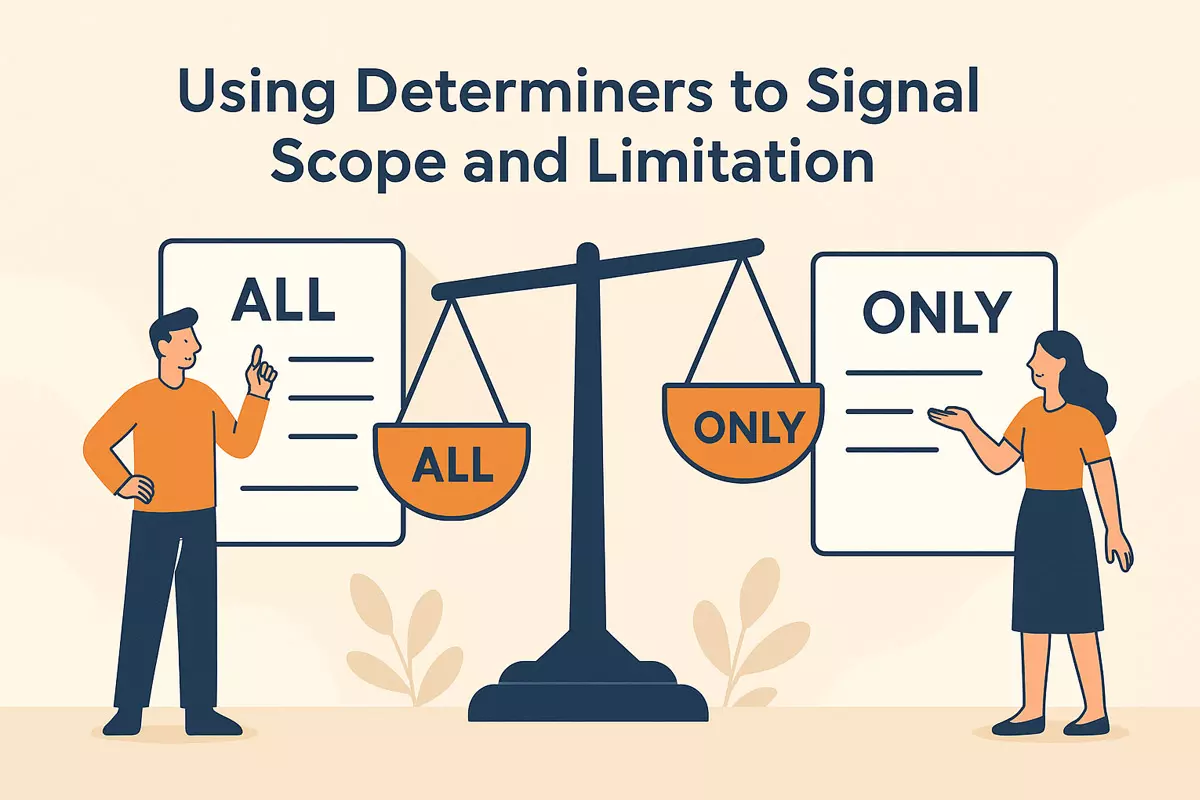 Here we how determiners such as any, each, every, most, and several define the range of meaning in statements. It covers restrictive versus expansive determiners, common mistakes, real-world examples, and practice in adjusting scope.
- How determiners define the range of meaning
- Using any, each, every, most, and several
- Scaling statements up or down with determiners
- Restrictive vs expansive determiners
- Examples from research, policy, and argument writing
- Common errors causing overgeneralization
- Practice: adjust scope in sample statements
Writers frequently depend on small words such as articles and quantifiers to help readers understand the specific scope and limits of their ideas. By skillfully using these subtle elements of language, writers can clearly indicate what is being discussed and avoid potential confusion. Mastery of articles and quantifiers not only improves the precision of communication but also ensures that readers interpret the intended meaning correctly, making the writing more effective and accessible to a wider audience.
How determiners define the range of meaning
Determiners act as linguistic signposts, setting clear boundaries for what a noun refers to. By choosing different determiners, speakers and writers can specify whether they mean something unique, a subset, or the whole category. This subtle control over scope is essential for clarity and precision in communication.
Specifying inclusion and exclusion
The use of determiners allows us to include or exclude certain items within a group. For example, "some" suggests an unspecified portion, while "all" covers every instance. "No" explicitly excludes everything in the category. These choices affect how broadly or narrowly a statement applies.
| Determiner | Meaning | Example |
|---|---|---|
| all | every member of the group | All students passed the final exam. |
| some | an unspecified subset | Some students stayed after class. |
| each | individual focus, one at a time | Each student received a certificate. |
| no | zero members included | No students were absent today. |
| any | non-specific, possible inclusion | Any student can apply for the program. |
| the | a specific, previously mentioned person or thing | The teacher announced the results. |
| a | any single, non-specific item | A teacher helped me after class. |
| this | a particular item nearby in context | This book is very helpful. |
| those | specific items farther away or previously mentioned | Those books belong to the library. |
| many | a large, but not exact, number | Many people attended the lecture. |
| few | a small, limited number | Few options remain available. |
| another | an additional, unspecified item | Could I have another chance? |
| either | one of two possibilities | You can choose either option. |
| neither | not one nor the other of two | Neither answer is correct. |
| my | shows personal possession | My idea was accepted. |
| our | shows shared possession | Our decision was final. |
Comparing determiners: scope and limitation
Some determiners inherently set strict boundaries, while others leave the scope open. For example, "every" applies to all individual members, but "some" leaves room for ambiguity. The following table highlights how determiners differ in expressing scope and limitation:
| Determiner | Scope / Limitation |
|---|---|
| All | Entire group included, no exceptions |
| Some | Partial group, unspecified quantity |
| Any | One, some, or all; context-dependent |
| No | Entire group excluded |
| Each | Every individual, considered separately |
| Few | Small, limited number |
| Many | Large number, but not totality |
| The | Specific, previously identified entity |
| A/An | Single, non-specific member |
| Neither | Excludes both options in a pair |
Choosing the right determiner
Selection depends on intent: do you want to generalize, specify, or restrict? For instance, "the" narrows the meaning to something known, while "a" leaves it open. This decision shapes both the scope and the limitations of your statement, influencing how the message is received. In summary, determiners are more than just grammatical necessities—they actively frame and limit what your nouns can mean.
Using any, each, every, most, and several
Determiners like "any," "each," "every," "most," and "several" play a crucial role in clarifying the reach and boundaries of statements. These words help specify whether we're talking about a part of a group, the whole group, or just a few members. Choosing the right determiner can completely change the meaning of a sentence, making your language more precise and effective.
Exploring Meanings and Scope
- Any suggests openness or lack of restriction, often used in questions or negatives for a non-specific member.
- Each focuses on individuals within a group, highlighting separateness.
- Every implies all members considered together, emphasizing totality.
- Most indicates a majority, but not all, showing a large portion.
- Several refers to more than two but not a large number, expressing a moderate quantity.
Common Patterns and Examples

Here are typical ways these determiners are used in sentences:
- Any: "You can choose any book from the shelf."
- Each: "Each student received a certificate."
- Every: "Every morning starts with coffee."
- Most: "Most people enjoy weekends."
- Several: "Several guests arrived early."
- "Do you have any questions?"
- "Each apple was carefully picked."
- "Every answer matters."
- "Most cats dislike water."
- "Several options are available."
- "Any solution will be considered."
- "Each participant must sign in."
- "Every attempt counts."
- "Most of the cake was eaten."
- "Several reasons were given."
Comparing Usage and Nuances
| Determiner | Typical Context | Example | Scope |
|---|---|---|---|
| Any | Non-specific, open choice, negatives/questions | "Is there any milk left?" | One, some, or all (uncertain) |
| Each | Individuals in a group, emphasis on separateness | "Each child has a locker." | All, individually |
| Every | All members, considered together | "Every seat was taken." | All, collectively |
| Most | Majority, more than half | "Most students passed." | Large part, not all |
| Several | More than two, but not many | "Several errors were found." | A few, but not all |
Tips for Choosing the Right Determiner
Consider the exact quantity or portion you want to express. If you mean every single member, use "every" or "each" (with "each" for individuals, "every" for groups). For less than all but more than one, "several" or "most" can help. "Any" is best for general, open-ended references or when the choice is unrestricted. Clear determiner use helps your audience understand exactly what you mean, reducing ambiguity in both writing and speech.
Scaling statements up or down with determiners
Determiners play a crucial role in expressing the scope of a statement—helping writers and speakers adjust how broad or limited their claims are. By selecting specific determiners, you can either amplify the reach of your statement or restrict it to a narrower set. This is especially important in academic, technical, and careful everyday communication, where the degree of generalization or limitation matters.
Widening or Limiting with Quantifiers
Quantifying determiners like all, some, many, few, and several enable you to easily modulate the inclusiveness of your message. Consider the difference between “All students must submit the form” (universal) and “Some students must submit the form” (partial). This choice signals whether you’re making a sweeping generalization or a more targeted point.
Common Determiners for Adjusting Scope
Here are some determiners that frequently help scale statements up or down:
- All – maximum inclusion (“All employees attended”)
- Most – a large majority (“Most employees attended”)
- Many – a significant number (“Many employees attended”)
- Several – more than a few, but not most (“Several employees attended”)
- Some – a non-specific, limited group (“Some employees attended”)
- A few – a small number (“A few employees attended”)
- Few – emphasizes scarcity (“Few employees attended”)
- No – zero inclusion (“No employees attended”)
- Each – individual focus (“Each employee attended”)
- Every – similar to all, but emphasizes individuals within the group (“Every employee attended”)
- Any – non-specific, often used in questions/negatives (“Did any employees attend?”)
- None – total exclusion (“None of the employees attended”)
Comparing the Effects of Different Determiners
The table below shows how changing the determiner can dramatically affect the meaning of otherwise similar statements:
| Example Statement | Implication |
|---|---|
| All solutions were effective. | Every single solution worked; no exceptions (broadest scope). |
| Some solutions were effective. | At least a few worked, but not all (partial inclusion). |
| Few solutions were effective. | Only a small number worked; most did not (strong limitation). |
| No solutions were effective. | None worked at all (total exclusion). |
| Most solutions were effective. | The majority worked, but not every single one (broad, but not universal). |
Practical Tips
- Always match the determiner to the evidence you have. Overstating with “all” or understating with “few” can mislead.
- For academic or precise writing, prefer explicit determiners over vague ones like “some” if you can quantify.
- In negative statements, “no” and “none” offer strong limitation, while “not all” leaves room for exceptions.
- Remember that “few” and “a few” are not interchangeable: “few” is more limiting, while “a few” is slightly more positive.
- Choosing the right determiner lets you fine-tune your message, ensuring your scope and limitations are clear to your audience.
Restrictive vs expansive determiners
When we talk about signaling the scope or limitation of a noun, it often comes down to whether the word narrows or broadens what we’re referring to. Some words point to a very specific subset, while others open the door to a wider group or even all possible cases. Understanding this distinction helps clarify what information you’re trying to convey, whether you’re writing instructions, making claims, or describing a situation.
What is a restrictive determiner?
A restrictive determiner limits the reference of a noun to a particular, often smaller, set. These words make it clear that you are not speaking in general terms, but rather about a specific group or individual. This is especially useful when you want to single out something unique or exclude other possibilities.
- the (as in the book on the table)
- my, your, his, her, its, our, their
- this, that, these, those
- each, every
- either, neither
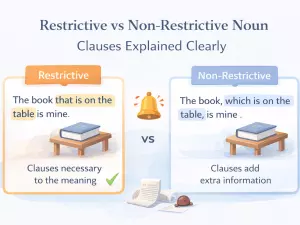
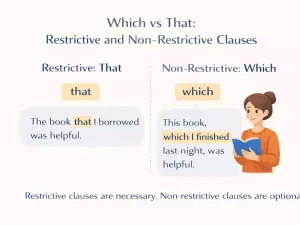
- which (in restrictive clauses)
- some (when specifying certain items, e.g., some students passed)
- certain
- another
- whose
What is an expansive determiner?
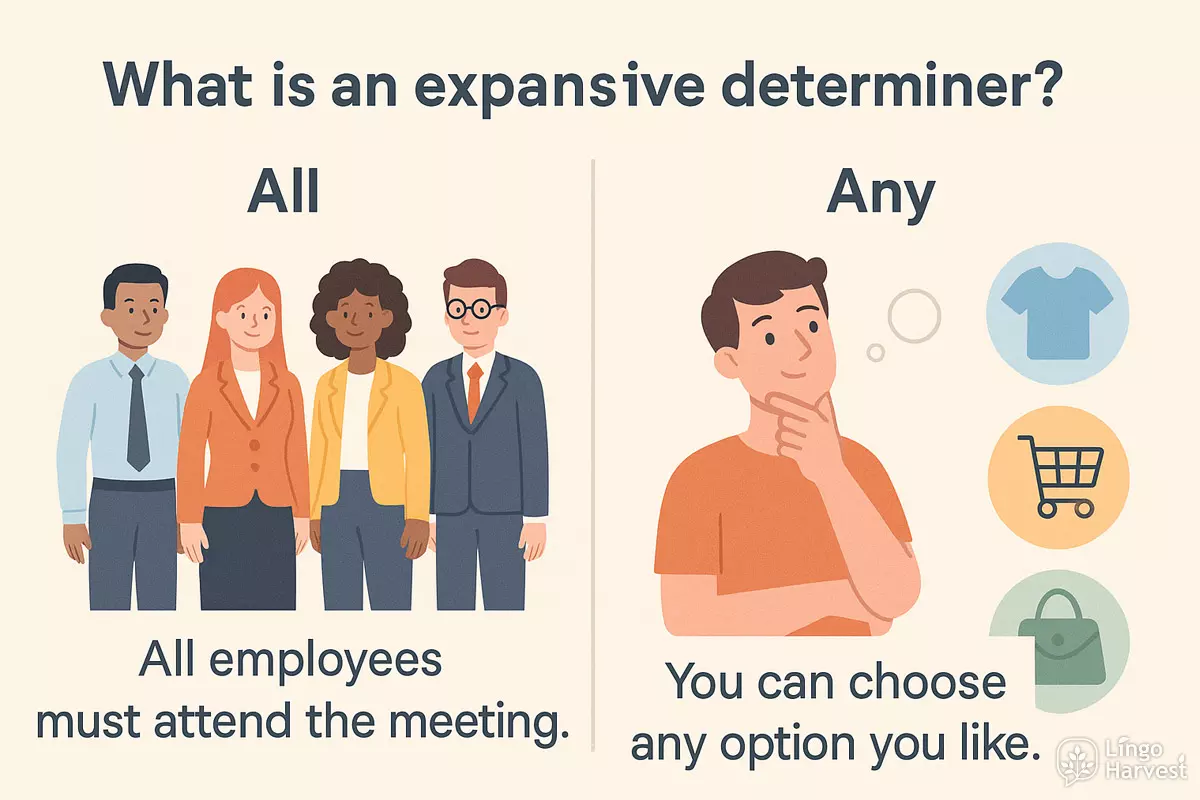
Expansive determiners widen the reference, indicating a broad or even unlimited group. These words are often used when you want to generalize or include as many relevant cases as possible. They’re helpful for making statements that apply widely, rather than to just one or a few items.
- all → All employees must attend the meeting.
- any → You can choose any option you like.
- most → Most students passed the exam.
- many → Many people supported the idea.
- several → Several attempts were made to fix the issue.
- various → Various solutions were предложены.
- few → Few participants arrived on time.
- a few → A few mistakes are acceptable.
- both → Both teams played very well.
- plenty of → There is plenty of time to prepare.
- numerous → Numerous studies confirm this result.
- much → There isn’t much information available.
Comparison of scope and limitation in determiners
| Restrictive Examples | Expansive Examples |
|---|---|
| the student | all students |
| my idea | many ideas |
| this answer | several answers |
| each option | various options |
| either solution | numerous solutions |
| certain rules | any rules |
Why does this distinction matter?
Choosing between narrowing and broadening determiners shapes how readers interpret your message. For example, saying “all results” signals no exceptions, while “these results” points to a selected subset. This can change the entire meaning of a sentence, especially in technical writing or academic contexts where precision is crucial. Being intentional with your choice helps avoid ambiguity and makes your statements more accurate. Whether you want to emphasize inclusivity or focus, the right determiner is your main tool for setting boundaries or expanding the discussion.
Examples from research, policy, and argument writing
When crafting academic, policy, or argumentative texts, determiners play a crucial role in defining the scope and boundaries of claims. They help clarify whether a statement applies universally, to specific instances, or only under certain conditions. Let's look at how determiners function in various contexts and the impact they have on the precision and reliability of written arguments.
Research Writing: Narrowing Claims
In scholarly writing, determiners often signal how broad or limited a conclusion is. For example:
- All participants reported improved outcomes. (Broad, universal claim)
- Some studies suggest a correlation. (Partial scope, not universal)
- These findings are limited to urban populations. (Specific, restricted scope)
- Many respondents expressed concerns. (Quantifies, but not all-inclusive)
- No significant difference was found. (Absolute, negative scope)
- Certain variables influenced the results. (Selective, highlights limitation)
- Each participant was given the same instructions. (Emphasizes individual treatment)
Policy Documents: Defining Applicability
Policy language relies on determiners to indicate who or what is affected:
- Any employee may request leave. (Open, inclusive scope)
- This policy applies to contractors. (Specific group targeted)
- All vehicles must display a permit. (Universal within a context)
- Only authorized personnel may enter. ❌ (Exclusive, strict limitation)
- Those under 18 are exempt. (Defined subset)
Argumentative Writing: Qualifying Assertions
Writers use determiners to strengthen or temper arguments. Consider the following patterns:
- Most experts agree that climate action is urgent. (Majority, but not all)
- Few alternatives remain. (Minimizing scope)
- Neither proposal addresses funding. (Dual exclusion)
- Each case presents unique challenges. (Individualized)
- Some evidence supports the claim. (Partial, cautious approach)
Comparing Determiner Usage Across Contexts
| Context | Typical Determiners and Example Phrases |
|---|---|
| Research | all, some, these, certain, no – e.g., "Some factors were not measured." |
| Policy | any, all, this, only, those – e.g., "Only those with clearance may proceed." |
| Argument | most, few, neither, each, some – e.g., "Few arguments withstand scrutiny." |
Why Careful Determiner Choice Matters
Choosing the right determiner not only clarifies intent but also protects against overgeneralization or misinterpretation. Whether specifying "all participants" or "some cases," this subtle grammar choice can shape the credibility and accuracy of your writing. Aim for precision: using a determiner that matches your evidence ensures your work is both trustworthy and clear.
Common errors causing overgeneralization
Writers often use determiners without realizing how they can unintentionally broaden the meaning of a statement. This typically happens when articles, quantifiers, or demonstratives are chosen carelessly, making claims seem more universal than intended. Misuse in this way can undermine the accuracy of academic, technical, or everyday writing by suggesting that a statement always applies, rather than only in certain cases.
Typical mistakes with determiners
- Using the when a or some would be more accurate (e.g., “The student struggles with math” instead of “Some students struggle with math”).
- Choosing all rather than many, several, or most (e.g., “All dogs bark at night” → “Many dogs bark at night”).
- Leaving out a determiner, resulting in overly broad generalizations (“Cats are afraid of water” instead of “Some cats are afraid of water”).
- Using every or each for groups with exceptions (“Every computer will crash eventually” instead of “Most computers may crash eventually”).
- Applying this or that to refer to one case as if it represents all cases.
Examples of overgeneralization due to determiner choice
Wording can shift from precise to overly broad with just a small change in the determiner. Consider these frequent patterns:
- “The internet is unreliable.” → “Some internet connections are unreliable.”
- “All children enjoy sweets.” → “Many children enjoy sweets.”
- “Every solution failed.” → “Several solutions failed.”
- “This result proves the theory.” → “This result supports the theory.”
- “People dislike change.” → “Some people dislike change.”
- “Students know the answer.” → “Some students know the answer.”
- “The evidence shows...” → “Some evidence suggests...”
- “All experts agree...” → “Most experts agree...”
- “Each attempt was unsuccessful.” → “Several attempts were unsuccessful.”
- “The study proves...” → “The study indicates...”
- “The data confirms...” → “The data suggests...”
- “Everyone prefers...” → “Many people prefer...”
- “The cause is...” → “A possible cause is...”
- “The answer is...” → “One possible answer is...”
Comparison of determiner scope
| Determiner | Scope/Implication |
|---|---|
| All | Universal, no exceptions implied; often leads to sweeping statements |
| Some | Partial, acknowledges exceptions; more accurate in most contexts |
| The | Specific or generic; can imply a representative case or the only case |
| A/An | Indefinite, refers to one example or instance; limits scope |
| Most | Majority, allows for exceptions; avoids overgeneralization |
| Every/Each | Applies to all members individually; can exaggerate regularity |
How to avoid these pitfalls
Careful selection of determiners is crucial for accurate and credible writing. Before finalizing a statement, ask whether the determiner matches the evidence or scope intended. If in doubt, opt for more restrictive or qualified language to prevent readers from assuming a claim applies universally. Reviewing for these subtle errors can greatly improve clarity and precision.
Practice: adjust scope in sample statements
Understanding how determiners shape the boundaries of a statement is crucial for clarity in writing. In this section, you'll work with example sentences to see how changing determiners can broaden or narrow the meaning. Determiners like some, many, all, no, each, and several are common tools for specifying scope and limitation.
Task: Choose the most precise determiner
For each sentence below, select the determiner that best matches the intended scope. Think about whether the statement should refer to every instance, just a few, or none at all.
- ________ students completed the assignment before the deadline.
- ________ of the proposals were accepted by the committee.
- ________ researcher can participate in the conference.
- There were ________ objections to the new policy.
- ________ participant provided feedback.
- ________ employees were informed about the changes.
- ________ of the equipment was damaged during transport.
- ________ student is required to submit an ID card.
- There is ________ interest in the new course this semester.
- ________ of these solutions will work in practice.
Show answers
- Most / Many / Several
- Some / All / None
- Any / Every / Each
- No / Few
- Each / Every
- Most / All / Many
- Some / Much / All
- Each / Every
- Much / Little
- Either / None
Examples: Adjusting scope with determiners
Notice how modifying the determiner alters the limitation or generality of a statement. Here are several sample sentences with different determiners to illustrate the effect:
- All employees must attend the meeting. → Applies to everyone, no exceptions.
- Some employees must attend the meeting. → Refers to an unspecified subset.
- No employees must attend the meeting. → The requirement is removed for everyone.
- Each employee must submit a report. → Highlights individual obligation.
- Several employees were late. → Indicates more than a few, but not all.
- Few employees were late. → Suggests a small number, emphasizing rarity.
- Every employee received an email. → Universal inclusion.
- Many employees received an award. → A large, but not total, group.
- Any employee may volunteer. → No restriction on who can volunteer.
- Neither employee was present. → Both were absent; total exclusion.
- Another employee joined the team. → Adds one more to the group.
- Both employees completed the task. → Applies to two specific members.
- Much of the data was inconclusive. → Refers to a large, uncountable amount.
- Most employees agreed with the policy. → Majority, but not all.
Comparison: Broader vs. narrower scope
The table below contrasts how different determiners affect the breadth of meaning in statements:
| Broader Scope | Narrower Scope |
|---|---|
| All participants completed the survey. | Some participants completed the survey. |
| Every solution was considered. | Few solutions were considered. |
| Any member can join the project. | Each member must be approved to join. |
| Most students passed the exam. | Several students passed the exam. |
| No restrictions apply. | One restriction applies. |
Rewrite activity: Limiting or expanding statements
Try changing the determiners in these statements to either widen or restrict their scope:
- All data points were included in the analysis.
- Each applicant received a response.
- Few errors were found in the report.
- No students failed the test.
- Most participants agreed with the proposal.
- Every department submitted its report.
- Several issues were raised during the discussion.
- Both solutions were tested in the experiment.
- Many employees attended the training session.
- Any user can access the basic features.
Show answers
- Some data points were included in the analysis. (narrower)
- Every applicant received a response. (broader)
- Many errors were found in the report. (broader)
- Some students failed the test. (broader; introduces possibility)
- Some participants agreed with the proposal. (narrower)
- Most departments submitted their reports. (slightly narrower)
- Many issues were raised during the discussion. (broader)
- Some solutions were tested in the experiment. (narrower)
- Most employees attended the training session. (slightly narrower)
- Some users can access the basic features. (narrower)
Practice using determiners thoughtfully to set clear boundaries in your writing. Adjusting the scope helps ensure your statements are as precise or general as needed for your context.