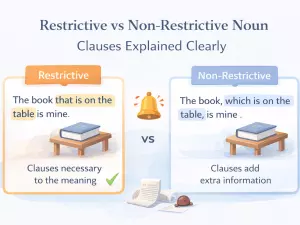
Which vs That: Restrictive and Non-Restrictive Clauses

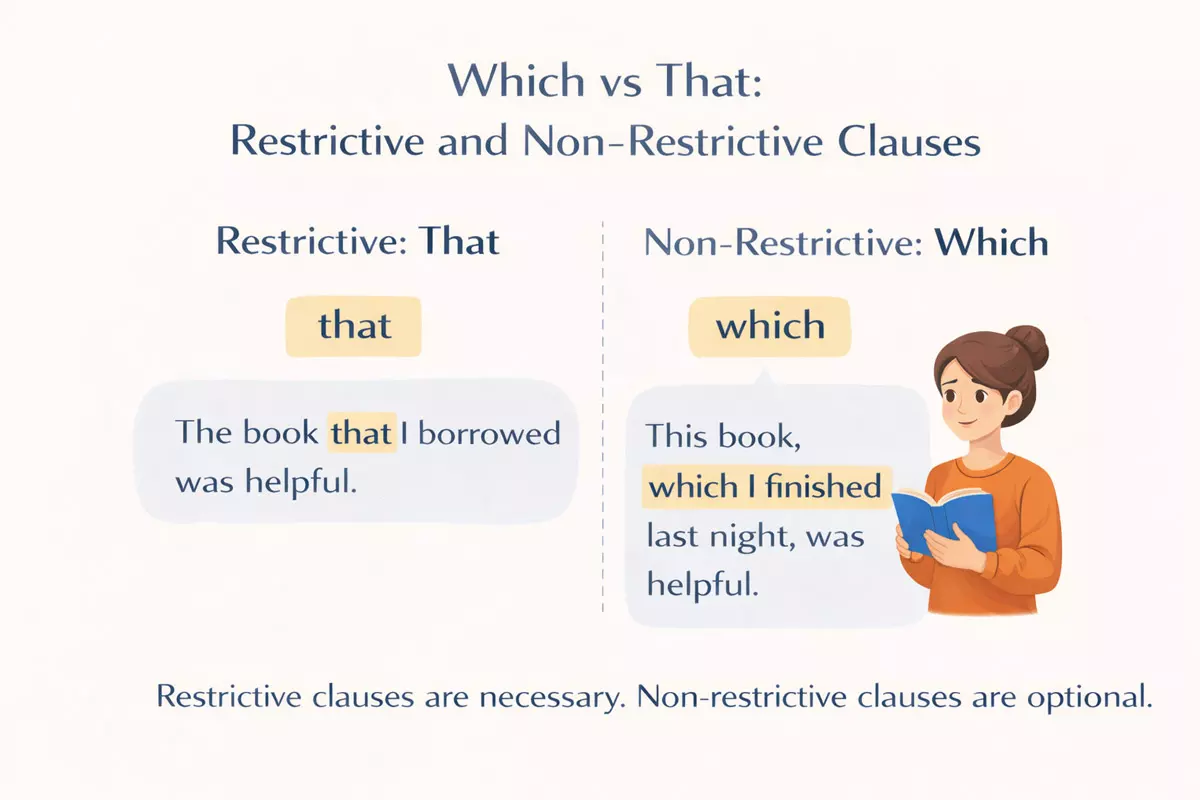 This article explains restrictive and non-restrictive clauses, the meaning change caused by commas, and the difference between which and that. It covers American English rules, spoken versus written use, punctuation mistakes, and editing tips.
- What restrictive and non-restrictive clauses are
- Meaning difference created by commas
- Which vs that in defining information
- Rules and preferences in American English
- Spoken vs written usage differences
- Common punctuation mistakes
- Editing tips to test clause type
- Practice: choose which or that correctly
Choosing between "which" and "that" can be challenging because each serves a different purpose in a sentence. "That" introduces restrictive clauses, which are essential to the meaning of the sentence and cannot be removed without altering the intended message. In contrast, "which" introduces non-restrictive clauses, which add extra information that can be omitted without changing the basic meaning. Recognizing this distinction helps you write clearer, more precise sentences and ensures your readers understand exactly what you mean.
What restrictive and non-restrictive clauses are
Understanding the difference between restrictive and non-restrictive clauses helps clarify sentence meaning and punctuation. Both types add information about a noun, but they do so in distinct ways and serve different purposes in writing.
Restrictive Clauses
A restrictive clause (often called a defining clause) provides essential information about the noun it modifies. Without this clause, the meaning of the sentence would change or become incomplete. These clauses are not set off by commas. In English, "that" is typically used to introduce restrictive clauses.
- The book that has a red cover is mine. (Specifies which book—essential detail)
- The students who arrived late missed the quiz. (Identifies a specific group—necessary for clarity)
- The cake she baked yesterday was delicious. (Points out a particular cake)
Non-Restrictive Clauses
A non-restrictive clause (also known as a non-defining clause) adds extra, non-essential information about a noun. If you remove this clause, the core meaning of the sentence remains the same. These clauses are always set off by commas, and "which" is commonly used to introduce them.
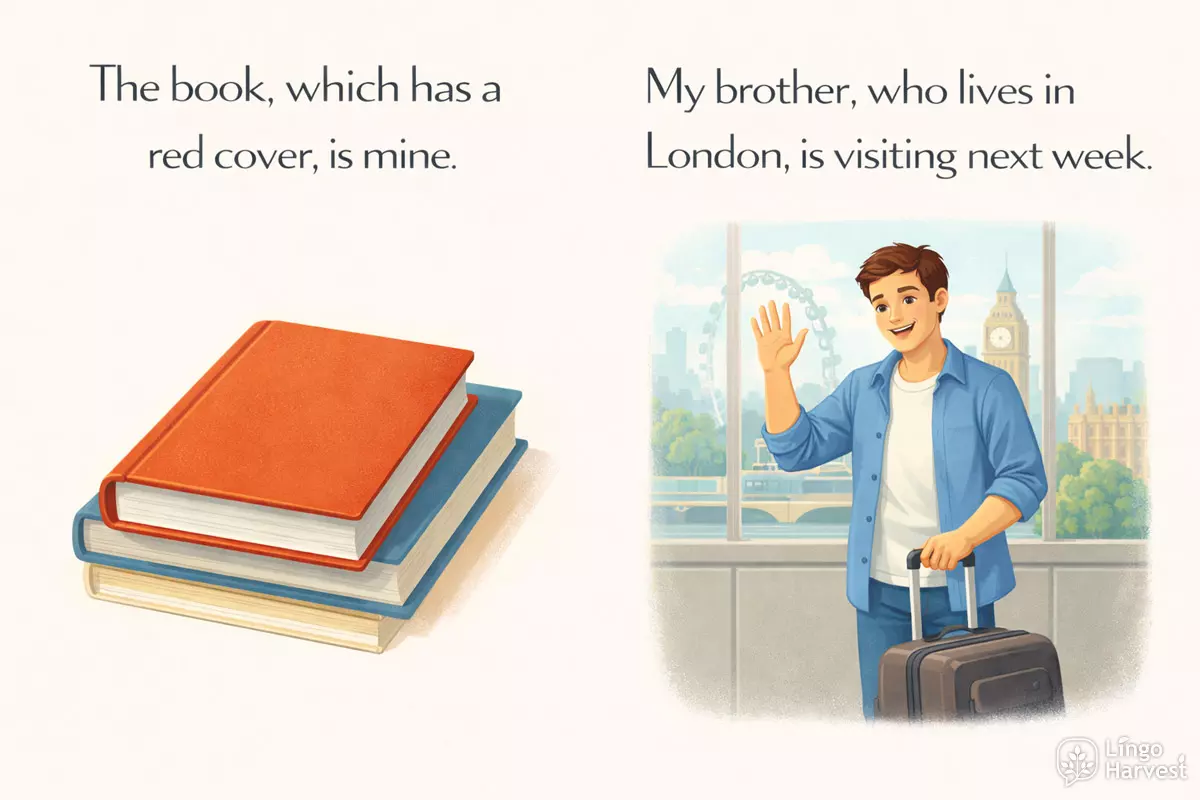
- The book, which has a red cover, is mine. (Extra detail—the sentence is clear without it)
- My brother, who lives in London, is visiting next week. (Adds info about the brother, but not needed to identify him)
- The cake, which she baked yesterday, was delicious. (The baking time is just additional information)
Key Differences at a Glance
| Restrictive Clause | Non-Restrictive Clause |
|---|---|
| Essential to meaning | Extra, non-essential detail |
| No commas | Set off by commas |
| Often uses "that" | Usually uses "which" |
| Cannot be omitted | Can be omitted without changing the main meaning |
Quick Reference: How to Spot Each Clause
- Ask yourself: Is the information required to identify the noun? If yes, it’s restrictive.
- If the detail can be removed without altering the basic meaning, it’s non-restrictive.
- Look for commas—non-restrictive clauses are always bracketed by them.
- Notice the pronoun: "that" signals restrictive; "which" often marks non-restrictive.
Getting comfortable with these patterns helps make your writing clearer and more precise. Knowing when to use "that" or "which" and whether to use commas is key for effective communication.
Meaning difference created by commas
Commas play a crucial role in distinguishing whether a clause is essential or extra information. The placement—or absence—of a comma can completely change what a sentence means. In English, "that" typically introduces restrictive (essential) clauses, while "which" is used with non-restrictive (non-essential) clauses, which are set off by commas. The use of punctuation marks, especially commas, signals whether the information is vital to identifying the noun or simply adds extra details.
How commas shift clause meaning
When a clause is set off by commas, it signals to the reader that the information is additional rather than necessary for identifying the subject. Without commas, the clause limits or restricts the meaning of the noun. This distinction can often lead to different interpretations of the same sentence.
- Restrictive clause (no commas): The book that has a red cover is mine. (Only the red book is mine; other books are not.)
- Non-restrictive clause (with commas): The book, which has a red cover, is mine. (The book is mine, and by the way, it has a red cover.)
- The cars that are parked outside belong to the staff. (Only those specific cars.)
- The cars, which are parked outside, belong to the staff. (All the cars are parked outside.)
- Students who arrive late must wait outside. (Only latecomers.)
- Students, who arrive late, must wait outside. (Implies all students are late.)
- The cookies that contain nuts should be labeled. (Only nut-containing cookies.)
- The cookies, which contain nuts, should be labeled. (All cookies have nuts.)
- The movie that won the award was excellent. (Refers to one specific movie.)
- The movie, which won the award, was excellent. (It’s already known which movie; adds detail.)
Side-by-side comparison
To see how punctuation influences meaning, compare these examples:
| Sentence (with/without commas) | Interpretation |
|---|---|
| The houses that have solar panels are valuable. | Only the houses with solar panels are valuable; others are not included. |
| The houses, which have solar panels, are valuable. | All the houses have solar panels; this is extra information about them. |
| Dogs that bark loudly annoy the neighbors. | Only some dogs (the loud barkers) annoy the neighbors. |
| Dogs, which bark loudly, annoy the neighbors. | All dogs bark loudly; this is a general statement about all dogs. |
Quick tips for clarity
- Use no commas for clauses that define or limit the noun—these are essential.
- Use commas for clauses that simply add extra information—these are non-essential.
- If removing the clause changes the meaning or leaves the noun unclear, commas should not be used.
- If the sentence remains clear without the clause, set it off with commas.
Understanding how commas affect meaning helps ensure your sentences are interpreted as you intend. This is especially important when choosing between "which" and "that," as the choice, together with commas, signals exactly how much information is necessary for your reader.
Which vs that in defining information
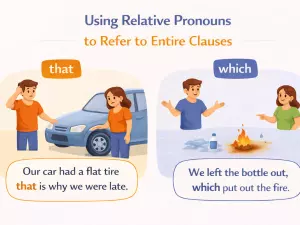
When you need to clarify exactly which person or thing you mean, choosing between “which” and “that” becomes important. In English grammar, “that” is typically used for restrictive (defining) clauses—parts of a sentence that are essential to its meaning. On the other hand, “which” generally introduces non-restrictive (non-defining) clauses, which add extra, but not essential, detail.
Understanding restrictive (defining) clauses
A restrictive clause tells us precisely which noun we’re talking about. Without this information, the sentence would lose its main point. For example, “The book that I borrowed is on the table.” Here, “that I borrowed” defines which book you mean.
- The car that is parked outside belongs to Jane. (Specifies which car.)
- Students that arrive late must wait outside. (Defines which students.)
- The cookies that have nuts are on the top shelf. (Clarifies which cookies.)
- She wore the dress that her mother made. (Specifies which dress.)
- The painting that was stolen has been found. (Defines which painting.)
Non-restrictive (non-defining) clauses and “which”
When the added information is not essential—meaning the sentence would still make sense without it—“which” is the preferred word. These clauses are usually set off by commas. For example, “The book, which I borrowed, is on the table.” Here, “which I borrowed” adds extra information but does not define the book.
- The car, which is red, belongs to Jane. (Extra detail about the car.)
- Students, which includes John, must submit their forms. (Adds info about students.)
- The cookies, which are homemade, are on the top shelf. (Non-essential detail.)
- She wore the dress, which her mother made, to the party. (Adds detail, not defining.)
- The painting, which was stolen, has been found. (The theft is extra information.)
Summary of usage
| Clause Type | Word Used | Example | Commas? |
|---|---|---|---|
| Restrictive (defining) | that | The movie that won the award is excellent. | ❌ (No commas) |
| Non-restrictive (non-defining) | which | The movie, which won the award, is excellent. | ✅ (Use commas) |
In summary, use “that” when the information is necessary to identify the noun, and “which” when you’re simply adding extra, non-essential detail. This distinction helps keep your writing precise and easy to understand.
Rules and preferences in American English
In American usage, "which" and "that" serve distinct roles when introducing restrictive and non-restrictive clauses. The general rule is straightforward: use "that" for clauses essential to the meaning of a sentence (restrictive), while "which" introduces extra, non-essential information (non-restrictive). This distinction helps readers quickly determine whether the information is crucial or simply additional detail.
Restrictive vs. Non-Restrictive Clauses
A restrictive clause narrows down the noun it modifies and is not separated by commas. In contrast, a non-restrictive clause offers supplementary information and is set off with commas. Sticking to these conventions improves clarity and reduces ambiguity.
| Clause Type | Preferred Relative Pronoun | Punctuation | Example |
|---|---|---|---|
| Restrictive | that | No commas | The book that you lent me was excellent. |
| Non-restrictive | which | Commas required | The book, which you lent me, was excellent. |
Key Preferences and Guidelines
- Use that only for restrictive clauses—never with commas.
- Use which only for non-restrictive clauses—always with commas.
- Do not use "which" for essential information in formal writing; this is considered incorrect by many style guides.
- Omitting "that" is sometimes acceptable in casual speech, but not in precise writing.
- Never use "that" to introduce a non-restrictive clause.
- In conversation, some Americans use "which" for restrictive clauses, but this is discouraged in edited texts.
- Academic and journalistic writing in the U.S. strictly follows this distinction.
- British English tends to be more flexible, but American English prefers a clear separation.
- Relative pronouns ("that," "which") refer to things, not people—use "who" for people.
- Ambiguity is avoided by following these conventions, especially in legal and technical documents.
Common Pitfalls
- Using "which" without commas for restrictive clauses ❌
- Adding commas with "that" clauses ❌
- Switching between "which" and "that" inconsistently in the same text ❌
- Forgetting commas with non-restrictive clauses ❌
Writers and editors in the U.S. are encouraged to apply these preferences consistently, especially in formal contexts. While spoken English can be more forgiving, clear writing benefits from following the established guidelines for "which" and "that" in relative clauses.
Spoken vs written usage differences
When comparing how "which" and "that" are used in conversation versus formal text, some clear patterns emerge. In everyday speech, strict rules often take a back seat to ease and speed of communication. By contrast, written English—especially in academic or professional contexts—tends to follow the traditional distinctions between restrictive ("that") and non-restrictive ("which") clauses more closely.
How people actually use "which" and "that" in speech
In informal dialogue, speakers frequently blur the lines between these two words. For example, many native speakers use "which" in places where prescriptive grammar would call for "that," and vice versa. This flexibility rarely causes confusion, as the intended meaning is usually clear from the context and intonation.
- "That" is commonly used for both essential and non-essential information in everyday conversation.
- "Which" sometimes appears in restrictive clauses when people speak informally.
- Commas are almost never considered in speech, so the distinction between restrictive and non-restrictive clauses is typically marked by pauses or emphasis instead.
- Native speakers often prioritize flow and efficiency over strict grammatical correctness.
- Listeners rely on tone and context to interpret meaning, rather than punctuation or explicit markers.
Written English: following the rules
Writers, especially in formal settings, are usually expected to maintain the distinction:
- "That" introduces restrictive (essential) clauses without commas.
- "Which" introduces non-restrictive (extra) clauses, set off by commas.
- Editors and teachers often correct misuse, especially in academic and business documents.
- Style guides like The Chicago Manual of Style or AP Stylebook reinforce this separation.
Key contrasts at a glance
| Spoken English | Written English (Formal) |
|---|---|
| Interchangeable use of "which" and "that" | Clear distinction based on clause type |
| Meaning indicated by tone and context | Punctuation (commas) marks the difference |
| Commas and strict rules often ignored | Rules and punctuation are enforced |
| Intended meaning rarely misunderstood | Precision and clarity prioritized |
Typical examples in conversation vs. writing
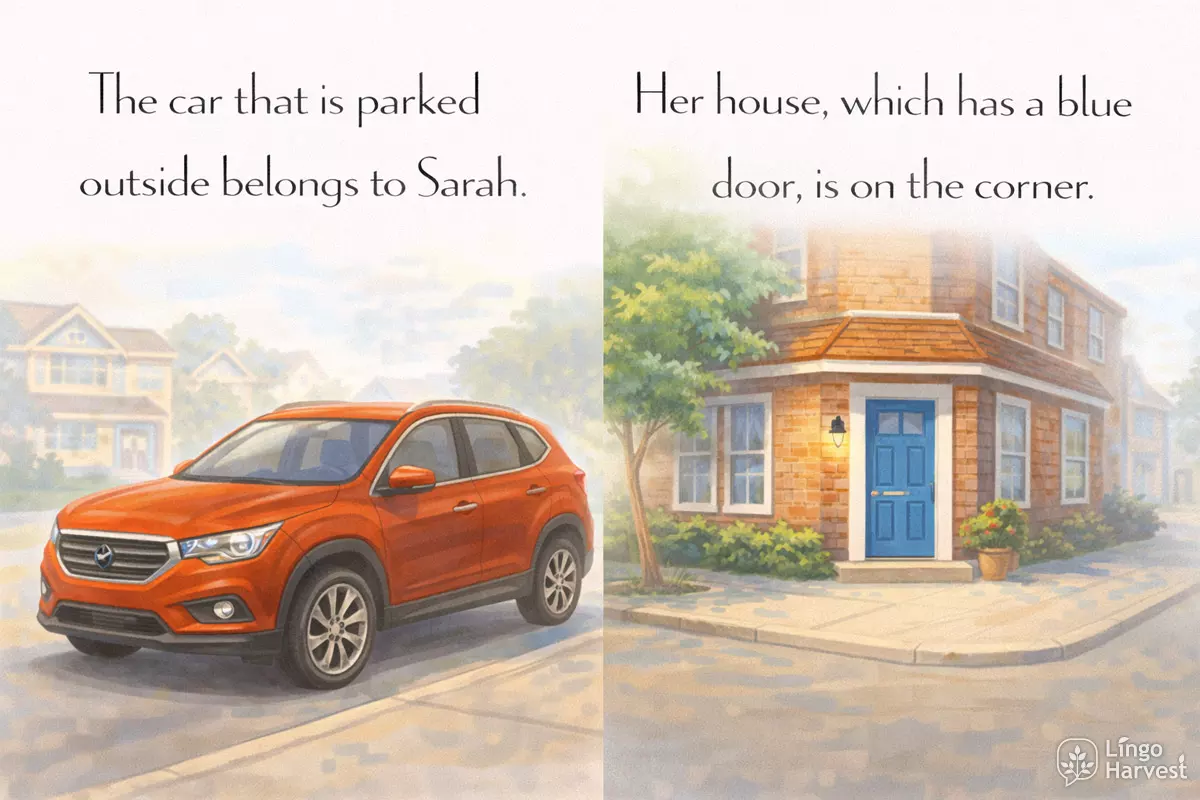
Here are some sample sentences showing the natural differences:
- Spoken: "The book which I lent you was new." (No pause, no comma)
- Spoken: "That’s the movie that I was talking about." (Used for both restrictive/non-restrictive)
- Written: "The car that is parked outside belongs to Sarah." (No comma, restrictive)
- Written: "Her house, which has a blue door, is on the corner." (Comma, non-restrictive)
- Spoken: "I like the cookies you made, which were delicious." (Pause for emphasis, but no comma needed in actual speech)
In summary, while formal writing maintains a sharp line between "which" and "that," spoken English is much more forgiving. Understanding both sets of conventions can help you adapt your language for any situation.
Common punctuation mistakes
Punctuation plays a critical role in clarifying whether a clause is restrictive or non-restrictive, especially when choosing between "which" and "that." Many writers stumble when deciding where to place commas, which can completely change the meaning of a sentence. Understanding these frequent errors can help you communicate your ideas more precisely.
Typical errors with commas
- Forgetting to use commas around non-restrictive clauses introduced by "which."
- Inserting unnecessary commas before restrictive clauses starting with "that."
- Confusing the two types of clauses, leading to misplaced or missing commas.
- Adding a comma before "that" (which is almost never needed in standard English).
- Omitting commas after non-restrictive clauses, causing sentences to run together.
- Using dashes or parentheses inconsistently instead of the required commas for non-restrictive information.
- Misplacing commas, so the clause modifies the wrong noun or phrase.
- Overusing commas, breaking up restrictive clauses and making them unclear.
- Leaving out commas before and after non-restrictive clauses in the middle of a sentence.
- Incorrectly punctuating sentences with multiple subordinate clauses, muddling which information is essential.
Examples: Correct vs Incorrect Punctuation
Here are some illustrative examples showing the consequences of punctuation mistakes with "which" and "that":
| Incorrect | Correct |
|---|---|
| The book that, I borrowed was excellent. | The book that I borrowed was excellent. |
| The car which is red is parked outside. | The car, which is red, is parked outside. |
| She wore the dress, that she bought yesterday. | She wore the dress that she bought yesterday. |
| My laptop which I bought last year crashed. | My laptop, which I bought last year, crashed. |
| The painting, that hangs in the hall, is a family heirloom. | The painting that hangs in the hall is a family heirloom. |
Quick tips to avoid errors
- Use commas to set off clauses introduced by "which" only when the information is non-essential.
- Never use a comma before "that" in standard restrictive clauses.
- Read the sentence aloud; a natural pause often signals where a comma belongs.
- Double-check whether the clause can be removed without changing the main meaning—if so, set it off with commas.
- Review sentences with both "which" and "that" to ensure punctuation matches the intended meaning.
Mastering punctuation with restrictive and non-restrictive clauses not only polishes your writing but also prevents misunderstandings.
Editing tips to test clause type
When revising sentences for clarity, distinguishing between restrictive (essential) and non-restrictive (non-essential) clauses helps ensure proper use of "which" and "that." Editors often apply a few reliable strategies to check clause types quickly and accurately.
Quick checks for essential vs. non-essential clauses
- Remove the clause: If omitting the clause changes the core meaning or makes the sentence ambiguous, it’s restrictive and should use "that." If the sentence remains clear and complete, the clause is likely non-restrictive and should use "which."
- Comma test: Non-restrictive clauses are set off with commas, while restrictive clauses are not. If you naturally want a pause, consider "which." If not, "that" might be correct.
- Replace with 'which' or 'that': Swap both words in the sentence to see which sounds more natural and maintains the intended meaning.
- Ask: Does this information define or add extra detail? Defining information points to "that," while extra detail suggests "which."
Common editing questions
- Does the clause limit or identify a noun, or is it just extra info?
- Would removing the clause create confusion?
- Is the clause surrounded by commas?
- Is the sentence formal or informal? (In informal writing, "which" is sometimes used for restrictive clauses, but this is discouraged in edited prose.)
Example test sentences
Try these practice sentences to determine which word and punctuation are appropriate.
- The book ____ you lent me was fascinating.
- The painting, ____ was restored last year, now hangs in the foyer.
- Any car ____ fails the inspection must be repaired.
- The cookies ____ she baked are almost gone.
- The museum, ____ opened in 1892, is a city landmark.
- The laptop ____ I bought yesterday stopped working.
- The conference, ____ attracted experts from around the world, lasted three days.
- All documents ____ are missing must be reported immediately.
- The song ____ you recommended is now my favorite.
- The bridge, ____ connects the two districts, was closed for repairs.
Show answers
- that
- which
- that
- that
- which
- that
- which
- that
- that
- which
Editing cues and signals
Editors look for certain cues in sentences. Here’s a list of signals that often indicate the clause type:
- Commas around the clause → usually non-restrictive ("which")
- No commas → usually restrictive ("that")
- Clauses starting with "who" or "where" follow similar rules
- Essential to the noun’s identity? Use "that"
- Additional, non-defining info? Use "which"
- Restrictive clauses often appear in technical and legal writing
- Non-restrictive clauses are more common in descriptive writing
- Test by reading the sentence aloud for natural pauses
- Watch for ambiguity—clarity is the top priority
- Revise sentences where clause type is unclear
Comparison of clause types
| Feature | Restrictive Clause ("that") | Non-Restrictive Clause ("which") |
|---|---|---|
| Defines noun? | Yes, essential information | No, adds extra detail |
| Comma usage | No commas | Set off by commas |
| Example | The cake that she made was delicious. | The cake, which she made yesterday, was delicious. |
| Can be omitted? | No, changes meaning | Yes, meaning remains |
By systematically applying these checks, editors and writers can confidently determine whether a clause is restrictive or non-restrictive, leading to clearer and more precise sentences.
Practice: choose which or that correctly
Understanding when to use "which" versus "that" is essential for writing clear, precise sentences. The following exercises will help you practice distinguishing between restrictive and non-restrictive clauses and selecting the appropriate relative pronoun. Review the sentences and decide which word fits best.
Choose the correct word for each sentence
Read each sentence and fill in the blank with either "which" or "that".
- The book ____ I borrowed from the library is overdue.
- My laptop, ____ I bought last year, still works perfectly.
- She wore the dress ____ she bought in Paris.
- The cake, ____ was homemade, tasted delicious.
- Do you remember the movie ____ we watched together?
- The car ____ has a red stripe is mine.
- My phone, ____ I use every day, needs a new battery.
- The shoes ____ are on the floor belong to Sarah.
- The building, ____ was constructed in 1920, is now a museum.
- This is the painting ____ won the competition.
Show answers
- that
- which
- that
- which
- that
- that
- which
- that
- which
- that
Quick Reference: Patterns for "which" and "that"
- Use that for essential (restrictive) information—no commas.
- Use which for extra (non-restrictive) information—set off with commas.
- Never use "which" without commas for restrictive clauses in formal English.
- "That" is never used after a comma.
Spot the Difference: Restrictive vs. Non-Restrictive
| Restrictive Clause (That) | Non-Restrictive Clause (Which) |
|---|---|
| The dog that barked all night kept me awake. | The dog, which barked all night, kept me awake. |
| The shoes that fit best are the blue ones. | The shoes, which are blue, fit best. |
| The car that I drive is electric. | The car, which I drive every day, is electric. |
| The report that you sent was helpful. | The report, which you sent yesterday, was helpful. |
Review these examples to reinforce how the choice between "which" and "that" changes the meaning or structure of a sentence. Practice regularly to build confidence in using relative clauses accurately.