Restrictive vs Non-Restrictive Noun Clauses Explained Clearly

 Here we the difference between restrictive and non-restrictive meanings in noun clauses, their role in sentence structure, how punctuation and information focus affect meaning, common introducers, typical learner errors, and practice identifying clause…
- Difference between restrictive and non-restrictive meaning
- Role of noun clauses in sentence structure
- How punctuation changes meaning in noun clauses
- Information focus in restrictive vs non-restrictive use
- Common verbs and nouns introducing noun clauses
- Typical learner errors with clause boundaries
- Practice: identify and correct noun clause types
Understanding the difference between essential and nonessential noun clauses can significantly improve your writing and comprehension skills. Essential noun clauses provide information that is necessary to the meaning of a sentence, while nonessential noun clauses add extra details that can be omitted without changing the core meaning. By recognizing how these clauses function, you can write more clearly and interpret sentences more accurately, ultimately enhancing both your grammar and your ability to communicate effectively.
Difference between restrictive and non-restrictive meaning
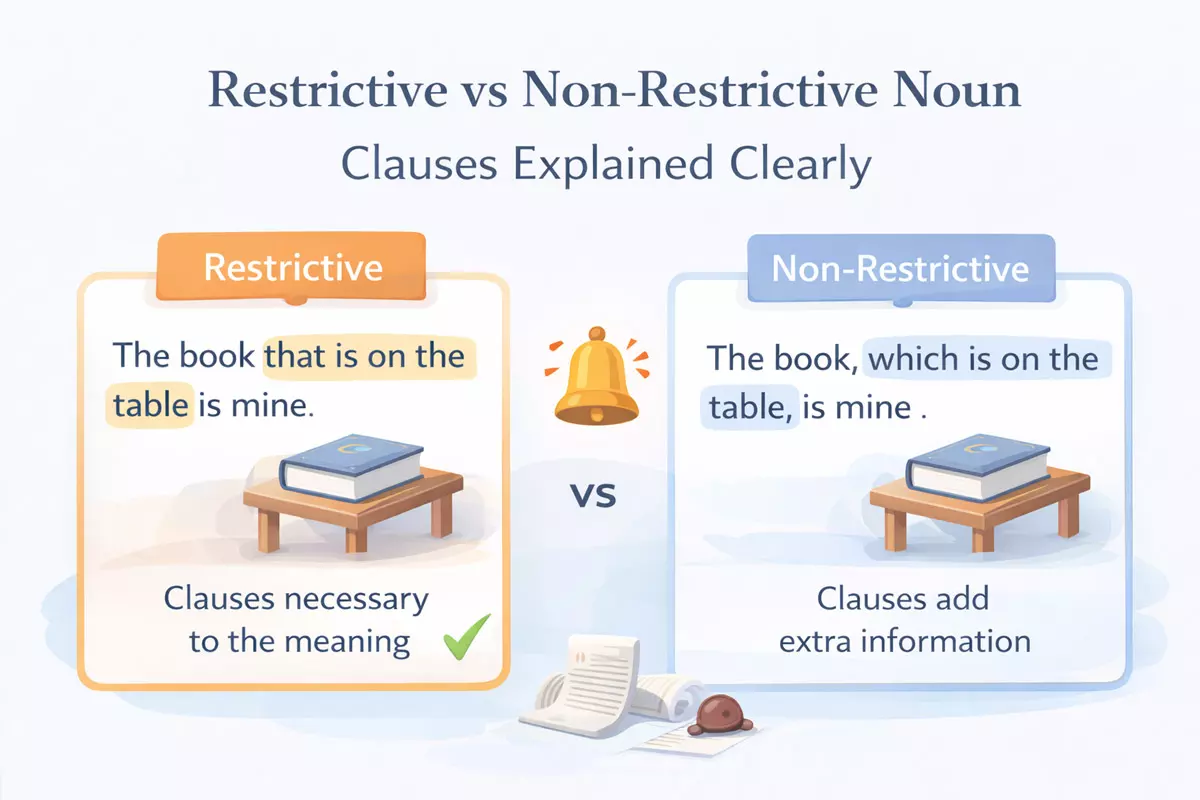
Understanding the distinction between restrictive and non-restrictive noun clauses is essential for clarity in English sentences. Restrictive clauses are vital to the core meaning of a sentence, while non-restrictive ones simply add extra information. This basic difference affects both punctuation and interpretation.
Restrictive Noun Clauses
A restrictive noun clause specifies exactly which person or thing you mean. If you remove it, the main idea of the sentence changes or becomes incomplete. There is no comma before or after a restrictive clause. For example:
- The idea that you suggested was brilliant. (Only the idea you suggested, not any other.)
- She believes what he said is true. (Refers to a specific statement.)
Non-Restrictive Noun Clauses

Non-restrictive noun clauses add extra, non-essential information. The main point of the sentence remains clear even if you remove the clause. These clauses are usually set off by commas. For example:
- His claim, which nobody believed, was ignored. (The claim is already identified; the clause just adds detail.)
- Her answer, that she would help, surprised everyone. (The exact answer is not needed to identify her response.)
Key Features Compared
| Restrictive Clause | Non-Restrictive Clause |
|---|---|
| Essential to the sentence’s meaning | Provides additional, non-essential information |
| No commas used | Set off by commas |
| Cannot be removed without changing the core meaning | Can be removed without affecting the basic sense |
| Often answers “which one?” or “what kind?” | Often answers “what else?” or “in addition?” |
Quick Reference: Common Signals
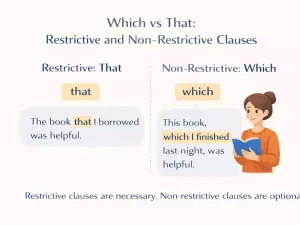
- That is typically used for restrictive clauses.
- Which often introduces non-restrictive clauses (with commas).
- Restrictive: “The book that you lent me was fascinating.”
- Non-restrictive: “The book, which you lent me, was fascinating.”
- Restrictive: “Anyone who wants to join is welcome.”
- Non-restrictive: “My brother, who lives abroad, is visiting.”
- Restrictive: No commas; non-restrictive: use commas.
- Restrictive clauses help specify or limit; non-restrictive simply elaborate.
Grasping when to use each type of clause improves both your writing and comprehension. By noticing punctuation and the role a clause plays, you can tell whether information is essential or simply descriptive.
Role of noun clauses in sentence structure
Noun clauses act as essential building blocks within sentences, functioning as subjects, objects, or complements. They allow writers and speakers to express complex thoughts, ask questions indirectly, and provide detailed information, all within a single sentence. By embedding these clauses, sentences can convey more nuanced meanings and link ideas efficiently.
Common Functions of Noun Clauses
Noun clauses can appear in various places within a sentence. Here are some of their most frequent roles:
- Subject: What you decided surprised everyone.
- Direct object: She didn’t hear what he said.
- Object of a preposition: We are interested in how this happened.
- Subject complement: The truth is that he lied.
- Appositive: The idea that we could win motivated the team.
How Noun Clauses Shape Meaning and Flow
Integrating noun clauses enables sentences to flow more naturally and to present information in a more sophisticated way. For example, instead of two separate sentences (“She knows the answer. The answer is correct.”), a noun clause creates a smoother structure: “She knows that the answer is correct.” This allows for greater clarity and cohesion.
Types of Information Conveyed by Noun Clauses
These clauses often answer implicit questions, report speech, or clarify uncertainty. Here are some patterns and triggers:
- What (uncertainty or content): What he wants is unclear.
- Whether/if (possibility): I wonder whether she’ll come.
- That (fact or statement): She said that she was tired.
- Who/whom/whose (identity): Tell me who called.
- Where (location): I remember where we met.
- When (time): Do you know when the train leaves?
- Why (reason): He explained why he left early.
- How (manner): She described how she solved the puzzle.
- Which (choice): Choose which one you like best.
- Whoever/whatever/whichever (indefinite): Whoever finishes first wins the prize.
Impact on Sentence Complexity and Clarity
Using noun clauses can make sentences more complex, but also more precise. They help writers avoid repetitive or choppy statements by embedding related information. However, overuse or poorly structured clauses can lead to confusion, so balance and clarity are important.
Comparing Restrictive and Non-Restrictive Noun Clauses
| Function | Restrictive Noun Clauses | Non-Restrictive Noun Clauses |
|---|---|---|
| Limits or defines the noun? | ✅ Yes, essential for meaning | ❌ No, adds extra information |
| Punctuation | No commas | Usually set off by commas |
| Example | I believe what you said is true. | The rumor, that he will quit, surprised us. |
| Effect on sentence | Makes the meaning specific | Adds non-essential detail |
Noun clauses are powerful tools for expressing detailed thoughts and relationships between ideas. Understanding how they function in different contexts helps writers construct clear, effective sentences.
How punctuation changes meaning in noun clauses
Punctuation marks—especially commas—play a crucial role in clarifying whether a noun clause is restrictive (essential) or non-restrictive (non-essential). The presence or absence of commas often signals to readers how much information is required to identify the noun being discussed. This subtle distinction can shape the entire meaning of a sentence.
Commas and Their Influence on Meaning
When a noun clause is essential to the meaning of the sentence, it usually appears without commas. In contrast, if the noun clause adds extra, non-essential information, it is set off with commas. This difference helps readers decide whether the information is necessary for understanding the sentence or simply extra detail.
- No commas: The clause is essential and restricts the noun’s reference.
- With commas: The clause provides extra information that could be omitted without changing the core meaning.
Examples: Impact of Punctuation
Consider these sentence pairs to see how punctuation changes interpretation:
- She didn’t hear what he said was important. → (The exact words he said are crucial.)
- She didn’t hear what he said, which was important. → (The fact she didn’t hear is important, not the words themselves.)
- We need whoever finishes first to help. → (Only the first finisher will help.)
- We need whoever finishes first, which is always John, to help. → (Extra, non-essential info: it’s always John.)
- I remember that she called. → (Her call is the key information.)
- I remember that she called, which surprised me. → (The surprising part is added detail.)
- The fact that he lied shocked us. → (His lying is the shocking part.)
- The fact that he lied, which nobody expected, shocked us. → (Unexpectedness is extra info.)
Punctuation Patterns: Quick Overview
| Pattern | Effect on Meaning |
|---|---|
| No commas around the noun clause | Clause is necessary; limits or defines the noun. Example: "The idea that you mentioned helped." |
| Commas around the noun clause | Clause is additional; can be removed without changing the main idea. Example: "The idea, that you mentioned, helped." |
| Comma before a following clause (often with 'which') | Introduces a comment about the entire previous statement. Example: "He finished the report, which surprised everyone." |
| No punctuation with 'that' clauses | 'That' clauses are almost always restrictive and never take commas. Example: "I believe that she is right." |
Common Pitfalls
Writers often add or omit commas without realizing the impact. Omitting necessary commas can make non-essential clauses seem essential, while adding unnecessary commas can confuse readers about what information really matters.
- Incorrect: I know, that you’re coming. ❌
- Correct: I know that you’re coming. ✅
- Incorrect: The rumor, that she left, spread quickly. ❌
- Correct: The rumor that she left spread quickly. ✅
Understanding how punctuation guides the reader’s interpretation of noun clauses is essential for clear and precise writing. Even minor changes in commas can shift the meaning dramatically, so attention to these details pays off.
Information focus in restrictive vs non-restrictive use
When using noun clauses, the choice between restrictive and non-restrictive forms signals what information is central or incidental in a sentence. Restrictive noun clauses pinpoint exactly which person or thing is meant, acting as essential identifiers. By contrast, non-restrictive clauses simply add extra detail, with the main subject already clear to the reader or listener.
How restrictive clauses guide attention
A restrictive noun clause narrows down meaning. For instance, in “The idea that she proposed was accepted,” the clause “that she proposed” tells us which specific idea is meant. Without it, the listener wouldn’t know which idea is being discussed. Such clauses are never set off by commas, highlighting their necessity to the sentence.
Non-restrictive clauses and supplementary information
Non-restrictive noun clauses, often introduced with “which,” “who,” or “whose,” present background or non-essential information. For example, “Her answer, which surprised everyone, was correct.” Here, “which surprised everyone” adds extra context—the main point is already understood. These clauses are always separated by commas.
Key contrasts in information emphasis
- Restrictive: Defines or limits the subject.
- Non-restrictive: Supplies optional, additional details.
- Restrictive: No commas; meaning would change if removed.
- Non-restrictive: Surrounded by commas; sentence remains clear if omitted.
- Restrictive: Answers “which one?” or “which kind?”
- Non-restrictive: Answers “what else about it?”
- Restrictive: Essential for understanding.
- Non-restrictive: Can be left out without loss of core meaning.
- Restrictive: Usually uses “that” (in relative clauses), but noun clauses themselves do not always show this distinction as clearly as adjective clauses.
- Non-restrictive: Often introduced by “which” or “who.”
Examples that clarify focus

- The claim that he made was false. → Specifies which claim.
- The claim, which he made yesterday, was false. → Adds information about when.
- The belief that hard work pays off is common. → Defines the belief in question.
- The belief, which many people hold, is common. → Adds extra detail about the belief.
Summary table: Essential vs. additional information
| Type | Information Focus | Punctuation | Effect if Removed |
|---|---|---|---|
| Restrictive | Identifies or limits the noun; crucial to meaning | No commas | Sentence meaning incomplete or unclear |
| Non-restrictive | Adds extra, non-essential detail | Set off by commas | Sentence remains clear and complete |
Understanding how each type directs your reader’s attention helps you craft sentences that are both precise and informative. Choosing between these forms is not just about grammar, but also about what you want your audience to focus on.
Common verbs and nouns introducing noun clauses
Understanding which words typically lead into noun clauses helps clarify how these clauses function in sentences. Noun clauses often follow specific verbs or nouns that signal a statement, question, or idea is about to be expressed. Recognizing these triggers is essential for both identifying and constructing restrictive and non-restrictive noun clauses.
Typical verbs used before noun clauses
Certain verbs frequently introduce noun clauses, especially those related to speech, thought, or perception. Here are some of the most common:
- say → Researchers say the results support the original hypothesis.
- think → Many experts think the policy will reduce emissions.
- know → We know that genetic factors influence development.
- believe → Scientists believe the method can be improved.
- hope → The team hopes the findings will guide future research.
- imagine → It is difficult to imagine the impact of complete automation.
- suggest → The data suggest a strong correlation between the variables.
- claim → The authors claim their model predicts outcomes accurately.
- realize → Students often realize their mistakes after revision.
- remember → Readers should remember that correlation does not imply causation.
- forget → The study warns researchers not to forget ethical considerations.
- admit → The researcher admitted several limitations in the design.
- deny → The company denied responsibility for the accident.
- expect → Analysts expect a rise in market demand.
- fear → Some fear automation may replace human labor.
- understand → The report helps readers understand complex mechanisms.
- wonder → Many students wonder how artificial intelligence works.
- explain → The authors explain the theory using clear examples.
- discover → Researchers discovered a new species in the region.
- report → The article reports significant progress in vaccine development.
These verbs are often followed by clauses beginning with "that," "if," or "whether," which act as the subject or object of the verb. For example: "She explained that she was late."
Nouns frequently followed by noun clauses
Certain nouns also tend to be followed by noun clauses. These usually refer to concepts, facts, or information:
- fact → It is a fact that climate patterns are changing.
- idea → The idea attracted attention from leading researchers.
- possibility → There is a real possibility that results may vary across regions.
- belief → The belief that technology improves learning remains widespread.
- news → The news generated strong reactions in the scientific community.
- assumption → The assumption behind the model proved to be inaccurate.
- suggestion → Her suggestion helped improve the final design.
- claim → The claim was supported by extensive evidence.
- question → The question remains whether the system is truly reliable.
- rumor → The rumor spread quickly despite lack of proof.
- statement → His statement clarified the purpose of the experiment.
- promise → The government made a promise to reduce carbon emissions.
- decision → The decision affected the outcome of the entire project.
- hope → There is hope that treatment will improve survival rates.
- fear → The fear of failure influenced participant responses.
- knowledge → Our knowledge of the disease continues to expand.
For example: "The fact that he arrived late surprised everyone."
Comparing verbs and nouns introducing noun clauses
The table below highlights key differences in how verbs and nouns can introduce noun clauses. This can help learners see patterns and choose the right structure.
| Verb introducing a noun clause | Noun introducing a noun clause |
|---|---|
| She thinks (that) he is honest. | The belief that he is honest is widespread. |
| They suggested (that) we leave early. | Her suggestion that we leave early was accepted. |
| I heard (that) you got a new job. | The news that you got a new job made me happy. |
| We decided (that) it was too late. | The decision that it was too late was unanimous. |
Key points to remember
- Verbs of reporting, thinking, and perceiving are the most frequent triggers for noun clauses.
- Abstract nouns related to ideas, facts, and information also commonly precede noun clauses.
- Both restrictive and non-restrictive noun clauses can follow these verbs and nouns, depending on context.
- Identifying these patterns in authentic sentences makes distinguishing between different types of noun clauses much easier.
Typical learner errors with clause boundaries
Learners often struggle with telling where one clause ends and another begins, especially when dealing with restrictive and non-restrictive noun clauses. Misunderstanding these boundaries can change the meaning of a sentence or make it hard to follow. Many students confuse which clauses should be set off with commas and which should not, or they incorrectly connect clauses, leading to run-ons or fragments.
Common mistakes in identifying clause limits
It’s easy to miss the subtle differences that separate a main clause from an embedded noun clause. For example, learners may:
- Forget to use commas with non-restrictive (extra information) clauses
- Insert unnecessary commas before essential (restrictive) clauses
- Combine two clauses without a conjunction or punctuation
- Confuse noun clauses with adjective (relative) clauses
- Misplace the clause, making the sentence ambiguous
- Use “that” with non-restrictive clauses (where “which” is correct)
- Omit the subject or verb in a dependent clause
- Start a new sentence where a clause should be attached
- Misuse pronouns that refer to the wrong noun
- Repeat the subject unnecessarily (“The fact that she that she left”)
- Use sentence fragments instead of full clauses
- Attach unrelated information in the same clause
How clause boundary errors affect meaning
A misplaced comma or an incorrectly joined clause can shift a sentence’s message. For instance, “The book, that you gave me is interesting” is confusing because the comma suggests extra information, but “that” introduces a restrictive clause, not a non-restrictive one. This blurring of boundaries can cause misunderstanding, especially in formal writing.
Examples: Correct vs. incorrect clause boundaries
| Incorrect ❌ | Correct ✅ |
|---|---|
| My friend who lives in Paris, is visiting. | My friend, who lives in Paris, is visiting. |
| The idea, that you suggested was great. | The idea that you suggested was great. |
| I know. That she is coming. | I know that she is coming. |
| The car which I bought last year is red. (should be "that" for restrictive) | The car that I bought last year is red. |
| She told me, what happened. | She told me what happened. |
Tips for recognizing clause boundaries
- Read sentences aloud to hear natural pauses (often where clauses end)
- Look for conjunctions like “that,” “which,” “who,” or “what” to identify starts of clauses
- Check if the clause adds essential or extra information—this affects punctuation
- Practice rewriting sentences by adding/removing commas and seeing how meaning changes
- Identify verbs and their subjects in each part of the sentence
Understanding these patterns helps learners avoid common mistakes and write clearer, more accurate sentences.
Practice: identify and correct noun clause types
Understanding how to distinguish between restrictive and non-restrictive noun clauses is essential for clear, precise communication. Below, you’ll find a variety of exercises and examples to help you identify, analyze, and correct different types of noun clauses in context. These exercises focus on recognizing both restrictive (essential for meaning) and non-restrictive (providing extra information) clauses, as well as correcting common mistakes.
Task 1: Identify the Noun Clause Type
Read each sentence below and decide whether the underlined noun clause is restrictive or non-restrictive.
- I don’t know who called you last night.
- The fact that you arrived early surprised everyone.
- My suggestion, that we meet earlier, was ignored.
- We will accept whatever you decide.
- Her hope, that her team would win, was finally realized.
- I wonder why he left so suddenly.
- The belief that practice improves skill is widely accepted.
- The rumor, that the event was cancelled, spread quickly.
- I understand what you mean.
- The assumption, that the results were accurate, turned out to be false.
Show answers
- Restrictive
- Restrictive
- Non-restrictive
- Restrictive
- Non-restrictive
- Restrictive
- Restrictive
- Non-restrictive
- Restrictive
- Non-restrictive
Task 2: Correct the Punctuation
Some sentences below have incorrect punctuation for their noun clauses. Rewrite the sentences, correcting any punctuation errors.
- The rumor that he quit, spread quickly.
- Her belief that everyone deserves respect was inspiring.
- His idea, that we cancel the trip was not popular.
- The claim, that the product works, is questionable.
- The assumption, that students learn better online, is debated.
- The fact that she won, shocked the audience.
- The belief that exercise improves mood, is supported by research.
- The hope, that they would return soon gave them strength.
- The suggestion that we postpone the event, was rejected.
- The fear that prices will rise, affected the market.
- The idea, that the Earth is flat, was disproved long ago.
- The report that the results were inaccurate, surprised the team.
Show answers
- The rumor that he quit spread quickly.
- Her belief that everyone deserves respect was inspiring.
- His idea that we cancel the trip was not popular.
- The claim that the product works is questionable.
- The assumption that students learn better online is debated.
- The fact that she won shocked the audience.
- The belief that exercise improves mood is supported by research.
- The hope that they would return soon gave them strength.
- The suggestion that we postpone the event was rejected.
- The fear that prices will rise affected the market.
- The idea that the Earth is flat was disproved long ago.
- The report that the results were inaccurate surprised the team.
Task 3: Compare Restrictive and Non-Restrictive Noun Clauses
Review how the meaning changes when a noun clause is restrictive versus when it is non-restrictive. This table provides side-by-side examples for clarity.
| Restrictive Noun Clause | Non-Restrictive Noun Clause |
|---|---|
| The idea that she proposed was brilliant. | Her idea, that we should leave early, was brilliant. |
| The hope that he would return kept her waiting. | Her hope, that he would return, kept her waiting. |
| The belief that hard work pays off is common. | His belief, that hard work pays off, is inspiring. |
| The fact that she won surprised everyone. | Her victory, that she won, surprised everyone. |
Task 4: Spot the Error
Each sentence below contains a noun clause mistake. Identify and correct the error.
- The idea, that we should skip the meeting was unpopular.
- Her belief that, she could win inspired others.
- I don’t know that why he left.
- The rumor, that he’s moving, spread quickly.
- The fact, that she passed the exam surprised everyone.
- The hope, that they would arrive early gave them confidence.
- The assumption that, results were accurate was incorrect.
- The claim, that the project failed was untrue.
- The belief that, technology improves learning is widely accepted.
- I don’t understand that what he means.
Show answers
- The idea that we should skip the meeting was unpopular.
- Her belief that she could win inspired others.
- I don’t know why he left.
- The rumor that he’s moving spread quickly.
- The fact that she passed the exam surprised everyone.
- The hope that they would arrive early gave them confidence.
- The assumption that results were accurate was incorrect.
- The claim that the project failed was untrue.
- The belief that technology improves learning is widely accepted.
- I don’t understand what he means.
Practicing with these varied examples strengthens your ability to distinguish between restrictive and non-restrictive noun clauses, improves your punctuation accuracy, and helps avoid common pitfalls in sentence construction.