Determiners in Relative Clauses: identifying vs non-identifying

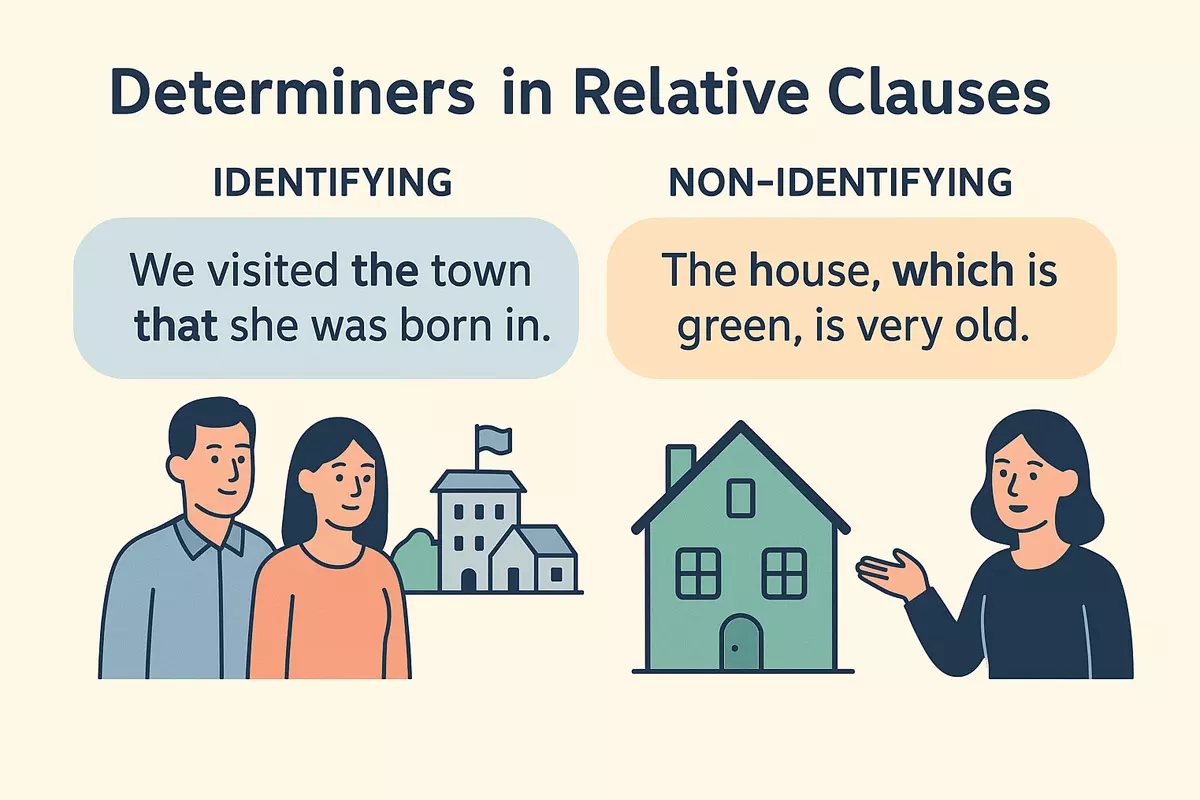 This article explains how relative clauses affect determiner choice, covers when to use the and a/an in identifying or descriptive contexts, addresses comma placement and ambiguity in complex noun phrases, and offers practical sentence revision examples.
- How relative clauses affect determiner choice
- Using the in identifying clauses to pin down reference
- Using a/an in non-identifying or descriptive contexts
- Comma placement and reference clarity
- Ambiguity risks in long noun + clause structures
- Examples from academic, descriptive, and narrative writing
- Practice: revise sentences for correct determiner reference
Understanding how specific words help us recognize or distinguish nouns within relative clauses can clarify confusing sentences, especially when it comes to telling apart essential and non-essential information. By exploring how subtle choices in wording affect meaning and clarity, we can improve both our comprehension and our writing. This awareness enables us to construct sentences that are not only grammatically correct but also clear and precise, reducing ambiguity and making communication more effective.
How relative clauses affect determiner choice
Relative clauses play a crucial role in shaping which determiners are appropriate in a noun phrase. The distinction between identifying (restrictive) and non-identifying (non-restrictive) relative clauses often determines whether you use a definite, indefinite, or other determiner. In essence, the information provided by the relative clause either narrows down the reference (restrictive) or adds extra, non-essential detail (non-restrictive), which directly influences determiner usage.
Influence of restrictive and non-restrictive clauses
Restrictive relative clauses specify which particular entity is meant. Because they limit the set, indefinite articles ("a," "an") and other determiners can be used:
- A student who studies hard will succeed. (Not just any student, but one with a specific characteristic.)
- Any book that interests you can be borrowed.
- Some people who know the answer might remain silent.
Non-restrictive relative clauses, on the other hand, add information about an already-identified referent. Here, the noun is typically already definite, so the definite article ("the") or possessive determiners are required:
- The teacher, who is very kind, helped me. (We already know which teacher.)
- My friend, who lives abroad, is visiting soon.
- Her car, which is red, is parked outside.
Common patterns and examples
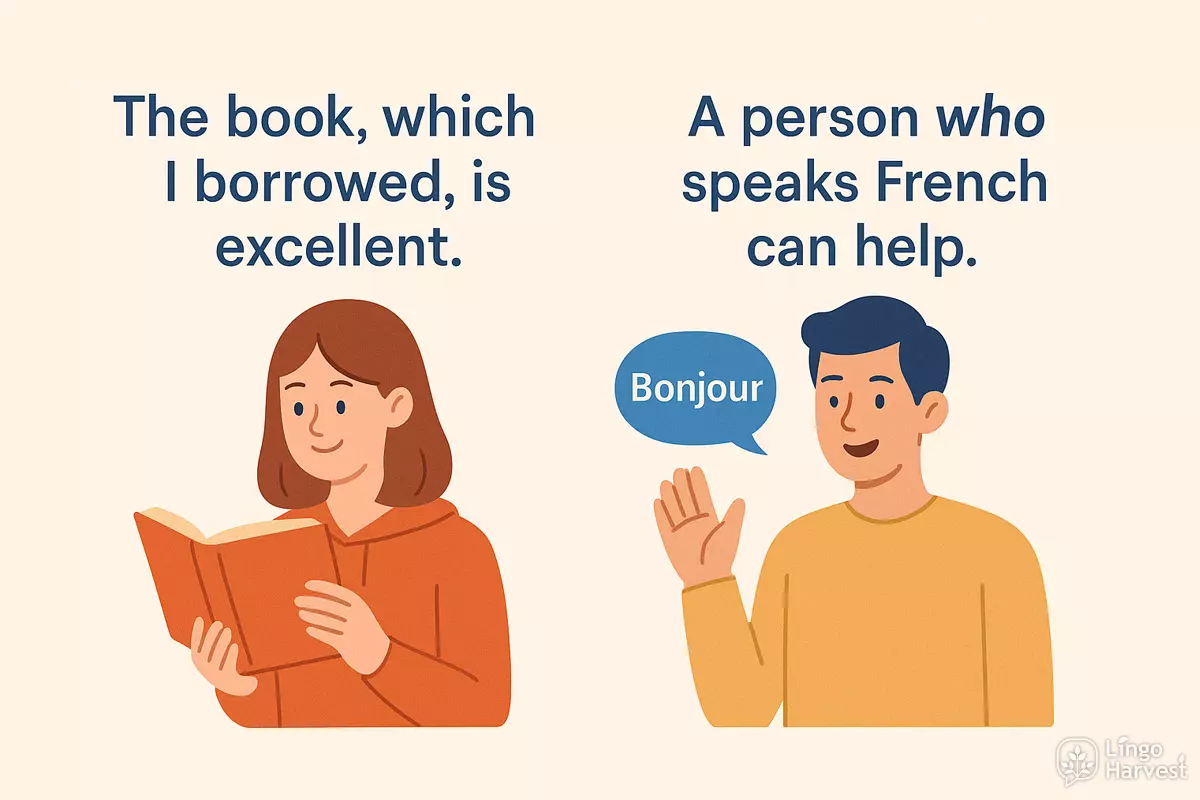
To clarify how noun phrase structure and determiner selection interact with relative clauses, here are typical patterns:
- Definite article + non-restrictive: The book, which I borrowed, is excellent.
- Indefinite article + restrictive: A person who speaks French can help.
- Demonstrative + restrictive: Those students who attended passed the test.
- Possessive + non-restrictive: His house, which is old, needs repairs.
- No determiner (plural) + restrictive: Students who fail must repeat the course.
- Quantifier + restrictive: Several books that I own are first editions.
- Definite article + restrictive: The book that you mentioned is out of print.
- Indefinite article + restrictive: An answer that makes sense is required.
- Demonstrative + non-restrictive: This painting, which was restored, is valuable.
- Zero article (proper noun) + non-restrictive: London, which is the capital, attracts tourists.
Summary table: Determiner use with different relative clause types
| Relative Clause Type | Typical Determiners | Example |
|---|---|---|
| Restrictive (identifying) | Indefinite, definite, demonstrative, quantifiers | A teacher who cares makes a difference. |
| Non-restrictive (non-identifying) | Definite, possessive, demonstrative | The teacher, who is new, greeted everyone. |
| Restrictive (zero article/plural) | None (with plural/common nouns) | Students who study succeed. |
| Non-restrictive (proper noun/unique) | Zero article | London, which is historic, is famous. |
Understanding the interaction between relative clauses and determiners helps ensure clarity and precision in English sentences. The type of clause directly guides which determiner is most suitable, reinforcing the intended meaning and level of specificity.
Using the in identifying clauses to pin down reference
Definite articles play a crucial role in specifying which person or thing we mean, especially when paired with identifying (restrictive) relative clauses. These clauses help single out a particular referent from a broader set, and the signals that the listener or reader should be able to determine which one is intended. For example, saying "the book that you lent me" doesn’t just refer to any book, but to a specific one distinguished by the added information in the clause.
How “the” interacts with identifying clauses
When we use “the” before a noun modified by a restrictive relative clause, the reference becomes unique within the context. The listener is expected to understand exactly which entity is meant based on the information in the clause. Compare this to non-identifying (non-restrictive) relative clauses, where “the” is not used to narrow down the reference.
- The student who won the prize — signals one particular student, defined by the clause.
- The keys that were on the table — refers to specific keys, not just any keys.
- The car that broke down — means a unique car, as identified by its problem.
- The letter I received yesterday — points to one letter from all possible letters.
- The movie we watched last night — indicates a specific film, not movies in general.
- The answer you gave — singles out that particular answer.
- The friend who called me — refers to one friend, not all friends.
- The painting you mentioned — specifies a single work of art.
- The team that won the championship — identifies the victorious team only.
- The house with the red door — means one particular house, not just any house.
- The teacher who helped me — signals a specific teacher.
- The restaurant you recommended — refers to a unique restaurant.
- The book that changed my life — a singular book, not any book.
- The project we discussed — pinpoints a certain project.
- The bag you left behind — a specific bag, as identified by the clause.
Comparison with non-identifying clauses
In contrast, non-restrictive clauses give extra information but don't define which item is meant, so “the” does not have the same narrowing function. The table below summarizes the difference between these clause types and how “the” works with them:
| Type of Clause | Function of “the” | Example |
|---|---|---|
| Identifying (restrictive) | Narrows reference to one specific entity | The dog that barked all night kept me awake. |
| Non-identifying (non-restrictive) | Does not restrict reference; adds extra info | My dog, who barked all night, kept me awake. |
| Identifying (restrictive) | Listener can identify referent from context | The cake she baked was delicious. |
| Non-identifying (non-restrictive) | Assumes referent is already known | Her cake, which she baked, was delicious. |
In summary, pairing “the” with restrictive relative clauses is essential for precise reference. This combination allows speakers and writers to efficiently guide listeners and readers to the exact person or thing being discussed, leaving little room for ambiguity.
Using a/an in non-identifying or descriptive contexts
When we use a or an in relative clauses, it often signals that the clause is non-identifying (sometimes called descriptive or non-restrictive). In these cases, the relative clause simply gives extra information about the noun, rather than specifying exactly which person or thing we mean. This is different from identifying clauses, where we use the or other specific determiners to pick out particular items.
How indefinite articles work in descriptive clauses
Indefinite articles (a/an) introduce a noun that is not uniquely identified for the listener. In relative clauses, this means the clause describes a type or example, not a specific, known entity. For instance:
- She is a teacher who loves music. (Describes what kind of teacher she is, not which particular teacher.)
- He bought a car that runs on electricity. (Describes the car, but doesn’t identify it as a unique, known car.)
Common patterns and examples
Here are some typical ways indefinite articles appear in non-restrictive or descriptive relative clauses:
- a person who enjoys hiking
- a book that explains grammar
- a city where jazz is popular
- a solution that works for everyone
- a friend who lives abroad
- a meal that contains nuts
- a project which requires teamwork
- a film that made me cry
- a job which involves travel
- a song that reminds me of home
- a museum which displays ancient art
- a phone that needs charging
- a cat that likes water
- a dress which fits well
- a plan that might succeed
Comparing identifying and descriptive clauses with articles
| Indefinite Article + Descriptive Clause | Definite Article + Identifying Clause |
|---|---|
| a scientist who studies insects (any scientist of this type) |
the scientist who won the prize (a specific, known scientist) |
| a house that has a garden (any house with this feature) |
the house that Jack built (a particular house) |
| a language that uses tones (any language with this property) |
the language that we studied (one specific language) |
| a recipe which includes chocolate (any such recipe) |
the recipe which my mother gave me (a particular recipe) |
Key points to remember
- Indefinite articles in relative clauses signal a general, descriptive meaning.
- They do not identify a unique person or thing, but rather describe a type or example.
- The focus is on giving extra information, not on narrowing down to one specific referent.
Understanding this distinction helps you write clearer, more natural English when describing people, places, or things in sentences with relative clauses.
Comma placement and reference clarity
Understanding where to place commas in sentences with relative clauses is essential for conveying the intended meaning. The difference between identifying (restrictive) and non-identifying (non-restrictive) relative clauses hinges largely on punctuation and how specifically the noun is being referenced.
Commas and clause type
When a relative clause is essential to define which person or thing is meant, no commas are used. In contrast, when additional, non-essential information is provided, commas are required to separate that detail from the main clause. This distinction helps readers determine whether the clause narrows the reference or merely adds extra information.
- No commas with identifying clauses: The book that has a red cover is mine.
- Commas required with non-identifying clauses: My book, which has a red cover, is on the table.
- Identifying clauses answer "Which one?"
- Non-identifying clauses answer "What about this one?"
- Omitting commas can cause ambiguity in reference.
- Using commas wrongly may change the sentence’s meaning.
- Determiners like "the," "this," or possessives can affect clarity but do not always dictate comma use.
- Relative pronouns ("who," "which," "that") interact with punctuation; "that" is rarely used with non-identifying clauses.
- Commas signal that the information can be omitted without losing the main point.
- Without commas, the clause is integral to the noun’s identity.
- In speech, pauses often reflect comma placement in writing.
- Double-checking punctuation can prevent misreading or confusion.
Comparison of identifying vs non-identifying clauses
| Clause Type | Example & Comma Use |
|---|---|
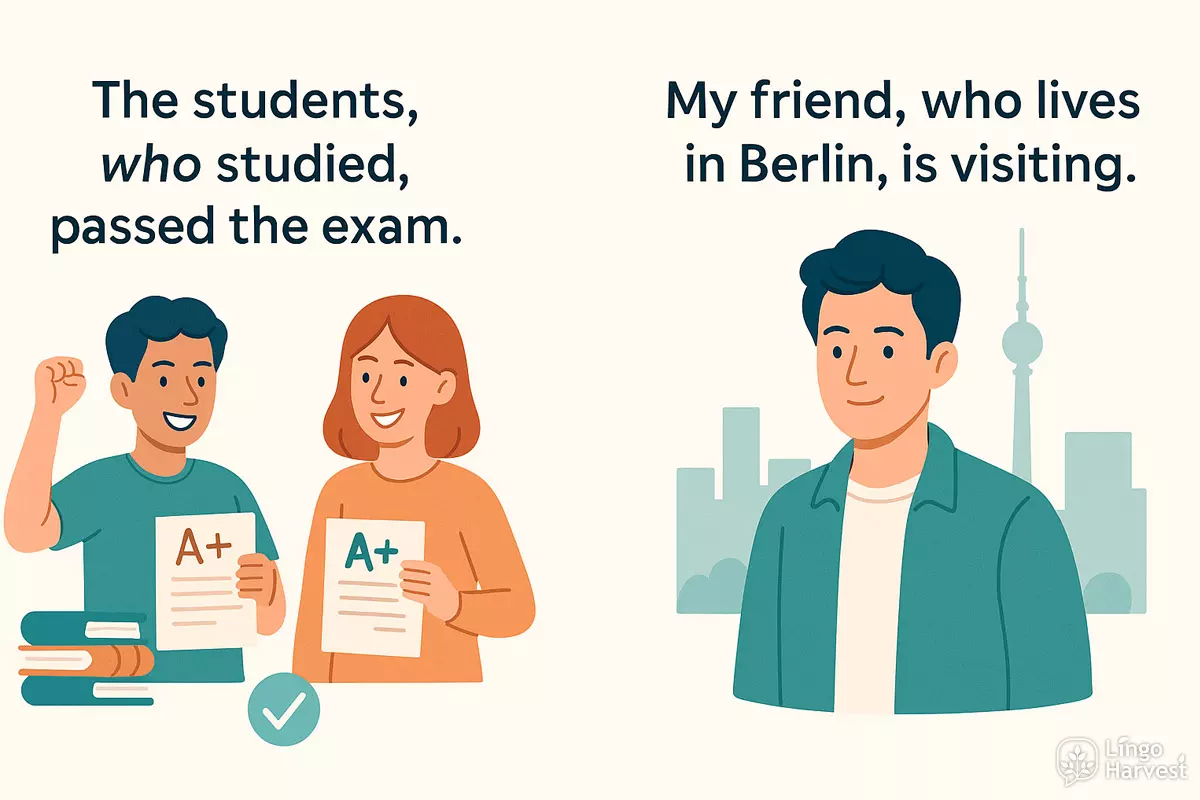
| Identifying (Restrictive) | No commas The students who studied passed the exam. (Only those students who studied passed.) |
| Non-identifying (Non-restrictive) | Commas used The students, who studied, passed the exam. (All the students studied and passed.) |
| Determiner Influence | Determiners like "my," "this," or "the" do not always require a comma; context matters. My friend who lives in Berlin is visiting. (No comma; I have more than one friend.) My friend, who lives in Berlin, is visiting. (Comma; I have only one friend.) |
| Reference Clarity | Punctuation guides the reader to the intended reference, preventing ambiguity. |
Tips for clear referencing
- Read your sentence aloud; natural pauses often indicate where commas belong.
- Check if the clause is essential to the noun—omit commas if so.
- If the clause simply adds extra information, use commas.
- Be cautious with determiners—context, not just the presence of a determiner, decides comma placement.
- Remember: misuse of commas can change the scope of reference dramatically.
Ambiguity risks in long noun + clause structures
When noun phrases are extended by relative clauses, especially with determiners, sentences can become difficult to parse. Readers and listeners may struggle to identify whether a relative clause is intended to restrict the noun (identifying/restrictive) or simply add information (non-identifying/non-restrictive). This confusion is amplified in longer constructions, where multiple modifiers and embedded clauses stack together.
Why complexity increases uncertainty
Long noun phrases with attached clauses often suffer from unclear boundaries. For example, extra adjectives, prepositional phrases, or nested clauses can make it hard to match which information belongs to which noun. The position and type of determiner (such as "the," "a," or possessives) play a key role in signaling whether a relative clause is essential or supplementary, but their effect can be diluted in sprawling structures.
Typical sources of confusion
- Unclear antecedent for the relative clause
- Overlapping or repeated determiners
- Multiple nouns before the clause, blurring attachment
- Use of "that" vs. "which" in restrictive/non-restrictive roles
- Parenthetical phrases splitting noun and clause
- Missing or misplaced commas
- Stacked modifiers (adjectives, prepositional phrases)
- Pronoun reference ambiguity
- Switching from singular to plural unexpectedly
- Unusual determiner-noun combinations
- Inconsistent tense within clauses
- Relative pronouns with unclear referents
- Inclusion of appositives that resemble relative clauses
- Ellipsis or omitted elements creating gaps
- Unexpected word order in complex sentences
Identifying vs. non-identifying: signals and challenges
The distinction between identifying (restrictive) and non-identifying (non-restrictive) relative clauses is vital for meaning. However, in long noun + clause structures, the cues that help readers distinguish the two—such as comma placement, choice of relative pronoun, or determiner use—can become obscured. The following comparison highlights common patterns and their potential for misreading:
| Pattern | Possible Interpretations | Ambiguity Risk |
|---|---|---|
| The report that the manager submitted last week | ✅ Only the report submitted last week (identifying) ❌ All reports, with extra info about last week (non-identifying misreading) |
High, if context is missing |
| My colleague's suggestion, which surprised everyone | ✅ All suggestions, with added detail (non-identifying) ❌ Only the surprising suggestion (identifying misreading) |
Moderate, especially if commas are omitted |
| A list of requirements that the client provided | ✅ Only requirements given by the client (identifying) ❌ All requirements, with extra info (non-identifying misreading) |
Medium, depends on determiner and punctuation |
| The students, who had finished early, left the room | ✅ All students (non-identifying) ❌ Only the students who had finished early (identifying misreading) |
High, if commas are missing |
How to minimize confusion
Writers can reduce misinterpretation by keeping noun phrases concise, clearly matching determiners to their nouns, and using punctuation consistently. When a sentence requires a long noun + clause structure, consider breaking it up or rephrasing for clarity. Always check that the intended meaning of the relative clause—restrictive or non-restrictive—is unmistakable, especially in complex constructions.
Examples from academic, descriptive, and narrative writing
Writers often use relative clauses to clarify or add detail, but the role of determiners within these clauses can shift depending on whether the clause is identifying (restrictive) or non-identifying (non-restrictive). To see how this works across different genres, let's look at sample sentences from scholarly articles, vivid descriptions, and storytelling. These examples highlight how determiners like "the," "a," "my," or "which" shape the meaning and specificity of relative clauses.
Academic Contexts
In formal writing, precision is key. Determiners in relative clauses help distinguish between general categories and specific entities:
- The study that the researchers published was groundbreaking. ✅ (identifying)
- Our analysis, which the committee reviewed, received positive feedback. ✅ (non-identifying)
- Students who completed the assignment scored higher. ✅ (identifying)
- The samples, which were collected last year, showed a clear trend. ✅ (non-identifying)
Descriptive Writing
Descriptive passages frequently use relative clauses to add layers of information. Notice how determiners affect interpretation:
- The garden that my grandmother tended was full of roses. ✅ (identifying)
- The old house, which had green shutters, stood at the end of the lane. ✅ (non-identifying)
- We admired the painting that an unknown artist created. ✅ (identifying)
- Her dress, which was made of silk, shimmered in the sunlight. ✅ (non-identifying)
Narrative and Storytelling
Stories often use both types to either drive the plot or add color:
- The boy who found the treasure became a legend. ✅ (identifying)
- His friend, who was always curious, wanted to know more. ✅ (non-identifying)
- She read the letter that her mother wrote. ✅ (identifying)
- The dog, which belonged to the neighbors, barked all night. ✅ (non-identifying)
Comparing Determiner Use in Relative Clauses
| Identifying (Restrictive) Clause | Non-identifying (Non-restrictive) Clause |
|---|---|
| The book that I borrowed is on the table. | The book, which I borrowed yesterday, is on the table. |
| The scientist who won the award gave a speech. | The scientist, who won the award, gave a speech. |
| People who eat vegetables are healthier. | People, who eat vegetables, are healthier. |
| The car that has red stripes is mine. | The car, which has red stripes, is mine. |
| The teacher whose lesson inspired me retired last year. | The teacher, whose lesson inspired me, retired last year. |
Identifying clauses (without commas) use determiners to specify exactly which noun is meant, while non-identifying clauses (with commas) use determiners to add extra, non-essential information. These patterns appear consistently across academic, descriptive, and narrative styles, shaping clarity and nuance in written English.
Practice: revise sentences for correct determiner reference
Understanding how determiners interact with relative clauses is key to clear and correct sentence construction. Determiners like "the," "a," "some," and "any" can change the meaning of a sentence, especially when combined with identifying (restrictive) and non-identifying (non-restrictive) relative clauses. Below, you'll find activities designed to help you recognize and correct issues involving determiners and relative clauses.
Exercise: Identify and Revise
Each sentence below contains a possible error in determiner use with a relative clause. Read each one carefully and rewrite it to improve clarity or correctness. Pay attention to whether the clause is identifying (essential to meaning) or non-identifying (extra information).
- I saw a students who was sleeping in the library.
- She borrowed the book that you recommended last week.
- Any paintings which are displayed here are famous.
- The teacher, who won the award, gave us an advice.
- There are some cars which need repairs in the parking lot.
- The children who lives next door are friendly.
- A apple that is on the table is rotten.
- He lost the keys, that were very important for his office.
- Only students who have submitted their assignments can enter the lab.
- We visited a museum, which had many interesting exhibits.
- They need any information that you can provide.
- The girl, who has a red backpack, is my cousin.
- Some of the people who was at the meeting left early.
- I met the author which wrote my favorite novel.
- An umbrella, that is broken, is in the closet.
Show answers
- I saw a student who was sleeping in the library. (Change "students" to "student" to match "a".)
- Correct as is. (Identifying clause with "the book".)
- The paintings which are displayed here are famous. (Use "the" for specific paintings; "any" is not suitable.)
- The teacher, who won the award, gave us some advice. (Use "some" or omit "an" as "advice" is uncountable.)
- Some cars which need repairs are in the parking lot. (Move "some" to modify "cars".)
- The children who live next door are friendly. (Change "lives" to "live" for plural.)
- An apple that is on the table is rotten. (Use "An" before "apple".)
- He lost the keys, which were very important for his office. (Use "which" for non-identifying clause.)
- Correct as is. (Identifying clause with "students".)
- Correct as is. (Non-identifying clause with "a museum".)
- All information that you can provide is needed. (Use "all" or "any" with uncountable "information" but revise for clarity.)
- Correct as is. (Non-identifying clause with "the girl".)
- Some of the people who were at the meeting left early. (Change "was" to "were".)
- I met the author who wrote my favorite novel. (Use "who" for people, not "which".)
- An umbrella, which is broken, is in the closet. (Use "which" for non-identifying clause.)
Quick Reference: Determiners and Relative Clauses
- Use "the" or "those" with specific, known referents (often with non-identifying clauses).
- Use "a/an" or "some" with new, non-specific or countable items (typically with identifying clauses).
- Uncountable nouns (like "information," "advice") do not take "a/an".
- Use "who" for people, "which" for things, and "that" for both in identifying clauses.
- Non-identifying clauses (extra info) are set off by commas and typically use "who" or "which", not "that".
Practicing these distinctions will help you write sentences that are both precise and easy to understand, especially when combining determiners with relative clauses.