Silent Letters in Noun Spelling: Common Patterns and Rules

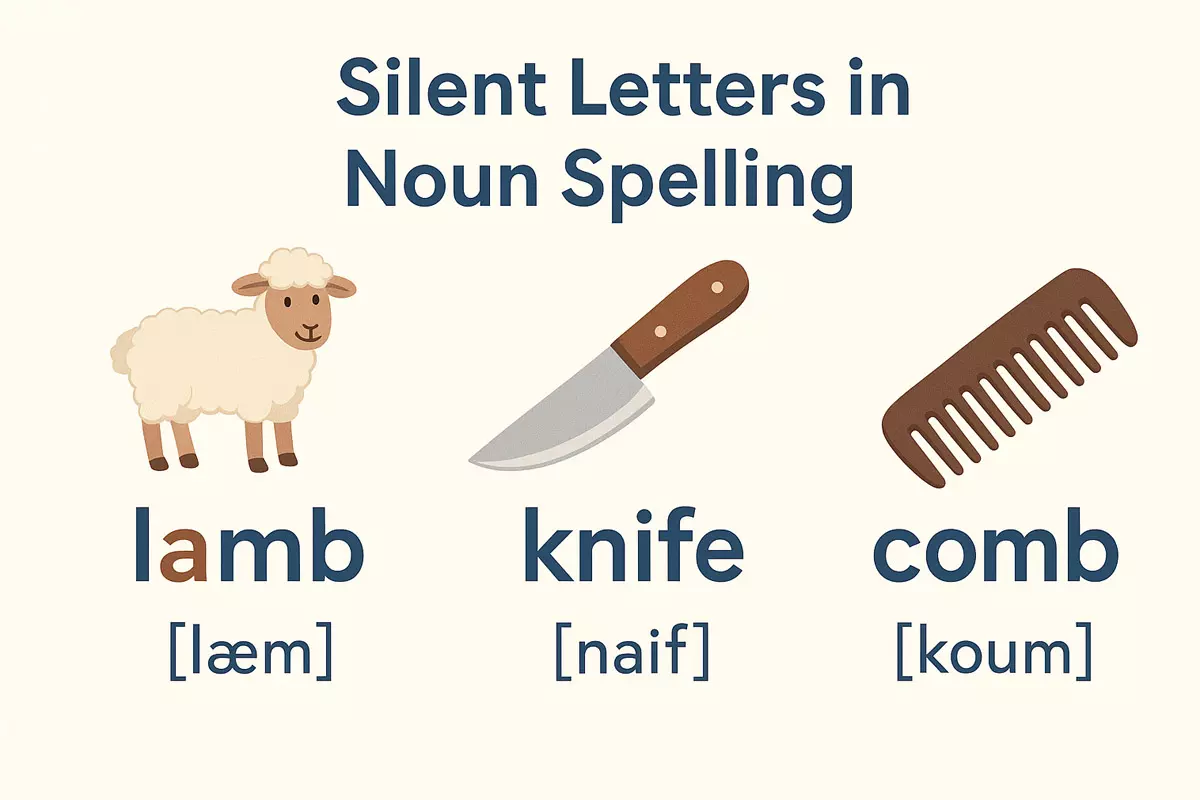 Here we silent letters in English noun spelling, focusing on patterns such as silent k, b, and g. It includes examples, pronunciation guidance, comparisons with similar nouns, common spelling mistakes, and practice exercises for correct usage.
- Overview of silent letters in English noun spelling
- Common silent letter patterns like k, b, and g
- Examples of everyday nouns with silent letters
- Pronunciation tips for nouns that break spelling rules
- Comparing similar nouns with and without silent letters
- Typical spelling mistakes caused by silent letters
- Practice: complete and correct noun spellings with silence
Have you ever wondered why some English words have letters you never pronounce? Many nouns include silent letters, making spelling a real challenge for learners. By exploring these tricky patterns, you can discover useful guidelines that help you remember how to spell words correctly. Understanding why certain letters are silent and recognizing common examples—like the “k” in “knight” or the “b” in “thumb”—can make mastering written English much easier and less confusing over time.
Overview of silent letters in English noun spelling
Silent letters are a common feature in English nouns, often confusing learners and even native speakers. These unpronounced letters can appear at the beginning, middle, or end of words, sometimes revealing a word’s etymology or helping to distinguish between homophones. Understanding the main patterns where silent letters occur can make spelling and pronunciation much easier.
Common positions and patterns
Most silent letters in nouns fall into a handful of predictable patterns. Some of the most frequent include:
- Silent “k” before “n”: knight, knee, knife, knock
- Silent “b” after “m”: thumb, comb, lamb, limb
- Silent “w” before “r”: wrist, wreath, wreck, wrinkle
- Silent “l” after “a” or “o”: calf, half, yolk, folk
- Silent “gh” after vowels: night, sigh, daughter, light
- Silent “t” in “-stle” or “-ten”: castle, whistle, listen, often
- Silent “h” after “g” or at the start of some words: ghost, ghoul, honest, hour
- Silent “p” before “n” or “s”: pneumonia, psalm, psychology
- Silent “u” after “g”: guilt, guest, guitar, guess
- Silent “c” before “k”: muscle, scissors
Why do silent letters exist?
Many unvoiced letters in English nouns reflect the language’s history. Borrowings from Old English, French, and Greek have left their mark. In some cases, silent letters were once pronounced but changed as English evolved. In others, they help differentiate words that sound the same but have different meanings (like knight vs. night).
Examples of silent letter patterns in nouns
| Silent Letter | Example Nouns |
|---|---|
| k (before n) | knife, knot, knee, knowledge |
| b (after m) | thumb, comb, lamb, plumber |
| w (before r) | wrist, wreath, wreck, wrinkle |
| gh (after vowel) | night, cough, dough, daughter |
| t (in “-stle” or “-ten”) | castle, whistle, listen, often |
| h (after g or at start) | ghost, heir, hour, honest |
Tips for recognizing silent letters in nouns
- Look for familiar roots and patterns, especially with words of Greek or French origin.
- Remember that many silent letters occur in clusters—learn common combinations like “kn-”, “wr-”, or “-mb”.
- When in doubt, check a reliable dictionary for pronunciation.
Silent letters can make English noun spelling tricky, but with practice and awareness of these patterns, you can spot them more easily and improve both your spelling and pronunciation.
Common silent letter patterns like k, b, and g
Silent letters often appear in nouns, especially with certain letter combinations. Some of the most frequent patterns involve the letters k, b, and g when they are placed before specific consonants. Recognizing these typical arrangements can help with both spelling and pronunciation.
Silent "k" before "n"
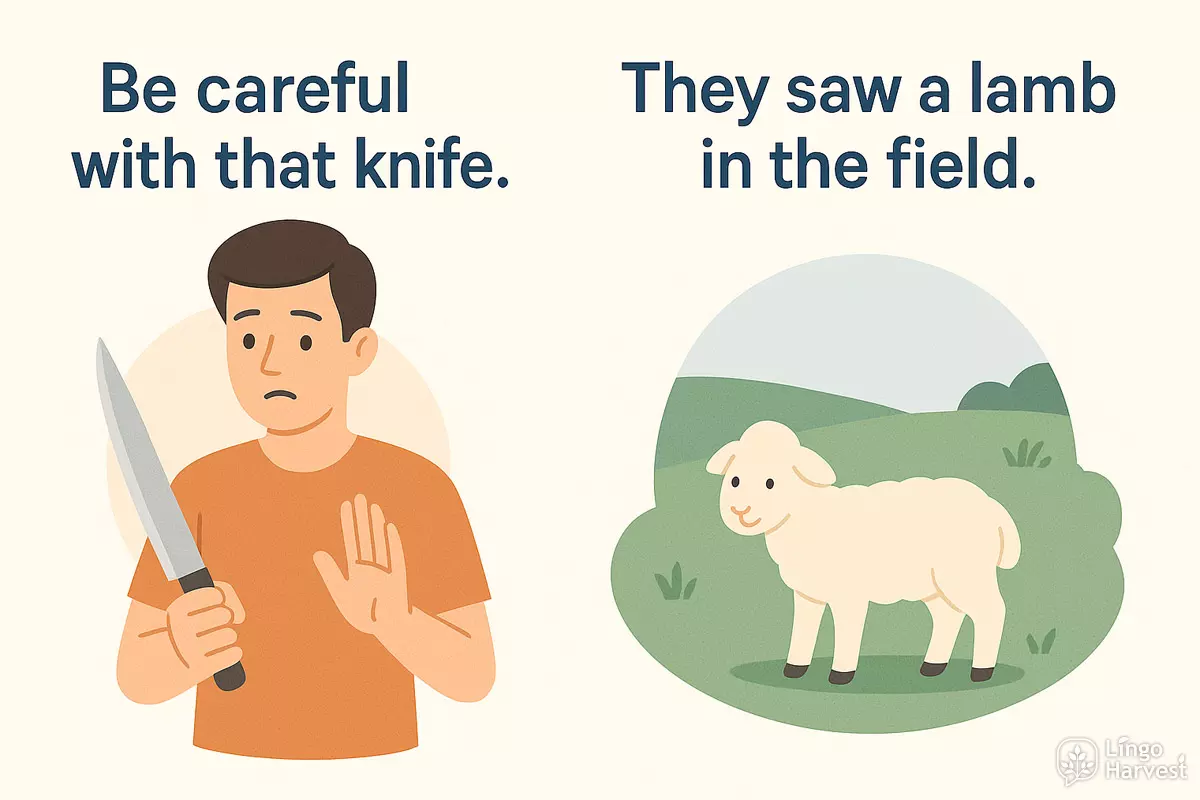
The letter k is usually not pronounced when it comes before n at the beginning of words. This pattern is common in many nouns:
- knife → Be careful with that knife.
- knight → The knight protected the castle.
- knee → He injured his knee while running.
- knob → Turn the knob to open the door.
- knack → She has a knack for solving problems.
- knuckle → He hit his knuckle on the table.
- knit → My grandmother likes to knit scarves.
- knot → There’s a knot in this rope.
- knoll → The house stands on a small knoll.
- knapsack → He packed his lunch in a knapsack.
Silent "b" after "m"
When b follows m at the end of a word, the b is generally silent. This occurs in several familiar nouns:
- lamb → They saw a lamb in the field.
- comb → I can’t find my comb.
- thumb → She cut her thumb while cooking.
- bomb → The movie was about a hidden bomb.
- womb → The baby develops in the womb.
- climb → We plan to climb the mountain.
- tomb → The tomb was discovered by archaeologists.
- crumb → There was a crumb on the table.
- plumb → The plumber checked if the pipe was plumb.
- dumb → That was a dumb mistake.
Silent "g" before "n"
The letter g is often silent when it comes before n, especially in the middle or end of nouns:
- gnome → A garden gnome stood near the fence.
- gnat → A gnat flew into my eye.
- gnaw → The dog began to gnaw on the bone.
- sign → Please read the sign carefully.
- design → The design looks modern.
- reign → The king’s reign lasted twenty years.
- align → The wheels need to align properly.
- foreign → She speaks a foreign language.
- campaign → The campaign starts next month.
- champagne → They celebrated with champagne.
Comparing silent "k", "b", and "g" patterns
| Silent Letter | Typical Position & Example Words |
|---|---|
| k | Before n at the start: knee, knife, knob |
| b | After m at the end: lamb, comb, thumb |
| g | Before n (various positions): sign, gnome, foreign |
Learning these silent letter rules can make spelling less confusing and help you recognize patterns in unfamiliar nouns. While there are exceptions, these guidelines cover the majority of cases for these three letters.
Examples of everyday nouns with silent letters
Many common English nouns include silent letters, which can make their spelling tricky for learners and native speakers alike. These unpronounced characters often appear due to historical changes in pronunciation or the influence of other languages. Becoming familiar with these words can help improve both written and spoken English.
Nouns with silent letters: a closer look
Below is an expanded list showcasing everyday vocabulary where one or more letters are not pronounced. These examples illustrate typical patterns, such as silent "k" before "n," or silent "b" after "m." Recognizing these patterns can make spelling and pronunciation much easier.
- Knee (silent "k") → He hurt his knee while running.
- Knife (silent "k") → She cut the bread with a sharp knife.
- Hour (silent "h") → It took about an hour to finish.
- Honest (silent "h") → She gave an honest answer.
- Island (silent "s") → They live on a small island.
- Thumb (silent "b") → He injured his thumb.
- Lamb (silent "b") → Lamb is often served with vegetables.
- Debt (silent "b") → He finally paid off his debt.
- Wrist (silent "w") → She wears a watch on her wrist.
- Wreck (silent "w") → The storm caused a shipwreck.
- Castle (silent "t") → The castle stands on a hill.
- Listen (silent "t") → Please listen carefully.
- Gnome (silent "g") → A gnome statue stood in the garden.
- Psychology (silent "p") → She studies psychology at university.
- Receipt (silent "p") → Keep the receipt in case you return it.
- Salmon (silent "l") → We had grilled salmon for dinner.
- Column (silent "n") → Read the left column first.
- Autumn (silent "n") → Autumn is my favorite season.
- Plumber (silent "b") → The plumber fixed the leak.
- Answer (silent "w") → He knew the correct answer.
Patterns in silent letter usage
Some silent letters occur in specific positions or combinations. For example, "kn" at the start of a word often means the "k" is silent, while "mb" at the end of a noun usually leaves the "b" unspoken. Understanding these common patterns can help avoid spelling mistakes and boost confidence in writing.
| Word | Silent Letter(s) & Position |
|---|---|
| Knee | Silent "k" at the beginning |
| Thumb | Silent "b" at the end |
| Honest | Silent "h" at the beginning |
| Castle | Silent "t" in the middle |
| Receipt | Silent "p" before "t" |
| Salmon | Silent "l" in the middle |
Mastering these silent letter patterns in nouns not only makes spelling easier but also helps with clearer, more accurate pronunciation. Regular exposure to such examples builds a stronger foundation for both reading and writing in English.
Pronunciation tips for nouns that break spelling rules
Navigating English nouns with silent letters can feel tricky, especially when spelling doesn’t match the way words sound. To help, it’s useful to focus on common silent letter patterns and learn some strategies for saying these nouns naturally. Often, the silent letter is present due to word origins or historical pronunciation, but today it’s not voiced.
Common silent letter patterns in nouns
- K is silent before n at the start: knight, knife, knee
- G is silent before n: gnome, gnat, gnaw
- W is silent before r: wrist, wreath, wrack
- B is silent after m: thumb, comb, limb, bomb
- L is silent after a or o: calf, half, yolk, folk
- P is silent before s: psalm, psychology (noun form: psychologist)
- T is silent in castle, whistle, ballet
- H is silent after g: ghost, ghoul
- S is silent in isle, debris
- D is silent in Wednesday, handsome
- C is silent in muscle, scissors
Tips for pronouncing tricky nouns
- Say the word slowly and focus on each sound you hear, not the letters you see.
- Listen to native speakers or use audio dictionaries to check natural pronunciation.
- Practice with minimal pairs (like knight vs night) to notice which letters are silent.
- Group nouns by silent letter patterns to remember which letters to drop.
- Record yourself and compare to standard pronunciation for feedback.
Comparison of Spelling vs. Pronunciation in Common Nouns
| Spelling | Pronunciation (IPA) | Notes |
|---|---|---|
| knight | /naɪt/ | K is silent at the start |
| comb | /koʊm/ | Silent B after M |
| debris | /dəˈbriː/ | Silent S at the end |
| wrist | /rɪst/ | Silent W before R |
| psalm | /sɑːm/ | Silent P before S |
| calf | /kæf/ | Silent L after A |
| muscle | /ˈmʌsəl/ | Silent C before L |
| gnome | /noʊm/ | Silent G before N |
| scissors | /ˈsɪzərz/ | Silent C |
| castle | /ˈkæsəl/ | Silent T |
Remember, the best way to master these exceptions is regular practice and exposure. Over time, your ear will adapt to these unusual patterns, and spelling will become less of a distraction when you speak and listen.
Comparing similar nouns with and without silent letters
English nouns sometimes appear in pairs or groups where one includes a silent letter and the other does not. These patterns can be confusing, especially for learners who rely on phonetic spelling. Recognizing these contrasts helps improve both spelling and pronunciation accuracy.
Often, the presence of a silent letter in a noun traces back to its etymology—words borrowed from French or Latin, for example, frequently retain silent consonants. By comparing related forms, you can spot patterns that reveal when a silent letter is likely or unlikely to appear.
Common pairs and groups: with and without silent letters
- Knot (silent “k”) → Not
- Gnome (silent “g”) → Nome (rare, but “nome” is a word)
- Knight (silent “k”) → Night
- Wreck (silent “w”) → Reck (archaic, but exists)
- Write (noun, as in “a write-up”) (silent “w”) → Rite / Right
- Debt (silent “b”) → Det (not standard, but “det” is used in some dialects)
- Hour (silent “h”) → Our
- Island (silent “s”) → Iland (archaic or in dialects)
- Lamb (silent “b”) → Lam (slang for “escape”)
- Comb (silent “b”) → Com (prefix, not a noun on its own)
- Castle (silent “t”) → Casle (misspelling or in rare dialects)
- Column (silent “n”) → Colum (variant spelling in early English)
- Salmon (silent “l”) → Samon (archaic or misspelling)
- Plumber (silent “b”) → Plumer (rare surname)
- Thumb (silent “b”) → Thum (nonstandard spelling)
- Scene (silent “c”) → Seen
- Psychic (silent “p”) → Sychic (not standard, but used informally)
- Gnarl (silent “g”) → Narl (rare dialectal form)
- Whale (silent “h”) → Wale
- Sword (silent “w”) → Sord (nonstandard or dialectal)
Patterns to watch for
Words with silent initial letters (“k,” “g,” “w,” and “p”) often have a phonetically spelled counterpart, but the meanings may differ. The silent “b” at the end of words (like “lamb,” “thumb,” and “comb”) is another regular pattern, especially in nouns with a Germanic origin. Not all phonetically similar forms are valid English words, but recognizing these relationships is helpful for spelling and vocabulary development.
Typical spelling mistakes caused by silent letters
Silent letters often trip up even experienced writers, leading to frequent errors in English noun spelling. Many mistakes happen when learners either omit a required silent letter or insert one where it doesn’t belong. These errors often reflect the unpredictable nature of English spelling, where the written form doesn’t always match pronunciation.
Common error patterns
Writers often struggle with certain silent letter combinations. The following issues are especially widespread:
- Dropping silent letters: Writing “knole” instead of “knole” for “knoll”, or “lam” instead of “lamb”.
- Adding unnecessary silent letters: Inserting a silent “b” in “tommb” instead of “tomb”.
- Confusing double consonants with silent ones, as in writing “commb” for “comb”.
- Misspelling due to misheard pronunciation, e.g., “sience” instead of “science”.
Examples of nouns frequently misspelled due to silent letters

Here are some nouns where silent letters cause the most confusion:
- Knot (often misspelled as “not”) → He tied a tight knot in the rope.
- Debt (misspelled as “det”) → She is trying to pay off her debt.
- Island (misspelled as “iland”) → They spent a week on a small island.
- Hour (misspelled as “our”) → It takes about an hour to get there.
- Honest (misspelled as “onest”) → He gave an honest answer.
- Receipt (misspelled as “receit”) → Keep the receipt in case you need a refund.
- Castle (misspelled as “castel”) → The old castle stands on a hill.
- Subtle (misspelled as “sutle”) → There was a subtle change in her tone.
- Thumb (misspelled as “thum”) → He hurt his thumb while cooking.
- Wrist (misspelled as “rist”) → She wears a watch on her wrist.
- Gnome (misspelled as “nome”) → A garden gnome stood near the door.
- Psychology (misspelled as “sycology”) → She studies psychology at university.
- Salmon (misspelled as “samon”) → We had grilled salmon for dinner.
- Plumber (misspelled as “plumer”) → The plumber fixed the leaking pipe.
- Wednesday (misspelled as “Wensday”) → The meeting is scheduled for Wednesday.
- Answer (misspelled as “anser”) → I don’t know the answer yet.
- Foreign (misspelled as “foren”) → She speaks several foreign languages.
- Muscle (misspelled as “mussel”) → This exercise helps build muscle.
Frequent silent letter confusions in noun spelling
| Incorrect spelling | Correct form |
|---|---|
| tomm | tomb |
| knite | knight |
| wrester | wrestler |
| colomn | column |
| scenerio | scenario |
| whistle | whistle |
| rescept | receipt |
| salmon | salmon |
These examples highlight just a few of the many ways silent letters can lead to confusion in English nouns. Developing an awareness of these patterns helps learners avoid common pitfalls and improve spelling accuracy over time.
Practice: complete and correct noun spellings with silence
Applying rules about silent letters is vital for precise spelling, especially when dealing with common English nouns. Silent letters often appear in familiar words, but their presence can be tricky for learners. Let’s explore targeted practice to help reinforce correct spelling patterns and identify where these "invisible" letters usually hide.
Spot the Silent Letters
Many nouns contain letters that are written but not pronounced. Review the following list of nouns and see if you can identify the silent letter in each:
- knee
- island
- debt
- lamb
- castle
- gnome
- hour
- thumb
- wrist
- plumber
- salmon
- receipt
- autumn
- psychology
- honor
- sword
- muscle
- whistle
- sign
- knight
Show answers
- knee – silent k
- island – silent s
- debt – silent b
- lamb – silent b
- castle – silent t
- gnome – silent g
- hour – silent h
- thumb – silent b
- wrist – silent w
- plumber – silent b
- salmon – silent l
- receipt – silent p
- autumn – silent n
- psychology – silent p
- honor – silent h
- sword – silent w
- muscle – silent c
- whistle – silent t
- sign – silent g
- knight – silent k
Complete the Spelling
Fill in the blanks with the correct silent letter to form a real noun:
- _nee
- wr_st
- _nowledge
- col_mn
- si_n
- com_
- hou_
- psy_hology
- _nife
- _nock
- thu_b
- lam_
- ans_er
- is_and
- au_umn
Show answers
- knee (k)
- wrist (w)
- knowledge (k)
- column (n)
- sign (g)
- comb (b)
- hour (h)
- psychology (p)
- knife (k)
- knock (k)
- thumb (b)
- lamb (b)
- answer (w)
- island (s)
- autumn (n)
Common Patterns of Silent Letters in Nouns
Silent letters often appear in certain positions or combinations. The table below summarizes some frequent patterns and examples:
| Pattern | Example Nouns |
|---|---|
| Silent k before n | knee, knife, knight |
| Silent w before r | wrist, wreath, write |
| Silent b after m | comb, lamb, thumb |
| Silent g before n | gnome, sign, design |
| Silent l after a | salmon, calm, palm |
| Silent t before le | castle, whistle, bustle |
Tips for Mastering Silent Letter Spellings
- Look for common letter pairings (like kn, wr, gn).
- Remember that not every silent letter follows a rule—memorization helps.
- Practice writing tricky nouns and saying them aloud to reinforce the correct spelling.
- When in doubt, check a trusted dictionary or spelling tool.
Regular practice with these patterns will improve your accuracy and confidence in English noun spelling, especially when dealing with silent letters.