Common Determiner Errors at All Levels: complete diagnostic guide

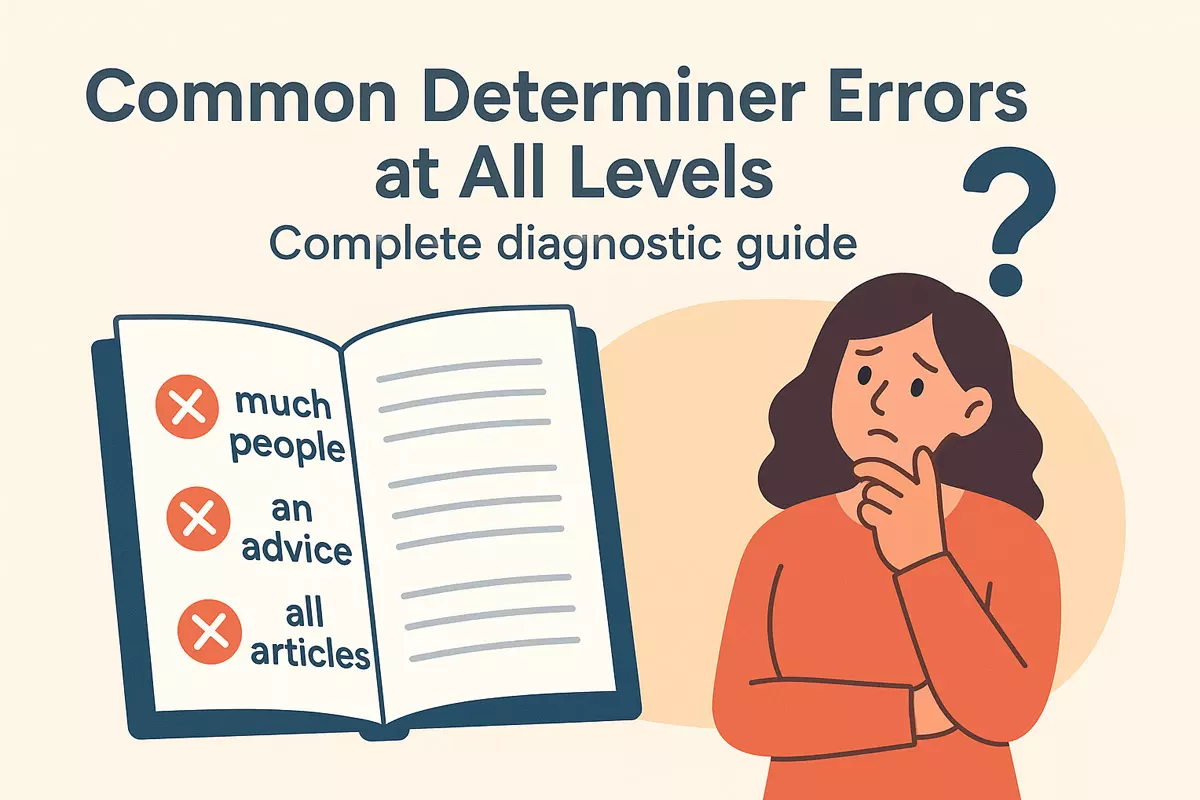 Here we the most common determiner mistakes at all proficiency levels, such as errors with articles, quantifiers, demonstratives, and countability.
- Most frequent determiner mistakes from A1 to C2
- Errors with articles, quantifiers, and demonstratives
- Ambiguity caused by missing or incorrect determiners
- Countability problems affecting determiner choice
- Influence of first language on determiner errors
- How to diagnose and correct recurring problems
- Practice: identify and fix errors in sample texts
Many English learners find it challenging to use words like some, the, or any correctly, and even advanced students can make mistakes with these small but important words. These errors can cause misunderstandings in both spoken and written communication. However, by paying close attention to how articles and quantifiers are used in different contexts, learners can gradually improve their accuracy. Recognizing the common pitfalls is a key part of developing clearer and more effective English skills.
Most frequent determiner mistakes from A1 to C2
Understanding typical errors with determiners can help learners at every level anticipate and fix common pitfalls. Each proficiency band exhibits distinct patterns of mistakes, ranging from missing articles to overcomplicated determiner use in advanced writing.
Entry-Level (A1–A2): Missing or Misusing Basic Articles
At the earliest stages, learners often forget to use articles or confuse "a" and "an" with "the." This leads to sentences like "I have cat" instead of "I have a cat." Definite and indefinite articles are frequently omitted or swapped.
- Omitting "a" or "an": "I am student." → Correct: "I am a student."
- Using "the" incorrectly: "I have the dog." (when referring to any dog, not a specific one)
- Confusing "some" and "any": "Do you have some milk?" (in a question instead of "any")
- Adding articles before uncountable nouns: "a information" instead of "information"
Intermediate (B1–B2): Quantifiers and Agreement Issues
As learners progress, mistakes shift toward quantifiers and agreement. Misuse of "much" and "many," or confusing "few," "a few," "little," and "a little" is typical. There’s also frequent confusion with possessives and demonstratives.
| Incorrect Usage | Correct Form |
|---|---|
| She has much friends. | She has many friends. |
| There isn’t much informations. | There isn’t much information. |
| This books are new. | These books are new. |
| He lost his keys and his wallet. He lost the both. | He lost both. |
Advanced (C1–C2): Subtlety and Overcorrection
Higher-level users sometimes overuse determiners for emphasis, or incorrectly omit them in striving for conciseness. Errors may also involve advanced structures, such as "such a" vs. "so," or the placement of "each" and "every."
- Overusing articles: "The honesty is important."
- Dropping necessary determiners: "He gave advice that helped."
- Confusing "such a" and "so": "It was so big problem." → "It was such a big problem."
- Misplacing "each" and "every": "Each students has their book."
- Incorrect double determiners: "The my friend is here."
Awareness of these recurring patterns can make editing and self-correction much easier at every stage of language development. Reviewing typical mistakes by level helps learners target their attention and avoid fossilizing errors.
Errors with articles, quantifiers, and demonstratives
Learners often struggle with the correct use of small but essential words like “a,” “the,” “some,” “many,” “this,” and “those.” These mistakes can change the meaning of a sentence or make it sound unnatural. Understanding the specific types of errors that occur with articles, quantifiers, and demonstratives helps learners avoid common pitfalls at any level.
Typical Mistakes with Articles
Articles (“a,” “an,” “the”) are frequently omitted or misused, especially by speakers of languages that do not use articles. Common problems include:
- Leaving out “the” before specific nouns (“I went to store” instead of “I went to the store”)
- Using “a” with plural nouns (“a apples” instead of “apples” or “some apples”)
- Confusing “a” and “an” before vowel sounds (“an university” instead of “a university”)
- Adding unnecessary articles (“the happiness is important”)
Quantifier Confusion
Quantifiers like “many,” “much,” “few,” and “little” can be tricky. Mistakes often involve using the wrong quantifier for countable or uncountable nouns, or mixing up words with similar meanings. For example:
- “Much apples” ❌ (should be “many apples”)
- “A few information” ❌ (should be “a little information”)
- “Too much people” ❌ (should be “too many people”)
- “Few money” ❌ (should be “little money”)
- “Some advices” ❌ (should be “some advice”)
Demonstrative Problems
Mistakes with demonstratives (“this,” “that,” “these,” “those”) often relate to number agreement or distance. Learners may say “this books” instead of “these books,” or confuse “that” with “those.” Here are frequent issues:
- “This cars” instead of “these cars”
- “Those book” instead of “that book”
- Using “these” for far objects (“these mountains over there” instead of “those mountains”)
- Mixing up “this” and “that” in narrative (“That is my friend here” when referring to someone nearby)
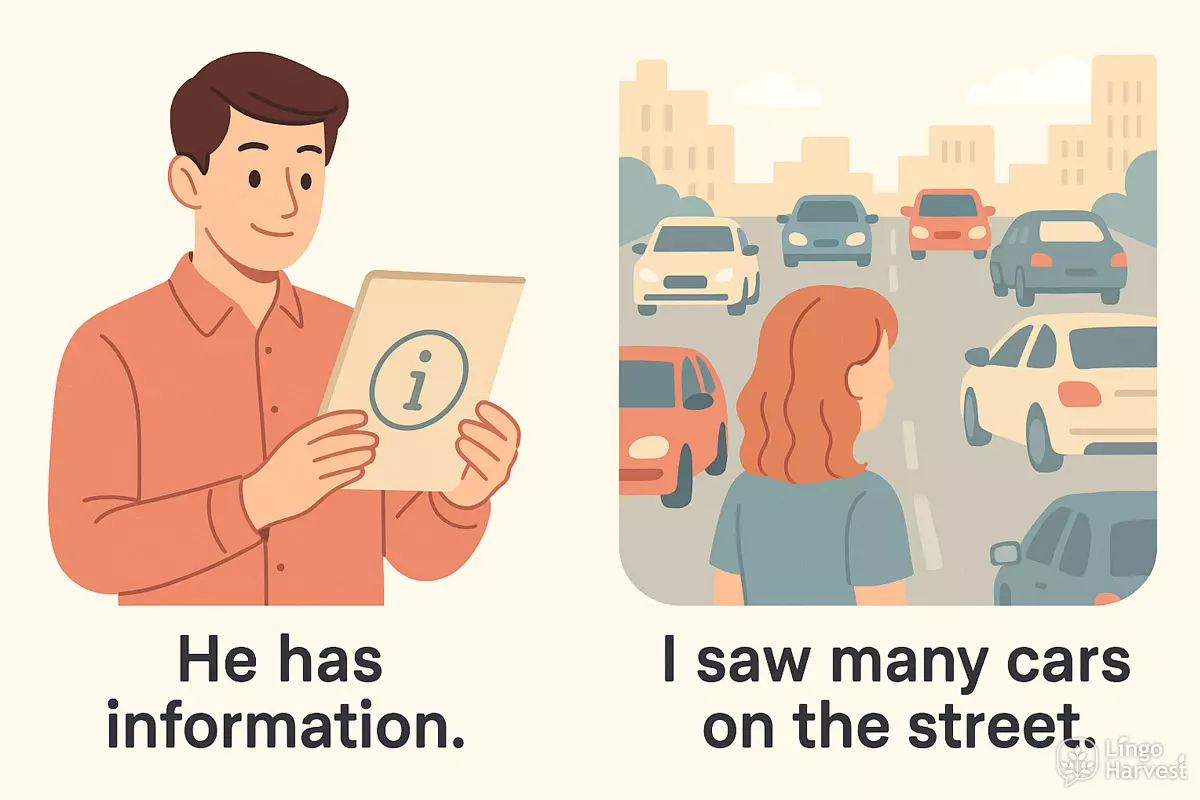
Comparison Table: Common Determiner Errors
| ❌ Incorrect Example | ✅ Correct Form |
|---|---|
| He has a informations. | He has information. |
| I saw much cars on the street. | I saw many cars on the street. |
| She bought these bread. | She bought this bread. |
| They visited the Paris. | They visited Paris. |
| This apples are fresh. | These apples are fresh. |
| Few advices were given. | Little advice was given. |
Quick Tips to Avoid Common Determiner Mistakes
- Remember: “a/an” for singular, non-specific; “the” for something specific or previously mentioned.
- Use “many/few” with countable nouns, “much/little” with uncountable nouns.
- “This/these” for things close; “that/those” for things further away.
- Don’t use articles with proper names (e.g., “the Paris”).
- Check noun form: don’t use plural with “a/an” or “this/that.”
Correct use of these small words takes practice, but awareness of the most common errors is the first step toward accuracy and fluency.
Ambiguity caused by missing or incorrect determiners
When determiners are omitted or chosen incorrectly, sentences can become unclear or confusing. The reader might be left wondering whether a noun is specific or general, singular or plural, or even countable or uncountable. This kind of confusion can occur at any proficiency level, making it a key area for diagnostic attention.
How missing determiners lead to confusion
Leaving out articles or demonstratives can make it unclear what or how many things are being talked about. For example, "I bought apple" could mean any apple or apples in general, but without "an" or "the," the sentence is incomplete and ambiguous.
- She saw dog in park. → Is it one dog, any dog, or a specific dog?
- Give me pencil. → Which pencil? Any pencil or a particular one?
- Children need supervision. → All children, some, or specific children?
Incorrect determiners and their impact
Using the wrong determiner can change the meaning of a sentence or make it nonsensical. For instance, saying "an informations" is incorrect, as "information" is uncountable and does not take "an." Similarly, "these advice" is ungrammatical; "advice" is singular and uncountable.
Common patterns where ambiguity arises
- Omitting articles before singular countable nouns ("He has car" instead of "He has a car")
- Using plural determiners with uncountable nouns ("many furniture")
- Mixing demonstratives and quantifiers incorrectly ("this apples" instead of "these apples")
- Leaving out possessives ("She took bag" vs. "She took her bag")
- Confusing "some" and "any" in statements and questions
- Using "the" with general plural nouns ("the cats are friendly" when talking about all cats in general)
- Placing determiners before proper nouns incorrectly ("the John")
- Repeating determiners ("the my book")
- Omitting determiners before adjectives ("I saw interesting movie")
- Using "another" with plural nouns ("another books")
- Using "a" or "an" with uncountable nouns ("an equipment")
- Omitting "the" in contexts where specificity is required ("Turn off light" when referring to a specific light)
- Confusing "each" and "every" ("each students")
- Mixing "few" and "a few" ("few apples left" vs. "a few apples left")
Comparison of determiner choices and effects
| Sentence Example | Potential Meaning or Ambiguity |
|---|---|
| I saw cat in the garden. | Unclear if it’s any cat, a specific cat, or a general reference. |
| She needs information. | Correct, but with "an information" ❌ it becomes ungrammatical and confusing. |
| He bought the car. | Refers to a specific car, but "a car" would mean any car, and omitting the article causes ambiguity. |
| They like music. | General preference. "The music" would mean specific music; "a music" is incorrect. |
Why accurate determiner use matters
Clear and precise communication depends on choosing the right determiner. Errors can make a sentence difficult to interpret or change its meaning entirely. Paying attention to these small words helps ensure your message is understood as intended.
Countability problems affecting determiner choice
Misunderstanding whether a noun is countable or uncountable often leads to mistakes with determiners. Learners may use "many" with uncountable nouns or "much" with countable nouns, which can make sentences sound unnatural or even confusing. This issue is especially common with words that have different meanings depending on their countability, such as "experience" or "paper".
Common challenges with countable and uncountable nouns
The distinction between countable and uncountable nouns directly impacts which determiners are appropriate. For example, "a" and "an" can only be used with singular, countable nouns, while "some" and "any" work for both types in the right context. Problems often arise when learners memorize vocabulary without noting if a noun is countable or not.
- Using "a" with uncountable nouns: a furniture ❌ → furniture ✅
- Using "many" with uncountable nouns: many information ❌ → much information ✅
- Using "much" with countable nouns: much apples ❌ → many apples ✅
- Forgetting "a" with singular countable nouns: I have cat ❌ → I have a cat ✅
- Incorrect use of "some" with singular countable nouns: some pen ❌ → a pen ✅
- Using "few" with uncountables: few advice ❌ → a little advice ✅
- Misusing "little" with countables: little books ❌ → few books ✅
- Adding "s" to uncountable nouns: furnitures ❌ → furniture ✅
- Confusing "each" and "every" for groups: each people ❌ → each person or all people ✅
- Using "an" before uncountables: an equipment ❌ → equipment ✅
- Incorrect "a lot of" with singulars: a lot of money (correct), a lot of book ❌ → a lot of books ✅
- Using "these" with singulars: these advice ❌ → this advice ✅
Patterns that cause confusion
Some nouns can be both countable and uncountable, but with different meanings. Learners may not notice the shift, leading to errors in article or quantifier use.
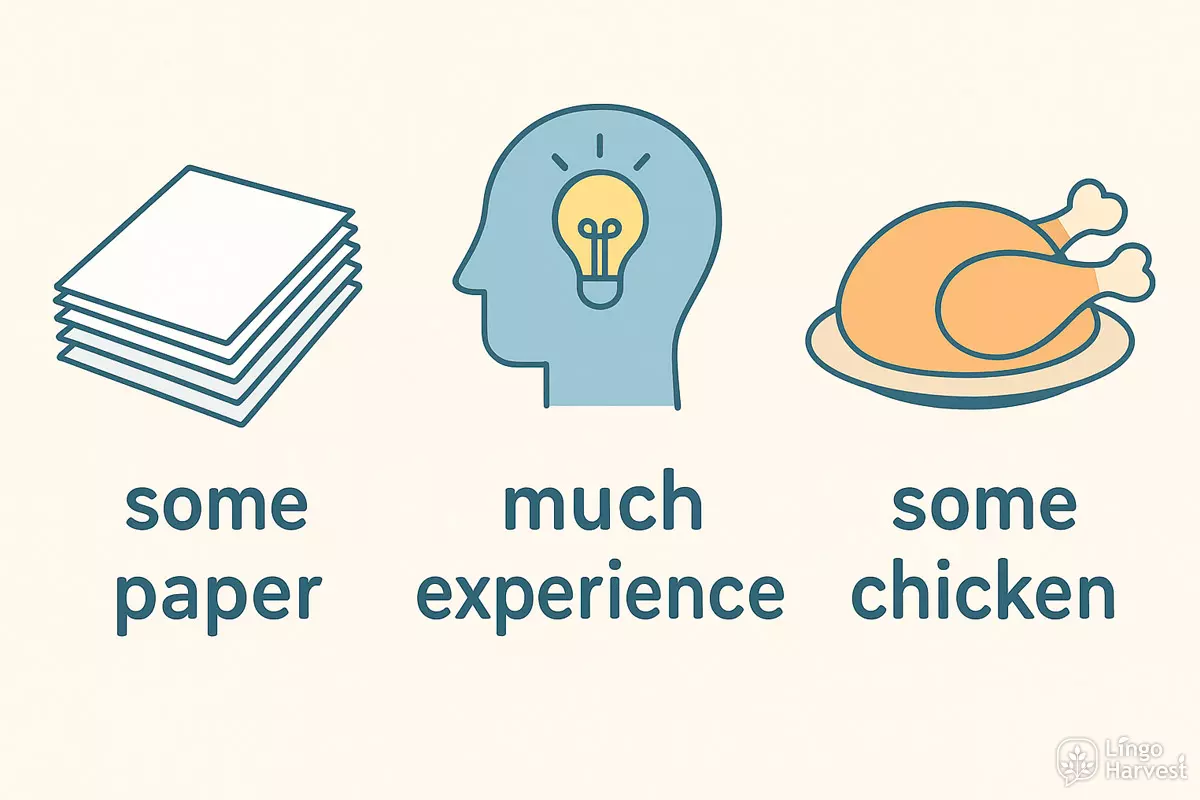
| Noun | Countable (with determiner) | Uncountable (with determiner) |
|---|---|---|
| Paper | a paper (a newspaper, an essay) | some paper (material) |
| Experience | an experience (an event) | much experience (knowledge) |
| Chicken | a chicken (an animal) | some chicken (meat/food) |
| Light | a light (a lamp) | some light (illumination) |
| Hair | a hair (one strand) | much hair (all hair on head) |
Tips for avoiding mistakes
To minimize errors, always check if a noun is countable, uncountable, or both with different meanings. Learn common quantifiers for each type, and practice with real examples. When in doubt, consult a reliable dictionary or grammar resource. Recognizing these patterns will help you choose the right determiner and make your English sound more natural.
Influence of first language on determiner errors
Learners’ native tongues shape how they use English articles and determiners. Some languages lack articles entirely, while others use them differently, leading to frequent and sometimes predictable mistakes. For example, speakers of Russian, Chinese, or Japanese often omit “a” or “the” because their languages don’t have equivalents. Meanwhile, Romance language speakers (like Spanish or French) may overuse certain articles due to interference from their own grammatical patterns.
Typical error patterns by language background
Certain first languages tend to produce specific mistakes when learners use English determiners. Here are common tendencies seen in learners from various linguistic backgrounds:
- Russian/Ukrainian: Omitting “a/an” and “the” in nearly all contexts
- Mandarin Chinese: Skipping articles or using “the” for all nouns
- Japanese: Leaving out articles or confusing “a” and “the”
- Arabic: Overusing “the” with generic nouns (e.g., “the life is short”)
- Spanish: Using “the” with names or professions (e.g., “the Maria is teacher”)
- German: Adding articles to abstract nouns (“the freedom” instead of just “freedom”)
- French: Omitting “a/an” with singular count nouns (“I have cat”)
- Korean: Avoiding articles or using “the” with all nouns
- Hindi: Mixing up “a” and “the” or omitting articles entirely
- Portuguese: Using definite articles with names (“the Ana”)
- Turkish: Omitting articles or using “the” for emphasis only
- Polish: Skipping articles, as they do not exist in Polish
- Italian: Adding articles before possessives (“the my car”)
- Thai: Not using articles, or using “the” only for specificity
- Vietnamese: Confusing “a” with “the” or omitting both
- Greek: Overusing definite articles due to strong presence in Greek
- Hungarian: Random insertion of “the” due to different article rules
- Hebrew: Using “the” with plural nouns unnecessarily
- Malay/Indonesian: Omitting articles altogether
- Farsi: Using “the” for generic references
Why native language matters
The presence, absence, or function of determiners in a learner’s first language directly influences their accuracy when using English articles. If the concept of “a/an” or “the” is new, learners may avoid using them or apply them inconsistently. On the other hand, if articles exist but have different rules, learners may transfer those rules to English, causing systematic errors.
Comparing determiner systems
Below is a comparison of how determiners work in English and a few selected languages, highlighting potential areas of confusion:
| Language | Article System & Common Interference |
|---|---|
| English | Has definite (“the”) and indefinite (“a/an”) articles; required for most singular count nouns. |
| Mandarin Chinese | No articles; quantifiers or classifiers used instead. Leads to omission of “a/an/the”. |
| Spanish | Articles exist but used more broadly, e.g., with names or general nouns (“La María”). Can cause overuse in English. |
| Russian | No articles at all. Learners often omit English articles or use them randomly. |
| German | Has definite and indefinite articles, but different usage rules, especially with abstract nouns. |
Summary
Understanding a learner’s first language helps predict which article mistakes are most likely. Tailoring instruction and feedback to these patterns can make correction more efficient and meaningful.
How to diagnose and correct recurring problems
Identifying why determiner mistakes keep happening is essential for making lasting improvements in English accuracy. The first step is to observe specific patterns in your writing or speaking. Look for repeated confusion with articles ("a/an/the"), demonstratives ("this/that/these/those"), possessives, or quantifiers.
Common signals of persistent determiner issues
- Frequent omission of articles before singular, countable nouns (e.g., "I bought car" instead of "I bought a car").
- Overusing "the" with general nouns ("The life is beautiful" instead of "Life is beautiful").
- Mixing up "some" and "any" in questions and negatives.
- Applying "a" before uncountable nouns ("a furniture").
- Incorrect use of demonstratives ("these information").
- Confusing possessive determiners ("my", "your") with pronouns ("mine", "yours").
- Placing determiners in the wrong order ("my these books").
- Using double determiners ("the my friend").
Step-by-step diagnostic process
- Collect samples: Gather recent writing or transcripts of speech.
- Highlight determiners: Mark all articles, demonstratives, possessives, and quantifiers.
- Note errors: Identify incorrect or missing determiners. Pay attention to repeated types of mistakes.
- Analyze patterns: Ask: Are the errors mostly with articles, quantifiers, or demonstratives? Do they happen after certain verbs or with specific nouns?
- Compare with correct usage: Use grammar references or model sentences to check how determiners should be used in each context.
Strategies for correction and long-term improvement
- Practice targeted exercises focusing on your most common mistake types.
- Create personalized correction lists or flashcards with typical errors and their corrections.
- Read and listen to native English materials, paying attention to how determiners are used.
- Write sentences or short paragraphs using determiners correctly, then self-check or ask for feedback.
- Use minimal pairs and contrastive drills (e.g., "a cat" vs. "the cat", "some apples" vs. "any apples").
- Record yourself and listen for recurring errors in spoken English.
Quick reference: Typical determiner error patterns and corrections
| Error Example | Correct Form |
|---|---|
| I have a advice. | I have some advice. |
| She is an honest person. | She is an honest person. |
| The people are friendly. | People are friendly. |
| I have the car. | I have a car. (If not previously mentioned) |
| This is a my book. | This is my book. |
| Give me an information. | Give me some information. |
| I don’t have some money. | I don’t have any money. |
Final tips for building accuracy
Consistency comes from focused practice and active self-monitoring. Notice which determiners challenge you most, and revisit those areas regularly. Over time, your awareness and control will grow, reducing repeated mistakes and boosting your confidence in both writing and speaking.
Practice: identify and fix errors in sample texts
Understanding determiners is crucial for clear and accurate English. To help you master their use, below are several short texts and sentences with typical mistakes. Your task is to spot the errors and suggest corrections. This will reinforce your ability to identify common determiners (such as the, a, an, some, any, much, many, few, little, these, those) and fix them in context.
Task 1: Spot and correct the mistakes
Read each sentence. Note any incorrect use or omission of determiners, then rewrite the sentence correctly.
- I have car and bike, but I prefer bike.
- She didn’t bring any umbrella, so she got wet.
- There are much people in the room.
- Can you give me informations?
- That apples on the table are fresh.
- He has few money left after shopping.
- We saw an elephants at the zoo.
- She always drinks glass of milk before bed.
- They didn’t buy any breads at store.
- This are best days of my life.
Show answers
- I have a car and a bike, but I prefer the bike.
- She didn’t bring an umbrella, so she got wet.
- There are many people in the room.
- Can you give me some information?
- The apples on the table are fresh.
- He has little money left after shopping.
- We saw an elephant at the zoo.
- She always drinks a glass of milk before bed.
- They didn’t buy any bread at the store.
- These are the best days of my life.
Task 2: Multiple choice – Which determiner fits?
Choose the correct word(s) to complete each sentence.
- There isn’t ___ milk left. (a / any / some)
- He has ___ friends in the city. (much / many / a)
- Could I have ___ water, please? (some / any / the)
- ___ books on the shelf are mine. (That / These / This)
- She doesn’t have ___ time today. (many / much / few)
- There are ___ apples in the basket. (much / several / little)
- Do you have ___ questions? (any / some / a)
- I need ___ advice about this problem. (many / much / several)
- ___ of the students passed the exam. (Much / Many / Little)
- We saw ___ interesting places during the trip. (much / a few / little)
Show answers
- any
- many
- some
- These
- much
- several
- any
- much
- Many
- a few
Common Determiner Errors: Quick Reference
Here is an overview of frequent mistakes and their correct forms, helping you compare and remember the right usage.
| Error Example | Corrected Version |
|---|---|
| I need advice about a job. | I need some advice about a job. |
| She’s looking for informations. | She’s looking for information. |
| There is too much cars on the street. | There are too many cars on the street. |
| This flowers are beautiful. | These flowers are beautiful. |
| He bought a apples. | He bought an apple. |
| She doesn’t have any money left. | She doesn’t have much money left. |
| I didn’t see any persons there. | I didn’t see any people there. |
| Give me glass of water. | Give me a glass of water. |
| Those book is interesting. | That book is interesting. |
| We have little friends in this town. | We have few friends in this town. |
Quick checklist: What to watch for
- Use a/an with singular countable nouns, unless the noun is already specified or unique.
- Use the when referring to something specific or already known.
- Don’t use plural forms with uncountable nouns (information, advice, bread).
- Choose many/few for countable nouns, much/little for uncountables.
- Use these/those for plural, this/that for singular nouns.
- Omit determiners with some proper nouns (e.g. Mount Everest, not the Mount Everest).
- Remember: some nouns change meaning with or without a determiner (e.g. school vs. the school).