Strong vs Weak Determiners: meaning and grammatical behavior

 Here we the difference between strong and weak determiners in English grammar, how they affect which nouns can follow, their impact on countability and number, and offers examples and practice to help intermediate learners classify them in context.
- Difference between strong and weak determiners in grammar
- How strong determiners restrict which noun is possible
- How weak determiners allow more flexible interpretation
- Examples with this, that, each, every, some, any
- Effect of strong and weak determiners on countability and number
- Why this contrast matters for intermediate learners
- Practice: classify determiners as strong or weak in context
Have you ever noticed how words such as every or some play a unique role in sentences? These determiners significantly influence both the meaning and structure of what we say, guiding which nouns we refer to and how broadly or specifically we express our ideas. By examining how determiners like these function in English grammar, we uncover interesting patterns that reveal not just rules but also the flexibility and nuance in our everyday language use, shaping communication in subtle yet powerful ways.
Difference between strong and weak determiners in grammar
English determiners fall into two broad groups based on how they interact with other noun modifiers and the type of reference they create. Understanding these types—often called “strong” and “weak” determiners—helps explain why some combinations are grammatical while others sound odd or ambiguous.
What are strong determiners?
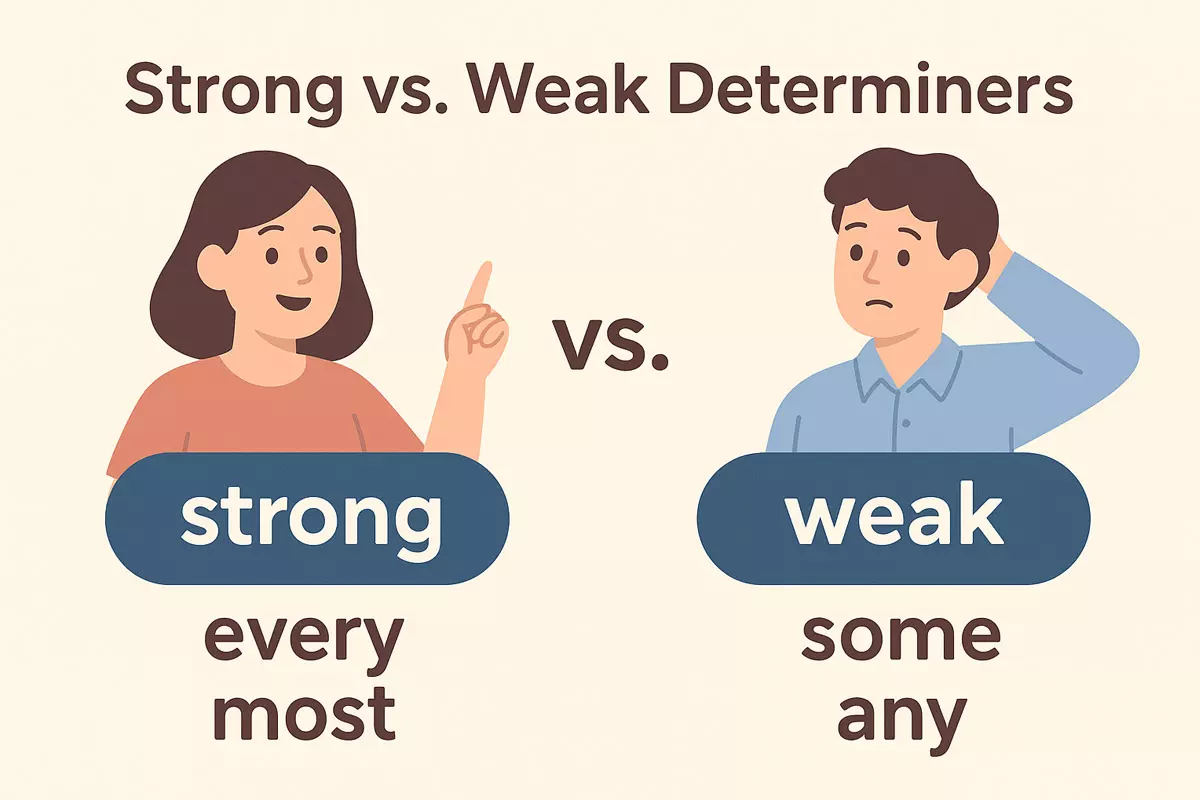
Strong determiners are words that fully specify the noun they modify, so nothing else of the same type can appear before the noun. They do not combine with other determiners (except rare exceptions). The noun phrase is usually complete after a strong determiner, leaving no room for another determiner like the or my.
- Examples: each, every, either, neither, another, any, some, no, this, that, these, those, which, what, whose
- Usage: each student ✅, the each student ❌
What makes a determiner weak?
Weak determiners are less restrictive. They often indicate quantity or possession and can sometimes combine with other determiners (especially “of” phrases). Weak determiners do not always uniquely identify the noun, so they frequently appear with additional determiners or adjectives.
- Examples: the, a, an, my, your, his, her, our, their, its, some (in some uses), any (in some uses), several, many, few, much, little, most, enough, all, both, half, either (in some uses)
- Usage: the students, my book, some of the apples
Key contrasts
Strong and weak determiners differ in how they combine with other words and what they signal about the noun’s reference. Here’s a side-by-side look at major distinctions:
| Feature | Strong Determiners | Weak Determiners |
|---|---|---|
| Can combine with other determiners? | No (rarely possible) | Often (especially in "of" phrases) |
| Reference | Fully specifies the noun | May leave reference open or general |
| Examples | each, every, this, that, which, any, no | the, a, my, several, many, all, most |
| Typical error | the each child ❌ | some of the books ✅ |
Summary list: strong vs. weak determiners
- Strong determiners cannot be used together (e.g., each and the).
- Weak determiners often allow combinations (e.g., some of the, all my).
- Strong determiners usually make the noun phrase definite or fully specified.
- Weak determiners can be indefinite, definite, or possessive, but don’t always uniquely specify the noun.
- Some words (like any, some, either) can function as strong or weak depending on context.
- Correct usage depends on both the determiner’s type and the structure of the noun phrase.
How strong determiners restrict which noun is possible
Strong determiners, such as every, no, and each, do more than simply specify reference—they also impose rules on the type and form of the noun that follows. This means that not every noun is compatible with every strong determiner, and certain noun phrases become ungrammatical or odd if the determiner and noun do not "match up" in terms of countability, number, or definiteness.
Countability and Number Constraints
A key way in which strong determiners shape noun selection is through countability. For example, each and every require singular count nouns (every idea, each student), but cannot combine with mass nouns or plurals (*every water, *each books). In contrast, all pairs with plural or mass nouns (all books, all information), but not singular count nouns.
- every chair ✅ | every chairs ❌ | every furniture ❌
- no solution ✅ | no solutions ✅ | no sugar ✅
- each apple ✅ | each apples ❌ | each water ❌
- all students ✅ | all student ❌ | all equipment ✅
Definiteness and Uniqueness
Another restriction comes from definiteness. Strong determiners often "block" the use of definite articles or other determiners in the same phrase. For instance, you cannot say every the student or no a dog. These determiners replace, rather than supplement, definiteness.
- every the book ❌
- no a problem ❌
- each this question ❌
Summary Table: Noun Compatibility With Common Strong Determiners
| Determiner | Singular Count Noun | Plural Noun | Mass Noun |
|---|---|---|---|
| every | ✅ every apple | ❌ every apples | ❌ every water |
| each | ✅ each idea | ❌ each ideas | ❌ each sand |
| no | ✅ no problem | ✅ no problems | ✅ no information |
| all | ❌ all apple | ✅ all apples | ✅ all water |
Special Cases and Exceptions
Some strong determiners allow more flexibility. For example, no can be used with singular, plural, and mass nouns. However, most strong determiners are strict in their requirements, and native speakers will quickly notice if a noun phrase violates these patterns. This interaction is a core part of how strong determiners shape the structure and meaning of noun phrases in English.
How weak determiners allow more flexible interpretation
Weak determiners, such as some, many, few, and several, play a unique role in sentence interpretation by leaving room for ambiguity or context-driven meaning. Rather than specifying a fixed set or quantity, these words let speakers and listeners negotiate meaning based on context, background knowledge, or conversational goals. This flexibility makes them especially useful in everyday language, storytelling, and situations where precision is either impossible or unnecessary.
Contextual openness and ambiguity
Unlike their strong counterparts (such as every or all), weak determiners do not force a single, clear-cut interpretation. For example, the sentence "Some students passed the exam" can mean any number of students greater than one, and the exact quantity is often left unstated. This open-endedness allows for nuanced conversation and can even soften statements or avoid confrontation.
Common patterns and examples

Here are some frequently used weak determiners and phrases that demonstrate this interpretive flexibility:
- some → I bought some apples at the market.
- many → Many people attended the concert.
- few → Few students understood the question.
- several → Several emails arrived this morning.
- a few → I have a few minutes to talk.
- most → Most people prefer coffee to tea.
- enough → We have enough time to finish the task.
- any → Do you have any questions?
- various → She tried various methods to solve the problem.
- certain → Certain details must remain confidential.
- either → You can choose either dress.
- neither → Neither answer is correct.
- more → We need more information before deciding.
- less → I spend less money than before.
- plenty of → There is plenty of food for everyone.
- lots of → He has lots of friends at school.
- other → I’ll take the other option.
- much → There isn’t much water left.
- little → She has little patience for delays.
- another → Can I have another cup of tea?
Comparing interpretive scope
To highlight how these determiners allow for broader or narrower readings, consider the following:
- "Few people know the answer." → Suggests a small, unspecified number, possibly emphasizing rarity.
- "Many students enjoy music." → Implies a large, but not total, proportion—open to interpretation.
- "Some options are better than others." → Leaves both the number and identity of options vague.
Summary of weak vs strong determiner flexibility
| Type of Determiner | Interpretive Flexibility | Example |
|---|---|---|
| Weak | High ✅ | "Several guests arrived early." |
| Strong | Low ❌ | "All guests arrived early." |
| Weak | High ✅ | "Few errors were found." |
| Strong | Low ❌ | "Every error was found." |
In sum, weak determiners are an essential resource for expressing uncertainty, generalizations, or nuance. Their grammatical behavior enables speakers to tailor messages for clarity, politeness, or subtlety, adapting to the communicative needs of any context.
Examples with this, that, each, every, some, any

Understanding how determiners like this, that, each, every, some, and any work in sentences helps clarify their grammatical roles and nuances. These words act as signals for specificity, quantity, or distinction, and their choice can affect both the meaning and structure of a sentence. Below are illustrative uses and patterns to show their differences.
Demonstratives: this & that
- This book is interesting. (refers to something close)
- That car looks expensive. (refers to something farther away)
- This is my favorite mug.
- That was a great concert.
Distributives: each & every
- Each student received a certificate. (focus on individuals one by one)
- Every student must bring their own lunch. (emphasizes the group as a whole)
- Each of the players has a number.
- Every morning, she drinks coffee.
Quantifiers: some & any
- Would you like some tea? (offers/requests, positive context)
- Are there any questions? (used in questions, often with negatives or uncertainty)
- We need some help with this project.
- There aren’t any apples left.
Comparing Use and Meaning
| Determiner | Typical Example & Grammatical Note |
|---|---|
| this | Used for something near in space/time: This chair is broken. |
| that | Used for something farther away: That mountain is beautiful. |
| each | Emphasizes individuals in a group: Each answer is correct. |
| every | Emphasizes the whole group: Every answer must be written in ink. |
| some | Indefinite quantity in positive statements: Some people arrived early. |
| any | Indefinite quantity in questions/negatives: Do you have any questions? |
Quick Patterns → Usage Tips
- This/That + singular noun: This idea, that option
- These/Those + plural noun: These apples, those cars
- Each/Every + singular countable noun: Each page, every student
- Some/Any + plural or uncountable noun: Some advice, any coins
- Negative statements often use any: I don’t have any money.
These examples and patterns highlight how choosing the right determiner can subtly change a sentence’s focus or meaning, and how the grammar of the noun phrase depends on which determiner is used.
Effect of strong and weak determiners on countability and number
How determiners interact with nouns—especially regarding countability and number—shapes both meaning and grammatical acceptability. Strong determiners, such as "every," "each," "no," and "the," tend to specify or restrict reference more tightly, often determining exactly how many or which entities are involved. Weak determiners, like "some," "any," "many," and "few," generally allow for less precise reference and can combine with a wider range of noun types.
Countable vs. uncountable nouns
Strong determiners usually require the noun to have clear countability. For example, "every" and "each" only work with singular, countable nouns ("every apple," not "every water"). Weak determiners are more flexible: "some," "any," and "much" can occur with both countable and uncountable nouns, adapting their meaning accordingly ("some books," "some water").
- every chair → correct (singular, countable)
- every furniture ❌ (uncountable, incorrect)
- some apples → correct (countable)
- some sugar → correct (uncountable)
- no information → correct (uncountable, strong determiner)
- many chairs → correct (countable, weak determiner)
- much time → correct (uncountable, weak determiner)
- few ideas → correct (countable, weak determiner)
- the advice → correct (uncountable, strong determiner)
- the chairs → correct (countable, plural)
Number agreement and grammatical restrictions
Strong determiners often enforce strict rules about singular or plural forms. For instance, "each" and "every" require a singular noun, while "all" and "both" require a plural. Weak determiners are less restrictive; "some" and "any" can occur with both singular mass nouns and plurals, depending on context.
| Determiner | Noun Type(s) Allowed | Number Agreement | Example |
|---|---|---|---|
| every | Countable only | Singular | every student |
| each | Countable only | Singular | each apple |
| all | Countable/Uncountable | Plural/Uncountable | all books, all information |
| some | Countable/Uncountable | Plural/Uncountable | some chairs, some rice |
| no | Countable/Uncountable | Singular/Plural/Uncountable | no answer, no answers, no water |
| many | Countable only | Plural | many ideas |
| much | Uncountable only | Uncountable | much time |
| few | Countable only | Plural | few options |
| the | All types | Singular/Plural/Uncountable | the car, the cars, the water |
| any | Countable/Uncountable | Plural/Uncountable | any questions, any advice |
Summary of patterns
Strong determiners tend to narrow down reference and usually require a clear match in countability and number. Weak determiners are more permissive, often working with both singular and plural, countable and uncountable nouns. Understanding these patterns is essential for forming grammatical and meaningful noun phrases in English.
Why this contrast matters for intermediate learners
Grasping the distinction between strong and weak determiners is a turning point for English learners aiming to express themselves with accuracy and confidence. At the intermediate level, learners can form sentences, but subtle errors with determiners often lead to misunderstandings or unnatural phrasing. Understanding how strong and weak determiners affect the meaning and structure of a sentence makes it easier to build complex ideas and avoid common mistakes.
Clarity and Precision in Communication
Choosing the right type of determiner helps learners signal whether they are speaking about something specific or general. For instance, mixing up "some" (weak) with "these" (strong) can change the listener’s understanding of what is being referred to. This clarity is especially important in academic, professional, or everyday contexts where precision matters.
Building Correct Sentences
Many determiners cannot be combined, and the rules differ depending on whether a determiner is strong or weak. Intermediate students often make mistakes like using "the my book" or "these any apples." Recognizing which determiners can appear together, and which cannot, is a practical skill that supports fluency.
Common Examples and Pitfalls
- Strong determiners: this, that, these, those, every, each, either, neither, my, your, his, her, its, our, their, whose, which, what
- Weak determiners: a, an, some, any, much, many, few, little, several, enough, all, both
- Incorrect: the my car ❌ Correct: my car ✅
- Incorrect: these any apples ❌ Correct: these apples ✅
Comparison of Strong and Weak Determiners
| Type | Typical Examples | Can Combine with Others? | Effect on Meaning |
|---|---|---|---|
| Strong | this, those, my, every, which | No | Specifies or limits reference; blocks other determiners |
| Weak | a, some, any, few, several | Sometimes | Does not fully specify; may combine with some strong determiners |
Why Intermediate Learners Benefit
Mastering this aspect of English grammar unlocks more natural, native-like expression. It also reduces hesitation and corrections during speaking and writing. As learners encounter more complex texts or conversations, understanding which determiners to use helps them decode meaning and participate more confidently.
Typical Situations Where the Contrast is Crucial
- Describing possessions: "my book" vs. "the book"
- Giving instructions: "Take any seat" vs. "Take this seat"
- Expressing quantity: "many apples" vs. "these apples"
- Asking questions: "Which car?" vs. "Any car?"
- Making offers: "Would you like some tea?" vs. "Would you like this tea?"
- Clarifying reference: "each student" vs. "the student"
- Comparing options: "either option" vs. "the option"
- Expressing generalizations: "all children" vs. "those children"
- Correcting misunderstandings: "No, my keys, not the keys"
- Reporting information: "some news" vs. "this news"
Developing an awareness of how determiners function sets learners up for more nuanced and effective communication, both in writing and speaking.
Practice: classify determiners as strong or weak in context
Understanding how determiners function in real sentences is key to mastering their usage. Below, you'll find a set of targeted exercises and practical examples designed to help you distinguish between strong and weak determiners based on their meaning and grammatical behavior.
Task: Identify strong and weak determiners in sentences
Read each sentence below and decide if the underlined determiner is strong or weak.
- Each student received a certificate.
- Did you bring any snacks?
- Those books are overdue.
- We have some time before the meeting starts.
- Every answer was correct.
- I don’t know which movie you mean.
- He found several coins on the street.
- This idea sounds interesting.
- She didn’t see many people at the party.
- All participants must register in advance.
- Do you have either of the books?
- He bought the last ticket.
- Much effort was needed for the project.
- My phone is charging.
- Another chance may come up.
- She wore no jewelry.
- These questions are difficult.
- I haven’t received enough information.
- Her explanation was clear.
- Both answers are acceptable.
Show answers
- 1. Strong
- 2. Weak
- 3. Strong
- 4. Weak
- 5. Strong
- 6. Strong
- 7. Weak
- 8. Strong
- 9. Weak
- 10. Weak
- 11. Strong
- 12. Strong
- 13. Weak
- 14. Strong
- 15. Strong
- 16. Strong
- 17. Strong
- 18. Weak
- 19. Strong
- 20. Strong
Quick reference: Common determiners classified
The following list groups widely used determiners by their strength to help you recognize patterns:
- Strong determiners: each, every, either, neither, this, that, these, those, which, another, both, any (in questions/negations), no, some (when it means “certain”)
- Weak determiners: a/an, some (in positive statements), any (in positive statements), much, many, few, little, several, all, enough, the, my, your, his, her, its, our, their
Contrast: Strong vs Weak Determiners in Noun Phrases
See how the two types function differently in context:
| Example Phrase | Type | Notes |
|---|---|---|
| each student | Strong | Cannot co-occur with another determiner |
| the student | Weak | Often combines with adjectives, quantifiers |
| which book | Strong | Question word; selects one/some specifically |
| many books | Weak | Can appear with “the,” “these,” etc. |
| those apples | Strong | Demonstrative; cannot have another determiner |
| some apples | Weak | Depends on context; often weak in statements |
Tips for distinguishing strong and weak determiners
- Strong determiners usually exclude the presence of other determiners in a phrase.
- Weak determiners often combine with other modifiers or quantifiers.
- Demonstratives (“this,” “those”) and question words (“which”) are nearly always strong.
- Possessives (“my,” “her”) generally act as weak determiners but can exclude others in some structures.
- Context may shift a determiner’s strength, especially with “some” and “any.”
Practice with varied examples helps solidify your understanding of how strong and weak determiners shape the structure and meaning of noun phrases.