Determiners for Emotive or Evaluative Language

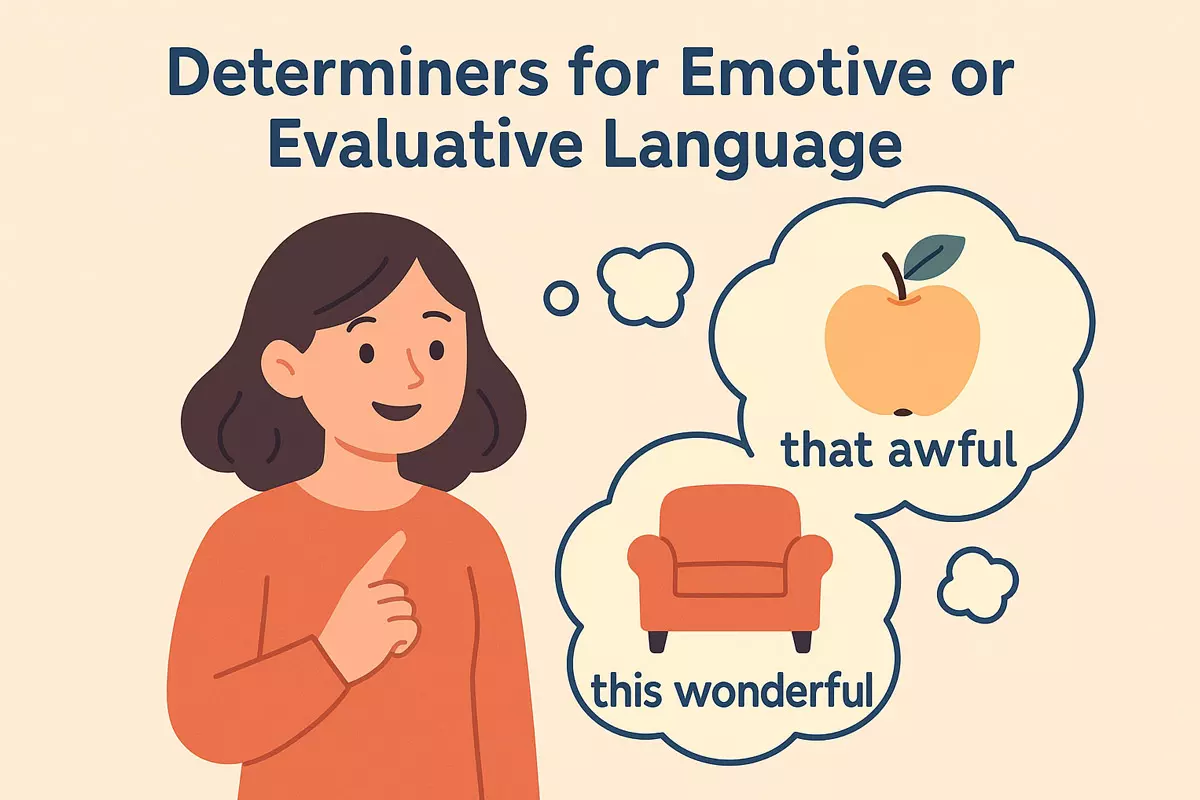 This article explains how determiners like that, this, certain, and such affect emotional tone, showing distance, disapproval, or sympathy. It covers their use in conversation, opinion writing, and media, with practice on rewriting sentences.
- How determiners influence emotional tone
- Using that to express distance or disapproval
- Using this for immediacy or sympathy
- Determinants in rhetorical criticism and praise
- Shading meaning with certain, such, those people
- Examples from conversation, opinion writing, and media
- Practice: rewrite sentences with different emotional impact
The words we choose before nouns, such as adjectives or determiners, can significantly influence the tone and meaning of our writing. These seemingly minor language choices play a crucial role in conveying our feelings or judgments, often shaping how readers interpret our emotions and opinions. By carefully selecting these words, writers can emphasize positivity, negativity, or neutrality, subtly guiding the reader’s response. Understanding this aspect of language helps us communicate more effectively and thoughtfully in both personal and professional contexts.
How determiners influence emotional tone
The choice of determiners can subtly shape how a sentence feels to the reader or listener. By selecting specific words like “this,” “that,” “such,” or “every,” a speaker can add warmth, distance, enthusiasm, or even judgment to their message. For instance, “these wonderful days” sounds more affectionate than “those days.” Small shifts in determiner usage can amplify or soften the impact of emotive language.
Determiner selection and emotional nuance
Certain determiners contribute directly to the evaluation or emotion in a statement. For example, “this” and “these” often create a sense of closeness or positivity, while “that” and “those” might suggest detachment or criticism. Indefinite determiners like “some” or “any” can make statements more vague or neutral, reducing emotional force.
- This amazing opportunity (personal, enthusiastic)
- That terrible mistake (distant, critical)
- Such a relief (heightened emotion)
- Every little problem (emphasizes frequency, possible frustration)
- No hope left (absolute, dramatic)
- Some good news (mild, tentative optimism)
- Any reason to worry? (uncertainty, possible anxiety)
- Each precious memory (individual focus, affection)
- Many happy returns (positive, abundant)
- Few regrets (minimizing, possibly comforting)
- All my love (totality, intensity)
- Another sad story (repetition, possible weariness)
- Much appreciated (formality, gratitude)
- Little hope (minimization, pessimism)
- Either solution works (openness, neutrality)
- Neither answer satisfied me (negativity, disappointment)
- Whichever way you choose (freedom, support)
- My deepest sympathy (personal, emotional)
- The best day ever (definitive, enthusiastic)
- That kind of joy (distance, possible envy)
Comparing determiner effects
To illustrate, here’s a comparison of how similar phrases shift in emotional tone based on the determiner used:
| Phrase | Emotional Effect |
|---|---|
| This moment | Immediate, intimate, positive |
| That moment | Distant, possibly regretful or critical |
| Every mistake | Emphasizes frequency, potential frustration |
| No mistake | Absolute, reassuring or dramatic |
| Such kindness | Intensifies admiration or gratitude |
| Some kindness | Mild, understated, tentative |
Takeaway
By carefully choosing among determiners, writers and speakers can fine-tune the emotional atmosphere of their language. Even small shifts, like swapping “this” for “that” or inserting “such,” can have a noticeable effect on how a message is received and felt.
Using that to express distance or disapproval
When speakers want to show emotional distance or negative judgment, the determiner "that" often comes into play. Unlike "this," which signals closeness or positive involvement, "that" can subtly (or not so subtly) convey that something is unwanted, unappealing, or simply not part of the speaker's sphere of approval. This effect is especially pronounced in spoken English, where tone and context reinforce the sense of detachment or criticism.
How "that" signals emotional distance
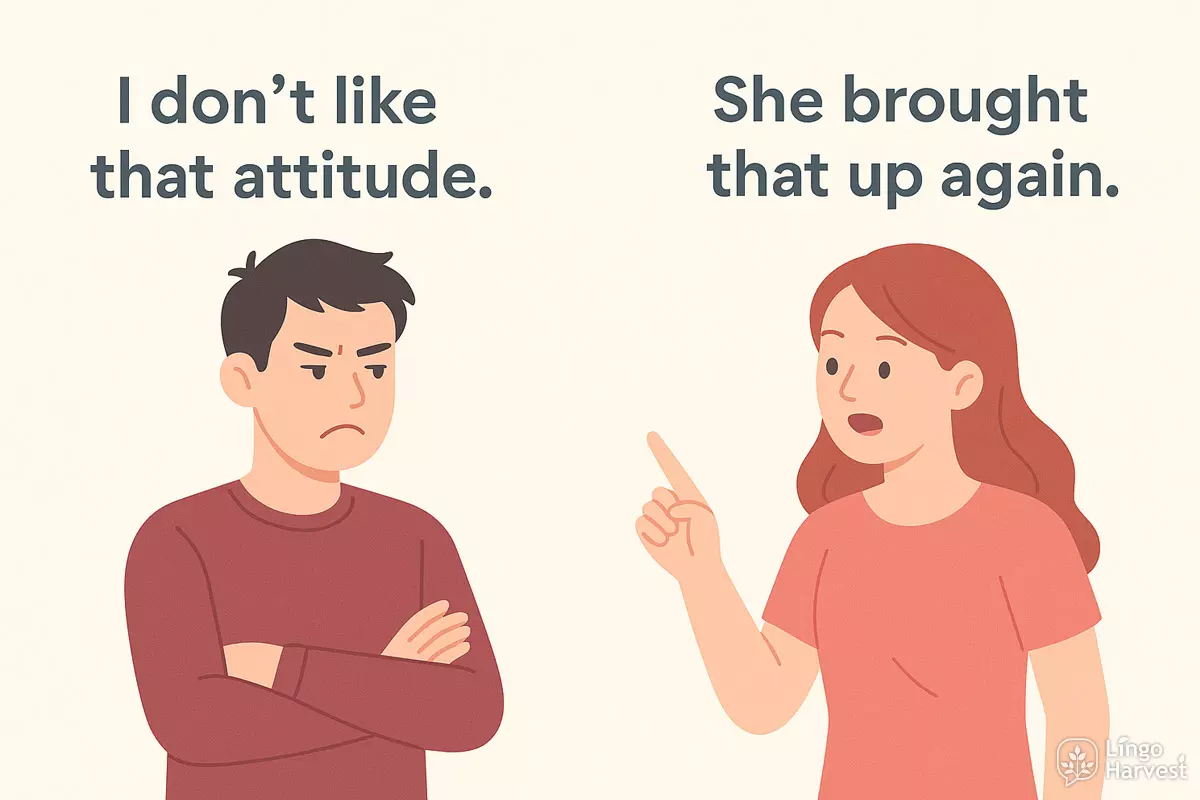
In everyday conversation, using "that" instead of "this" can make the referent seem remote—physically, emotionally, or evaluatively. It's a common way to mark something as outside one's group, values, or preferences. For example:
- “I don’t like that attitude.”
- “She brought that up again.”
- “Are you wearing that shirt?”
- “We don’t need that kind of behavior here.”
- “Listen to that noise!”
- “I can’t stand that smell.”
- “They’re serving that soup again.”
- “Not that idea again!”
- “Why do you always use that tone?”
- “I don’t trust that man.”
- “Don’t give me that look.”
- “Is that your solution?”
- “That’s what you call helpful?”
- “He’s got that smug grin.”
- “You’re not going to do that, are you?”
- “I’ve had enough of that nonsense.”
- “Don’t start with that again.”
Notice how "that" in these sentences expresses a boundary between the speaker and the subject, often signaling annoyance, skepticism, or rejection.
Common patterns for negative or evaluative distance
The structure often pairs "that" with nouns or noun phrases the speaker wants to distance from:
- That + negative noun: “that mess,” “that problem,” “that attitude”
- That + evaluative phrase: “that sort of thing,” “that kind of talk”
- Rhetorical questions: “Are you serious with that?”
- Exclamations: “Ugh, that again!”
Comparison: "this" vs. "that" for emotional stance
Sometimes the contrast between "this" and "that" is subtle but meaningful. "This" draws things closer, showing involvement or sympathy, whereas "that" pushes them away. Here’s a quick comparison:
| Example with "this" | Example with "that" |
|---|---|
| I love this idea! | Not that idea again! |
| Why do I always get this room? | Why did you give me that room? |
| Listen to this song—it’s great. | I can’t stand that song. |
| I’m enjoying this conversation. | I don’t like that kind of talk. |
Key takeaways
Using "that" as a determiner is a simple but powerful way to express emotional or evaluative distance. It can signal disapproval, irritation, or detachment, especially when compared to the more inclusive "this." Paying attention to these subtle cues can help you interpret the speaker's attitude and respond appropriately in conversation.
Using this for immediacy or sympathy
When we choose determiners like "this" or "these" instead of "the" or "those," we can subtly influence how readers or listeners feel about what we're describing. "This" brings a sense of closeness—either emotionally or in time—which can highlight urgency or invite empathy. For instance, saying "this problem" instead of "the problem" makes the issue feel present and pressing, as if it’s right in front of us.
How "this" shapes emotional response
Writers and speakers often use "this" to create a feeling of shared experience or to draw the audience closer to a subject. This way, the language encourages readers to pay attention or to care more deeply. In stories, news, or even everyday conversation, using "this" can make events sound more immediate or personal.
- This situation signals urgency or shared concern.
- This child draws attention to a specific person, encouraging empathy.
- This kind of attitude personalizes a discussion, making it more relatable.
- This tragedy invokes sympathy by focusing on a particular event.
- This challenge suggests the issue is current and relevant.
- This community creates a sense of belonging or shared fate.
- This injustice frames the issue as urgent and deserving of emotional response.
- This moment emphasizes immediacy and presence.
- This opportunity highlights timeliness and relevance.
- This pain makes the experience feel personal and ongoing.
- This behavior draws direct attention to an action, often to express concern or disapproval.
- This feeling invites readers to empathize with an emotional state.
- This decision signals the importance or difficulty of a choice.
- This loss underscores the emotional weight of an event.
- This hope brings optimism into the immediate conversation.
Comparing "this" and "the" in emotional contexts
The choice between "this" and "the" is not just grammatical—it’s a tool for shaping how an audience responds. "The" tends to distance or generalize, while "this" creates proximity and emotional involvement. For example, "the crisis" might sound detached, but "this crisis" feels urgent and shared.
| Phrase with "the" | Phrase with "this" (emotive effect) |
|---|---|
| The problem is serious. | This problem is affecting all of us. |
| The news was unexpected. | This news has really shocked me. |
| The loss was great. | This loss is hard to bear. |
| The opportunity is rare. | This opportunity is too good to miss. |
| The child needs help. | This child needs our support right now. |
| The injustice continues. | This injustice cannot go unnoticed. |
Choosing "this" over more neutral determiners can make language more vivid, immediate, and emotionally charged. Whether you want to highlight urgency or foster a sense of connection, paying attention to your choice of determiners can have a powerful effect on your audience.
Determinants in rhetorical criticism and praise
Understanding what shapes the language of judgment—whether in censure or commendation—requires more than simply spotting strong adjectives. In rhetorical analysis, critics focus on the subtle cues and linguistic patterns that signal subjective evaluation. These determinants can be linguistic, contextual, or even cultural, each influencing how statements are interpreted as critical or laudatory.
Linguistic Markers of Evaluation
Certain words and structures consistently mark statements as emotionally charged or evaluative. Adjectives like “brilliant,” “disastrous,” or “mediocre” immediately frame the subject in a positive or negative light. Beyond single words, intensifiers (“absolutely,” “utterly”) and modal verbs (“should,” “must”) can amplify the force of criticism or praise. However, less obvious determinants, such as irony or understatement, also play crucial roles in conveying a speaker’s stance.
- Explicit adjectives: “remarkable,” “uninspired,” “exceptional,” “dreadful”
- Comparative forms: “better than,” “worse than”
- Adverbs: “surprisingly,” “regrettably,” “notably”
- Metaphors and analogies: “a beacon of hope,” “a sinking ship”
- Intensifiers: “truly,” “deeply,” “incredibly”
- Negation: “not helpful,” “never impressive”
- Irony/sarcasm: “What a genius idea!” (when context implies the opposite)
- Appeals to values: “morally right,” “socially irresponsible”
- Pronoun choice: “We appreciate…,” “They failed…”
- Modal verbs: “ought to,” “must not”
- Nominalizations: “a triumph,” “a disaster”
- Rhetorical questions: “Who could possibly approve of this?”
- Quotations/attributions: “As critics have noted, …”
- Hedging: “arguably,” “somewhat,” “seems to be”
- Direct address: “Let us applaud…”
Contextual and Cultural Factors
The meaning and force of evaluative language depend heavily on context. What counts as harsh criticism in one culture or discourse community may be read as mild elsewhere. The relationship between speaker and audience, the subject matter’s sensitivity, and even genre conventions all shape the interpretation of evaluative cues. For example, satire relies on shared knowledge for its critical tone to be recognized, while straightforward academic critique uses more formalized markers.
Comparison of Criticism and Praise Determiners
| Common Forms of Criticism | Common Forms of Praise |
|---|---|
| “Disappointing results” | “Outstanding achievement” |
| “Serious flaws” | “Impressive innovation” |
| “Unacceptable behavior” | “Exemplary effort” |
| “Lacks substance” | “Highly effective” |
| “Fails to deliver” | “Remarkably successful” |
| “Misguided approach” | “Well-crafted solution” |
Summary
Effective rhetorical evaluation hinges on a mix of lexical choices, syntactic patterns, and contextual awareness. Recognizing these determinants helps both critics and readers discern the intended shade of meaning, whether the aim is to highlight excellence or expose shortcomings.
Shading meaning with certain, such, those people
Writers and speakers often use words like certain, such, and those people to subtly influence how we interpret or emotionally react to information. These determiners and phrases do more than simply pick out a group; they carry nuance, sometimes hinting at attitudes, judgments, or shared assumptions. Understanding how these terms work can help you spot bias, implication, or stance in both formal and informal contexts.
How "certain," "such," and "those people" color language
Using certain before a noun often implies selectivity or reservation, perhaps even suspicion or skepticism. Such can intensify approval or disapproval, highlighting the speaker’s attitude. Those people creates distance, sometimes signaling otherness or disapproval, especially if said with a particular tone.
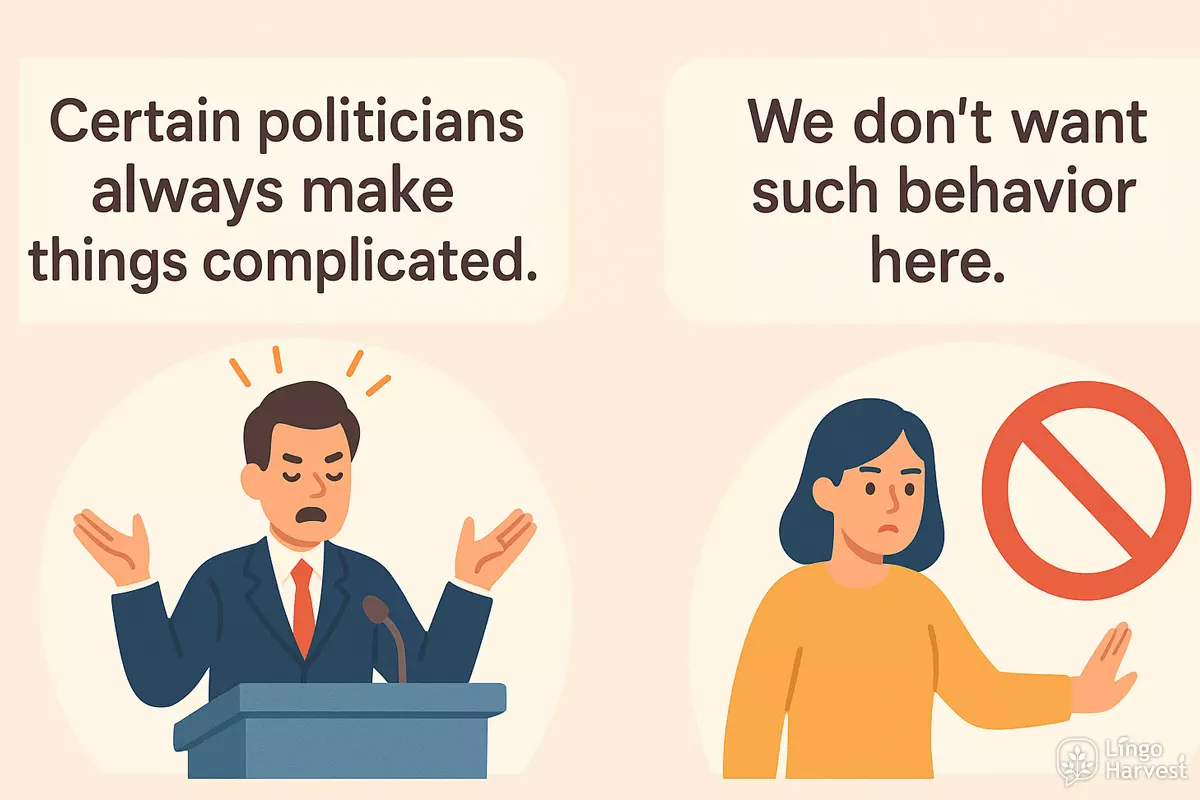
- Certain politicians always make things complicated. (implies not all, and possibly a negative view)
- We don’t want such behavior here. (disapproves, excludes)
- Those people never understand what we go through. (distances, possibly negative)
- Only certain brands are worth the price. (selective praise or criticism)
- I can’t stand such noise when I’m working. (strong negative reaction)
- Those people across the street are always loud. (implies separation or judgment)
- There are certain risks involved. (suggests caution)
- He’s not the type for such talk. (evaluative, hints at inappropriateness)
- You know how those people act at parties. (stereotyping, generalizing)
- Certain rumors have been going around. (implies secrecy or selectivity)
- She avoids such situations. (evaluative, negative)
- Those people always get special treatment. (resentment, exclusion)
Subtle effects in conversation
Choosing one of these expressions over a more neutral determiner can create a sense of “us versus them,” show emotional involvement, or downplay responsibility. For example, saying “certain mistakes were made” often sounds less direct than “we made mistakes.” Similarly, “such a mess” expresses stronger feeling than the plain “a mess.”
Comparing nuance and effect
| Phrase | Implied Attitude or Effect |
|---|---|
| Certain people | Selectivity, possible suspicion or criticism |
| Such ideas | Intensifies approval/disapproval, signals stance |
| Those people | Distance, exclusion, or otherness |
| Certain comments | Hints at reservation, sometimes secrecy |
| Such behavior | Explicit evaluation (often negative) |
| Those people over there | Physical or social separation, possibly judgment |
Takeaway for readers and writers
Recognizing these subtle cues helps you interpret the underlying attitudes in what you read or hear. When writing, being aware of your determiner choices allows you to shape your message’s emotional and evaluative impact—whether you want to include, exclude, intensify, or distance.
Examples from conversation, opinion writing, and media
Emotive or evaluative determiners often shape how statements are perceived in everyday speech, reviews, and journalism. These words can show approval, disdain, surprise, or uncertainty, and their use varies by context. Let’s look at how such determiners appear in different forms of communication.
Common Patterns in Everyday Speech
In casual conversation, people frequently use determiners to express emotion or judgment. For instance:
- That ridiculous idea won’t work.
- This wonderful place is my favorite.
- Such a terrible movie!
- What an amazing performance!
- Those boring meetings drag on.
- Every single excuse sounds the same.
- That awful weather ruined our plans.
- These incredible results surprised us all.
- Some foolish mistakes were made.
- Any honest person would agree.
- No decent explanation was offered.
- This stupid rule makes no sense.
- That fantastic idea deserves recognition.
- Such a cute puppy!
- These inspiring stories motivate me.
- Every silly rumor spreads quickly.
Opinion Writing and Reviews
Writers and critics rely on emotionally charged determiners to make their evaluations clear. Examples include:
- This groundbreaking research will change the field.
- That disappointing finale left viewers unsatisfied.
- Such an engaging read is rare these days.
- Those misleading claims should be challenged.
- Every thoughtful detail enhances the story.
Media Headlines and Broadcasts
News and media often use strong determiners to influence reader perception. Notice the difference in tone:
| Neutral Determiner | Emotive/Evaluative Determiner |
|---|---|
| This report examines the event. | This shocking report exposes the event. |
| That announcement was made yesterday. | That controversial announcement sparked outrage yesterday. |
| These policies were introduced in June. | These disastrous policies were introduced in June. |
| Such decisions are common in politics. | Such reckless decisions are common in politics. |
| This plan was approved by the board. | This bold plan was approved by the board. |
Key Takeaways
Determinants with emotional or evaluative force can dramatically alter the meaning and tone of statements. Whether in informal discussion, critical writing, or mass media, these words help convey the speaker’s attitude and influence the audience’s response. Recognizing their use is essential for both understanding and crafting persuasive or expressive communication.
Practice: rewrite sentences with different emotional impact
Understanding how determiners shape the emotional tone of a sentence is essential for expressing subtle attitudes or strong feelings. The right choice of words can make a statement sound neutral, positive, or negative. Below, you'll find practice tasks and examples that show how minor changes in determiners or evaluative language can shift the mood or implication of a sentence.
How determiners influence emotional color
Small adjustments in determiners—such as "some," "any," "this," "that," or "these"—can change not only the meaning but also the emotional temperature of your message. Compare the following rewrites to see the effect:
- Original: He brought presents.
- Positive: He brought some wonderful presents.
- Negative: He brought just a few presents.
- Neutral: He brought several presents.
Rewrite practice: Adjusting emotional impact
Try rewriting these sentences to make them more positive, negative, or neutral by changing determiners and evaluative expressions.
- She has ideas.
- This solution works.
- They made mistakes.
- We received feedback.
- He chose a path.
Show answers
- She has ideas.
- Positive: She has many brilliant ideas.
- Negative: She has some questionable ideas.
- Neutral: She has a few ideas.
- This solution works.
- Positive: This excellent solution works perfectly.
- Negative: This so-called solution barely works.
- Neutral: This solution works.
- They made mistakes.
- Positive: They made only a couple of minor mistakes.
- Negative: They made numerous serious mistakes.
- Neutral: They made some mistakes.
- We received feedback.
- Positive: We received valuable feedback.
- Negative: We received harsh feedback.
- Neutral: We received some feedback.
- He chose a path.
- Positive: He chose a promising path.
- Negative: He chose a risky path.
- Neutral: He chose a path.
Common determiners for emotional or evaluative language
Here’s a list of determiners and modifiers frequently used to add emotional nuance or judgment:
- some (positive/neutral/negative, depending on context)
- a few (often positive or neutral)
- just (can downplay: "just a mistake")
- such (adds emphasis: "such a disaster")
- this/these (can be approving or critical: "this amazing result" / "these problems")
- that/those (can distance or criticize: "that silly idea")
- every (often positive: "every opportunity")
- no (strongly negative: "no chance")
- any (sometimes negative: "any hope left?")
- all (can be positive or negative: "all the right moves" / "all those mistakes")
- many (neutral or positive: "many achievements")
- few (often negative: "few options")
- little (negative: "little hope")
- plenty of (positive: "plenty of reasons")
- several (neutral: "several attempts")
- only (restrictive: "only a minor issue")
- much (context-dependent: "much success" / "much trouble")
- certain (adds selectivity: "certain advantages")
- mere (minimizing: "a mere detail")
- every single (emphatic: "every single detail")
Comparison: Emotional impact of determiners
Below is a structured comparison of how different determiners and evaluative words can alter a sentence’s tone. Notice how each choice shapes the reader’s perception.
| Sentence | Emotional Impact |
|---|---|
| This result is just a coincidence. | Minimizing, dismissive |
| This result is such a breakthrough. | Strongly positive, enthusiastic |
| He made no effort. | Strongly negative, critical |
| He made every effort. | Strongly positive, approving |
| She found few reasons to stay. | Negative, discouraged |
| She found plenty of reasons to stay. | Positive, supportive |
| Those ideas are interesting. | Neutral to mildly positive |
| These ideas are brilliant. | Strongly positive |
Experiment with these patterns in your own writing to see how subtle shifts in determiners and evaluative words can dramatically alter the emotional undertone of your sentences.