Emotion Nouns in Real Communication and Expressing Feelings

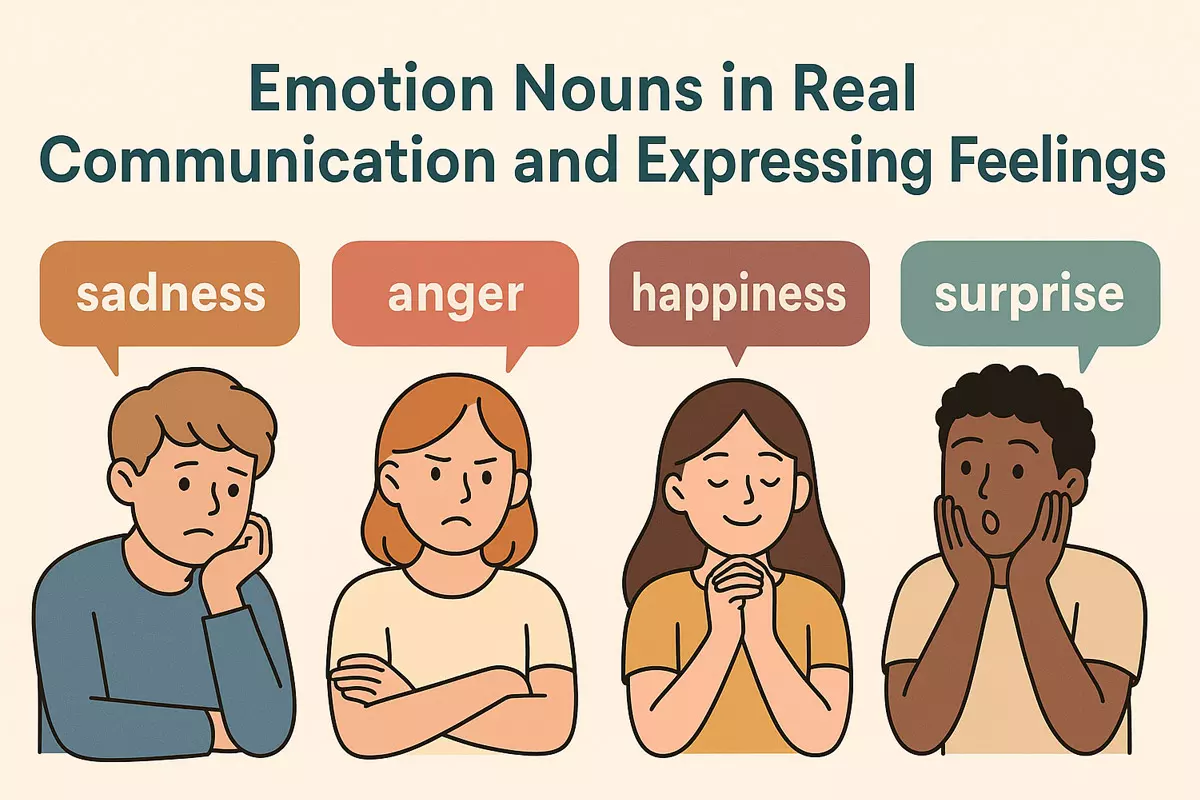 The article defines emotion nouns in daily English, gives common positive and negative examples, explains their use with verbs like feel or express, contrasts them with adjectives, explores cultural nuance, highlights frequent learner errors, and offers practice…
- What emotion nouns are in everyday English
- Common positive and negative emotion nouns
- Using emotion nouns with verbs like feel and express
- Differences between emotion nouns and adjectives
- Cultural tone in using emotion-related nouns
- Typical learner errors with emotion vocabulary
- Practice: describe situations using correct emotion nouns
Discussing our feelings plays an essential role in everyday communication, as the specific words we choose for various emotions can influence the depth and clarity of our conversations. By examining the language we use to describe and express our internal experiences, we gain insight into how vocabulary shapes not only our own understanding but also the way others perceive and respond to us. This process highlights the significant impact that language has on building empathy and fostering genuine connections in our interactions.
What emotion nouns are in everyday English
Emotion nouns are words that name feelings, states, or emotional experiences. In daily English, people use these terms to talk about how they or others feel, describe moods, or explain reactions. Recognizing and using these nouns can help express yourself more clearly, whether you’re chatting with friends, writing messages, or sharing personal stories.
Common Emotion Nouns Used in Conversations
A wide variety of nouns for emotions appear in everyday speech. Some are very basic and universal, while others are more nuanced. Here are some of the most frequently used emotion nouns:
- Happiness → She felt happiness after hearing the good news.
- Sadness → His sadness was clear in his eyes.
- Anger → Her anger grew when she saw the mess.
- Fear → He trembled with fear during the storm.
- Excitement → The children jumped with excitement.
- Disgust → He reacted with disgust to the smell.
- Surprise → Her surprise was genuine and loud.
- Love → They showed love through small actions.
- Jealousy → His jealousy made him act strangely.
- Guilt → She felt guilt after the argument.
- Shame → He lowered his head in shame.
- Pride → She spoke with pride about her work.
- Anxiety → His anxiety kept him awake all night.
- Hope → They held onto hope during hard times.
- Relief → She sighed with relief after the exam.
- Frustration → His frustration grew with every delay.
- Confusion → Her confusion showed on her face.
- Trust → They built trust over many years.
- Envy → His envy made him compare himself to others.
- Gratitude → She expressed gratitude for the help.
How Emotion Nouns Function in Real Communication
These nouns help people describe their internal world and connect with others. For example, saying “I feel anxiety before presentations” or “There was so much excitement at the party” uses emotion nouns to make feelings clear. They also appear in questions (“What’s your biggest fear?”), advice (“Don’t let anger control you”), and stories (“Her joy was obvious”).
Examples of Emotion Nouns in Context
- “My main worry is missing the deadline.”
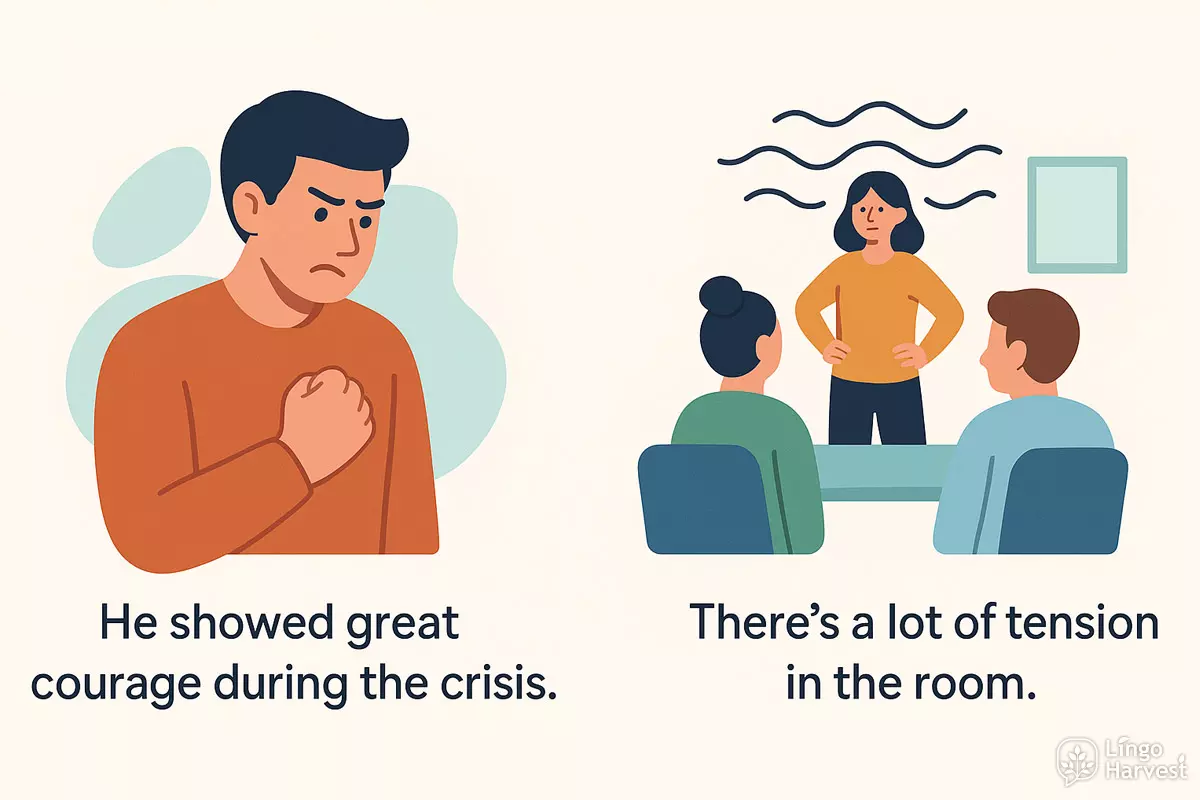
- “He showed great courage during the crisis.”
- “There’s a lot of tension in the room.”
- “She felt deep gratitude for the help.”
- “His pride wouldn’t let him apologize.”
Comparing Positive and Negative Emotion Nouns
| Positive Emotion Nouns | Negative Emotion Nouns |
|---|---|
| Joy | Fear |
| Gratitude | Anger |
| Hope | Jealousy |
| Pride | Guilt |
| Relief | Frustration |
Understanding these words and their use can make emotional communication more precise and meaningful. Whether you’re describing your own feelings or interpreting someone else’s, having a good grasp of emotion nouns is a valuable part of everyday English.
Common positive and negative emotion nouns
Understanding how to name and discuss feelings is essential for clear, authentic communication. Knowing the vocabulary for both uplifting and challenging emotions helps people express themselves and relate to others more effectively. Below, you’ll find examples of nouns that frequently appear in conversations about emotional experiences.
Positive emotion nouns
Words that describe pleasant or desirable feelings can add warmth and encouragement to interactions. Here are some commonly used nouns for positive emotions:
- Joy → She felt joy when she saw her friends.
- Gratitude → He expressed gratitude for the support.
- Hope → They held onto hope during difficult times.
- Pride → She spoke with pride about her achievements.
- Relief → He breathed a sigh of relief.
- Contentment → She enjoyed a moment of contentment.
- Excitement → The kids were full of excitement.
- Affection → He showed affection by helping her.
- Admiration → She looked at the artwork with admiration.
- Amusement → His joke brought amusement to everyone.
- Serenity → The quiet park gave her a sense of serenity.
- Trust → They built trust over many years.
Negative emotion nouns
Describing uncomfortable or distressing states allows for honesty and can help in resolving misunderstandings. Here is a selection of nouns often used to convey negative emotions:
- Anger → His anger was hard to hide.
- Fear → She froze in fear when she heard the noise.
- Sadness → A deep sadness filled the room.
- Disgust → He reacted with disgust to the smell.
- Anxiety → Her anxiety increased before the interview.
- Guilt → He felt guilt after making a mistake.
- Shame → She avoided eye contact out of shame.
- Frustration → His frustration grew with every delay.
- Jealousy → Jealousy made her doubt herself.
- Disappointment → Their disappointment was obvious.
- Loneliness → Loneliness made the evenings difficult.
- Regret → He spoke with regret about his decision.
Comparing positive and negative emotion nouns
To better understand the contrasts between these types of feelings, here is a structured side-by-side comparison of selected nouns and their general emotional tone:
| Positive Emotion | Negative Emotion |
|---|---|
| Joy | Sadness |
| Trust | Fear |
| Pride | Shame |
| Hope | Despair |
| Gratitude | Envy |
| Relief | Anxiety |
These examples can help you identify and articulate emotions in various contexts, from personal reflection to social interactions. Expanding your emotional vocabulary not only improves communication but also fosters greater empathy and understanding.
Using emotion nouns with verbs like feel and express
Knowing how to combine emotion nouns with action verbs helps you talk clearly about your feelings in everyday conversation. Instead of just saying “I am happy,” English often uses verbs like “feel” or “express” together with nouns that name specific emotions. This structure allows you to describe emotional states, reactions, and attitudes in a more detailed way.
Common patterns for describing emotions
The most typical way to use emotion nouns in sentences is with verbs such as “feel,” “show,” “express,” “experience,” and “hide.” Here are some practical examples:
- I feel joy when I see my friends.
- She expressed anger about the decision.
- They showed gratitude for the support.
- He hides his disappointment well.
- We experience fear in dangerous situations.
- You often express admiration for others.
- I felt relief after hearing the news.
- She expressed sympathy for the victim.
- He showed confusion during the meeting.
- They experience pride in their work.
- She hides her anxiety behind a smile.
- He feels regret about his choice.
- We expressed wonder at the view.
- You showed interest in the project.
- I expressed concern for his health.
- He feels envy sometimes.
- They hide their embarrassment.
- She expressed love openly.
- We showed respect for the rules.
Choosing the right verb for the right emotion
Some verbs and emotion nouns pair more naturally than others. For example, “feel” fits best with internal states, while “express” or “show” works for emotions that become visible to others. Here’s a quick comparison of how different verbs combine with emotion nouns:
| Verb | Typical Emotion Nouns | Example Sentence |
|---|---|---|
| feel | happiness, sadness, relief, regret, envy, pride | I feel pride in my achievements. |
| express | anger, gratitude, sympathy, concern, admiration | She expressed concern for her friend. |
| show | interest, respect, confusion, embarrassment | They showed interest in the topic. |
| hide | disappointment, anxiety, embarrassment, fear | He hides his anxiety at work. |
Tips for natural communication
To sound natural, match the verb to both your intention and the emotion. Use “feel” for your private state, “express” when you communicate it, “show” for visible reactions, and “hide” when you mask it. Adjusting your word choices in this way makes your communication more precise and relatable.
Differences between emotion nouns and adjectives
Understanding how nouns and adjectives related to feelings function in real communication helps us use language more precisely. Emotion nouns like “anger,” “happiness,” or “fear” refer to the emotion itself as an abstract concept or a specific instance of feeling. In contrast, adjectives such as “angry,” “happy,” or “afraid” describe the state or quality of a person, object, or situation. This distinction affects both sentence structure and the nuance of what is being expressed.
How They Work in Sentences
Emotion nouns typically serve as the subject or object: “Sadness filled the room.” Adjectives, on the other hand, are used to qualify nouns: “She felt sad.” The grammatical role each plays changes how information is delivered and what is emphasized.
Common Usage Patterns
- Nouns often follow verbs like “feel,” “experience,” “express,” or “cause”: “He experienced joy.”
- Adjectives are used after linking verbs (be, seem, become): “They became anxious.”
- Emotion nouns can be modified by adjectives: “intense fear,” “deep love.”
- Emotion adjectives can be intensified: “very angry,” “a little jealous.”
Comparing Forms and Functions
| Emotion Noun | Emotion Adjective | Example Sentence |
|---|---|---|
| anger | angry | She felt anger rising. → She was angry. |
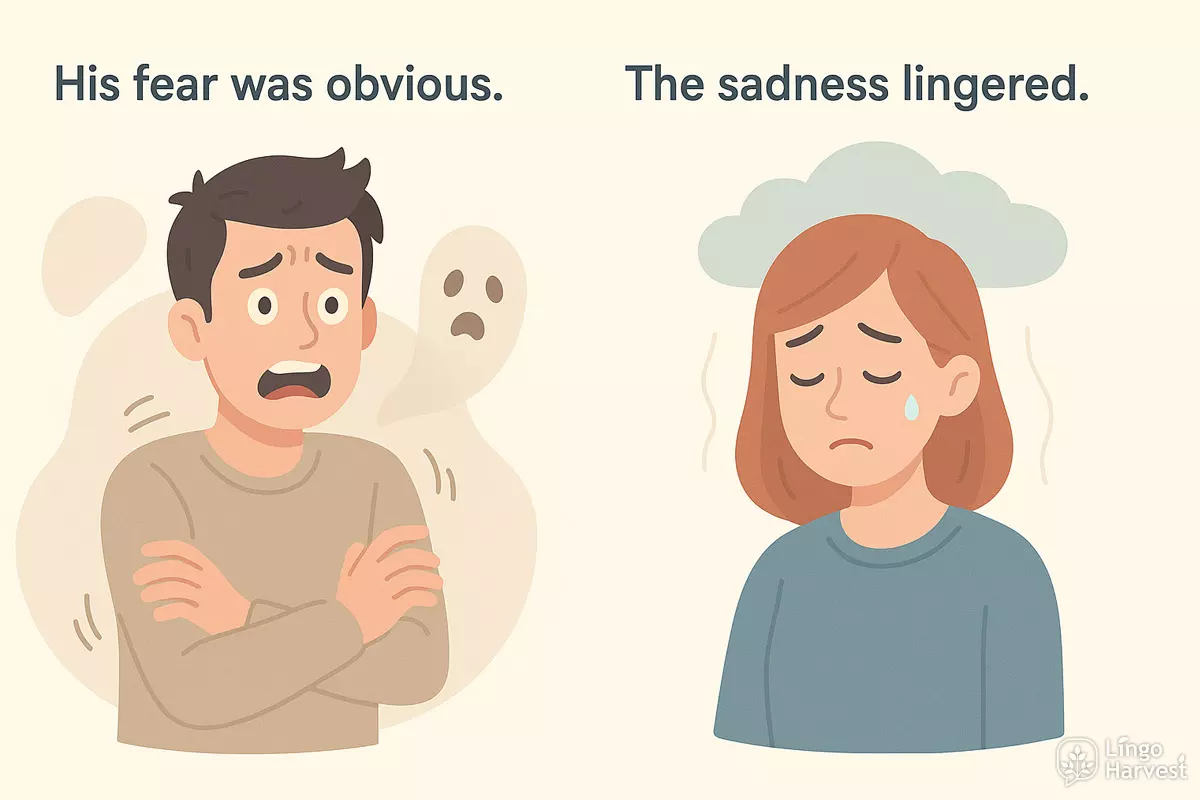
| fear | afraid | His fear was obvious. → He looked afraid. |
| happiness | happy | Her happiness was contagious. → She felt happy. |
| sadness | sad | The sadness lingered. → They seemed sad. |
| disgust | disgusted | He expressed disgust. → She looked disgusted. |
| surprise | surprised | A look of surprise appeared. → He was surprised. |
| love | loving | Their love was clear. → She is loving. |
| envy | envious | He felt envy. → She was envious. |
| jealousy | jealous | His jealousy was obvious. → He was jealous. |
| shame | ashamed | She felt shame. → He looked ashamed. |
Practical Communication Implications
Choosing between a noun or adjective form lets you focus on either the abstract feeling or the emotional state of a person. For example, using a noun can make the emotion seem more objective or external (“There was excitement in the air”), while adjectives connect more directly to the subject’s experience (“We were excited”). This flexibility allows for subtle shifts in emphasis and meaning in both spoken and written language.
Cultural tone in using emotion-related nouns
How people use words like “happiness,” “fear,” or “shame” can reveal a lot about their cultural background. Societies shape the ways we talk about feelings, both in what we say and what we avoid. For example, some cultures encourage open sharing of personal emotions, while others prefer more reserved or indirect expressions. The emotional vocabulary we choose—whether it’s formal, casual, poetic, or clinical—often matches what is considered polite, respectful, or appropriate in a given group.
Directness vs. Indirectness
In many Western cultures, it’s common to use emotion nouns directly: “I feel sadness,” or “That was a moment of joy.” In contrast, East Asian languages and cultures often favor less direct expressions, sometimes omitting emotion nouns or using metaphors instead. This difference can affect both spoken and written communication, influencing how feelings are understood or interpreted.
- “Pride” may be celebrated in some communities, but avoided in others where humility is valued.
- “Anger” might be openly named in individualistic cultures, but softened or replaced by euphemisms in collectivist settings.
- “Gratitude” is often explicitly stated in English, while in Japanese, indirect references are more common.
- “Shame” can be a public concept in some societies, but a private feeling elsewhere.
- “Love” is sometimes reserved for close relationships, while in other languages, it’s used broadly for friends, family, or even food.
- “Anxiety” may be medicalized in some contexts, but described with everyday terms in others.
- “Compassion” can be a core value in religious discourse, yet less discussed in secular conversations.
- “Sorrow” is often linked to formal rituals or ceremonies.
- “Hope” might be a casual word or a deeply spiritual concept, depending on the culture.
- “Disgust” can be expressed openly or suppressed, especially in mixed company.
Comparing Emotional Vocabulary Across Cultures
| Culture | Common Approaches to Emotion Nouns |
|---|---|
| American English | Frequent, direct naming of emotions (e.g., “happiness,” “anger”); open sharing encouraged. |
| Japanese | Indirect references; context and nonverbal cues preferred; emotion nouns often omitted. |
| Russian | Rich emotional vocabulary; poetic or dramatic use common in literature and conversation. |
| Arabic | Emotional nouns tied to honor and family; balance between directness and respect. |
| German | Precise terms for complex feelings; sometimes formal or philosophical in tone. |
Social Context and Register
Choosing the right emotional noun often depends on the setting and relationship between speakers. Formal situations may call for abstract or softened expressions, while informal chats might use vivid, personal terms. Age, status, and even gender can influence what’s said and how it’s received. For instance, elders might expect more respectful wording, while close friends use playful or even invented emotion words. Adapting to these unwritten rules helps keep communication smooth and culturally sensitive.
Typical learner errors with emotion vocabulary
Understanding how to use emotion nouns correctly is a common hurdle for language learners. Many students struggle with choosing the right word for a specific feeling, distinguishing between similar terms, or forming grammatically accurate expressions. These challenges can lead to misunderstandings or unnatural communication, especially in real-life conversations where precise emotional vocabulary matters.
Confusing similar emotion nouns
Learners often mix up words that seem alike but carry different nuances. For example, “anger” and “annoyance” both relate to negative emotions, but “anger” is much stronger. Using one instead of the other can change the meaning of a sentence.
- Confusing “happiness” and “joy”
- Mixing up “fear” and “anxiety”
- Substituting “sadness” for “disappointment”
- Using “love” in place of “affection”
- Misusing “surprise” and “shock”
- Interchanging “pride” and “arrogance”
- Confusing “compassion” and “sympathy”
- Using “envy” instead of “jealousy”
- Mixing up “relief” and “gratitude”
- Substituting “embarrassment” for “shame”
Incorrect collocations and prepositions
Emotion nouns often require specific prepositions or collocations to sound natural. Learners might say “in happiness” instead of “with happiness,” or “fear from spiders” instead of “fear of spiders.” These small errors can make speech sound awkward.
Overgeneralization and literal translation
Translating directly from one’s native language can result in odd or incorrect usage. For instance, using “make a happiness” instead of “feel happiness,” or creating unnatural phrases like “I have a sadness.” English typically uses “feel” with emotion nouns: “I feel sadness,” “She feels anger.”
Register and appropriateness
Some emotion nouns are formal or literary, while others are casual. Learners may use “melancholy” in daily conversations where “sadness” would be more appropriate, or choose slang like “guts” (for courage) in a formal setting.
Common misuses: examples
Below are frequent mistakes learners make, along with the correct forms.
| Incorrect Usage ❌ | Correct Usage ✅ |
|---|---|
| I have a happiness for you. | I feel happiness for you. |
| He is full with anger. | He is full of anger. |
| She feels a jealousy to her friend. | She feels jealousy towards her friend. |
| They showed a big surprise about the news. | They showed great surprise at the news. |
| I have fear from dogs. | I have a fear of dogs. |
Tips for avoiding common mistakes
To use emotion nouns accurately, pay attention to context, collocations, and subtle differences in meaning. Practice with real-life examples, check how native speakers use these words, and review set phrases or idiomatic expressions. Over time, this will help your emotional vocabulary sound more natural and precise.
Practice: describe situations using correct emotion nouns
Understanding how to choose the right emotion noun in context is crucial for clear communication. Below, you will find various realistic scenarios. Your task is to select the most accurate emotion noun for each situation. This exercise will help you recognize subtle differences between emotions and practice expressing feelings accurately in real-life conversations.
Identify the Emotion Noun
- You have just received a long-awaited acceptance letter from your favorite university. What emotion noun best describes your feeling?
- After forgetting your friend's birthday, you feel bad about your oversight. Which emotion noun fits this situation?
- When hearing thunder at night, you suddenly feel uneasy and a bit scared. What emotion noun should you use?
- You see someone achieve a goal that you also wanted, and you feel a mix of admiration and longing. Which emotion noun applies?
- At the end of a difficult project, you feel satisfied with your accomplishments. What noun expresses this?
- During a heated argument, your face turns red and your voice rises. Which noun describes your feeling?
- When your friend surprises you with a thoughtful gift, you feel thankful. Which emotion noun is appropriate?
- After hearing disappointing news, you feel a heavy sense of loss. What emotion noun matches this?
- Before giving an important presentation, your heart races. What emotion noun describes this state?
- You witness an act of cruelty and feel strongly that it is unfair. Which noun describes your feeling?
Show answers
- Joy
- Guilt
- Fear
- Envy
- Pride
- Anger
- Gratitude
- Sadness
- Anxiety
- Indignation
Emotion Noun Vocabulary for Everyday Situations
- Happiness → She felt happiness when the plan succeeded.
- Disappointment → His disappointment was clear after the loss.
- Shame → He lowered his eyes in shame.
- Surprise → Her surprise made everyone laugh.
- Relief → She exhaled in relief after the exam.
- Admiration → He looked at the painting with admiration.
- Frustration → Her frustration grew with every error.
- Compassion → He showed compassion by helping the injured dog.
- Excitement → The children were full of excitement.
- Loneliness → Loneliness made the nights difficult.
- Embarrassment → His face turned red with embarrassment.
- Hope → They never lost hope during the challenge.
- Regret → She spoke with regret about her decision.
- Trust → They built trust through honesty.
- Contentment → He felt contentment while relaxing at home.
- Resentment → Her resentment grew after the argument.
- Confusion → His confusion showed on his face.
- Disgust → She reacted with disgust to the spoiled food.
Comparing Similar Emotion Nouns
| Emotion Noun | Typical Situation |
|---|---|
| Pride | Feeling after achieving something important, such as winning a competition |
| Gratitude | When someone helps you unexpectedly or gives you a gift |
| Shame | After making a public mistake or breaking a social rule |
| Envy | Seeing someone else have what you desire, like a new job or success |
| Frustration | When repeated efforts fail to solve a problem or reach a goal |
| Relief | When a stressful situation ends or a danger passes |
| Regret | Wishing you had made a different decision in the past |
| Admiration | Respecting someone's skills, achievements, or qualities |
Challenge: Expressing Feelings in Context
Try to write your own short descriptions for three emotions from the vocabulary list above. For each, describe a situation where you or someone else might feel that emotion. This will help internalize the use of specific emotion nouns in real communication.
Show answers
- Relief: After finding your lost keys, you feel relief because your worries are over.
- Admiration: Watching a talented musician perform, you feel admiration for their skill.
- Regret: After declining an invitation to a great event, you experience regret.