How to Express Past Obligation Using Modal Verbs

 It explains how English talks about past responsibilities, including structures for past necessity and expectations and the difference between had to and should have. You’ll see examples of past rules and duties, how speakers justify earlier requirements in explanations or storytelling, plus practice exercises.
- How English refers to responsibilities that existed in the past
- Structures used to describe past necessity and expectations
- The difference between had to and should have in past contexts
- Examples of past rules, duties, and requirements
- How speakers explain why an action was required earlier
- Situations where past obligation appears in explanations or storytelling
- Exercises and practice activities describing past obligations
Describing past duties can be tricky, but modal verbs help you show whether something was required, expected, or simply the best choice. In everyday stories, we often explain why we acted, what rules applied, or what we didn’t finish. This article shows how to use forms like had to, should have, and was supposed to so your meaning stays clear and natural.
How English refers to responsibilities that existed in the past
English usually signals earlier duty by combining a modal pattern with a past time reference (yesterday, last week, when I was a child) or by using a “past form” of a modal construction. The key is to separate two ideas: (1) what the rule or expectation was at that time, and (2) whether the duty was actually completed.
Core patterns for past obligation
| Form | Typical meaning | Example |
|---|---|---|
| had to + base verb | Required by rules/situation; common and neutral | I had to submit the form by Friday. |
| was/were supposed to + base verb | Expected/arranged; often implies the plan may not have happened | We were supposed to meet at 6, but he cancelled. |
| should have + past participle | Past duty seen as the right thing; often regret/criticism | You should have told me earlier. |
| ought to have + past participle | Similar to should have; slightly more formal | I ought to have apologized. |
| was/were to + base verb | Formal plans/instructions in the past (often in narratives) | The documents were to remain confidential. |
| needed to + base verb | Necessity (practical requirement), less “rule-like” than had to | We needed to lock up before leaving. |
Choosing the right form (what you want to communicate)
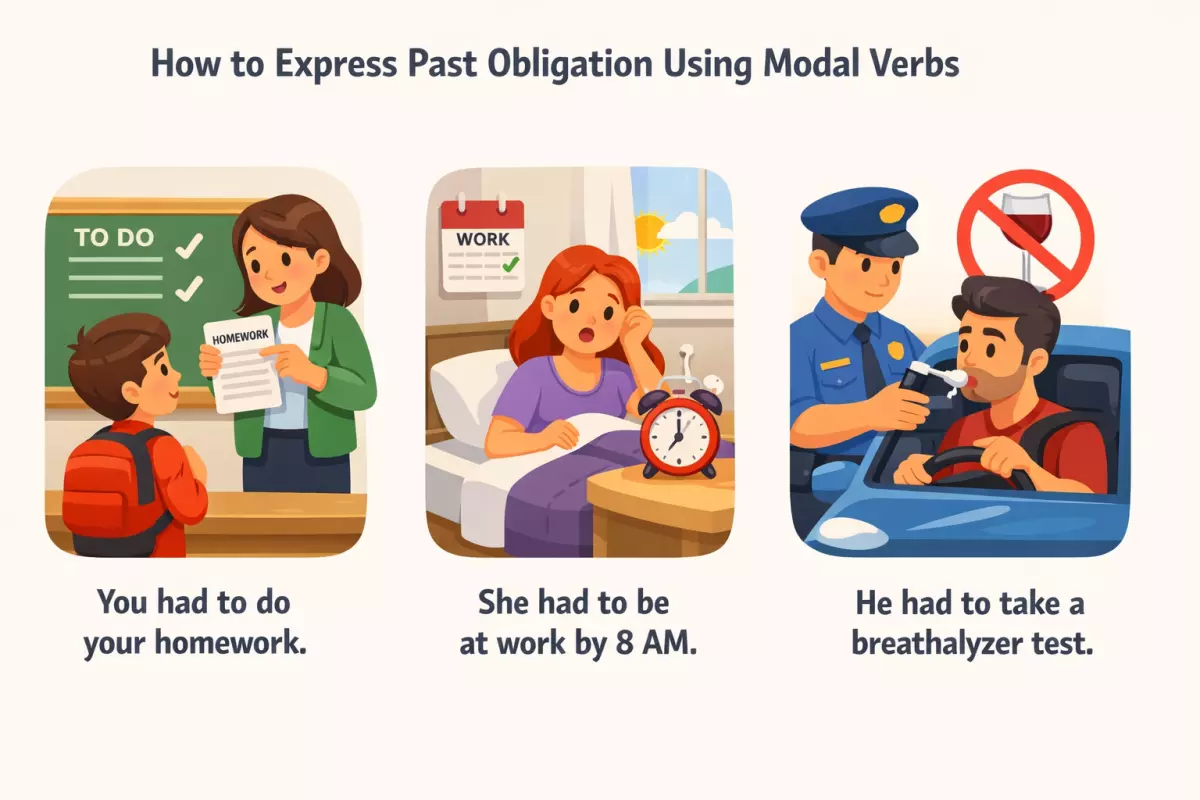
- Use “had to” for a clear past requirement, especially when the situation forced it: “I had to work late because the deadline was moved.”
- Use “was/were supposed to” for expectations, instructions, or plans—often with a contrast showing it didn’t happen: “She was supposed to call, but she forgot.”
- Use “should have / ought to have” to judge a past choice (advice after the fact): “They should have checked the address.”
- Use “was/were to” for official-sounding obligations in reports, rules, or storytelling: “No one was to enter the room.”
- Use “needed to” when the emphasis is practical necessity rather than authority: “I needed to charge my phone before the trip.”
Completed vs. not completed: common signals
- Duty existed and was completed: “I had to renew my passport, so I did it on Monday.”
- Duty existed but was not completed (often implied): “I was supposed to renew my passport, but I didn’t have time.”
- Criticism/regret about non-completion: “I should have renewed it earlier.”
- Past requirement with a negative: “We didn’t have to pay for parking.” (meaning: it was not necessary)
- Past prohibition (strong): “We weren’t allowed to take photos.” (often clearer than trying to force a modal)
High-value example set (patterns you can reuse)
- I had to wear a uniform at my old school.
- He had to leave early to catch the last train.
- We didn’t have to show ID, so we walked in.
- You were supposed to back up the files every week.
- They weren’t supposed to share the password.
- I was supposed to be there at 9, but the bus was late.
- You should have read the instructions first.
- She shouldn’t have signed the contract without advice.
- We ought to have warned them about the change.
- He ought not to have spoken to the client that way.
- The staff were to report any safety issues immediately.
- No visitor was to enter without permission.
- I needed to finish the report before the meeting.
- They needed to replace the lock after losing the key.
When you’re unsure, “had to” is the safest default for past necessity. Switch to “was/were supposed to” when you want the idea of expectation (especially if it wasn’t followed), and use “should have” when you’re evaluating a past action rather than describing a rule.
Structures used to describe past necessity and expectations
English uses several patterns to talk about what was required, expected, or advisable in the past. The choice depends on whether the obligation was real or only assumed, whether it was fulfilled, and whether you are judging the outcome now.
Core patterns and when to use them
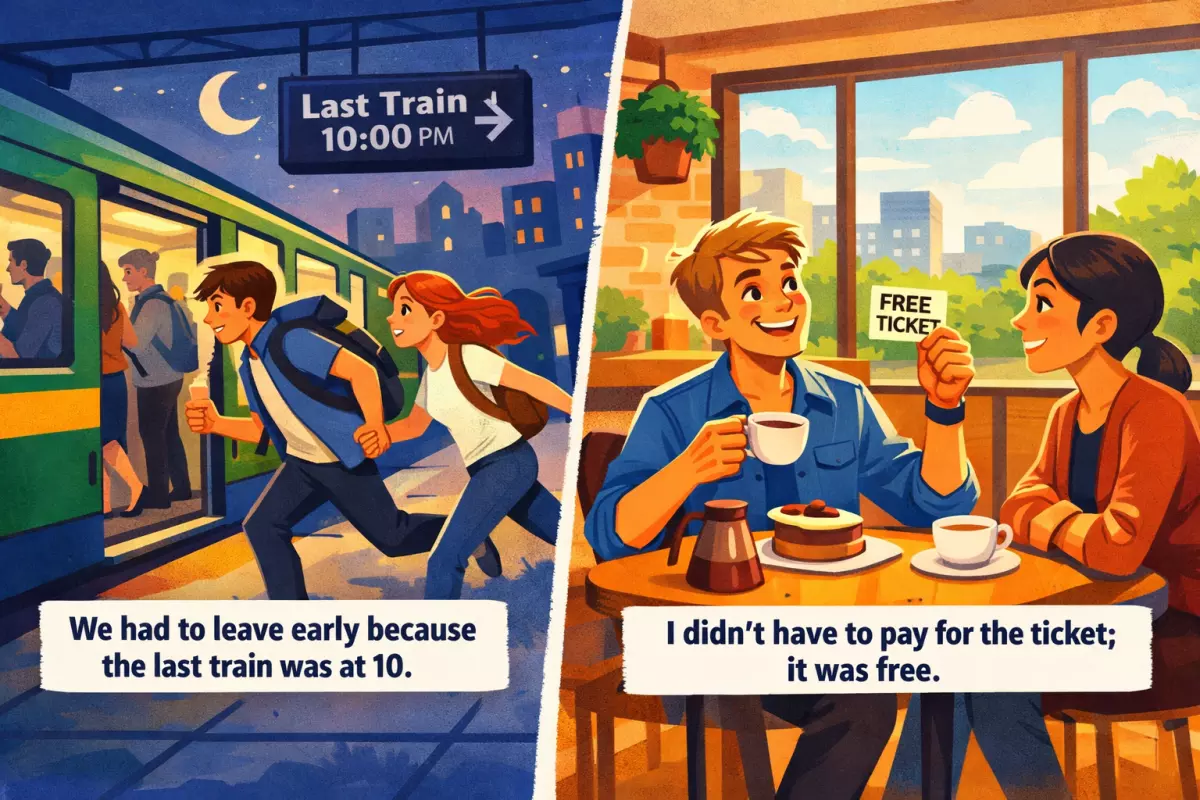
- had to + base verb (past necessity; external requirement): “We had to leave early because the last train was at 10.”
- didn’t have to + base verb (no necessity; not required): “I didn’t have to pay for the ticket; it was free.”
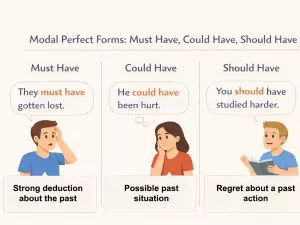
- must have + past participle (logical conclusion about the past, not obligation): “She must have forgotten the meeting.”
- was/were supposed to + base verb (expectation/arrangement; often implies it didn’t happen): “You were supposed to call me yesterday.”
- was/were meant to + base verb (intended plan or design; may imply a mismatch with reality): “The key was meant to open the back door, but it didn’t.”
- was/were to + base verb (formal scheduled duty or instruction): “The trainees were to report to reception at 8.”
- should have + past participle (past advice/criticism; speaker judges it as the better choice): “I should have brought an umbrella.”
- shouldn’t have + past participle (regret/criticism for an action done): “He shouldn’t have said that in public.”
- ought to have + past participle (similar to should have; slightly more formal): “They ought to have informed us earlier.”
- needn’t have + past participle (unnecessary action was done anyway): “You needn’t have bought a gift; your visit was enough.”
- didn’t need to + base verb (lack of necessity; often suggests the action did not happen): “We didn’t need to book in advance, so we didn’t.”
- could have + past participle (missed possibility; sometimes mild criticism): “You could have asked for help.”
- was/were expected to + base verb (social or institutional expectation): “Staff were expected to wear ID badges.”
- was/were required to + base verb (official rule; stronger and more explicit): “Visitors were required to sign in.”
Common contrasts that change the meaning
- had to vs should have:
✅ “I had to work late.” (it was necessary)
✅ “I should have left earlier.” (it would have been wiser) - must have vs had to:
✅ “He must have missed the bus.” (deduction)
✅ “He had to take a taxi.” (necessity) - needn’t have vs didn’t need to:
✅ “I needn’t have printed the form.” (I printed it, but it wasn’t necessary)
✅ “I didn’t need to print the form.” (printing wasn’t necessary; often implies I didn’t print it) - was supposed to vs was expected to:
✅ “She was supposed to meet us at 6.” (plan/arrangement; often broken)
✅ “She was expected to meet clients politely.” (general expectation)
Form reminders to avoid common errors
- Modal + have + past participle is the standard shape for past evaluation: “should have done,” “could have gone,” “might have seen.”
- ❌ “should have went” → ✅ “should have gone” (use the past participle).
- For past obligation, must usually becomes had to: “I had to renew my passport.” (more natural than “I musted…”).
- Negative meaning changes with the structure: “didn’t have to” (not required) is different from “shouldn’t have” (it was a mistake to do it).
The difference between had to and should have in past contexts
Use had to to report a real past necessity (something was required or unavoidable). Use should have to evaluate a past action (something was the better choice, but it may not have happened). In other words, one describes what was necessary; the other expresses judgment, regret, or criticism about what would have been wiser.
| Form | Core meaning in the past | Typical source | Example |
|---|---|---|---|
| had to + base verb | Past necessity / requirement (fact) | Rules, circumstances, external pressure, practical need | I had to leave early to catch the last train. |
| didn’t have to + base verb | No necessity (it was optional) | Lack of requirement | We didn’t have to show ID at the entrance. |
| should have + past participle | Past advice / missed best option (evaluation) | Speaker’s opinion after the fact; expectations | You should have called before you arrived. |
| shouldn’t have + past participle | Past criticism / regret (something was a bad idea) | Speaker’s judgment; negative outcome | I shouldn’t have said that in the meeting. |
| Should have…? (question) | Asking about the best past choice | Uncertainty about what was appropriate | Should we have waited for a reply? |
Patterns and common contrasts
- Fact vs. evaluation: “I had to work late” reports a real requirement; “I should have worked late” judges what would have been better (often because of consequences).
- External pressure vs. personal standard: “We had to wear helmets” suggests a rule or safety requirement; “We should have worn helmets” suggests it was wise, even if not required.
- What happened vs. what would have been better: “She had to cancel” means cancellation was necessary; “She should have canceled” implies she didn’t cancel (or did, but the speaker is emphasizing it was the right call).
- Negatives do different jobs: “didn’t have to” = not necessary; “shouldn’t have” = a mistake. These are not interchangeable.
- Timing focus: “had to” focuses on the situation at that time; “should have” focuses on the later viewpoint (often after seeing results).
Example set (with quick usage notes)
- I had to reset my password because the system locked me out. (requirement)
- I didn’t have to reset it; support fixed the issue. (not required)
- I should have reset it earlier to avoid delays. (better choice)
- You had to show your ticket at the gate. (rule)
- You should have kept your ticket until the end. (advice after the fact)
- We had to take a taxi because buses stopped running. (circumstances)
- We should have checked the schedule before leaving. (missed precaution)
- She had to apologize to the client as part of the process. (obligation)
- She shouldn’t have blamed the client in her email. (criticism)
- I had to skip lunch to finish the report. (necessity)
- I shouldn’t have skipped lunch; I felt awful later. (regret)
- They had to postpone the event due to the storm. (unavoidable)
- They should have postponed it sooner to avoid confusion. (judgment)
- Did you have to sign anything at reception? (asking about requirement)
- Should I have brought a printed copy? (asking about the best past choice)
Common learner errors to avoid
- ❌ “I didn’t have to go, but I went, so I shouldn’t have gone.” → Use both carefully: “I didn’t have to go (optional), but I went. I shouldn’t have gone (it was a bad idea).”
- ❌ “I should to go yesterday.” → ✅ “I had to go yesterday” (necessity) or “I should have gone yesterday” (missed obligation/advice).
- ❌ “I had to have called you.” (usually wrong for obligation) → ✅ “I had to call you” (necessity) / “I should have called you” (regret).
- ❌ Using “should have” to mean a rule: “We should have worn badges (because it was required).” → If it was truly required, prefer “We had to wear badges.”
Examples of past rules, duties, and requirements

When you talk about obligations in the past, the form you choose depends on whether the duty was an external rule, a personal necessity, or something that was required but not done. The patterns below show common ways to express past rules and responsibilities clearly.
Common patterns and example sentences
- had to + base verb (a past requirement, often from rules or circumstances): “We had to wear helmets on the site.”
- had to (a single necessary action): “I had to call the bank before they closed.”
- had to (repeated obligation in a past period): “During training, we had to run five kilometers every morning.”
- didn’t have to + base verb (no obligation; it was optional): “We didn’t have to bring our own tools.”
- didn’t have to (optional action that may or may not have happened): “I didn’t have to attend the meeting, but I went anyway.”
- had to (stronger than “should” for rules): “Visitors had to sign in at reception.”
- was/were supposed to + base verb (expected duty; focus on what was planned/expected): “I was supposed to submit the form by Friday.”
- was/were supposed to (expectation that was not met, often implied): “They were supposed to lock the gate at night.”
- ✅ “I had to renew my visa.” → obligation existed (whether you liked it or not).
- ✅ “I was supposed to renew my visa.” → expectation/schedule; may imply you forgot or failed.
- should have + past participle (a past duty seen as the right thing, often criticism/regret): “You should have told your manager earlier.”
- shouldn’t have + past participle (a past action was a mistake): “We shouldn’t have ignored the warning signs.”
- must have + past participle (logical conclusion, not obligation): ❌ “I must have finished the report.” (This means “I’m sure I finished,” not “I was required to finish.”)
- ✅ “I had to finish the report.” → required duty in the past.
- needed to + base verb (practical necessity; slightly softer than “had to”): “We needed to show ID to enter.”
- was/were required to + base verb (formal rules, policies, contracts): “Employees were required to complete safety training.”
- was/were allowed to + base verb (permission in the past; useful when contrasting with rules): “We were allowed to leave early on Fridays.”
- could + base verb (general permission/possibility in the past, not duty): “We could park behind the building.”
Mini-checks for meaning
- Use had to when the main idea is “it was necessary/required.”
- Use didn’t have to to say “it wasn’t required” (not the same as “I didn’t do it”).
- Use was/were supposed to when the main idea is “it was expected,” especially when the expectation wasn’t met.
- Use should have for evaluation after the fact (advice, criticism, regret), not for stating a rule.
How speakers explain why an action was required earlier
When describing a past obligation, speakers often add a reason so the listener understands the pressure behind the decision. In English, this is usually done by pairing a past-obligation form (like had to, needed to, or was supposed to) with a clear cause (a rule, a deadline, a problem, or someone else’s request).
Common reason patterns that follow past obligation
- Because + clause: “I had to leave early because my train was cancelled.”
- Because of + noun phrase: “We had to postpone the meeting because of the storm.”
- So (that) + clause (purpose): “I had to call her so she wouldn’t worry.”
- In order to + verb: “He had to work overtime in order to finish the report.”
- Due to / owing to + noun phrase (more formal): “Flights had to be rerouted due to heavy fog.”
- Since / as + clause (background reason): “Since the office was closed, we had to reschedule.”
- To avoid + noun/gerund: “I had to apologize to avoid an argument.”
- To make sure + clause: “She had to double-check to make sure the numbers were correct.”
- Otherwise (consequence if not done): “I had to renew my visa; otherwise, I couldn’t travel.”
- Or else (often stronger/colloquial): “We had to submit it that day, or else we’d lose the slot.”
- So + result (reason stated as outcome pressure): “The deadline moved up, so we had to rush.”
- That meant + clause: “The server went down. That meant we had to stop the rollout.”
- There was no choice: “The contract changed, and there was no choice—we had to comply.”
- It was required / it was mandatory (rule-based explanation): “It was mandatory, so I had to attend.”
- Someone insisted / asked / told me to: “My manager told me to, so I had to stay late.”
Choosing the right past-obligation verb for the reason
- Had to is the most common for external pressure (rules, circumstances): “We had to evacuate because the alarm went off.”
- Needed to highlights necessity (practical requirement): “I needed to charge my phone so I could call a taxi.”
- Was supposed to explains expectation or duty (plans, rules, promises), and it often sets up whether it happened or not: “I was supposed to submit it by Friday because that’s the policy.”
- Was required to sounds formal and strongly rule-driven: “All visitors were required to sign in due to security rules.”
Adding clarity: obligation vs. explanation vs. outcome
- Put the obligation first when the action is the main point: “I had to cancel because my kid was sick.”
- Put the reason first when the cause is the main point: “Because the roads were closed, we had to turn back.”
- Add the consequence to show what was at stake: “I had to pay that day; otherwise, the booking would be cancelled.”
- Use a short follow-up sentence for emphasis in spoken English: “I had to do it. There wasn’t time to wait.”
- Keep tense consistent in the explanation: “I had to call because I had lost your number” (past reason) vs. “because I was worried” (state in the past).
Situations where past obligation appears in explanations or storytelling
Writers and speakers often refer to earlier duties, rules, or expectations to explain why something happened. In narratives, this kind of language helps connect actions to responsibilities, show pressure from authority, or highlight a choice someone made (or avoided) at the time.
Common contexts and the patterns you’ll see
- Giving background reasons for an outcome: use had to to show a real necessity in the past.
- “We had to leave early because the last train stopped at ten.”
- Explaining rules at a past time: use had to for external rules and regulations.
- “At that school, students had to wear a uniform.”
- Describing obligations created by a situation (not a person): had to is typical.
- “The roads were closed, so we had to take a longer route.”
- Reporting instructions from someone else: had to is common in reported speech.
- Direct: “You must submit it today.” → Reported: “He said we had to submit it that day.”
- Showing a duty that was fulfilled: had to + base verb focuses on completion or necessity.
- “I had to call the client before the meeting.”
- Showing a duty that existed but was not fulfilled: use should have / ought to have + past participle to express regret or criticism.
- “I should have checked the address.”
- “They ought to have warned us earlier.”
- Making a moral judgment about the past: should have is more natural than had to when it’s about values, not rules.
- “She should have apologized after the argument.”
- Contrasting “necessity” vs. “advice”: choose the form based on whether the speaker means obligation or evaluation.
- ✅ “We had to cancel.” (no real choice)
- ✅ “We should have canceled.” (it would have been wiser)
- Building tension in storytelling: had to can signal urgency and pressure.
- “I had to decide in seconds.”
- Explaining a character’s motivation: obligation language clarifies why someone acted against their preference.
- “He didn’t want to go, but he had to support his team.”
- Describing workplace or institutional expectations: had to is the default in past-time policy explanations.
- “We had to log every request in the system.”
- Emphasizing that something was unnecessary: use didn’t have to for “no obligation” (not the same as “didn’t do it”).
- ✅ “We didn’t have to pay.” (payment was not required)
- ❌ “We mustn’t pay.” (means “not allowed to pay,” which is rare and usually wrong here)
- Clarifying that an action was optional but still done: combine didn’t have to with a separate past action.
- “I didn’t have to bring documents, but I brought them anyway.”
- Expressing prohibition in past contexts: use wasn’t allowed to / couldn’t (not “mustn’t” in most narrative reporting).
- “We weren’t allowed to enter the lab without a supervisor.”
- “I couldn’t talk during the exam.”
- Describing repeated past requirements: had to works well for routines imposed by circumstances or rules.
- “During training, we had to run five kilometers every morning.”
- Adding hindsight in explanations: should have often appears when the speaker knows the result now.
- “Looking back, I should have asked more questions.”
Quick usage reminders in narrative
- Use had to for past necessity: a rule, a deadline, a consequence, or a practical constraint.
- Use should have / ought to have for past evaluation: what was advisable, responsible, or fair (often not done).
- Use didn’t have to to say there was no requirement; it does not automatically mean the action didn’t happen.
- Use wasn’t allowed to / couldn’t for past prohibition; it’s clearer than trying to force “mustn’t” into past reporting.
Exercises and practice activities describing past obligations
Focus on choosing the correct structure for what actually happened in the past: (1) a duty that was required and completed, (2) a duty that was required but not completed, (3) an action that was unnecessary, or (4) a past expectation/advice. Use these patterns as your guide:
- Required and done: had to + base verb (common), was/were required to + base verb (formal)
- Required but not done: should have + past participle (criticism/regret), was/were supposed to + base verb (expectation not met)
- Not necessary: didn’t have to + base verb (no obligation), needn’t have + past participle (did it, but it wasn’t needed)
- Prohibited: wasn’t/weren’t allowed to + base verb, couldn’t + base verb (past inability/permission)
1) Choose the best form (8 items)
- We ________ wear helmets on the site, so everyone put one on. (had to / should have)
- I ________ bring cash; the café accepted cards. (didn’t have to / needn’t have)
- She ________ submit the form by Friday, but she forgot. (had to / was supposed to)
- You ________ told me earlier; now it’s too late to change the booking. (should have / had to)
- They ________ park there; it was a private driveway. (weren’t allowed to / didn’t have to)
- He ________ take the train, but he drove instead and got stuck in traffic. (was supposed to / had to)
- We ________ pay for entry because it was free that day. (didn’t have to / shouldn’t have)
- I ________ emailed the file twice; the first email went through. (needn’t have / didn’t have to)
Show answers
- had to
- didn’t have to
- was supposed to
- should have
- weren’t allowed to
- was supposed to
- didn’t have to
- needn’t have
2) Rewrite to match the meaning (10 items)
Rewrite each sentence using the word(s) in brackets. Keep the meaning as close as possible.
- It wasn’t necessary for me to call a taxi. (didn’t have to)
- It was a mistake that we brought so much food; nobody ate it. (needn’t have)
- The rule required visitors to show ID. (had to)
- She didn’t follow the expectation to reply within 24 hours. (was supposed to)
- It would have been better if you had checked the address first. (should have)
- The sign said photography was prohibited. (weren’t allowed to)
- Because of the storm, the flight requirement changed and we were required to stay overnight. (had to)
- There was no obligation to print the ticket; a QR code was enough. (didn’t have to)
- He followed the rule and wore safety glasses. (had to)
- They met the requirement and submitted the report on time. (had to)
Show answers
- I didn’t have to call a taxi.
- We needn’t have brought so much food.
- Visitors had to show ID.
- She was supposed to reply within 24 hours.
- You should have checked the address first.
- We weren’t allowed to take photos.
- We had to stay overnight.
- You didn’t have to print the ticket.
- He had to wear safety glasses.
- They had to submit the report on time.
3) Error correction: fix the pattern (10 items)
Each sentence contains one common mistake with past obligation forms. Rewrite it correctly.
- ❌ I musted finish the report yesterday.
- ❌ You should to have called me.
- ❌ We didn’t had to pay.
- ❌ She needn’t to have booked a second room.
- ❌ They were supposed to submitted it on Monday.
- ❌ He didn’t have to went to the meeting.
- ❌ I should have went earlier.
- ❌ We weren’t allowed parking there.
- ❌ You didn’t have to have brought your passport; they checked it at the door.
- ❌ She had to finished before noon.
Show answers
- I had to finish the report yesterday.
- You should have called me.
- We didn’t have to pay.
- She needn’t have booked a second room.
- They were supposed to submit it on Monday.
- He didn’t have to go to the meeting.
- I should have gone earlier.
- We weren’t allowed to park there.
- You didn’t have to bring your passport; they checked it at the door.
- She had to finish before noon.
4) Mini-scenarios: choose the best sentence (6 items)
Select the sentence (A or B) that best matches the situation.
- You brought an umbrella, but it never rained.
- A) You didn’t have to bring an umbrella.
- B) You needn’t have brought an umbrella.
- There was no requirement to attend; you stayed home and it was fine.
- A) You didn’t have to attend.
- B) You needn’t have attended.
- It was required to sign in, and everyone signed in.
- A) Everyone should have signed in.
- B) Everyone had to sign in.
- He was expected to call, but he didn’t.
- A) He was supposed to call.
- B) He had to call.
- It would have been better to back up the files; now they’re gone.
- A) You had to back up the files.
- B) You should have backed up the files.
- Parking was prohibited, so you parked somewhere else.
- A) We weren’t allowed to park there.
- B) We didn’t have to park there.
Show answers
- B
- A
- B
- A
- B
- A
5) Production practice: write your own (guided)
- Write 5 sentences about a past day at work/school using had to for real requirements you completed.
- Write 3 sentences using didn’t have to for things that were optional (and you may or may not have done them).
- Write 3 sentences using needn’t have + past participle for things you did that turned out to be unnecessary.
- Write 3 sentences using should have + past participle to express regret or criticism about a missed duty.
- Write 3 sentences using was/were supposed to for expectations that were not met, and add one short reason why.