Modal Verbs in Customer Service Conversations

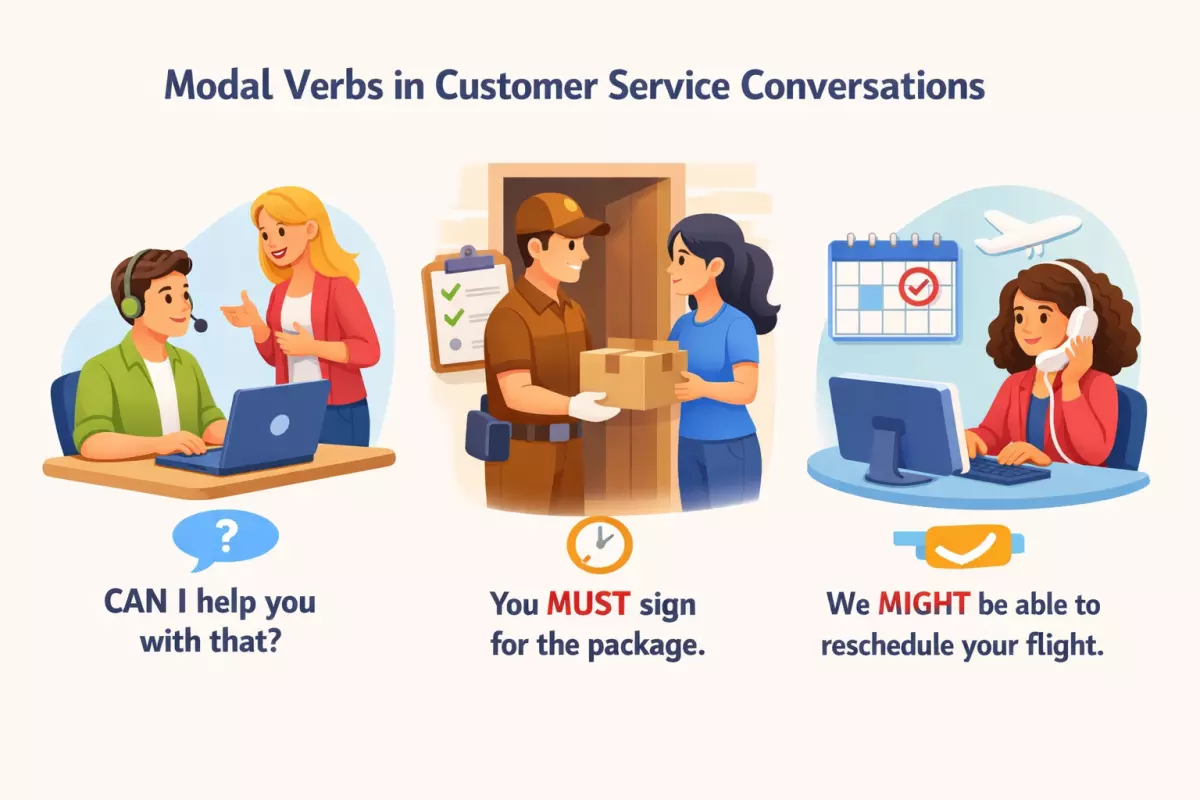 This article explains how modal verbs support polite customer interactions. It covers common modals for offering help, examples using could, may, and would, how they clarify procedures and policies, how tone affects results, when they soften refusals, and practice exercises.
- How modal verbs help create polite customer interactions
- Common modal verbs used when offering assistance to customers
- Examples of service responses using could, may, and would
- How modal verbs clarify procedures or company policies
- How tone influences the effectiveness of service communication
- Situations where modal verbs soften explanations or refusals
- Exercises and practice activities with modal verbs in customer service dialogues
In support chats and calls, the small helper verbs used to ask, offer, or soften requests can shift the mood of an exchange. You hear them when an agent says they can check an order, might suggest a fix, or would like to confirm details. Understanding how these forms signal politeness, certainty, and options helps you sound calm, professional, and genuinely helpful.
How modal verbs help create polite customer interactions
Politeness in service language often comes from reducing directness. Modal verbs help you do that by turning commands into requests, adding options, and signaling respect for the customer’s time and preferences. The key is choosing the right modal for the situation and pairing it with common softening patterns.
Core patterns that sound courteous (and why they work)
- Request instead of command: Use could or would to make the action feel optional. Example: “Could you confirm your order number?” (less forceful than “Confirm your order number.”)
- Offer help without pressure: Use can / could to present assistance as available. Example: “I can help you reset your password.” / “I could walk you through the steps.”
- Polite preference and willingness: Use would to show readiness and respect. Example: “I’d be happy to replace that item.”
- Gentle necessity: Use may need to or might need to to explain requirements without sounding strict. Example: “We may need to verify your address before shipping.”
- Permission and formality: Use may for formal permission and policy language. Example: “You may return the item within 30 days.”
- Soft suggestions: Use might or could to propose a solution without insisting. Example: “You might try clearing your cache first.”
- Careful promises: Use should for expected outcomes (not guarantees). Example: “That should arrive by Friday.”
- Respectful refusals: Use can’t with an alternative using can or could. Example: “I can’t change the billing date, but I can help set up reminders.”
- Conditional politeness: Use “If you could…” or “If you’d like…” to give control to the customer. Example: “If you’d like, I can resend the confirmation email.”
- Question forms for de-escalation: Ask with modals to lower tension. Example: “Could you tell me what error message you see?”
Common modal choices in customer service (with usage notes)
| Modal / pattern | Typical function | Example in a service context |
|---|---|---|
| Could you…? | Polite request (softer than “can you”) | “Could you share the email used for the account?” |
| Would you…? | Polite request, often more formal | “Would you like me to place the order for you?” |
| Can I…? | Offer / checking permission to act | “Can I put you on a brief hold while I check that?” |
| May I…? | More formal permission; careful tone | “May I confirm your shipping address?” |
| I can… / I could… | Offering solutions; “could” sounds less pushy | “I can refund it today.” / “I could also offer store credit.” |
| You can… | Giving options or instructions (can sound blunt if overused) | “You can update your password in Settings.” |
| You might… | Suggestion without insisting | “You might want to restart the app before trying again.” |
| We may need to… | Explaining process requirements politely | “We may need to verify the payment method for security.” |
| It should… | Expected result; avoids absolute promises | “It should sync within a few minutes.” |
Softening add-ons that pair well with modals
- “please” placement: “Could you please confirm…” (natural), not “Please could you…” (less common in many contexts).
- Reason + modal: “Could you confirm your address so I can update the shipment?”
- Time minimizers: “Can I place you on hold for a moment?” / “Could you wait a minute while I check?”
- Choice framing: “Would you prefer a refund, or could I offer a replacement?”
- Hedging for uncertainty: “This might be caused by a browser update.”
Quick corrections: avoiding unintended bluntness
- ✅ “Could you upload a screenshot?” → ❌ “Upload a screenshot.”
- ✅ “May I ask a few questions to troubleshoot?” → ❌ “I need you to answer questions.”
- ✅ “It should arrive tomorrow, but I can check the tracking now.” → ❌ “It will arrive tomorrow.” (too absolute if delays are possible)
- ✅ “I can’t access that information, but I can help you update it.” → ❌ “I can’t do that.” (no alternative offered)
Common modal verbs used when offering assistance to customers
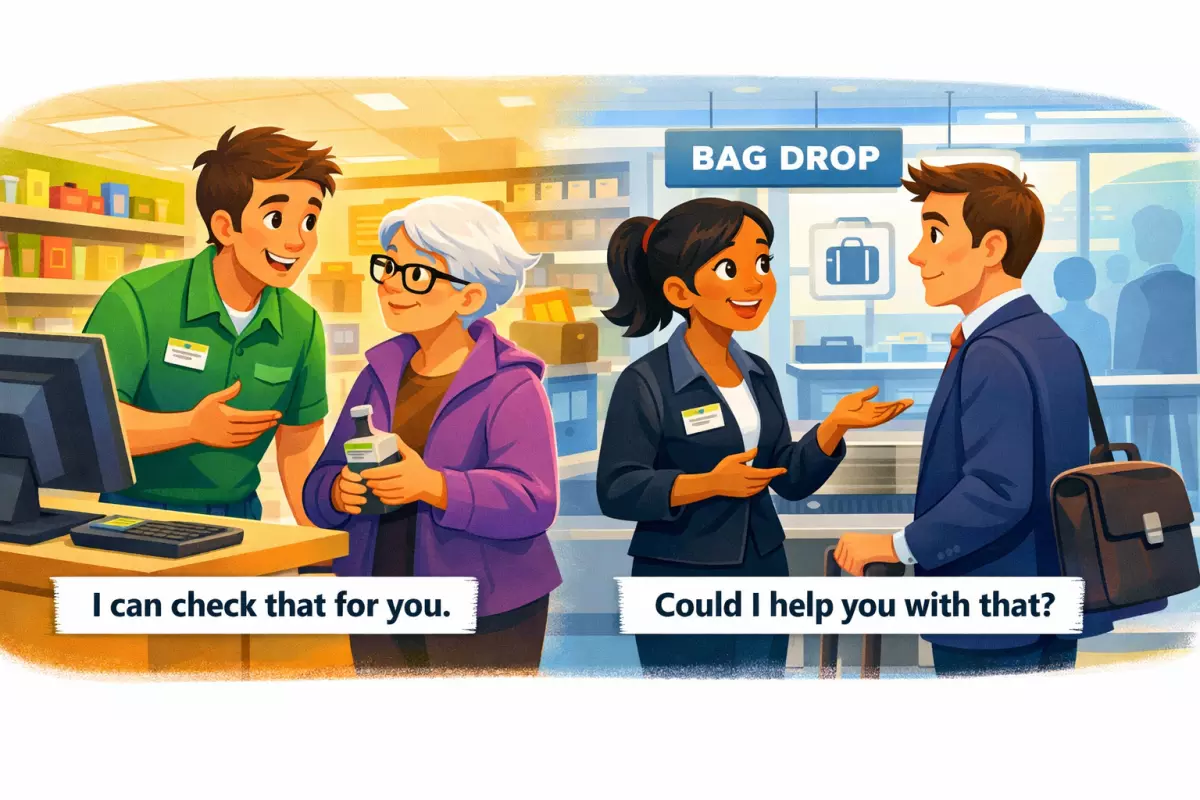
When you offer help in a service interaction, modal verbs let you sound polite, flexible, and clear about what is possible. They also help you control tone: softer for requests, firmer for rules, and more confident for solutions. The patterns below show how modals typically work in customer-facing sentences.
Core modals for offering help (and the patterns they follow)
- Can + base verb: use for ability/possibility and quick, friendly offers. Example: “I can check that for you.”
- Could + base verb: use for more polite or tentative offers, especially in formal support. Example: “I could look into the order history.”
- May + base verb: use for formal permission or careful, respectful offers. Example: “I may be able to refund the shipping fee.”
- Might + base verb: use to signal uncertainty while still being helpful. Example: “We might be able to extend the deadline by one day.”
- Will + base verb: use for firm commitments and next steps. Example: “I will email you the confirmation.”
- Would + base verb: use for polite offers and preferences; common in scripted service language. Example: “I would be happy to replace it.”
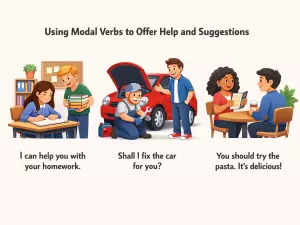
- Shall + base verb (question form): use to propose an action together; sounds more formal or British. Example: “Shall I arrange a callback?”
- Should + base verb: use for recommendations and expected outcomes. Example: “Restarting the app should fix the login issue.”
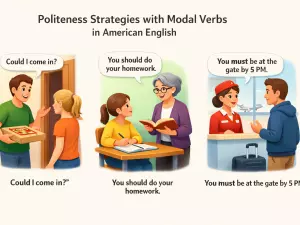
- Must + base verb: use for non-negotiable requirements (policies, safety, legal). Example: “For security, we must verify your identity.”
- Have to + base verb: use for external requirements; often softer than “must” in policy explanations. Example: “We have to confirm the billing address.”
- Need to + base verb: use for necessary steps in a process; practical and neutral. Example: “I need to ask one more question to locate the account.”
- Ought to + base verb: occasional alternative to “should,” but less common in modern support scripts. Example: “That ought to resolve the error.”
Useful sentence frames you can reuse
- Offer + action: “I can + base verb …” / “I can help you + base verb …” (e.g., “I can help you reset your password.”)
- Polite offer: “I could + base verb …” / “I would + base verb …” (e.g., “I could submit a request for you.”)
- Permission-based offer: “May I + base verb …?” (e.g., “May I place you on a brief hold?”)
- Proposal: “Shall I + base verb …?” / “Should we + base verb …?” (e.g., “Should we try a different delivery address?”)
- Recommendation: “You should + base verb …” / “It should + base verb …” (e.g., “It should arrive by Friday.”)
- Requirement with reason: “We must/have to/need to + base verb … because …” (e.g., “We need to confirm the email because the link is account-specific.”)
- Managing expectations: “We might be able to + base verb …” / “This may + base verb …” (e.g., “This may take up to 24 hours to update.”)
Common accuracy points (form and tone)
- Use the base verb after a modal: ✅ “I can check.” ❌ “I can checked.”
- Prefer could/would when you need extra politeness, especially with sensitive issues (fees, delays, errors).
- Reserve must for strict rules; if the goal is to sound cooperative, need to or have to often feels less forceful.
- When you are not sure, use may/might plus a clear next step: “We might be able to replace it; I’ll confirm eligibility now.”
- Pair commitments with will and a timeframe when possible: “I will follow up within two hours.”
Examples of service responses using could, may, and would
In customer support, these modal verbs help you sound polite while still being clear about what you can do, what is allowed, and what you are offering. The most common patterns are: requesting information (Could you…?), asking permission (May I…?), and making offers (Would you like…?).
Quick patterns to copy
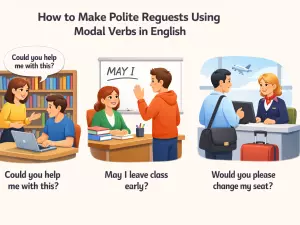
- Could + subject + base verb: “Could you confirm…?” (polite request)
- May + I/we + base verb: “May I place you on hold…?” (formal permission)
- Would + subject + base verb: “Would you like me to…?” (offer or preference)
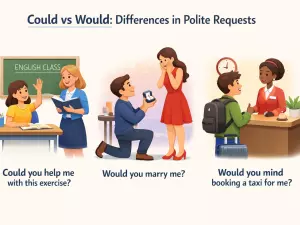
- Would you mind + -ing: “Would you mind sharing a screenshot?” (very polite request)
- Could I + base verb: “Could I verify your email address?” (polite request from the agent’s side)
Service-ready example responses
- Could you share your order number so I can locate the purchase?
- Could you confirm the email address on the account?
- Could you try restarting the app and letting me know what happens?
- Could you tell me the exact error message you’re seeing?
- Could you send a screenshot of the checkout page?
- Could I ask a couple of quick questions to narrow this down?
- May I have your full name as it appears on the account?
- May I place you on a brief hold while I check that for you?
- May I confirm the delivery address before I update the shipment?
- May I suggest a workaround while we investigate the root cause?
- Would you like a refund, or would you prefer a replacement?
- Would you like me to resend the confirmation email?
- Would you like me to walk you through the steps now?
- Would you like us to schedule a call, or continue here in chat?
- Would it be okay if I escalated this to our technical team?
- Would you mind waiting one minute while I review your case notes?
Choosing the right modal for the situation
- Use could to request details or actions without sounding demanding: “Could you verify…?”
- Use may when you need permission or want a more formal tone, especially for holds and account access: “May I put you on hold…?”
- Use would to offer options, ask preferences, or soften proposals: “Would you like…?” / “Would it help if…?”
- When you need to be direct but still polite, pair the modal with a reason: “Could you confirm your address so I can update the label?”
- Avoid over-softening urgent steps; keep the modal but stay specific: “Could you reset your password now to secure the account?”
How modal verbs clarify procedures or company policies
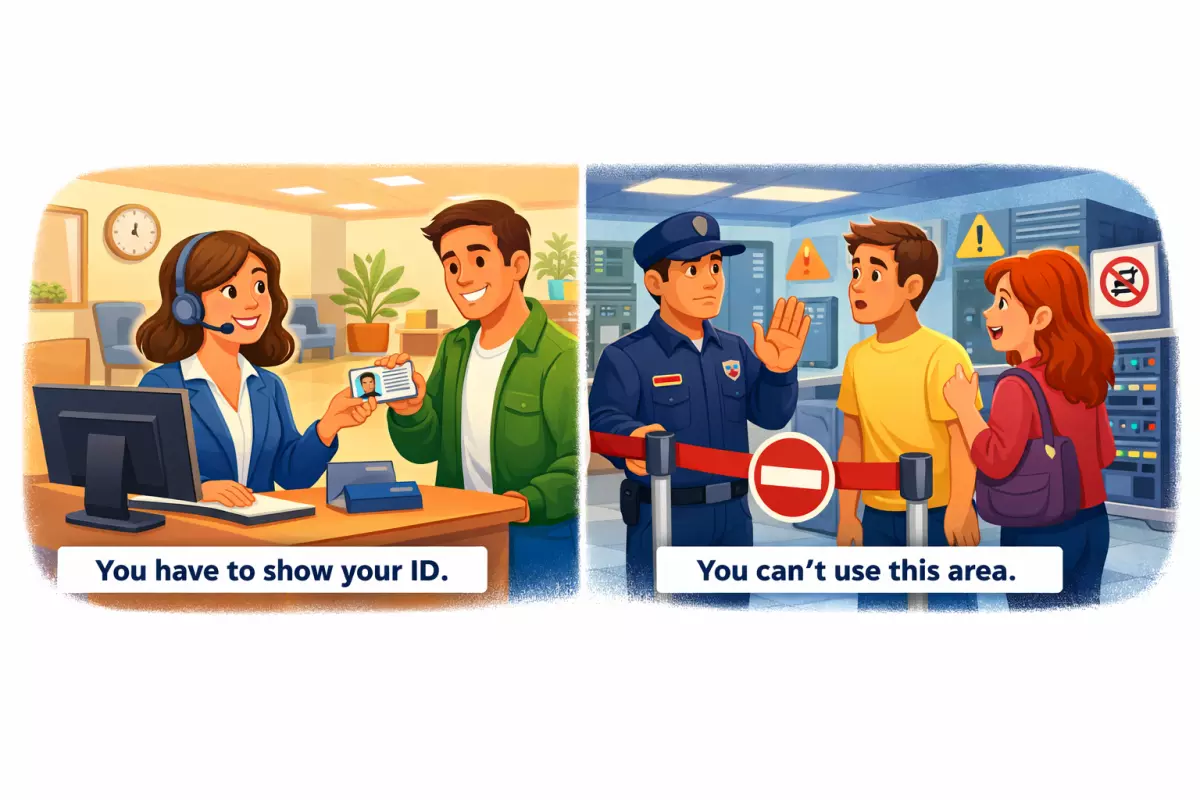
Procedure language works best when it separates what is required, what is allowed, what is recommended, and what is not possible. Modal verbs do that efficiently, especially in customer service where the agent needs to sound clear, consistent, and policy-aligned without sounding abrupt.
Choose the modal that matches the policy level
- Must / have to: use for non-negotiable requirements (legal, security, system rules). Prefer “have to” when you want a slightly softer tone.
- Must not / can’t: use for prohibitions. “Can’t” often feels less accusatory because it points to a constraint rather than a personal refusal.
- Can / may: use for permission and available options. “May” is more formal; “can” is more common in everyday support.
- Should / ought to: use for guidance and best practice, not strict rules. Helpful for troubleshooting steps and prevention tips.
- Will: use for commitments and next steps the company will take (actions, timelines, follow-ups).
- Would: use for conditional commitments and polite offers, especially when a choice or condition is involved.
- Could: use for possible alternatives and “one option is…” language; good for de-escalation and flexibility.
- Might: use for uncertainty and careful predictions (causes, outcomes), avoiding overpromising.
Reliable sentence patterns for policy explanations
- Requirement: “To process the request, we have to verify your account.”
- Prohibition: “For security reasons, we can’t change the email address without verification.”
- Permission: “You can update your billing address in Settings.”
- Limited permission: “You may return the item within 30 days, as long as it’s unopened.”
- Recommendation: “You should restart the app before trying again.”
- Company commitment: “We will email the confirmation once the refund is approved.”
- Conditional commitment: “We would be able to replace it if the warranty is still active.”
- Offering options: “You could choose store credit, or we can refund the original payment method.”
- Explaining constraints: “We can’t access full card details; the system only shows the last four digits.”
- Setting expectations: “The transfer may take up to 24 hours to appear.”
- Clarifying responsibility: “You have to submit the form; we will review it within two business days.”
- Softening a refusal with an alternative: “We can’t waive that fee, but we can help you switch to a plan without it.”
Common policy areas and example phrasing
- Identity checks: “We have to confirm the account owner before making changes.”
- Data privacy: “We can’t share order details with anyone not listed on the account.”
- Refund windows: “You can request a refund within 14 days; after that, we may offer store credit.”
- Returns condition: “Items must be unused and in original packaging.”
- Shipping limits: “We can’t ship to PO boxes for this product.”
- Warranty coverage: “We will repair it if the issue is covered; accidental damage may require a paid service.”
- Account changes: “You can update your phone number, but you have to confirm the one-time code.”
- Promotions: “The discount can be applied once per account; it can’t be combined with other offers.”
- Chargebacks: “If a chargeback is filed, we may pause the investigation until the bank process is complete.”
- Service availability: “We can schedule a technician Monday–Friday; weekend visits may cost extra.”
- Escalations: “I can escalate this to our billing team, and they will respond within 48 hours.”
- Security locks: “After too many attempts, the account will lock and you have to reset the password.”
Accuracy checks to avoid unintended meaning
- ✅ “You can return it within 30 days.” → permission/option
❌ “You must return it within 30 days.” → sounds like an obligation to return - ✅ “We can’t change that setting on our side.” → system constraint
❌ “We won’t change that setting.” → can sound like refusal rather than limitation - ✅ “It may take 24 hours.” → possible delay
❌ “It will take 24 hours.” → fixed promise - ✅ “You should update the app.” → recommendation
❌ “You have to update the app.” → requirement (use only if truly mandatory)
How tone influences the effectiveness of service communication
In customer service, modal verbs do more than express ability or permission; they shape how a message feels. The same policy can sound supportive, neutral, or abrupt depending on the modal you choose, the sentence structure around it, and how directly you address the customer’s goal.
Key tone shifts created by modal choices
- Possibility vs. certainty: ✅ “We can replace it today” feels more decisive than “We might be able to replace it today,” which signals uncertainty and can reduce confidence.
- Permission vs. instruction: “You can reset your password here” reads as enabling; “You must reset your password” reads as a command and can trigger resistance.
- Softening constraints: “We may need a photo of the label” prepares the customer for a requirement without sounding accusatory; “We need a photo” is efficient but can feel blunt if the customer is already frustrated.
- Politeness level: “Could you confirm your order number?” is generally gentler than “Can you confirm…?” and much gentler than “Confirm your order number.”
- Formality and distance: “We would be happy to…” is formal and courteous, but overuse can sound scripted; mixing in clear, direct help (“We can do X next”) keeps the interaction grounded.
- Obligation framing: “You have to” often lands harder than “You need to,” which often lands harder than “You may need to,” even when the practical meaning is similar.
- Customer autonomy: “You can choose a refund or replacement” gives control; “We will issue a refund” is clear but removes choice unless you explicitly offer options.
- Empathy without overpromising: “We can look into this right away” is supportive and safe; “We will fix this today” is reassuring but risky if timelines are uncertain.
Practical patterns that keep tone helpful and clear
- Lead with what is possible, then add limits: “We can exchange the item. We may need the receipt to complete it.” This avoids starting with a barrier.
- Use question forms for customer actions: “Could you share a screenshot?” often gets better cooperation than “You must send a screenshot.”
- Reserve strong obligation modals for true non-negotiables: Use “must” only for legal, safety, or security requirements. For process steps, “need to” or “have to” is usually enough.
- Prefer “can” for capability and “could” for requests: “We can update your address” (agent capability) vs. “Could you confirm the new address?” (customer action).
- Use “would” to offer options, not to hide decisions: “Would you prefer a refund or a replacement?” is clear. Avoid “We would refund you” when you mean “We will refund you,” because it can sound evasive.
- Pair modals with transparent reasons: “We may ask for ID to protect your account” reduces the chance that a requirement feels arbitrary.
- Avoid stacking too many hedges: “We might be able to possibly…” sounds unsure. Choose one hedge when needed: “We may be able to…”
- Keep refusals respectful and specific: Instead of “We can’t do that,” use “We can’t change the billing date, but we can adjust the plan starting today.”
- Use “should” for guidance, not blame: “You should see a confirmation email in 5 minutes” is helpful. Avoid “You should have done this earlier,” which sounds judgmental.
- Choose “will” for next steps you control: “I will escalate this to our shipping team” signals ownership and reduces customer uncertainty.
- Prefer direct negatives over vague ones: “We can’t deliver on Sundays” is clearer than “We may not deliver on Sundays,” which can sound like a choice rather than a constraint.
- Use conditional modals to set expectations: “If the package is marked delivered, we can open an investigation” and “If it’s lost, we could resend it” separates steps without sounding dismissive.
Example rewrites: same content, different tone
- ❌ “You must send photos.” → ✅ “Could you send a couple of photos? That will help us confirm the issue faster.”
- ❌ “We can’t refund.” → ✅ “We can’t refund after 30 days, but we can offer store credit.”
- ❌ “You should check your spam.” → ✅ “You may find it in spam; could you check there and tell me what you see?”
- ❌ “We might fix it soon.” → ✅ “We will update you within 24 hours, and we may need one more detail to proceed.”
- ❌ “You have to wait.” → ✅ “It may take up to 2 business days; I can notify you as soon as it’s ready.”
Situations where modal verbs soften explanations or refusals
In customer support, modals help you sound cooperative even when you must say “no,” set limits, or ask for extra time. They reduce bluntness by framing messages as possibilities, constraints, or polite requests rather than commands or final judgments. Common softeners include could, would, may, might, can, and should, often paired with short reasons and a next step.
Common scenarios and useful modal patterns
- Requesting missing information
Patterns: “Could you share…?”, “Would you mind confirming…?”, “Can you send…?”
Example: “Could you share the order number so I can locate the shipment?” - Asking the customer to try a step
Patterns: “Could you try…?”, “Would you be able to…?”, “Can you check…?”
Example: “Could you try restarting the app and signing in again?” - Explaining a limitation without sounding dismissive
Patterns: “We may not be able to…”, “We might not have access to…”, “We can’t currently…” (softened with reason + option)
Example: “We may not be able to edit the invoice after it’s issued, but we can add a note for your records.” - Refusing a request while offering alternatives
Patterns: “We can’t…, but we can…”, “We wouldn’t be able to…, however we could…”
Example: “We can’t extend the warranty past two years, but we could apply a discount on the repair.” - Setting boundaries and policy constraints
Patterns: “We can only…”, “We’re only able to…”, “We would need to…”
Example: “We can only ship to the billing address for this payment method.” - Giving cautious timelines
Patterns: “It should take…”, “It may take up to…”, “It could be ready by…”
Example: “It may take up to 24 hours for the change to appear in your account.” - Managing expectations with uncertainty
Patterns: “This might be caused by…”, “It could be related to…”, “It may happen if…”
Example: “This might be caused by a cached setting, so clearing the browser data could help.” - Making recommendations without sounding pushy
Patterns: “You might want to…”, “You could…”, “It may help to…”
Example: “You could enable two-factor authentication to prevent future lockouts.” - Offering options and letting the customer choose
Patterns: “We could… or we could…”, “Would you prefer…?”, “You can either…”
Example: “We could resend the item, or we could issue a refund—what would you prefer?” - Requesting patience during investigation
Patterns: “Could you give me…?”, “Would you mind waiting…?”, “May I have a moment to…?”
Example: “May I have a moment to check this with our billing team?” - De-escalating when a customer is upset
Patterns: “I can understand…”, “We’d like to…”, “We can look into…”
Example: “I can understand why that’s frustrating; we can look into what happened and update you.” - Clarifying what you can do now vs. later
Patterns: “I can… today, and I can… once…”, “We could… after…”
Example: “I can reset the account now, and we can restore access once you confirm the email address.” - Asking for permission before taking an action
Patterns: “May I…?”, “Could I…?”, “Would it be okay if I…?”
Example: “Would it be okay if I cancel this order and place a new one with the correct address?” - Delivering bad news with a reason + path forward
Patterns: “We may not be able to…, because…”, “We can’t…, due to…, but we can…”
Example: “We can’t reinstate the expired promotion because it ended last week, but we can apply the current offer.” - Correcting misinformation politely
Patterns: “It may look like…, but…”, “You might be seeing…, however…”
Example: “It may look like you were charged twice, but one entry is a pending authorization that should drop off.”
Practical usage notes (what to pair with the modal)
- Add a brief reason after the modal to avoid sounding evasive: “We can’t change it because the payment is already captured.”
- Offer a next step to keep momentum: “We may not be able to replace it, but we could repair it or issue store credit.”
- Choose the right strength: “can’t” (firm limit), “may not be able to” (policy/technical constraint), “might” (uncertainty), “should” (expected outcome).
- Avoid accidental bluntness by softening imperatives: ❌ “Send a screenshot.” → ✅ “Could you send a screenshot?”
Exercises and practice activities with modal verbs in customer service dialogues
Build accuracy by practicing common service patterns: offering help (can, may), making polite requests (could, would), stating rules (must, have to), and proposing solutions (might, should). Focus on form (modal + base verb) and on tone (direct vs. softened).
1) Quick pattern drills (complete the line)
Fill in each blank with one modal (can, could, may, might, must, should, would, have to). Use each sentence’s context to choose the best fit.
- ________ I have your order number, please?
- You ________ restart the device to complete the update.
- We ________ offer a replacement if the item arrived damaged.
- ________ you like me to email the receipt or send it by SMS?
- Guests ________ check out by 11 a.m. due to housekeeping schedules.
- I ________ be able to apply a discount if you’re within the return window.
- To protect your account, you ________ verify your identity.
- ________ you hold for a moment while I check that for you?
- You ________ try clearing your browser cache; it often fixes this error.
- ________ I place you on a brief hold?
- We ________ not share your details without your consent.
- ________ you confirm the delivery address?
Show answers
- Could
- must / have to
- can
- Would
- must / have to
- might
- must / have to
- Could
- should
- May
- must
- Could
2) Politeness tuning (rewrite without changing meaning)
Rewrite each line to sound more customer-friendly by adjusting the modal. Keep the meaning as close as possible.
- Give me your email address.
- Wait.
- You need to pay now.
- I can’t help with that.
- Send a photo of the damage.
- Explain the issue again.
- We will not refund opened items.
- Tell me your booking code.
Show answers
- Could you share your email address, please?
- Could you hold for a moment, please?
- You’ll need to pay now / You may need to pay now to proceed.
- I’m afraid I may not be able to help with that, but I can suggest an alternative.
- Could you send a photo of the damage, please?
- Could you explain the issue again so I can assist you better?
- We can’t refund opened items / We’re unable to refund opened items.
- Could you tell me your booking code, please?
3) Choose the best option (tone + policy)
Select the option that fits the situation (polite, clear, and accurate). Only one is best.
- Asking permission to put a customer on hold:
- A) I put you on hold now.
- B) May I place you on a brief hold?
- C) You must wait.
- Stating a non-negotiable security requirement:
- A) You might verify your identity.
- B) You should verify your identity if you want.
- C) You must verify your identity to access the account.
- Offering a possible solution (not guaranteed):
- A) This will fix it.
- B) Clearing your cache might fix it.
- C) You have to clear your cache.
- Making a polite request for information:
- A) Give me your postcode.
- B) Could you confirm your postcode, please?
- C) You must tell me your postcode.
Show answers
- B
- C
- B
- B
4) Dialogue build (insert one modal phrase per line)
Add one suitable modal phrase to complete each turn. Keep the conversation natural for a service desk or call center.
- Agent: Hello! ________ I help you today?
- Customer: My package hasn’t arrived.
- Agent: I’m sorry about that. ________ you share your tracking number?
- Customer: Sure, it’s 55821.
- Agent: Thanks. You ________ see an update within 24 hours, but I’ll also contact the carrier.
- Customer: I need it urgently.
- Agent: I understand. We ________ be able to upgrade the shipping at no cost if it’s delayed.
- Customer: Okay.
- Agent: ________ I confirm your delivery address before I submit the request?
- Customer: Yes, it’s 18 Oak Street.
Show answers
- Can
- Could
- should
- might
- May
5) Error check (spot and fix the modal pattern)
Correct each sentence. Watch for the most common issue: using “to” or -ing after a modal, or using the wrong strength (rule vs. suggestion).
- ❌ You must to sign here.
- ❌ Could you to repeat that?
- ❌ We might can replace it.
- ❌ You should to update the app.
- ❌ May you send me the invoice?
- ❌ You have to verifying your email.
- ❌ I would like help you with that.
- ❌ We mustn’t to share passwords.
Show answers
- ✅ You must sign here.
- ✅ Could you repeat that?
- ✅ We might be able to replace it.
- ✅ You should update the app.
- ✅ Could you send me the invoice? / Would you send me the invoice?
- ✅ You have to verify your email.
- ✅ I would like to help you with that.
- ✅ We mustn’t share passwords.
6) Useful modal bundles to recycle in service talk
- Could you + base verb…? (Could you confirm your address?)
- Would you + base verb…? (Would you like a refund or an exchange?)
- May I + base verb…? (May I place you on hold?)
- Can I + base verb…? (Can I check that for you?)
- You must + base verb… (You must show a valid ID.)
- You have to + base verb… (You have to reset your password to continue.)
- You should + base verb… (You should update the app for the latest fixes.)
- This might + base verb… (This might resolve the error.)
- I might be able to + base verb… (I might be able to extend the deadline.)
- We can + base verb… (We can resend the confirmation email.)
- We can’t + base verb… (We can’t change the name after ticketing.)
- Would you like me to + base verb…? (Would you like me to open a case?)
- Could I ask you to + base verb…? (Could I ask you to restart the router?)
- You don’t have to + base verb… (You don’t have to print anything.)
- We may need to + base verb… (We may need to escalate this to billing.)