Using Modal Verbs to Offer Help and Suggestions

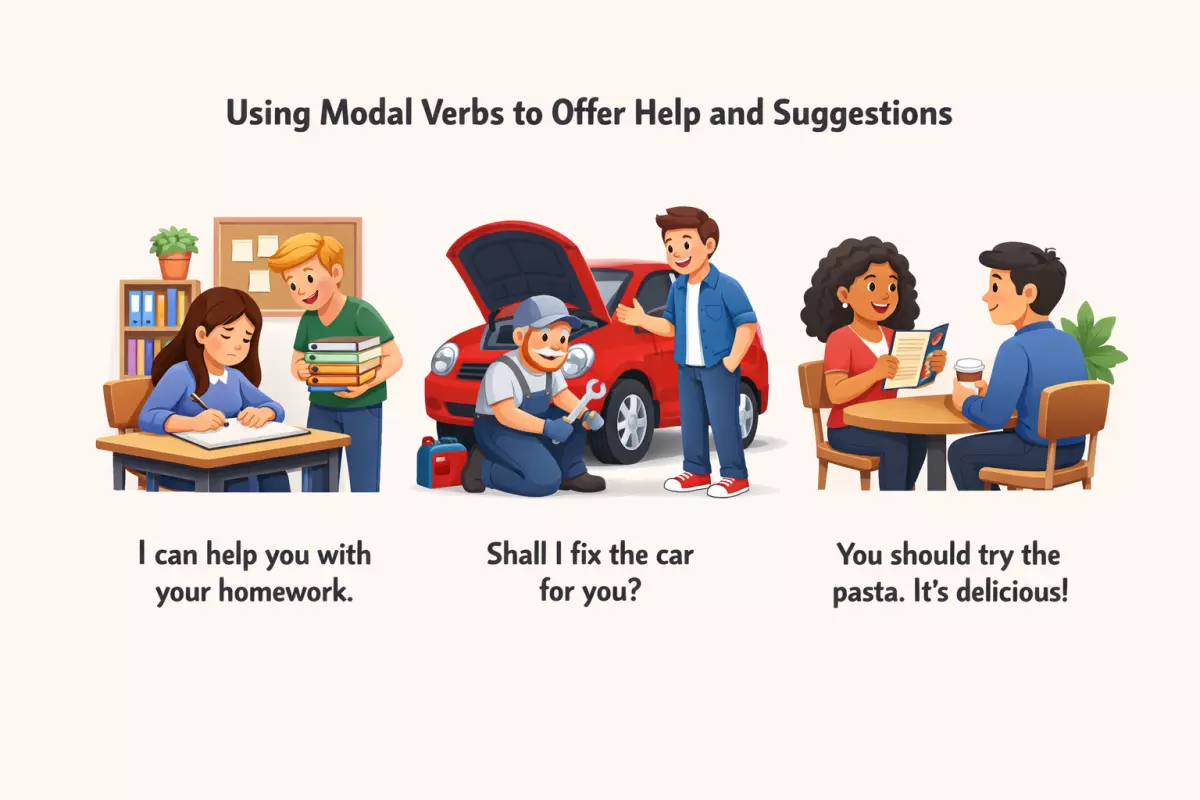 Learn how modal verbs help you offer assistance politely, use common suggestion phrases, and see how can, could, and shall change tone. Get everyday examples, when indirect hints work best, plus exercises and practice activities to improve.
- How modal verbs allow speakers to offer help politely
- Common expressions used when suggesting actions to others
- How can, could, and shall appear in offers and suggestions
- Examples of offering help in everyday communication
- How tone changes depending on the modal verb chosen
- Situations where speakers prefer indirect suggestions
- Exercises and practice activities using modal verbs for offers and suggestions
Modal verbs are small but powerful words that shape how your English sounds when you offer help or give advice. In everyday conversations, they let you choose between a direct suggestion and a softer, more polite approach, so you sound confident without being pushy. We will practise using can, could, should, and might to make your offers and recommendations feel natural and clear.
How modal verbs allow speakers to offer help politely
Polite offers often depend on two things: giving the other person control (so they can say no easily) and sounding tentative rather than forceful. Modal verbs do this by softening the message, turning a direct action into a question, and signaling willingness instead of obligation.
Core patterns for offering help
- Can + I/we + verb? Use for friendly, straightforward offers in everyday situations: “Can I carry that for you?”
- Could + I/we + verb? More formal or more gentle than can: “Could I help you with those boxes?”
- Shall + I + verb? Common in British English for offers and suggestions: “Shall I open the window?”
- Would you like + noun/to + verb? Focuses on the other person’s preference: “Would you like some help?” / “Would you like me to check it?”
- Would + you like + me/us + to + verb? A clear offer of action, often service-oriented: “Would you like me to email the details?”
- Should I + verb? Useful when the offer is based on what seems appropriate: “Should I call a taxi for you?”
- May + I + verb? Very formal/polite, often for permission-based help: “May I assist you with your luggage?”
- Could + you + verb? This is a polite request (not an offer), but it’s often paired with an offer to collaborate: “Could you send the file? I can review it today.”
Choosing the right modal: tone and distance
- Can sounds direct and warm; it fits quick, practical help with people you know.
- Could adds distance and respect; it works well with strangers, customers, or sensitive situations.
- Would is ideal when you want to emphasize choice and comfort: it frames help as an option, not pressure.
- Shall is natural for immediate, small actions you can do right now (especially in UK contexts).
- May is best for formal settings where politeness conventions are strong (reception desks, ceremonies, official interactions).
Useful example offers (ready to reuse)
- Can I give you a hand with that?
- Could I help you set this up?
- Would you like me to explain the next step?
- Would you like some help finding the right file?
- Shall I book a table for you?
- Should I message them and confirm?
- May I assist you with your coat?
- Could I get you some water?
- Can I walk you to the station?
- Would you like me to double-check the numbers?
- Could I take a look at the error message?
- Shall I send a quick summary after the meeting?
- Would you like me to handle the call?
- Can I help you carry those upstairs?
- Could I show you where to click?
- Should I print a copy for you?
Common usage notes (what makes it sound polite)
- Use questions to reduce pressure: ✅ “Could I help?” ❌ “I will help.” (can sound too decided).
- Add softeners when needed: “just,” “a bit,” “quickly,” “if you’d like,” “if that helps.” Example: “I could just proofread it, if you’d like.”
- Offer a specific action instead of a vague “Let me know”: “I can draft the email” is easier to accept than “Tell me if you need anything.”
- Avoid must and other obligation language when offering support: “You must let me help” often feels pushy.
- Make refusal easy with an “out”: “I can stay a little longer, but no worries if you’re all set.”
Common expressions used when suggesting actions to others

When you recommend a next step, modal verbs help you sound appropriately direct, polite, or tentative. The patterns below show common ways to propose actions, from gentle hints to stronger advice, along with typical grammar that follows each expression.
Core modal patterns for suggestions
- Could + base verb (soft option): “You could try restarting the app.”
- Can + base verb (practical possibility): “You can check the settings menu.”
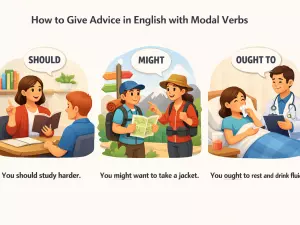
- Should + base verb (clear recommendation): “You should back up your files first.”
- Ought to + base verb (similar to should, slightly formal): “You ought to tell them in advance.”
- Might want to + base verb (cautious, polite): “You might want to confirm the time.”
- May want to + base verb (more formal): “You may want to review the terms.”
- Would + base verb (gentle guidance, often in questions): “Would it help to write it down?”
- Wouldn’t + base verb (suggestion framed as a question): “Wouldn’t it be better to email them?”
Suggestion questions (useful for polite tone)
- Could you + base verb…? “Could you send a screenshot?”
- Can you + base verb…? “Can you try again in a few minutes?”
- Would you + base verb…? “Would you like to reschedule?”
- Should we + base verb…? “Should we meet earlier?”
- Could we + base verb…? “Could we move this to tomorrow?”
- Why don’t we + base verb…? “Why don’t we split the tasks?”
- How about + -ing / noun…? “How about taking a short break?”
- What about + -ing / noun…? “What about a quick call?”
Common fixed expressions with modal-style meaning
- Let’s + base verb (inclusive, friendly): “Let’s look at the first example.”
- You’d better + base verb (strong warning/advice): “You’d better save your work.”
- If I were you, I’d + base verb (advice from your perspective): “If I were you, I’d ask for clarification.”
- It might be a good idea to + base verb (careful suggestion): “It might be a good idea to update your password.”
- You’re going to need to + base verb (practical necessity): “You’re going to need to bring an ID.”
Usage notes and common pitfalls
- Use the base verb after modals: ✅ “You should call them.” ❌ “You should to call them.”
- Use “ought to” (not “ought” + base verb): ✅ “You ought to check.” ❌ “You ought check.”
- Choose strength carefully: could/might sound optional; should/ought to sound like advice; had better can sound urgent or threatening in some contexts.
- Prefer questions to reduce pressure: “Could we…?” and “Would you…?” often feel more cooperative than “You should…”.
How can, could, and shall appear in offers and suggestions
These modals help you shape an offer or suggestion by changing the level of politeness, directness, and who controls the next step. They often appear in short question forms, but they can also be used in statements that introduce a proposed action.
1) Using can: practical, direct offers
Can is common when the speaker is ready and able to help. It sounds straightforward and is typical in everyday conversation, customer service, and quick planning.
- Can I + verb? to offer help: “Can I carry that for you?”
- Can I + verb + for you? to focus on the listener’s benefit: “Can I book a table for you?”
- Can we + verb? to suggest a joint action: “Can we meet after lunch?”
- You can + verb to suggest an option (permission/possibility): “You can try restarting your phone.”
- Can I just + verb? to soften a quick action: “Can I just check one detail?”
- Can I help you (with…)? as a set offer: “Can I help you with your bags?”
2) Using could: more polite, more tentative suggestions
Could usually sounds more courteous or less forceful than can. It is useful when you want to avoid sounding pushy, when the listener may say no, or when you are proposing an idea rather than taking immediate action.
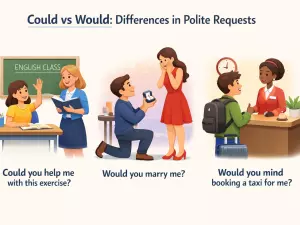
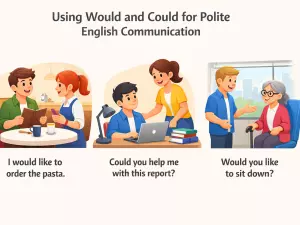
- Could I + verb? to offer politely: “Could I help you with that?”
- Could I + verb + for you? for service-style offers: “Could I arrange a taxi for you?”
- Could we + verb? to suggest a plan gently: “Could we move the meeting to Friday?”
- You could + verb to suggest one possible solution: “You could email the support team.”
- We could + verb to float an idea without commitment: “We could take the train instead.”
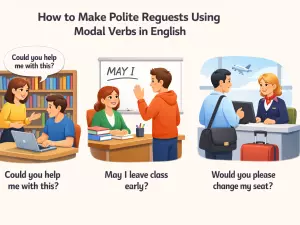
- Could you + verb? is a request, not an offer: “Could you send me the file?” (useful to contrast forms)
3) Using shall: formal or “let’s decide” offers
Shall is most common in questions that invite the listener to choose the next step. It can sound formal, traditional, or very organized. In many varieties of English, it appears more in set phrases and in more formal contexts than in casual speech.
- Shall I + verb? to offer and ask for a decision: “Shall I open the window?”
- Shall we + verb? to propose a shared action (often like “let’s”): “Shall we start?”
- Shall I + verb + for you? to offer a specific service: “Shall I call reception for you?”
- Shall we + verb + now/today? to move the plan forward: “Shall we review the draft now?”
- Shall can sound too formal in very casual situations; many speakers switch to can or could instead.
Common patterns and quick accuracy notes
- Offer (speaker acts): “Can I…?”, “Could I…?”, “Shall I…?”
- Suggestion (shared plan): “Can we…?”, “Could we…?”, “Shall we…?”
- Suggestion (listener’s option): “You can…”, “You could…”
- ✅ “Shall we begin?” → shared decision; ❌ “Shall you begin?” (usually sounds like an order, not a friendly suggestion)
- ✅ “You could try updating the app.” → one idea; “You can try…” often sounds more confident that it will work.
- In short answers, these modals can stand alone: “Shall we?” / “Could we?” / “Can I?” when the main verb is understood from context.
Examples of offering help in everyday communication

When you offer assistance or make a suggestion, modal verbs help you choose the right level of politeness, confidence, and pressure. The most common patterns are questions for offering help (Can I…?, Shall I…?), indirect offers (Would you like me to…?), and gentle suggestions (You could…, You might want to…).
Common offer and suggestion patterns
- Can I + verb…? “Can I carry that for you?” (friendly, direct)
- Could I + verb…? “Could I help you with those boxes?” (more polite, slightly softer)
- Shall I + verb…? “Shall I open the window?” (often used when you’re ready to act)
- Would you like me to + verb…? “Would you like me to email the notes?” (very polite, gives the other person control)
- Do you want me to + verb…? “Do you want me to call a taxi?” (casual, can sound blunt in formal settings)
- I can + verb… “I can pick you up after work.” (offers a concrete solution)
- I could + verb… “I could stay a bit later if that helps.” (tentative; leaves room to decline)
- I’ll + verb… “I’ll print a copy for you.” (decisive; use when you’re sure it’s welcome)
- You can + verb… “You can use my charger.” (permission/availability; sounds practical)
- You could + verb… “You could try restarting your phone.” (suggestion, not a command)
- You might want to + verb… “You might want to save a backup first.” (gentle warning + advice)
- We can + verb… “We can split the task if you want.” (collaborative offer)
- We could + verb… “We could meet earlier to avoid traffic.” (proposal for planning)
- Maybe we should + verb… “Maybe we should ask for clarification.” (soft recommendation)
- Should I + verb…? “Should I book the tickets now?” (checks preference before acting)
- Could you + verb…? “Could you send me the file, and I can format it?” (pairs a request with an offer)
Everyday mini-dialogues (how the modals work in context)
- At home: “Shall I do the dishes?” → “Thanks, that would be great.”
- With a friend: “Do you want me to come with you?” → “Yeah, if you’re free.”
- At work: “Would you like me to draft the reply?” → “Yes, please—keep it short.”
- Customer service: “How can I help you today?” → “Could you tell me how to reset my password?”
- Tech help: “You could clear the cache first.” → “Good idea, I’ll try that.”
- Planning: “We could take the earlier train.” → “That might be safer.”
- Polite check: “Should I leave this here?” → “Yes, that’s fine.”
- Offering a choice: “I can drive, or we could take a taxi.” → “Let’s take a taxi.”
Small usage notes to keep offers natural
- Use could and would to sound less forceful: “I could help” / “Would you like me to…?”
- Use shall I when you’re ready to do it now: “Shall I turn it down?”
- Avoid sounding pushy by adding a choice: “I can help if you want.” / “We could, but it’s up to you.”
- For advice, prefer could or might want to over commands: ✅ “You could update the app.” ❌ “Update the app.”
How tone changes depending on the modal verb chosen
The modal you choose signals how direct, polite, tentative, or authoritative your offer of help or suggestion will sound. Some modals feel collaborative and low-pressure, while others sound more like instructions or firm recommendations. Paying attention to form (question vs. statement, negatives, and softeners) helps you match the level of urgency and social distance.
| Modal verb | Typical tone | Common patterns for help/suggestions | Example |
|---|---|---|---|
| can | Friendly, practical, fairly direct | Can I + verb…? / You can + verb… | Can I carry that for you? |
| could | More polite and less forceful than can | Could I + verb…? / You could + verb… | You could email them first to confirm. |
| may | Formal, respectful, distant | May I + verb…? / You may want to + verb… | May I help you with your bags? |
| might | Very tentative; “just an idea” | You might + verb… / You might want to + verb… | You might want to back up the file first. |
| should | Advice with expectation; moderately strong | You should + verb… / Should I + verb…? | You should talk to your manager before Friday. |
| ought to | Similar to should; slightly formal, moral/“duty” feel | You ought to + verb… | You ought to label these boxes to avoid confusion. |
| would | Polite, service-oriented; less direct than will | Would you like me to + verb…? / I’d + verb… | Would you like me to set up the meeting? |
| will | Confident, decisive; can sound firm | I’ll + verb… / I will + verb… | I’ll send you the updated version today. |
| shall | Formal; cooperative planning (especially in questions) | Shall I + verb…? / Shall we + verb…? | Shall I book a table for 7? |
| must | Very strong; obligation; can feel pushy in suggestions | You must + verb… (use carefully) | You must submit the form by noon. |
Choosing a modal based on how much pressure you want to apply
- Low pressure (idea-sharing): Use might or could when you want to leave room for the other person to decide. Example: “You could try restarting it.”
- Neutral, helpful (everyday offers): Use can for simple, practical help. Example: “I can print that for you.”
- Polite service tone (customer-facing): Use would for offers and preferences. Example: “Would you like me to wrap it?”
- Clear advice (you expect agreement): Use should when the speaker believes it’s the best option. Example: “You should update your password.”
- Authority/obligation (rules, deadlines): Use must mainly for requirements, not casual suggestions. Example: “You must wear a badge in this area.”
Pattern choices that soften or strengthen the tone
- Questions sound less imposing than statements: “Could I help?” often feels gentler than “I can help.”
- “Would you like…?” focuses on the listener’s preference: “Would you like me to call them?” avoids assuming help is wanted.
- “You may want to…” reduces directness: It frames advice as an option, not an order. Example: “You may want to save a copy.”
- “I can…” offers ability; “I’ll…” signals commitment: “I can look into it” (availability) vs. “I’ll look into it” (decision made).
- Adding a reason supports stronger modals: “You should leave now because traffic is heavy” sounds more cooperative than “You should leave now” alone.
- Negative forms can sound warning-like: “You shouldn’t click that link” is protective advice; “You can’t click that link” sounds like a restriction.
- Conditional framing reduces pressure: “If you’d like, I can…” or “If it helps, you could…” keeps the suggestion optional.
- “Shall I…?” is formal but collaborative: It often fits planning and logistics: “Shall I draft the email?”
Common mismatches to avoid
- ❌ “You must try this feature.” (often too forceful for a suggestion) → ✅ “You could try this feature.”
- ❌ “May you send me the file?” (unnatural for requests) → ✅ “Could you send me the file?”
- ❌ “Can you like me to…?” (wrong structure) → ✅ “Would you like me to…?”
- ❌ “You might to restart.” (incorrect infinitive) → ✅ “You might restart.” / “You might want to restart.”
Situations where speakers prefer indirect suggestions
Speakers often choose a softer, less direct way to offer help when they want to protect the listener’s autonomy, avoid sounding bossy, or keep the conversation polite. In these contexts, modal verbs such as could, might, would, and may let you frame advice as an option rather than a command.
Common contexts where indirect phrasing works best
- When you have less authority (peer-to-peer or speaking “up” to a manager): use possibility language.
- “We could try a shorter agenda.”
- “You might want to loop in Finance.”
- When the topic is sensitive (health, money, performance, personal habits): avoid implying judgment.
- “You might feel better if you took a break.”
- “It may help to set a budget for the month.”
- When the listener may feel defensive (after criticism, during conflict): reduce pressure with conditional forms.
- “It might be easier if we start with the main issue.”
- “We could look at another approach.”
- When you are not fully sure (limited information, incomplete context): show uncertainty honestly.
- “This might be a settings issue.”
- “You could check the latest version notes.”
- When you want to be tactful in writing (email, chat, tickets): indirect modals sound less abrupt than imperatives.
- “You could attach a screenshot so we can troubleshoot.”
- “We might need a bit more detail to proceed.”
- When you’re offering help, not taking control: frame your support as available, not imposed.
- “I could help you draft the first paragraph, if you’d like.”
- “I would be happy to review it before you send it.”
- When the other person is busy or stressed: keep the suggestion light and optional.
- “We could postpone this until tomorrow.”
- “You might want to take five minutes before the next call.”
- When you’re proposing a change to someone else’s work: respect ownership by using collaborative language.
- “We could reorganize this section for clarity.”
- “You might consider adding one example.”
- When you need cooperation (requests that depend on the listener): indirect forms sound less like orders.
- “Could you send the file when you have a moment?”
- “Would you be able to confirm the time?”
- When you are correcting someone (errors, misunderstandings): soften the correction to keep rapport.
- “You might have the dates swapped.”
- “It may be better to cite the original source.”
- When you want to avoid sounding absolute (opinions, preferences): modals keep space for disagreement.
- “We could start with the simplest option.”
- “It might be worth testing both versions.”
- When you’re speaking to strangers or in formal settings: polite distance matters.
- “You may want to take a seat while you wait.”
- “We could schedule a follow-up appointment.”
Useful patterns that keep suggestions indirect
- Modal + base verb: “You could try restarting.” / “We might postpone.”
- Modal question (more polite): “Could you…?” / “Would you like to…?”
- It might be better to… (gentle evaluation): “It might be better to email them first.”
- You might want to… (common spoken advice): “You might want to save a copy.”
- Would it help if…? (support-focused): “Would it help if I took notes?”
- We could… (collaborative): “We could split the tasks.”
- If you’d like / if you want (adds choice): “I could join the call, if you’d like.”
- Maybe + clause (very soft): “Maybe we can meet earlier.”
Exercises and practice activities using modal verbs for offers and suggestions
Use the activities below to build accuracy with common patterns for offering help and making suggestions. Focus on form (modal + base verb), level of directness, and how context changes what sounds natural.
1) Choose the best modal (offers vs. suggestions)
- Your colleague looks busy. You say: “I ____ finish the report if you want.” (can / should)
- A friend has a headache. You say: “You ____ take a break and drink some water.” (could / will)
- You’re at the door with heavy bags. You ask: “____ you open the door for me?” (Could / Must)
- You’re hosting. You say: “I ____ get you some tea.” (might / could)
- Your teammate is stuck. You say: “We ____ try a different approach.” (could / must)
- You want to be polite to a customer. You ask: “____ I help you with that?” (May / Should)
- A friend is late often. You say: “You ____ set an alarm.” (should / can)
- You’re unsure but offering help. You say: “I ____ give you a ride, if that helps.” (can / will)
- You want to propose an idea gently. You say: “We ____ meet earlier to avoid traffic.” (could / have to)
- You promise help. You say: “Don’t worry—I ____ handle it.” (will / might)
Show answers
- can
- could
- Could
- could
- could
- May
- should
- can
- could
- will
2) Rewrite to change the tone (more polite, less direct, more confident)
Rewrite each sentence using the instruction in brackets. Keep the meaning as close as possible.
- “Open the window.” (make it a polite request with a modal)
- “I’ll carry that for you.” (make it a softer offer, not a promise)
- “You need to talk to your manager.” (make it a suggestion, not an obligation)
- “Give me your email.” (make it more formal and polite)
- “We are meeting at 9.” (change it into a suggestion)
- “I can’t help.” (change it into a conditional offer if you have time)
- “Try restarting the router.” (make it sound less certain)
- “Do it now.” (make it a polite request)
Show answers
- Could you open the window, please?
- I could carry that for you, if you like.
- You could talk to your manager.
- Could I have your email, please?
- We could meet at 9.
- I could help if I have time.
- You might try restarting the router.
- Could you do it now, please?
3) Spot and fix the pattern errors (modal + base verb)
Each sentence has one issue with form or appropriateness. Correct it.
- ❌ “I can to help you with your luggage.”
- ❌ “You should to see a doctor.”
- ❌ “May you help me?” (in a service setting, you are offering help)
- ❌ “We could to meet after lunch.”
- ❌ “Could you helping me for a second?”
- ❌ “I will can do it later.”
- ❌ “You might to try resetting your password.”
- ❌ “Should you open the window?” (you want to offer to do it)
- ❌ “Can I to get you anything?”
- ❌ “You could speaking to HR.”
Show answers
- ✅ “I can help you with your luggage.”
- ✅ “You should see a doctor.”
- ✅ “May I help you?”
- ✅ “We could meet after lunch.”
- ✅ “Could you help me for a second?”
- ✅ “I can do it later.” or “I will do it later.”
- ✅ “You might try resetting your password.”
- ✅ “Shall I open the window?” or “I can open the window.”
- ✅ “Can I get you anything?”
- ✅ “You could speak to HR.”
4) Build your own offers and suggestions (guided prompts)
Write one sentence for each situation. Use the modal in brackets and add a natural ending (for example: “if you’d like,” “if that helps,” “maybe,” “instead”).
- Your friend is searching for a document. (can)
- A coworker is new and looks confused. (could)
- Someone is carrying boxes. (shall)
- Your guest looks cold. (can)
- A classmate is stressed about an exam. (might)
- Your team is behind schedule. (should)
- A customer is waiting. (may)
- Your sibling can’t decide what to eat. (could)
- You want to help but you’re not sure you’re available. (might)
- You want to volunteer for a task in a meeting. (can)
5) Quick pattern bank (use as a checklist while practicing)
- Offer (volunteering): “I can + base verb …” / “I could + base verb …” / “Shall I + base verb …?”
- Offer (asking permission to help): “May I + base verb …?” / “Can I + base verb …?”
- Request for help: “Could you + base verb …?” / “Can you + base verb …?”
- Suggestion (gentle): “You could + base verb …” / “We could + base verb …”
- Suggestion (tentative): “You might + base verb …” / “We might + base verb …”
- Advice (stronger): “You should + base verb …”
- Confident promise: “I’ll + base verb …” (use when you intend to do it)
- Common add-ons: “if you want,” “if you’d like,” “if that helps,” “maybe,” “instead,” “for a moment”
- Form reminder: modal + base verb (❌ “to help,” “helping,” “helped” after a modal)
- Politeness lever: could/might (softer) → can/should (more direct) → will (commitment)