Abstract Noun Collocation Families (research, progress, access)

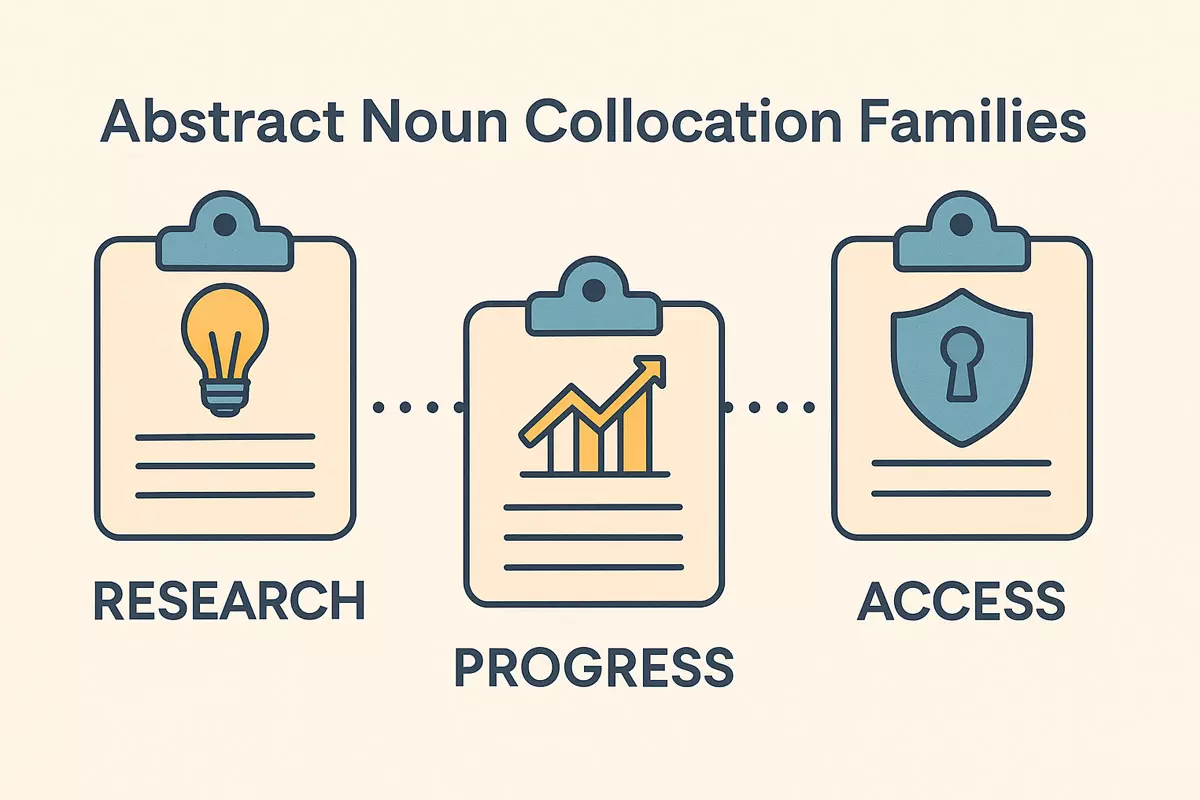 The article explains what abstract nouns are, why collocations matter, and which verbs, adjectives, and prepositions commonly pair with research, progress, and access. It also offers tips and practice for expanding effective academic collocations.
- What abstract nouns are and why they matter
- Collocation idea: which words naturally go together
- Research: common verb, adjective, and preposition partners
- Progress: make, show, measure, track, significant progress
- Access: gain, provide, limit, deny, improve access
- How collocation families support academic style
- Avoiding odd or literal combinations with abstract nouns
- Practice: expand collocation tables and write sample sentences
Examining how abstract ideas such as research, progress, and access commonly pair with particular words uncovers interesting patterns in English usage. Recognizing these natural word combinations, often called collocations, enables learners to express themselves more fluently and accurately. By paying attention to how native speakers use these terms together in context, students can improve both their comprehension and their ability to communicate clearly, making their English sound more authentic and natural.
What abstract nouns are and why they matter
Abstract nouns are words that refer to concepts, qualities, or conditions—things you can’t touch or see directly, like freedom, knowledge, or progress. Unlike concrete nouns, which name physical objects or people, these terms capture ideas, emotions, or experiences. They enable us to talk about things that exist in thought or as part of human understanding, rather than in material form.
Why these nouns are significant in communication
Using abstract nouns allows us to express complex relationships, goals, and values. For instance, when discussing research, we’re not just talking about a single project but the broader process of inquiry and discovery. Similarly, access doesn’t refer to one doorway, but to the general ability or right to approach or use something. These words help us generalize, summarize, and analyze situations beyond the tangible.
Common examples and their uses

- Success
- Happiness
- Justice
- Progress
- Information
- Research
- Access
- Knowledge
- Freedom
- Growth
- Belief
- Trust
- Development
- Innovation
- Ability
- Patience
- Experience
- Understanding
How context shapes meaning
The meaning of these terms often shifts depending on their collocations—the words that commonly appear with them. For example, “make progress,” “gain access,” or “conduct research” are set phrases that clarify how the abstract noun functions in context. Recognizing these patterns can help learners and writers use such vocabulary more naturally and precisely.
Comparison: Abstract vs. Concrete Nouns
| Type | Examples |
|---|---|
| Abstract | progress, research, access, justice, courage |
| Concrete | book, apple, teacher, door, computer |
In sum, abstract nouns form the backbone of many academic and professional discussions. They let us engage with big ideas and shared values, making our communication richer and more nuanced.
Collocation idea: which words naturally go together
Understanding how abstract nouns “fit” with other words is essential for sounding natural in English. Words like research, progress, and access don’t stand alone—they typically appear with specific verbs, adjectives, and prepositions that form familiar patterns. Learning these typical combinations, or collocations, helps you express ideas more clearly and fluently.
Typical partners for abstract nouns
Let’s look at some common word pairings for the abstract nouns research, progress, and access. Notice how certain verbs or adjectives just “sound right” with each noun, while others rarely appear together.
- Research: conduct research, carry out research, publish research, groundbreaking research, scientific research, ongoing research, research shows, research suggests, extensive research, academic research
- Progress: make progress, show progress, slow progress, rapid progress, steady progress, significant progress, monitor progress, progress report, progress towards, remarkable progress
- Access: gain access, provide access, have access, access to information, easy access, limited access, deny access, unrestricted access, access rights, improve access
Collocation patterns: verbs, adjectives, and prepositions
These abstract nouns often combine with particular types of words. For example, “conduct” almost always relates to “research,” while “make” is the natural verb for “progress.” Noticing these habits helps avoid awkward or incorrect combinations.
| Abstract Noun | Common Verbs | Typical Adjectives/Prepositions |
|---|---|---|
| Research | conduct, carry out, publish | extensive, scientific, ongoing; on, into |
| Progress | make, monitor, show | steady, rapid, remarkable; towards, of |
| Access | gain, provide, deny | easy, limited, direct; to, for |
Why collocations matter
Using the right word combinations makes your English more natural and precise. For example, we say “make progress” (✅) but not “do progress” (❌). Similarly, “gain access to data” is expected, while “find access” sounds odd. Becoming familiar with these families of word partners helps you avoid mistakes and communicate more smoothly.
Tips for building collocation awareness
- Notice how native speakers use abstract nouns in context.
- Record useful pairings in a vocabulary notebook.
- Practice using collocations in your own sentences.
- Read widely to see more examples in action.
Mastering these typical combinations takes practice, but it’s a powerful way to boost both accuracy and confidence in using abstract nouns like research, progress, and access.
Research: common verb, adjective, and preposition partners
Understanding how "research" combines with other words helps learners sound more natural and precise. This section explores typical verbs, adjectives, and prepositions that frequently partner with "research" in academic and everyday English. Recognizing these collocation patterns is especially useful for writing reports, proposals, or discussing academic topics.
Frequent verbs used with "research"
Certain verbs are commonly paired with "research" to describe different actions, stages, or attitudes. Here are some of the most frequent verb partners:
- conduct research
- carry out research
- undertake research
- do research
- publish research
- present research
- fund research
- support research
- analyze research
- review research
- initiate research
- pursue research
- oversee research
- expand research
- apply research
Typical adjectives modifying "research"
Adjectives provide nuance, indicating the quality, scale, or focus of the studies. Here are some standard adjective collocates:
- scientific research
- original research
- extensive research
- groundbreaking research
- empirical research
- current research
- ongoing research
- independent research
- medical research
- theoretical research
- applied research
- basic research
- qualitative research
- quantitative research
- interdisciplinary research
Common prepositions with "research"
Prepositions help indicate the focus or subject of studies. The following are frequently used:
- research on climate change
- research into causes of disease
- research in neuroscience
- research for a thesis
- research about social trends
- research with a partner institution
- research by leading scientists
Summary table: Key collocation patterns
| Verb + research | Adjective + research | Preposition + research |
|---|---|---|
| conduct, carry out, publish, fund, analyze | scientific, extensive, groundbreaking, basic, applied | on, into, in, for, about, with, by |
Learning these word combinations will help you communicate ideas involving "research" with greater clarity and naturalness.
Progress: make, show, measure, track, significant progress
Understanding how abstract nouns like "progress" combine with common verbs and adjectives is essential for achieving natural, precise English. In academic, professional, and everyday contexts, "progress" is often paired with verbs that highlight different aspects of development and improvement. These combinations, known as collocations, can change the nuance of what is being communicated.
Common Verbs with "Progress"
Certain verbs naturally pair with "progress" to convey action, assessment, or demonstration. Here are some frequently used combinations:
- make progress
- show progress
- measure progress
- track progress
- monitor progress
- report progress
- achieve progress
- evaluate progress
- record progress
- assess progress
- demonstrate progress
- slow progress
- hinder progress
- observe progress
- accelerate progress
- review progress
Each verb introduces a slightly different shade of meaning. For instance, "make progress" focuses on advancement, while "track progress" emphasizes ongoing observation.
Describing the Degree of Progress
Adjectives often modify "progress" to indicate how much or how little has been made. Some commonly used modifiers include:
- significant progress
- steady progress
- rapid progress
- limited progress
- slow progress
- substantial progress
- incremental progress
- remarkable progress
- modest progress
- considerable progress
These adjectives help specify the extent or pace of improvement, making communication more precise.
Patterns and Example Sentences
Recognizing typical patterns makes it easier to use these collocations naturally. Here are some example sentences:
- After several months, the team made significant progress on the project.
- We need to measure progress regularly to ensure we are on track.
- The report shows steady progress in reducing emissions.
- It's important to track progress over time for continuous improvement.
- Despite challenges, there was remarkable progress in the second quarter.
Comparison of Verb Collocations with "Progress"
| Verb | Typical Use or Nuance |
|---|---|
| make | Emphasizes the act of advancing or moving forward. |
| show | Focuses on demonstrating or revealing improvement. |
| measure | Concerns quantifying or assessing the degree of advancement. |
| track | Involves monitoring ongoing changes or development. |
| achieve | Highlights reaching a particular stage or goal in development. |
By mastering these collocation patterns, you can communicate about advancement and development with greater clarity and accuracy. Whether discussing academic research, workplace goals, or personal achievements, the right combination of verbs and adjectives with "progress" will make your English sound more fluent and precise.
Access: gain, provide, limit, deny, improve access
The noun "access" is often paired with a range of verbs that reflect how people interact with opportunities, information, or spaces. In academic, professional, and everyday settings, collocations with "access" can signal whether availability is being increased, restricted, or modified. Understanding these patterns is crucial for clear communication in both written and spoken English.
Common Collocations with "Access"
- Gain access – to obtain entry or the right to use something.
- Provide access – to make something available or open to others.
- Limit access – to restrict entry or usage.
- Deny access – to refuse permission or ability to enter or use.
- Improve access – to make it easier or more possible for people to use or enter.
- Secure access – to ensure that entry is protected or regulated.
- Facilitate access – to help make entry or use easier.
- Control access – to manage or supervise who can enter or use something.
- Obtain access – to get permission or ability to use or enter.
- Block access – to prevent entry or use.
- Grant access – to officially allow entry or use.
- Restrict access – to set boundaries on who can enter or use.
- Broaden access – to allow more people to enter or use.
- Request access – to ask for permission to enter or use.
- Monitor access – to keep track of who is entering or using something.
- Enhance access – to increase ease or availability.
- Regulate access – to set rules for entry or use.
- Lose access – to no longer have the ability to enter or use.
- Revoke access – to take back previously granted permission.
- Offer access – to present the possibility to enter or use.
Patterns and Usage Notes
The choice of verb with "access" often reflects power dynamics or policy decisions. For example, organizations might "provide" or "limit" access depending on their goals or resources. In technology, "gain" and "deny" are frequent in the context of security and permissions.
| Verb | Example Sentence |
|---|---|
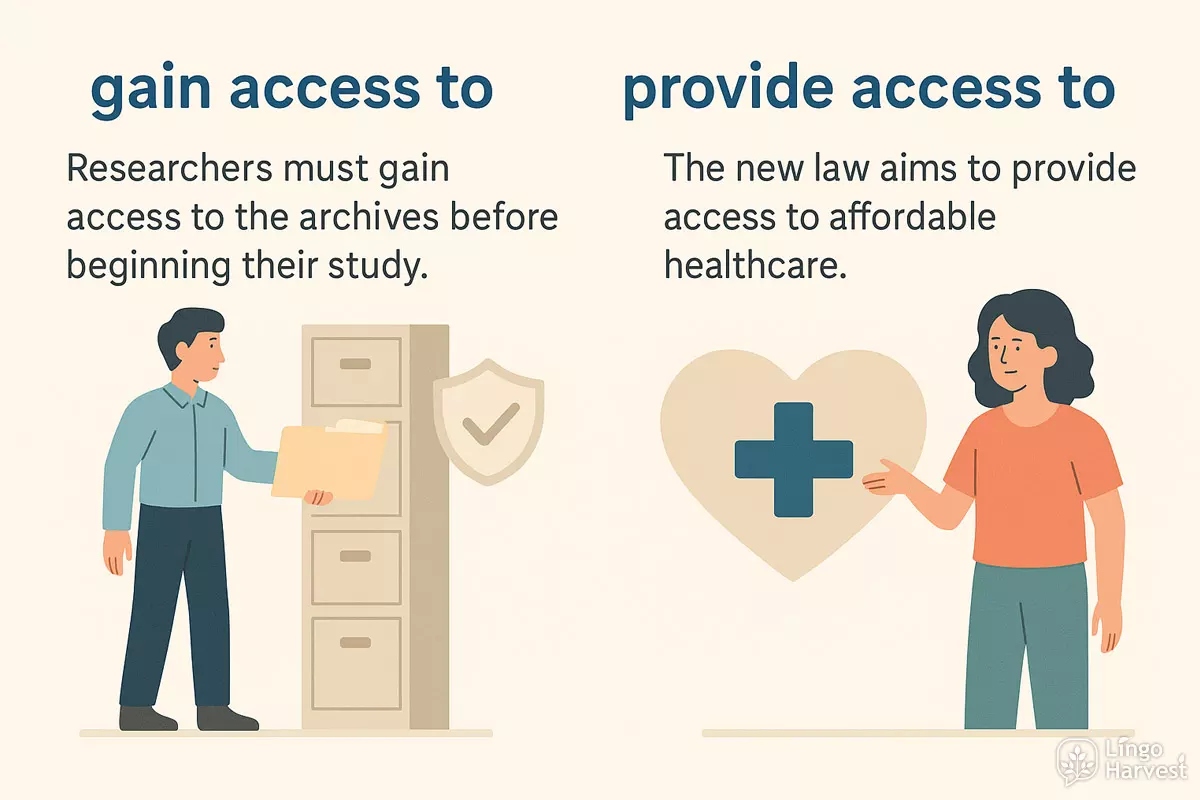
| gain | Researchers must gain access to the archives before beginning their study. |
| provide | The new law aims to provide access to affordable healthcare. |
| limit | Some websites limit access to members only. |
| deny | Unauthorized users are denied access to confidential files. |
| improve | The city plans to improve access to public transportation. |
Contexts for "Access" Collocations
These collocations appear in diverse fields:
- Education: improving access to online resources.
- Healthcare: providing access to treatment.
- Technology: limiting access to sensitive data.
- Public Policy: broadening access to social services.
When using "access" with these verbs, consider the implications for inclusion, security, and fairness. Choosing the right verb helps clarify whether the focus is on enabling, restricting, or changing the availability of something.
How collocation families support academic style
Academic writing often relies on precise and predictable language patterns, which is where collocation families—groups of words that commonly appear with certain abstract nouns—play a crucial role. By using these established word combinations, writers can express complex ideas clearly and align with the expectations of scholarly discourse.
Benefits of mastering collocation families
Grasping the typical word partners for abstract nouns like research, progress, and access helps writers:
- Convey meaning efficiently and avoid awkward phrasing
- Increase the credibility and formality of their work
- Meet reader expectations for clarity and fluency
- Improve coherence by using familiar language patterns
Common collocates for key academic nouns
Writers can make their arguments more persuasive by combining abstract nouns with verbs, adjectives, and prepositions that frequently occur together in academic texts. For example:
- Research: conduct research, publish research, research findings, research methodology, ongoing research, empirical research, research grants, research team
- Progress: make progress, monitor progress, significant progress, slow progress, rapid progress, progress towards, hinder progress, assess progress, progress report
- Access: gain access, provide access, limited access, access to information, access rights, deny access, access issues, facilitate access, access policy
Collocation patterns as academic conventions
Using standard collocations is not just about vocabulary—it signals an understanding of academic norms. This helps readers process information more smoothly and reduces ambiguity. For instance, "make progress" is much more natural than "do progress," and "gain access" is preferred over "get access" in formal contexts.
Comparing collocation families: research, progress, access
Below is a structured overview of typical collocation patterns for three central abstract nouns in academic writing. This table illustrates how each noun forms predictable combinations with verbs and adjectives, supporting clarity and formality.
| Abstract Noun | Common Verbs | Typical Adjectives/Modifiers |
|---|---|---|
| Research | conduct, undertake, publish, fund, review | empirical, recent, ongoing, scientific, original |
| Progress | make, achieve, monitor, hinder, report | significant, steady, rapid, slow, substantial |
| Access | gain, provide, limit, facilitate, deny | equal, limited, direct, restricted, universal |
Summary
Selecting appropriate word combinations for abstract nouns not only improves the quality of academic texts but also demonstrates the writer’s familiarity with the conventions of scholarly communication. This approach fosters greater clarity, precision, and professionalism in academic writing.
Avoiding odd or literal combinations with abstract nouns
Choosing the right partners for abstract nouns like research, progress, or access is essential for clear and natural English. Abstract nouns represent ideas or qualities, not physical objects, so they rarely combine smoothly with verbs or adjectives that suggest something concrete or physical. For instance, while you can "make a cake," you wouldn't "make a research"—the correct collocation is "conduct research."
Common pitfalls with abstract noun combinations
Writers sometimes pair abstract nouns with verbs or adjectives that sound logical in their native language but are awkward or incorrect in English. Such mismatches often occur with direct translations or literal thinking. Here are some examples to watch out for:
- ❌ "Open a progress" → Correct: "make progress"
- ❌ "Do an access" → Correct: "gain access"
- ❌ "Research a solution" (when intending the noun) → Correct: "conduct research on a solution"
- ❌ "Build a research" → Correct: "carry out research"
- ❌ "Give a progress" → Correct: "show progress" or "report progress"
Natural collocations for key abstract nouns
Pairing abstract nouns with their typical verbs and adjectives helps your writing sound fluent and idiomatic. Here are some common and natural combinations:
- conduct research
- make progress
- gain access
- grant access
- ongoing research
- significant progress
- limited access
- groundbreaking research
- steady progress
- immediate access
- further research
- rapid progress
- full access
- preliminary research
- slow progress
- unrestricted access
- future research
- visible progress
- direct access
- basic research
Literal vs. idiomatic: side-by-side comparison
A direct translation or literal pairing often results in odd phrasing. Compare common mistakes with their natural alternatives:
| Literal Combination | Natural Collocation |
|---|---|
| do a progress | make progress |
| make an access | gain access |
| build a research | conduct research |
| give a research | present research |
| take a progress | show progress |
By learning the standard ways to combine abstract nouns with verbs and adjectives, you avoid awkward or confusing expressions. This not only improves clarity but also makes your language sound more professional and natural.
Practice: expand collocation tables and write sample sentences
Exploring how abstract nouns like research, progress, and access combine with other words helps learners use them naturally. Let's look at common collocations for each, and see how they work in real sentences.
Collocation Patterns for "research", "progress", and "access"
The following table organizes some frequent collocations for these nouns. Notice the verbs, adjectives, and prepositions that commonly appear with each.
| Noun | Common Verbs | Typical Adjectives | Prepositional Phrases |
|---|---|---|---|
| research | conduct, carry out, publish, undertake, review | extensive, groundbreaking, ongoing, scientific, academic | on (a topic), into (a field), in (an area) |
| progress | make, achieve, monitor, hinder, accelerate | steady, significant, rapid, remarkable, slow | in (a field), towards (a goal), with (a project) |
| access | gain, provide, restrict, allow, deny | easy, direct, limited, equal, exclusive | to (resources), for (users), by (means) |
Sample Sentences Using Collocations
Applying these collocations in sentences helps reinforce usage. Here are examples for each noun:
- The team conducted extensive research on renewable energy sources.
- She has made remarkable progress in her language studies this year.
- All students should have equal access to quality education.
- They are undertaking groundbreaking research in biotechnology.
- We need to monitor progress towards our sustainability goals.
- Some communities lack direct access to clean water.
- The article reviews ongoing research in the field of artificial intelligence.
- Budget cuts may hinder progress with the new project.
- Only authorized staff are allowed access to the laboratory.
- The university publishes academic research every semester.
- Technological advances have accelerated progress in medicine.
- The government plans to provide easier access for remote learners.
- He was denied access to sensitive information.
- They carried out a review of the research on climate change.
- The company is making steady progress with its new software.
Practice Tasks: Choose the Best Collocation
For each sentence, select the most natural collocation to complete the idea.
- The scientists are ____________ (making / providing / allowing) significant progress in cancer treatment.
- The university will ____________ (gain / conduct / deny) research into sustainable agriculture.
- Many people in rural areas struggle to ____________ (achieve / gain / publish) access to healthcare.
- The report highlights ____________ (equal / steady / ongoing) research in the sector.
- New policies aim to ____________ (restrict / make / monitor) access to private data.
Show answers
- making significant progress
- conduct research
- gain access
- ongoing research
- restrict access
Try creating your own sentences with these collocations to deepen your understanding of how abstract nouns form natural phrases in English.